
lovethailand home >Central Travel Attractions >Sing Buri Travel Attractions >Muang Sing Buri >Bang Krabue > Wat Kradangnga Buppharam
TL;DR: Wat Kradangnga Buppharam is located at Moo 6, Bang Krabue Subdistrict, Mueang Sing Buri District, Sing Buri Province, open Daily, hours 08.00 – 16.00.
Wat Kradangnga Buppharam
Open Days: Daily
Opening Hours: 08.00 – 16.00
Wat Kradangnga Buppharam in Sing Buri is an old Buddhist temple in Bang Krabue Subdistrict, Mueang Sing Buri District, Sing Buri Province. It is one of the province’s meaningful historical and cultural sites, especially for travelers who want to explore central Thai temple architecture beyond the most famous tourist stops. The temple is known for its unusual modern ordination hall built on the base of an older sermon hall, an ancient bell-shaped stupa resembling early Ayutthaya-style architecture, an old chapel with clay roof tiles, beautifully carved wooden doors, and sacred Buddha images respected by local residents. Located on Highway 311, the old Sing Buri – Chai Nat route, the temple is easy to combine with other cultural attractions around Sing Buri.
Wat Kradangnga Buppharam is located in Moo 6 of Bang Krabue Subdistrict, slightly beyond Wat Prachotikaram when traveling along the old Sing Buri – Chai Nat road. The temple atmosphere is quiet, local, and reflective, making it suitable for visitors who prefer slow cultural travel rather than hurried sightseeing. Although the temple is not large in scale, it contains several layers of heritage within one compound. Visitors can pay respect to sacred images, observe old architectural details, study a registered ancient monument, and appreciate the continuity of local Buddhist faith.
The first major feature that many visitors notice is the modern ordination hall. Its form is distinctive and unlike the more familiar traditional Thai ubosot found in many temples. The hall was built on the base of an older sermon hall, which gives the structure an added historical layer. This architectural choice makes the building more than a new religious structure. It represents the continuation of sacred space from one generation to another. What was once a sermon hall, a place for Buddhist teaching and community activities, has become the foundation of a newer temple building that continues to serve the religious life of the community.
This relationship between old and new architecture is one of the reasons Wat Kradangnga Buppharam is worth visiting. Many Thai temples have been repaired, rebuilt, or expanded over time through local faith and community support. At this temple, that continuity is visible in the way the new ordination hall stands on an older base. Travelers can see how a Buddhist temple is not a frozen monument, but a living place where buildings change while sacred meaning remains. This makes the temple especially interesting for visitors who enjoy architecture, conservation, and the living culture of Thai Buddhism.
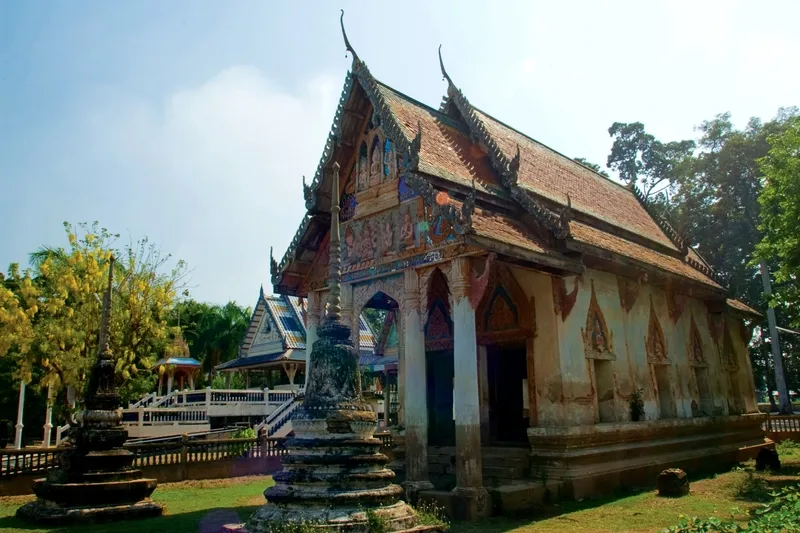
The most historically important structure in the temple is the ancient bell-shaped stupa. Its form resembles early Ayutthaya-style stupas, with a tiered base, an inverted-bell body, and decorative elements rising toward the upper section. The stupa is regarded as one of the most complete examples of its type from the same period and has been registered as a national ancient monument. This status confirms its importance as a heritage structure that should be protected and studied. For travelers interested in Thai art history, the stupa is the key reason to visit Wat Kradangnga Buppharam.
The bell-shaped stupa should be observed slowly and respectfully. Its tiered base gives the structure a sense of stability, while the bell form creates a calm and solemn visual rhythm. In Buddhist symbolism, a stupa is not merely an architectural object. It is a sacred form connected with merit-making, memory, devotion, and the presence of Buddhism in a community. The survival of this stupa allows visitors to see how faith and craftsmanship were expressed in central Thailand during earlier periods. It is also a reminder that small local temples can preserve heritage of national significance.
In front of the stupa stands an old chapel with clay roof tiles. This older building has a very different mood from the modern ordination hall. Its materials, proportions, and atmosphere reflect older local building traditions. One of its most impressive details is the carved wooden door, which is highly valued for its beautiful patterns. In Thai temple architecture, doors are not simply functional objects. They often carry artistic meaning and serve as a respectful threshold into sacred space. The carved door at Wat Kradangnga Buppharam reflects local craftsmanship, careful design, and the devotion of the people who created and preserved it.
The presence of both the old chapel and the modern ordination hall gives the temple a strong sense of time. Visitors can compare the quiet dignity of the older chapel with the more distinctive form of the newer hall. The clay roof tiles, carved wood, old surfaces, and ancient stupa create a historical atmosphere, while the modern hall shows how the temple continues to evolve. This combination makes Wat Kradangnga Buppharam an open-air lesson in Thai temple development. It shows how sacred buildings are repaired, renewed, and reinterpreted while still remaining connected to the same community.
The history of Wat Kradangnga Buppharam is connected with local narratives from the Ayutthaya period. Local accounts describe the temple as an old monastery associated with stories of military figures and acts of merit-making. The temple is also linked with the memory of Luang Pho Ueng, whose statue is enshrined in the viharn. These stories give the temple emotional value for the local community. While architectural evidence such as the ancient stupa gives the site historical weight, local stories help explain why the temple remains meaningful to people who live around it.
Another sacred focus of the temple is Luang Pu Chin, a revered Buddha image respected by local residents. Paying respect to Luang Pu Chin is one of the main activities for visitors. For foreign travelers, this is a good opportunity to understand how Thai temple visits combine history, art, and living devotion. A temple is not only a place to look at old architecture. It is also a place where people pray, make merit, seek blessings, and maintain relationships with their community. Visitors should dress modestly, behave calmly, and respect those who come for religious purposes.
Wat Kradangnga Buppharam remains a living temple rather than a detached historical site. Phra Khru Singha Phatthanathon serves as the abbot of the temple, and the temple continues to be connected with local religious activities. This living context is important. Ancient monuments within active temples require both conservation and daily care. Monks, local residents, local authorities, and worshippers all contribute to keeping the temple meaningful. The preservation of such a place depends not only on protecting old structures, but also on allowing the temple to continue serving the religious life of the community.
Religious events and merit-making activities are another part of the temple’s identity. Like many Buddhist temples in central Thailand, Wat Kradangnga Buppharam serves as a place for ceremonies, merit-making, offerings, seasonal festivals, and community gatherings. A visit on an ordinary day offers a peaceful experience for viewing architecture and paying respect. A visit during a temple event reveals the stronger social role of the temple, when local people gather to make merit and support religious activities. Travelers who wish to visit during annual events should follow announcements from the temple or local authorities for accurate dates.
From an art historical perspective, the temple is interesting because it contains ancient and modern elements in one compound. The bell-shaped stupa represents early religious architecture and the memory of the Ayutthaya period. The old chapel and carved wooden door reveal traditional materials and craftsmanship. The modern ordination hall shows contemporary temple development and the continuing faith of the community. Together, these structures allow visitors to see how Thai temple architecture changes over time while maintaining its religious purpose.
A good way to visit the temple is to begin with the ancient stupa, because it is the most historically significant structure. From there, visitors can continue to the old chapel and observe the clay roof tiles and carved wooden door. After that, the modern ordination hall can be viewed as the contemporary layer of the temple’s story. This sequence allows visitors to move from the older heritage of the site toward its present-day life. It also makes the visit more meaningful than simply taking photographs of separate buildings.
For photographers, Wat Kradangnga Buppharam offers several attractive viewpoints. The modern ordination hall on the old base, the bell-shaped stupa, the old chapel, and the carved wooden door all provide strong visual details. However, photography should be done respectfully. Visitors should not climb on structures, touch ancient surfaces unnecessarily, or enter restricted areas. Poses that are inappropriate for a sacred site should be avoided. Respectful behavior helps protect the temple and maintains a positive relationship with the local community.
The temple is suitable for several types of travelers. Buddhist visitors can pay respect to sacred images. Cultural travelers can study local temple architecture. History enthusiasts can observe a registered ancient monument. Families can use the visit as a chance to teach children about heritage conservation and proper temple manners. For foreign travelers, the temple provides a quieter and more local experience than highly commercial tourist temples, making it a valuable stop for understanding everyday religious life in central Thailand.
Its location on the old Sing Buri – Chai Nat road makes the temple convenient for a one-day cultural route. Nearby places include Wat Prachotikaram, Wat Sawang Arom, Wat Phra Non Chakkrasi Worawihan, Sing Buri City Pillar Shrine, and the Bang Rachan Heroes Monument. This route can give travelers a broader view of Sing Buri through temples, sacred images, craft traditions, local history, and community memory. The temple can also be combined with local restaurants around Bang Krabue and Mae La, especially for travelers interested in freshwater fish dishes and central Thai food.
Getting There is convenient by private car. Use Highway 311, the old Sing Buri – Chai Nat route, around kilometer marker 6. The temple is about 7 km from Mueang Sing Buri District and is located slightly beyond Wat Prachotikaram. Travelers can set the destination as Wat Kradangnga Buppharam in Bang Krabue Subdistrict. Those using public transport can take local services along the Sing Buri – Chai Nat route and continue with local transport to the temple. Transport schedules should be checked in advance, especially during holidays or late afternoon travel.
The best time to visit is in the morning or early afternoon, when the light is comfortable for walking and photography. Visitors who want to observe the carved wooden door and old structures should allow enough time to walk slowly around the temple. As with all Buddhist temples in Thailand, visitors should dress modestly, remove shoes where required, speak quietly, avoid touching ancient structures, and follow the guidance of temple staff or monks. These practices help preserve both the sacred atmosphere and the historical fabric of the temple.
Overall, Wat Kradangnga Buppharam is a valuable cultural destination in Sing Buri because it brings together Ayutthaya-period heritage, a registered ancient stupa, traditional craftsmanship, a modern ordination hall, sacred images, and active community faith. It is not only a place to stop briefly for photographs, but a temple that rewards careful observation. Every major feature within the compound helps tell the story of central Thai Buddhism, local memory, and the continuity of sacred space from the past to the present.
| Name | Wat Kradangnga Buppharam |
| Location | Moo 6, Bang Krabue Subdistrict, Mueang Sing Buri District, Sing Buri Province |
| Address | No. 80, Moo 6, Sing Buri – Chai Nat Road, Bang Krabue Subdistrict, Mueang Sing Buri District, Sing Buri 16000, Thailand |
| Highlights | Distinctive modern ordination hall built on the base of an old sermon hall, ancient bell-shaped stupa, old chapel with clay roof tiles, carved wooden door, and Luang Pu Chin revered by local people |
| History | An old temple associated with local Ayutthaya-period narratives, featuring an ancient stupa resembling early Ayutthaya-style architecture and registered as a national ancient monument |
| Distinctive Features | A temple where ancient architecture, traditional craftsmanship, modern religious architecture, and living local faith exist within one compound |
| Main Areas / Zones | 1. Modern Ordination Hall on the Base of an Old Sermon Hall 2. Ancient Bell-Shaped Stupa 3. Old Chapel with Clay Roof Tiles 4. Carved Wooden Door 5. Viharn and Luang Pho Ueng Statue 6. Luang Pu Chin Worship Area |
| Travel Information | Use Highway 311, the old Sing Buri – Chai Nat route, around kilometer marker 6. The temple is about 7 km from Mueang Sing Buri District and is located slightly beyond Wat Prachotikaram |
| Current Status | Open to visitors and recognized as a historical attraction in Bang Krabue Subdistrict |
| Open Days | Daily |
| Opening Hours | 08.00 – 16.00 |
| Abbot / Caretaker | Phra Khru Singha Phatthanathon, Abbot of Wat Kradangnga Buppharam |
| Main Contact Number | 081-7781117 Bang Krabue Subdistrict Administrative Organization: 036-699257 |
| Official Website / Official Page | Facebook: Wat Kradangnga Buppharam, Sing Buri |
| Nearby Tourist Attractions | 1. Wat Prachotikaram, about 2 km 2. Wat Sawang Arom, about 5 km 3. Wat Phra Non Chakkrasi Worawihan, about 8 km 4. Sing Buri City Pillar Shrine, about 9 km 5. Bang Rachan Heroes Monument, about 17 km |
| Nearby Restaurants | 1. Lan Mae Phayung Boat Noodles, about 2 km, Tel. 083-444-1402, 081-016-2231, 088-483-6747 2. Tamnan Mae La Restaurant, about 2 km, Tel. 036-690288, 088-6391535 3. Kai Op Ong Ajarn Nong Sing Buri Branch, about 3 km, Tel. 082-8526709 4. Chao Plo Jai Cafe Coffee Chonprathan, about 3 km, Tel. 098-5808246 5. Ban Suan Mae La Ka Rong Restaurant, about 8 km, Tel. 036-501047, 092-8024928 |
| Nearby Accommodations | 1. Heyday Singburi Hotel, about 9 km 2. Chaisaeng In The Park, about 10 km, Tel. 081-9919133, 036-812462, 036-510228 3. In In Resort, about 13 km, Tel. 036-694544, 097-1360410 4. Maethongbai Resort, about 15 km, Tel. 098-2807106, 098-2807100 5. Chao Phraya Sing Buri Hotel, about 10 km |
Frequently Asked Questions (FAQ)
Q: Where is Wat Kradangnga Buppharam located?
A: Wat Kradangnga Buppharam is located at No. 80, Moo 6, on the Sing Buri – Chai Nat Road in Bang Krabue Subdistrict, Mueang Sing Buri District, Sing Buri Province.
Q: What is Wat Kradangnga Buppharam known for?
A: The temple is known for its modern ordination hall built on the base of an old sermon hall, ancient bell-shaped stupa, old chapel with clay roof tiles, carved wooden door, and Luang Pu Chin revered by local people.
Q: Why is the ancient stupa at Wat Kradangnga Buppharam important?
A: The stupa is an ancient bell-shaped structure resembling early Ayutthaya-style architecture. It has a tiered base and decorative upper elements and has been registered as a national ancient monument.
Q: What are the opening hours of Wat Kradangnga Buppharam?
A: The temple is open daily from 08.00 to 16.00.
Q: Who is the abbot of Wat Kradangnga Buppharam?
A: The abbot of Wat Kradangnga Buppharam is Phra Khru Singha Phatthanathon.
Q: How can travelers get to Wat Kradangnga Buppharam?
A: Travelers can use Highway 311, the old Sing Buri – Chai Nat route, around kilometer marker 6. The temple is about 7 km from Mueang Sing Buri District and lies slightly beyond Wat Prachotikaram.
Q: What nearby attractions can be visited with Wat Kradangnga Buppharam?
A: Nearby attractions include Wat Prachotikaram, Wat Sawang Arom, Wat Phra Non Chakkrasi Worawihan, Sing Buri City Pillar Shrine, and Bang Rachan Heroes Monument.
Q: How should visitors behave at Wat Kradangnga Buppharam?
A: Visitors should dress modestly, speak quietly, avoid touching ancient structures, follow temple rules, and behave respectfully around monks and worshippers.
 Category: ●Places of Worship
 Group: ●Temple
Last Update : 6 MonthAgo
 Last Update : 6 MonthAgo

 Click to Access the Navigation Map GPS
Wat Kradangnga Buppharam Map

 Art, Culture and Heritage
 Historical Sites and Monuments(4)
 Landmarks and Memorials(3)
 Art, Craft Centres, Tradition(3)
 Museums(1)
 Educational Places
 Library(1)
Temple(42)
 Church(1)
 Other Sacred Sites(2)
 Research and Development
 Royal Project(3)
 Suburban Living
 Village, Community(1)
 Local Market(1)
 Nature and Wildlife
 National Parks and Marine Reserves(1)
 River, Canal(7)
 Bays and Beaches(1)
 Other natural attractions(2)
 Entertainment and Agricultural
 Animal camps and shows(1)
 Farms, Parks and Ecotourism(1)
 Travel Articles, Recipes
 Travel Review, Food Review(1)


