
lovethailand home >North Travel Attractions >Sukhothai Travel Attractions >Si Sat Chana Lai >Si Sat Chana Lai > Si Satchanalai Chinese Shrine
TL;DR: Si Satchanalai Chinese Shrine is located at Ban Wong Yai, Moo 2, Si Satchanalai Subdistrict, Si Satchanalai District, Sukhothai Province, open Daily, hours Daytime.
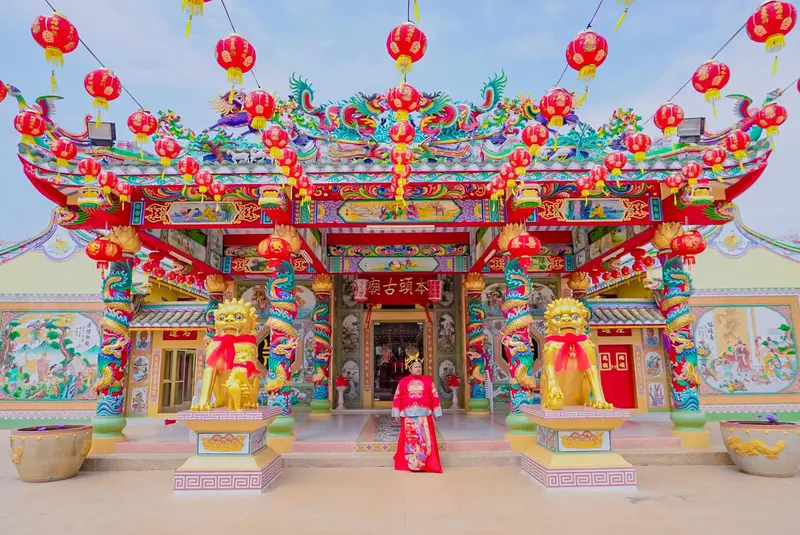
Si Satchanalai Chinese Shrine
Open Days: Daily
Opening Hours: Daytime
Si Satchanalai Chinese Shrine in Ban Wong Yai, Moo 2, Si Satchanalai Subdistrict, Si Satchanalai District, Sukhothai Province, is an old Chinese shrine with a history of about 150 years. It is one of the lesser-known but culturally important places in Si Satchanalai, revealing the story of Chinese settlers, riverside trade, teak log rafting, Buddhist-Annam Nikaya beliefs, and the role of the Yom River in shaping local life.
For travelers who visit Si Satchanalai only for the historical park, this shrine offers another layer of the town’s identity. Si Satchanalai is famous for ancient temples, celadon kilns, and World Heritage ruins, but it was also a living riverside community where Thai, Chinese, and other cultural influences met. The Chinese shrine at Ban Wong Yai helps visitors understand this human side of the old town: families, merchants, boatmen, timber traders, ritual practice, and community faith.
The shrine was founded by Chinese people who settled in this area in the past. These families practiced Buddhism in the Annam Nikaya tradition and used the shrine as a place for ceremonies, worship, merit-making, and prayers. In this context, the shrine was not merely a religious building. It was a community anchor that helped immigrants maintain identity, spiritual confidence, and social connection in a new environment.
Historically, many Chinese residents in this part of Si Satchanalai were involved in trade. Some worked as merchants, while others were connected with teak log rafting and the transportation of timber from Phrae Province down the Yom River. Timber and goods were moved through this area before continuing downstream toward Ayutthaya and Bangkok. This made the Yom River much more than a natural waterway. It was an economic route, a transportation corridor, and a lifeline for riverside communities.
The existence of the shrine reflects this riverside economy. People who lived by trade and river transport often needed a sacred place where they could pray for safety, prosperity, family stability, and success in business. For those who traveled or worked along the river, spiritual protection was important. The shrine therefore became a place where practical life and religious faith met naturally.
The belief system associated with Si Satchanalai Chinese Shrine is connected with Annam Nikaya Buddhism, a Mahayana Buddhist tradition present in some Chinese and Vietnamese-related communities in Thailand. In many Chinese religious spaces, Buddhist devotion, reverence for protective deities, ancestor respect, and prayers for auspiciousness are blended together. This makes the shrine meaningful not only as a place of worship but also as a cultural expression of gratitude, moral conduct, and family continuity.
Visitors should not expect the shrine to be a grand tourist monument. Its value lies in its age, atmosphere, and local meaning. At around 150 years old, the shrine carries the memory of an earlier Si Satchanalai, when river traffic, wooden rafts, market life, and local trade were part of daily reality. The shrine stands as a quiet reminder of the Chinese families who helped shape the economy and community life of the area.
In the past, Chinese settlers did not live separately from the local Thai community. Over time, they built relationships through trade, family networks, ceremonies, and everyday cooperation. The shrine became both a religious space for people of Chinese descent and a shared cultural place respected by the wider community. This is why Thai visitors and local residents from different backgrounds may also come to pay respect and pray for good fortune.
The shrine is especially associated with prayers for prosperity. Local belief holds that those who worship respectfully may receive blessings for personal growth, family happiness, livelihood, trade, career success, and advancement in government service. These ideas match the values often associated with Chinese migrant communities: diligence, patience, honesty, gratitude, and commitment to family stability.
A respectful visit usually begins with a calm mind. Visitors may light incense and candles according to local custom, make offerings if appropriate, and pray respectfully. Those unfamiliar with Chinese shrine rituals should observe local practice or ask a caretaker before performing any ceremony. The most important rule is to treat the shrine as a living sacred space rather than just a photo stop.
The shrine also adds depth to the history of Si Satchanalai. The ancient city is widely known as part of the Sukhothai cultural landscape, with important temples such as Wat Chang Lom, Wat Chedi Chet Thaeo, Wat Nang Phaya, and Wat Phra Si Rattana Mahathat Chaliang. However, Si Satchanalai did not stop being meaningful after the ancient period. Later communities continued to live, trade, worship, and create new cultural layers. The Chinese shrine belongs to this later but very important history.
The story of teak rafting is particularly important for understanding the shrine’s background. In northern Thailand, teak was a valuable resource, and waterways were essential for moving heavy timber. The Yom River connected upstream forest areas with downstream trade centers. Chinese merchants and workers who participated in this system contributed to local exchange and helped connect Si Satchanalai with larger economic networks. The shrine preserves the spiritual memory of this era.
Today, Si Satchanalai Municipality has improved the shrine as one of the important places in the area. This helps preserve the site and makes it more accessible as a cultural learning point. Travelers can use the shrine as a starting point to understand old Chinese settlement in Si Satchanalai before continuing to the historical park, riverside communities, textile and gold-work heritage, and nearby temples.
The most rewarding way to visit Si Satchanalai Chinese Shrine is to see it as part of a cultural route. A traveler can begin at the shrine, continue to Wat Phra Si Rattana Mahathat Chaliang, explore Si Satchanalai Historical Park, visit Wat Chang Lom and Wat Nang Phaya, and then stop at local restaurants or craft communities. This route shows how the town combines ancient ruins, Buddhist temples, Chinese heritage, riverside life, and local craftsmanship.
Getting There is most convenient by private car, rental car, or hired local transport. From Sukhothai town, travelers can follow Highway 101 toward Si Satchanalai District and continue into Si Satchanalai Subdistrict, Ban Wong Yai, Moo 2. The journey from Sukhothai town to Si Satchanalai generally takes a little over one hour, depending on route and traffic. Having a private vehicle makes it easier to combine the shrine with nearby historical sites in one day.
Travelers using public transportation can first reach Si Satchanalai District or the Hat Siao area, then continue by local transport or hired vehicle to Ban Wong Yai. This option is suitable for slower travel, but it requires more flexible timing. For visitors planning to see the historical park, temples, restaurants, and accommodation areas in the same day, hiring a vehicle is usually more practical.
The best time to visit is in the morning or afternoon, when the weather is more comfortable. A short stop at the shrine can be combined with a longer visit to the historical park. Visitors should dress modestly, speak quietly, avoid disturbing worshippers, and refrain from touching ritual objects or offerings without permission. Photography should be done respectfully, especially if local people are performing ceremonies.
For foreign travelers, the shrine is a valuable place to understand Thailand’s cultural diversity. Thailand is not only a country of Theravada Buddhist temples and ancient monuments. It also contains Chinese shrines, Mahayana-related Buddhist traditions, ancestor worship, trade communities, and hybrid local identities. Si Satchanalai Chinese Shrine helps explain how different cultural groups lived together and contributed to the character of the town.
In terms of heritage preservation, the shrine is important because it records the history of ordinary people. Major historical narratives often focus on kings, cities, monuments, and wars, but local shrines preserve the memory of merchants, migrant families, river workers, and community rituals. Protecting the shrine means protecting a part of Si Satchanalai’s social history that might otherwise be overlooked.
Si Satchanalai Chinese Shrine is a modest but meaningful destination. It does not require a long visit, yet it adds depth to any cultural journey in Sukhothai Province. The shrine connects faith, migration, trade, timber rafting, the Yom River, and local identity in one place. For travelers who want to see Si Satchanalai beyond the World Heritage ruins, this old Chinese shrine offers a quiet and memorable perspective.
| Name | Si Satchanalai Chinese Shrine |
| Location | Ban Wong Yai, Moo 2, Si Satchanalai Subdistrict, Si Satchanalai District, Sukhothai Province |
| Highlights | An old Chinese shrine of about 150 years, linked with Chinese settlement, riverside trade, teak rafting, and Annam Nikaya Buddhist belief along the Yom River |
| History | A shrine established by Chinese settlers in Si Satchanalai, associated with trade, teak log rafting from Phrae, and river transport toward Ayutthaya and Bangkok |
| Name Origin | Named as the Chinese shrine of the Si Satchanalai community, serving as a spiritual center for Chinese settlers around Ban Wong Yai |
| Distinctive Features | A Chinese religious site combining Annam Nikaya Buddhist belief, ancestor respect, protective blessings, and local community faith |
| Key Belief | Worshippers believe that respectful prayer brings prosperity to personal life, family, business, career, and government service |
| Travel Information | Travel from Sukhothai town via Highway 101 toward Si Satchanalai District, then continue to Si Satchanalai Subdistrict, Ban Wong Yai, Moo 2. Private car, rental car, or hired local transport is recommended |
| Current Status | A sacred local place and cultural learning point connected with the old Chinese community of Si Satchanalai, improved by Si Satchanalai Municipality as an important community site |
| Open Days | Daily |
| Opening Hours | Daytime |
| Facilities | Worship area, surrounding community space, and route connections to nearby cultural attractions in Si Satchanalai |
| Caretaker / Related Authority | Si Satchanalai Municipality |
| Nearby Tourist Attractions | 1. Wat Taling Chan, about 1 km 2. Wat Phra Si Rattana Mahathat Chaliang / Wat Phra Prang, about 3 km 3. Si Satchanalai Historical Park, about 5 km 4. Wat Chang Lom, about 6 km 5. Wat Nang Phaya, about 6 km 6. Sathorn Gold Textile Museum, about 6 km |
| Nearby Restaurants | 1. Ban Klang Na Restaurant, Si Satchanalai, about 4 km, Tel. 081-441-6185 2. Kulab Restaurant, Si Satchanalai, about 6 km, Tel. 055-671-151 3. Pa Song Restaurant, Si Satchanalai, about 7 km, Tel. 055-672-514 4. Sathorn Boulangerie, about 6 km, Tel. 096-456-4445 5. Kafae Tai Thun Ban, Ban Na Ton Chan, about 17 km, Tel. 096-668-9046 6. Khao Perb Yai Khrueng, Ban Na Ton Chan, about 17 km |
| Nearby Accommodations | 1. Si Satchanalai Heritage Resort, about 2 km, Tel. 055-615-423, 086-443-2799 2. Smile Loft Resort, about 7 km, Tel. 055-672-456, 086-449-7500 3. Si Satchanalai Resort Hotel, about 9 km, Tel. 055-672-666, 086-935-8115, 085-963-3481 4. Accommodations in Hat Siao Area, about 7 km 5. Accommodations near Si Satchanalai Historical Park, about 5 km |
Frequently Asked Questions (FAQ)
Q: Where is Si Satchanalai Chinese Shrine located?
A: It is located at Ban Wong Yai, Moo 2, Si Satchanalai Subdistrict, Si Satchanalai District, Sukhothai Province.
Q: How old is Si Satchanalai Chinese Shrine?
A: The shrine is about 150 years old and is connected with the old Chinese community of Si Satchanalai.
Q: Why is the shrine important?
A: It preserves the memory of Chinese settlers, Annam Nikaya Buddhist belief, riverside trade, teak rafting, and the cultural diversity of Si Satchanalai.
Q: Can general visitors worship at the shrine?
A: Yes. Visitors may pay respect at the shrine, but they should dress modestly, speak quietly, keep the area clean, and respect local worshippers.
Q: What do people usually pray for at the shrine?
A: People commonly pray for prosperity, family well-being, business success, career progress, and good fortune in government service.
Q: What nearby places can travelers visit after the shrine?
A: Nearby places include Wat Phra Si Rattana Mahathat Chaliang, Si Satchanalai Historical Park, Wat Chang Lom, Wat Nang Phaya, Wat Taling Chan, and Sathorn Gold Textile Museum.
Q: What type of traveler will appreciate this shrine?
A: It is suitable for travelers interested in Chinese community history, local religious culture, riverside trade heritage, and cultural tourism connected with Si Satchanalai’s World Heritage landscape.
 Category: ●Places of Worship
 Group: ●Other Sacred Sites
Last Update : 3 MonthAgo
 Last Update : 3 MonthAgo
 Click to Access the Navigation Map GPS
Si Satchanalai Chinese Shrine Map
Recommend

 Art, Culture and Heritage
 Historical Sites and Monuments(4)
 Landmarks and Memorials(5)
 Art, Craft Centres, Tradition(11)
 Museums(5)
 Temple(40)
Other Sacred Sites(10)
Temple(40)
Other Sacred Sites(10)
 Suburban Living
 Village, Community(3)
 Nature and Wildlife
 National Parks and Marine Reserves(3)
 Mountain (Doi)(2)
 Dam, Reservoir, Lake(4)
 Waterfalls(8)
 Caves(4)
 River, Canal(2)
 Entertainment and Agricultural
 Farms, Parks and Ecotourism(3)


