
lovethailand home >North Travel Attractions >Sukhothai Travel Attractions >Muang Sukhothai >Muang Kao > Wat Traphang Ngoen
TL;DR: Wat Traphang Ngoen is located at Central Zone, Sukhothai Historical Park, Mueang Kao Subdistrict, Mueang Sukhothai District, Sukhothai Province, open Daily, hours Monday – Friday and Sunday 06.30 – 19.30 / Saturday 06.30 – 21.00.
Wat Traphang Ngoen
Open Days: Daily
Opening Hours: Monday – Friday and Sunday 06.30 – 19.30 / Saturday 06.30 – 21.00
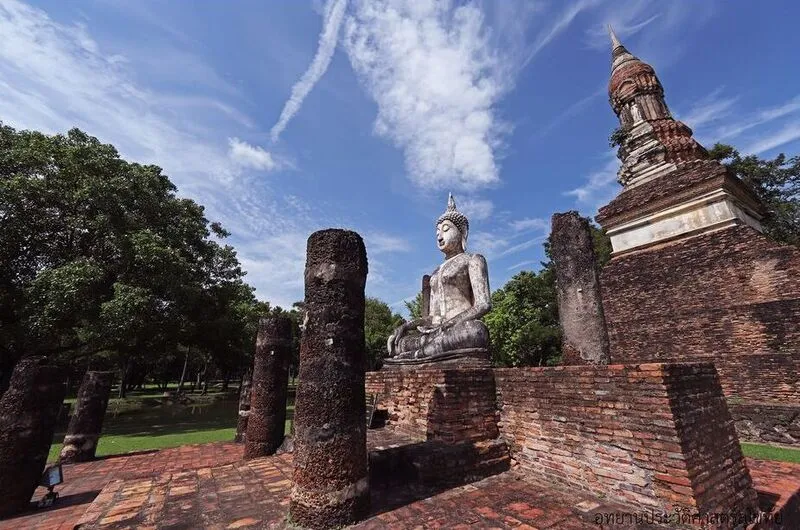
Wat Traphang Ngoen in Sukhothai Province is an important ancient monument in the central zone of Sukhothai Historical Park. It is located west of Wat Mahathat, about 300 meters away, on the western edge of Traphang Ngoen pond. The temple is a fine example of Sukhothai architecture, where sacred structures, water landscape, Buddhist symbolism, and artistic elegance are integrated into a peaceful and meaningful setting. Its main features include a lotus-bud-shaped chedi, a vihara in front of the chedi, a water-bound ordination hall, and the natural beauty of the pond with lotus plants around it.
The word “traphang” in the Sukhothai context means a pond, reservoir, or water body. Water was a major component of ancient Sukhothai urban planning and temple design. The word “ngoen” means silver, suggesting coolness, beauty, and auspicious value. The name Wat Traphang Ngoen therefore reflects both the temple’s location near a pond and the graceful atmosphere created by water, lotus flowers, and sacred architecture.
Wat Traphang Ngoen lies within the old city walls of Sukhothai and forms part of the central historical landscape of the ancient capital. Its location west of Wat Mahathat shows the close relationship between major religious sites in the old city. Temples in Sukhothai were not arranged randomly. They were connected with ponds, roads, city walls, sacred axes, and the main religious center of the kingdom. Wat Traphang Ngoen helps visitors understand this careful urban and religious planning.
One distinctive feature of Wat Traphang Ngoen is the absence of an enclosing boundary wall. This allows visitors to see the main components of the temple clearly from the surrounding area. The lotus-bud-shaped chedi, vihara, pond, and water-bound ordination hall can be viewed as a unified sacred landscape. The openness of the site also strengthens the connection between architecture and nature, which is one of the most attractive qualities of this monument.
The main chedi of Wat Traphang Ngoen is built in the lotus-bud or phum khao bin form, one of the most distinctive forms of Sukhothai architecture. The lotus is a powerful Buddhist symbol of purity, spiritual growth, and enlightenment. A lotus grows from mud but rises cleanly above the water, making it an ideal symbol for the Buddhist path. The lotus-bud-shaped chedi therefore carries both architectural beauty and deep religious meaning.
What makes the main chedi of Wat Traphang Ngoen particularly special is the presence of niches on all 4 sides of the central chamber. These niches were used to enshrine standing Buddha images and walking Buddha images. This feature makes the chedi different from many other lotus-bud-shaped chedis in Sukhothai. The niches give the monument a dynamic quality, allowing sacred images to face multiple directions and allowing visitors to experience the chedi from different viewpoints.
The walking Buddha image is one of the most refined expressions of Sukhothai art. It shows the Buddha in graceful movement, with a sense of balance, gentleness, and spiritual calm. The walking posture represents the spreading of the Dhamma and the active presence of compassion in the world. By placing walking Buddha images in the niches of the chedi, Wat Traphang Ngoen expresses both artistic sophistication and Buddhist meaning.
In front of the main chedi, on the eastern side, stands the vihara. In Sukhothai temple planning, the vihara usually served as the main worship hall for monks and laypeople. It created the first major point of devotion before the visitor’s attention moved toward the chedi, the symbolic center of the temple. This arrangement reflects the religious sequence of worship: gathering, paying respect to the Buddha image, and contemplating the sacred presence represented by the chedi.
The principal Buddha image inside the vihara was a stucco Buddha in the maravijaya posture, a classic Sukhothai form. The maravijaya posture represents the moment when the Buddha overcame Mara before attaining enlightenment. It symbolizes inner strength, wisdom, and victory over temptation. The presence of this image in the vihara gives Wat Traphang Ngoen a strong devotional focus and connects the monument with the core teachings of Buddhism.
To the east of the main chedi and vihara lies Traphang Ngoen pond. In the middle of the pond is a small island where the ordination hall once stood. This water-bound ordination hall reflects the concept of nathisima or udakasima, in which water is used as a pure boundary for monastic ceremonies. Water is therefore not simply scenic. It is part of the religious function of the site, defining a sacred space for Sangha acts.
The water-bound ordination hall is one of the most meaningful components of Wat Traphang Ngoen. By placing the ordination hall on an island, the builders created a space separated from ordinary surroundings. The surrounding water symbolized purity, calmness, and sacred separation. This shows that Sukhothai temple designers understood both Buddhist discipline and landscape symbolism, using nature itself as part of the temple’s sacred structure.
The pond of Traphang Ngoen adds great beauty to the temple. Lotus plants around the pond create a peaceful atmosphere and reinforce Buddhist symbolism. The lotus has long been associated with purity and enlightenment, and its presence around the temple enhances the spiritual and visual character of the site. When the lotus flowers bloom, the pond, chedi, and sky together form one of the most memorable scenes in the central zone of Sukhothai Historical Park.
The arrangement of the chedi, vihara, and water-bound ordination hall shows that the builders of Wat Traphang Ngoen did not design each structure separately. They conceived the whole area as a unified sacred landscape. The main chedi served as the central symbol of faith. The vihara provided a place for worship. The ordination hall used the pond as a sacred boundary. Together, these elements formed a complete Buddhist religious space.
Wat Traphang Ngoen also demonstrates the Sukhothai ability to blend architecture with nature. The lotus-bud chedi, pond, lotus plants, and open landscape create a gentle and balanced visual impression. Unlike monuments that rely mainly on size or mass, Wat Traphang Ngoen is remarkable for its calm proportions, open setting, and symbolic use of water. This makes it especially rewarding for visitors who appreciate subtle beauty and thoughtful design.
Historically, Wat Traphang Ngoen is an important witness to the prosperity of Sukhothai as a center of Buddhism, art, and urban planning. Its location near Wat Mahathat shows that major temples were grouped around the heart of the old city. Each temple contributed a different artistic and symbolic role, while together they formed the sacred landscape of the capital.
The Fine Arts Department restored and improved the landscape of Wat Traphang Ngoen in 2006. This conservation work helped preserve the monument and make the site more suitable for study and tourism. The restoration is important because Wat Traphang Ngoen is not merely an old ruin; it is evidence of Sukhothai religious thought, artistic achievement, and landscape planning.
Today, Wat Traphang Ngoen is managed by Sukhothai Historical Park under the Fine Arts Department, Ministry of Culture. It is not an active community temple with resident monks, so it does not have a resident abbot in the modern sense. Its main caretaker is the historical park authority, which is responsible for conservation, visitor management, and the protection of the monument as part of Thailand’s national cultural heritage.
For visitors, Wat Traphang Ngoen is best appreciated slowly. Important details to observe include the lotus-bud shape of the main chedi, the 4 directional niches, the traces of standing and walking Buddha images, the vihara in front of the chedi, Traphang Ngoen pond, and the water-bound ordination hall. Each element helps explain the beauty and intelligence of Sukhothai architecture.
Wat Traphang Ngoen is also a fine place for photography. The combination of the lotus-bud chedi, pond, lotus flowers, and open sky creates elegant compositions. Early morning and late afternoon are the best times to visit because the light is softer and the forms of the chedi and pond reflections are clearer. Photographs that include both the monument and the water landscape best capture the identity of this temple.
Compared with other monuments in Sukhothai Historical Park, Wat Traphang Ngoen has a distinctive character. Wat Mahathat represents the spiritual center of the old city. Wat Sa Si is famous for its island setting and Sri Lankan-style chedi. Wat Si Sawai reflects the transition from Brahman-Hindu traditions to Buddhism. Wat Traphang Ngoen stands out for its lotus-bud chedi, walking Buddha niches, and water-bound ordination hall. Visiting these temples together gives travelers a fuller understanding of the artistic diversity of Sukhothai.
A visit to Wat Traphang Ngoen is therefore more than a stop at an ancient monument. It is a chance to understand Sukhothai’s water system, the meaning of the word traphang, the concept of a sacred water boundary, the lotus-bud chedi form, and the elegance of Sukhothai walking Buddha art. These elements reveal that Sukhothai art was not only beautiful in form, but also rich in religious symbolism.
Getting There is convenient from modern Sukhothai town to Mueang Kao Subdistrict, about 12 kilometers away. Wat Traphang Ngoen is located in the central zone of Sukhothai Historical Park, about 300 meters west of Wat Mahathat. Visitors can reach it on foot, by bicycle, or by park tram. Those staying in the old city area can easily combine Wat Traphang Ngoen with Wat Mahathat, Wat Sa Si, Wat Si Sawai, and Ramkhamhaeng National Museum in a single route.
Visitors should dress respectfully, avoid climbing on ancient structures, avoid touching or writing on the chedi, vihara, or laterite elements, and refrain from entering the pond. Because Wat Traphang Ngoen is a valuable historical and artistic monument, respectful conduct helps preserve the site for future generations.
Wat Traphang Ngoen is therefore a site worth studying and visiting. It combines the lotus-bud chedi, walking Buddha images, vihara, water-bound ordination hall, pond, lotus flowers, and peaceful landscape into one of the most elegant monuments of Sukhothai. Visitors will gain historical knowledge, artistic appreciation, and a quiet impression of the old city’s spiritual atmosphere.
| Name | Wat Traphang Ngoen |
| Location | Central Zone, Sukhothai Historical Park, Mueang Kao Subdistrict, Mueang Sukhothai District, Sukhothai Province |
| Address | Mueang Kao Subdistrict, Mueang Sukhothai District, Sukhothai 64210, Thailand |
| Coordinates | Approximately 17.0190, 99.7000 |
| Highlights | Lotus-bud-shaped main chedi, 4 directional niches with standing and walking Buddha images, front vihara, and water-bound ordination hall based on the nathisima concept |
| History | An ancient Sukhothai-period monument inside the old city wall, located west of Wat Mahathat and restored with landscape improvement by the Fine Arts Department in 2006 |
| Name Origin | “Traphang” means pond or reservoir, while “Ngoen” means silver, reflecting the temple’s graceful pond-side setting |
| Distinctive Features | Open temple layout without an enclosing wall, lotus-bud chedi, vihara, maravijaya Buddha image, walking Buddha niches, Traphang Ngoen pond, and water-bound ordination hall |
| Travel Information | About 12 km from modern Sukhothai town to Mueang Kao. Located about 300 meters west of Wat Mahathat in the central zone. Accessible on foot, by bicycle, or by park tram |
| Current Status | Open to visitors as an important ancient monument within Sukhothai Historical Park |
| Open Days | Daily |
| Opening Hours | Monday – Friday and Sunday 06.30 – 19.30 / Saturday 06.30 – 21.00 |
| Fees | Central Zone: Thai visitors 20 THB, foreign visitors 200 THB |
| Facilities | Ticketing point, walking paths, bicycle route, park tram, parking areas, and tourist information services |
| Main Areas / Zones | Lotus-bud-shaped main chedi, vihara, stucco maravijaya Buddha image, standing and walking Buddha niches, Traphang Ngoen pond, and water-bound ordination hall |
| Caretaker | Sukhothai Historical Park, Fine Arts Department, Ministry of Culture |
| Main Contact Number | 055-697-527 |
| Official Website / Official Page | Sukhothai Historical Park, Fine Arts Department |
| Nearby Tourist Attractions | 1. Wat Mahathat, about 0.3 km 2. Wat Sa Si, about 0.7 km 3. Wat Si Sawai, about 1 km 4. King Ramkhamhaeng Monument, about 1 km 5. Ramkhamhaeng National Museum, about 1 km 6. Wat Traphang Thong, about 1 km 7. Wat Si Chum, about 3 km |
| Nearby Restaurants | 1. Krua Krung Kao Sukhothai, about 1 km, Tel. 087-732-1669 2. Chanda’s Historical Garden Restaurant, about 1 km, Tel. 092-993-3408 3. Chorphaka Sukhothai, about 2 km, Tel. 088-885-5188 4. Phum Phor Coffee Restaurant, about 2 km, Tel. 064-626-3639, 055-010-356 5. Sinvana Restaurant, about 2 km, Tel. 091-840-4546 |
| Nearby Accommodations | 1. Sukhothai Garden, about 1 km, Tel. 084-751-1533 2. Thai Thai Sukhothai Resort, about 2 km, Tel. 084-932-1006 3. Scent of Sukhothai Resort, about 2 km, Tel. 083-211-8898 4. Legendha Sukhothai Resort, about 2 km, Tel. 055-697-214, 082-450-0177 5. Sawasdee Sukhothai Resort, about 3 km, Tel. 088-559-9089 |
Frequently Asked Questions (FAQ)
Q: Where is Wat Traphang Ngoen located?
A: Wat Traphang Ngoen is located in the central zone of Sukhothai Historical Park, Mueang Kao Subdistrict, Mueang Sukhothai District, Sukhothai Province, about 300 meters west of Wat Mahathat.
Q: What is Wat Traphang Ngoen famous for?
A: It is famous for its lotus-bud-shaped main chedi, 4 directional niches with standing and walking Buddha images, front vihara, pond landscape, and water-bound ordination hall.
Q: What does the word traphang mean?
A: Traphang means a pond, reservoir, or water body. It is closely connected with Sukhothai’s ancient water system and temple landscape.
Q: Why is the water-bound ordination hall important?
A: The ordination hall reflects the nathisima or udakasima concept, using water as a pure boundary for monastic ceremonies.
Q: What are the opening hours of Wat Traphang Ngoen?
A: Wat Traphang Ngoen is open daily as part of the central zone of Sukhothai Historical Park. It opens from 06.30 to 19.30 on Monday to Friday and Sunday, and from 06.30 to 21.00 on Saturday.
Q: Does Wat Traphang Ngoen have an abbot?
A: Wat Traphang Ngoen is an ancient monument within Sukhothai Historical Park, not an active community temple. It is managed by Sukhothai Historical Park under the Fine Arts Department.
Q: What type of visit is Wat Traphang Ngoen suitable for?
A: It is suitable for walking tours, studying Sukhothai art, photographing the lotus-bud chedi and pond, and visiting nearby monuments in the central zone.
Q: What nearby attractions can be visited with Wat Traphang Ngoen?
A: Nearby attractions include Wat Mahathat, Wat Sa Si, Wat Si Sawai, Wat Traphang Thong, Ramkhamhaeng National Museum, and Wat Si Chum.
 Category: ●Places of Worship
 Group: ●Temple
Last Update : 4 MonthAgo
 Last Update : 4 MonthAgo
 Click to Access the Navigation Map GPS
Wat Traphang Ngoen Map
Recommend

 Art, Culture and Heritage
 Historical Sites and Monuments(4)
 Landmarks and Memorials(5)
 Art, Craft Centres, Tradition(11)
 Museums(5)
Temple(40)
Museums(5)
Temple(40)
 Other Sacred Sites(10)
 Suburban Living
 Village, Community(3)
 Nature and Wildlife
 National Parks and Marine Reserves(3)
 Mountain (Doi)(2)
 Dam, Reservoir, Lake(4)
 Waterfalls(8)
 Caves(4)
 River, Canal(2)
 Entertainment and Agricultural
 Farms, Parks and Ecotourism(3)


