
lovethailand home >North Travel Attractions >Sukhothai Travel Attractions >Si Sat Chana Lai >Nong O > Thuriang Kilns
TL;DR: Thuriang Kilns is located at Ban Ko Noi, Si Satchanalai Subdistrict, Si Satchanalai District, Sukhothai Province, open Daily, hours 09.00 - 16.00.

Thuriang Kilns
Open Days: Daily
Opening Hours: 09.00 - 16.00
Thuriang Kilns, also known as the Celadon Kiln Site Study and Conservation Centre at Ban Ko Noi, is one of the most important archaeological and cultural learning sites in Si Satchanalai District, Sukhothai Province. Located in the ancient Sangkhalok production zone north of the old city of Si Satchanalai, the site reveals a side of Sukhothai history that goes far beyond temples and city walls. It shows that Si Satchanalai was once a major ceramic production center with advanced kiln technology, skilled artisans, organized labor, and trade connections across Southeast Asia.
TL;DR: Thuriang Kilns at Ban Ko Noi is an ancient Sangkhalok ceramic kiln site in Si Satchanalai, Sukhothai Province. Located along the Yom River about 6.5 km north of the old city, the area contains numerous ancient kilns associated with the production of Sangkhalok ware during the Sukhothai period. Today, the site is preserved as a study and conservation centre, open daily from 09.00 to 16.00. It is ideal for travelers interested in Thai history, archaeology, celadon ceramics, ancient technology, and cultural routes in Si Satchanalai.
The term “Thuriang Kilns” refers to a group of ancient ceramic kilns used to produce Sangkhalok ware, the famous glazed ceramics associated with Sukhothai and Si Satchanalai. These kilns are not simply old ruins scattered along the riverbank. They are evidence of an ancient industrial system that required technical knowledge, raw materials, skilled craftsmanship, fuel management, firing control, and trade organization. Every Sangkhalok vessel was the result of many stages: clay selection, clay preparation, shaping, drying, decorating, glazing, firing, sorting, and distribution.
The ancient Sangkhalok industrial zone of Si Satchanalai was located outside the main city to the north. Two important production areas were Ban Pa Yang and Ban Ko Noi. Both areas are associated with the Yom River, which played a crucial role in production and transport. The location near the river was practical and strategic. It provided access to water, clay, sand, fuel, and transportation routes. Finished ceramics could be moved along the river to other settlements and trade networks. The Thuriang Kilns therefore show how geography, craft production, and commerce were closely linked in the ancient city.
Large numbers of kilns have been found in the Ban Ko Noi and Ban Pa Yang areas. Some records refer to more than 200 kilns, while other surveys mention more than 500 kiln remains along the Yom River. The difference reflects varying methods of survey and classification, but the overall picture is clear: this was a large-scale ceramic production area, not a small household craft site. It functioned as an important industrial district of ancient Si Satchanalai.
Sangkhalok ware from Si Satchanalai is known for its refined forms, distinctive glazes, and elegant painted designs. Archaeological finds include bowls, dishes, jars, bottles, covered containers, and many other ceramic forms. Some were used in daily life, some were connected with religious or ritual purposes, and many were likely produced for trade. Common decorative motifs include fish, plants, geometric lines, and underglaze designs. These patterns reflect the artistic skill and visual culture of Sukhothai-period craftsmen.
The importance of Thuriang Kilns also lies in the history of regional trade. Sangkhalok ware was not limited to local use. It traveled widely through riverine and maritime trade networks in Southeast Asia. The discovery of Sangkhalok ceramics in many archaeological contexts confirms that Si Satchanalai was a production center connected to wider markets. Producing ceramics on such a scale required a reliable system of labor, raw materials, kiln operation, quality control, storage, and transport.
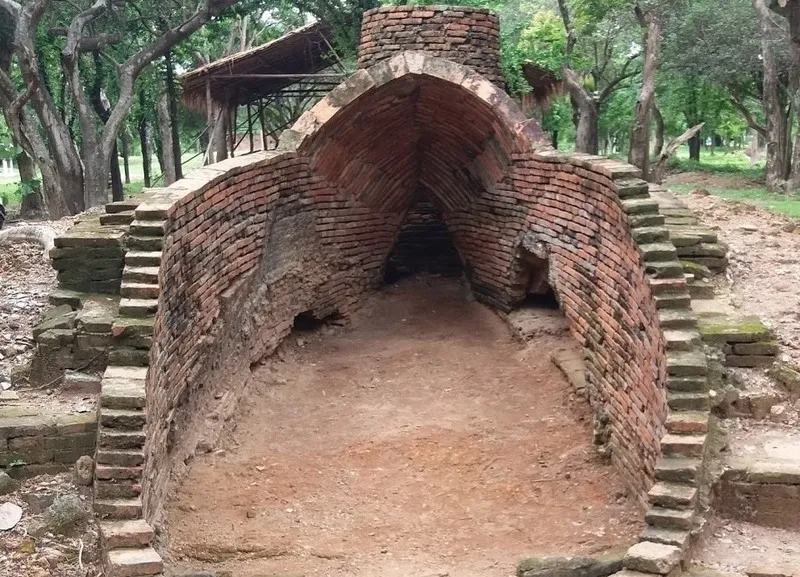
The Celadon Kiln Site Study and Conservation Centre at Ban Ko Noi was developed to preserve and explain this ancient ceramic heritage. The site includes exhibition buildings, preserved kiln structures, ceramic displays, and archaeological remains. Visitors can see excavated kilns, traces of firing, ceramic fragments, and interpretive displays that explain the production process. The centre functions as an open-air museum, an archaeological site, and a historical classroom for understanding Si Satchanalai’s industrial past.
The structure of the ancient kilns is especially interesting. Many kilns have a long oval form resembling a boat canopy. Some include firing chambers, combustion areas, and heat-control features. Such design allowed craftsmen to control temperature and firing conditions more effectively. Glazed ceramics require high temperatures and careful management of the kiln atmosphere. If the fire was too strong, vessels could deform or the glaze could run too much. If the fire was too weak, the glaze might not mature properly. The kilns are therefore direct evidence of technical experimentation and advanced ceramic knowledge.
A visit to Thuriang Kilns helps travelers understand that a single Sangkhalok vessel was never a simple object. Before becoming a beautiful ceramic piece, it passed through many skilled hands and many technical decisions. Clay had to be selected, cleaned, kneaded, shaped, dried, decorated, glazed, and fired. Even a small error could ruin an entire batch. The large amount of broken ceramic fragments found around kiln sites should not be seen as meaningless waste. They are valuable evidence of production, experimentation, failure, learning, and quality control in the ancient workshop system.
Sangkhalok ceramics also reveal the creativity and aesthetic taste of Sukhothai-period society. The craftsmen did not make only functional containers. They created objects with graceful proportions, lively painted designs, and distinctive glazes. Some pieces are simple and elegant, while others show energetic brushwork and symbolic motifs such as fish and plants. These ceramics are both utilitarian objects and works of art. They help us understand how beauty, belief, and daily life were connected in the ancient Thai world.
Culturally, Thuriang Kilns show that Si Satchanalai was not merely a satellite city of Sukhothai. It had its own specialized economy and creative strength. Ceramic production required many groups of workers: clay diggers, clay preparers, potters, decorators, glaze makers, kiln operators, fuel suppliers, sorters, transporters, and traders. The kiln site therefore reflects a complex economic system and a highly skilled artisan community. It also shows that cultural heritage can include technology and labor, not only temples and royal monuments.
The relationship between the kilns and the Yom River is central to understanding the site. The river was both a resource and a route. It supported settlement, provided water, helped transport goods, and connected Si Satchanalai with wider economic networks. The placement of kilns along the river was a strategic production decision. The ceramics of Ban Ko Noi were created in a landscape where natural resources and human skill worked together.
Conservation of the Thuriang Kilns is highly important because ancient kilns are fragile archaeological remains. Without careful protection, they could be damaged by erosion, weather, construction, or uncontrolled excavation. The creation of protective buildings, systematic excavation, and public interpretation helps preserve the site while allowing visitors to learn from it. Good conservation does not simply store the past; it keeps the past meaningful for present and future generations.
For students, researchers, historians, archaeologists, and art lovers, the centre is worth a detailed visit. It explains several important topics at once: kiln technology, ceramic production, Sukhothai-period trade, local resources, ancient industry, and the relationship between craft and society. Seeing the actual kiln structures gives a clearer understanding than viewing ceramics only in a museum cabinet. The site helps connect finished objects with the places and people that made them.
For general travelers, Thuriang Kilns add depth to a trip to Si Satchanalai. Sukhothai and Si Satchanalai are often remembered for Buddhist temples, ancient walls, and elegant ruins. Ban Ko Noi adds another dimension: the world of craftsmen, kilns, workshops, clay, fire, and trade. Visiting the kilns after exploring Si Satchanalai Historical Park helps complete the story of the ancient city. It shows that the city was not only a religious and political center but also a productive and creative industrial community.
Visitors should take time to observe the layout of the kiln area, the remains of firing structures, and the ceramic fragments on display. Details such as kiln shape, fire channels, vessel types, glaze fragments, and firing traces all help tell the story of production. Reading the interpretive signs and moving slowly through the exhibition areas will make the visit much more meaningful.
Getting There is convenient by private car or rental car. From Si Satchanalai Historical Park, travel north toward Ban Ko Noi via the Tao Mo Gate route for about 6.5 km. Travelers can also approach from Si Satchanalai District using Highway 1201 toward Ban Ko Noi. The centre is located near the Yom River. Visitors without a private vehicle should arrange local transport in advance because the kiln site is outside the main historical park area.
The best time to visit is in the morning or early afternoon, when the weather is more comfortable and there is enough time to explore the site. Visitors should wear comfortable shoes, avoid touching fragile kiln structures, refrain from collecting ceramic fragments, and follow site regulations. The kiln remains and pottery fragments are archaeological evidence, and respectful travel helps preserve them for future study.
Ban Ko Noi also offers the atmosphere of an old riverside community. The area can be combined with Si Satchanalai Historical Park, Wat Chang Lom, Wat Chedi Chet Thaeo, Wat Nang Phaya, Wat Chom Chuen, and Hat Siao community, known for traditional textiles and Tai Phuan culture. This route is ideal for travelers interested in history, archaeology, craft heritage, and local life along the Yom River.
Thuriang Kilns also have strong potential for sustainable cultural tourism. The site can support learning activities such as pottery demonstrations, explanations of firing technology, ceramic heritage routes, and contemporary craft products inspired by Sangkhalok designs. When managed carefully, ancient heritage can support local pride and community income without losing its historical integrity.
For international visitors, Thuriang Kilns make Thai history easier to understand through a universal object: pottery. Every culture understands vessels, clay, fire, and craft. Seeing the actual kilns allows visitors to understand how one ceramic object connects with landscape, technology, labor, art, and trade. The site is therefore an excellent destination for travelers who want to understand Sukhothai beyond temples and monuments.
In conclusion, Thuriang Kilns at Ban Ko Noi, or the Celadon Kiln Site Study and Conservation Centre, is one of the most valuable archaeological sites in Sukhothai Province. It preserves evidence of ceramic technology, artistic creativity, ancient industry, and regional trade. The kilns show that Si Satchanalai was once a major center of Sangkhalok production with skilled artisans and a sophisticated production system. Visiting the site is not simply about looking at old kilns. It is about understanding the creative power of ancient people and the importance of preserving cultural heritage for future generations.
| Name | Celadon Kiln Site Study and Conservation Centre / Thuriang Kilns at Ban Ko Noi |
| Location | Ban Ko Noi, Si Satchanalai Subdistrict, Si Satchanalai District, Sukhothai Province |
| Address | Ban Ko Noi, Si Satchanalai Subdistrict, Si Satchanalai District, Sukhothai 64310, Thailand |
| Approximate Coordinates | Ban Ko Noi area along the Yom River, north of the old city of Si Satchanalai |
| Highlights | Ancient Sangkhalok kilns, preserved excavated kiln structures, ceramic displays, pottery fragments, and traces of an ancient industrial zone along the Yom River |
| History | Associated with Sangkhalok ceramic production during the Sukhothai and Si Satchanalai period, representing one of the region’s most important ancient ceramic production zones |
| Key Evidence | Numerous ancient kilns found in the Ban Pa Yang and Ban Ko Noi areas, together with ceramic fragments, excavated kiln structures, and evidence of Sangkhalok production |
| Name Origin | “Thuriang Kilns” is the traditional name used for ancient kilns that produced Sangkhalok ware in the Si Satchanalai area |
| Distinctive Features | Many kilns have a long oval shape similar to a boat canopy, with some structures measuring about 7-8 meters long, showing advanced ancient firing technology |
| Travel Information | From Si Satchanalai Historical Park, travel north via the Tao Mo Gate route to Ban Ko Noi for about 6.5 km, or use Highway 1201 from Si Satchanalai District toward Ban Ko Noi |
| Current Status | Open as an archaeological learning site and Sangkhalok kiln conservation centre for visitors, students, researchers, and cultural travelers |
| Open Days | Daily |
| Opening Hours | 09.00 - 16.00 |
| Fees | Thai visitors 20 baht, foreign visitors 100 baht |
| Caretaker / Related Authority | Si Satchanalai Historical Park, Fine Arts Office 6 Sukhothai, Fine Arts Department |
| Main Contact Number | Si Satchanalai Historical Park, Tel. 055-950714 / 055-900002; Museum database also lists 055-615599 |
| Nearby Tourist Attractions | 1. Ban Ko Noi Thuriang Kilns No. 42 and No. 61, about 0.5 km 2. Si Satchanalai Historical Park, about 6.5 km 3. Wat Chang Lom, about 7 km 4. Wat Chedi Chet Thaeo, about 7 km 5. Wat Nang Phaya, about 7 km 6. Wat Chom Chuen, about 8 km 7. Hat Siao Community / Traditional Textile Learning Area, about 12 km |
| Nearby Restaurants | 1. Kesanong Sangkhalok Ban Ko Noi, about 1 km 2. Ban Klang Na Restaurant Si Satchanalai, about 8 km, Tel. 081-4416185 3. Khao Perp Yai Khrueang, about 12 km 4. CSL Restaurant, about 12 km 5. Pa Song Restaurant, Si Satchanalai District, about 14 km |
| Nearby Accommodations | 1. Chanalai Resort and Hotel, about 12 km, Tel. 055-672555 2. Sisatchanalai Heritage Resort, about 8 km 3. Navy Sisatchanalai, about 12 km 4. Downhill Resort, about 12 km 5. Akara House Sukhothai, about 13 km 6. Nam Yom Resort, about 13 km |
Frequently Asked Questions (FAQ)
Q: Where are the Thuriang Kilns at Ban Ko Noi located?
A: They are located at Ban Ko Noi, Si Satchanalai Subdistrict, Si Satchanalai District, Sukhothai Province, north of the old city of Si Satchanalai along the Yom River.
Q: Why are the Thuriang Kilns important?
A: They are an important ancient Sangkhalok ceramic production site that shows kiln technology, craft production, trade, and the prosperity of Si Satchanalai during the Sukhothai period.
Q: What are the opening hours of the Celadon Kiln Site Study and Conservation Centre?
A: The centre is open daily from 09.00 to 16.00.
Q: How much is the admission fee?
A: The admission fee is 20 baht for Thai visitors and 100 baht for foreign visitors.
Q: What can visitors see inside the centre?
A: Visitors can see excavated and preserved ancient kilns, Sangkhalok ceramic displays, pottery fragments, firing traces, and information about ancient ceramic production.
Q: What places can be visited together with Thuriang Kilns?
A: The site can be combined with Si Satchanalai Historical Park, Wat Chang Lom, Wat Chedi Chet Thaeo, Wat Nang Phaya, Wat Chom Chuen, and Hat Siao community.
Q: Is Thuriang Kilns suitable for international travelers?
A: Yes. It is highly suitable for international travelers who want to understand Sukhothai through ancient technology, ceramic production, trade history, and Thai craft heritage beyond temple ruins.
 Category: ●Art, Culture and Heritage
 Group: ●Art, Craft Centres, Tradition
Last Update : 3 MonthAgo
 Last Update : 3 MonthAgo
Recommend

 Historical Sites and Monuments(4)
 Landmarks and Memorials(5)
Art, Craft Centres, Tradition(11)
Landmarks and Memorials(5)
Art, Craft Centres, Tradition(11)
 Museums(5)
 Places of Worship
 Temple(40)
 Other Sacred Sites(10)
 Suburban Living
 Village, Community(3)
 Nature and Wildlife
 National Parks and Marine Reserves(3)
 Mountain (Doi)(2)
 Dam, Reservoir, Lake(4)
 Waterfalls(8)
 Caves(4)
 River, Canal(2)
 Entertainment and Agricultural
 Farms, Parks and Ecotourism(3)


