
lovethailand home >Central Travel Attractions >Nakhon Nayok Travel Attractions >Ongkharak >Bueng San > St Teresa International University
TL;DR: St Teresa International University is located at Bueng San Subdistrict, Ongkharak District, Nakhon Nayok Province, Thailand, open Monday – Sunday (University Administrative Offices), hours Monday – Friday 08:00 – 17:00; Saturday – Sunday 08:00 – 12:00.
St Teresa International University
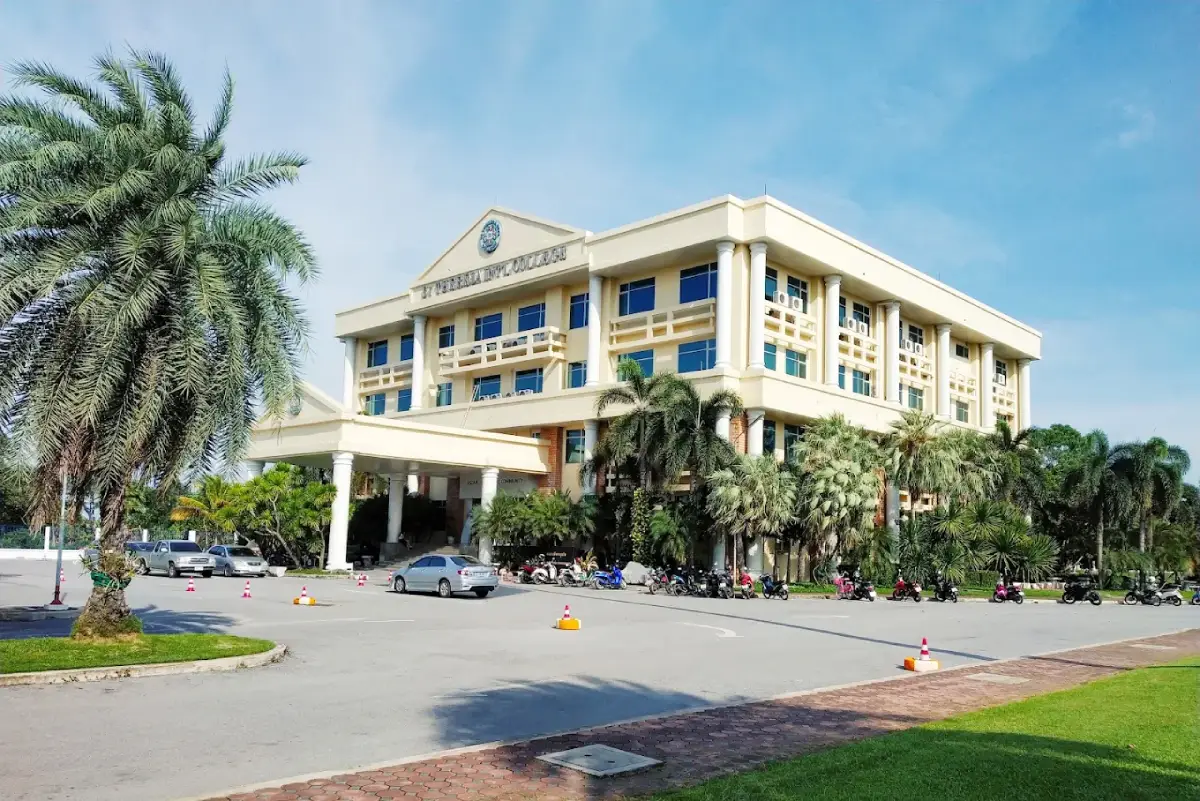
Open Days: Monday – Sunday (University Administrative Offices)
Opening Hours: Monday – Friday 08:00 – 17:00; Saturday – Sunday 08:00 – 12:00
St Teresa International University (TRSU) is a private higher education institution in Thailand with a strong emphasis on international education, English-medium instruction, professional development, and practical learning. Located at 1 Moo 6, Rangsit–Nakhon Nayok Road, Khlong 14, Bueng San Subdistrict, Ongkharak District, Nakhon Nayok Province, the university provides undergraduate and postgraduate education across five faculties: Business Administration, Humanities and Social Sciences, Education, Nursing Science, and Public Health. Its institutional history dates to the early development of St Theresa Inti College, with 2001 recognized by the university as its founding year. The institution was officially upgraded from an international college to a university in 2024, marking an important milestone in its development. Today, TRSU combines academic programs, specialized training facilities, international partnerships, student accommodation, and extracurricular activities within a campus designed to support both academic achievement and personal growth.
The university is situated in Ongkharak District, an area of Nakhon Nayok Province connected to Bangkok and Pathum Thani by Rangsit–Nakhon Nayok Road, also known as Highway 305. Unlike universities located in densely developed metropolitan districts, TRSU occupies a spacious campus surrounded by the agricultural communities and local landscapes of eastern central Thailand. This setting offers students a distinctive environment in which academic buildings, residential facilities, recreation areas, and green spaces are integrated within the same university grounds.
According to the university's institutional information, its campus covers approximately 150 rai and includes around 15 buildings. These comprise teaching facilities, a library, auditoriums, a cafeteria, a sports club with a swimming pool, and six student residential buildings. The campus arrangement reflects an educational environment in which learning is not limited to formal classrooms. Students can access academic resources, participate in extracurricular activities, use recreational facilities, and live in university accommodation while remaining connected to the wider academic community.
The history of St Teresa International University is closely associated with the expansion of private higher education in Thailand during a period of growing demand for English proficiency, international business skills, and professionally qualified graduates. Institutional historical records trace the origins of the educational project to 1995, when a partnership was established between St Theresa International School of Business Administration in Thailand and Inti College in Malaysia. The institution initially developed under the name St Theresa Inti College, reflecting its international educational orientation and the cooperation between the Thai and Malaysian institutions.
A significant institutional milestone occurred on 10 May 2001, when the establishment of the college was announced in the Royal Gazette. The university's official introductory website identifies 2001 as its founding year. It is therefore useful to distinguish between the earlier development of the educational project in 1995 and its formal establishment as a higher education institution in 2001. These separate stages help explain the institution's historical development and its transition into Thailand's recognized private higher education system.
In 2003, the institution received recognition relating to its use of English as the medium of instruction. This became a defining characteristic of its educational identity. Rather than treating English simply as a separate language subject, the university incorporated it into academic and professional learning across fields such as business, hospitality, health sciences, communications, and education. This approach was intended to strengthen students' ability to apply specialist knowledge while communicating in international and multicultural professional environments.
Another important transition took place during the 2009 academic year, when the institution adopted the name St Theresa International College. The new name reflected its broader international educational identity and remained in use for many years. During this period, the college continued developing its academic structure and establishing relationships with overseas educational institutions. These connections supported academic exchange, international cooperation, and opportunities for eligible students to continue parts of their education through approved partner arrangements.
One of the institution's major areas of academic expansion was nursing education. The Faculty of Nursing Science was established in 2007 and began offering its Bachelor of Nursing Science program during the same academic year. Nursing education represented a significant extension of the college's academic responsibilities because the profession requires comprehensive scientific knowledge, clinical skills, ethical judgment, and the ability to communicate effectively with patients and multidisciplinary healthcare teams.
Public health education became another important area of development. The Faculty of Public Health was established in 2011, initially offering education in occupational health and safety before developing additional public health programs. This expansion responded to the need for professionals who understand disease prevention, workplace risks, occupational safety, environmental conditions, and community health. The field also provides an important connection between university education and the broader wellbeing of society.
In the 2011 academic year, the institution underwent its third cycle of external educational quality assessment conducted by Thailand's Office for National Education Standards and Quality Assessment. Quality assurance has been an important aspect of the university's development, covering institutional management, educational provision, student outcomes, academic standards, and the continuous improvement of teaching and learning.
The academic structure continued to evolve in subsequent years. In 2012, the Faculty of Humanities was renamed the Faculty of Humanities and Social Sciences to reflect its broader academic scope. In the 2013 academic year, the institution expanded its postgraduate education in areas including business administration, public health, and education. This marked a further transition from a college primarily associated with undergraduate education toward an institution offering opportunities for advanced professional and academic study.
The Faculty of Education was established as a separate academic unit in the 2014 academic year, following the reorganization of education-related programs previously associated with the Faculty of Humanities and Social Sciences. Its development provided a dedicated institutional framework for preparing teachers, education professionals, and school administrators. The faculty emphasizes subject knowledge, teaching methods, educational research, curriculum development, learning assessment, and English-language communication.
Between 2015 and 2020, the college continued developing programs across a wider range of academic fields. These included digital media, accountancy, airline business, aeronautics, air traffic control, mathematics education, science education, and learning management. The expansion helped shape the institution into a multidisciplinary educational community, bringing together business, science, technology, communication, health, and teacher education.
In the 2021 academic year, the institution completed its fourth external educational quality assessment cycle. The following academic year brought further development in doctoral education, particularly in Educational Administration. Advanced academic programs allow experienced professionals to investigate educational challenges, conduct research, examine institutional policies, and develop leadership capabilities relevant to contemporary education systems.
A major change in institutional status occurred in 2024. Thailand's Higher Education Commission considered the proposal to change St Theresa International College into St Teresa International University at its meeting on 16 January 2024. The institution subsequently changed its institutional category to a university on 22 February 2024. This represented an important milestone following more than two decades of higher education provision and continuing academic development.
Based on 2001, the year identified in the university's official introduction, St Teresa International University reached 25 years of institutional history in 2026. Over this period, the institution experienced changes in its official name, legal status, academic organization, degree programs, educational facilities, and international partnerships. Its development illustrates how a private higher education institution can expand its academic responsibilities while responding to changing educational standards and workforce requirements.
The university is led by Dr. Piyada Wattanasarn, who is identified as President on its official administrative and university council pages. Her professional background includes educational administration, financial management, and academic program leadership. The university's governance structure also includes the University Council, vice presidents, faculty deans, and administrative units responsible for educational quality, institutional planning, academic management, and student services.
The institutional identity of St Teresa International University is expressed through its name, emblem, architecture, and several Christian cultural features on campus. Notable examples include St Mary Auditorium, St Christopher Sports Club, the university chapel, and the Mother Mary Fountain near the main building. These features contribute to the distinctive appearance of the campus and reflect elements of the cultural background associated with the institution.
At the same time, the university's educational environment brings together students and academic staff from different linguistic, national, and cultural backgrounds. This diversity creates opportunities for intercultural communication, collaborative learning, and the development of perspectives that extend beyond a single national or professional context. English-language learning also plays an important role in helping students participate in academic discussions and professional communication.
The Faculty of Business Administration is one of the university's major academic units. Its published programs include International Business, Logistics Management, Tourism and Hotel, Airline Business, Accountancy, Aeronautics, and Air Traffic Control. These areas connect management knowledge with international trade, transport, aviation, tourism, and service industries. Students are encouraged to combine theoretical understanding with practical competencies relevant to professional organizations and international workplaces.
The university's aviation-related facilities are especially notable. They include an aeronautics flight simulator, an airplane cabin mock-up, and air traffic control simulation facilities featuring an aerodrome control tower environment and radar control rooms. These specialized learning environments support practical exercises in operational procedures, communication, situational awareness, technical decision-making, and safety-related principles. Such facilities help students connect academic concepts with the professional environments of aviation and transportation.
The Faculty of Humanities and Social Sciences focuses on communication, language, and contemporary media. Its published undergraduate offerings include English for Business Communication and Digital Media. These fields are relevant to professional communication, content production, digital platforms, media technologies, and creative industries. Students can also benefit from specialized facilities such as photography studios, audio recording rooms, digital editing laboratories, acting studios, and computer laboratories.
The Faculty of Education prepares future teachers and educational professionals through undergraduate programs in English, Mathematics, Science, and Early Childhood Education. It also provides postgraduate opportunities in Educational Administration and Learning Management. The faculty places importance on understanding learners, designing educational experiences, assessing learning outcomes, developing curriculum, and applying research to improve teaching practices.
Graduate Diploma programs in Teaching Profession are another important component of the university's educational offerings. TRSU has published admissions information for both Thai and international teaching profession programs for the 2026 academic year. Prospective applicants should examine the applicable admissions requirements, curriculum structure, practical teaching components, and professional licensing regulations issued by the relevant authorities before enrolling.
The Faculty of Nursing Science emphasizes professional healthcare education supported by both classroom learning and simulated clinical practice. Its facilities include hospital ward simulation environments, maternity ward simulation areas, and clinical training spaces. These provide opportunities to strengthen practical nursing competencies before supervised professional placements. Nursing students must develop scientific understanding, patient assessment skills, clinical judgment, ethical awareness, and effective communication with healthcare professionals.
The Faculty of Public Health offers academic programs related to Public Health and Occupational Health and Safety, together with postgraduate education in public health. Students study subjects relevant to health promotion, disease prevention, workplace safety, risk assessment, public health administration, and community wellbeing. The knowledge and professional competencies associated with these fields are applicable to healthcare organizations, industry, workplaces, public institutions, and community development activities.
At postgraduate level, TRSU publishes programs in Business Administration, Educational Administration, Learning Management, and Public Health. Doctoral education is also represented through Business Administration and Educational Administration. Advanced study supports the development of analytical thinking, leadership, research methodology, and the practical application of academic knowledge to complex problems encountered in professional and institutional settings.
Academic quality assurance remains an important part of institutional governance. The university's self-assessment report for the 2024 academic year, covering 1 June 2024 to 31 May 2025, recorded 20 operating degree programs across five faculties, consisting of 13 undergraduate programs and seven postgraduate programs. The university's more recent public course directory presents a broader selection of degree pathways, majors, and certificates. These figures should be understood according to the reporting period and the distinction between formally counted degree programs and the individual study options displayed in the course directory.
International collaboration is another defining element of the university's academic identity. Its published international partner network includes institutions such as the University of South Wales, University of East London, University of Northampton, and other international educational organizations. Such partnerships support institutional cooperation and opportunities for academic exchange. Eligibility for credit transfer, overseas study, or joint degree arrangements depends on the specific agreements and requirements of the relevant program.
Alongside its international activities, the university also participates in academic cooperation within Thailand. One example is the collaboration between TRSU's Faculty of Public Health and the Faculty of Physical Education at Srinakharinwirot University in 2025. The cooperation focused on academic work related to Occupational Health and Safety and the development of beneficial learning opportunities for students. This illustrates the university's role in strengthening educational relationships with institutions in the surrounding region.
Research and academic services contribute to the university's wider educational mission. Relevant fields include public health, occupational safety, educational research, business management, and teaching development. University research activities help students and academic staff investigate problems systematically, assess evidence, apply research methods, and develop ideas that can be used in professional or community settings. These activities complement classroom instruction by encouraging critical thinking and the practical application of knowledge.
Student life at TRSU includes academic exhibitions, sports, cultural activities, and social events. In September 2026, the Faculties of Business Administration and Education organized Academic Expo 2026 activities at the Joseph Marie Building. The events gave students opportunities to present academic achievements, creative work, and innovative ideas. Such experiences help develop communication, presentation, teamwork, and organizational skills beyond the formal curriculum.
Other activities publicized in 2026 included the Faculty of Nursing Science's sports events and the TRSU Prince & Princess celebration. Extracurricular participation plays an important role in building friendships, confidence, leadership, and a sense of belonging within the university community. These experiences are particularly relevant in an international educational environment where students may come from different countries and cultural backgrounds.
University commencement ceremonies are also important milestones in the academic calendar. They recognize graduating students and bring together families, lecturers, administrators, and alumni to celebrate academic achievement. St Mary Auditorium is used for major university ceremonies, including graduation activities. Graduates are expected to follow the official procedures for registration, rehearsal, and participation announced for each ceremony.
Among the university's major learning facilities, the Library and Academic Resource Center supports independent study, academic reading, research, and coursework. A university library is particularly important for higher education students who need access to scholarly information beyond classroom materials. It also supports the development of research skills and academic literacy, including the use of English-language reference materials.
The Joseph Marie Building is another significant academic location and has hosted exhibitions, meetings, and student presentations. St Mary Auditorium provides a larger venue for university ceremonies and major gatherings. Meeting facilities and multipurpose academic spaces support the university's educational, administrative, and community-building activities.
The campus also contains several specialized laboratories and practical learning environments. Science and nursing laboratories support professional health education, while aviation simulation facilities provide technical learning opportunities. Digital media facilities serve students interested in photography, audio production, video work, and creative communication. This combination of facilities demonstrates the university's emphasis on supporting professional education through hands-on learning.
Sports and recreation are supported by St Christopher Sports Club, which includes fitness and swimming facilities. The university also publishes information about outdoor sports areas, basketball and volleyball courts, a football pitch, and a golf driving range. These facilities provide opportunities for physical activity and student recreation, complementing academic learning with social participation and personal wellbeing.
Daily student needs are supported by St Anne Cafeteria, an on-campus convenience store, and university residential halls. Student accommodation is especially relevant for those arriving from other Thai provinces or overseas. Living on campus can make it easier to attend classes, access learning facilities, participate in university events, and adjust to the academic environment.
The university chapel is another distinctive campus feature. Together with buildings bearing Christian names and the Mother Mary Fountain, it contributes to the cultural character of the institution. Visitors interested in architecture and religious heritage may find these features noteworthy, although access to religious spaces and other university buildings remains subject to the institution's rules and the activities taking place.
Prospective students and families can explore the university through its official virtual campus tour. The online tour includes the main building, Mother Mary Fountain, chapel, aviation simulation facilities, digital media laboratories, nursing simulation rooms, science laboratories, library, fitness center, swimming pool, cafeteria, residence halls, auditoriums, and landscaped outdoor areas. This resource provides a useful introduction to the campus before visiting in person.
TRSU also provides a Campus Tour booking service for prospective students and their families. According to the university's visitor information, tour reservations should be submitted at least 48 hours in advance. The advertised tour includes residential halls, dining facilities, the fitness center, swimming pool, classrooms, library, and selected specialized laboratories. Arranging a tour is particularly useful for applicants who wish to compare academic facilities, understand the campus environment, and discuss degree options before making an enrollment decision.
University administrative office hours should not be confused with unrestricted public access to the campus. The university lists office hours as Monday to Friday from 08:00 to 17:00 and Saturday to Sunday from 08:00 to 12:00. Entry to classrooms, laboratories, residential buildings, and other restricted facilities is governed by university procedures. Visitors interested in academic tours, photography, or institutional visits should make arrangements with the university before arriving.
The university also maintains a connection with the surrounding community of Ongkharak District. The area is known for agricultural activities, local markets, religious sites, and ornamental plant cultivation. One of its notable attractions is the Khlong 15 Ornamental Plant Village, a well-established center for cultivating and selling flowers, ornamental plants, and landscaping materials. The village reflects the agricultural skills and commercial traditions of local residents and provides an interesting destination for visitors interested in horticulture and community-based economic activities.
Other places of local interest include the historic Saowapha Market and several temples and community landmarks in Ongkharak District. The area's combination of traditional markets, agricultural communities, and educational institutions offers an opportunity to explore aspects of provincial life beyond Thailand's major tourist cities. Visitors traveling to TRSU may therefore incorporate local cultural or agricultural stops into their journey, depending on their schedule.
Getting There St Teresa International University is located near Khlong 14 on Rangsit–Nakhon Nayok Road, Highway 305, in Ongkharak District, Nakhon Nayok Province. Travelers coming from Bangkok by car can head toward Rangsit via Phahonyothin Road before joining Rangsit–Nakhon Nayok Road. Continue eastward along Highway 305 toward Ongkharak and Nakhon Nayok, following the canal-numbered sections until reaching the Khlong 14 area and the university entrance.
Public transport is another option. The university's official travel guidance describes minibus connections through Future Park Rangsit, with onward services along the Rangsit–Nakhon Nayok route. Visitors should confirm current boarding points, operating schedules, and the exact stopping location before traveling. Those arriving through Don Mueang International Airport or Suvarnabhumi Airport can also arrange road transport to the university, subject to traffic conditions and available services.
Prospective students attending interviews, submitting documents, or joining university events should confirm the relevant appointment time and building location in advance. Because the campus contains multiple academic and administrative facilities, identifying the correct office before arrival can make the visit more efficient. Families wishing to inspect accommodation and learning facilities may also benefit from using the university's official Campus Tour booking system.
St Teresa International University represents the development of a Thai private higher education institution with an international educational foundation and a growing range of professional disciplines. Its historical journey from St Theresa Inti College to St Theresa International College and subsequently to university status in 2024 demonstrates institutional continuity and academic expansion. With five faculties, English-oriented education, specialized laboratories, international collaborations, and a residential campus in Nakhon Nayok Province, TRSU continues to provide educational opportunities for students seeking professional preparation and academic development within an internationally connected learning environment.
| University Name | St Teresa International University (TRSU) |
| Thai Name | มหาวิทยาลัยนานาชาติเซนต์เทเรซา |
| Institution Type | Private University |
| Location | Bueng San Subdistrict, Ongkharak District, Nakhon Nayok Province, Thailand |
| Full Address | 1 Moo 6, Rangsit–Nakhon Nayok Road, Khlong 14, Bueng San, Ongkharak, Nakhon Nayok 26120, Thailand |
| Early Institutional Development | 1995, through an educational partnership associated with St Theresa Inti College |
| Official Founding Year | 2001 |
| Institutional Age | 25 Years in 2026, based on the university's stated founding year |
| Former Names | St Theresa Inti College; St Theresa International College |
| University Status Date | 22 February 2024 |
| President | Dr. Piyada Wattanasarn |
| Number of Faculties | 5 |
| Faculties | Faculty of Business Administration Faculty of Humanities and Social Sciences Faculty of Education Faculty of Nursing Science Faculty of Public Health |
| Levels of Education | Practical Nursing Certificate, Bachelor's Degrees, Graduate Diplomas, Master's Degrees, and Doctoral Degrees, according to the university's published course directory |
| Academic Strengths | International Education, Business Administration, Aviation, Logistics, Tourism, Communication, Education, Nursing, and Public Health |
| Important Campus Facilities | Main Building, Mother Mary Fountain, Library and Academic Resource Center, Joseph Marie Building, St Mary Auditorium, St Christopher Sports Club, St Anne Cafeteria, Chapel, and Residence Halls |
| Learning Facilities | Aviation Flight Simulator, Air Traffic Control Simulation, Cabin Mock-Up, Digital Media Studios, Science Laboratories, Nursing Simulation Rooms, Computer Laboratories, Library, and Language Laboratories |
| Recreational Facilities | Fitness Center, Swimming Pool, Outdoor Sports Courts, Football Pitch, Golf Driving Range, and Student Activity Spaces |
| University Activities | Commencement Ceremonies, Student Orientation, Sports Activities, Cultural Events, and Academic Expo 2026 |
| Administrative Office Days | Monday – Sunday |
| Administrative Office Hours | Monday – Friday: 08:00 – 17:00 Saturday – Sunday: 08:00 – 12:00 |
| Campus Visits | Campus Tours are available through advance booking at least 48 hours before the intended visit. Access to restricted areas is subject to university regulations. |
| Getting There | Via Highway 305, Rangsit–Nakhon Nayok Road, toward Khlong 14 in Ongkharak District. Travel options include private cars, taxis, and public transport connections through Future Park Rangsit. |
| Nearby Places of Interest | 1. Khlong 15 Ornamental Plant Village 2. Saowapha Old Market 3. Ongkharak City Pillar and Local Shrine Area 4. Wat Prasitthiwet 5. Srinakharinwirot University, Ongkharak Campus |
| Restaurants in Ongkharak | 1. St Anne Cafeteria 2. Montreux Café and Farm 3. Pa-In Garden 2 4. KOPI HOUSE Khlong 15 5. The Burger & Steak |
| Accommodation in Ongkharak | 1. Tonrak Resort 2. A&B Resort Ongkharak 3. Reaunporn Resort 4. Hug Me Home Nakhon Nayok 5. Mazecape |
| Telephone | +66 (0) 37-349933 to 37-349935 |
| Official Website | https://trsu.ac.th/ |
| Current Status | Operating private university with active institutional news, academic program information, and student admissions services in 2026 |
Academic Programs and Fields of Study at St Teresa International University, Academic Year 2026 The following table presents the degree programs, certificates, and study options listed in the university's official undergraduate and postgraduate directories. The list distinguishes program levels and faculty affiliations. A program's appearance in the directory does not automatically establish that it accepts new students during every admissions period.
| Faculty | Academic Programs and Fields of Study |
| Faculty of Business Administration | Undergraduate Programs 1. Bachelor of Accountancy 2. Bachelor of Science in Aeronautics 3. Bachelor of Science in Air Traffic Control 4. Bachelor of Business Administration in Airline Business 5. Bachelor of Business Administration – International Business 6. Bachelor of Business Administration – Logistics Management 7. Bachelor of Business Administration – Tourism and Hotel Master's Degree 1. Master of Business Administration (Modern Business Administration) Doctoral Degree 1. Doctor of Business Administration (DBA) |
| Faculty of Humanities and Social Sciences | Undergraduate Programs 1. Bachelor of Arts in English for Business Communication 2. Bachelor of Communication Arts in Digital Media |
| Faculty of Education | Undergraduate Programs 1. Bachelor of Education in Early Childhood Education 2. Bachelor of Education in English 3. Bachelor of Education in Mathematics 4. Bachelor of Education in Science Graduate Diploma 1. Graduate Diploma in Teaching Profession (Thai and International Programs) Master's Degrees 1. Master of Education in Educational Administration 2. Master of Education in Learning Management Doctoral Degree 1. Doctor of Philosophy in Educational Administration |
| Faculty of Nursing Science | Undergraduate Program 1. Bachelor of Nursing Science Certificate Program 1. Certificate for Practical Nurse |
| Faculty of Public Health | Undergraduate Programs 1. Bachelor of Science in Occupational Health and Safety 2. Undergraduate Program in Public Health Master's Degree 1. Master of Public Health |
Frequently Asked Questions (FAQ)
Q: Where is St Teresa International University located?
A: St Teresa International University is located at 1 Moo 6, Rangsit–Nakhon Nayok Road, Khlong 14, Bueng San Subdistrict, Ongkharak District, Nakhon Nayok Province 26120, Thailand.
Q: What are the opening days and hours of St Teresa International University?
A: The university's administrative offices operate Monday to Friday from 08:00 to 17:00 and Saturday to Sunday from 08:00 to 12:00. Access to academic buildings and restricted campus facilities is subject to university regulations.
Q: When was St Teresa International University established?
A: The university identifies 2001 as its founding year, while the institutional project has historical origins dating to 1995. It officially changed its institutional category from an international college to a university on 22 February 2024.
Q: Is St Teresa International University a public or private university?
A: It is a private university in Thailand with an emphasis on international education, English-language learning, and professional academic programs.
Q: How many faculties does St Teresa International University have?
A: The university has five faculties: Business Administration, Humanities and Social Sciences, Education, Nursing Science, and Public Health.
Q: Does St Teresa International University offer international programs?
A: Yes. The university publishes English-medium and international study options in fields such as International Business, Aviation, English for Business Communication, and Education. Applicants should check the language requirements of their specific program.
Q: Can prospective students and families visit the university campus?
A: Yes. The university provides a Campus Tour booking service for prospective students and their families. Reservations should be submitted at least 48 hours before the intended visit.
Q: How can visitors reach St Teresa International University from Bangkok?
A: Visitors can drive via Highway 305, Rangsit–Nakhon Nayok Road, toward Khlong 14 in Ongkharak District. Public transport connections through Future Park Rangsit are also described on the university's official website. Current boarding locations and services should be confirmed before traveling.
 Category: ●University
 Group: ●Private University
Last Update : 2 DayAgo
 Last Update : 2 DayAgo
 Click to Access the Navigation Map GPS
St Teresa International University Map
Recommend

 Art, Culture and Heritage
 Historical Sites and Monuments(1)
 Landmarks and Memorials(2)
 Art, Craft Centres, Tradition(2)
 Museums(3)
 Educational Places
 Educational Gardens, Farm(1)
 Public university(1)
Private University(1)
 Places of Worship
 Temple(24)
 Church(1)
 Mosque(2)
 Other Sacred Sites(10)
 Suburban Living
 Village, Community(3)
 Local Market(1)
 Nature and Wildlife
 Dam, Reservoir, Lake(7)
 Waterfalls(9)
 Other natural attractions(1)
 Entertainment and Agricultural
 Farms, Parks and Ecotourism(5)
 Waterpark(1)
 Outdoor and Adventure Activities(1)
 Travel Articles, Recipes
 Travel Review, Food Review(1)


