
lovethailand home >Central Travel Attractions >Bangkok Travel Attractions >Bang Kapi >Khlong Chan > Rattana Bundit University
TL;DR: Rattana Bundit University, open Monday – Saturday (Registration and Evaluation Office, Bang Kapi Campus), hours 08:30 – 16:30 (Building B, 2nd Floor, Room B205).

Rattana Bundit University
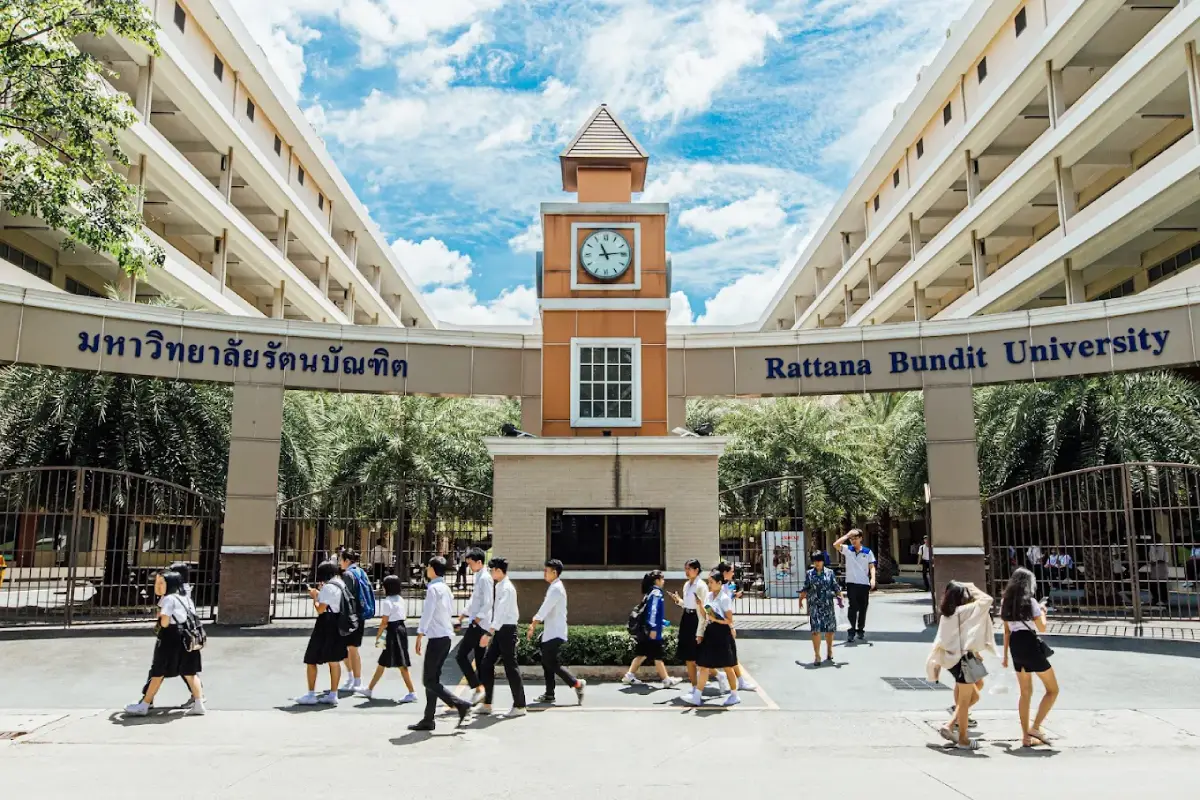
Open Days: Monday – Saturday (Registration and Evaluation Office, Bang Kapi Campus)
Opening Hours: 08:30 – 16:30 (Building B, 2nd Floor, Room B205)
Rattana Bundit University (RBAC) is a private higher education institution in Thailand, with its main campus located at 306 Soi Lat Phrao 107, Khlong Chan, Bang Kapi District, Bangkok 10240. The university also operates an educational campus in Pathum Thani Province, particularly for the Faculty of Nursing Science in Chiang Rak Noi, Sam Khok District. Rattana Bundit University was officially granted its establishment license on December 18, 1997, and began offering academic programs in the 1999 academic year under the name Rattana Bundit College. It subsequently attained university status in 2005. The institution was founded through the efforts of Ajarn Prachum Rattanapian and Ajarn Wichitra Rattanapian, who sought to expand educational opportunities and develop knowledgeable, professionally competent graduates capable of contributing to society. Today, the university provides bachelor's, master's, and doctoral education across accounting, business and finance, hospitality and service industries, digital communication, engineering, law, public administration, education, nursing, and medical technology. It also offers regular and continuing education options in designated programs.
Rattana Bundit University is widely recognized by its English abbreviation, RBAC, a name that has remained familiar to students, alumni, and the public since its earlier development as a college. The name Rattana Bundit is associated with the Rattanapian family, whose members established the institution. The Thai word "Bundit" refers to an educated or learned person, reflecting the founders' intention to create an educational environment in which students could develop knowledge, professional skills, moral character, and a sense of social responsibility. These values remain closely connected with the university's approach to teaching and student development.
The main campus on Soi Lat Phrao 107 is situated in Khlong Chan, a residential and commercial neighborhood within Bangkok's Bang Kapi district. The surrounding area contains housing communities, local shops, restaurants, student accommodation, educational institutions, and numerous services supporting daily urban life. Lat Phrao Road provides connections to Nawamin Road, Ramkhamhaeng Road, Srinakarin Road, and other parts of eastern Bangkok. The university therefore functions not only as an educational institution but also as part of the wider social and economic environment of the local community.
The campus comprises several academic buildings, a central library, professional training facilities, sports areas, student residences, and administrative offices. Rattana Bundit University promotes a welcoming atmosphere through its concept of "Make Yourself At Home," emphasizing an educational environment where students feel comfortable learning, participating in activities, and developing relationships with faculty members and fellow students. This approach is particularly relevant to an institution that serves learners from different educational backgrounds and stages of life.
The history of Rattana Bundit University can be traced to the extensive experience of its founders, Ajarn Prachum Rattanapian and Ajarn Wichitra Rattanapian, in Thailand's private education sector. Their involvement in educational administration began several decades before the establishment of the university. The transformation from commercial and vocational educational institutions into a university reflects a longstanding effort to provide continuous learning opportunities and respond to the need for professionally trained personnel in business, management, and other fields.
Ajarn Prachum Rattanapian was born on February 25, 1926, to Im and Waew Rattanapian. He became an important figure in education, politics, and sports in Thailand. During his public career, he served several terms as a member of the House of Representatives for Trat Province and held significant responsibilities in political and public organizations. His experience in public service contributed to his understanding of the importance of developing human resources and providing educational opportunities that would enable individuals to improve their professional capabilities and participate more effectively in society.
In 1962, Prachum Rattanapian founded Dusit Commercial School, a private institution specializing in commercial education. The school contributed to the development of vocational and business education in Thailand. Over time, he expanded his educational activities through additional institutions, including Rattana Commercial School on Lat Phrao Road and Nanthanaworawit School in Bang Bua Thong District, Nonthaburi Province. These establishments provided educational opportunities at different levels and formed an important foundation for the eventual development of Rattana Bundit University.
Ajarn Wichitra Rattanapian played a significant role alongside Prachum Rattanapian in developing and administering their educational institutions. Both shared the belief that education was fundamental to human resource development and national progress. Their efforts to establish institutions serving students from childhood through higher education reflected an intention to provide accessible learning opportunities for individuals with different educational needs, circumstances, and professional ambitions.
Prachum Rattanapian also made important contributions to Thai sports. He served as President of the Football Association of Thailand and President of the Amateur Boxing Association of Thailand, and he was involved in activities associated with the National Olympic Committee of Thailand. His background in sports is relevant to the university's later development of physical education, sports management, and athletic activities. It also illustrates the close relationship between education, leadership, discipline, and physical development within the institution's broader educational philosophy.
As Thailand's private education sector expanded during the late 1980s and 1990s, Prachum and Wichitra Rattanapian worked toward establishing a higher education institution that would complement their existing educational network. Their objective was to enable students to continue their studies to degree level and acquire knowledge applicable to business, professional services, and other areas of employment.
On December 18, 1997, Rattana Bundit College received its official license to operate as a private higher education institution. This date marks the legal establishment of the institution and represents a major milestone in the founders' expansion from school-level and vocational education into university-level studies.
The institution began teaching in the 1999 academic year under the name Rattana Bundit College. Its early operations coincided with the period following Thailand's 1997 financial crisis, when businesses and professional organizations were adapting to major economic changes. Knowledge of business administration, finance, technology, and communication became increasingly important. Higher education institutions consequently played a significant role in helping young people acquire qualifications and practical skills for an evolving employment market.
On June 24, 2003, the Ministry of University Affairs approved the establishment of another institution under the name Rattana Bundit University of Science and Technology. In the same year, approval was given for its operations to be integrated with Rattana Bundit College. This development formed part of a broader restructuring process intended to strengthen the institution's academic capacity and expand its educational activities.
In 2005, the institution received approval to operate under the name Rattana Bundit University, which remains its official name today. The transition from college to university represented an important stage in its institutional development. It broadened the scope of higher education activities, including the provision of academic programs at different levels and the university's responsibilities in research, academic services, and the preservation of arts and culture.
Following its transition to university status, Rattana Bundit University progressively expanded its academic programs and student services. Fields of study included accountancy, business administration, service industry management, languages, communication arts, information technology, engineering, law, and public administration. This diversification created additional educational pathways for students seeking qualifications relevant to contemporary employment and professional development.
During the 2007 academic year, the university received national recognition for a creative freshman welcoming initiative. It won a national competition for constructive student orientation activities organized with the involvement of the Thai Health Promotion Foundation. This achievement reflected the institution's efforts to encourage positive relationships between senior and junior students, promote responsible participation in student life, and create a supportive environment for newcomers.
The university also expanded its academic support services through the development of its central library. Library operations began in the 1999 academic year as a documentation and learning resource center on the third floor of Building E. As the institution developed, the facility became known as the Central Library. In the 2007 academic year, it moved to Building G, known as THE LIBRARY, a dedicated four-story building designed to accommodate collections, study areas, and information services for students and academic staff.
Over time, Rattana Bundit University developed flexible learning options for students who were already employed. These included designated weekend continuing education programs and distance education arrangements. Such educational pathways were particularly important for learners managing employment, family responsibilities, and academic commitments simultaneously. By offering alternative study schedules, the university expanded opportunities for professional development beyond conventional full-time education.
The university subsequently expanded its academic activities into the health sciences through the Faculty of Nursing Science and the College of Allied Health Sciences. Its development of the Pathum Thani Campus created additional capacity for programs requiring specialized classrooms, practical training facilities, and professional learning environments. The expansion into healthcare education reflected the importance of developing qualified personnel who could contribute to Thailand's medical and public health services.
Rattana Bundit University's Pathum Thani Campus is located at 8 Moo 5, Chiang Rak Noi, Sam Khok District, Pathum Thani 12160. It serves as an important educational location for the Faculty of Nursing Science, where students undertake academic and professional learning related to nursing. Prospective nursing students and visitors attending faculty appointments should therefore use the Pathum Thani address rather than automatically traveling to the university's main campus on Lat Phrao 107 in Bangkok.
In the 2026 academic year, Rattana Bundit University continued to provide academic services and announce student admissions. Published recruitment information included the Bachelor of Education programs in Physical Education and English, with application requirements, portfolio submission, written examinations, and interviews scheduled during March and April 2026. The Faculty of Nursing Science at Pathum Thani Campus also published information concerning applications for its Bachelor of Nursing Science program for the same academic year.
In addition to new student admissions, university activities in 2026 included registration services, final examinations, academic assessment, and graduation administration. These continuing functions demonstrate the institution's role as an active higher education provider serving students through teaching, academic support, and administrative services.
The founders and important personalities associated with Rattana Bundit University are closely connected with the Rattanapian family. Prachum Rattanapian established the foundations of the educational network, while Wichitra Rattanapian contributed to the development and administration of its institutions. Their combined efforts provided the university with a background in private education extending many years before the establishment of Rattana Bundit College.
Prachum Rattanapian passed away on March 30, 2013, at the age of 87. His legacy includes the educational institutions he helped establish and the belief that access to education contributes directly to human resource development. His work in politics, public service, and sports also reflects the broad range of responsibilities he undertook in Thai society.
Associate Professor Dr. Prawet Rattanapian is another significant figure in the university's administrative history. According to his university-published professional biography, he became Vice President for Administration in 1999, Senior Vice President in 2008, and President of Rattana Bundit University in 2012. His work has been associated with institutional administration, educational development, public activities, and cooperation in the field of sports.
The university emblem and institutional identity reflect Rattana Bundit University's responsibilities as a higher education institution. Its emblem takes the form of a shield divided into four symbolic sections, representing the university's principal missions: graduate education, research, academic services to society, and the preservation of arts and culture. The name RATTANA BUNDIT UNIVERSITY appears along the lower part of the emblem. The university's official colors are blue and gold, expressing its institutional identity and aspirations toward educational quality and responsible professional development.
The concept of "University of Opportunities" is part of Rattana Bundit University's contemporary institutional image. It communicates the idea of offering educational pathways to learners with different interests, qualifications, and circumstances. Another concept, "Plearn," combines the ideas of playing and learning, reflecting an approach that seeks to make educational experiences engaging while encouraging the development of knowledge, practical abilities, and life skills.
University traditions and student culture place importance on relationships among students, teachers, and alumni. Freshman welcoming activities introduce new students to the university community, encourage cooperation among classmates, and help learners understand the institution's values. Such activities support the transition from school life to the greater independence and responsibility associated with university education.
One notable tradition is the Necktie and University Pin Ceremony, marking the formal welcome of new students into the institution. During this activity, students receive encouragement and guidance from university executives and faculty members while meeting academic staff responsible for their programs. The necktie and university pin symbolize a new stage of education and the responsibilities that accompany membership in the university community.
Other freshman welcoming activities have included creative events designed to bring new and continuing students together. Examples include welcoming ceremonies and symbolic gestures of encouragement from senior students to newcomers. The university has also organized visits to nine Buddhist temples, connecting student orientation with opportunities to explore Thai cultural traditions, religious practices, and the heritage of local communities.
The Wai Khru Ceremony is another important educational tradition at Rattana Bundit University. On July 21, 2022, the university organized its annual Wai Khru ceremony at RBAC Hall, bringing together students from bachelor's and master's degree programs, continuing education, and distance education. The ceremony included floral offerings, expressions of gratitude to teachers, and student pledges. It reflected the importance of respect, responsibility, and the relationship between teachers and learners in Thai educational culture.
For the 2026 academic year, the university also publicized a Wai Khru ceremony in July involving university administrators, faculty members, and student representatives. The continued observance of this tradition reflects the institution's commitment to maintaining respect for teachers and strengthening relationships between different generations of students and academic staff.
Important facilities at the Bang Kapi Campus include a number of academic and administrative buildings. Building B houses the Registration and Evaluation Office on the second floor, Room B205. The office is responsible for academic registration, enrollment records, assessment, and documentation associated with the completion of degree requirements. Its location on campus provides students with a central point of contact for academic administration.
RBAC Central Library is located in Building G, also known as THE LIBRARY, a four-story building dedicated to academic information services. Its facilities include reading areas, book borrowing and returning services, reserved academic materials, newspapers, journals, seminar rooms, and access to electronic library resources. These services support classroom learning, individual assignments, academic projects, and research activities undertaken by students and faculty members.
The Central Library operates from Monday to Saturday, 08:30–16:30, and is closed on Sundays, public holidays, and designated university annual holidays. Its Saturday service is especially useful for students enrolled in weekend courses, allowing them to use library resources on the same day as their classes.
Studio 306 is a practical learning facility supporting education in communication and digital media. The university identifies several functional areas within the facility, including a DJ room, recording room, broadcasting room, production studio, and costume preparation room. These spaces enable students to develop practical skills in media production, audio and video recording, program preparation, and the use of professional equipment. Learning in such environments helps connect academic knowledge with the actual processes involved in communication and entertainment industries.
RBAC Hall serves as an important venue for university ceremonies, meetings, and activities involving students from different faculties. Events such as the Wai Khru ceremony have taken place in this hall. Other student activity spaces also provide opportunities to develop leadership, teamwork, organizational abilities, and communication skills through participation in university events.
RBAC University Stadium is associated with the university's physical education activities, athletic training, and sporting events. The availability of sports facilities supports students studying physical education and sports management while also encouraging exercise and healthy lifestyles among members of the wider university community.
RBAC Fitness is a campus fitness facility providing exercise equipment for students. University information identifies weekday services from Monday to Friday. The availability of a dedicated fitness area encourages students to develop healthy routines and maintain a balance between academic responsibilities, recreational activities, and personal well-being.
RBAC PLACE and RBAC BOYS' Student Residences contribute to the university's accommodation services for students living away from home. Published university information identifies RBAC BOYS' as a male residence comprising Buildings A and B. RBAC PLACE includes residential buildings intended for male and female students. Accommodation close to campus can help reduce daily commuting difficulties while supporting social interaction and the development of friendships among students.
Academic strengths at Rattana Bundit University include a combination of business-related disciplines, professional education, service industry management, communication technology, and healthcare sciences. The university's published undergraduate directory identifies 11 academic faculties or colleges, together with a Graduate School. Its educational approach emphasizes career development and the application of academic knowledge to professional practice.
The Faculty of Accountancy provides education in accounting and financial information management, fundamental subjects for businesses and public organizations. Students develop knowledge of accounting records, financial reporting, data analysis, and responsibilities arising under professional accounting standards. The university also publishes a weekend Bachelor of Accountancy study arrangement intended for eligible working students.
The Faculty of Business and Financial Management publishes academic fields in Digital Marketing, Modern Business Organization Management, Information Technology for Business Management, and Game Business and Esports Management. These programs reflect changes in the business sector, where digital technologies, data analysis, online marketing, and creative commercial activities are increasingly important. Students can relate management principles to the development of contemporary products, services, and organizational systems.
The Faculty of Service Industry offers fields connected with Sports and Health Management, Logistics and Supply Chain Management, Tourism, Hotel and Event Business, Aviation Business, Culinary Arts and Restaurant Management, and Security Management Systems. These subjects are particularly relevant to service industries, which require professional communication, operational planning, customer service, coordination, and specialized technical knowledge.
The Faculty of Creative Industries provides education in the Creative Music and Performing Arts Industry. The field connects artistic development with knowledge of production, performance, and the organization of activities in the entertainment sector. Such learning is relevant to the expansion of digital media, contemporary music, performance, and other creative cultural industries.
The Faculty of International Business focuses on Business English and Business Chinese. These disciplines develop language and communication abilities applicable to organizations engaged in international activities. Students study language use in business contexts, including professional communication, negotiation, coordination, and awareness of cultural differences.
The Faculty of Digital Communication publishes programs in Digital Radio and Television Media and Digital Media Design. These fields involve content development, media planning, filming, editing, and presentation across contemporary communication platforms. Practical facilities such as Studio 306 support the development of production skills through hands-on projects and simulated professional activities.
The Faculty of Engineering and Technology offers a program in Computer and Information Engineering. The field relates to computer systems, information technology development, and the application of software and digital infrastructure to organizational activities. Engineering education also encourages systematic thinking, technical problem-solving, and practical experience with specialized tools.
The Faculty of Law and Government offers undergraduate education in Law and Public Administration. Legal studies provide knowledge of rights, obligations, regulations, and judicial systems. Public Administration focuses on government organizations, public policy, resource management, and the delivery of public services. Together, these subjects contribute to the development of professionals working in legal, administrative, and public sector roles.
The Faculty of Education offers Bachelor of Education programs in Physical Education and English. For the 2026 academic year, the university published admissions and selection information for both fields. Physical Education studies involve the teaching of movement, sports, exercise, and health-related subjects, while English education connects language proficiency with teaching methods and educational principles. Admission to professional teacher education programs is governed by the qualifications and selection requirements specified by the university.
The Faculty of Nursing Science offers a Bachelor of Nursing Science program at the university's Pathum Thani Campus. The program develops scientific healthcare knowledge, patient care skills, professional communication, and the practical competencies required in nursing. Healthcare education also emphasizes professional ethics, responsibility, and cooperation with other members of the healthcare team.
The College of Allied Health Sciences provides education in Medical Technology, a field associated with medical laboratory analysis and diagnostic services. Medical technologists contribute to healthcare by examining biological samples and producing laboratory information that helps medical professionals assess health conditions and make clinical decisions.
The Graduate School publishes master's and doctoral programs in fields including business administration and management, law and legal development, public administration, accounting, educational administration, physical education, and digital radio and television communication. Graduate education supports advanced research skills, organizational analysis, professional expertise, and the creation of knowledge that can be applied to academic and workplace challenges.
Weekend education is another feature of the university's academic offerings. Published Saturday–Sunday study arrangements include Accountancy, Digital Marketing, Information Technology for Business Management, Law, Computer and Information Engineering, and Logistics and Supply Chain Management. These pathways allow eligible students to continue developing academic knowledge while maintaining professional responsibilities, subject to the requirements and schedules of individual programs.
Research and academic services form part of the university's responsibilities alongside teaching and graduate development. Rattana Bundit University maintains research-related units, academic journals, and quality assurance functions that support scholarly activity and curriculum development. Research in business, education, service management, and communication can contribute to the understanding of organizational problems and the improvement of professional practices.
The university's community service activities also include cooperation with external organizations. On January 23, 2026, Rattana Bundit University collaborated with Bangkok Employment Office Area 4 to organize a job fair intended to expand employment opportunities for members of the public, recent graduates, and individuals seeking new positions. The event demonstrated the university's connection with the labor market and its ability to use institutional resources to support the wider community.
Relationships with the Bang Kapi community are another important aspect of university life. The area surrounding Lat Phrao 107 contains restaurants, student accommodation, shops, and local service businesses that respond to the daily needs of students and staff. The presence of a higher education institution contributes to local economic activity, while neighborhood businesses help make studying and living in the area more convenient.
Educational visits and academic tourism at Rattana Bundit University may interest people studying the history of Thailand's private higher education system, the transformation of a college into a university, and the development of professionally oriented academic programs. Visitors can explore the university's institutional history through its academic buildings, Central Library, media production facilities, and sporting spaces. Group visits and access to specialized learning areas should be arranged with the university in advance.
The surrounding Bang Kapi area also offers opportunities for cultural exploration and recreation. Wat Bueng Thonglang is a Buddhist temple associated with the local Lat Phrao community. Tawanna Market is a commercial destination reflecting everyday urban shopping culture. The Mall Lifestore Bangkapi provides shopping and recreational facilities, while Seri Thai Park offers green spaces for exercise and relaxation. Wat Thep Leela is another religious destination of cultural interest in the wider Bang Kapi area. These places provide additional opportunities for students and visitors to experience the neighborhood beyond the campus.
Getting to Rattana Bundit University at its main Bang Kapi Campus is possible by private car, taxi, public bus, and the MRT Yellow Line. The main entrance is accessed through Soi Lat Phrao 107 from Lat Phrao Road, leading into the campus area in Khlong Chan. For navigation, use the address 306 Soi Lat Phrao 107, Khlong Chan, Bang Kapi, Bangkok 10240, Thailand.
For rail transportation, visitors can use the MRT Yellow Line and alight at Lat Phrao 101 Station or Bang Kapi Station, then continue by taxi, motorcycle taxi, or another suitable local transport service to the campus on Soi Lat Phrao 107. The most convenient station and transfer point will depend on the traveler's route. Since the final part of the journey follows local roads inside the neighborhood, visitors should allow additional travel time during busy periods.
Public bus passengers can use services operating along Lat Phrao Road and through the Bang Kapi area, then alight near the entrance to Soi Lat Phrao 107 before continuing to the university. Because Bangkok's public bus routes and numbering systems may change, travelers should check current route information with the relevant transport operator before their journey.
Visitors traveling to the Faculty of Nursing Science should use the separate Pathum Thani Campus address: 8 Moo 5, Chiang Rak Noi, Sam Khok District, Pathum Thani 12160. Applicants attending interviews, admissions appointments, or organized visits should confirm the correct location with the faculty to avoid confusion between the Bangkok and Pathum Thani educational sites.
The Registration and Evaluation Office at the Bang Kapi Campus is located in Building B, second floor, Room B205, and operates Monday through Saturday from 08:30 to 16:30. The office can be contacted by telephone at +66 2 375 4480 to +66 2 375 4486, extensions 120, 185, and 186. The Central Library in Building G follows the same general weekday and Saturday service hours. These schedules apply to the respective administrative and academic service units and do not constitute unrestricted public opening hours for every building on campus.
Rattana Bundit University represents an important example of the development of private higher education in Thailand from a foundation in vocational and career-oriented education. From its legal establishment in 1997 and the beginning of teaching in 1999, the institution developed into a multidisciplinary university offering educational opportunities in Bangkok and Pathum Thani. Its continuing emphasis on professional knowledge, practical skills, ethical development, respect for teachers, and supportive student life reflects the wider contribution of private education to Thailand's human resource development in 2026.
| University Name | Rattana Bundit University (มหาวิทยาลัยรัตนบัณฑิต) |
| Abbreviation | RBAC |
| University Type | Private University |
| Main Campus Location | Khlong Chan, Bang Kapi District, Bangkok, Thailand |
| Main Campus Address | 306 Soi Lat Phrao 107, Khlong Chan, Bang Kapi District, Bangkok 10240, Thailand |
| Pathum Thani Campus Address | 8 Moo 5, Chiang Rak Noi, Sam Khok District, Pathum Thani 12160, Thailand |
| Official Establishment License | December 18, 1997 |
| First Academic Year | 1999, Under the Name Rattana Bundit College |
| Important Institutional Transition | June 24, 2003 — Approval for Rattana Bundit University of Science and Technology and the Subsequent Integration with Rattana Bundit College |
| Year of University Status | 2005 |
| Institutional Age in 2026 | Reaching 29 Years Since the Establishment License on December 18, 2026 |
| Founders | Ajarn Prachum Rattanapian and Ajarn Wichitra Rattanapian |
| Important Historical Figures | 1. Prachum Rattanapian 2. Wichitra Rattanapian 3. Associate Professor Dr. Prawet Rattanapian |
| University Colors | Blue and Gold |
| University Emblem | A Shield with Four Symbolic Sections Representing Graduate Education, Research, Academic Services, and the Preservation of Arts and Culture |
| Institutional Concepts | University of Opportunities / Make Yourself At Home / Plearn – Play and Learn |
| Campuses | 1. Main Bang Kapi Campus, Bangkok 2. Pathum Thani Campus, Sam Khok District, Pathum Thani |
| Undergraduate Faculties and Colleges | 1. Faculty of Accountancy 2. Faculty of Business and Financial Management 3. Faculty of Service Industry 4. Faculty of Creative Industries 5. Faculty of International Business 6. Faculty of Digital Communication 7. Faculty of Engineering and Technology 8. Faculty of Law and Government 9. Faculty of Education 10. Faculty of Nursing Science 11. College of Allied Health Sciences |
| Graduate Academic Unit | Graduate School |
| Qualification Levels | Bachelor's Degrees, Master's Degrees, Doctoral Degrees, and Designated Continuing Education Programs |
| Academic Strengths | Accounting, Digital Business, Logistics, Service Industry Management, Digital Media, Sports and Physical Education, Computer Engineering, Law, Public Administration, Nursing Science, and Medical Technology |
| Important Facilities at Bang Kapi Campus | 1. Building B and Registration and Evaluation Office, Room B205 2. Building G — THE LIBRARY 3. Studio 306 4. RBAC Hall 5. RBAC University Stadium 6. RBAC Fitness 7. RBAC PLACE 8. RBAC BOYS' Student Residence |
| University Traditions and Activities | 1. Wai Khru Ceremony 2. Necktie and University Pin Ceremony 3. Freshman Welcoming Activities 4. Cultural and Sporting Activities 5. Community Service and Employment Events |
| Registration Office Open Days | Monday – Saturday |
| Registration Office Hours | 08:30 – 16:30, Building B, 2nd Floor, Room B205 |
| Central Library Open Days | Monday – Saturday; Closed Sundays, Public Holidays, and Designated University Annual Holidays |
| Central Library Opening Hours | 08:30 – 16:30, Building G |
| Educational Visits | Advance Arrangements Are Recommended for Classrooms, Laboratories, Sports Buildings, and Specialized Academic Facilities |
| Facilities | Central Library, Digital Media Studios, Sports Stadium, Fitness Center, Student Residences, and Academic Service Offices |
| Transportation | MRT Yellow Line to Lat Phrao 101 or Bang Kapi Station, Followed by Local Transport to Soi Lat Phrao 107; Also Accessible by Car, Taxi, and Public Bus |
| Nearby Tourist Attractions | 1. Wat Bueng Thonglang, Khlong Chan 2. Tawanna Market, Lat Phrao Road 3. The Mall Lifestore Bangkapi, Lat Phrao Road 4. Seri Thai Park, Bueng Kum District 5. Wat Thep Leela, Bang Kapi District |
| Nearby Restaurants and Cafés | 1. Wangja Grill & Shabu, Soi Lat Phrao 107, Tel. +66 80 390 6924 2. Chuang Chuang Liang Malatang, Soi Lat Phrao 107, Tel. +66 84 943 2283 3. Baan Tiaw Ruea by Ayutthaya, Soi Lat Phrao 107 Yaek 25, Tel. +66 98 271 6681 4. Mellow Steak, Soi Lat Phrao 107 Yaek 9, Tel. +66 93 668 4345 5. Café Amazon, Rattana Bundit University Branch, Tel. +66 63 204 9819 |
| Nearby Accommodation | 1. Baron Zotel Bangkok, Soi Lat Phrao 117, Tel. +66 2 734 0033 2. HappyLand Mansion, Happy Land Area, Tel. +66 2 375 4333 3. Vabua Asotel Bangkok, Soi Lat Phrao 130, Tel. +66 2 733 9044 4. 130 Hotel & Residence Bangkok, Soi Lat Phrao 130, Tel. +66 2 138 7850 5. 101 Holiday Suite, Soi Lat Phrao 101, Tel. +66 91 119 1448 |
| University Telephone | +66 2 375 4480 to +66 2 375 4486 |
| Registration Office Telephone | +66 2 375 4480 to +66 2 375 4486, Ext. 120, 185, 186 |
| Faculty of Nursing Science Contact, Pathum Thani | +66 2 375 4480 |
| University Email | info@rbac.ac.th |
| Official Website | www.rbac.ac.th |
| University Status in 2026 | Active Private University Offering Bachelor's, Master's, and Doctoral Education, with Published 2026 Admissions Announcements for Education and Nursing Science Programs |
Rattana Bundit University Academic Programs and Fields of Study, Academic Year 2026 (B.E. 2569) The following table presents undergraduate programs and fields of study published in the university's faculty and admissions directories, together with graduate degree programs appearing in its official academic listings. Specific admissions announcements for the 2026 academic year were published for the Bachelor of Education programs in Physical Education and English and the Bachelor of Nursing Science program at Pathum Thani Campus. Other degree programs are included according to the university's published academic directory. Their availability for new applicants, admission periods, and individual requirements depend on announcements from the relevant faculties and academic units. Weekend study arrangements are identified separately from degree titles and should not be counted as additional independent degree programs.
| Faculty / College / Campus | Academic Programs and Fields of Study |
| Faculty of Accountancy — Bang Kapi Campus | Bachelor's Degree 1. Bachelor of Accountancy — Accountancy Published Study Format Weekend Bachelor of Accountancy Program (Saturday–Sunday) |
| Faculty of Business and Financial Management — Bang Kapi Campus | Bachelor's Degrees 1. Bachelor of Business Administration — Digital Marketing 2. Bachelor of Business Administration — Modern Business Organization Management 3. Bachelor of Business Administration — Information Technology for Business Management 4. Bachelor of Business Administration — Game Business and Esports Management Published Study Formats Saturday–Sunday Study Options in Digital Marketing and Information Technology for Business Management |
| Faculty of Service Industry — Bang Kapi Campus | Bachelor's Degree Fields 1. Sports and Health Management 2. Logistics and Supply Chain Management 3. Tourism, Hotel and Event Business 4. Aviation Business 5. Culinary Arts and Restaurant Management 6. Security Management Systems Published Study Format Saturday–Sunday Program in Logistics and Supply Chain Management |
| Faculty of Creative Industries — Bang Kapi Campus | Bachelor's Degree 1. Bachelor of Arts — Creative Music and Performing Arts Industry |
| Faculty of International Business — Bang Kapi Campus | Bachelor's Degrees 1. Bachelor of Arts — Business English 2. Bachelor of Arts — Business Chinese |
| Faculty of Digital Communication — Bang Kapi Campus | Bachelor's Degrees 1. Bachelor of Communication Arts — Digital Radio and Television Media 2. Bachelor of Communication Arts — Digital Media Design |
| Faculty of Engineering and Technology — Bang Kapi Campus | Bachelor's Degree 1. Bachelor of Engineering — Computer and Information Engineering Published Study Format Saturday–Sunday Computer and Information Engineering Program |
| Faculty of Law and Government — Bang Kapi Campus | Bachelor's Degrees 1. Bachelor of Laws (LL.B.) 2. Bachelor of Public Administration Published Study Format Saturday–Sunday Bachelor of Laws Program |
| Faculty of Education — 2026 Admissions | Bachelor's Degrees — Explicit 2026 Admissions Announcements 1. Bachelor of Education — Physical Education 2. Bachelor of Education — English |
| Faculty of Nursing Science — Pathum Thani Campus | Bachelor's Degree — Explicit 2026 Admissions Announcement 1. Bachelor of Nursing Science — Nursing Science Campus Address: 8 Moo 5, Chiang Rak Noi, Sam Khok District, Pathum Thani 12160, Thailand |
| College of Allied Health Sciences — Academic Locations According to Program Arrangements | Bachelor's Degree 1. Bachelor of Science — Medical Technology |
| Graduate School — Bang Kapi Campus | Master's Degrees — Published Graduate Program Directory 1. Master of Business Administration — Management 2. Master of Laws — Law and Development 3. Master of Public Administration 4. Master of Accountancy 5. Master of Education — Educational Administration 6. Master of Education — Physical Education 7. Master of Communication Arts — Digital Radio and Television Media Doctoral Degrees — Published Graduate Program Directory 1. Doctor of Business Administration — Management 2. Doctor of Philosophy — Physical Education 3. Doctor of Philosophy — Educational Administration 4. Doctor of Philosophy — Business Administration |
Frequently Asked Questions (FAQ)
Q: Where is Rattana Bundit University located?
A: The main campus is located at 306 Soi Lat Phrao 107, Khlong Chan, Bang Kapi District, Bangkok 10240, Thailand. The university also has a Pathum Thani Campus at 8 Moo 5, Chiang Rak Noi, Sam Khok District, Pathum Thani 12160.
Q: When was Rattana Bundit University established?
A: The institution received its establishment license on December 18, 1997, began teaching in the 1999 academic year as Rattana Bundit College, and was granted university status in 2005.
Q: Who founded Rattana Bundit University?
A: Ajarn Prachum Rattanapian and Ajarn Wichitra Rattanapian were the principal founders. They developed the university from their earlier experience in establishing and administering private educational institutions in Thailand.
Q: Was Rattana Bundit University still operating in 2026?
A: Yes. The university continued academic and student administration services and published 2026 admissions information for its Bachelor of Education and Bachelor of Nursing Science programs.
Q: What are the opening days and hours of Rattana Bundit University?
A: The Registration and Evaluation Office at the Bang Kapi Campus operates Monday through Saturday, 08:30–16:30. The Central Library also opens Monday through Saturday, 08:30–16:30, and closes on Sundays and designated university holidays. These hours apply to the respective service units.
Q: Where is Rattana Bundit University's Faculty of Nursing Science located?
A: The Faculty of Nursing Science is located at the Pathum Thani Campus, 8 Moo 5, Chiang Rak Noi, Sam Khok District, Pathum Thani 12160, separate from the main campus in Bangkok.
Q: What faculties and academic programs does Rattana Bundit University offer?
A: The university publishes academic programs in accountancy, business and financial management, service industries, creative industries, international business, digital communication, engineering, law, public administration, education, nursing science, and medical technology. Its Graduate School also lists master's and doctoral programs.
Q: How can I reach Rattana Bundit University by MRT?
A: Take the MRT Yellow Line to Lat Phrao 101 Station or Bang Kapi Station, then continue by taxi, motorcycle taxi, or another suitable local transport service to the university on Soi Lat Phrao 107.
 Category: ●University
 Group: ●Private University
Last Update : 1 WeekAgo
 Last Update : 1 WeekAgo
 Click to Access the Navigation Map GPS
Rattana Bundit University Map
Recommend

 Art, Culture and Heritage
 Historical Sites and Monuments(3)
 Landmarks and Memorials(23)
 Royal Palace(13)
 Art, Craft Centres, Tradition(35)
 Museums(59)
 Historic Homes and Cities(3)
 Art Gallery(16)
 Educational Places
 Museum for Study(6)
 Library(4)
 Public university(8)
 Autonomous Universities(8)
 Rajamangala University of Technology(6)
 Rajabhat University(6)
Private University(22)
 Places of Worship
 Temple(72)
 Church(2)
 Mosque(67)
 Other Sacred Sites(8)
 Research and Development
 Royal Project(1)
 Suburban Living
 Village, Community(5)
 Local Market(9)
 Floating Market(2)
 Nature and Wildlife
 River, Canal(3)
 Bays and Beaches(1)
 Other natural attractions(1)
 Entertainment and Agricultural
 Zoos and Aquariums(5)
 Animal camps and shows(5)
 Stadium(9)
 Farms, Parks and Ecotourism(20)
 Amusement Park(1)
 Waterpark(4)
 Theater(7)
 Cinema(1)
 Shopping
 Shopping and Night Market(20)
 Department Store(7)
 Spas and Wellness
 Spas and Wellness(1)
 Restaurant
 Michelin Star(5)
 Accommodation
 Hotel(3)
 Call Customer Service in Tourism
 Call Customer Service in Tourism(1)
 Travel Articles, Recipes
 Travel Review, Food Review(43)
 Royal Thai Desserts and Recipes(56)


