
lovethailand home >Central Travel Attractions >Bangkok Travel Attractions >Thon Buri >Wat Kanlaya > Dhonburi Rajabhat University
TL;DR: Dhonburi Rajabhat University, open Monday – Friday (Administrative Offices), hours 08:30 – 16:30. (DRU), known in Thai as Mahawitthayalai Rajabhat Thonburi, is a public university in Thailand with an educational history dating back to.
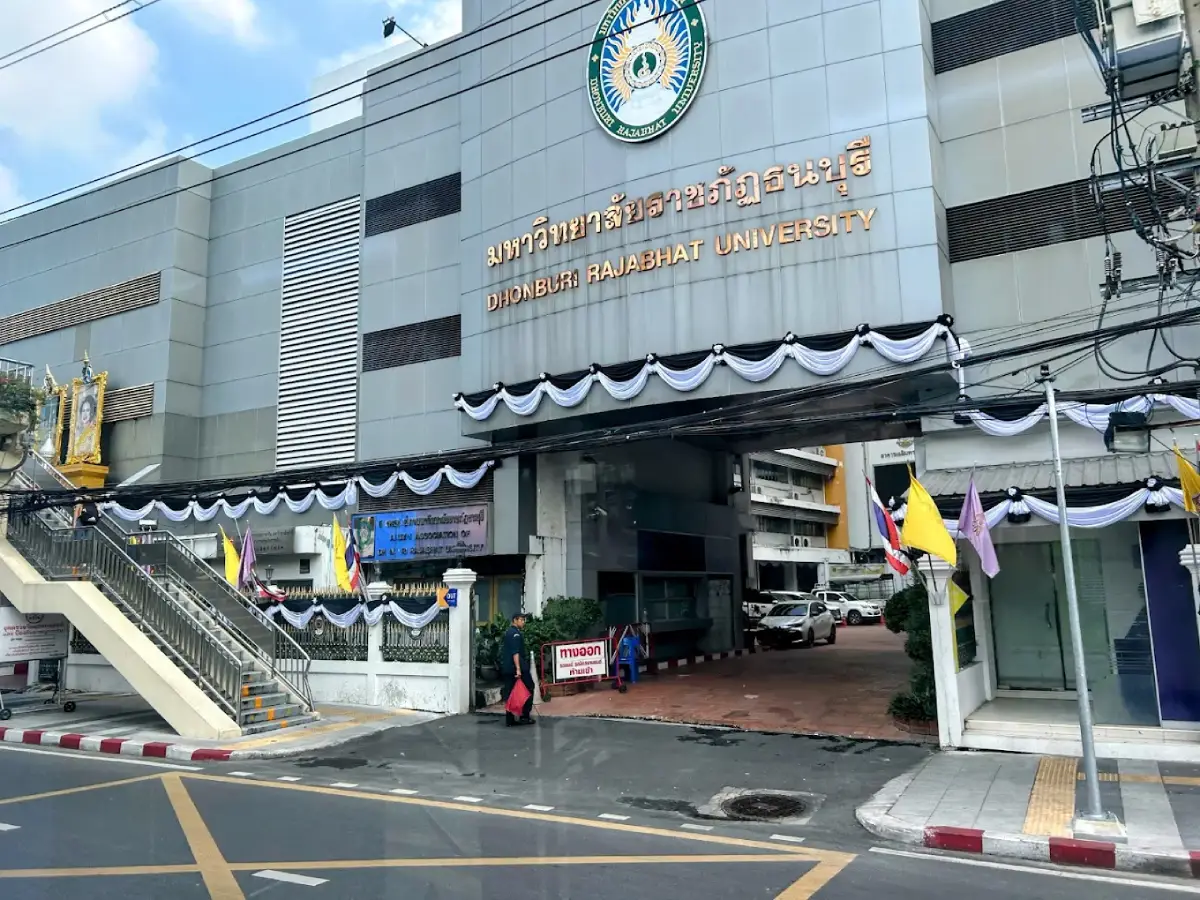
Dhonburi Rajabhat University
Open Days: Monday – Friday (Administrative Offices)
Opening Hours: 08:30 – 16:30
Dhonburi Rajabhat University (DRU), known in Thai as Mahawitthayalai Rajabhat Thonburi, is a public university in Thailand with an educational history dating back to July 8, 1948. Established originally as a vocational teacher-training school for women, the institution gradually developed into Thonburi Teacher Training School, Thonburi Teachers College, Dhonburi Rajabhat Institute, and finally Dhonburi Rajabhat University on June 15, 2004. Today, it operates educational facilities in Bangkok and Samut Prakan Province, offering studies across teacher education, humanities, social sciences, business, management, science, technology, nursing, and health sciences. In 2026, the institution celebrated its 78th anniversary, reflecting nearly eight decades of contributions to teacher development, higher education, community engagement, and professional training in Thailand.
The university is particularly interesting because its history brings together several important strands of Thai education. Its beginnings reflect the country's need for vocational teachers in the years following World War II, while its later development illustrates the wider transformation of Thailand's teacher-training colleges into multidisciplinary public universities. Its Bangkok location also connects the institution to historic riverside communities, places of worship, and cultural landmarks on the western bank of the Chao Phraya River.
Dhonburi Rajabhat University belongs to Thailand's Rajabhat university network, whose institutions have strong traditions in teacher preparation, community-oriented education, research, academic services, and cultural preservation. The university's academic mission has expanded considerably since its early years, but its historical relationship with education and local development remains a defining element of its identity.
The Bangkok educational site is located at 172 Itsaraphap Road, Wat Kanlaya Subdistrict, Thon Buri District, Bangkok 10600. This location lies within one of Bangkok's historically significant neighborhoods, close to the Kudi Chin community and several important Buddhist and Christian landmarks. The Samut Prakan educational site is located at 59/1 Moo 14, Soi Thetsaban Bang Pu 119, Sukhumvit Road, Bang Pla Subdistrict, Bang Phli District, Samut Prakan Province 10540. These two locations connect the university with different communities, labor markets, and educational needs.
The origins of Dhonburi Rajabhat University can be traced to July 8, 1948, when the Women's Vocational Teacher Training School opened under Thailand's Department of Vocational Education. Its original mission was to train teachers in women's vocational and handicraft education. The initial two-year teacher-training program admitted students who had completed advanced vocational schooling. During its earliest period, the institution relied on facilities belonging to another vocational school rather than possessing a fully developed campus of its own.
The school's establishment took place during a period when Thailand was working to strengthen its educational infrastructure and prepare a larger professional workforce. Vocational teacher education was particularly important because the expansion of practical and career-oriented schooling required qualified instructors. The new institution therefore served a specific national purpose: producing teachers equipped to pass occupational knowledge and skills to subsequent generations.
By 1951, the school had introduced a three-year elementary-level vocational teacher-training program. A significant step toward establishing a permanent institutional home followed in 1952, when the Department of Vocational Education purchased land and buildings formerly belonging to Chao Phraya Phonthep (Chaloem Komarakul Na Nakhon) on Itsaraphap Road. This acquisition created a foundation for the development of dedicated teaching facilities and the institution's longer-term presence in Thonburi. Historical records refer to a different street number from the university's current address.
In 1955, the institution was transferred to the Department of Teacher Training under the Ministry of Education. This administrative change was part of a broader adjustment to the country's teacher preparation system and helped move the school beyond its original focus on vocational education for women. Academic programs and institutional responsibilities gradually evolved in response to changing national standards and requirements.
On May 12, 1961, the institution was renamed Thonburi Teacher Training School. The new name reflected its role in providing teacher education comparable to that offered at other training institutions across Thailand. It also established a lasting relationship between the institution's official identity and the historic name of Thonburi.
Another important transition occurred in 1967, when the school began admitting male students and adopted coeducation. This marked a clear departure from its origins as an institution serving female vocational teacher trainees. In 1969, it introduced after-hours classes, extending educational opportunities to people who needed greater flexibility to pursue teaching qualifications or continue their studies.
On October 1, 1970, Thonburi Teacher Training School was upgraded to Thonburi Teachers College. The change followed the development of higher-level teacher education and reflected the institution's increasing academic maturity. The Teachers College Act of 1975 subsequently provided an important legal framework that allowed teacher-training colleges to develop bachelor's degree education.
As the college developed more advanced programs and academic administration, its educational responsibilities broadened. It was no longer concerned only with preparing teachers for classrooms but increasingly contributed to higher education, professional development, and knowledge transfer within the surrounding communities. These changes formed part of the wider transformation of Thailand's teacher-training institutions during the late twentieth century.
February 14, 1992, marked an important milestone for the country's teachers colleges when King Bhumibol Adulyadej bestowed the name “Rajabhat” upon them. Under the Rajabhat Institute Act of 1995, Thonburi Teachers College became Dhonburi Rajabhat Institute. This development strengthened the institution's broader responsibilities in higher education, research, community academic services, and cultural preservation.
As the institution expanded, its original Bangkok grounds placed limits on further physical development. The establishment of educational facilities in Samut Prakan became an important part of its long-term growth. The additional location offered opportunities to develop specialized teaching spaces, practical training facilities, and programs responding to the needs of communities and employers in the Bangkok metropolitan region.
On June 15, 2004, Dhonburi Rajabhat Institute acquired university status under the Rajabhat University Act of 2004 and became Dhonburi Rajabhat University. The legislation recognized Rajabhat universities as public higher education institutions with legal-entity status. The transition represented the culmination of more than five decades of institutional development, from a specialized teacher-training school into a university with a wider academic and social mission.
The university's chronology therefore includes five principal institutional stages: the Women's Vocational Teacher Training School established in 1948, Thonburi Teacher Training School from 1961, Thonburi Teachers College from 1970, Dhonburi Rajabhat Institute from 1995, and Dhonburi Rajabhat University from 2004. The institution's age is calculated from its foundation in 1948, rather than from the date it received university status. Consequently, July 8, 2026, marked its 78th founding anniversary.
The university's name and identity reflect both its geographical roots and its educational heritage. “Dhonburi,” an alternative English rendering of Thonburi, refers to the historic area on the western side of the Chao Phraya River. “Rajabhat” connects the institution with the royal name bestowed upon Thailand's teachers colleges and the subsequent development of the Rajabhat higher education network.
Historical university publications identify yellow and white as its institutional colors and the pikul and chan trees as its symbolic trees. The significance of these trees is also visible in the name of Lan Pikul Chan, an important ceremonial space on the Bangkok campus. The institution's published motto, “Wisdom arises from education,” expresses the central role of learning in intellectual development, professional competence, and personal growth.
The university's identity also extends beyond formal emblems and colors. Academic traditions, alumni connections, recognition ceremonies, and community service all contribute to a shared institutional culture. Its origins in teacher preparation continue to give particular significance to learning, professional responsibility, ethical conduct, and service to society.
University leadership and historical figures form another important part of Dhonburi Rajabhat University's story. In 2026, the rector is Associate Professor Dr. Panadda Yimsakul, who was appointed to the position with effect from June 2, 2025. The present administration continues the development of an institution that has experienced major changes in its legal status, academic organization, facilities, and geographical reach.
Chao Phraya Phonthep (Chaloem Komarakul Na Nakhon) also occupies a distinct place in the university's historical narrative because the government purchased his former land and buildings for the school's development in 1952. His name is preserved in the Chao Phraya Phonthep Auditorium, demonstrating how the institution commemorates historical connections through the names of important facilities.
University traditions and cultural activities are particularly visible during the annual founding anniversary on July 8. The occasion brings together university administrators, lecturers, staff, students, alumni, and local community representatives. It serves not only as a commemoration of institutional history but also as an opportunity to celebrate achievements and maintain relationships across generations.
On July 8, 2026, Dhonburi Rajabhat University celebrated its 78th anniversary with religious ceremonies, a tribute to King Taksin the Great, and presentations of awards recognizing outstanding contributions. Buddhist ceremonies took place in the 50th Anniversary Meeting Room on the 15th floor of Building 1. A ceremonial tribute to King Taksin the Great was held at Lan Pikul Chan, while an awards ceremony took place at the Chao Phraya Phonthep Auditorium on the 15th floor of Building 7.
The tribute to King Taksin carries particular historical meaning because the university is located in Thonburi, the city associated with the Thonburi Kingdom. Remembering the monarch during a university ceremony connects institutional traditions with the wider history of Bangkok's western riverbank. It also illustrates the way local historical identity remains part of the university's cultural life.
Alongside the founding anniversary, student life includes educational and cultural activities associated with university communities, such as orientation, respect-for-teachers ceremonies, professional development events, community engagement, and creative projects. These activities complement formal teaching by helping students build practical experience, social relationships, teamwork, and a sense of responsibility toward their wider communities.
Important places at the Bangkok university site include teaching buildings, meeting rooms, and ceremonial spaces. Lan Pikul Chan is particularly associated with founding-anniversary commemorations and tributes to King Taksin the Great. Its importance is therefore cultural as well as functional, representing a place where institutional memory and public ceremonies come together.
The Chao Phraya Phonthep Auditorium in Building 7 is another important university venue, used for major gatherings and recognition ceremonies. The 50th Anniversary Meeting Room in Building 1 likewise accommodates institutional events and ceremonial activities. Together, these facilities demonstrate how the university has developed spaces for teaching, administration, professional gatherings, and community participation.
For visitors interested in educational history, the relationship between building names, commemorative ceremonies, and the university's chronological development is especially meaningful. However, teaching facilities and meeting rooms are working academic spaces. Anyone wishing to visit specific buildings, arrange a group tour, or undertake an educational study visit should contact the relevant university office in advance.
The Samut Prakan educational site represents the university's expansion into an area with different community and economic characteristics. This location supports academic programs and professional training connected to the metropolitan region and provides space for specialized educational facilities that complement the historic Bangkok setting.
One of the most significant facilities at Samut Prakan is the seven-storey Chaloem Phra Kiat Building, officially inaugurated by Her Royal Highness Princess Maha Chakri Sirindhorn on July 10, 2023. The building was developed to support education and practical training for the service industries, with facilities relating to hospitality, tourism, food preparation, and professional service operations.
The building includes practical training spaces for front-desk operations, hotel rooms and guest services, Thai, Chinese, and European cooking, food and beverage preparation, tourism services, aviation-related services, ticket reservations, housekeeping, and spa operations. Such facilities allow students to practice industry-related tasks in dedicated learning environments, connecting classroom knowledge with professional skills.
Academic strengths at Dhonburi Rajabhat University begin with its historical specialization in teacher education. Over time, its academic provision has expanded considerably. The 2026 admissions information covers areas such as language studies, law, visual and digital design, public administration, logistics, digital business, hospitality, computer science, electrical engineering, railway systems management engineering, and nursing.
The Faculty of Education continues the university's original educational mission by preparing future teachers. The 2026 admissions lists include fields such as Thai, English, mathematics, general science, social studies, computer education, physical education, and early childhood education. The availability of individual teaching specializations differs between Bangkok and Samut Prakan, making the location of study an essential consideration for prospective applicants.
The Faculty of Humanities and Social Sciences provides studies across languages, law, public administration, social and cultural development, performing arts, and creative design. Subjects listed in the 2026 admissions system include Thai, Business English, Chinese for Communication, Law, Public Administration, Social and Cultural Development, Dance and Theatre, Visual Design, Communication Design, and Digital Design. These subjects reflect the role of humanities and social sciences in cultural understanding, public affairs, creative industries, and communication.
The Faculty of Management Science focuses on disciplines relevant to business and professional services. Its admissions listings include marketing, management, human resource management, logistics management, digital business technology, accounting, communication arts, tourism, aviation-related business, hotel and restaurant management, advertising, and streaming media production. Several fields are presented as majors within broader degree programs rather than entirely separate degree qualifications.
The Faculty of Science and Technology encompasses applied science, computing, food studies, and industrial technology. The Bangkok admissions list includes industrial management technology, electrical technology, home economics, computer science, and food industry studies. The Samut Prakan list additionally includes electrical engineering, railway systems management engineering, environmental management, and sustainable agricultural management. Together, these subjects demonstrate the university's engagement with technological and industrial workforce development.
The Faculty of Nursing and Health Sciences contributes to health-related professional education. For the 2026 academic year, the regular undergraduate admissions list identifies the Bachelor of Nursing Science program at the Samut Prakan educational site. Nursing education is an important component of professional workforce development because it prepares graduates for responsibilities within health services and patient care.
Academic programs and admissions in 2026 must be considered separately for each educational site. Some fields are listed in Bangkok, some in Samut Prakan, and others at both locations. The university also provides admissions pathways that include direct admission, TCAS, and special study arrangements under its official announcements. Applicants with higher vocational diplomas may find credit-transfer admission options in certain fields. These pathways should not be mistaken for separate degree programs when they lead to the same underlying qualification.
Choosing a degree at Dhonburi Rajabhat University therefore involves more than selecting an academic subject. Prospective students should review the specific major, the teaching location, entry qualifications, training requirements, and opportunities related to their intended careers. A program's appearance in the annual admissions catalog does not necessarily mean that places remain available in every application round.
Research and community-oriented innovation are important parts of the university's wider mission. Projects presented in connection with the inauguration of the Samut Prakan building illustrate how academic expertise can contribute to local development. These included work relating to the Ban Khun Samut Chin community museum, improved packaging for agricultural products, products made from water hyacinth, biomass fuel developed from cattail plants, and income-generating activities for older residents.
Such activities show how a university can contribute beyond the formal classroom by helping communities preserve local knowledge, develop products, make use of local resources, and strengthen livelihoods. They also reflect a wider Rajabhat university tradition of applying academic knowledge to the needs of surrounding populations.
In December 2025, Dhonburi Rajabhat University also entered into a collaboration with the Innovation and Environment Association concerning environmental knowledge, digital technology, innovation, industrial standards, and workforce development for a lower-carbon economy. This is an example of how the university's engagement with professional and industrial sectors has expanded alongside emerging environmental and technological priorities.
Connections with the historic Thonburi community give the Bangkok campus a particularly distinctive setting. Nearby neighborhoods contain Buddhist temples, a historic Catholic church, a Chinese shrine, traditional residential streets, and community spaces associated with the Chao Phraya River. These surroundings are relevant to students and researchers interested in local history, religion, social change, architecture, cultural diversity, and urban development.
Community representatives from several Thonburi neighborhoods participated in the university's 78th anniversary events in 2026. Communities represented included Kudi Chin, Wat Kanlaya, and Wat Prayurawongsawat, among others. Their participation demonstrates that the relationship between Dhonburi Rajabhat University and its surrounding neighborhoods extends beyond student recruitment and includes cultural, commemorative, and public activities.
Educational visits and cultural learning can be approached from several perspectives. Visitors interested in the history of Thai education may focus on the university's evolution from a specialized teacher-training institution to a multidisciplinary university. Those researching local communities may explore the relationship between the institution and Thonburi's heritage. Visitors interested in professional education may wish to learn about the specialized training facilities at Samut Prakan. Access to particular facilities should be arranged with the responsible faculty or office in advance.
The surrounding Bangkok neighborhood also offers meaningful opportunities for cultural exploration. Wat Kalayanamit, Santa Cruz Church and the Kudi Chin community, Kian Un Keng Shrine, Wat Prayurawongsawat, and Wat Arun are among the notable nearby destinations. Taken together, these places offer insights into the religious diversity, architecture, trading history, and riverside settlement patterns that have shaped Thonburi over generations.
Getting to Dhonburi Rajabhat University in Bangkok is possible by private vehicle, public bus, and the MRT metro system. MRT Itsaraphap Station serves the surrounding area, from which travelers can continue to the university on Itsaraphap Road. Visitors using a private vehicle should navigate to the official address at 172 Itsaraphap Road, Thon Buri District, and follow university regulations regarding entrances and parking.
Getting to Dhonburi Rajabhat University in Samut Prakan requires using its separate address at 59/1 Moo 14, Soi Thetsaban Bang Pu 119, Sukhumvit Road, Bang Pla Subdistrict, Bang Phli District. Travelers driving from other parts of the metropolitan area can use Sukhumvit Road and follow navigation directions into the specified soi. Those relying on public transportation should check current connecting services before their journey, as travel arrangements differ substantially from those for the Bangkok campus.
For prospective students, parents, and visitors, verifying the correct educational location is essential. A degree field listed under the Bangkok admissions section may not be offered at Samut Prakan, and vice versa. Confirming the teaching location in advance can prevent confusion and makes it easier to plan accommodation, transportation, and other study-related expenses.
After 78 years of development, Dhonburi Rajabhat University stands as an example of the transformation of Thai teacher education into a broader public university system. Its long history, two educational locations, expanding range of academic subjects, specialized training facilities, and continuing relationships with local communities give it significance beyond its role as a degree-granting institution. The university's identity remains closely tied to its educational origins, the cultural history of Thonburi, and its wider responsibility to develop knowledge and professional skills for Thai society.
| University Name | Dhonburi Rajabhat University (มหาวิทยาลัยราชภัฏธนบุรี) |
| Abbreviation | DRU |
| University Type | Public University, Rajabhat University Network |
| Bangkok Address | 172 Itsaraphap Road, Wat Kanlaya, Thon Buri, Bangkok 10600, Thailand |
| Samut Prakan Address | 59/1 Moo 14, Soi Thetsaban Bang Pu 119, Sukhumvit Road, Bang Pla, Bang Phli, Samut Prakan 10540, Thailand |
| Bangkok Coordinates | 13.73411, 100.49167 |
| Original Foundation Date | July 8, 1948 |
| University Status Granted | June 15, 2004 |
| Institutional Age in 2026 | 78 Years |
| Former Names | Women's Vocational Teacher Training School; Thonburi Teacher Training School; Thonburi Teachers College; Dhonburi Rajabhat Institute |
| Historical Figure | Chao Phraya Phonthep (Chaloem Komarakul Na Nakhon), former owner of land acquired for the institution |
| Rector in 2026 | Associate Professor Dr. Panadda Yimsakul |
| University Colors | Yellow and White |
| Symbolic Trees | Pikul and Chan Trees |
| Motto | Wisdom Arises from Education |
| Faculties | 1. Faculty of Education 2. Faculty of Humanities and Social Sciences 3. Faculty of Management Science 4. Faculty of Science and Technology 5. Faculty of Nursing and Health Sciences |
| Educational Locations | 1. Thon Buri, Bangkok 2. Bang Phli, Samut Prakan |
| Academic Strengths | Teacher Education, Languages, Social Sciences, Business, Logistics, Hospitality, Technology, Engineering, Nursing, and Health Sciences |
| Important Bangkok Facilities | 1. Lan Pikul Chan Ceremonial Area 2. Chao Phraya Phonthep Auditorium, Building 7, 15th Floor 3. 50th Anniversary Meeting Room, Building 1, 15th Floor |
| Important Samut Prakan Facility | Seven-storey Chaloem Phra Kiat Building, with hospitality, culinary, tourism, and service-industry training facilities |
| Major Traditions | Founding Anniversary on July 8, Ceremonial Tribute to King Taksin the Great, Buddhist Ceremonies, and Recognition Awards |
| Visitor Arrangements | Arrange Educational Visits and Access to Academic Buildings with the Relevant University Office in Advance |
| Getting to Bangkok Location | Itsaraphap Road, Public Buses, Private Vehicles, and MRT Itsaraphap Station with Onward Travel |
| Getting to Samut Prakan Location | Sukhumvit Road and Soi Thetsaban Bang Pu 119, Bang Phli District |
| Nearby Attractions in Bangkok | 1. Wat Kalayanamit 2. Santa Cruz Church and Kudi Chin Community 3. Kian Un Keng Shrine 4. Wat Prayurawongsawat 5. Wat Arun |
| Nearby Restaurants in Bangkok | 1. Noreeya, Soi Itsaraphap 24, Tel. +66 89 216 2443 2. Yum TriO, Soi Itsaraphap 20, Tel. +66 62 956 0759 3. Dhou Noodles, Itsaraphap Road, Tel. +66 93 724 2241 4. Samurai Ramen, Soi Itsaraphap 31, Tel. +66 86 387 1233 5. Ramruay Yen Ta Fo, Soi Itsaraphap 36, Tel. +66 95 753 5438 |
| Nearby Accommodation in Bangkok | 1. Baan PadSeeEw - Rooftop Riverview, Tel. +66 82 497 9499 2. Adelphi Itsaraphap, Tel. +66 2 077 5171 3. Bangluang Boutique Hotel, Tel. +66 82 219 0774 4. TUAN Hotel Bangkok near Wat Arun, Tel. +66 82 854 2572 5. Kasayapi Hotel, Tel. +66 98 279 5707 |
| Bangkok Contact | +66 2 890 1801, Extensions 50150, 60120, and 60130 |
| Samut Prakan Contact | +66 2 325 2010, Extensions 2105, 2106, and 2107 |
| Official Websites | www.dru.ac.th reg.dru.ac.th sp.dru.ac.th |
| Current Status in 2026 | Active Public University with Official Academic Year 2026 Admissions |
Dhonburi Rajabhat University Academic Programs and Fields of Study, Academic Year 2026 (B.E. 2569) The following table covers undergraduate fields and majors listed in the university's regular admissions system for the 2026 academic year. Degree programs may contain more than one major, and credit-transfer routes are not counted as separate degree qualifications. Program availability and application status may differ by admissions round.
| Faculty / Study Location | Fields of Study and Majors Listed for 2026 |
| Faculty of Education — Bangkok | 1. Mathematics Education 2. Thai Language Education 3. English Language Education 4. General Science Education 5. Social Studies Education 6. Computer Education |
| Faculty of Education — Samut Prakan | 1. Physical Education 2. Computer Education 3. Early Childhood Education |
| Faculty of Humanities and Social Sciences — Bangkok | 1. Social and Cultural Development 2. Thai Language (Bachelor of Arts) 3. Public Administration 4. Law 5. Visual Design — Street Art and Integrated Design Major 6. Communication Design and Digital Design 7. Dance and Theatre 8. Business English 9. Chinese for Communication |
| Faculty of Humanities and Social Sciences — Samut Prakan | 1. Business English 2. Chinese for Communication 3. Thai Language 4. Law 5. Public Administration 6. Visual Design — Street Art and Integrated Design Major 7. Communication Design and Digital Design 8. Social and Cultural Development 9. Dance and Theatre |
| Faculty of Management Science — Bangkok | 1. Business Administration — Marketing Major 2. Business Administration — Management Major 3. Business Administration — Human Resource Management Major 4. Business Administration — Logistics Management Major 5. Digital Business Technology 6. Accounting 7. Communication Arts — Radio, Television and Streaming Media Production Major 8. Communication Arts — Advertising and Digital Communication Major 9. Service Industry — Tourism Industry and Aviation Business Major 10. Service Industry — Hotel and Restaurant Management Major Premium Graduate Project (CP ALL) admission entries are listed for Marketing and Management. Credit-transfer routes are also listed in several fields. |
| Faculty of Management Science — Samut Prakan | 1. Digital Business Technology 2. Business Administration — Marketing Major 3. Business Administration — Management Major 4. Business Administration — Human Resource Management Major 5. Business Administration — Logistics Management Major 6. Accounting 7. Service Industry — Hotel and Restaurant Management Major 8. Service Industry — Tourism Industry and Aviation Business Major 9. Communication Arts — Radio, Television and Streaming Media Production Major 10. Communication Arts — Advertising and Digital Communication Major Premium Graduate Project (CP ALL) and eligible higher-vocational-diploma credit-transfer routes also appear in the admissions listings. |
| Faculty of Science and Technology — Bangkok | 1. Industrial Management Technology 2. Electrical Technology 3. Home Economics 4. Computer Science 5. Food Industry Credit-transfer admission routes are listed for Industrial Management Technology and Electrical Technology. |
| Faculty of Science and Technology — Samut Prakan | 1. Home Economics 2. Computer Science 3. Food Industry 4. Electrical Engineering 5. Environmental Management 6. Railway Systems Management Engineering 7. Sustainable Agricultural Management 8. Industrial Management Technology 9. Electrical Technology Credit-transfer routes are listed for Railway Systems Management Engineering, Industrial Management Technology, and Electrical Technology. |
| Faculty of Nursing and Health Sciences — Samut Prakan | 1. Bachelor of Nursing Science |
Frequently Asked Questions (FAQ)
Q: Where is Dhonburi Rajabhat University located?
A: The university has educational locations at 172 Itsaraphap Road, Thon Buri, Bangkok, and 59/1 Moo 14, Soi Thetsaban Bang Pu 119, Bang Pla, Bang Phli, Samut Prakan.
Q: When was Dhonburi Rajabhat University founded?
A: The institution began teaching on July 8, 1948, as the Women's Vocational Teacher Training School. It officially became Dhonburi Rajabhat University on June 15, 2004.
Q: How old was Dhonburi Rajabhat University in 2026?
A: The institution celebrated its 78th founding anniversary on July 8, 2026.
Q: How many faculties does Dhonburi Rajabhat University have?
A: The 2026 undergraduate admissions system lists five faculties: Education, Humanities and Social Sciences, Management Science, Science and Technology, and Nursing and Health Sciences.
Q: Where is the university's nursing program offered?
A: The regular undergraduate admissions list for 2026 identifies the Bachelor of Nursing Science program at the Samut Prakan educational site.
Q: Can visitors reach the Bangkok site by MRT?
A: Yes. Visitors can use MRT Itsaraphap Station and continue to the university on Itsaraphap Road.
Q: When is Dhonburi Rajabhat University's founding anniversary?
A: The anniversary falls on July 8. The 2026 celebration included Buddhist ceremonies, a ceremonial tribute to King Taksin the Great, and awards recognizing outstanding achievements.
Q: Can the public arrange an educational visit to the university?
A: Visitors and groups should contact the relevant university office or faculty in advance to arrange access to academic buildings, training facilities, or other university spaces.
 Category: ●University
 Group: ●Rajabhat University
Last Update : 1 WeekAgo
 Last Update : 1 WeekAgo

 Click to Access the Navigation Map GPS
Dhonburi Rajabhat University Map
Recommend

 Art, Culture and Heritage
 Historical Sites and Monuments(3)
 Landmarks and Memorials(23)
 Royal Palace(13)
 Art, Craft Centres, Tradition(35)
 Museums(59)
 Historic Homes and Cities(3)
 Art Gallery(16)
 Educational Places
 Museum for Study(6)
 Library(4)
 Public university(8)
 Autonomous Universities(8)
 Rajamangala University of Technology(6)
Rajabhat University(6)
 Private University(22)
 Places of Worship
 Temple(72)
 Church(2)
 Mosque(67)
 Other Sacred Sites(8)
 Research and Development
 Royal Project(1)
 Suburban Living
 Village, Community(5)
 Local Market(9)
 Floating Market(2)
 Nature and Wildlife
 River, Canal(3)
 Bays and Beaches(1)
 Other natural attractions(1)
 Entertainment and Agricultural
 Zoos and Aquariums(5)
 Animal camps and shows(5)
 Stadium(9)
 Farms, Parks and Ecotourism(20)
 Amusement Park(1)
 Waterpark(4)
 Theater(7)
 Cinema(1)
 Shopping
 Shopping and Night Market(20)
 Department Store(7)
 Spas and Wellness
 Spas and Wellness(1)
 Restaurant
 Michelin Star(5)
 Accommodation
 Hotel(3)
 Call Customer Service in Tourism
 Call Customer Service in Tourism(1)
 Travel Articles, Recipes
 Travel Review, Food Review(43)
 Royal Thai Desserts and Recipes(56)


