
lovethailand home >Central Travel Attractions >Bangkok Travel Attractions >Sam Phan Tha Wong >Chakkrawat > Rajamangala University of Technology Rattanakosin ..
TL;DR: Rajamangala University of Technology Rattanakosin (Bophit Phimuk Chakkrawat Campus) is located at Chakkrawat, Samphanthawong, Bangkok, Thailand, open Monday–Friday (Except Public Holidays).

Rajamangala University of Technology Rattanakosin (Bophit Phimuk Chakkrawat Campus)
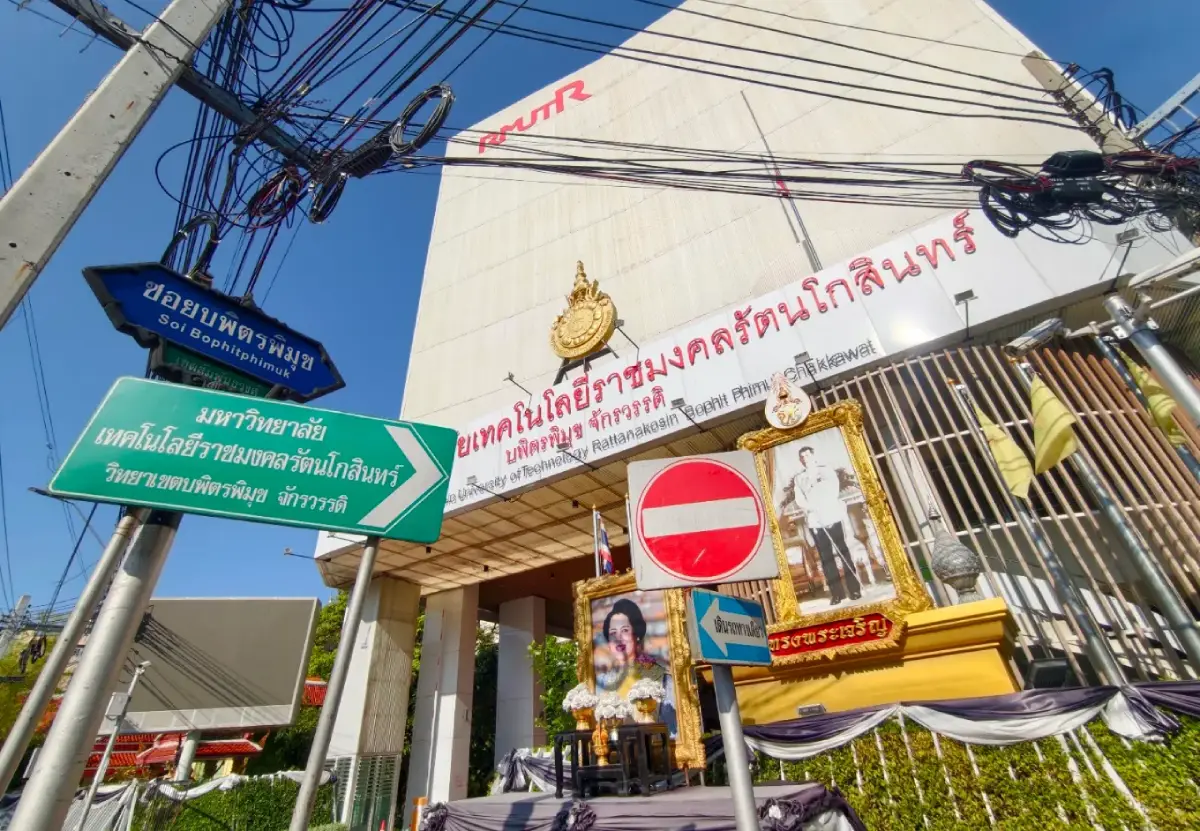
Open Days: Monday–Friday (Except Public Holidays)
Business Faculty Office Hours: 09:00–16:30
Rajamangala University of Technology Rattanakosin, Bophit Phimuk Chakkrawat Campus, officially designated the Bophit Phimuk Chakkrawat Area, is one of Thailand's historically significant educational institutions, with a heritage extending back 141 years. Located at 264 Chakkrawat Road, Chakkrawat, Samphanthawong, Bangkok 10100, the campus traces its origins to Wat Choeng Len School, also known as Wat Bophit Phimuk School. The school was formally established as one of Thailand's early royal schools for the general public in May 1885 during the reign of King Chulalongkorn (King Rama V). Over the following decades, it developed through several stages of Thailand's educational system, including secondary education, vocational training, commercial studies, and university-level education. In 2005, it became part of Rajamangala University of Technology Rattanakosin. Today, the campus is primarily associated with the Faculty of Business Administration and the Faculty of Liberal Arts, offering education in accounting, marketing, management, digital business, business English, Chinese, Japanese, and English for international communication. Its importance extends beyond modern professional education, as the institution preserves a direct connection to the early development of public schooling in Thailand.
Bophit Phimuk Chakkrawat occupies a distinctive position among Thailand's higher education institutions because of its location in Bangkok's historic Samphanthawong district. The surrounding neighborhoods have played an important role in the city's commercial and cultural development, particularly through trade networks connecting Thai and Chinese communities. Streets such as Chakkrawat Road, Yaowarat Road, and Ratchawong Road, together with the historic Sampheng trading area, form part of an urban landscape shaped by commerce, migration, traditional businesses, and changing patterns of city life.
This urban environment provides an interesting context for the campus's academic specializations. Business students can observe how commercial activities operate within one of Bangkok's oldest trading districts, while language students are surrounded by a culturally diverse setting with strong connections to Chinese heritage and international commerce. The relationship between the university and its surroundings reflects a broader characteristic of the institution: education is closely connected with practical knowledge and the economic life of the community.
The historical significance of Bophit Phimuk Chakkrawat lies in its transformation across different educational eras. Its development illustrates the progression from temple-based learning to formal primary and secondary education, vocational training, commercial studies, and university degree programs. Over more than a century, the institution adapted to changing social and economic needs while preserving the educational heritage associated with its original school.
Before the establishment of the royal school, Wat Bophit Phimuk, historically known as Wat Choeng Len, was an important center of local learning. Buddhist temples traditionally played a central role in Thai education, with monks and novices teaching literacy and basic knowledge to children and young people. Instruction was often conducted in temple buildings, monks' residences, assembly halls, or other suitable spaces within the temple grounds.
Temple education formed an essential part of Thai society before the emergence of a nationwide modern school system. Temples functioned not only as places of religious worship but also as community institutions responsible for preserving language, knowledge, and cultural traditions. This background helps explain why several early public schools were established in association with Buddhist temples.
During the reign of King Chulalongkorn, Thailand underwent extensive reforms in public administration, education, infrastructure, and international relations. The increasing need for educated government personnel and commercially skilled workers encouraged the development of a more systematic educational structure. The expansion of royal schools formed part of this process, helping establish formal learning opportunities for people beyond traditional temple-based instruction.
May 1885 marks the defining moment in the history of Bophit Phimuk Chakkrawat. King Chulalongkorn authorized the establishment of Wat Bophit Phimuk School as one of the first royal schools intended to provide education to the general population. The first teacher was Khun Anukit Withun (Noi Chunlawithun), and the school initially enrolled only 34 students. These modest beginnings marked the foundation of an institution that would develop into part of Thailand's modern university system.
During its first year, Wat Bophit Phimuk School offered an elementary curriculum classified as the first level of basic general education. Students were organized according to the traditional instructional texts they studied, including Munlabot Banphakit, Wahanitikorn, Akson Prayok, Sangyok Phithan, Waiphot Phichan, and Phisan Karan. This educational structure reflected a transitional period when traditional Thai literacy instruction was gradually becoming incorporated into the formal school system.
In 1896, the school expanded its instruction to a higher level of basic general education. Primary education was introduced in 1902, followed by secondary education in 1903. These changes reflected the growing importance of organized schooling and the need to provide students with opportunities to progress through increasingly advanced levels of education.
As Thailand's educational system continued developing during the early twentieth century, Wat Bophit Phimuk School adjusted its academic programs to serve new social requirements. In 1934, it introduced upper-secondary education for Mathayom 7 and 8 students with a special emphasis on foreign languages. English was compulsory, while students also selected an additional language from French, German, Chinese, or Japanese.
The introduction of foreign-language education was particularly significant because it laid the foundation for the institution's later specialization in language studies and international business communication. At a time when Thailand's commercial and diplomatic relationships with other countries were expanding, foreign-language proficiency became increasingly valuable for office work, international correspondence, trading activities, and professional employment.
Language education also reflected the influence of Bangkok's commercial development. The growing presence of businesses and trading networks required personnel who could communicate across linguistic and cultural boundaries. Foreign languages therefore became closely associated with practical career opportunities, rather than being studied solely as academic subjects.
In 1949, the school expanded its upper-secondary curriculum into two streams: general education and vocational foreign-language education. This development offered students different pathways based on their educational interests and career objectives. It also reflected the wider evolution of Thailand's education system, in which vocational subjects were becoming increasingly important alongside traditional general studies.
Another important development occurred in 1950, when the institution introduced adult education, Thai and English typing instruction, and commercial accounting courses. These subjects addressed the growing demand for employees capable of handling administrative documents, business records, correspondence, and accounting procedures. Typing and bookkeeping were essential skills in offices and commercial organizations during the period, making such programs directly relevant to employment opportunities.
In 1952, the school established an advanced vocational division offering foreign-language and secretarial education. According to the institution's historical records, this marked the establishment of the first secretarial education division in a Thai government school. The development was particularly important because secretarial work involved a combination of language proficiency, administrative organization, document preparation, business communication, and professional coordination.
Secretarial training became an important stage in the institution's educational development. As government departments and commercial organizations expanded, there was increasing demand for staff who could communicate efficiently, manage documents, arrange correspondence, and coordinate administrative activities. The institution's willingness to introduce professionally relevant subjects demonstrated its ability to respond to changes in the labor market.
In 1953, the school introduced a two-year clerical training program to prepare students for administrative and office-related occupations. Although several earlier vocational divisions were later discontinued or reorganized, their influence remained important. The combination of languages, accounting, and commercial skills formed a foundation for the institution's subsequent business administration programs.
A major institutional milestone occurred in 1973, when the Ministry of Education elevated the school to Bophit Phimuk College. The college began offering higher vocational certificate education, known in Thailand as the Por Wor Sor qualification. This transition marked an expansion from school-level education into more advanced professional training, providing students with qualifications designed to support employment in commercial and administrative occupations.
In 1977, the college introduced evening programs at the higher vocational certificate level. It was also transferred from the Department of Vocational Education to the College of Technology and Vocational Education system, becoming known as Bophit Phimuk Campus. Evening education helped expand access for working students and individuals seeking to develop their professional qualifications while maintaining employment.
In 1983, the Ministry of Education divided Bophit Phimuk into two separate educational campuses: Bophit Phimuk Chakkrawat and Bophit Phimuk Mahamek. This administrative separation became particularly important in the institutions' subsequent histories. Although they share a historical connection and similar names, the two campuses eventually became parts of different universities.
Today, Bophit Phimuk Chakkrawat belongs to Rajamangala University of Technology Rattanakosin, while Bophit Phimuk Mahamek belongs to Rajamangala University of Technology Krungthep. The two institutions have distinct administrative structures, educational locations, and university affiliations. Prospective students and visitors should therefore distinguish between the two when searching for admissions information, academic programs, or campus directions.
Another important historical milestone came on September 15, 1988, when King Bhumibol Adulyadej (King Rama IX) bestowed the name Rajamangala Institute of Technology upon the former College of Technology and Vocational Education. The Rajamangala identity subsequently became a central part of the institution's educational heritage and was carried forward into the names of the separate Rajamangala universities established in 2005.
In 1993, Bophit Phimuk Chakkrawat began offering a two-year continuing bachelor's degree program in Business Administration with an accounting specialization. A business language specialization followed in 1994, while additional continuing degree opportunities were introduced in 1997. These programs helped graduates of higher vocational certificate courses progress toward university-level qualifications.
Further expansion took place in 1999 with the introduction of four-year bachelor's degree programs in accounting and business English, alongside continuing programs in general management. The institution added a regular continuing program in general management in 2000 and a four-year general management program in 2001. These changes reflected an increasing emphasis on degree-level professional education and broader academic preparation.
The year 2002 represented another important step in the development of language education. The institution introduced four-year undergraduate programs in Chinese and Japanese, extending its long tradition of foreign-language instruction. These programs responded to growing opportunities in international trade, tourism, service industries, and organizations conducting business with Chinese- and Japanese-speaking partners.
In 2003, the institution introduced business information systems education, reflecting the increasing importance of information technology in commercial organizations. This development connected traditional business administration subjects with digital systems, data management, and technology-supported organizational processes.
The next major transformation occurred under the Rajamangala University of Technology Act B.E. 2548 (2005), published in the Royal Thai Government Gazette on January 18, 2005, and effective from January 19, 2005. The legislation reorganized the former Rajamangala Institute of Technology into nine separate Rajamangala universities. Bophit Phimuk Chakkrawat became an educational area of Rajamangala University of Technology Rattanakosin.
Rajamangala University of Technology Rattanakosin operates through four educational locations: Salaya in Nakhon Pathom Province, Bophit Phimuk Chakkrawat in Bangkok, Poh-Chang Academy of Arts in Bangkok, and Wang Klai Kangwon Campus in Prachuap Khiri Khan Province. These locations preserve distinct educational traditions and academic specializations. Salaya serves as the university's administrative center, while Bophit Phimuk Chakkrawat continues to focus on business administration and foreign-language education.
Following the university's establishment in 2005, the former Faculty of Applied Liberal Arts was renamed the Faculty of Liberal Arts. The faculty expanded its academic profile with English for International Communication, building upon the Chinese and Japanese degree programs introduced earlier. The updated academic structure strengthened the relationship between language education, university qualifications, and professional communication skills.
In 2026, Bophit Phimuk Chakkrawat marked 141 years since the establishment of Wat Bophit Phimuk School in 1885. Rajamangala University of Technology Rattanakosin, by comparison, reached 21 years since its establishment as an independent university in 2005. These two dates represent different stages of the same institutional story: the historical foundation of the original school and the legal establishment of the present university.
King Chulalongkorn is the most important historical figure associated with the foundation of the institution. His educational reforms helped establish the foundations of modern schooling in Thailand, and the creation of Wat Bophit Phimuk School was part of the expansion of formal education during his reign. The institution's origins therefore reflect a wider period of modernization in Thai public administration and society.
Another important figure was Khun Anukit Withun (Noi Chunlawithun), who served as the school's first teacher. The institution's development from a school with a single teacher and 34 students into a university educational area with business and language programs demonstrates the importance of long-term educational continuity and the contributions of successive generations of teachers.
Historical university reports also identify several individuals who studied at the former institution, including Phraya Phirom Phakdi (Boon Rawd Phirombhakdi), Phraya Phakdi Naraset (Lert Sreshthaputra), and Phraya Ronnachai Chanyut (Suk Chotisathian). Their association with the school illustrates its place within Bangkok's educational and social history.
The name Bophit Phimuk derives from Wat Bophit Phimuk Worawihan, the temple historically known as Wat Choeng Len. The use of a temple name for the school reflects the close relationship between Buddhist institutions and education during the nineteenth century. Although the educational institution subsequently underwent several administrative and academic transformations, it retained the historical name as a connection to its origins.
The designation Chakkrawat refers to the road and subdistrict where the campus is located. It distinguishes Bophit Phimuk Chakkrawat from Bophit Phimuk Mahamek, which has a separate present-day university affiliation. The complete campus name therefore has both historical and geographical significance.
The emblem of Rajamangala University of Technology Rattanakosin reflects the shared identity of the Rajamangala university system. Its principal elements include the royal emblem associated with King Rama IX, a circular design with eight lotus petals, the numeral nine, a royal crown, and a curved band bearing the university's name. The emblem represents an important part of the university's institutional identity and its historical association with the Rajamangala educational tradition.
Today, Bophit Phimuk Chakkrawat accommodates two principal faculties: the Faculty of Business Administration and the Faculty of Liberal Arts. These faculties pursue different but complementary educational goals. Business Administration focuses on accounting, marketing, management, digital business, and commercial communication, while Liberal Arts emphasizes foreign-language proficiency and intercultural communication.
The Faculty of Business Administration developed from the institution's historical commercial and office training programs. Its academic disciplines have evolved from traditional accounting, clerical work, and general management into contemporary fields involving digital marketing, information technology, innovation, and international business communication. This development illustrates how professional education responds to changing business practices and technological requirements.
For the 2026 academic year, the Faculty of Business Administration at Bophit Phimuk Chakkrawat announced undergraduate admissions in six fields: Accounting, Digital Marketing, Business English, Management Innovation, Digital Business Technology, and Business Administration in a Chinese-language program. Depending on the program, admission was available through regular study, special study arrangements, or credit-transfer pathways for eligible vocational graduates.
Accounting remains one of the essential foundations of business administration. Students in this field develop an understanding of financial transactions, accounting records, financial reporting, analysis, auditing principles, and related information systems. These skills are important for organizational management, cost control, financial decision-making, and compliance with professional requirements.
Digital Marketing focuses on understanding consumer behavior, developing marketing strategies, and using digital communication channels to reach target audiences. As organizations increasingly depend on websites, social media, online marketplaces, and digital advertising, the ability to interpret market data and evaluate marketing performance has become an important professional skill.
Management Innovation connects conventional business management with the improvement of organizational systems and work processes. Students explore management principles, strategic planning, organizational resources, and approaches to solving business problems. The innovation component encourages the development of more efficient services, management practices, and organizational models in response to changing economic conditions.
Digital Business Technology addresses the use of information systems and digital tools in modern organizations. Its professional relevance includes the management of business information, digital operations, and technology-supported services. Knowledge in this field helps students understand how organizations can improve efficiency and competitiveness through appropriate applications of digital technology.
Business English continues one of the institution's longest academic traditions: education in foreign languages for professional purposes. Students develop language skills applicable to commercial correspondence, workplace communication, presentations, customer relations, and international business activities. The combination of English proficiency and business knowledge provides a foundation for working in organizations that communicate across national and cultural boundaries.
The Chinese-language Business Administration program is another distinctive academic option. It combines business-related education with Chinese-language communication, supporting the development of skills relevant to commercial relationships between Thailand and China. This combination is particularly meaningful in a campus situated near Bangkok's historic Chinatown, where Chinese commercial and cultural influences have long shaped the surrounding neighborhood.
Graduate education is also available through the Faculty of Business Administration. For the 2026 academic year, the faculty advertised a Master of Business Administration (MBA) program specializing in Creative Entrepreneurship Innovation. The program is designed to develop entrepreneurial perspectives and business innovation skills, with scheduled Sunday classes suited to people combining postgraduate study with professional commitments.
The Faculty of Liberal Arts maintains the campus's long tradition of foreign-language education. It lists three bachelor's degree programs at Bophit Phimuk Chakkrawat: Chinese, Japanese, and English for International Communication. These programs seek to develop students' language proficiency and cultural understanding, together with the communication skills needed in academic, professional, and international environments.
Chinese language education is particularly relevant to international trade, tourism, business services, and communication with Chinese-speaking partners. Students develop listening, speaking, reading, and writing skills while studying aspects of Chinese culture and communication. The campus's location near Sampheng and Yaowarat also provides an interesting setting for observing the cultural and commercial significance of Chinese language in Bangkok.
The Japanese program has a history connected with the institution's earlier foreign-language education. Its bachelor's degree program began in 2002 and has subsequently developed within the Faculty of Liberal Arts. Japanese language proficiency supports opportunities in business coordination, translation, tourism, and organizations maintaining professional relationships with Japan.
English for International Communication was introduced as an undergraduate program in 2005, according to the faculty's institutional history. The program focuses on developing communication abilities applicable to daily life, education, and professional environments. It also encourages students to understand how language is used across different cultural and social contexts.
The Faculty of Liberal Arts expresses its educational philosophy through the Thai statement “Phatthana Khon, Chiao Chan Dan Phasa, Su Sangkhom Kanprakopkan,” meaning the development of people with language expertise for an entrepreneurial society. The philosophy connects linguistic knowledge with professional capabilities and the ability to participate effectively in contemporary economic and social activities.
One of the campus's most distinctive academic characteristics is the potential connection between its business and language disciplines. Business students benefit from foreign-language communication skills when dealing with international partners, while language students can apply their abilities in commercial, marketing, hospitality, and service settings. These complementary fields support the development of graduates who understand both professional practices and intercultural communication.
Contemporary education at Bophit Phimuk Chakkrawat also reflects the increasing importance of digital technology and lifelong learning. Business students must understand digital systems, data-driven practices, and changing consumer expectations. Language students must develop flexible communication skills and cultural awareness. Together, these capabilities help prepare graduates for employment in rapidly changing professional environments.
Research and Academic Services form part of the wider university's mission. The Faculty of Business Administration and the Faculty of Liberal Arts contribute to fields such as management, accounting, marketing, language education, communication, and entrepreneurship. Research and academic service activities in these disciplines can support organizational development, professional skills, business competitiveness, and educational opportunities for communities.
The Chakkrawat and Samphanthawong districts provide a particularly relevant setting for understanding traditional and contemporary urban commerce. The surrounding neighborhoods contain wholesale businesses, retail shops, family enterprises, food vendors, and long-established commercial networks. Their activities provide useful examples of small-business management, inventory systems, trade relationships, customer communication, and the growing influence of digital commerce.
For Chinese language students, the neighboring commercial and cultural districts of Sampheng, Yaowarat, and Song Wat offer valuable historical context. Shop signs, trading traditions, food culture, and the everyday activities of Thai-Chinese communities demonstrate the role that language plays in commercial relationships and cultural identity. Understanding these environments can enrich the study of language and intercultural communication.
The university's relationship with the community can also be understood through the practical relevance of its academic disciplines. Accounting, marketing, management, and digital business knowledge are directly related to the needs of small enterprises and family-run businesses. Foreign-language knowledge supports communication with customers, visitors, and commercial partners from different countries. These professional fields help explain why the campus's academic identity is closely connected to Bangkok's commercial environment.
Cultural traditions and respect for teachers remain important elements of Thai university life. Wai Khru ceremonies express gratitude toward teachers and acknowledge the value of education, while orientation and student-welcoming activities help strengthen the relationship between students and their institutions. At Bophit Phimuk Chakkrawat, the preservation of institutional history is particularly meaningful because the campus has educational roots extending to the nineteenth century.
The institution's association with King Chulalongkorn forms another important part of its historical identity. Studying the foundation of Wat Bophit Phimuk School encourages an understanding of the royal educational reforms that helped establish modern schooling in Thailand. The institution's transformation from an early royal school into a university campus provides a tangible example of the development of Thai education across successive generations.
The educational facilities at Bophit Phimuk Chakkrawat include academic and administrative buildings supporting the Faculty of Business Administration and the Faculty of Liberal Arts. The campus has buildings known as the 100-Year Building and the 115-Year Building. In September 2026, the university published procurement information concerning exterior painting improvements for these buildings, demonstrating continued maintenance of facilities within the historic campus.
In addition to teaching buildings, the campus contains administrative and student-support facilities associated with registration, academic services, library resources, and information technology. These facilities are important for supporting classroom education, independent study, access to academic information, and the administrative requirements of university students.
For researchers and visitors interested in educational history, Bophit Phimuk Chakkrawat offers a valuable case study of Thailand's transition from temple-based instruction to modern higher education. Its history includes royal-school education in the late nineteenth century, foreign-language instruction, commercial and secretarial training, higher vocational qualifications, and degree-level business and language education. Few educational histories illustrate such a broad sequence of institutional changes within a single historical tradition.
Educational tourism in the surrounding area can be combined with visits to important cultural and historical sites in Bangkok's Old Town. The Samphanthawong and Phra Nakhon districts contain Buddhist temples, traditional commercial streets, old markets, and neighborhoods associated with Thai-Chinese cultural heritage. These places help visitors understand the relationship between religion, trade, migration, education, and urban development in the Thai capital.
Wat Bophit Phimuk Worawihan is especially important because of its connection to the institution's historical origins. Other notable destinations in the wider surrounding area include Sampheng Market, Yaowarat Road, Song Wat Road, the Ong Ang Canal neighborhood, and historic sites around Wang Burapha. Each provides a different perspective on Bangkok's cultural history, from religious architecture and commercial traditions to street food and everyday urban life.
The campus itself remains an active educational and administrative institution rather than an unrestricted tourist attraction. Visitors who wish to enter academic buildings, conduct research, photograph facilities, or arrange a study tour should contact the responsible university office in advance. Access to classrooms, administrative areas, and other facilities is subject to university regulations and the activities taking place on the campus.
Getting There: Rajamangala University of Technology Rattanakosin, Bophit Phimuk Chakkrawat Campus is located at 264 Chakkrawat Road, Chakkrawat, Samphanthawong, Bangkok 10100. Visitors may travel by private car, taxi, public bus, or Bangkok's MRT Blue Line. Sam Yot MRT Station provides a convenient connection to the surrounding Old Town area, from which visitors can continue toward Chakkrawat Road. Local buses and nearby river transport services provide additional options depending on the starting point and destination.
Visitors traveling to the campus can use Wang Burapha, Sampheng Market, and the Ong Ang Canal neighborhood as reference points. Public transportation is often a practical choice because the surrounding historic streets are relatively narrow and may experience heavy commercial traffic. Drivers should allow sufficient time for travel and confirm parking or campus entrance arrangements before arriving.
For prospective students considering admission in the 2026 academic year, the Faculty of Business Administration published recruitment information for six undergraduate fields and an MBA program in Creative Entrepreneurship Innovation. The Faculty of Liberal Arts lists bachelor's degree programs in Chinese, Japanese, and English for International Communication. Applicants should consult the relevant faculty announcements for the latest recruitment rounds, entry requirements, study schedules, and available places.
The transformation of Wat Bophit Phimuk School from its foundation in 1885 into a modern university educational area illustrates the institution's capacity to adapt to changing educational and economic needs. Its development has encompassed basic literacy, foreign-language instruction, secretarial studies, accounting, business management, and digital technology. These changes have expanded the scope of its educational mission while maintaining a continuous connection to its historical roots.
Rajamangala University of Technology Rattanakosin, Bophit Phimuk Chakkrawat Campus, therefore represents an important chapter in the history of Thai education. Its significance includes the early establishment of public schooling under King Chulalongkorn, the development of vocational and commercial education, and the continuing preparation of graduates with business and foreign-language skills. More than 140 years after its foundation, the institution remains relevant through its combination of historical heritage, practical professional education, and its connection to the commercial and multicultural life of Bangkok.
| Institution Name | Rajamangala University of Technology Rattanakosin, Bophit Phimuk Chakkrawat Campus |
| Thai Name | มหาวิทยาลัยเทคโนโลยีราชมงคลรัตนโกสินทร์ พื้นที่บพิตรพิมุข จักรวรรดิ |
| Other Names | Bophit Phimuk Chakkrawat, Bophit Phimuk Campus, RMUTR Bophit Phimuk Chakkrawat |
| Institution Type | Educational Campus of a Thai Public University |
| Location | Chakkrawat, Samphanthawong, Bangkok, Thailand |
| Address | 264 Chakkrawat Road, Chakkrawat, Samphanthawong, Bangkok 10100, Thailand |
| Original Foundation | May 1885 (B.E. 2428) |
| Historical Age in 2026 | 141 Years |
| University Establishment | January 19, 2005 (Act Published January 18, 2005) |
| Historical Founder | King Chulalongkorn (King Rama V) |
| First Teacher | Khun Anukit Withun (Noi Chunlawithun) |
| Initial Enrollment | 34 Students |
| Former Institution Names | Wat Choeng Len School, Wat Bophit Phimuk School, Wat Bophit Phimuk Secondary School, Bophit Phimuk College, Bophit Phimuk Campus, Rajamangala Institute of Technology Bophit Phimuk Chakkrawat Campus |
| Important Historical Milestones | 1. 1885: Established as a Royal School 2. 1903: Secondary Education Introduced 3. 1934: Expansion of Foreign-Language Education 4. 1952: Introduction of Secretarial Education 5. 1973: Upgraded to Bophit Phimuk College 6. 1983: Chakkrawat and Mahamek Campuses Separated 7. 1993: Continuing Bachelor's Degree Programs Introduced 8. 2002: Chinese and Japanese Bachelor's Degree Programs Introduced 9. 2005: Became Part of Rajamangala University of Technology Rattanakosin |
| University President in 2026 | Associate Professor Dr. Udomwit Chaisakunkiet |
| Faculties at the Campus | 1. Faculty of Business Administration 2. Faculty of Liberal Arts |
| Academic Specializations | Accounting, Digital Marketing, Management Innovation, Digital Business Technology, Business English, Chinese-Language Business Administration, Chinese, Japanese, and English for International Communication |
| Degree Levels | Bachelor's and Master's Degrees According to Faculty Programs and Admissions Announcements |
| Other University Locations | 1. Salaya Area, Nakhon Pathom 2. Poh-Chang Academy of Arts, Bangkok 3. Wang Klai Kangwon Campus, Prachuap Khiri Khan |
| Important Campus Buildings | 100-Year Building, 115-Year Building, Faculty Teaching Buildings, and Administrative Facilities |
| Historical Significance | Originated as an Early Royal School under King Rama V and Played an Important Role in the Development of Foreign-Language, Secretarial, Commercial, and Business Education in Thailand |
| Administrative Open Days | Monday–Friday, Except Public Holidays |
| Business Faculty Office Hours | 09:00–16:30 |
| Campus Visits | Prior Arrangements with the Relevant University Office Are Recommended for Visits to Academic Buildings, Research Activities, and Study Tours |
| Getting There | Private Car, Taxi, Public Bus, or MRT Blue Line to Sam Yot Station, Followed by Local Transportation or Walking Toward Chakkrawat Road |
| Nearby Attractions | 1. Wat Bophit Phimuk Worawihan 2. Ong Ang Canal and Saphan Han Neighborhood 3. The Old Siam Plaza 4. Wat Ratchaburana Ratchaworawihan (Wat Liap) 5. Sampheng Market and Yaowarat Chinatown 6. Museum Siam |
| Nearby Restaurants | 1. Padthai, Sampheng Area 2. HAGOW Yaowarat, Tel. +66 63 956 2752 3. Lanzhou Noodles, Woeng Nakhon Kasem Area, Tel. +66 93 446 6548 4. Xie Chinatown, Yaowarat Road, Tel. +66 96 915 6659 5. SHAXIA SNACK, Mangkon Road, Tel. +66 65 186 0000 |
| Nearby Accommodation | 1. Sip N' Camp, Chakkrawat Road, Tel. +66 84 080 2112 2. Sampheng Boutique Apartment, Anuwong Road, Tel. +66 2 224 2612 3. Merchant's Gate Songwat, Song Wat Road, Tel. +66 82 275 2367 4. Hotel Royal Bangkok@Chinatown, Yaowarat Road, Tel. +66 2 226 0026 5. River View Residence, Song Wat Road, Tel. +66 2 234 5429 |
| Campus Telephone | +66 2 226 5925–26, +66 2 222 2814 |
| Business Faculty Telephone | +66 2 226 5925 or +66 2 222 2814, Extensions 5330, 5350, 5351, 5319, 5312 |
| Campus Website | https://bpc.rmutr.ac.th/ |
| University Website | https://www.rmutr.ac.th/ |
| Faculty of Business Administration Website | https://bua.rmutr.ac.th/ |
| Faculty of Liberal Arts Website | https://la.rmutr.ac.th/ |
| Current Status | Operating as an Educational Area of Rajamangala University of Technology Rattanakosin, with Academic Programs and Admissions Activities Continuing in 2026 |
Academic Programs and Fields of Study at Rajamangala University of Technology Rattanakosin, Bophit Phimuk Chakkrawat Campus — Academic Year 2026
| Faculty / Degree Level | Programs and Fields of Study |
| Faculty of Business Administration — Bachelor's Degree | Programs and fields advertised for the 2026 academic year: 1. Accounting — Regular Program 2. Digital Marketing — Regular Program 3. Business English — Regular Program 4. Management Innovation — Regular and Special Programs 5. Digital Business Technology — Regular Program 6. Business Administration (Chinese-Language Program) — Regular Program |
| Faculty of Business Administration — Master's Degree | 1. Master of Business Administration (MBA) in Creative Entrepreneurship Innovation — Advertised for Admission in the 2026 Academic Year, with Sunday Classes |
| Faculty of Liberal Arts — Bachelor's Degree | 1. Bachelor of Arts in Chinese 2. Bachelor of Arts in Japanese 3. Bachelor of Arts in English for International Communication |
| Admissions Information | The Faculty of Business Administration has published 2026 admissions information for its listed undergraduate fields and MBA program. The Faculty of Liberal Arts publishes its bachelor's degree programs on its official website. Applicants should verify the current admission round, eligibility requirements, study format, and recruitment availability directly with the relevant faculty. |
Frequently Asked Questions (FAQ)
Q: Where is Rajamangala University of Technology Rattanakosin, Bophit Phimuk Chakkrawat Campus located?
A: The campus is located at 264 Chakkrawat Road, Chakkrawat, Samphanthawong, Bangkok 10100, Thailand.
Q: When was Bophit Phimuk Chakkrawat founded?
A: The institution traces its origins to Wat Bophit Phimuk School, established as a royal school in May 1885 during the reign of King Rama V. Its history reached 141 years in 2026. Rajamangala University of Technology Rattanakosin was established separately in 2005.
Q: Who founded the original Wat Bophit Phimuk School?
A: King Chulalongkorn (King Rama V) authorized the school's establishment. Its first teacher was Khun Anukit Withun (Noi Chunlawithun), and the first enrollment consisted of 34 students.
Q: Which faculties operate at Bophit Phimuk Chakkrawat Campus?
A: The campus accommodates the Faculty of Business Administration and the Faculty of Liberal Arts, offering education in business-related subjects, accounting, digital marketing, and foreign languages.
Q: What is Bophit Phimuk Chakkrawat best known for?
A: The institution is known for its long educational history, foreign-language teaching, commercial and business education, and its role in the early development of secretarial training in Thailand in 1952.
Q: Are Bophit Phimuk Chakkrawat and Bophit Phimuk Mahamek part of the same university?
A: No. Bophit Phimuk Chakkrawat belongs to Rajamangala University of Technology Rattanakosin, while Bophit Phimuk Mahamek belongs to Rajamangala University of Technology Krungthep. The two campuses share historical roots but were separated administratively in 1983.
Q: How can visitors reach Bophit Phimuk Chakkrawat Campus by MRT?
A: Visitors can take the MRT Blue Line to Sam Yot Station and continue toward Chakkrawat Road, where the campus is located.
Q: How can I contact Bophit Phimuk Chakkrawat Campus?
A: The campus can be contacted at +66 2 226 5925–26 or +66 2 222 2814. Its official website is https://bpc.rmutr.ac.th/. Visitors should contact the relevant office during working days to confirm service hours and appointment arrangements.
 Category: ●University
 Group: ●Rajamangala University of Technology
Last Update : 1 WeekAgo
 Last Update : 1 WeekAgo
 Click to Access the Navigation Map GPS
Rajamangala University of Technology Rattanakosin (Bophit Phimuk Chakkrawat Campus) Map
Recommend

 Art, Culture and Heritage
 Historical Sites and Monuments(3)
 Landmarks and Memorials(23)
 Royal Palace(13)
 Art, Craft Centres, Tradition(35)
 Museums(59)
 Historic Homes and Cities(3)
 Art Gallery(16)
 Educational Places
 Museum for Study(6)
 Library(4)
 Public university(8)
 Autonomous Universities(8)
Rajamangala University of Technology(6)
 Rajabhat University(6)
 Private University(22)
 Places of Worship
 Temple(72)
 Church(2)
 Mosque(67)
 Other Sacred Sites(8)
 Research and Development
 Royal Project(1)
 Suburban Living
 Village, Community(5)
 Local Market(9)
 Floating Market(2)
 Nature and Wildlife
 River, Canal(3)
 Bays and Beaches(1)
 Other natural attractions(1)
 Entertainment and Agricultural
 Zoos and Aquariums(5)
 Animal camps and shows(5)
 Stadium(9)
 Farms, Parks and Ecotourism(20)
 Amusement Park(1)
 Waterpark(4)
 Theater(7)
 Cinema(1)
 Shopping
 Shopping and Night Market(20)
 Department Store(7)
 Spas and Wellness
 Spas and Wellness(1)
 Restaurant
 Michelin Star(5)
 Accommodation
 Hotel(3)
 Call Customer Service in Tourism
 Call Customer Service in Tourism(1)
 Travel Articles, Recipes
 Travel Review, Food Review(43)
 Royal Thai Desserts and Recipes(56)


