
lovethailand home >Central Travel Attractions >Bangkok Travel Attractions >Nong Khaem >Nong Khaem > Southeast Asia University
TL;DR: Southeast Asia University is located at Nong Khang Phlu, Nong Khaem, Bangkok, Thailand.
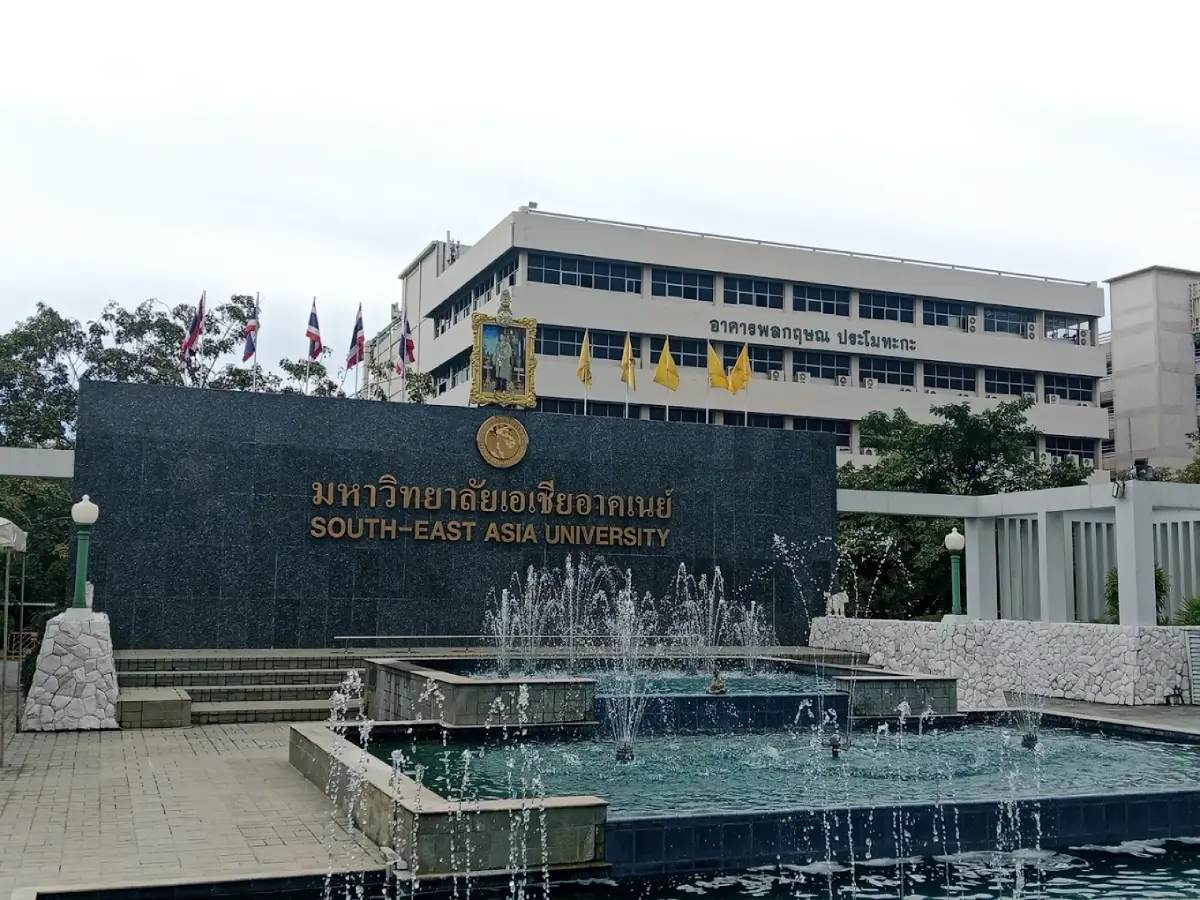
Southeast Asia University
Admission Center Open Days: Monday – Sunday
Admission Center Hours: 8:30 AM – 5:00 PM
Scheduled Teaching Days: Tuesday – Sunday
Scheduled Teaching Hours: 8:30 AM – 9:00 PM
Southeast Asia University (SAU), known in Thai as มหาวิทยาลัยเอเชียอาคเนย์, is a long-established private university in Bangkok, Thailand. Located at 19/1 Phet Kasem Road, Nong Khang Phlu, Nong Khaem, Bangkok 10160, the institution was founded on August 6, 1973, as Southeast Asia College and became Southeast Asia University on March 5, 1992. Its foundation was inspired by the charitable vision of Khun Ya Plaek Muean Pio (แปลก เหมือนปิ๋ว), Phonlakrit Pramothaka (พลกฤษณ ประโมทะกะ), and Prasert Samalapha (ประเสริฐ สมะลาภา), who wanted to establish an educational institution that would help Thailand develop technically skilled professionals. The university became a pioneer in private-sector engineering education and subsequently expanded into business administration, arts and sciences, law, and postgraduate studies. In 2026, it continues to operate through four main faculties, guided by the Buddhist-inspired philosophy “Viriyena Dukkhama Ccheti,” meaning that individuals can overcome suffering through perseverance.
The university is situated in western Bangkok along Phet Kasem Road, close to Soi Phet Kasem 106. This major transportation corridor connects Nong Khaem with Bang Khae, Phasi Charoen, and neighboring Samut Sakhon Province. The surrounding area includes residential neighborhoods, commercial businesses, industrial activities, and community services. Its location has made the university accessible to students from western Bangkok and nearby provinces, including learners who combine university education with employment and professional responsibilities.
The founding history of Southeast Asia University began with a family's determination to use private land for the wider public good. Khun Ya Plaek Muean Pio wished for her property to serve a lasting social purpose. Her grandson, Phonlakrit Pramothaka, took this intention forward and discussed the establishment of a technical educational institution with Prasert Samalapha. Their shared objective was to create opportunities for students to acquire practical knowledge and professional skills that could contribute to national development.
The economic and educational conditions of Thailand before 1973 were important influences on this initiative. During this period, Thailand and other Southeast Asian countries were expanding their industries, infrastructure, and technical capabilities. Demand was increasing for workers who possessed both theoretical knowledge and practical training. However, opportunities for advanced technical and engineering education remained limited compared with the growing demand for skilled personnel.
Phonlakrit Pramothaka had participated in an academic conference concerning rural reconstruction and development in Southeast Asia, attended by representatives and specialists from several countries. The conference emphasized regional cooperation and the improvement of living conditions. This experience contributed to the idea that a new educational institution should have an identity connected with the Southeast Asian region rather than focusing only on a single locality.
Prasert Samalapha was another important contributor to the founding initiative. He had studied engineering at the SEATO Graduate School of Engineering, which later became the Asian Institute of Technology (AIT). His engineering background and the regional associations of that institution helped shape the founders' choice of the name “Southeast Asia.” They selected Southeast Asia College to reflect an outward-looking educational mission and the ambition to contribute to technical and professional development across the region.
Preparations for establishing the college began in 1972, including land development, building construction, and the application for official permission to establish an educational institution. Southeast Asia College received authorization on August 6, 1973, under Thailand's Private College Act of 1969. Its early academic work concentrated on industrial science and technology, areas directly related to the country's need for technically trained workers.
From the beginning, the college emphasized the importance of practical education. Students were expected to build scientific foundations while developing the skills needed to work with industrial equipment, electrical systems, machinery, and technical processes. This approach reflected the founders' belief that education should lead to useful professional competence rather than remain an exclusively theoretical exercise.
In 1977, the college expanded into business administration, introducing studies in accounting and marketing. This development recognized that industrial and economic progress required not only engineers and technicians but also professionals capable of managing organizations, financial systems, business operations, and commercial activities.
In 1982, the Muean Bua Higher Education Foundation assumed responsibility for operating the institution, with Phonlakrit Pramothaka playing an important leadership role. The foundation structure reflected the founders' original commitment to education as a public benefit and helped provide an institutional basis for the college's continued development.
A significant academic milestone followed in 1985, when the institution introduced four-year bachelor's degree education in engineering. This made Southeast Asia College an important pioneer in Thailand's private higher education sector. Engineering degree programs had traditionally been concentrated in public institutions, and the expansion of private engineering education provided additional opportunities for students seeking technical and professional qualifications.
In 1989, the institution further developed its industrial technology education through continuing bachelor's degree pathways in mechanical engineering, electronics engineering, civil engineering, and electrical engineering. These programs supported the progression of students who had completed vocational qualifications and wished to expand their knowledge and academic credentials.
March 5, 1992, marked another major stage in the institution's history. Southeast Asia College received approval to change its status to Southeast Asia University. The new status enabled the institution to strengthen its academic organization, develop additional programs, and expand its responsibilities in higher education while maintaining its emphasis on professional competence and ethical development.
After becoming a university, SAU continued to expand its engineering education and other academic disciplines. In 1995, the Faculty of Arts and Sciences introduced programs in Business English and Computer Science. The Faculty of Law began offering evening legal education in 1996, followed by regular daytime legal studies in 2000. These developments broadened the university's academic scope beyond its original technical focus.
The institution also expanded its physical facilities during the early 2000s. In 2002, the Muean Bua Higher Education Foundation was renamed the Southeast Asia University Foundation, while the acquisition of additional adjoining land supported the university's long-term plans for academic buildings, services, and campus development.
As Thailand entered the twenty-first century, digital technologies became increasingly important across the university's curriculum. Computer engineering, information systems, networks, digital media, and technology-based business management developed alongside traditional engineering and business disciplines. Internet-based distance education also became an important educational option for students and working professionals who required greater flexibility.
In 2026, Southeast Asia University marks 53 years since its foundation in 1973. The university continues to offer undergraduate, master's, and doctoral education, including selected daytime, evening, weekend, and online study arrangements. This diversity of learning formats reflects its continuing adaptation to the different educational needs of students, graduates, and professionals.
Important figures in the university's history include Khun Ya Plaek Muean Pio, whose wish to dedicate land for public benefit provided the original inspiration; Phonlakrit Pramothaka, who helped initiate and sustain the educational project; and Prasert Samalapha, whose engineering knowledge contributed to the planning and identity of the college. Their combined vision established a university tradition centered on educational opportunity, technical competence, and service to society.
In 2026, Dr. Chattawut Phichphon (ดร.ฉัททวุฒิ พีชผล) serves as President of Southeast Asia University. His role includes leading institutional development and participating in major academic events. He presided over the SAUNIC 2026 academic conference, which provided a forum for researchers, faculty members, students, and specialists to discuss research and emerging technologies.
The university's philosophy and identity are rooted in the Pali expression “Viriyena Dukkhama Ccheti,” which conveys the idea that suffering and hardship can be overcome through perseverance. This principle emphasizes determination, patience, personal responsibility, and continuous self-development. It is consistent with the founders' belief that education should create opportunities for individuals to improve their lives through sustained effort.
The official university colors are blue and gold. According to the institution's historical explanation, blue symbolizes the monarchy, while gold represents Buddhism and auspiciousness. These colors form part of an identity shaped by Thai cultural traditions and the values associated with morality, learning, and social responsibility.
The university emblem is circular, with the Thai university name displayed along the upper portion and the words “Southeast Asia University” along the lower portion. At its center is a representation of Thailand and parts of the surrounding Southeast Asian region, including neighboring countries and areas of the Pacific and Indian Oceans. The emblem reflects the regional vision behind the university's name and also incorporates the founding year, 1973.
The century-old weeping fig tree is one of the most distinctive natural and historical features of Southeast Asia University. The tree is identified as Ficus benjamina, a species known for its spreading branches and dense shade. It was already growing on the property long before the university was established and is described in institutional history as being more than 100 years old.
The tree represents more than a natural landmark. It preserves a connection between the original landowners, the history of the property, and the later development of the campus. In Thai cultural traditions, large and ancient trees often carry associations with respect for nature and continuity across generations. The university's old fig tree therefore forms part of its cultural memory as well as its physical environment.
The memorial statue of Khun Ya Plaek Muean Pio is another historically significant feature of the university. Created in 1977, it is a dark bronze statue depicting her in a seated position. The statue stands within a traditional Thai wooden pavilion beneath the shade of the old fig tree. The pavilion's setting recalls her former residence beside Khlong Bang Waek in Bangkok's Phasi Charoen District. The memorial expresses the university community's lasting gratitude to one of its original benefactors.
A further historical landmark is the large Seiko clock presented to the college on its opening day, August 6, 1973. The clock was donated by Muang Thong Company Limited as a gesture of support for the founders' charitable educational initiative. Its original stated value was 600,000 baht. The clock was installed at the institution's first building, in the area later associated with the Phonlakrit Pramothaka Building. It remains an important part of the university's recorded founding history.
University traditions and cultural activities reflect its emphasis on gratitude, moral values, and community relationships. One of the most important observances is the anniversary ceremony honoring the university's establishment and its founders. In October 2026, SAU organized activities marking its 53rd anniversary, including religious ceremonies and the laying of floral tributes in memory of Khun Ya Plaek Muean Pio and Phonlakrit Pramothaka.
The anniversary is significant not only as a celebration of the institution's age but also as an occasion to remember its founding purpose. During the university's 52nd anniversary activities in 2025, nine Buddhist monks were invited to perform religious chanting. The program also included offerings, visits to memorial shrines, and recognition of employees who had served the university for important milestones in their careers. These traditions strengthen the relationship between institutional history, gratitude, and community identity.
The Wai Khru ceremony and the Bai Sri Su Khwan welcoming ceremony are also important parts of university culture. Wai Khru allows students to express respect and gratitude to their teachers, while Bai Sri Su Khwan draws on Thai ceremonial traditions to welcome new members into a community. SAU publicized both ceremonies for the 2026 academic year, demonstrating the continued place of cultural practices within its university life.
Another recurring activity is the university's “Tak Bat Toem Bun” merit-making program, through which students and staff participate in Buddhist almsgiving. In 2026, the university publicized the continuation of this activity through its 101st event. Alongside religious traditions, SAU also organizes orientation activities, volunteer projects, blood donations, and student development programs that connect moral values with practical service to society.
New-student orientation in 2026 included SAU OPEN CONNECT DAY and the NEXTGEN ORIENTATION 2026 program, held on August 2 under the theme “The Future Begins Here.” These events introduced students to university life, teaching staff, support services, and opportunities to meet fellow students. The programs form an important part of the transition into higher education.
The Faculty of Engineering remains central to Southeast Asia University's academic identity. Its undergraduate disciplines include Electrical Engineering, Mechanical Engineering, Civil Engineering, Industrial Engineering, Safety Engineering, Environmental Engineering, and Computer Engineering. Students study scientific and mathematical fundamentals before applying these concepts to engineering analysis, design, experiments, and problem-solving.
Electrical and Computer Engineering are especially relevant to the development of modern technological systems. Electrical engineering supports power distribution and industrial applications, while computer engineering involves programming, networks, intelligent devices, and digital systems. As industries increasingly adopt automation, artificial intelligence, and the Internet of Things, professionals need to understand the interactions between hardware, software, communications, and data.
Civil and Mechanical Engineering focus on the design and performance of physical systems, including buildings, infrastructure, machinery, and production processes. Industrial Engineering contributes to the improvement of operational efficiency and resource management, while Safety Engineering addresses workplace risks and accident prevention. Environmental Engineering provides knowledge relevant to pollution management, industrial sustainability, and the protection of natural resources.
SAU has expanded opportunities for computer engineering education through internet-based distance learning. The university has also publicized cooperation with WeStride on its FutureX initiative, designed to develop education in Computer Engineering and Digital Technology. The initiative connects degree education with professional skills associated with software development, data systems, and digital applications.
The Faculty of Business Administration provides education in Accounting, Digital Marketing, Human Resource Management, Information Systems for Digital Business, Management, Trade Innovation Management, and Logistics and Supply Chain Management. Selected programs are also available through online learning formats. The faculty emphasizes the relationship between business knowledge and the changing technological environment in which organizations operate.
Accounting supports financial reporting and organizational decision-making, while marketing education develops an understanding of customers, market communication, and brand management. Human Resource Management addresses employee development and organizational performance. Logistics and Supply Chain Management focus on transportation, warehousing, distribution, and the coordination of products and resources across business networks.
In August 2026, the faculty organized a practical learning activity titled “Beginner's Digital Shop,” in which Trade Innovation Management students developed their own retail concepts. Students practiced product planning, pricing, digital tools, booth preparation, and business presentations. The event demonstrated how classroom knowledge could be connected to entrepreneurship and the challenges of operating a real business.
The Faculty of Arts and Sciences brings together language education, digital technology, social sciences, and creative studies. Its published undergraduate offerings include Business English, Digital Technology and Innovation, Public Administration, and Digital Media, with selected internet-based distance education options. These disciplines respond to the needs of communication-oriented businesses, public organizations, and the digital creative economy.
Business English develops communication skills for commercial and international settings. Digital Technology and Innovation focus on the use of computing and emerging technologies in organizations. Digital Media provides knowledge related to creative production and contemporary communication platforms, while Public Administration examines public organizations, government management, and public policies that affect society.
The Faculty of Law provides legal education covering the Thai legal system, individual rights and responsibilities, legal reasoning, and the administration of justice. Its educational activities also connect legal principles with contemporary issues. In 2026, the university publicized training concerning computer-related offenses and Thailand's Personal Data Protection Act (PDPA), illustrating the relevance of legal knowledge in digital society.
SAU also offers postgraduate study in business administration, engineering, public administration, educational administration, and digital technology innovation management. These programs support graduates and working professionals who wish to undertake advanced study, research, and professional development. Some courses offer online and international formats, making postgraduate education available through different modes of learning.
Research and innovation are supported by the university's research office and academic departments. In 2026, the university organized SAUNIC 2026, a national and international academic conference featuring research presentations and discussions on emerging technologies. Topics included the future direction of artificial intelligence and ethical considerations in using AI for research. The conference provided opportunities for academics and students to exchange ideas through oral and poster presentations.
Technology-focused learning has also developed through external partnerships and specialized training. Examples include data-oriented learning platforms, AI Classroom initiatives, and Upskill and Reskill programs for businesses and industrial personnel. The university has also undertaken Smart Farming activities using Internet of Things technologies, demonstrating how engineering concepts can be applied to agricultural management and production systems.
Another example of industry-oriented education is the Digital Technology Innovation Management postgraduate program, which has been associated with training in data analytics, user experience design, and IT support. Such education supports the application of analytical and technical skills to problems faced by contemporary organizations and working professionals.
Community engagement and public service are closely connected with the university's founding mission. SAU organizes volunteer activities, blood donations, educational outreach, and professional training projects. In 2026, the university held a blood donation activity on August 19 and welcomed schools to campus learning activities, helping young people learn about university education and professional career pathways.
SAU has also cooperated with local organizations, including the Nong Khaem District Office and Nong Khang Phlu Metropolitan Police Station, on educational and community-related initiatives. These collaborations demonstrate the university's role in connecting academic knowledge with public institutions, businesses, and the surrounding community.
Preserving local knowledge and culture is another part of its outreach activities. On July 11, 2026, students from the Faculty of Business Administration visited the Poon Bamphen community around Soi Bang Waek 116. The educational visit introduced students to local lifestyles, traditional crafts, and community-based tourism. Such activities help students understand the economic and cultural value of local knowledge through experience outside the classroom.
Important campus facilities include academic buildings, laboratories, the Central Library, Information Technology Center, Research Office, Cultural Center, and administrative services. The Phonlakrit Pramothaka Building and the historic Seiko clock preserve aspects of the institution's early history. The century-old fig tree and Khun Ya Plaek memorial pavilion are particularly important for understanding the charitable origins and cultural identity of the university.
The Central Library has supported academic learning since the establishment of Southeast Asia College in 1973. Over time, the library developed alongside the university, providing resources for coursework, research, and independent study. Library and information services continue to play an important role in supporting education across engineering, business, law, and other fields.
Educational visits and campus exploration are suitable for secondary-school students, parents, prospective applicants, and organizations interested in private higher education. The university's history is particularly relevant to visitors interested in the development of engineering education in Thailand. Its historical memorials, ancient tree, academic facilities, and professional programs offer opportunities to connect institutional heritage with contemporary learning.
Prospective visitors can contact the Public Relations and Admissions Center regarding campus visits and university open-house events. Access to teaching rooms, laboratories, and specialist facilities is subject to university arrangements. Advance coordination is recommended for groups and those seeking a structured educational visit.
Getting There: Southeast Asia University is located on Phet Kasem Road next to Soi Phet Kasem 106 in Bangkok's Nong Khaem District. Visitors traveling by private car from central Bangkok can continue along Phet Kasem Road through Bang Khae towards Nong Khaem. Those approaching from Samut Sakhon Province can also reach the university by using the Phet Kasem Road corridor.
Visitors using Bangkok's MRT Blue Line can travel to Lak Song Station and then continue by taxi or public bus towards Nong Khaem. The university's official transport information lists several bus services, including Routes 80, 81, 84, 84ก, 123, 163, 189, and 547, and identifies the stop near Soi Phet Kasem 77/4 opposite the university. Passengers should verify current route numbers and operating services before traveling.
The Admissions Center publishes opening hours of Monday through Sunday, 8:30 AM to 5:00 PM. The university also publishes scheduled teaching hours of Tuesday through Sunday, 8:30 AM to 9:00 PM. Individual departments and academic programs may operate on different schedules, so administrative appointments and specialist facility visits should be arranged according to the relevant office's timetable.
The surrounding Nong Khaem area offers local temples, markets, restaurants, and accommodation options. Nearby places of interest include Wat Nong Khaem, Wat Udom Rangsi, Wat Rakhang Phromrangsi, Wat Nong Khaem Morning Market, and Nong Khaem Community Market. These places provide opportunities to explore the everyday culture of western Bangkok beyond the better-known central tourist districts.
Local food establishments and apartment-style accommodation are concentrated around Phet Kasem Road and the Phet Kasem 77 neighborhood. These services are useful for students, parents, university visitors, and people attending academic events. The area reflects the practical character of a Bangkok university neighborhood, combining education with long-established local communities and commercial activities.
Southeast Asia University is therefore more than a private higher education institution in Bangkok. Its history reflects the development of professional and engineering education in Thailand, the charitable dedication of land for public benefit, and the expansion of educational opportunities over more than five decades. From its origins in industrial technology, the university has continued to develop programs in digital business, modern management, science, and other professional disciplines. At the same time, it preserves the memory of its founders and the values of perseverance, ethical conduct, and gratitude that remain central to its identity.
| University Name | Southeast Asia University (SAU) |
| Institution Type | Private University |
| Location | Nong Khang Phlu, Nong Khaem, Bangkok, Thailand |
| Address | 19/1 Phet Kasem Road, Next to Soi Phet Kasem 106, Nong Khang Phlu, Nong Khaem, Bangkok 10160, Thailand |
| Founding Date | August 6, 1973 |
| Original Institution Name | Southeast Asia College |
| University Status Granted | March 5, 1992 |
| Institutional Age in 2026 | 53 Years Since Establishment |
| Founders and Key Benefactors | Khun Ya Plaek Muean Pio (แปลก เหมือนปิ๋ว), Phonlakrit Pramothaka (พลกฤษณ ประโมทะกะ), and Prasert Samalapha (ประเสริฐ สมะลาภา) |
| University President | Dr. Chattawut Phichphon (ดร.ฉัททวุฒิ พีชผล) |
| University Philosophy | Viriyena Dukkhama Ccheti — Individuals Can Overcome Suffering Through Perseverance |
| University Colors | Blue and Gold |
| University Emblem | Circular Emblem Featuring the University Name in Thai and English and a Map of Thailand and Southeast Asia |
| Main Faculties | 1. Faculty of Engineering 2. Faculty of Business Administration 3. Faculty of Arts and Sciences 4. Faculty of Law |
| Published Program Totals | 28 Undergraduate Entries, 9 Master's Programs, and 5 Doctoral Entries According to the University's Published Curriculum Overview |
| Academic Strengths | Engineering, Digital Technology, Business Administration, Accounting, Logistics, Digital Media, Public Administration, and Law |
| Historic Campus Landmarks | Century-Old Weeping Fig Tree, Khun Ya Plaek Memorial Statue, Traditional Thai Wooden Pavilion, Historic Seiko Clock, and Phonlakrit Pramothaka Building |
| Campus Facilities | Academic Buildings, Laboratories, Central Library, Information Technology Center, Research Office, Cultural Center, and Admissions Center |
| Traditions and Events | University Anniversary, Wai Khru Ceremony, Bai Sri Su Khwan Ceremony, Buddhist Merit-Making Activities, Student Orientation, Graduation Ceremonies, and Community Service |
| Admission Center Open Days | Monday – Sunday |
| Admission Center Hours | 8:30 AM – 5:00 PM |
| Scheduled Teaching Days | Tuesday – Sunday |
| Scheduled Teaching Hours | 8:30 AM – 9:00 PM |
| Campus Visits | Contact the Public Relations and Admissions Center in Advance for Campus Visit Arrangements |
| Getting There | By Car via Phet Kasem Road, or MRT Blue Line to Lak Song Station Followed by Taxi or Local Public Bus Towards Nong Khaem |
| Nearby Places of Interest | 1. Wat Nong Khaem 2. Wat Udom Rangsi 3. Wat Rakhang Phromrangsi 4. Wat Nong Khaem Morning Market 5. Nong Khaem Community Market |
| Nearby Restaurants and Cafés | 1. Fresh Me, Southeast Asia University Branch 2. Pizza Hut, Asia University Branch 3. Krua Khun Ah, Phet Kasem 77/4 4. Nakhon Kaeng, Phet Kasem 69 Branch |
| Nearby Accommodation | 1. Asia Suite Apartment, Phet Kasem 77 2. Welcome Home 77, Phet Kasem 77 3. Sri Fa Mansion, Phet Kasem 77 4. S.L. Mansion, Phet Kasem 77 5. Saengchan Apartment, Phet Kasem 77 |
| University Telephone | +66 2 807 4500–27 |
| Admissions Center Contact | +66 2 807 4500 Ext. 190, 192; Mobile +66 86 324 9122 |
| Official Website | https://www.sau.ac.th/ |
| Admissions Website | https://admission.sau.ac.th/ |
| Current Status | Operating Private University Offering Higher Education Programs in the 2026 Academic Year |
Academic Programs and Fields of Study at Southeast Asia University, Academic Year 2026 (2569)
| Faculty of Engineering | Bachelor's Degree 1. Electrical Engineering 2. Mechanical Engineering 3. Civil Engineering 4. Industrial Engineering 5. Safety Engineering 6. Environmental Engineering 7. Computer Engineering 8. Computer Engineering (Internet-Based Distance Education) Master's Degree 1. Master of Engineering in Electrical Engineering 2. Master of Engineering in Construction Innovation Management 3. Master of Engineering in Engineering Management (International Program) Doctoral Degree 1. Doctor of Philosophy in Electrical Engineering |
| Faculty of Business Administration | Bachelor's Degree 1. Accounting 2. Accounting (Internet-Based Distance Education) 3. Digital Marketing 4. Human Resource Management 5. Information Systems for Digital Business 6. Management 7. Trade Innovation Management 8. Logistics and Supply Chain Management 9. Logistics Management (Internet-Based Distance Education) 10. International Business Management (Internet-Based Distance Education) Master's Degree 1. Master of Business Administration 2. Master of Business Administration (International Program) 3. Master of Business Administration in Digital Logistics and Supply Chain Management (Internet-Based Distance Education) 4. Master of Science in Digital Technology Innovation Management (Internet-Based Distance Education) Doctoral Degree 1. Doctor of Philosophy in Business Administration 2. Doctor of Philosophy in Business Administration (International Program) |
| Faculty of Arts and Sciences | Bachelor's Degree 1. Business English 2. Business English (Internet-Based Distance Education) 3. Digital Technology and Innovation 4. Public Administration 5. Public Administration (Internet-Based Distance Education) 6. Digital Media 7. Politics and Government (Internet-Based Distance Education) 8. Smart Industrial Management (Internet-Based Distance Education) Graduate Diploma 1. Graduate Diploma in Teaching Profession Master's Degree 1. Master of Public Administration 2. Master of Education in Educational Administration Doctoral Degree 1. Doctor of Philosophy in Educational Administration 2. Doctor of Philosophy in Educational Administration (International Program) |
| Faculty of Law | Bachelor's Degree 1. Bachelor of Laws |
Frequently Asked Questions (FAQ)
Q: Where is Southeast Asia University located?
A: The university is located at 19/1 Phet Kasem Road, next to Soi Phet Kasem 106, Nong Khang Phlu, Nong Khaem, Bangkok 10160, Thailand.
Q: Is Southeast Asia University still operating?
A: Yes. Southeast Asia University continues to operate and offers undergraduate and postgraduate education in the 2026 academic year.
Q: What are the opening days and hours of Southeast Asia University?
A: The Admissions Center operates Monday through Sunday from 8:30 AM to 5:00 PM. Published teaching hours are Tuesday through Sunday, from 8:30 AM to 9:00 PM. Individual office and facility schedules may differ.
Q: When was Southeast Asia University established?
A: It was founded on August 6, 1973, as Southeast Asia College and became Southeast Asia University on March 5, 1992.
Q: Who founded Southeast Asia University?
A: Important founding figures include Khun Ya Plaek Muean Pio (แปลก เหมือนปิ๋ว), Phonlakrit Pramothaka (พลกฤษณ ประโมทะกะ), and Prasert Samalapha (ประเสริฐ สมะลาภา).
Q: What is Southeast Asia University known for?
A: The university is known for its pioneering role in private-sector engineering education in Thailand. It also offers programs in business administration, digital technology, arts and sciences, law, and postgraduate studies.
Q: How many faculties does Southeast Asia University have?
A: The university has four main faculties: Engineering, Business Administration, Arts and Sciences, and Law.
Q: What historic landmarks can visitors find at Southeast Asia University?
A: Important landmarks include a century-old weeping fig tree, the bronze statue of Khun Ya Plaek Muean Pio in a traditional Thai pavilion, the historic Seiko clock presented on the college's opening day, and the Phonlakrit Pramothaka Building.
Q: How can I reach Southeast Asia University by MRT?
A: Take the MRT Blue Line to Lak Song Station and continue by taxi or local public bus along Phet Kasem Road towards Nong Khaem and Soi Phet Kasem 106.
Q: How can I contact Southeast Asia University?
A: Call +66 2 807 4500–27, extensions 190 or 192, for admissions, or mobile +66 86 324 9122. Official information is available at https://www.sau.ac.th/.
 Category: ●University
 Group: ●Private University
Last Update : 1 WeekAgo
 Last Update : 1 WeekAgo

 Click to Access the Navigation Map GPS
Southeast Asia University Map
Recommend

 Art, Culture and Heritage
 Historical Sites and Monuments(3)
 Landmarks and Memorials(23)
 Royal Palace(13)
 Art, Craft Centres, Tradition(35)
 Museums(59)
 Historic Homes and Cities(3)
 Art Gallery(16)
 Educational Places
 Museum for Study(6)
 Library(4)
 Public university(8)
 Autonomous Universities(8)
 Rajamangala University of Technology(6)
 Rajabhat University(6)
Private University(22)
 Places of Worship
 Temple(72)
 Church(2)
 Mosque(67)
 Other Sacred Sites(8)
 Research and Development
 Royal Project(1)
 Suburban Living
 Village, Community(5)
 Local Market(9)
 Floating Market(2)
 Nature and Wildlife
 River, Canal(3)
 Bays and Beaches(1)
 Other natural attractions(1)
 Entertainment and Agricultural
 Zoos and Aquariums(5)
 Animal camps and shows(5)
 Stadium(9)
 Farms, Parks and Ecotourism(20)
 Amusement Park(1)
 Waterpark(4)
 Theater(7)
 Cinema(1)
 Shopping
 Shopping and Night Market(20)
 Department Store(7)
 Spas and Wellness
 Spas and Wellness(1)
 Restaurant
 Michelin Star(5)
 Accommodation
 Hotel(3)
 Call Customer Service in Tourism
 Call Customer Service in Tourism(1)
 Travel Articles, Recipes
 Travel Review, Food Review(43)
 Royal Thai Desserts and Recipes(56)


