
lovethailand home >Central Travel Attractions >Bangkok Travel Attractions >Lat Krabang >Lat Krabang > CMKL University
TL;DR: CMKL University is located at Lat Krabang District, Bangkok, Thailand. is a non-profit private university in Bangkok, Thailand, established in October 2017 through a collaboration between Carnegie Mellon.

CMKL University
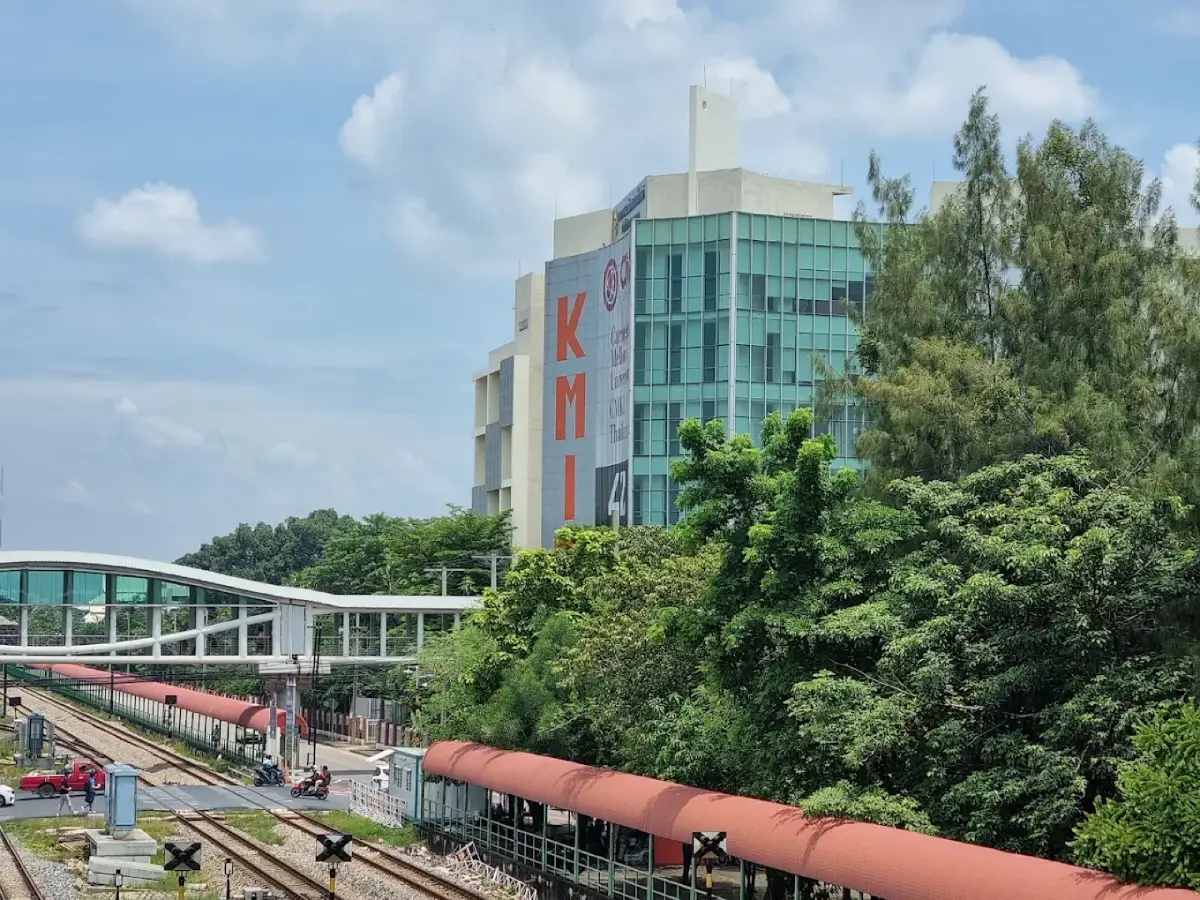
Open Days (General Office): Monday – Friday
Opening Hours (General Office): 09:00 – 17:00
CMKL University is a non-profit private university in Bangkok, Thailand, established in October 2017 through a collaboration between Carnegie Mellon University in the United States and King Mongkut's Institute of Technology Ladkrabang (KMITL) in Thailand. Located at 1 Soi Chalongkrung 1, Lat Krabang District, Bangkok 10520, the university specializes in artificial intelligence, computer engineering, electrical and computer engineering, advanced computing systems, and digital innovation. CMKL was established to develop highly skilled professionals capable of connecting advanced technological knowledge with practical solutions to real-world problems. Today, it offers undergraduate, master's, and doctoral education, including dual-degree pathways with partner institutions. Its academic programs are taught in English, with strong emphasis on research, industry collaboration, and practical experience.
CMKL University differs from large comprehensive universities by concentrating on a relatively small number of advanced technological disciplines. Artificial intelligence is at the center of its academic identity, reflecting the expanding role of AI in healthcare, manufacturing, finance, communications, creative industries, and the digital economy. Rather than treating research as a separate activity undertaken only after students have acquired theoretical knowledge, CMKL integrates practical projects and research-based learning into its educational approach. Students are encouraged to design, test, evaluate, and improve technological solutions throughout their studies.
The university is situated within the wider educational and innovation environment of King Mongkut's Institute of Technology Ladkrabang in eastern Bangkok. The surrounding area contains academic buildings, research facilities, learning spaces, student accommodation, commercial services, and established residential communities. This setting connects the university with both Thailand's engineering education sector and the economic activities of the Lat Krabang area, where educational institutions coexist with technology-related businesses and industrial development.
For prospective students seeking clarification about the institution's status, CMKL is a privately operated, non-profit university with its own academic administration. It is not simply a faculty of KMITL or a conventional overseas branch campus of Carnegie Mellon University. Although the university has close institutional relationships with both founding partners, the academic programs, admissions processes, and degrees awarded depend on the particular study pathway. This distinction is especially important when comparing CMKL's single-degree programs with its dual-degree arrangements.
The historical origins of CMKL University are connected to Thailand's efforts to strengthen higher education and advanced technology capabilities during a period of significant global technological change. Artificial intelligence, automation, big data, and digitally connected industries were becoming increasingly important to national economic competitiveness. Universities were therefore expected not only to educate graduates but also to develop research capacity, encourage international academic exchange, and translate scientific knowledge into commercially and socially useful innovation.
In May 2017, Thailand established the Committee for the Promotion of Economic and Financial Cooperation (CPEF) to facilitate international collaboration in higher education. One objective was to encourage the transfer of academic expertise, institutional experience, and educational resources from leading overseas universities into Thailand. This broader policy environment helped create the conditions for establishing an institution with an international academic foundation and a strong focus on advanced engineering and technology.
In October 2017, King Mongkut's Institute of Technology Ladkrabang initiated a collaboration with Carnegie Mellon University, a research university based in Pittsburgh, Pennsylvania. The partnership led to the signing of a declaration in Pittsburgh to establish CMKL University. During the same month, CMKL was formally established under Agreement No. 1/2017, associated with Thailand's initiative to promote collaboration with high-potential international higher education institutions. The university was created as a non-profit institution operating in Thailand.
The collaboration combined complementary academic strengths. Carnegie Mellon University contributed an internationally established research tradition in computing, engineering, and technological innovation, while KMITL brought extensive experience in engineering education and relationships with Thailand's industrial sector. The resulting institution was intended to develop specialized academic programs, strengthen advanced research, and create opportunities for collaboration among students, researchers, universities, and industry partners across Thailand and Southeast Asia.
The university began establishing industrial research partnerships soon after its foundation. In November 2017, CMKL developed a partnership with ThaiBev to support research funding, laboratory development, scholarships, and technological innovation. The following month, collaboration with Betagro focused on investigating artificial intelligence applications in agriculture. These early initiatives demonstrated the institution's interest in applying computing technologies to existing industries rather than limiting research to purely theoretical questions.
During its subsequent development, CMKL expanded its academic and research activities in electrical and computer engineering, particularly through graduate-level cooperation with Carnegie Mellon University. The Electrical and Computer Engineering, or ECE, programs became an important part of the university's international educational model, connecting academic work in Thailand with the research and educational environment in Pittsburgh. This arrangement created opportunities for students to pursue advanced engineering education through a structured international degree pathway.
CMKL later expanded undergraduate education through its Artificial Intelligence and Computer Engineering program, commonly known as AiCE. The development of undergraduate study enabled students to begin specializing in AI and related computing disciplines earlier in their academic careers. The curriculum integrates mathematical foundations, software development, engineering systems, artificial intelligence, and research activities, with particular emphasis on preparing students to develop technologies that can be applied across different industries.
In 2022, CMKL also participated in cooperation among Thai universities to develop the Artificial Intelligence Engineering Institute, or AIEI. This initiative reflected an expanding role beyond the education of CMKL's own students. Through institutional networks and professional training, the university has contributed to efforts to develop AI skills and expertise across a wider section of Thailand's academic and professional communities.
By 2026, CMKL's activities extended across AI infrastructure, advanced computing, medical AI, open technology systems, and interdisciplinary innovation. The university presented research on computing resource management and large language models at international technology events and supported student research activities involving overseas partners. These developments continued the original institutional objective of linking higher education with research capabilities that can contribute to industrial and social development.
The name CMKL originates from the names Carnegie Mellon University and King Mongkut's Institute of Technology Ladkrabang, the two principal institutions involved in its establishment. The abbreviation therefore represents the university's international academic roots and the collaboration between Thailand and the United States. Its official English name is CMKL University, while its Thai name is มหาวิทยาลัยซีเอ็มเคแอล.
Several academic leaders have played important roles in the institution's development. Professor Suchatvee Suwansawat, Sc.D., is identified by the university as Chairman of its Board of Trustees. He has been associated with initiatives to strengthen international engineering education and advanced technology development in Thailand. Associate Professor Supan Tungjitkusolmun, Ph.D., is identified as President of CMKL University in the university's current leadership information.
Dr. Supan Tungjitkusolmun has an academic background in electrical and biomedical engineering. He earned his bachelor's degree from the University of Pennsylvania and his master's and doctoral degrees from the University of Wisconsin–Madison. His research interests include signal processing, computational modeling, medical imaging, and biomedical technologies. This combination of engineering expertise and academic leadership reflects the university's emphasis on connecting technical education with practical problems affecting society.
CMKL's institutional identity is expressed through the phrase "Enabling Endless Possibilities." The university's vision focuses on transforming education, cultivating entrepreneurial professionals, and advancing collaborative research and development. Its mission emphasizes nurturing talent and transforming industries through knowledge, technology, research, and innovation. These principles provide a consistent framework for the university's teaching methods, research partnerships, and student development initiatives.
The academic culture of CMKL encourages students to challenge existing approaches, turn ideas into functioning systems, and create meaningful impact beyond the classroom. This philosophy is reflected in an educational model that places practical research and development activities throughout a student's academic journey. Students learn to identify problems, formulate research questions, collaborate across disciplines, evaluate technical solutions, and communicate their findings to different audiences.
A distinctive feature of the university is its use of competency-based education. Rather than measuring student development solely through completion of a conventional sequence of courses, this approach emphasizes demonstrable abilities and learning outcomes. The AiCE undergraduate curriculum is organized around major areas including artificial intelligence, software engineering, scalable systems, cybersecurity, human-centered design, and entrepreneurship and innovation.
These areas are interconnected in practical technological development. For example, creating an AI application for healthcare requires more than an understanding of machine-learning algorithms. Developers must also consider reliable data systems, user experience, privacy and security, technical performance, and the requirements of medical professionals. CMKL's interdisciplinary curriculum encourages students to understand these relationships and choose appropriate methods for solving complex problems.
The university's principal undergraduate program is the Bachelor of Engineering in Artificial Intelligence and Computer Engineering (B.Eng. AiCE). The English-taught program generally offers a three- to four-year study pathway, depending on academic progress and program requirements. Students study computing and engineering foundations while developing practical capabilities in software, intelligent systems, cybersecurity, and technological innovation. Research and development activities are incorporated into the learning process rather than being reserved exclusively for a final-year project.
An additional undergraduate pathway is the Dual Bachelor's Degree Program jointly associated with CMKL University and KMITL. This arrangement connects CMKL's Bachelor of Engineering in Artificial Intelligence and Computer Engineering with KMITL's Bachelor of Engineering in Computer Innovation Engineering. Students who successfully fulfill the requirements receive degrees from both institutions. The dual-degree pathway is designed as a four-year program and includes a capstone project during the final stage of study. According to the university's admissions information, the CMKL curriculum is delivered at CMKL's campus facilities within the KMITL area.
At graduate level, CMKL offers the Master of Science in Artificial Intelligence and Computer Engineering and the Doctor of Philosophy in Artificial Intelligence and Computer Engineering. The master's program is designed around approximately 1.5 years of study and includes opportunities to build expertise through advanced coursework, research, and innovation-oriented projects. The doctoral program places stronger emphasis on original research, developing new technical knowledge, and addressing complex engineering questions requiring advanced investigation.
CMKL also offers an Integrated Master and Bachelor pathway, commonly called IMB, for eligible undergraduate AiCE students. This pathway allows high-achieving students to connect undergraduate and graduate study, including opportunities to begin suitable master's-level coursework during the later stages of their bachelor's degree. The IMB arrangement is an integrated study pathway rather than an additional independent degree program in the university's main program count.
The Electrical and Computer Engineering programs are delivered through international collaboration between CMKL University and Carnegie Mellon University. These include the Master of Science in Electrical and Computer Engineering and Doctor of Philosophy in Electrical and Computer Engineering. Both programs are associated with dual-degree arrangements, under which students who meet the academic requirements receive degrees from the two universities.
The ECE master's pathway generally spans two years, with approximately one year of study in Thailand and another year in Pittsburgh, United States. The doctoral pathway emphasizes advanced research and academic supervision involving faculty members from both institutions. Carnegie Mellon's published program information describes an approximately five-year doctoral structure with academic and research periods in both countries. These arrangements provide an international experience that differs from CMKL's regular single-degree AiCE programs.
Understanding the distinction between AiCE and ECE is important for prospective students. AiCE focuses specifically on artificial intelligence and its integration with computer engineering, including intelligent systems, software, and computational technologies. ECE covers a broader engineering foundation, including electrical engineering, hardware systems, signal processing, communications, embedded systems, software, and advanced computing. Applicants should therefore compare research interests, degree structures, academic requirements, and career objectives before selecting a program.
In addition to its five principal degree-granting programs, CMKL has previously offered the Master of Science in Technology and Creative Innovation (MSTCI). The program connected technology with design, interactive media, games, virtual and augmented reality, and creative experiences. Although information about the program remains available on the university's academic website, CMKL explicitly states that it is no longer accepting applications. It should therefore be distinguished from the current degree programs available to prospective applicants in the 2026–2027 academic year.
The university's wider educational activities also include professional training, internships, and entrepreneurship programs. Important initiatives include the Artificial Intelligence Engineering Institute (AIEI), Software Engineering Institute (SEI), AI OpenClass activities, and the Zero to 1 Accelerator. These activities serve professional development, practical training, and technological entrepreneurship. They are separate from the university's degree-granting programs and should not be counted as additional bachelor's, master's, or doctoral degrees.
Research and innovation are central to CMKL's academic mission. The university identifies several major research areas: AI Infrastructure, Physical AI, Medical AI, Creative AI, Learning Innovation, and Entrepreneurship and Innovation. These areas encompass both the technical systems required to operate modern artificial intelligence and the development of applications that interact with people, industries, and the physical environment.
AI Infrastructure is especially important because modern artificial intelligence depends on high-performance computing, efficient memory management, networking, and reliable software systems. Research in this area explores computing resource allocation, hardware-software co-design, performance optimization, scalable architectures, and confidential computing. Such work supports the development of AI systems that can handle demanding tasks while addressing security, reliability, and operational efficiency.
In 2026, CMKL presented research related to AI infrastructure and large language models at NVIDIA GTC 2026. Among the featured projects were Project Glider, which addresses intelligent AI workload management, and Mango, a language-model initiative designed for advanced AI applications. Research of this kind contributes to discussions about how countries can strengthen their computing capabilities, develop specialized technical expertise, and make advanced AI infrastructure more accessible to researchers and industry.
Another research area is Physical AI, which concerns artificial intelligence systems that interact with physical environments. These technologies include robotics, autonomous systems, sensing devices, and intelligent control systems. Research may involve processing sensor data, interpreting physical conditions, supporting automated decisions, and connecting computational models with equipment operating in real-world settings. CMKL's published research includes AI and Internet of Things applications related to precision agriculture and environmental monitoring.
Medical AI research at CMKL demonstrates the potential of engineering and artificial intelligence to support healthcare-related tasks. One example involves applying generative AI to produce synthetic computed tomography images from magnetic resonance imaging data, with the aim of supporting radiotherapy planning workflows. Other research explores brain-computer interfaces and neural signals. Such projects require collaboration across computing, engineering, and health-related disciplines, with careful attention to technical reliability and real-world applicability.
Creative AI and Learning Innovation provide another perspective on the university's work. These fields connect contemporary computing technologies with human creativity, educational methods, and cultural expression. One particularly relevant example is the Spatial Immersion Training Application (SITA), a mixed-reality project designed to support the learning of traditional Thai dance through immersive three-dimensional motion visualization.
The relationship between digital innovation and cultural learning is significant because many forms of traditional knowledge, including dance, performance, and craftsmanship, have historically depended on direct transmission between experienced teachers and learners. Interactive media and immersive visualization can provide additional tools for studying movements, techniques, and artistic details. Although technology does not replace the cultural understanding and personal guidance offered by expert teachers, it can broaden access to learning resources and create new ways to engage with cultural heritage.
Other projects published by CMKL include intelligent scheduling tools for schools and medical personnel, environmental forecasting applications, and software intended to assist small businesses in managing information. These initiatives share an emphasis on identifying practical needs and applying data, algorithms, and engineering methods to address them. They demonstrate how university research can extend into ordinary activities rather than remaining confined to specialized laboratories.
Entrepreneurial development is also part of CMKL's innovation environment. Programs such as the Zero to 1 Accelerator connect technical product development with business planning, market validation, and startup creation. By participating in such initiatives, students and researchers can gain a broader understanding of how technological ideas are transformed into usable products and services, and how technical feasibility relates to customers, organizational needs, and economic sustainability.
In May 2026, CMKL announced its participation in international open-technology communities associated with the Linux Foundation, SONiC Foundation, and RISC-V International. These organizations and initiatives are connected with open software, networking technologies, and processor architectures. The collaborations support opportunities for research, engineering education, and participation in globally developed technology ecosystems. They also reflect the importance of open standards and shared technical infrastructure in the development of contemporary computing systems.
Student life at CMKL reflects the character of a specialized, internationally oriented academic institution. The university promotes close engagement between students and academic mentors, small-group collaboration, and individualized educational planning. Its official institutional overview reports a student-to-faculty-and-staff ratio of approximately 7.5 to 1, illustrating an educational environment designed to support relatively close interaction between learners and university personnel.
Major university activities include orientation programs, academic advising, research presentations, innovation events, graduation ceremonies, and opportunities to engage with industry professionals. During the 2026–2027 academic year, CMKL held Fall 2026 Orientation Week from August 3 to August 6, 2026. The program introduced incoming students to academic resources, learning platforms, research opportunities, student activities, and the university's competency-based educational system.
The orientation program also provided opportunities for new students to meet faculty members, senior students, and the Student Council. Participants were encouraged to develop communication, collaboration, adaptability, and self-directed learning skills. Individual academic planning sessions with faculty advisors helped students begin shaping educational pathways aligned with their interests, academic goals, and future professional development.
Another important public-facing event was CMKL Open Days 2026, held from September 2 to September 6, 2026. The event welcomed prospective students, parents, and other visitors interested in the university's academic programs, scholarships, student experiences, and AI education. Activities included the AI Engineering in Action workshop series, with topics such as supervised and unsupervised learning, generative AI, physical AI, privacy and security, creative AI, and agentic AI.
The event also offered opportunities to explore the university's AI computing initiatives, including demonstrations associated with APEX Supercomputer and Mango AI. Through discussions, technical presentations, and student project showcases, visitors were able to gain a clearer understanding of how artificial intelligence, computer engineering, and innovation are integrated into the university's approach to education.
CMKL's academic traditions reflect the culture of an international, research-oriented university rather than a model built solely around long-established ceremonial practices. Orientation programs, graduation events, research presentations, student activities, and professional networking help create institutional continuity and a shared sense of belonging. These activities support communication between students, faculty, researchers, alumni, and the wider technology community.
The university's learning environment is connected with facilities in the KMITL area. One particularly important location is the KMITL Lifelong Learning Center, commonly known as KLLC. The center provides learning and collaborative spaces that support reading, group work, academic projects, and educational activities. Its first-floor co-working area has a separately published access arrangement, while other parts of the building operate under their respective schedules and access requirements.
In August 2026, CMKL used the sixth floor of the KLLC building for its Fall Orientation activities. This illustrates the role of contemporary learning spaces as venues for academic meetings, project presentations, training, and student engagement. Rather than serving only as conventional classrooms, such facilities support different forms of learning and collaboration between members of the university community.
CMKL students may also have access to facilities and services within the wider KMITL environment, depending on eligibility and institutional arrangements. These include libraries, study spaces, sports facilities, a swimming pool, fitness services, banking facilities, and nearby healthcare services. Access conditions and operating hours differ by facility, and some services are reserved for registered students or other authorized users.
Student support services at CMKL include admissions and enrollment assistance, academic records, financial information, student affairs, information technology support, and academic advising. These services help students manage their educational responsibilities and access resources throughout their studies. For international students, practical information about immigration procedures, housing, local transportation, and student life in Bangkok is particularly important.
Accommodation is another important consideration for students moving to Lat Krabang. CMKL publishes a list of nearby private residences and apartments, including AJ Park, AP House, Bed Jinda, Maethus Grand Suvarnabhumi, and All Smile Mansion. These options differ in rental conditions, room facilities, and resident eligibility. Students are responsible for contacting accommodation providers directly, as the university does not operate or guarantee all the listed properties.
The relationship between CMKL and the surrounding Lat Krabang community is also evident in the local economy. Restaurants, cafés, apartment buildings, retail services, and transportation providers serve students, university personnel, and neighborhood residents. The district combines established canal-side communities with modern education and industrial activities, offering a distinctive urban environment in which advanced technological research and everyday local life exist alongside each other.
For visitors interested in educational tourism, CMKL can provide an introduction to Thailand's emerging AI and engineering innovation ecosystem. Opportunities to visit are best arranged through university-organized open days, academic events, or scheduled campus tours. Research laboratories, specialized teaching spaces, and staff facilities should not be assumed to be freely accessible during general office hours, as access may require authorization.
Visitors to the Lat Krabang area can also explore nearby cultural and community attractions. Hua Takhe Old Market is a historic canal-side neighborhood known for traditional wooden buildings, local food, and creative community spaces. Local temples and public parks provide additional perspectives on the everyday cultural landscape of eastern Bangkok. A visit to the university area can therefore be combined with an exploration of the neighborhood's heritage and changing social environment.
Getting There CMKL University is accessible by private car, taxi, public bus, railway, and Airport Rail Link. The university is located on Soi Chalongkrung 1 in Lat Krabang District, close to the main KMITL educational area. Travelers using navigation applications can search for CMKL University or KMITL Lifelong Learning Center. Visitors arriving by car should confirm the appropriate entrance and available parking arrangements for their intended destination.
Travelers using Airport Rail Link can get off at Lat Krabang Station and continue by taxi or a university shuttle service operating according to designated arrangements. CMKL also publishes information about public bus routes serving the university area, including routes 143, 151, 157, and 1013. Visitors should confirm current services and stopping points before traveling, as public transportation routes and operating schedules may change.
Those using Thailand's Eastern Railway can travel to railway stops in the Lat Krabang and Phra Chom Klao area and continue to campus using suitable local transport. Travelers arriving at Suvarnabhumi Airport can use a taxi or connect through Airport Rail Link and local transportation. Travel times depend on traffic conditions, the exact departure point, and the availability of connecting services.
The university's general office contact hours are Monday to Friday, 09:00–17:00. These hours should be distinguished from class schedules, student access arrangements, and special events. Prospective students, researchers, and visitors who wish to arrange a campus tour, academic meeting, or admissions consultation should make an appointment through the university's official contact channels before arriving.
CMKL University represents a distinctive model of international higher education collaboration in Thailand. From its establishment in 2017 to its academic and research activities in 2026, the university has developed a focused role in artificial intelligence, advanced engineering, and innovation. Its educational approach brings together academic knowledge, practical experience, research collaboration, and industry engagement. For prospective students, researchers, and visitors interested in Thailand's evolving technological landscape, CMKL offers an important example of how higher education can respond to the opportunities and challenges of the AI era.
| University Name | CMKL University (มหาวิทยาลัยซีเอ็มเคแอล) |
| University Type | Non-Profit Private University Specializing in Advanced Technology |
| Location | Lat Krabang District, Bangkok, Thailand |
| Address | 1 Soi Chalongkrung 1, Lat Krabang, Bangkok 10520, Thailand |
| Established | October 2017 |
| Institutional Age | 9 Years as of 2026 |
| Founding Partners | Carnegie Mellon University, USA, and King Mongkut's Institute of Technology Ladkrabang (KMITL), Thailand |
| Chairman | Professor Suchatvee Suwansawat, Sc.D. |
| President | Associate Professor Supan Tungjitkusolmun, Ph.D. |
| Academic Strengths | Artificial Intelligence, Computer Engineering, Electrical and Computer Engineering, AI Infrastructure, Medical AI, Physical AI and Applied Research |
| Language of Instruction | English |
| Degree Levels | Bachelor's, Master's and Doctoral Degrees |
| Principal Degree Programs | 5 Degree-Granting Programs, Excluding Separate Counts for Integrated and Dual-Degree Pathways |
| Dual-Degree Pathways | AiCE x CIE with KMITL; ECE with Carnegie Mellon University |
| Academic and Professional Initiatives | Artificial Intelligence Engineering Institute (AIEI), Software Engineering Institute (SEI), AI OpenClass and Zero to 1 Accelerator |
| Important Facilities | CMKL Academic Facilities, KMITL Lifelong Learning Center (KLLC), Research and Student Activity Spaces, and Eligible Shared KMITL Facilities |
| University Activities | Orientation Week, Graduation Ceremonies, CMKL Open Days, Research and Innovation Events, and AI Workshops |
| General Office Days | Monday – Friday |
| General Office Hours | 09:00 – 17:00 |
| Campus Visits | By Prior Appointment or During Public Events Announced by the University |
| Facilities and Services | Learning Spaces, Library Resources, Co-working Areas, Student Services, and Eligible Sports and Healthcare Facilities in the KMITL Area |
| Transportation | Private Car, Taxi, Airport Rail Link Lat Krabang Station, Eastern Railway and Public Buses 143, 151, 157 and 1013 |
| Nearby Attractions | 1. KMITL Lifelong Learning Center 2. Hua Takhe Old Market 3. Wat Lat Krabang 4. Wat Lan Bun 5. Lat Krabang Park (Suan Phra Nakhon) |
| Nearby Restaurants and Cafés | 1. Siam Steak KMITL, Tel. +66 95 371 8678 2. Laohu Shabu KMITL, Tel. +66 65 681 6926 3. Lita Cafe & Roaster KMITL, Tel. +66 82 481 8980 4. The Boon Cafe KMITL, Tel. +66 95 502 4929 5. Coffzilla Cafe, Tel. +66 92 827 1601 |
| Nearby Accommodation | 1. AP House, Approx. 0.6 km, Tel. +66 81 922 4669 (Thai Male Residents Only) 2. Bed Jinda, Approx. 0.8 km, Tel. +66 92 782 2663 3. Maethus Grand Suvarnabhumi, Approx. 1.2 km, Tel. +66 62 314 2777 4. All Smile Mansion, Approx. 1.7 km, Tel. +66 84 019 9000 5. AJ Park, Approx. 15 Minutes' Walk, Tel. +66 97 091 9724 |
| Telephone | +66 65 878 5000 |
| Official Website | https://cmkl.ac.th |
| Current Status | Operating as an Educational and Research Institution in the 2026–2027 Academic Year |
CMKL University Academic Programs and Degree Pathways, Academic Year 2026–2027
| Academic Group / Partner Institution | Programs and Degree Levels |
| Artificial Intelligence and Computer Engineering (AiCE) CMKL University, Thailand | Bachelor's Degree 1. Bachelor of Engineering in Artificial Intelligence and Computer Engineering (B.Eng. AiCE) Master's Degree 2. Master of Science in Artificial Intelligence and Computer Engineering (M.S. AiCE) Doctoral Degree 3. Doctor of Philosophy in Artificial Intelligence and Computer Engineering (Ph.D. AiCE) |
| Electrical and Computer Engineering (ECE) CMKL University and Carnegie Mellon University | Master's Dual Degree 4. Master of Science in Electrical and Computer Engineering (M.S. ECE) Doctoral Dual Degree 5. Doctor of Philosophy in Electrical and Computer Engineering (Ph.D. ECE) |
| Undergraduate Dual-Degree Pathway CMKL University and KMITL | Two Bachelor's Degrees 1. Bachelor of Engineering in Artificial Intelligence and Computer Engineering (AiCE), CMKL University 2. Bachelor of Engineering in Computer Innovation Engineering (CIE), KMITL This four-year pathway combines degree requirements from both institutions and is not counted as an additional independent program beyond the five principal degree programs. |
| Integrated Master and Bachelor (IMB) CMKL University, Thailand | Integrated Undergraduate and Graduate Pathway 1. Bachelor of Engineering in Artificial Intelligence and Computer Engineering (AiCE) 2. Master of Science in Artificial Intelligence and Computer Engineering (AiCE) Designed for eligible AiCE students who wish to connect undergraduate and master's-level study. |
Frequently Asked Questions (FAQ)
Q: Where is CMKL University located?
A: CMKL University is located at 1 Soi Chalongkrung 1, Lat Krabang District, Bangkok 10520, Thailand, within the wider KMITL educational area.
Q: When was CMKL University established?
A: The university was formally established in October 2017 through a collaboration between Carnegie Mellon University and King Mongkut's Institute of Technology Ladkrabang.
Q: Is CMKL University a public or private university?
A: CMKL University is a non-profit private university with its own academic and institutional administration.
Q: What days and hours is CMKL University open?
A: General office hours are Monday to Friday, from 09:00 to 17:00. Class schedules, special events, and student access arrangements may differ from general office hours.
Q: What programs does CMKL University offer in the 2026–2027 academic year?
A: CMKL lists five principal degree-granting programs in Artificial Intelligence and Computer Engineering and Electrical and Computer Engineering at bachelor's, master's, and doctoral levels, together with selected dual-degree and integrated study pathways.
Q: Do all CMKL students receive a degree from Carnegie Mellon University?
A: No. Carnegie Mellon degrees are awarded under designated dual-degree arrangements, such as the ECE programs. Regular AiCE single-degree programs award degrees from CMKL University.
Q: Can visitors tour CMKL University?
A: Prospective students and other visitors can arrange campus visits through the university or attend public events such as CMKL Open Days. Access to research laboratories and specialized academic areas may require prior authorization.
Q: How can I reach CMKL University by Airport Rail Link?
A: Take Airport Rail Link to Lat Krabang Station, then continue by taxi or an available university shuttle service to CMKL University or KMITL Lifelong Learning Center.
 Category: ●University
 Group: ●Private University
Last Update : 2 DayAgo
 Last Update : 2 DayAgo
 Click to Access the Navigation Map GPS
CMKL University Map
Recommend

 Art, Culture and Heritage
 Historical Sites and Monuments(3)
 Landmarks and Memorials(23)
 Royal Palace(13)
 Art, Craft Centres, Tradition(35)
 Museums(59)
 Historic Homes and Cities(3)
 Art Gallery(16)
 Educational Places
 Museum for Study(6)
 Library(4)
 Public university(8)
 Autonomous Universities(8)
 Rajamangala University of Technology(6)
 Rajabhat University(6)
Private University(22)
 Places of Worship
 Temple(72)
 Church(2)
 Mosque(67)
 Other Sacred Sites(8)
 Research and Development
 Royal Project(1)
 Suburban Living
 Village, Community(5)
 Local Market(9)
 Floating Market(2)
 Nature and Wildlife
 River, Canal(3)
 Bays and Beaches(1)
 Other natural attractions(1)
 Entertainment and Agricultural
 Zoos and Aquariums(5)
 Animal camps and shows(5)
 Stadium(9)
 Farms, Parks and Ecotourism(20)
 Amusement Park(1)
 Waterpark(4)
 Theater(7)
 Cinema(1)
 Shopping
 Shopping and Night Market(20)
 Department Store(7)
 Spas and Wellness
 Spas and Wellness(1)
 Restaurant
 Michelin Star(5)
 Accommodation
 Hotel(3)
 Call Customer Service in Tourism
 Call Customer Service in Tourism(1)
 Travel Articles, Recipes
 Travel Review, Food Review(43)
 Royal Thai Desserts and Recipes(56)


