
lovethailand home >North Travel Attractions >Chiang Mai Travel Attractions >Muang Chiang Mai >Chang Moi > Wat Chai Si Phum
TL;DR: Wat Chai Si Phum is located at Wichayanon Road, Chang Moi Subdistrict, Mueang Chiang Mai District, Chiang Mai Province, open Daily, hours 07.00 – 18.00.

Wat Chai Si Phum
Open Days: Daily
Opening Hours: 07.00 – 18.00
Wat Chai Si Phum in Chiang Mai is a historic community Buddhist temple on Wichayanon Road, Chang Moi Subdistrict, Mueang Chiang Mai District. Located just outside the moat near Chaeng Si Phum, the northeastern corner of Chiang Mai’s old city, the temple is closely connected with Lanna urban cosmology, the auspicious “Si Phum” quarter, the former Wat Phan Ta Koen name, the sacred city fig tree tradition, and the local belief that this area helped bring prosperity and protection to Chiang Mai. The temple remains open daily for worship, merit-making, and cultural sightseeing.
Wat Chai Si Phum is a practical and meaningful stop for travelers who want to explore Chiang Mai beyond the most famous temples inside the old city. It is close to Tha Phae Gate, Chaiyapoom Road, Wichayanon Road, Moon Muang Road, Somphet Market, Warorot Market, Wat Chiang Man, and the Chang Moi old-town neighborhood. Visitors can reach the temple by private car, red songthaew, tuk-tuk, taxi app, or on foot from the eastern and northeastern parts of the moat. A visit can include worship, observation of Lanna architecture, the viharn, the ubosot, the prasat-style chedi, the scripture hall, and the atmosphere of a working local temple.
The importance of Wat Chai Si Phum begins with its location. Chaeng Si Phum is the northeastern corner of Chiang Mai’s old city and has long carried symbolic meaning in the traditional understanding of city space. The word “Si Phum” can be understood as an auspicious or prosperous land. A temple associated with this corner is therefore not only a neighborhood temple but also part of a wider sacred geography. It reflects how Lanna cities connected religion, protection, prosperity, water, gates, corners, roads, and community life into one meaningful urban system.
The temple’s older name was Wat Phan Ta Koen, sometimes written in Thai as Wat Pan Ta Koen. This name has several layers of explanation. One version connects it with a soldier or local leader named Phan Ta Koen, who is remembered as a principal figure in the temple’s establishment. Another explanation links the word “koen” with a traditional northern tool resembling a long climbing ladder or stepped implement. These explanations show how the temple’s name preserves both personal memory and old Lanna vocabulary.
Wat Chai Si Phum is also associated with the name Wat Asokaram. In Buddhist language, “Asokaram” refers to a monastery free from sorrow. This meaning relates to local belief that the temple area could help remove misfortune and grief. Older accounts connect the temple with a ritual idea of going to the water landing in front of Wat Chai Si Phum to wash away suffering and misfortune. Whether approached as belief, ritual memory, or community tradition, this gives the temple a strong identity as a place of protection and emotional relief.
The temple’s history is linked with the later Mangrai dynasty period and with stories connected to King Phra Mueang Kaeo. Wat Chai Si Phum is remembered as a temple built to support the auspicious power of Chiang Mai. It was also associated with a red sandalwood Buddha image, an important sacred object in the temple’s historical memory. This connection adds spiritual weight to the temple because sandalwood Buddha images are associated with fragrance, devotion, sacred craftsmanship, and the protective power of revered Buddha images.
The temple site is also connected with a Nigrodha fig tree, remembered as an auspicious city tree. In Lanna belief, a sacred tree could represent shade, protection, fertility, stability, and the vital force of a city. Local history tells that this city tree was cut down during the reign of King Tilokarat because of a wartime deception intended to weaken the auspicious power of Chiang Mai. This story reflects the close relationship between warfare, politics, city protection, and sacred symbolism in northern Thai history.
To understand Wat Chai Si Phum properly, visitors should view it together with the old city layout. The temple stands just outside the moat near a meaningful corner of the city, close to roads, markets, and old neighborhoods. This location made the temple part of religious life, movement, commerce, and city identity. It helps explain Chiang Mai not only as a city of major royal temples but also as a city shaped by smaller community temples positioned around important urban nodes.
The temple is located at 437 Wichayanon Road, Chang Moi Subdistrict, Mueang Chiang Mai District, Chiang Mai 50300. The compound covers about 4 rai and 16 square wa. Important buildings and areas include the ubosot, viharn, sermon hall, monks’ residences, multipurpose hall, funeral hall, scripture hall, dining hall, kitchen, chedi, merit-making areas, and walking areas inside the temple compound. These features show that Wat Chai Si Phum functions as a complete community temple rather than a single monument.
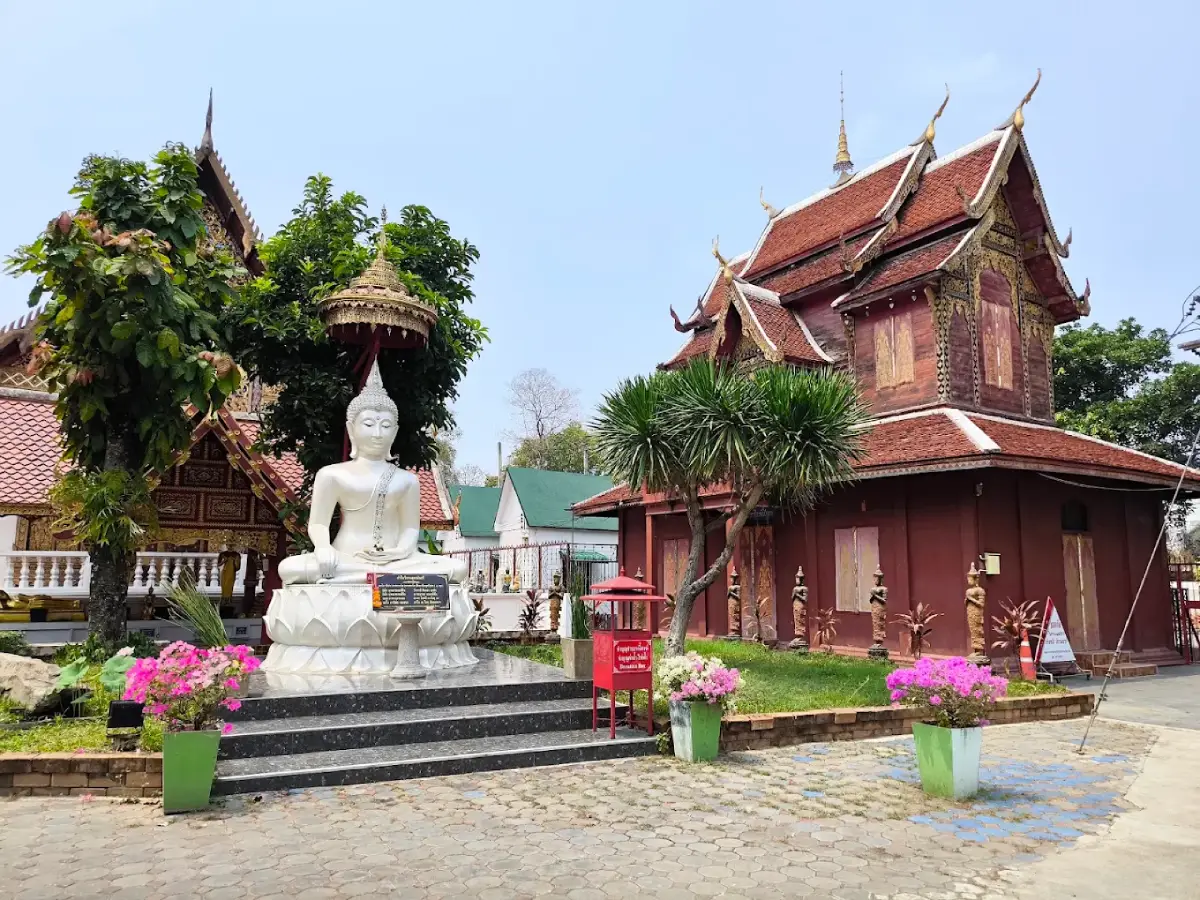
One of the main structures to see is the Lanna-style viharn. The building has a front portico, naga stairway balustrades, carved wooden gable decoration, and gilded foliate patterns. The viharn represents the elegance of northern Thai temple architecture through proportion, carving, roof form, and symbolic details. For visitors interested in Lanna craftsmanship, this is one of the temple’s most rewarding areas to observe carefully.
The viharn is visually impressive within the relatively compact temple compound. Its roofline, front porch, wooden elements, and decorated gable give the building a refined and dignified presence. The beauty of this temple lies not in monumental size but in architectural detail. When natural light reaches the gilded ornamentation, the carved patterns become clearer and the craftsmanship of local artisans is easier to appreciate.
The temple also has a Phra Chao Than Chai viharn, a wooden hall associated with the Than Chai Buddha tradition. In northern Thai Buddhist culture, Phra Chao Than Chai is connected with quick fulfillment of sincere wishes and the power of concentrated devotion. This gives Wat Chai Si Phum a devotional layer that is accessible to local worshippers and visitors alike. The wooden viharn also reflects the importance of timber construction in Lanna temple culture.
Another meaningful sacred area is connected with Phra Chao Fon Saen Ha. The name evokes rain, abundance, fertility, and the well-being of agricultural communities. Although the temple is now in an urban district, this name preserves the older agricultural imagination of Lanna society, where rain and seasonal balance were essential to community life. It adds another layer to the temple’s role as a place of blessing and protection.
Other important Buddha images associated with the temple include Phra Chai Khi Miang or Phra Chao Saen Chai, as well as the red sandalwood Buddha image. These names show how an old northern temple often contains many sacred objects, each with its own memory and devotional meaning. Visitors should approach these objects respectfully and allow local worshippers space for prayer and offerings.
The ubosot, or ordination hall, is a restored religious building enclosed by a boundary wall. Inside is a reclining Buddha image. In the temple’s local belief, the reclining image was placed in relation to the road alignment in front of and behind the ubosot, symbolically preventing harmful forces from passing through the area. This shows how Buddhist imagery, protective belief, and the spatial arrangement of a neighborhood could be combined in Lanna religious practice.
The prasat-style chedi is another key feature of Wat Chai Si Phum. It combines square architectural forms with rounded elements in a Lanna style. The chedi stands as a center of devotion and memory inside the compound. In Buddhist tradition, a chedi represents continuity, merit, sacred presence, and the endurance of faith. At Wat Chai Si Phum, the chedi should also be seen in relation to the temple’s city-corner location and its auspicious associations with Si Phum.
The chedi and the old city corner reinforce each other symbolically. Chaeng Si Phum is an auspicious urban point, while the chedi is a sacred architectural center within the temple. Seeing both together helps visitors understand how Lanna Buddhism worked with city planning, directional belief, and ritual geography. Wat Chai Si Phum is therefore valuable not only for its structures but also for the way those structures relate to Chiang Mai’s wider sacred landscape.
The ho trai, or scripture hall, is a 2-storey traditional building. A ho trai is important because it is associated with the preservation of Buddhist scriptures and religious knowledge. In northern Thai temples, scripture halls often received careful architectural treatment because they protected sacred texts from humidity, insects, and damage. The presence of a ho trai at Wat Chai Si Phum gives the temple an educational and doctrinal dimension beyond worship and sightseeing.
The scripture hall is also visually distinctive. Its timber elements, traditional form, and decorative character make it an important point for architectural observation. For travelers interested in temple layout, the ho trai helps show that a Buddhist temple is not only a place for images and ceremonies. It is also a place where knowledge, texts, memory, and monastic learning are preserved for future generations.
The bell tower adds another layer to the temple compound. In Thai Buddhist temples, a bell tower is both functional and symbolic. Bells mark time, call attention to temple activities, and help create a sense of order inside sacred space. Visitors should see the bell tower together with the viharn, ubosot, chedi, and ho trai to understand the temple as a complete system of buildings, rituals, and community use.
The atmosphere inside Wat Chai Si Phum is calm and local. Although the temple is close to important roads, markets, and old-city walking routes, the compound provides a quieter space for worship and reflection. The elevated character of parts of the temple ground also gives it a distinct sense of place. This contrast between busy city streets and temple calm is one of the reasons the temple works well as a cultural stop in central Chiang Mai.
Wat Chai Si Phum continues to function as a community temple. The compound is maintained as a clean, peaceful, and usable religious space for monks, local residents, public agencies, and visitors. This contemporary role is important because it confirms that the temple is not merely a historical site. It remains part of living Buddhist practice and local community life in the Chang Moi and Si Phum edge area.
Getting to Wat Chai Si Phum is easy. From Tha Phae Gate, visitors can walk north along the eastern side of the moat toward Chaeng Si Phum, then continue to Wichayanon Road. From Warorot Market or the Ping River area, the temple can be reached by a short ride or a walk through the Chang Moi area. Red songthaews, tuk-tuks, taxi apps, and private cars are all practical options.
Visitors using private cars should allow extra time for traffic around the moat and nearby markets. The area has many narrow streets, shops, hotels, restaurants, and tourist routes. When giving directions to a driver, use “Wat Chai Si Phum, Wichayanon Road, near Chaeng Si Phum” to avoid confusion with similarly named temples elsewhere. The temple’s location makes it especially convenient for travelers staying near Tha Phae Gate, Moon Muang Road, Chang Moi, or Warorot Market.
A good visit to Wat Chai Si Phum takes about 30–60 minutes. Begin by paying respect in the main worship area, then observe the Lanna-style viharn, gilded wooden gable, naga stairway, ubosot, reclining Buddha image, prasat-style chedi, scripture hall, bell tower, and surrounding temple grounds. Moving slowly through the compound allows visitors to understand the temple as a combination of faith, architecture, city symbolism, and neighborhood memory.
The best time to visit is in the morning or late afternoon. Morning is suitable for worship and a calmer temple atmosphere. Late afternoon is convenient for travelers continuing to Tha Phae Gate, Somphet Market, Warorot Market, or nearby walking streets. Visitors who want to photograph architectural details should come when natural light is sufficient, because the light helps reveal the wood carving, gilded patterns, and Lanna ornamentation more clearly.
Visitors should follow standard temple etiquette. Dress modestly, remove shoes before entering sacred buildings, keep voices low, do not climb on the chedi base, and avoid touching Buddha images, old woodwork, murals, scripture halls, or sacred objects. If monks or local worshippers are using the space, visitors should step aside and allow religious activity to take priority. Respectful behavior helps preserve the temple’s atmosphere and supports better cultural tourism.
Wat Chai Si Phum is also suitable for cultural photography. Interesting subjects include the Lanna viharn, gilded foliate gable, naga balustrades, prasat-style chedi, ho trai, bell tower, and the temple’s setting near Chaeng Si Phum. Photography should be done from an appropriate distance, without flash near sacred objects or old artworks, and without interrupting monks, worshippers, or ceremonies.
For itinerary planning, Wat Chai Si Phum combines easily with nearby old-city and market attractions. A simple walking route can include Somphet Market, Wat Chai Si Phum, Wat Chiang Man, Tha Phae Gate, Wat Ou Sai Kham, Warorot Market, and Wat Buppharam. This route gives visitors a compact view of Chiang Mai through temples, moat corners, markets, old lanes, and local food stops.
The strength of Wat Chai Si Phum is its dense cultural story. It brings together the old Wat Phan Ta Koen name, the auspicious Si Phum city corner, the sacred fig tree tradition, the red sandalwood Buddha image, Wat Asokaram belief, Phra Chao Than Chai, Phra Chao Fon Saen Ha, the reclining Buddha image, the prasat-style chedi, the scripture hall, and the surrounding old-town community. These layers make the temple more meaningful than its compact size might suggest.
Overall, Wat Chai Si Phum is a historic temple in the Chang Moi area that is worth visiting when exploring Tha Phae Gate, Somphet Market, Warorot Market, and the northeastern corner of Chiang Mai’s old city. It offers a calm place for worship, a strong link with Lanna city symbolism, and several architectural and sacred features within a compact compound. For travelers who want to understand Chiang Mai through local temples and old urban memory, Wat Chai Si Phum is a valuable stop.
| Name | Wat Chai Si Phum |
| Location | Wichayanon Road, Chang Moi Subdistrict, Mueang Chiang Mai District, Chiang Mai Province |
| Address | 437 Wichayanon Road, Chang Moi Subdistrict, Mueang Chiang Mai District, Chiang Mai 50300, Thailand |
| Coordinates | 18.79463, 98.99413 |
| Temple Type | Community Buddhist Temple Under The Mahanikaya Order |
| Highlights | Historic temple near Chaeng Si Phum, associated with the auspicious city quarter of Chiang Mai, Lanna viharn, Phra Chao Than Chai viharn, Phra Chao Fon Saen Ha, reclining Buddha image, prasat-style chedi, and traditional scripture hall |
| History | Connected with the later Mangrai dynasty period and Lanna city-corner symbolism. The temple was formerly known as Wat Phan Ta Koen and later became known as Wat Chai Si Phum because of its location near Chaeng Si Phum. |
| Name Origin | Chai Si Phum refers to an auspicious and prosperous city area. The older name Phan Ta Koen is linked with both a remembered founder figure and old northern Thai vocabulary. |
| Temple Area | About 4 rai and 16 square wa |
| Distinctive Features | Lanna-style viharn with a front portico, naga balustrades, gilded carved wooden gable, prasat-style Lanna chedi, and 2-storey traditional ho trai |
| Sacred Objects | Reclining Buddha image in the ubosot, Phra Chao Than Chai, Phra Chao Fon Saen Ha, Phra Chai Khi Miang or Phra Chao Saen Chai, and the red sandalwood Buddha image tradition |
| Travel Information | Accessible from Tha Phae Gate, Moon Muang Road, Chaiyapoom Road, Wichayanon Road, Somphet Market, and Warorot Market by private car, red songthaew, tuk-tuk, taxi app, or on foot from the northeastern old-city area |
| Current Status | Open for worship, merit-making, and temple sightseeing during operating hours |
| Open Days | Daily |
| Opening Hours | 07.00 – 18.00 |
| Fees | Free Entry |
| Facilities | Viharn, ubosot, sermon hall, monks’ residences, multipurpose hall, funeral hall, scripture hall, dining hall, kitchen, merit-making areas, restrooms, and parking area |
| Main Areas / Zones | Lanna viharn, Phra Chao Than Chai viharn, Phra Chao Fon Saen Ha area, ubosot, reclining Buddha image, prasat-style chedi, ho trai, bell tower, pavilions, and community merit-making areas |
| Visitor Guidelines | Dress modestly, remove shoes before entering sacred buildings, do not climb the chedi base, do not touch Buddha images, old woodwork, the ho trai, or sacred objects, and respect worshippers inside the temple. |
| Nearby Tourist Attractions | 1. Chaeng Si Phum And Chiang Mai Moat, About 0.1 km 2. Somphet Market, About 0.3 km 3. Wat Ou Sai Kham, About 0.5 km 4. Tha Phae Gate, About 0.8 km 5. Warorot Market, About 0.8 km 6. Wat Chiang Man, About 0.8 km 7. Wat Buppharam, About 1 km 8. Wat Chedi Luang Worawihan, About 1.2 km |
| Nearby Restaurants | 1. ShaPel Cafe, About 0.1 km, Tel. 092-916-6995 2. Kuai Tiao Nuea Wua Rot Yiam, Moon Muang Road, About 0.1 km, Tel. 081-885-9114 3. Roxpresso Coffee Craft, About 0.1 km, Tel. 081-681-0186 4. AiTomoe Chaeng Si Phum, About 0.2 km, Tel. 096-656-9203, 099-268-4699 5. Cat House Chiang Mai, About 0.3 km, Tel. 094-756-0128 6. The Hideout, About 0.4 km, Tel. 081-960-3889 |
| Nearby Accommodations | 1. Baanlansa Bed&Bar, About 0.2 km, Tel. 052-000-173 2. Sleep Guesthouse, About 0.3 km, Tel. 089-635-9750 3. Vieng Mantra Hotel, About 0.6 km, Tel. 096-984-7461 4. Amora Thapae Hotel Chiang Mai, About 0.6 km, Tel. 053-251-531 5. Hotel M Chiang Mai, About 0.7 km, Tel. 053-211-069, 088-258-8362 6. De Chai The Deco Chiang Mai, About 0.9 km, Tel. 053-273-700 |
Frequently Asked Questions (FAQ)
Q: Where is Wat Chai Si Phum located?
A: Wat Chai Si Phum is located at 437 Wichayanon Road, Chang Moi Subdistrict, Mueang Chiang Mai District, Chiang Mai Province, near Chaeng Si Phum, the Chiang Mai moat, Somphet Market, and Tha Phae Gate.
Q: What are the opening hours of Wat Chai Si Phum?
A: Wat Chai Si Phum is open daily from 07.00 to 18.00.
Q: Is there an entrance fee at Wat Chai Si Phum?
A: No. General entry to Wat Chai Si Phum is free.
Q: What was the former name of Wat Chai Si Phum?
A: The temple was formerly known as Wat Phan Ta Koen or Wat Pan Ta Koen. It later became known as Wat Chai Si Phum because of its location near Chaeng Si Phum, an auspicious corner of Chiang Mai.
Q: Why is Wat Chai Si Phum historically important?
A: The temple is important because it is associated with Lanna city symbolism, the auspicious Si Phum quarter, the sacred city fig tree tradition, and the belief that this area supported the prosperity and protection of Chiang Mai.
Q: What should visitors see inside Wat Chai Si Phum?
A: Key features include the Lanna viharn, Phra Chao Than Chai viharn, Phra Chao Fon Saen Ha, the ubosot with a reclining Buddha image, the prasat-style chedi, the scripture hall, the bell tower, and important Buddha images associated with the temple’s history.
Q: How can travelers get to Wat Chai Si Phum?
A: Travelers can reach the temple from Tha Phae Gate, Moon Muang Road, Chaiyapoom Road, Wichayanon Road, Somphet Market, or Warorot Market by private car, red songthaew, tuk-tuk, taxi app, or on foot from the northeastern old-city area.
Q: What nearby places can be visited with Wat Chai Si Phum?
A: Nearby places include Chaeng Si Phum, Somphet Market, Wat Ou Sai Kham, Tha Phae Gate, Warorot Market, Wat Chiang Man, Wat Buppharam, and Wat Chedi Luang Worawihan.
 Category: ●Places of Worship
 Group: ●Temple
Last Update : 2 MonthAgo
 Last Update : 2 MonthAgo

 Click to Access the Navigation Map GPS
Wat Chai Si Phum Map
Recommend

 Muang Chiang Mai(121)Chom Thong(47)Mae Chaem(25)Chiang Dao(33)Doi Saket(68)Mae Taeng(85)Mae Rim(69)Samoeng(29)Fang(71)Mae Ai(59)Phrao(70)San Pa Tong(103)San Kamphaeng(66)San Sai(73)Hang Dong(73)Hot(32)Doi Tao(22)Omkoi(11)Saraphi(74)Wiang Haeng(15)Chai Prakan(28)Mae Wang(32)Mae On(22)Doi Lo(33)Galyani Vadhana(1)


