lovethailand home >North Travel Attractions >Uttaradit Travel Attractions >Mueang Uttaradit >Hat Kruat > Wat Wang Moo
TL;DR: Wat Wang Moo is located at Ban Wang Moo, Hat Kruat Subdistrict, Mueang Uttaradit District, Uttaradit Province, open Daily for general merit-making and visits, hours Daytime is suitable for visiting.
Wat Wang Moo
Open Days: Daily for general merit-making and visits
Opening Hours: Daytime is suitable for visiting
Wat Wang Moo is located in Ban Wang Moo, Hat Kruat Subdistrict, Mueang Uttaradit District, Uttaradit Province. It is a Theravada Buddhist temple under the Maha Nikaya monastic order and is one of the historically significant community temples in the area. The temple is believed to have been established during the Sukhothai period around 1157, or B.E. 1700, and received its consecrated boundary in B.E. 1732. With a history of more than 800 years, Wat Wang Moo is a deeply meaningful religious and cultural site for the people of Hat Kruat and Mueang Uttaradit.
Although Wat Wang Moo has not been officially registered as an ancient monument by the Fine Arts Department, its cultural value is clearly visible through its old temple structures, local legend, sacred spaces, and long relationship with the community. The temple is not only a place for Buddhist ceremonies. It is also a place where local memory, folklore, faith, architecture, and community life are preserved. For travelers interested in cultural tourism in Uttaradit, Wat Wang Moo offers a rare opportunity to explore a temple where history and legend remain closely connected.
The most distinctive story associated with Wat Wang Moo is the legend of the golden wild boar. According to local tradition, a wild boar with a shining golden body once appeared at a riverside landing on the opposite bank of the Nan River. The story tells of 2 Mon traders who were rowing their boat upstream to trade in the area around Ban Tha Thong. While their boat was moored at the landing, they saw a golden wild boar coming down to drink water. The sight was so extraordinary that both traders and local villagers were amazed.
Driven by wonder, the 2 Mon traders rowed after the golden boar. Instead of running away like an ordinary animal, the boar disappeared and reappeared in the water as it moved toward a whirlpool. It then emerged again at a raised piece of land in the area that later became Ban Wang Moo before vanishing into the grass without a trace. The traders searched for it but could not find it. Because of this mysterious event, local people believed the golden boar was a sacred or supernatural being. The story became the origin of the names Ban Wang Moo and Wat Wang Moo.
This legend gives Wat Wang Moo a unique identity. The name of the temple is not merely a geographic label. It carries the memory of a local story involving the Nan River, water, trade, a sacred animal, and the formation of a community name. The word “Wang” suggests a deep pool or whirlpool, while “Moo” refers to the boar in the legend. Together, the name preserves both the landscape and the belief system of the community. This makes Wat Wang Moo an excellent example of how Thai local temples can carry layers of history, geography, and folklore.
Historically, Wat Wang Moo is significant because it was established in the Sukhothai period. During that era, Theravada Buddhism played an important role in Thai society, especially in northern and central regions connected by major river routes. The presence of an old temple in Ban Wang Moo shows that communities along the Nan River were linked with Buddhism, settlement, trade, and cultural exchange for many centuries. The temple therefore served as a religious center, a community anchor, and a cultural learning space from the past to the present.
One of the most important architectural features of Wat Wang Moo is its old Maha Ud ordination hall with a lower structure resembling a Chinese junk or sailing vessel. This form is visually distinctive and culturally meaningful. In Buddhist symbolism, the idea of a boat can be associated with spiritual crossing, movement, and the journey beyond suffering. Architecturally, the building reflects a combination of older temple design, late Ayutthaya artistic influence, and local craftsmanship adapted to the community context.
The term “Maha Ud” refers to a type of ordination hall with fewer openings and a more enclosed atmosphere. Such a design creates a solemn and sacred interior suitable for monastic rites. The old ordination hall at Wat Wang Moo is therefore valuable not only as an old building, but also as evidence of past beliefs and temple architecture. Visitors interested in historic Buddhist buildings should take time to observe the shape, base, proportions, and atmosphere of the hall.
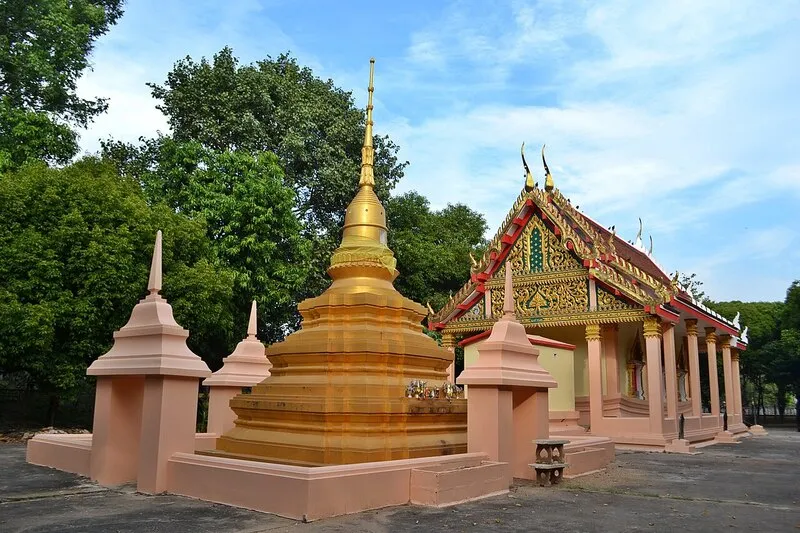
Another important feature is the stupa that enshrines relics of the Buddha. Its folk-art style combines influences from Lanna, Burmese, and Ayutthaya artistic traditions. This mixture of styles reflects the cultural position of Uttaradit as a place connected to several artistic and historical routes. In the past, the area was not isolated. It was influenced by movements of people, trade, religion, and craftsmanship from different regions. The stupa at Wat Wang Moo therefore serves as an architectural record of cultural exchange.
The temple also contains slate boundary stones in the Ayutthaya style. Boundary stones, or bai sema, are important markers that define the sacred space of an ordination hall. Their presence confirms the religious significance and long history of the temple. These stones are not simply old objects. They are signs of a consecrated Buddhist space where monastic ceremonies have been performed over generations. For visitors, the bai sema help reveal the depth of the temple’s historical continuity.
The wooden sermon hall, built in B.E. 2506, is another meaningful structure in the temple. Although it is younger than the old ordination hall and boundary stones, it reflects the modern community role of Wat Wang Moo. The hall is used for Dhamma talks, merit-making, meetings, annual festivals, and local activities. Its wooden construction gives it a warm and traditional character. It shows how the temple continues to serve the community as a living religious and social space.
The glass viharn at Wat Wang Moo houses a statue of Luang Pu Meng, a revered monk respected by local residents. The presence of this statue adds another layer of spiritual meaning to the temple. Visitors can pay respect to Luang Pu Meng and reflect on the virtues of local Buddhist teachers who helped guide communities through faith and practice. This makes Wat Wang Moo meaningful not only for its buildings and legend, but also for its connection to respected monks.
The golden boar statues located near the temple entrance and in front of the wooden sermon hall are important cultural symbols. They make the local legend visible to visitors as soon as they enter the temple grounds. The statues serve as reminders of the story that gave the village and temple their names. They are also memorable landmarks for travelers and educational objects for younger generations who may learn the legend through seeing the statues.
Wat Wang Moo has long served as a center of Buddhist and cultural life for the local community. Villagers come here for important Buddhist days such as Makha Bucha Day, Visakha Bucha Day, Asalha Bucha Day, Buddhist Lent, and the end of Buddhist Lent. The temple also hosts Kathin ceremonies, forest robe offerings, ordination ceremonies, and annual merit-making events. Through these activities, the temple continues to bring together people of different generations and helps preserve Buddhist traditions in the community.
The temple also plays a role in supporting moral education and youth activities. Community temples in Thailand often function as informal learning spaces where children and young people learn about respect, generosity, gratitude, discipline, and communal responsibility. Wat Wang Moo is part of this tradition. Through merit-making, ordination, religious training, and community work, the temple helps transmit Buddhist values in practical ways.
In cultural terms, Wat Wang Moo is an important learning site for local folklore, settlement history along the Nan River, and the blending of artistic traditions. Visitors interested in local history can use this temple as a gateway to understanding Hat Kruat and Mueang Uttaradit more deeply. The history of the community is not preserved only in books or museums. It is also found in temple names, old buildings, golden boar statues, boundary stones, and stories still remembered by local people.
The atmosphere inside the temple is calm and simple. Visitors are encouraged to walk slowly and respectfully. A meaningful visit may begin with paying respect to the Buddha images, then observing the old Maha Ud ordination hall, the stupa, the boundary stones, the wooden sermon hall, the glass viharn, and the golden boar statues. When visitors understand the background of these elements, the temple becomes much more than a scenic stop. It becomes a place where every object has a relationship with history, faith, and community memory.
For spiritual travelers, Wat Wang Moo is suitable for merit-making, quiet worship, and cultural reflection. Visitors should dress modestly, speak softly, and respect monks and local worshippers. Photography should be done carefully and without disturbing religious activities. Since the temple remains a sacred and active space for the community, respectful behavior helps preserve its atmosphere and supports the local people who continue to care for the temple.
Getting There is convenient from Uttaradit city. Travelers can head toward Hat Kruat Subdistrict using the Uttaradit – Phichai road or local roads leading to Ban Wang Moo. Traveling by private car, rental car, or local transport is the most practical option. A visit to Wat Wang Moo can be combined with nearby temples such as Wat Thap Mai, Wat Noen Pho, Wat Phai Yai, Wat Dong Chang Di, Wat Khao Tong Phrom Prasit, and attractions in Uttaradit city.
The journey from Uttaradit city to Hat Kruat does not take long, making Wat Wang Moo suitable for a half-day cultural trip. Visiting during the daytime is recommended because it allows travelers to see the old ordination hall, golden boar statues, and wooden sermon hall clearly. Visitors should also prepare for the weather, especially during the hot season, and plan enough time to explore the temple respectfully rather than rushing through the site.
Wat Wang Moo is ideal for travelers who enjoy deeper cultural experiences. The temple contains many layers of interest: Sukhothai-period history, the golden boar legend, old ordination hall architecture, a relic stupa, boundary stones, a glass viharn, Luang Pu Meng, and the continuing role of the temple in community life. A visit here rewards travelers who are willing to slow down and listen to the stories embedded in the place.
From a conservation perspective, Wat Wang Moo deserves careful preservation. Its value is not limited to old structures. It also includes the golden boar legend, local memory, craftsmanship, sacred space, and the bond between the temple and the people of Ban Wang Moo. Sharing accurate information about the temple and respecting its community context are important parts of cultural conservation.
Overall, Wat Wang Moo brings together several forms of value in one place. It is an old temple of more than 800 years, a sacred site connected with a distinctive local legend, a place with an old ship-shaped ordination hall, a center for community merit-making, and a cultural learning site linked to the Nan River and local identity. It is suitable for cultural travelers, students, local history enthusiasts, Buddhist visitors, and anyone seeking a peaceful temple experience in Uttaradit.
In summary, Wat Wang Moo in Ban Wang Moo, Hat Kruat Subdistrict, Mueang Uttaradit District, is a temple that should not be overlooked. Its Sukhothai-period history, golden boar legend, Maha Ud ordination hall shaped like a sailing vessel, relic stupa, slate boundary stones, wooden sermon hall, glass viharn, Luang Pu Meng statue, and golden boar statues make it one of the most distinctive cultural temples in Uttaradit. For travelers who want to make merit, learn local folklore, and experience a peaceful old temple near the Nan River, Wat Wang Moo is a highly meaningful destination.
| Name | Wat Wang Moo |
| Location | Ban Wang Moo, Hat Kruat Subdistrict, Mueang Uttaradit District, Uttaradit Province |
| Address | Hat Kruat Subdistrict, Mueang Uttaradit District, Uttaradit Province 53000 |
| Coordinates | Latitude 17.5365021446, Longitude 100.115509485 |
| Highlights | An old Sukhothai-period temple over 800 years old, known for the golden boar legend, a Maha Ud ordination hall shaped like a sailing vessel, a relic stupa, slate boundary stones, a wooden sermon hall, and golden boar statues |
| History | Established around B.E. 1700 during the Sukhothai period and received its consecrated boundary in B.E. 1732 |
| Name Origin | The name comes from the local legend of a golden wild boar that appeared near the riverside and vanished in the Ban Wang Moo area, giving rise to the names of both the village and the temple |
| Distinctive Features | A Theravada Buddhist temple under the Maha Nikaya order with historical, artistic, folkloric, and community significance |
| Main Areas / Zones | Maha Ud ordination hall shaped like a sailing vessel, relic stupa, wooden sermon hall, glass viharn, slate boundary stones, Luang Pu Meng statue, and golden boar statues |
| Important Figure | Luang Pu Meng, a revered monk respected by local villagers |
| Sacred Objects | Old ordination hall, relic stupa, partially buried Buddha image in front of the ordination hall, Luang Pu Meng statue, and golden boar statues |
| Travel Information | From Uttaradit city, head toward Hat Kruat Subdistrict using the Uttaradit – Phichai road or local roads leading to Ban Wang Moo; private car, rental car, or local transport is recommended |
| Current Status | An active temple in Hat Kruat Subdistrict and a local art and cultural site worthy of preservation |
| Open Days | Daily for general merit-making and visits |
| Opening Hours | Daytime is suitable for visiting |
| Facilities | Merit-making area, sermon hall, community activity space, and areas for viewing local artistic and religious features |
| Abbot / Caretaker | Phra Khru Sathit Thammawutthi |
| Nearby Tourist Attractions | 1. Wat Thap Mai, about 3 km 2. Wat Noen Pho, about 4 km 3. Wat Phai Yai, about 5 km 4. Wat Dong Chang Di, about 6 km 5. Wat Khao Tong Phrom Prasit, about 7 km 6. Phraya Phichai Dap Hak Monument, about 13 km |
| Nearby Restaurants | 1. Ton Makham Restaurant, about 2 km, Tel. 080-271-0439 2. Made My Day, about 3 km, Tel. 062-246-4698 3. Krua Dao Nuea, about 3 km, Tel. 065-249-7899 4. Jeab Coffee and Steak, about 7 km, Tel. 081-455-7854, 064-741-2950 5. Petch Cafe’59, about 8 km, Tel. 091-841-3485 6. Wimon Restaurant, about 12 km |
| Nearby Accommodations | 1. Areena Resort Uttaradit, about 13 km, Tel. 055-414-939, 089-566-4327 2. Grand Wana Hotel, about 13 km, Tel. 055-403-333 3. K2 Living Hotel Uttaradit, about 14 km, Tel. 055-411-548, 090-243-4468 4. O.U.M. Hotel, about 14 km 5. B-Cozy Hotel Uttaradit, about 15 km, Tel. 065-692-6366, 055-042-062 6. Tonthong Resort Hotel, about 16 km |
Frequently Asked Questions (FAQ)
Q: Where is Wat Wang Moo located?
A: Wat Wang Moo is located in Ban Wang Moo, Hat Kruat Subdistrict, Mueang Uttaradit District, Uttaradit Province.
Q: How old is Wat Wang Moo?
A: Wat Wang Moo has a history of more than 800 years and is believed to have been established around B.E. 1700 during the Sukhothai period.
Q: What is the origin of the name Wat Wang Moo?
A: The name comes from the local legend of a golden wild boar that appeared near the riverside and vanished in the Ban Wang Moo area.
Q: What are the main things to see at Wat Wang Moo?
A: Important features include the Maha Ud ordination hall shaped like a sailing vessel, the relic stupa, slate boundary stones, wooden sermon hall, glass viharn, Luang Pu Meng statue, and golden boar statues.
Q: Is Wat Wang Moo registered as an ancient monument?
A: Wat Wang Moo has not been officially registered as an ancient monument by the Fine Arts Department, but it is recognized as a valuable local art and cultural site.
Q: How can visitors travel to Wat Wang Moo from Uttaradit city?
A: Visitors can travel from Uttaradit city toward Hat Kruat Subdistrict using the Uttaradit – Phichai road or local roads leading to Ban Wang Moo.
Q: What nearby attractions can be visited with Wat Wang Moo?
A: Nearby attractions include Wat Thap Mai, Wat Noen Pho, Wat Phai Yai, Wat Dong Chang Di, Wat Khao Tong Phrom Prasit, and the Phraya Phichai Dap Hak Monument.
 Category: ●Places of Worship
 Group: ●Temple
Last Update : 5 MonthAgo
 Last Update : 5 MonthAgo
 Click to Access the Navigation Map GPS

 Art, Culture and Heritage
 Historical Sites and Monuments(2)
 Landmarks and Memorials(8)
 Art, Craft Centres, Tradition(3)
 Museums(1)
 Historic Homes and Cities(1)
Temple(42)
 Other Sacred Sites(6)
 Suburban Living
 Village, Community(4)
 Nature and Wildlife
 National Parks and Marine Reserves(5)
 Mountain (Doi)(3)
 Dam, Reservoir, Lake(3)
 Waterfalls(11)
 Caves(3)
 River, Canal(3)
 Other natural attractions(3)
 Entertainment and Agricultural
 Farms, Parks and Ecotourism(1)
 Travel Articles, Recipes
 Travel Review, Food Review(1)


