
lovethailand home >South Travel Attractions >Surat Thani Travel Attractions >Muang Surat Thani >Makham Tia > Tapee University
TL;DR: Tapee University, Surat Thani attractions : University, Private University.

Tapee University
Open Days: Tuesday – Saturday (Office of Academic Promotion and Registration)
Opening Hours: 8:30 AM – 4:30 PM (Academic Promotion and Registration Office only)
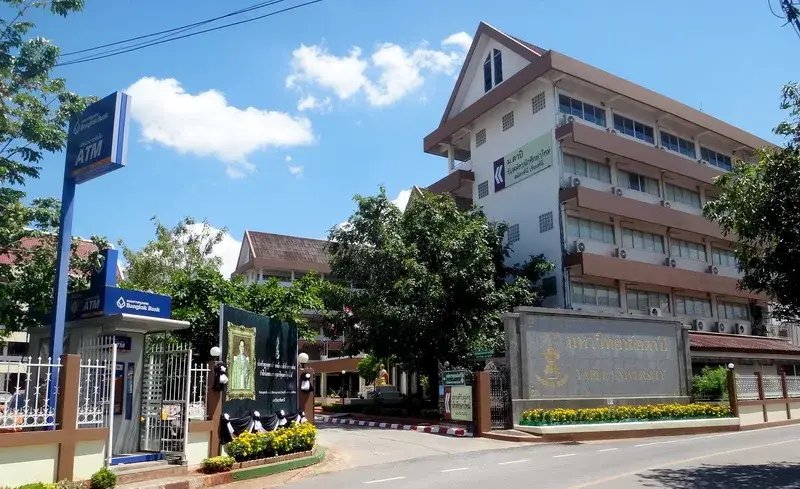
Tapee University (มหาวิทยาลัยตาปี) is a private university located at 8/151 Sri Wichai Road, Makham Tia Subdistrict, Mueang Surat Thani District, Surat Thani Province, southern Thailand. It holds an important place in the province's educational history as Surat Thani's first private higher education institution. Originally established as Tapee College on February 26, 1999, with Ajarn Worot Sripairoj as the license holder, the institution received authorization to begin operations on May 1, 1999. It was subsequently upgraded from college to university status in 2012. As of 2026, Tapee University provides academic programs in business administration, digital technology, accounting, education, law, and public administration, emphasizing professional knowledge, practical skills, and social responsibility.
The significance of Tapee University extends beyond its position as the first private higher education institution established in Surat Thani Province. Its history reflects the growing role of private universities in expanding educational opportunities outside Thailand's largest cities. Beginning with business administration, the institution gradually broadened its academic offerings to include disciplines related to law, public administration, accounting, digital innovation, and education. This development reflects changing professional requirements and the increasing importance of specialized knowledge in the economy of southern Thailand.
Tapee University's main contact address is in Makham Tia, an urban subdistrict of Mueang Surat Thani District connected to the city's transportation network. The university is accessible via Sri Wichai Road, an important local road serving residential areas, businesses, educational facilities, and other services. The university environment includes teaching buildings, administrative offices, classrooms, computer facilities, and spaces supporting academic and student activities. Its location provides access to the services and amenities of Surat Thani city while supporting the university's educational functions.
Surat Thani is an important commercial and transportation center in upper southern Thailand. Its economy is supported by agriculture, commerce, services, transportation, and tourism. The province also connects mainland communities with internationally known destinations in the Gulf of Thailand. These economic activities require personnel with knowledge of business operations, management, accounting, information technology, legal systems, and public administration. Tapee University's academic development can be understood within this wider regional context, as its programs address several professional fields relevant to businesses and organizations in the area.
The institution's formal history began on February 26, 1999, when Ajarn Worot Sripairoj received a license from the Ministry of University Affairs to establish a private higher education institution. The authorization was issued under the private higher education legislation in force at the time. The establishment of Tapee College represented an important development for Surat Thani because it introduced another institutional pathway to higher education within the province, expanding the choices available to students and working adults.
Ajarn Worot Sripairoj was an important figure in the institution's establishment and subsequent development. As the original license holder, he played a central role in the creation of Tapee College. His involvement continued into the university's institutional transition, including the process through which Tapee College obtained university status. His name is therefore closely associated with both the foundation of the college and its later development into Tapee University.
On May 1, 1999, Tapee College received official recognition to begin operations. Its initial academic activities centered on the Faculty of Business Administration and Bachelor of Business Administration programs. The educational arrangements included a four-year undergraduate program and two-year continuing programs, with regular and supplementary study formats according to the approvals in force during that period. This structure broadened access for learners with different academic backgrounds and professional commitments.
Business administration was a practical choice for the college's initial academic development. Surat Thani's commercial activities created demand for individuals with skills in accounting, marketing, business computing, and organizational management. These subjects provided students with knowledge that could be applied in companies, small businesses, administrative departments, and commercial organizations. The early curriculum therefore established an academic foundation closely connected with professional employment.
On June 1, 2000, Tapee College received educational standards recognition from the Ministry of University Affairs. The qualifications associated with its continuing Bachelor of Business Administration program also received recognition under the relevant requirements beginning in the 2000 academic year. These developments were significant because the recognition of academic programs and qualifications is essential to the credibility and professional usefulness of higher education.
On June 1, 2002, the four-year Bachelor of Business Administration program received recognition of its educational standards. During the 2002 academic year, the college also obtained authorization to provide a program in General Management. This expansion strengthened the institution's business education offerings by introducing additional opportunities to study organizational administration, operational planning, resource management, and professional decision-making.
Another major development took place during the 2003 academic year, when Tapee College obtained authorization to offer a Bachelor of Laws program in a supplementary study format. Introducing law marked an expansion beyond the college's original concentration on business administration. It provided a new academic pathway for students interested in legal systems, rights and responsibilities, legal reasoning, and the role of law in government, business, and society.
As the college continued developing its programs and academic organization, it began the process of changing its institutional category from a college to a university. On August 14, 2012, a ceremony was held for the presentation of the license authorizing the change from Tapee College to Tapee University. Worot Sripairoj, serving as Chairman of the University Council, participated in the presentation conducted by the Secretary-General of the Commission on Higher Education. This marked an important milestone in the institution's history.
The year 2012 should be distinguished from 1999 when describing the history of Tapee University. The institution was originally established in 1999, whereas 2012 marked its conversion into a university. These dates represent different stages of institutional development. The former identifies the beginning of its higher education operations, while the latter relates to its subsequent recognition and classification as a university.
Following its change of status, Tapee University continued its development as a multidisciplinary private institution. Earlier university structures included faculties associated with Business Administration, Law, Liberal Arts, Science and Technology, and Accounting. Its academic organization subsequently evolved in response to changing curriculum requirements and developments in professional education. By 2026, the university's official website identified five principal faculties offering programs across undergraduate and graduate levels.
The university's name is associated with the Tapee River, also commonly known as the Tapi River, one of the most important waterways in Surat Thani Province. The river has long influenced settlement, transportation, trade, and community life in the region. Using a name connected to this prominent local geographical feature reinforces the university's relationship with Surat Thani and its wider cultural landscape.
The university's emblem incorporates the image of Phra That Si Surat, an important religious landmark in Surat Thani. Radiating elements appear above the central structure, while a Bodhi leaf motif forms part of the lower design. These elements symbolize local cultural heritage, the spread of goodness, knowledge, and wisdom. The emblem therefore expresses an identity connected to both higher education and the cultural and religious traditions of the province.
Yellow is associated with the university's official institutional color and traditional flag. The institution's historical identity also emphasizes professional effectiveness and volunteer-minded service. The ability to work effectively involves practical competence, analytical thinking, continuous learning, creativity, and the application of academic knowledge. Volunteer service reflects concern for the well-being of others, a willingness to contribute to community activities, and responsibility toward society.
The emphasis on professional competence is especially relevant to higher education that seeks to connect learning with employment. Students require theoretical understanding as well as practical skills, communication abilities, problem-solving techniques, and adaptability. At the same time, the university's commitment to volunteer service encourages graduates to recognize that professional knowledge can benefit communities and organizations beyond their own careers.
In 2026, Tapee University presented its educational approach under the concept of learning alongside professional work. Its academic direction emphasized contemporary workplace skills, digital technology, and practical applications of knowledge. This approach responds to changes in employment, including the growing need for digital literacy, data-related skills, organizational management, and the ability to learn new technologies throughout a professional career.
The university's academic organization consists of five principal faculties: the Faculty of Business Administration, the Faculty of Digital Technology Innovation, the Faculty of Accounting, the Faculty of Education and Liberal Arts, and the Faculty of Law and Political Science. Its published 2026 program directory lists seven undergraduate programs and three graduate-level programs, including a graduate diploma and two master's degrees. Together, these programs provide opportunities for learners interested in different academic qualifications and professional fields.
The Faculty of Business Administration offers the Bachelor of Business Administration in Business Management and the Bachelor of Business Administration in Marketing. The faculty emphasizes organizational administration, commercial operations, business planning, and the development of management skills. Students learn about business environments, decision-making, resource management, customer relationships, and the planning of products and services.
Business Management focuses on the principles and practices of running organizations, coordinating operations, and managing business activities. These skills can be applied in family enterprises, small businesses, private companies, and administrative departments. Marketing, meanwhile, concentrates on consumer behavior, marketing communication, market planning, and business activities in the digital economy. Both subjects are relevant to the changing commercial landscape of Surat Thani and other regions.
The Faculty of Business Administration also offers the Master of Business Administration. This graduate program is designed for students and professionals seeking advanced knowledge of management, organizational leadership, and business decision-making. The program emphasizes the application of management concepts, strategic thinking, and digital technology in contemporary organizations.
The Faculty of Digital Technology Innovation reflects the university's response to technological developments in business and society. Its undergraduate programs are the Bachelor of Science in Digital Technology and the Bachelor of Business Administration in Digital Business Computing. Both programs connect technology-related knowledge with professional applications, although their academic emphases differ.
Digital Technology focuses on contemporary digital systems and their applications, including artificial intelligence, data, cloud technologies, and digital innovation. The subject is relevant to organizations that depend on technology for communication, information processing, operational improvement, and service development. Digital Business Computing combines business knowledge with information systems and digital tools, helping students understand how technology supports organizational administration and commercial activities.
The Faculty of Accounting provides the Bachelor of Accountancy program. Accounting is essential to financial management, business administration, and organizational accountability. The curriculum includes subjects relating to accounting principles, taxation, auditing, finance, and accounting information systems. Students in this field develop accuracy, analytical thinking, professional responsibility, and the ability to interpret financial information for organizational purposes.
The Faculty of Education and Liberal Arts provides graduate-level education in the teaching profession and educational administration. Its published programs include the Graduate Diploma in the Teaching Profession and the Master of Education in Educational Administration. These programs are relevant to learners who wish to develop professional educational qualifications or gain advanced knowledge of school leadership and educational management.
The Graduate Diploma in the Teaching Profession supports the development of teaching-related knowledge and competencies for eligible university graduates, subject to the program's admission requirements and professional regulations. The Master of Education in Educational Administration focuses on educational leadership, institutional management, innovation, technology, and good governance in education. Such knowledge is relevant to school administrators and professionals involved in educational development.
The Faculty of Law and Political Science offers the Bachelor of Laws in Law and the Bachelor of Public Administration in Public Administration. The two programs share an interest in institutions, governance, and public responsibility but emphasize different professional areas. Law provides the foundations for understanding legal systems, legal reasoning, justice, and the rule of law. Public Administration examines the organization and management of government agencies, public services, administrative processes, and governance.
Legal education helps students understand the principles governing relationships among individuals, businesses, and public institutions. Public Administration develops knowledge of public-sector management, public policy, administrative law, and organizational responsibility. Both subjects prepare students to understand the legal and administrative environments in which public and private organizations operate.
At the graduate level, Tapee University's published program directory for 2026 includes three programs: the Graduate Diploma in the Teaching Profession, the Master of Education in Educational Administration, and the Master of Business Administration. The fact that a program appears in the university's directory does not necessarily mean that it is accepting new applicants in every admission period. Applicants should consult the official admissions system for the specific intake, admission requirements, study plan, and supporting documents.
Digital learning support forms part of the university's academic environment. The university has an office dedicated to learning support and digital technology, with services related to information systems used by students and staff. Online systems help support registration, academic records, timetables, credit transfer, and other student services. Such facilities contribute to greater administrative efficiency and provide learners with access to important academic information.
The university also lists a center dedicated to promoting digital innovation and business capabilities. This reflects the importance of technology in contemporary professional education. Digital skills are now relevant across many fields, including business management, marketing, accounting, administration, and public services. The development of these capabilities supports students who need to understand digital tools alongside the requirements of their primary academic disciplines.
Research and academic services form another component of the university's mission. Its Office of Research and Academic Services supports activities associated with knowledge development and engagement with the wider community. Research and academic services help connect the resources of a higher education institution with the needs of local organizations, businesses, and communities. Activities may include professional training, knowledge exchange, applied studies, and the transfer of academic expertise.
The university's historical mission also places importance on preserving arts and culture, community traditions, local ways of life, and the environment. This role is particularly relevant in Surat Thani, a province with strong Buddhist traditions, riverside communities, local craftsmanship, and distinctive southern Thai cultural practices. Cultural activities provide students with opportunities to understand the relationship between education and the communities in which they live.
The official academic calendar for the first semester of 2026 recorded several significant student and cultural activities. Undergraduate orientation and institutional sports activities were scheduled for June 27, 2026. The annual Wai Khru, or teacher-honoring ceremony, took place on July 18, 2026, while a Buddhist Lent candle-offering activity was scheduled for July 26, 2026. These events contributed to student engagement and reflected the university's connection with Thai educational and religious traditions.
The Wai Khru ceremony is an important Thai educational tradition expressing gratitude and respect toward teachers. Within a university, it provides students with an opportunity to acknowledge the contribution of their instructors and reflect on the ethical values associated with learning. The Buddhist Lent candle-offering tradition similarly connects university life with local religious practices and the preservation of Buddhist cultural heritage.
The university's 2026 academic calendar also included an activity promoting the Chak Phra and Thot Pha Pa traditions on October 26, 2026. These traditions are important elements of the cultural identity of Surat Thani Province. Chak Phra is closely associated with Buddhist beliefs and community participation following the end of Buddhist Lent, while Thot Pha Pa involves offering robes and donations to support Buddhist institutions. Including these activities in the academic calendar reflects the university's connection with the cultural life of the surrounding region.
Student life at Tapee University involves academic learning, group work, practical training, student activities, and the use of digital learning services. Its educational emphasis on combining study with work-related skills encourages students to develop communication, cooperation, adaptability, and problem-solving abilities. These competencies are particularly relevant to professional environments in which employees must apply knowledge effectively and respond to changing organizational needs.
One of the university's important administrative units is the Office of Academic Promotion and Registration. It provides services relating to course registration, academic records, official educational documents, academic calendars, and student information. The university also offers online services supporting the management of registration, timetables, credit transfers, and academic requests. These systems are useful to both current students and individuals who need to contact the university about academic matters.
The Office of Academic Promotion and Registration is open Tuesday through Saturday from 8:30 AM to 4:30 PM. Its telephone number is +66 77 204 431, extension 230, and its email address is reg@tapee.ac.th. These are the published contact hours of the registration office, not the opening and closing hours of the entire university. Academic buildings, classrooms, individual departments, and special activities may follow different schedules.
Prospective students can use the university's official online admission system to review available programs, admission rounds, and application requirements. The online process includes creating an applicant account, providing academic and personal information, submitting the required documents, and following the specific procedures for each program. Using the official admissions platform helps applicants obtain information directly from the university and avoid confusion caused by outdated or unofficial listings.
Visitors interested in organized educational visits should contact the relevant department before arriving. As an active university, Tapee University uses its buildings and facilities for scheduled teaching and administrative functions. Classrooms, computer laboratories, and academic offices may have access restrictions or require advance arrangements. Confirming the purpose and location of a visit is therefore useful for students, parents, prospective applicants, and other visitors.
From an educational tourism perspective, Tapee University provides an opportunity to understand the development of private higher education in Surat Thani. Its institutional history illustrates the transition from a business-oriented private college to a university offering several professional disciplines. The university's emblem also connects its identity with Phra That Si Surat, a local religious landmark, creating an additional link between education, cultural heritage, and the history of the province.
Getting There: Tapee University's published contact address is 8/151 Sri Wichai Road, Makham Tia Subdistrict, Mueang Surat Thani District, Surat Thani Province 84000. Visitors traveling by private car can use Sri Wichai Road and enter the university name or full address into a navigation application. Those staying in central Surat Thani can arrange a hired vehicle or available local transportation. Travelers arriving at Surat Thani Railway Station or Surat Thani International Airport can continue into Mueang Surat Thani before traveling to the university. Using the official Sri Wichai Road address will help identify the correct destination for university administration and registration services.
Some external location directories also identify a Tapee University site in Maluan Subdistrict, Phunphin District, commonly referred to as the Phunphin Campus or Surat Thani International Airport Campus. This location is separate from the official contact address on Sri Wichai Road in Mueang Surat Thani. Students and visitors should follow the specific destination stated in their appointment or university notice and confirm the location with the relevant department before traveling.
A visit to the university can also be combined with an exploration of important places in Surat Thani. Khao Tha Phet and Phra That Si Surat are particularly relevant because of the religious landmark's connection with the university's emblem. Other places of interest include Ko Lamphu Public Park, Surat Thani City Pillar Shrine, and the Saphan Narit riverside area along the Tapi River. These sites provide opportunities to experience the province's landscape, local beliefs, public spaces, and riverside community life.
Since the establishment of Tapee College in 1999 and its conversion into Tapee University in 2012, the institution has continued developing its role in private higher education in southern Thailand. Its historical significance as Surat Thani's first private higher education institution is complemented by its academic programs in business, accounting, digital technology, law, public administration, and education. Through its emphasis on professional competence, volunteer service, and community-oriented academic activities, Tapee University remains part of the educational and social development of Surat Thani Province and upper southern Thailand.
Summary Table
| University Name | Tapee University |
| Thai Name | มหาวิทยาลัยตาปี |
| Abbreviation | TPU |
| Institution Type | Private university |
| Location | Makham Tia Subdistrict, Mueang Surat Thani District, Surat Thani Province, Thailand |
| Official Contact Address | 8/151 Sri Wichai Road, Makham Tia, Mueang Surat Thani, Surat Thani 84000, Thailand |
| Former Name | Tapee College |
| Institution Founded | February 26, 1999 |
| Authorized to Begin Operations | May 1, 1999 |
| Conversion to University Status | 2012; university license presentation held on August 14, 2012 |
| Institutional Age in 2026 | 27 years since the original establishment in 1999 and 14 years since the conversion to university status in 2012 |
| Founder and Important Figure | Ajarn Worot Sripairoj, original license holder and a key figure in the university's development |
| Historical Significance | The first private higher education institution established in Surat Thani Province |
| Name Origin | Associated with the Tapee (Tapi) River, an important river in Surat Thani Province |
| University Emblem | Phra That Si Surat motif with radiating elements and a Bodhi leaf, symbolizing goodness, knowledge, and wisdom |
| University Color | Yellow |
| Institutional Identity | Professional competence and volunteer-minded service |
| Educational Approach | Learning alongside professional work, with emphasis on practical knowledge, digital skills, and social responsibility |
| Academic Faculties | 1. Faculty of Business Administration 2. Faculty of Digital Technology Innovation 3. Faculty of Accounting 4. Faculty of Education and Liberal Arts 5. Faculty of Law and Political Science |
| Published Academic Programs for 2026 | 7 undergraduate programs and 3 graduate-level programs, totaling 10 programs in the university's published directory |
| Major Academic Fields | Business Administration, Marketing, Digital Technology, Digital Business Computing, Accounting, Law, Public Administration, Teaching Profession, and Educational Administration |
| Important Academic Support Units | Office of Academic Promotion and Registration, Office of Research and Academic Services, Office of Learning Support and Digital Technology, Center for Digital Innovation and Business Capability Development, and Student Affairs |
| University Traditions and Activities | New Student Orientation, Wai Khru Ceremony, Institutional Sports Activities, Buddhist Lent Candle Offerings, and Activities Promoting Chak Phra and Thot Pha Pa Traditions |
| Registration Office Open Days | Tuesday – Saturday |
| Registration Office Hours | 8:30 AM – 4:30 PM |
| Campus Visits | Advance arrangements are recommended. Academic buildings, laboratories, and administrative offices have their own access conditions. |
| Getting There | Travel from central Surat Thani to Sri Wichai Road in Makham Tia by private car or hired local transportation, using the university's official address for navigation. |
| Attractions in Mueang Surat Thani and Surrounding Areas | 1. Khao Tha Phet 2. Phra That Si Surat Viewpoint 3. Ko Lamphu Public Park 4. Surat Thani City Pillar Shrine 5. Saphan Narit and the Tapi River Waterfront |
| Restaurants and Cafés in Mueang Surat Thani | 1. Pang Nom Sod Suratthani, Sri Wichai Road, Tel. +66 95 971 9719 2. Kungfu's Daddy, Sri Wichai Soi 31, Tel. +66 80 681 9697 3. Kapi Restaurant, Tel. +66 99 023 4789 4. Mee Par Cafe, Talad Mai Road, Tel. +66 81 895 7566 5. Cafe Yu, Namueang Road, Tel. +66 99 287 4255 |
| Accommodation in Mueang Surat Thani | 1. Rhienchai Place Hotel, Sri Wichai Soi 28, Tel. +66 77 275 992 2. Silatel Hotel, Sri Wichai Road, Tel. +66 85 697 1666 3. The Centrino Serviced Residence, Sri Wichai Road, Tel. +66 98 691 6155 4. Marlin Hotel, Sri Wichai Soi 1, Tel. +66 98 013 3191 5. Wang Tai Hotel, Talad Mai Road, Tel. +66 77 283 020 |
| University Telephone | +66 77 204 431 |
| Registration Office Telephone | +66 77 204 431, extension 230 |
| University Email | tpu@tapee.ac.th |
| Registration Office Email | reg@tapee.ac.th |
| Official Website | https://www.tapee.ac.th/ |
| Admissions Website | https://admission.tapee.ac.th/ |
| Current Status | Operating as an active private university with academic programs and admission activities in the 2026 academic year |
Academic Programs at Tapee University, Academic Year 2026 (B.E. 2569)
| Faculty and Degree Level | Programs and Fields of Study |
| Faculty of Business Administration | Bachelor's Degrees 1. Bachelor of Business Administration in Business Management (at least 120 credits) 2. Bachelor of Business Administration in Marketing (at least 120 credits) Master's Degree 3. Master of Business Administration (36 credits) |
| Faculty of Digital Technology Innovation | Bachelor's Degrees 1. Bachelor of Science in Digital Technology (121 credits) 2. Bachelor of Business Administration in Digital Business Computing (121 credits) |
| Faculty of Accounting | Bachelor's Degree 1. Bachelor of Accountancy (at least 120 credits) |
| Faculty of Education and Liberal Arts | Graduate Diploma 1. Graduate Diploma in the Teaching Profession (at least 33 credits) Master's Degree 2. Master of Education in Educational Administration (at least 42 credits) |
| Faculty of Law and Political Science | Bachelor's Degrees 1. Bachelor of Laws in Law (136 credits) 2. Bachelor of Public Administration in Public Administration (124 credits) |
Frequently Asked Questions (FAQ)
Q: Where is Tapee University located?
A: Tapee University's official contact address is 8/151 Sri Wichai Road, Makham Tia Subdistrict, Mueang Surat Thani District, Surat Thani Province 84000, Thailand.
Q: What are the opening days and hours of Tapee University?
A: The Office of Academic Promotion and Registration is open Tuesday to Saturday from 8:30 AM to 4:30 PM. Other departments and campus facilities may follow separate schedules.
Q: When was Tapee University established?
A: The institution was founded on February 26, 1999, as Tapee College and was authorized to begin operations on May 1, 1999. It became a university in 2012.
Q: Who founded Tapee University?
A: Ajarn Worot Sripairoj was the original license holder who established Tapee College and played an important role in its subsequent development into Tapee University.
Q: Is Tapee University a public or private university?
A: Tapee University is a private university and is recognized as the first private higher education institution established in Surat Thani Province.
Q: How many faculties does Tapee University have?
A: The university lists five principal faculties: Business Administration, Digital Technology Innovation, Accounting, Education and Liberal Arts, and Law and Political Science.
Q: Does Tapee University offer master's degree programs?
A: Yes. Its published graduate programs include the Master of Business Administration and the Master of Education in Educational Administration. Admission depends on the specific program and intake.
Q: How can I apply to Tapee University?
A: Prospective students can review programs and admission periods through the official online admissions website at https://admission.tapee.ac.th/ or contact the university at +66 77 204 431.
 Category: ●University
 Group: ●Private University
Last Update : 4 DayAgo
 Last Update : 4 DayAgo
 Click to Access the Navigation Map GPS

 Art, Culture and Heritage
 Landmarks and Memorials(1)
 Art, Craft Centres, Tradition(8)
 Museums(5)
 Educational Places
 Educational Gardens, Farm(1)
 Public university(1)
 Rajabhat University(1)
Private University(1)
 Places of Worship
 Temple(32)
 Other Sacred Sites(8)
 Research and Development
 Royal Project(1)
 Suburban Living
 Village, Community(6)
 Local Market(1)
 Nature and Wildlife
 National Parks and Marine Reserves(8)
 Mountain (Doi)(2)
 Dam, Reservoir, Lake(8)
 Waterfalls(34)
 Hot Springs(7)
 Caves(18)
 River, Canal(11)
 Bays and Beaches(30)
 Islands(16)
 Other natural attractions(10)
 Entertainment and Agricultural
 Animal camps and shows(6)
 Farms, Parks and Ecotourism(7)
 Outdoor and Adventure Activities(2)
 Shopping
 Shopping and Night Market(1)
 Travel Articles, Recipes
 Travel Review, Food Review(1)
 Southern Food Menu, Southern Food Recipes(1)


