
lovethailand home >South Travel Attractions >Ranong Travel Attractions >Muang Ranong >Khao Niwet > Khaw Soo Cheang Monument
TL;DR: Khaw Soo Cheang Monument is located at Permphon Road, in front of Ranong Municipality, Khao Niwet Subdistrict, Mueang Ranong District, Ranong Province, open Daily, hours 24 Hours.
Khaw Soo Cheang Monument
Open Days: Daily
Opening Hours: 24 Hours
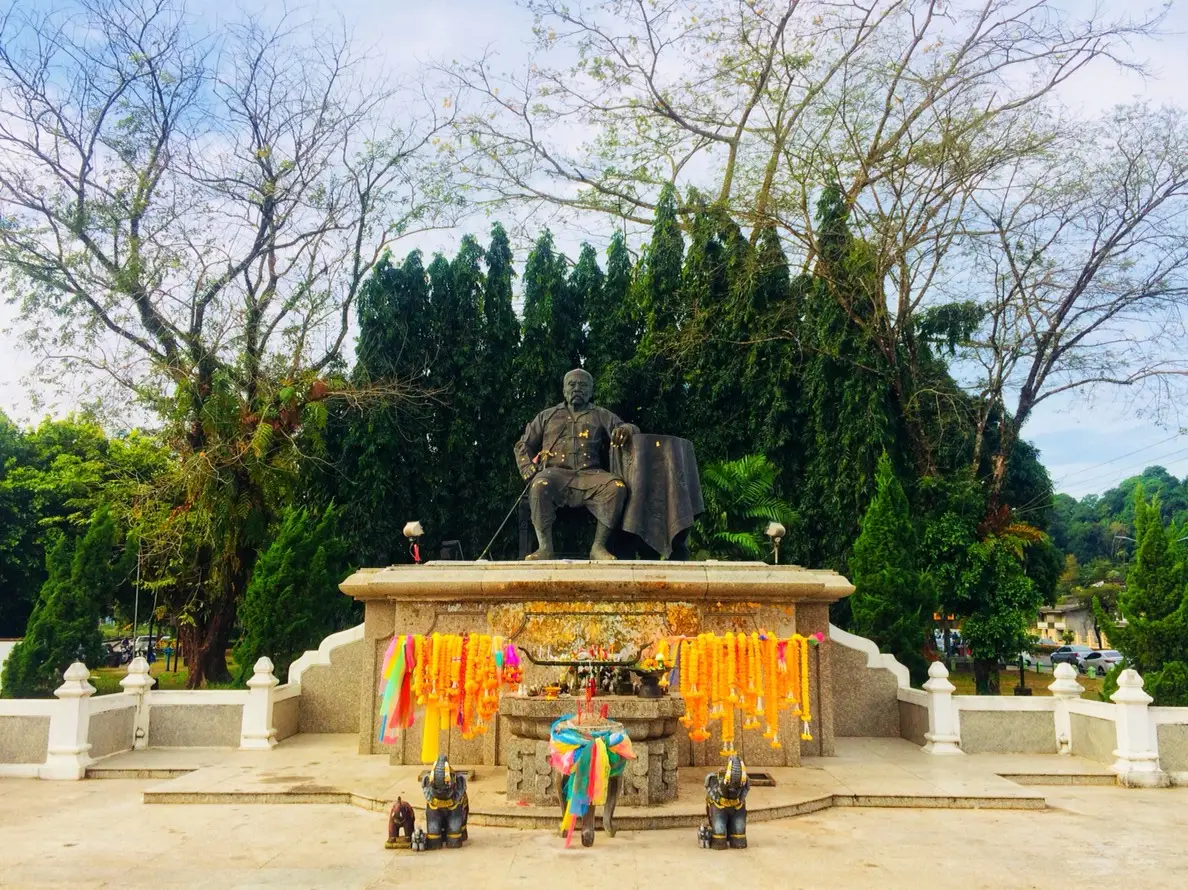
Khaw Soo Cheang Monument in Ranong, officially known as the Phraya Damrong Sucharit Mahisorn Phakdi Monument, is located in the public square in front of Ranong Municipality on Permphon Road, Khao Niwet Subdistrict, Mueang Ranong District, Ranong Province. It is one of the most meaningful historical landmarks in Ranong town and a respected place of homage for local people. The monument was built to commemorate Phraya Damrong Sucharit Mahisorn Phakdi, also known as Khaw Soo Cheang Na Ranong, the first governor of Ranong and the founder of the Na Ranong family. He played a decisive role in developing Ranong through tin mining, tin-tax administration, trade, and local governance. The surrounding plaza is open, accessible, and suitable for paying respect, taking photographs, resting briefly, and beginning a heritage route through Ranong town.
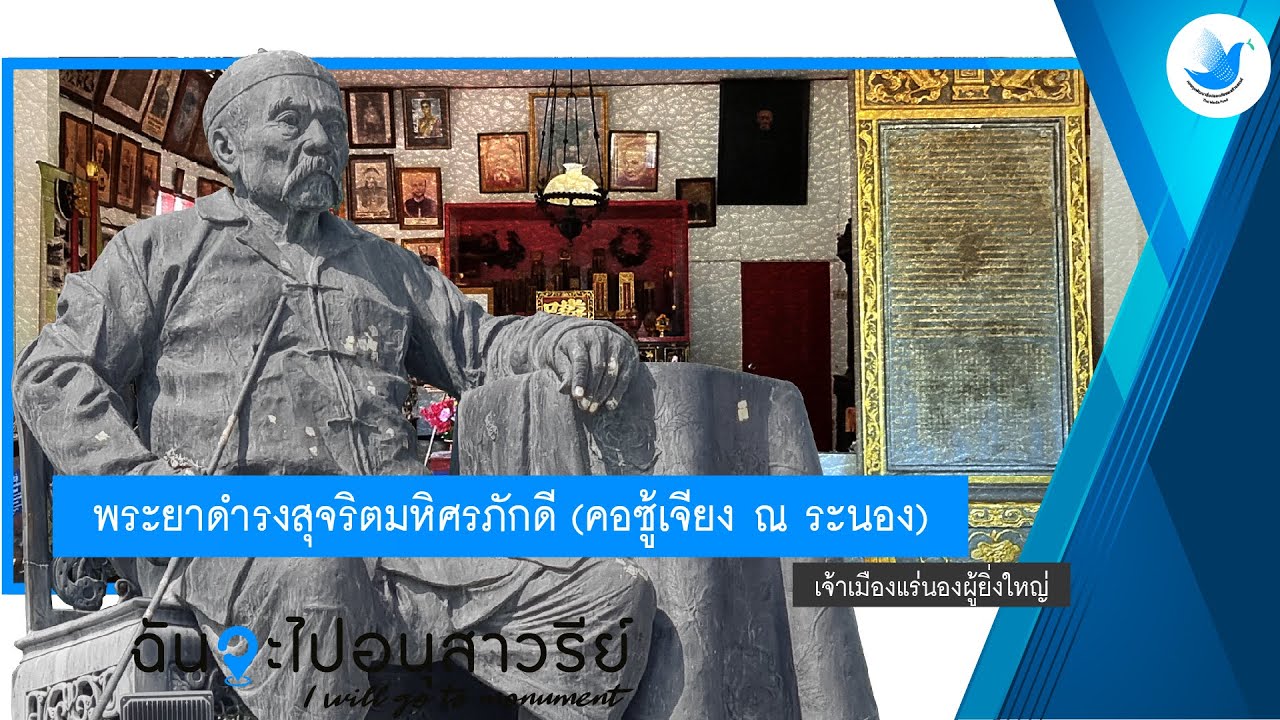
Khaw Soo Cheang Monument in Ranong is more than a statue in the middle of town. It is a compact historical landmark that helps visitors understand how Ranong grew from a small frontier settlement into an important Andaman-side town. Khaw Soo Cheang, later known by his Thai title Phraya Damrong Sucharit Mahisorn Phakdi, was a Hokkien Chinese migrant who entered Siam and built his life through trade, mining, and administration. His name remains central to Ranong because he helped shape the town’s economy and governance during the period when tin was one of the most important resources on the western coast of southern Thailand.
The monument stands on Permphon Road in front of Ranong Municipality, in Khao Niwet Subdistrict. This location is important because it places the monument in the civic heart of the town. It is surrounded by government offices, old-town streets, restaurants, hotels, the city pillar shrine, and several major heritage sites. Visitors can therefore use the monument as a starting point for understanding Ranong’s historical identity before continuing to nearby places such as Rattanarangsan Palace, Ranong Governor’s Residence, Raksawarin Hot Springs, and Ranong Governor’s Grave.
Khaw Soo Cheang was central to Ranong’s early development because the province was historically linked with tin. The old town depended on mining, trade, taxation, and maritime connections. Ranong was once a small town under wider regional administration before it grew in importance through tin production and commercial activity. Khaw Soo Cheang recognized the economic potential of Ranong and nearby areas, took part in mining and trade, and later gained the trust of the royal administration. His rise from merchant and miner to governor reflects the close relationship between economic skill, local leadership, and state service in nineteenth-century southern Thailand.
His life also reflects the wider story of overseas Chinese communities in the Andaman region. Like many Hokkien migrants in Southeast Asia, he moved through maritime trade networks before establishing himself in Siam. His success came from endurance, commercial ability, local knowledge, and reliability in administrative work. The monument therefore represents both the history of an individual and the broader historical movement of Chinese migrants who helped shape commerce, mining, and urban development in southern Thailand.
What gives this monument strong historical weight is the fact that it stands in the town Khaw Soo Cheang helped build. Ranong’s landscape includes mountains, rivers, hot springs, coastal routes, forests, and mineral resources. Turning such a landscape into a functioning provincial town required leadership, labor, trade networks, and administrative capacity. Khaw Soo Cheang’s role in tin mining and taxation was part of this larger process of building Ranong’s economy and civic structure.
The statue of Phraya Damrong Sucharit Mahisorn Phakdi was installed on 23 November 2000. The seated figure stands on a raised pedestal and presents the image of a respected elder, administrator, and town leader. The base of the monument provides space for garlands, flowers, candles, incense, and offerings. These details show that the site is not only a historical memorial but also an active place of respect for local residents and visitors.
The surrounding area is an open public square, allowing people to gather, rest, pay respect, and take photographs. This simple urban setting is part of the monument’s value. It is not a distant museum object; it is integrated into the daily life of Ranong. Local people can visit it easily, and travelers can include it in a short walk or a heritage route through the town center.
The monument also helps balance the common image of Ranong. Many travelers know the province for hot springs, Koh Phayam, Grass Hill, waterfalls, rain, and Andaman coastal scenery. The Khaw Soo Cheang Monument introduces another side of Ranong: the history of tin mining, Chinese-Hokkien settlement, tax administration, provincial governance, and the Na Ranong family. To understand Ranong fully, visitors should see both its natural landscape and its historical foundations.
The name Khaw Soo Cheang is closely tied to the economic and social structure of old Ranong. Tin was a resource that connected Ranong with other Andaman-side towns such as Phang Nga, Phuket, Takua Pa, and trading centers across the sea. Khaw Soo Cheang’s movement from trade and mining into official administration shows how economic influence and state trust could create a new local leadership class during that period.
When combined with nearby heritage sites, the monument becomes even more meaningful. Ranong City Pillar Shrine expresses the spiritual identity of the town. Rattanarangsan Palace connects Ranong with King Rama V’s visit and the royal history of the Rattanakosin period. Ranong Governor’s Residence reflects the former administrative and residential compound of the Na Ranong family. Ranong Governor’s Grave preserves Chinese funerary art and the memory of the family lineage. Visiting these places together provides a fuller picture of Ranong’s history.
The monument area is also used for commemorative and homage activities related to Phraya Damrong Sucharit Mahisorn Phakdi. Government offices and local people gather at the plaza to pay respect to this important figure in Ranong’s history. This continuing use shows that Khaw Soo Cheang is not only remembered in books or old documents; he remains part of Ranong’s public memory and local pride.
Visitors interested in history should begin by observing the statue, pedestal, offerings, and surrounding civic setting. The monument’s meaning becomes clearer when seen together with the story of tin mining, tax collection, trade, provincial governance, and the growth of Ranong as a western-coast town. Khaw Soo Cheang’s life was tied not only to business but also to the practical work of developing a town in a challenging landscape.
For photography, the front view of the monument is the most direct composition, showing the seated statue and the offering area. Side angles can include the public square and trees, while wider views show the monument’s relationship with Ranong Municipality. Visitors should photograph respectfully, avoid climbing on the pedestal, avoid touching the statue unnecessarily, and avoid behavior that does not fit a place of homage.
Getting to the monument is easy because it is in central Ranong. Travelers from Bangkok can follow Highway 4, or Phet Kasem Road, toward Chumphon. At the Chumphon-Ranong junction, continue toward Ranong Province and enter Ranong town. The monument stands in front of Ranong Municipality on Permphon Road. Once in town, it is easy to continue to nearby heritage sites, restaurants, hotels, and local markets.
Getting There within Ranong town is convenient by private car, rental car, motorcycle, local hired vehicle, or on foot from nearby accommodation. Visitors staying around Rueang Rat Road, Permphon Road, Rattanarangsan Palace, or the old-town area can reach the monument in a short time. It works well as the first stop of a town walk or as an evening stop before dinner.
The plaza is accessible throughout the day, but the best visiting times are morning, late afternoon, and early evening. Morning is quiet and suitable for paying respect. Late afternoon offers softer light for photography. Early evening works well for travelers who want to combine the monument with dinner or a walk through the old-town area. Visitors who want to read historical information or photograph details should come while there is enough natural light.
There is no entrance fee. The monument is a public memorial and open civic space. Expenses are limited to transport, food, accommodation, or optional offerings. This makes the site suitable for all types of visitors, including families, students, independent travelers, and anyone who wants to understand Ranong through a meaningful central landmark.
Visitors should behave respectfully because the monument is a place of homage for Ranong residents. Dress appropriately, move calmly, do not climb on the pedestal, do not disturb offerings, do not litter, and avoid loud or disruptive behavior. If taking photos, choose angles that do not disturb others and preserve the dignity of the site.
Important details to notice include the statue’s seated posture, the pedestal, the offering area, the public square, and the location in front of Ranong Municipality. These elements show how the monument functions as a memorial, a civic landmark, a place of homage, and a symbol of respect for the person who helped establish Ranong’s foundations.
A practical half-day heritage route can begin at Khaw Soo Cheang Monument, continue to Ranong City Pillar Shrine, Rattanarangsan Palace, Rueang Rat Road, and Ranong Governor’s Residence, then end at Raksawarin Hot Springs. This route is not difficult and gives travelers a strong overview of Ranong’s historical and urban identity.
Travelers with more time should continue to Ranong Governor’s Grave in Bang Non Subdistrict. The grave is the burial place of Khaw Soo Cheang and contains important Chinese funerary art. Visiting the monument and the grave together helps travelers understand both public memory and family memory: the monument represents civic homage, while the grave reflects ancestry, Chinese belief, feng shui, and the continuity of the Na Ranong family.
The Na Ranong family became influential across southern Thailand. Khaw Soo Cheang’s descendants were connected with Ranong, Trang, Phuket, and other Andaman-side towns. A visit to the monument is therefore not only about one person. It also introduces the wider network of trade, administration, and family leadership that shaped the region.
The site is also useful for families and students because it is easy to access and clearly connected with local history. It helps explain how a town is formed through people, resources, roads, trade, administration, and community memory. In this sense, the monument works like an open-air classroom in the center of Ranong.
For travelers who enjoy food and old-town walks, the monument’s location is convenient. It is close to local restaurants, breakfast shops, southern Thai eateries, seafood restaurants, cafés, and accommodation in the town center. Combining the monument with local food gives visitors a better sense of Ranong as both a historical town and a living community.
Overall, Khaw Soo Cheang Monument in Ranong is a small but highly important historical landmark. It brings together the story of Phraya Damrong Sucharit Mahisorn Phakdi, tin mining, Ranong’s early governance, Chinese-Hokkien migration, the Na Ranong family, and the growth of an Andaman-side provincial town. A visit does not require a long time, but it gives valuable context before exploring Ranong’s hot springs, hills, islands, and coastal scenery.
| Name | Khaw Soo Cheang Monument |
| Official / Alternative Names | Phraya Damrong Sucharit Mahisorn Phakdi Monument, Phraya Damrong Sucharit Monument |
| Thai Name | อนุสาวรีย์คอซู้เจียง ณ ระนอง |
| Location | Permphon Road, in front of Ranong Municipality, Khao Niwet Subdistrict, Mueang Ranong District, Ranong Province |
| Address | Public square in front of Ranong Municipality, Permphon Road, Khao Niwet, Mueang Ranong, Ranong 85000, Thailand |
| Coordinates | 9.96106, 98.63905 |
| Important Figure | Phraya Damrong Sucharit Mahisorn Phakdi, or Khaw Soo Cheang Na Ranong, the first governor of Ranong and founder of the Na Ranong family |
| Significance | Commemorates a key figure in Ranong’s tin mining, tin-tax administration, trade, governance, and early town development |
| Statue Installation Date | 23 November 2000 |
| Highlights | Seated statue of Khaw Soo Cheang, offering area, public square, shaded town setting, and easy access to Ranong old-town attractions |
| Travel Information | From Bangkok, follow Highway 4 toward Chumphon. At the Chumphon-Ranong junction, continue toward Ranong Province and enter Ranong town. The monument is located in front of Ranong Municipality on Permphon Road. |
| Current Status | Open as a historical landmark, place of homage, and public square in front of Ranong Municipality |
| Open Days | Daily |
| Opening Hours | 24 Hours |
| Admission Fee | Free Admission |
| Facilities | Public square, offering area, walking space, resting area, nearby roadside parking, nearby restaurants, and nearby accommodation |
| Main Areas / Zones | Monument Pedestal, Offering Area, Public Square In Front Of Ranong Municipality, Walking Area, Shaded Resting Area |
| Local Authority | Ranong Municipality |
| Local Authority Contact | 0-7781-1422 |
| Nearby Tourist Attractions | 1. Ranong City Pillar Shrine, about 0.2 km 2. Rattanarangsan Palace, about 0.6 km 3. Raksawarin Hot Springs, about 1 km 4. Wat Suwan Khiri, Mueang Ranong, about 2 km 5. Ranong Governor’s Grave, about 3 km |
| Nearby Restaurants | 1. FarmHouse Restaurant, about 1 km, Tel. 087-278-4224 2. Ranong O Cha, about 2 km, Tel. 088-167-4164, 077-822-101 3. Khun Lin Ranong, about 2 km, Tel. 077-822-863, 081-892-3455 4. Chill Chill, about 1 km, Tel. 077-983-350 5. KeingLay Ranong, about 7 km, Tel. 086-304-2628 |
| Nearby Accommodations | 1. Numsai Khaosuay Resort, about 0.5 km, Tel. 087-222-8886 2. The B Ranong Trend Hotel, about 1 km, Tel. 077-823-111 3. FarmHouse Hotel Ranong, about 1 km, Tel. 087-278-4224 4. Sook Hotel Ranong, about 1 km, Tel. 093-581-2500 5. Baan Yamoo Ranong, about 4 km, Tel. 095-020-9111 |
Frequently Asked Questions (FAQ)
Q: Where is Khaw Soo Cheang Monument located?
A: Khaw Soo Cheang Monument is located in the public square in front of Ranong Municipality on Permphon Road, Khao Niwet Subdistrict, Mueang Ranong District, Ranong Province.
Q: Who was Khaw Soo Cheang?
A: Khaw Soo Cheang, later known as Phraya Damrong Sucharit Mahisorn Phakdi, was the first governor of Ranong and the founder of the Na Ranong family. He played an important role in tin mining, tin-tax administration, trade, and the early development of Ranong.
Q: Is the monument open every day?
A: Yes. The monument is open daily and accessible 24 hours as a public memorial area. Morning, late afternoon, and early evening are the most suitable times for paying respect and taking photographs.
Q: Is there an admission fee?
A: No. There is no admission fee to visit the monument.
Q: Why is Khaw Soo Cheang Monument important to Ranong?
A: The monument commemorates a key historical figure who contributed to Ranong’s tin mining economy, trade, taxation, administration, and growth as an important Andaman-side town.
Q: How do travelers get to the monument?
A: From Bangkok, follow Highway 4 toward Chumphon, then continue toward Ranong Province at the Chumphon-Ranong junction. Once in Ranong town, head to Ranong Municipality on Permphon Road.
Q: What nearby places can be combined with this visit?
A: Nearby places include Ranong City Pillar Shrine, Rattanarangsan Palace, Raksawarin Hot Springs, Wat Suwan Khiri, and Ranong Governor’s Grave.
Q: How should visitors behave at the monument?
A: Visitors should dress respectfully, move calmly, avoid climbing on the pedestal, avoid touching the statue or offerings unnecessarily, and help keep the public square clean.
 Category: ●Art, Culture and Heritage
 Group: ●Landmarks and Memorials
Last Update : 2 MonthAgo
 Last Update : 2 MonthAgo
 Click to Access the Navigation Map GPS
Khaw Soo Cheang Monument Map
Recommend

 Historical Sites and Monuments(4)
Landmarks and Memorials(1)
 Royal Palace(1)
 Art, Craft Centres, Tradition(4)
 Educational Places
 Educational Gardens, Farm(1)
 Places of Worship
 Temple(12)
 Other Sacred Sites(2)
 Suburban Living
 Village, Community(2)
 Nature and Wildlife
 National Parks and Marine Reserves(6)
 Mountain (Doi)(4)
 Waterfalls(15)
 Hot Springs(3)
 Caves(4)
 River, Canal(2)
 Bays and Beaches(10)
 Islands(8)
 Other natural attractions(3)
 Travel Articles, Recipes
 Travel Review, Food Review(1)


