
lovethailand home >South Travel Attractions >Ranong Travel Attractions >Muang Ranong >Bang Non > Ranong Governor is Cemetery
TL;DR: Ranong Governor is Cemetery is located at Rakhang Thong Hill, Bang Non Subdistrict, Mueang Ranong District, Ranong, open Daily, hours Outdoor Site; Best Visited During Daylight Hours.
Ranong Governor is Cemetery
Open Days: Daily
Opening Hours: Outdoor Site; Best Visited During Daylight Hours
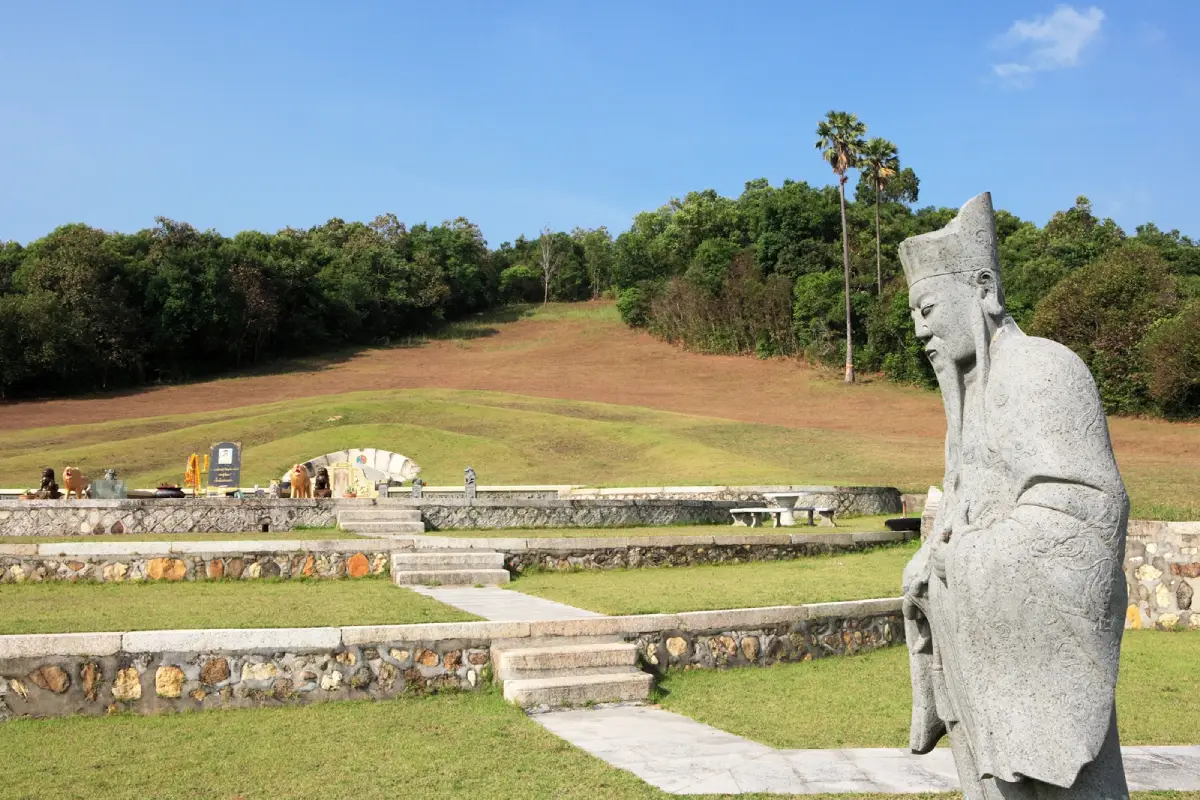
Ranong Governor’s Grave, also known as Ranong Governor Cemetery, is an important historical site in Bang Non Subdistrict, Mueang Ranong District. Located on Rakhang Thong Hill about 1 kilometer from Ranong town along Highway 4004, the cemetery was built in 1883 as the Chinese-style tomb of Chao Phraya Damrong Sucharit Mahisorn Phakdi, better known as Khaw Soo Cheang, the first governor of Ranong and the founder of the Na Ranong family line. The site is known for its Chinese feng shui layout, terraced stone courtyard, imported granite sculptures, Chinese official statues, horses, goats, tigers, stone pillars, and a hillside setting with symbolic meaning tied to power, wisdom, prosperity, loyalty, authority, and the historical identity of Ranong.
Ranong Governor’s Grave is one of the most meaningful historical places to visit in Ranong town. It brings together the story of an influential local leader, the rise of Ranong as a tin-mining town, Chinese Hokkien heritage, feng shui belief, and old stone craftsmanship in a single landscape. The cemetery stands on Rakhang Thong Hill in Bang Non Subdistrict, Mueang Ranong District, close enough to the town center to be visited easily within a short trip. It can also be combined with the Governor’s Residence, Rattanarangsan Palace, Raksawarin Hot Springs, Ranong City Pillar Shrine, and other cultural sites in town.
The cemetery was built in 1883 as the burial place of Chao Phraya Damrong Sucharit Mahisorn Phakdi, or Khaw Soo Cheang, Ranong’s first governor, who passed away in 1882. Khaw Soo Cheang was a Hokkien Chinese migrant who entered Siam in the early Rattanakosin period and built his life through trade, tin mining, and local administration. His integrity, endurance, commercial ability, and administrative vision made him an important figure in the western coast of southern Thailand. Over time, he rose through the official ranks and became one of the key people responsible for shaping Ranong into a significant provincial town on the Andaman side.
Ranong was historically important because of tin, border trade, maritime routes, and its position near the Myanmar frontier. The area has mountains, estuaries, coastal routes, and links to Penang and the Malay Peninsula. Khaw Soo Cheang played a major role in strengthening Ranong’s economy and governance during the tin-mining era. Visiting his grave is therefore not only a visit to an old cemetery. It is a way to understand the foundation of modern Ranong through the life of the man who helped transform the town’s status and identity.
The cemetery is located on land granted by King Chulalongkorn, King Rama V, in honor of Khaw Soo Cheang and the Na Ranong family. The site follows Chinese feng shui principles, with the hill behind the tomb and an open view toward the sea in front. This type of setting reflects the belief that landform, direction, mountain, water, and open space can support family continuity, dignity, prosperity, and future stability. The landscape is therefore part of the meaning of the cemetery, not merely a scenic background.
When visitors enter the cemetery area, the first impression is calmness and balance. A large stone courtyard rises in tiers toward the main tomb. The surrounding hillside and greenery make the site feel quiet and separate from the movement of town. The cemetery is dignified without being excessive. Its beauty lies in the harmony between the stone platforms, granite sculptures, hill backdrop, open lawn, and symbolic objects placed in careful positions along the approach.
Many key elements of the cemetery were made from stone brought from China, including paved stone surfaces, pillars, statues, and decorative details connected with Chinese funerary belief. These materials reflect wealth, trading networks, cultural roots, and the cross-sea connections of the Na Ranong family. They are not merely decorations. They are evidence of Chinese cultural influence in southern Thailand during a time when maritime trade, tin, and overseas Chinese networks played a major role in the Andaman region.
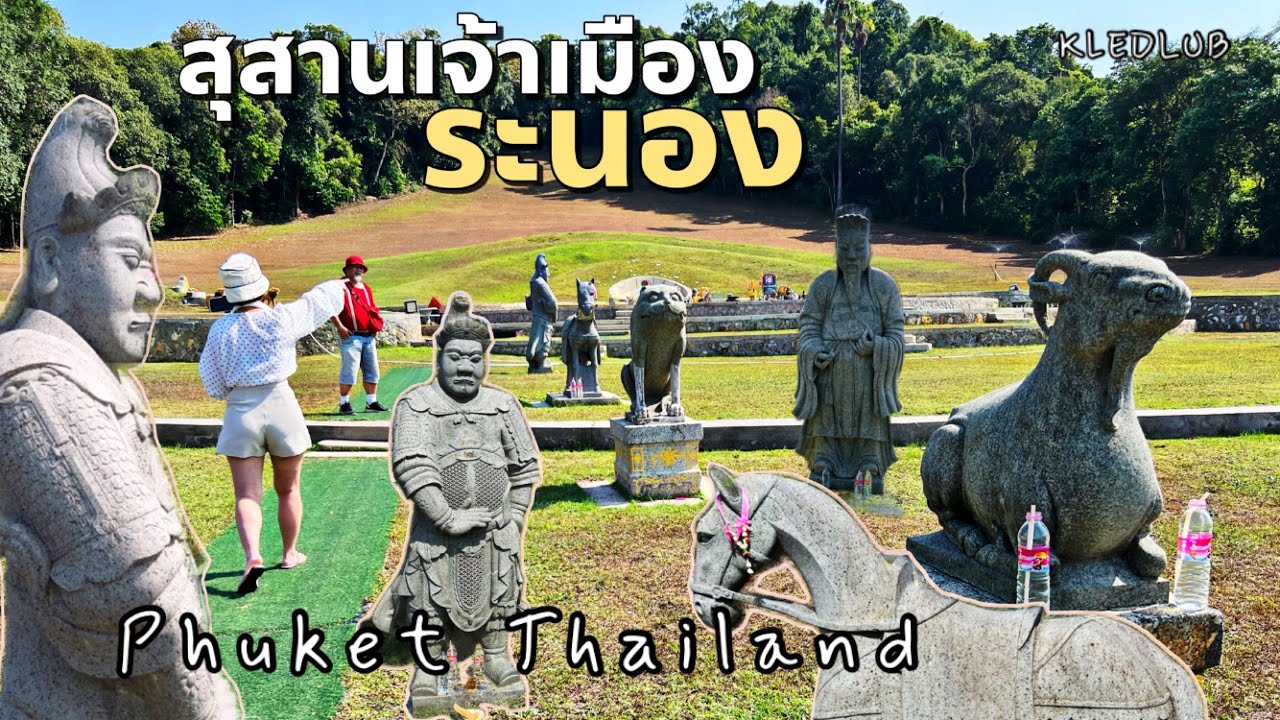
The old granite sculptures placed along both sides of the cemetery are among the most important features to observe. The Chinese military official statues represent warriors, defense, strength, and the stability of the family and the town. The civil official statues represent scholars, wisdom, learning, and administrative ability. Horses symbolize attendants, movement, speed, and active trade. Goats symbolize wealth, prosperity, generosity, and abundance. Tigers symbolize power, authority, courage, and greatness.
Understanding these meanings makes the visit more rewarding. The sculptures are not random ornaments. They form a symbolic procession leading to the tomb. Each figure reinforces a value that the family and community associated with the deceased: strength, wisdom, prosperity, service, protection, and authority. In this way, the cemetery becomes a visual language of Chinese belief translated into stone and adapted to the landscape of Ranong.
The two stone pillars are also important. They carry meanings linked to praise for Ranong’s beauty, peace, prosperity, and the idea of the town as a place that produces capable people. These pillars show that the memory of Khaw Soo Cheang extends beyond the private family sphere. It also connects to the public identity of Ranong as a town shaped by mountains, water, resources, leadership, and local talent.
Architecturally, Ranong Governor’s Grave is a Chinese-style tomb with a broad front courtyard, ascending stone platforms, and a hill rising behind it. The layout creates a clear central axis from the lower approach to the burial area. The open courtyard allows visitors to see the proportions of the whole site, while the hill behind gives the tomb a strong sense of protection and permanence. This combination gives the place historical, artistic, spiritual, and landscape value at the same time.
The cemetery was registered as an archaeological site by the Fine Arts Department on 22 January 1999. This status confirms its importance as a cultural and historical place worthy of conservation. The cemetery is not just a quiet photo stop. It is a material record of local history, Chinese migration, tin-mining economy, political authority, and the development of southern Thailand’s western coast.
Besides the main tomb of Chao Phraya Damrong Sucharit Mahisorn Phakdi, the surrounding area includes the tomb of Khunying Damrong Sucharit Mahisorn Phakdi, also known as Khunying Sit Kim Lian, the matriarch of the Na Ranong family. Other family tombs nearby belong to descendants who served Ranong and other southern towns. This gives the area the character of a family memorial landscape rather than a single isolated burial site.
The descendants of the Na Ranong family were important in southern administration. Names such as Kho Sim Cheng, Kho Sim Kong, Kho Sim Tek, and Kho Sim Bee are linked to political and administrative roles in Ranong, Lang Suan, Phuket, Trang, Phang Nga, Krabi, Takua Pa, Satun, and other southern areas. Phra Rassadanupradit Mahisorn Phakdi, or Kho Sim Bee, was especially important as a commissioner of the Phuket Monthon. Because of this connection, the cemetery helps visitors understand not only Ranong’s local history, but also the wider administrative history of southern Thailand.
Within the broader story of Ranong, the cemetery works together with the Governor’s Residence and Rattanarangsan Palace. The Governor’s Residence reflects the living and administrative space of the city ruler. Rattanarangsan Palace connects Ranong with royal visits and the role of the town in the Rattanakosin period. The cemetery represents memory, honor, lineage, and the final resting place of the first governor. Visiting these places together gives a more complete picture of Ranong’s historical identity.
The atmosphere at the cemetery is best experienced slowly. Visitors should take time to read the historical information, look carefully at the stone sculptures, notice the placement of the figures, and observe how the tomb sits within the hillside landscape. Details that are easy to overlook include the costumes of the Chinese officials, the animal forms, dragon and floral motifs, bird designs, and scenes of old Chinese life carved into the tomb structures.
Ranong Governor’s Grave is suitable for several types of visitors. History travelers can learn about Ranong’s first governor, tin mining, and provincial administration. Visitors interested in Chinese culture can study the feng shui layout and auspicious symbols. Photographers can capture the stone courtyard, ancient sculptures, and green hillside. Travelers who want to understand Ranong beyond hot springs, beaches, and islands will find the cemetery especially valuable.
Getting There is easy from Ranong town. Take Highway 4004, the Ranong-Pak Nam route, toward Bang Non Subdistrict. The cemetery is about 1 kilometer from the municipal town area and is located on Rakhang Thong Hill. Visitors traveling by private car or rental car can set the destination as Ranong Governor’s Grave or Ranong Governor Cemetery. Those using local hired transport should tell the driver they are going to the governor’s cemetery in Bang Non on the road toward Pak Nam Ranong.
The best time to visit is during daylight. The site is outdoors, and the details of the stone platforms, sculptures, pillars, and hillside are best seen in natural light. Morning is good for cooler weather, while late afternoon gives softer light for photography. Visitors should avoid heavy rain because the stone surfaces may become slippery and outdoor viewing becomes less comfortable.
Visitors should behave respectfully. This is both a historical site and a burial place connected to an important family lineage. Dress modestly, walk carefully, do not climb on stone sculptures or tomb structures, do not move objects, do not leave rubbish, and avoid behavior that does not suit the solemn character of the place. The appropriate attitude is similar to visiting a shrine, memorial site, or protected historical place.
For photography, the best compositions include the front stone courtyard, the Chinese official statues, the animal figures, the stone pillars, and the tomb with the hillside behind it. Visitors should take photographs without disturbing anyone who may be paying respect at the site. The strongest images are usually those that show the calmness, symmetry, and cultural detail of the cemetery.
Ranong Governor’s Grave is especially useful for understanding Ranong’s identity. The province is often associated with hot springs, Koh Phayam, Grass Hill, and coastal scenery, but its history also includes Chinese communities, tin mining, trade, administration, and Andaman maritime connections. This cemetery is a direct gateway to those stories. Its location, materials, sculptures, inscriptions, and layout all express the relationship between people, land, power, and memory.
A practical heritage route can begin at Rattanarangsan Palace and Ranong City Pillar Shrine, continue to the Governor’s Residence, then visit Ranong Governor’s Grave to complete the historical story of Khaw Soo Cheang and the Na Ranong family. The day can end at Raksawarin Hot Springs or Chan Damri Beach. This route is not too demanding and gives visitors a balanced view of Ranong through history, old town sites, nature, and relaxation.
What makes Ranong Governor’s Grave worth a detailed visit is that it offers more than the phrase “Chinese tomb” suggests. It tells a layered story of migration, trade, tin mining, government service, family memory, and the blending of Chinese belief with Thai provincial history. When understood properly, the quiet hillside site becomes one of the clearest places to see how Ranong developed and why the Na Ranong family remains important in local memory.
Overall, Ranong Governor’s Grave is a highly valuable historical attraction for travelers who want to know Ranong beyond its natural scenery. It links Khaw Soo Cheang’s life to the founding history of Ranong, presents Chinese funerary art through granite sculptures and feng shui design, and reflects ideas of authority, wisdom, prosperity, loyalty, and family honor. For anyone with time in Ranong town, this site deserves a careful visit because it adds depth and context to the story of this small but historically significant Andaman province.
| Name | Ranong Governor’s Grave |
| Alternative Name | Ranong Governor Cemetery / Tomb Of Khaw Soo Cheang |
| Location | Rakhang Thong Hill, Bang Non Subdistrict, Mueang Ranong District, Ranong |
| Address | Bang Non Subdistrict, Mueang Ranong District, Ranong 85000, Thailand |
| Coordinates | 9.9819343702, 98.6553157949 |
| Highlights | Chinese-style tomb of Chao Phraya Damrong Sucharit Mahisorn Phakdi, or Khaw Soo Cheang, Ranong’s first governor, with stone terraces, Chinese granite sculptures, and a feng shui layout facing the sea with a hill behind |
| History / Period | Built in 1883 after Khaw Soo Cheang passed away in 1882, on land granted by King Rama V |
| Historical Site Status | Registered as an archaeological site by the Fine Arts Department on 22 January 1999 |
| Distinctive Features | Hillside Chinese tomb, terraced stone courtyard, stone materials from China, old granite statues, Chinese stone pillars, and auspicious feng shui symbolism |
| Meaning Of Sculptures | Military officials symbolize strength and stability; civil officials symbolize wisdom; horses symbolize attendants and movement; goats symbolize wealth; tigers symbolize power and authority |
| Travel Information | From Ranong town, take Highway 4004 on the Ranong-Pak Nam route toward Bang Non Subdistrict; the cemetery is about 1 kilometer from the municipal town area |
| Current Status | Open as a historical attraction and registered archaeological site in Bang Non Subdistrict |
| Open Days | Daily |
| Best Visiting Time | Daylight hours, especially morning or late afternoon, are best for viewing stone details and photographing the outdoor site |
| Facilities | Outdoor courtyard, walking path, roadside parking area, and historical information signage around the cemetery |
| Main Areas / Zones | Front Stone Courtyard, Approach Path, Main Tomb Of Khaw Soo Cheang, Chinese Official Statues, Horse Statues, Goat Statues, Tiger Statues, Chinese Stone Pillars, Tomb Of Khunying Sit Kim Lian, Na Ranong Family Tombs |
| Local Authority In The Area | Bang Non Municipality |
| Local Authority Contact | 077-826809 |
| Nearby Tourist Attractions | 1. Wat Suwan Khiri, about 1 km 2. Rattanarangsan Palace, about 2 km 3. Ranong Governor’s Residence, about 2 km 4. Raksawarin Hot Springs, about 4 km 5. Chan Damri Beach, about 8 km |
| Nearby Restaurants | 1. Khun Lin Ranong, about 4 km, Tel. 077-822-863, 081-892-3455 2. Roti Nisara, about 3 km, Tel. 086-574-4324 3. FarmHouse Restaurant, about 3 km, Tel. 094-424-2459 4. Chill Chill, about 3 km, Tel. 080-559-3945, 089-733-5312 5. KeingLay Ranong, about 9 km, Tel. 086-304-2628, 063-620-6090, 063-287-8924 |
| Nearby Accommodations | 1. The B Ranong Trend Hotel, about 2 km, Tel. 077-823-111 2. FarmHouse Hotel Ranong, about 3 km, Tel. 087-278-4224 3. Sook Hotel Ranong, about 3 km, Tel. 093-581-2500 4. Numsai Khaosuay Resort, about 4 km, Tel. 087-222-8886, 077-989-855 5. Baan Yamoo Ranong, about 5 km, Tel. 095-020-9111 |
Frequently Asked Questions (FAQ)
Q: Where is Ranong Governor’s Grave located?
A: Ranong Governor’s Grave is located on Rakhang Thong Hill in Bang Non Subdistrict, Mueang Ranong District, Ranong, about 1 kilometer from the municipal town area along Highway 4004 on the Ranong-Pak Nam route.
Q: When was Ranong Governor’s Grave built?
A: The cemetery was built in 1883 as the tomb of Chao Phraya Damrong Sucharit Mahisorn Phakdi, or Khaw Soo Cheang, the first governor of Ranong.
Q: Who was Khaw Soo Cheang?
A: Khaw Soo Cheang was Chao Phraya Damrong Sucharit Mahisorn Phakdi, the first governor of Ranong and the founder of the Na Ranong family. He played an important role in the development of Ranong during the tin-mining era.
Q: What is special about Ranong Governor’s Grave?
A: The site is a Chinese-style hillside tomb with a feng shui layout, stone terraces, Chinese official statues, horse, goat, and tiger sculptures, Chinese stone pillars, and nearby tombs of the Na Ranong family.
Q: What do the stone sculptures mean?
A: Military officials represent strength and stability, civil officials represent wisdom, horses represent attendants and movement, goats represent wealth, and tigers represent power and authority.
Q: What is the best time to visit Ranong Governor’s Grave?
A: Daylight hours are best, especially morning and late afternoon, because the site is outdoors and the stone details, sculptures, and landscape are easier to appreciate in natural light.
Q: How do travelers get to Ranong Governor’s Grave?
A: From Ranong town, take Highway 4004 toward Pak Nam Ranong and Bang Non Subdistrict. The site is about 1 kilometer from the municipal town area and can be reached by private car, rental car, or local hired transport.
Q: What nearby places can be combined with Ranong Governor’s Grave?
A: Nearby places include Wat Suwan Khiri, Rattanarangsan Palace, Ranong Governor’s Residence, Raksawarin Hot Springs, and Chan Damri Beach, making it easy to plan a heritage-and-nature route in Ranong town.
 Category: ●Art, Culture and Heritage
 Group: ●Historical Sites and Monuments
Last Update : 2 MonthAgo
 Last Update : 2 MonthAgo
 Click to Access the Navigation Map GPS
Ranong Governor is Cemetery Map
Recommend
 Historical Sites and Monuments(4)
 Landmarks and Memorials(1)
 Royal Palace(1)
 Art, Craft Centres, Tradition(4)
 Educational Places
 Educational Gardens, Farm(1)
 Places of Worship
 Temple(12)
 Other Sacred Sites(2)
 Suburban Living
 Village, Community(2)
 Nature and Wildlife
 National Parks and Marine Reserves(6)
 Mountain (Doi)(4)
 Waterfalls(15)
 Hot Springs(3)
 Caves(4)
 River, Canal(2)
 Bays and Beaches(10)
 Islands(8)
 Other natural attractions(3)
 Travel Articles, Recipes
 Travel Review, Food Review(1)


