
lovethailand home >South Travel Attractions >Phatthalung Travel Attractions >Muang Phatthalung >Lam Pam > Wat Wang
TL;DR: Wat Wang is located at Moo 4, Lam Pam Subdistrict, Mueang Phatthalung District, Phatthalung Province, open Daily, hours 07:00 - 17:00.
Wat Wang
Open Days: Daily
Opening Hours: 07:00 - 17:00
Wat Wang in Phatthalung Province is one of the most important historic temples and sacred sites in the old Lam Pam area of Mueang Phatthalung District. Located at Moo 4, Lam Pam Subdistrict, about 6 - 7 km from Phatthalung city along Aphai Aphirak Road or Highway 4047, the temple is closely connected with the former urban center of Phatthalung, the Governor’s Palace, old administrative rituals, and early Rattanakosin-period art. Wat Wang is not only a place of worship. It is a living historical site where visitors can study traditional Thai architecture, mural painting, Buddhist sculpture, royal ceremonial objects, and the memory of old Phatthalung.
The temple is especially important because Lam Pam was once associated with the old city center of Phatthalung before the administrative center later moved to Khuha Sawan. This makes Wat Wang part of a wider historical landscape that includes temples, waterways, local communities, and the Governor’s Palace of Phatthalung. A visit to Wat Wang helps travelers understand how religion, local administration, elite residences, and community life were linked in the old town.
Historical sources describe Wat Wang as an ancient temple. Some accounts suggest that it may have been founded in the late Ayutthaya period and later rebuilt by Phraya Phatthalung (Thong Khao) during the reign of King Rama III. Other cultural heritage sources describe it as an important temple of early Rattanakosin Phatthalung. The temple is best known for its role as a place where government officials once performed the Oath of Allegiance Water Ceremony, an important royal administrative ritual in the old provincial system.
The name “Wat Wang” has 2 local explanations. One explanation says that there was a deep water basin south of the temple called Hua Wang, and the temple took its name from that feature. Another explanation says the temple was named Wat Wang because it is located near the Governor’s Palace. Both explanations reflect the character of Lam Pam as a place shaped by water, settlement, religious life, and the presence of former provincial rulers.
In the early Rattanakosin period, Wat Wang was used for the Oath of Allegiance Water Ceremony, in which local officials expressed loyalty and honesty to the king. This gave the temple an important public and administrative role. It was not merely a village temple, but a sacred venue where religious authority and royal administration met. This ceremonial role is one of the reasons Wat Wang remains highly significant in Phatthalung’s local history.
When Phatthalung’s administrative center moved from Lam Pam to Khuha Sawan, the importance of the old Lam Pam area gradually declined, and Wat Wang deteriorated over time. The temple was restored in 1969, preserving its historic architecture and works of art for later generations. This restoration was essential because the temple contains some of Phatthalung’s most valuable early Rattanakosin artistic heritage.
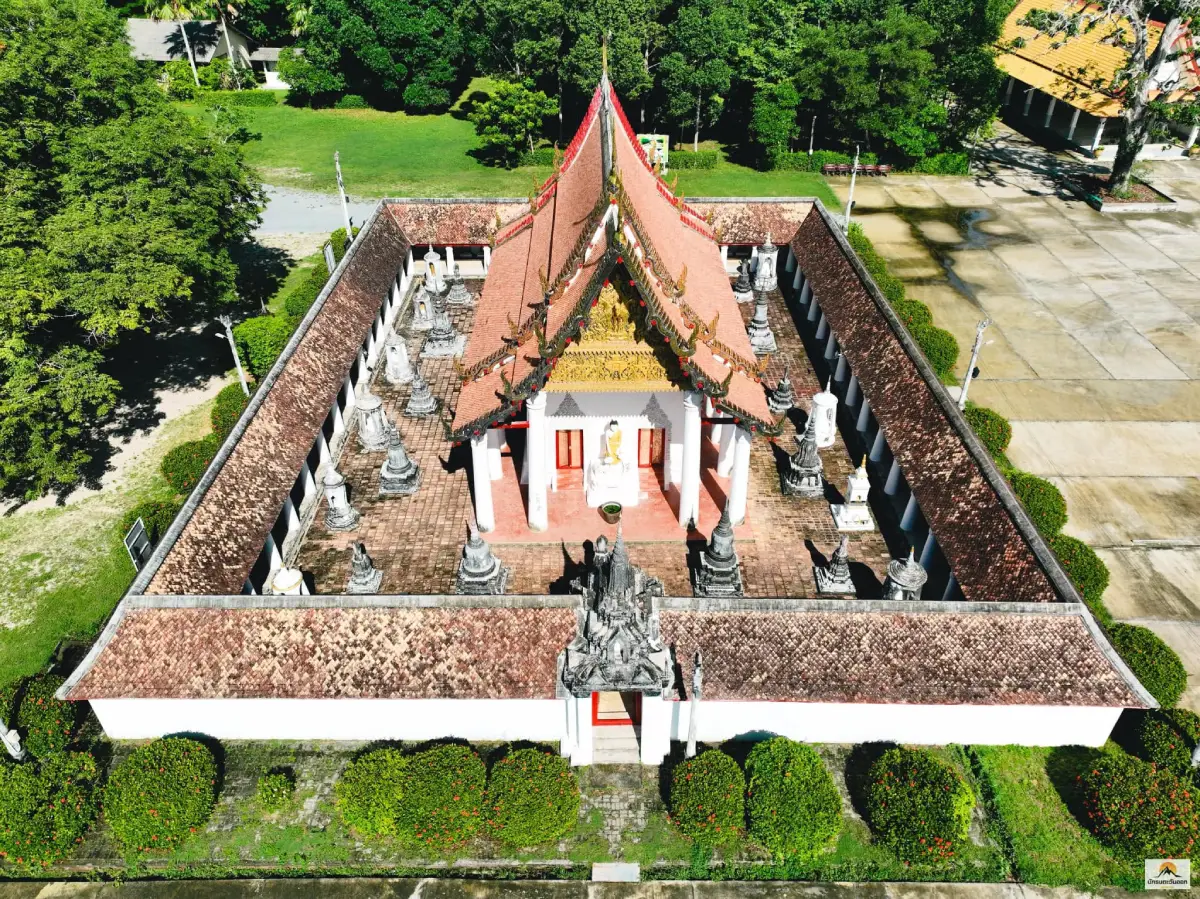
The most important structure at Wat Wang is the ordination hall, a Rattanakosin-period brick-and-plaster building. It has a traditional Thai roof with chofa and bairaka finials, clay roof tiles, and a projecting front porch. A cloister surrounds the ordination hall, giving the sacred area a formal and dignified layout. The building is especially valuable for visitors interested in traditional Thai architecture because it preserves structure, ornament, spatial planning, and religious function in one place.
Inside the ordination hall are gilded Buddha images and a principal stucco Buddha image in the subduing Mara posture. The temple’s greatest artistic treasure is its mural painting, executed in traditional powder colors on the interior walls. The murals depict episodes from the life of the Buddha, celestial assemblies, and Buddhist themes. They are regarded as among the most important mural paintings in Phatthalung and are associated with the artistic style of the early Rattanakosin period, particularly around the reigns of King Rama III and King Rama IV.
The murals of Wat Wang are significant because they show both refined composition and traditional Buddhist storytelling. The paintings present figures, costumes, architectural elements, heavenly beings, and religious scenes in a detailed manner. Some accounts say the murals may have been created by artists from the same circle as those who painted the murals in the ordination hall of Wat Phra Si Rattana Satsadaram in Bangkok. This has made Wat Wang a key destination for anyone interested in Thai mural painting and southern Buddhist art.
Around the cloister are 108 stucco Buddha images arranged in order. This is one of the temple’s most memorable features. The rows of Buddha images create a strong visual and devotional atmosphere, surrounding the ordination hall with a sense of sacred continuity. For visitors, walking around the cloister is a way to appreciate Buddhist sculpture, spatial design, and the scale of faith behind the temple’s construction.
The temple also contains 2 twelve-indented-cornered chedis, which are important architectural elements of the Rattanakosin period. They help complete the sacred layout of the temple and show how the ordination hall, cloister, chedis, and surrounding structures were designed to work together as a coherent religious space rather than as separate buildings.
Another important object is the carved wooden gilded pulpit, decorated with floral and plant motifs. Historical accounts state that King Rama VI ordered it to be made as a royal dedication for the royal funeral of King Chulalongkorn in 1910. The pulpit is therefore valuable not only as a fine example of wood carving and gilded decoration, but also as an object connected with royal merit-making and ceremonial history.
Wat Wang also preserves a lacquered scripture cabinet kept in the abbot’s residence. The cabinet has lion-foot legs and is decorated with gold-on-black lacquer patterns featuring scrollwork and animal motifs. Such a cabinet is more than a storage object. It reflects reverence for Buddhist scripture and demonstrates the refined craftsmanship of early Rattanakosin Thai artisans.
Another notable object is a pair of water jars from the Qing dynasty, once used in the Oath of Allegiance Water Ceremony of Phatthalung officials. These jars are direct material evidence of the temple’s old administrative ritual role. They allow visitors to connect the written history of the oath ceremony with surviving objects in the temple compound.
The Fine Arts Department has registered Wat Wang as a national historic site. The site was registered in 2 stages, and the protected area was later defined as about 9 rai, 1 ngan, and 46 square wah. This official registration confirms the temple’s national value as a historic and artistic site. Visitors should avoid touching murals, writing on walls, climbing on historic structures, or disturbing religious areas that are still in use.
Today, Wat Wang remains an important temple in Lam Pam and continues to be used for Buddhist ceremonies. It also serves as a learning site for students, researchers, travelers, and anyone interested in Phatthalung’s history and art. The abbot identified in cultural heritage records is Phra Khru Kittiyanakovit, who has provided historical interpretation about the temple’s possible origin in the late Ayutthaya period.
A recommended visit should begin at the ordination hall to see the architecture and murals, followed by the cloister and the 108 Buddha images. Visitors can then observe the chedis, the gilded pulpit, the scripture cabinet, and the Qing-dynasty water jars. After visiting the temple, travelers should continue to the Governor’s Palace of Phatthalung nearby. The 2 sites explain each other well: the temple represents faith and royal ceremony, while the palace represents governance and the life of former provincial rulers.
Getting There is convenient from Phatthalung city. Follow Aphai Aphirak Road or Highway 4047 toward Lam Pam Subdistrict for about 6 km. Wat Wang is on the right before reaching the Governor’s Palace of Phatthalung. Travelers arriving by train can get off at Phatthalung Railway Station and continue by local transport. The route is ideal for a half-day historical itinerary covering Wat Wang, the Governor’s Palace, Saen Suk Lam Pam Beach, Lam Pam Floating Market, and nearby Lam Pam cultural sites.
The best time to visit is from morning to afternoon, when there is enough light to appreciate the architecture and mural paintings. Visitors should dress modestly, keep their voices low inside the ordination hall, and behave respectfully because the temple remains an active religious site. Photography should be done carefully, and flash should be avoided when viewing mural paintings.
Wat Wang is an essential stop for travelers who want to understand Phatthalung beyond natural attractions. It connects the old Lam Pam city, the Governor’s Palace, the Oath of Allegiance Water Ceremony, Rattanakosin architecture, mural painting, and 108 stucco Buddha images in one place. A visit here is not only a temple visit, but a journey into the historical heart of old Phatthalung.
| Name | Wat Wang, Phatthalung Province |
| Location | Moo 4, Lam Pam Subdistrict, Mueang Phatthalung District, Phatthalung Province |
| Address | Lam Pam Subdistrict, Mueang Phatthalung District, Phatthalung 93000, Thailand |
| Coordinates | 7.6291058615, 100.149780986 |
| Type | Ancient Temple / Historic Site / Important Buddhist Site In Phatthalung |
| Highlights | Rattanakosin-Period Ordination Hall, Powder-Color Murals, 108 Stucco Buddha Images, Cloister, Chedis, Gilded Wooden Pulpit, Lacquered Scripture Cabinet, And Qing-Dynasty Water Jars |
| History | Possibly founded in the late Ayutthaya period, rebuilt by Phraya Phatthalung (Thong Khao) during the reign of King Rama III, and formerly used for the Oath of Allegiance Water Ceremony of Phatthalung officials |
| Importance | An important temple of old Phatthalung connected with Lam Pam, the Governor’s Palace, royal administrative ritual, and early Rattanakosin art |
| Inside The Ordination Hall | Principal Stucco Buddha Image In The Subduing Mara Posture, Gilded Buddha Images, And Murals Depicting The Life Of The Buddha, Celestial Assemblies, And Buddhist Themes |
| Mural Paintings | Traditional Powder-Color Murals Created Around The Reigns Of King Rama III - IV Or Around 1860, Depicting Buddhist Stories And Celestial Assemblies |
| Historic Registration | Registered As A National Historic Site, With A Protected Area Of About 9 Rai, 1 Ngan, And 46 Square Wah |
| Abbot | Phra Khru Kittiyanakovit |
| Local Heritage Contact | Phatthalung Local Natural And Cultural Environment Conservation Unit |
| Open Days | Daily |
| Opening Hours | 07:00 - 17:00 |
| Admission Fee | No Admission Fee |
| Main Zones / Areas | Ordination Hall, Cloister, 108 Stucco Buddha Images, Chedis, Gilded Wooden Pulpit, Lacquered Scripture Cabinet, Qing-Dynasty Water Jars, And Area Connected With The Governor’s Palace Of Phatthalung |
| Local Heritage Contact Number | Phatthalung Local Natural And Cultural Environment Conservation Unit, Tel. 0-7461-3023 |
| Travel Information | From Phatthalung City, Follow Aphai Aphirak Road Or Highway 4047 Toward Lam Pam For About 6 Km. The Temple Is On The Right Before The Governor’s Palace Of Phatthalung |
| Nearby Tourist Attractions | 1. Governor’s Palace Of Phatthalung, About 0.1 Km 2. Wat Wihan Boek, About 1 Km 3. Saen Suk Lam Pam Beach, About 2 Km 4. Lam Pam Floating Market, About 2 Km 5. Wat Pa Lilai, About 3 Km 6. Phraya Thukkharat (Chuai) Monument, About 5 Km 7. Wat Khuha Sawan, About 7 Km |
| Nearby Restaurants | 1. Lam Pam Seafood, About 1 Km, Tel. 081-957-3437, 095-641-4569 2. Kiang Talay Terrace Lam Pam, About 2 Km, Tel. 088-752-9532, 096-820-6679 3. Chai Daen Restaurant Lam Pam, About 2 Km, Tel. 080-140-1245 4. Itim Phad Chailai Lam Pam Floating Market, About 2 Km 5. Lanna Waterside Phatthalung, About 8 Km, Tel. 084-062-3334 |
| Nearby Accommodations | 1. Sor Ruean Mai Homestay, About 1 Km, Tel. 094-320-1510 2. Saeree Resort, About 2 Km, Tel. 084-860-8287 3. Rimlay Park Resort, About 8 Km, Tel. 061-381-2564, 093-719-5686 4. City Park Hotel Phatthalung, About 6 Km, Tel. 074-613-516 5. The Centris Hotel Phatthalung, About 7 Km, Tel. 074-616-555 6. Siva Royal Hotel, About 8 Km, Tel. 074-673-999 |
Frequently Asked Questions (FAQ)
Q: Where is Wat Wang located?
A: Wat Wang is located at Moo 4, Lam Pam Subdistrict, Mueang Phatthalung District, Phatthalung Province, about 6 km from Phatthalung city and close to the Governor’s Palace of Phatthalung.
Q: What are the opening hours?
A: Wat Wang opens daily from 07:00 to 17:00.
Q: Is there an admission fee?
A: No. There is no admission fee for worshipping or visiting the temple area.
Q: Why is Wat Wang important?
A: Wat Wang is an ancient temple of Phatthalung. It was once used for the Oath of Allegiance Water Ceremony of local officials and preserves important Rattanakosin-period art and architecture.
Q: What are the main highlights of Wat Wang?
A: The highlights include the Rattanakosin-period ordination hall, powder-color murals, 108 stucco Buddha images, chedis, gilded wooden pulpit, lacquered scripture cabinet, and Qing-dynasty water jars.
Q: What do the murals inside the ordination hall depict?
A: The murals depict the life of the Buddha, celestial assemblies, and Buddhist themes using traditional powder-color technique.
Q: How can visitors get to Wat Wang?
A: From Phatthalung city, follow Aphai Aphirak Road or Highway 4047 toward Lam Pam for about 6 km. The temple is on the right before the Governor’s Palace of Phatthalung.
Q: What nearby places can be visited on the same trip?
A: Nearby places include the Governor’s Palace of Phatthalung, Wat Wihan Boek, Saen Suk Lam Pam Beach, Lam Pam Floating Market, Wat Pa Lilai, Phraya Thukkharat Monument, and Wat Khuha Sawan.
 Category: ●Places of Worship
 Group: ●Temple
Last Update : 2 MonthAgo
 Last Update : 2 MonthAgo
 Click to Access the Navigation Map GPS

 Art, Culture and Heritage
 Historical Sites and Monuments(1)
 Landmarks and Memorials(1)
 Art, Craft Centres, Tradition(6)
 Historic Homes and Cities(1)
 Educational Places
 Educational Gardens, Farm(1)
Temple(25)
 Other Sacred Sites(4)
 Research and Development
 Royal Project(2)
 Suburban Living
 Village, Community(3)
 Nature and Wildlife
 National Parks and Marine Reserves(3)
 Mountain (Doi)(4)
 Dam, Reservoir, Lake(7)
 Waterfalls(16)
 Hot Springs(2)
 Caves(12)
 River, Canal(5)
 Bays and Beaches(6)
 Islands(2)
 Other natural attractions(4)
 Entertainment and Agricultural
 Farms, Parks and Ecotourism(4)
 Travel Articles, Recipes
 Travel Review, Food Review(1)


