
lovethailand home >South Travel Attractions >Phang Nga Travel Attractions >Takua Thung >Kra Som > Wat Suwan Khuha
TL;DR: Wat Suwan Khuha is located at Moo 2, Krasom Subdistrict, Takua Thung District, Phang Nga Province, open Daily, hours 08.00 – 17.00.

Wat Suwan Khuha
Open Days: Daily
Opening Hours: 08.00 – 17.00
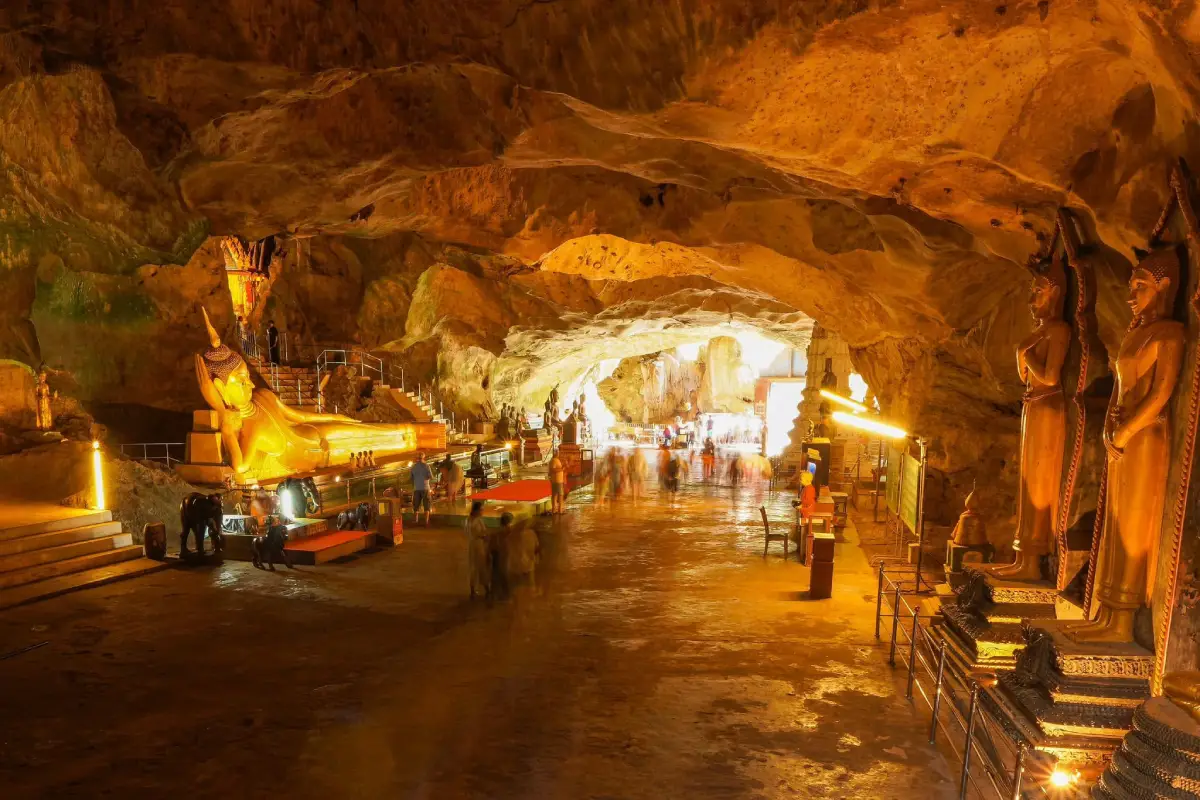
Wat Suwan Khuha in Phang Nga Province, widely known as Wat Tham or the Cave Temple, is one of the most important historic temples in Takua Thung District. Located in Moo 2, Krasom Subdistrict, along Highway 4 on the Phang Nga-Phuket route, the temple is about 9 km from Phang Nga town. Its main attraction is a limestone hill containing several connected caves, with the largest cave serving as a natural Buddhist sanctuary. Inside the main cave are many Buddha images, including the highly revered reclining Buddha. The temple also preserves royal initials and royal names inscribed on the cave wall, archaeological evidence, a temple museum, and a well-known troop of monkeys living near the cave entrance.
Wat Suwan Khuha is more than a simple cave temple. It is a place where Buddhist worship, local history, archaeology, geology, and Phang Nga’s cultural memory meet in one landscape. The temple has long been known by local people as Wat Tham because its sacred area is built into a limestone cave. Historical temple records indicate that the temple originated around 1700. According to local tradition, a wandering monk and novice discovered the quiet cave area and settled there for meditation before the site gradually developed into a temple. The name Suwan Khuha suggests a beautiful or precious cave, a fitting description for a site whose religious and historical value is centered on the cave itself.
The temple is located at Ban Khao Tham, Phet Kasem Road, kilometer marker 30, Moo 2, Krasom Subdistrict, Takua Thung District, Phang Nga Province. The temple stands beside a small isolated limestone hill on flat land. To the east and south, Khlong Tham flows toward Phang Nga Bay. This physical setting makes Wat Suwan Khuha both a religious place and a natural site. The limestone formation is extremely old, and the cave contains stalactites, stalagmites, columns, draperies, and other calcite features formed over long geological periods. Visiting the temple therefore combines merit-making, cave exploration, and a close look at Southern Thailand’s karst landscape.
The hill contains several caves, including Tham Yai or Tham Phra, Tham Chaeng, Tham Mued, Tham Kaeo, Tham Phueng, Tham Khrua, and Tham Bon. Tham Yai, the main cave, is the lowest and most visited chamber. It functions as the principal worship area of the temple. Beyond it, visitors can continue toward Tham Chaeng, Tham Mued, and Tham Kaeo, where natural limestone formations create a very different atmosphere from the open main shrine. These connected caves make the temple distinctive because visitors move gradually from an active Buddhist sanctuary into darker and more natural cave spaces.
The main cave is the heart of Wat Suwan Khuha. It has a broad floor, a high curved ceiling, and a spacious interior that feels like a natural hall. The cave is decorated with ceramics, blue-and-white porcelain, and Benjarong-style bowls and plates. These ceramic decorations are not simply ornamental. They reflect older forms of devotion, offering, and temple patronage. Inside the cave are many Buddha images, including seated, standing, reclining, contemplative, Naga-protected, and Parinirvana postures, as well as a replica Buddha footprint and an image of Maha Kassapa. Together, these sacred objects turn the cave into a natural vihara filled with religious meaning.
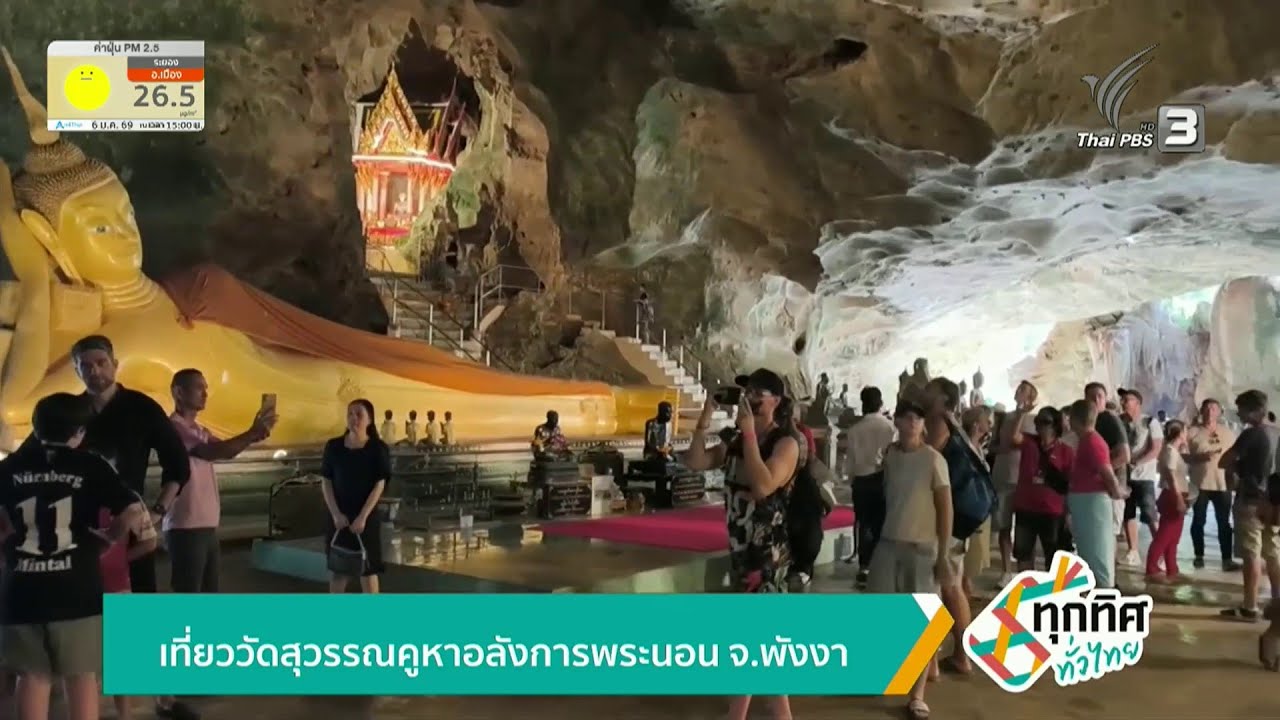
The most important Buddha image in the cave is the reclining Buddha, measuring 7 wa and 2 sok, or about 15 meters in length. The image rests peacefully inside the limestone chamber and is the main reason many visitors come to the temple. The golden figure contrasts with the rock walls and creates a calm, dignified atmosphere. Visitors usually pay respect to the reclining Buddha first, then continue deeper into the cave system and the areas where royal initials are preserved on the cave walls.
One of the most important historical records at Wat Suwan Khuha is the inscription of Phraya Borisut Lohaphumintarathibodi inside the main cave. This slate inscription, shaped like a boundary marker, was written in old Thai script during the early Rattanakosin period. It records the major restoration of the temple in 1858. The text refers to Phraya Borisut Lohaphumintarathibodi, the administrator of Takua Thung, who ordered the restoration of the temple, the construction of the vihara, and the creation of important Buddha images such as the reclining Buddha, the Naga-protected Buddha, and the Parinirvana Buddha. It also mentions ceramic ceiling decorations and a prang containing the ashes of relatives from the Na Takua Thung family.
The Na Takua Thung family played an important role in the history of Wat Suwan Khuha. Phraya Borisut Lohaphumintarathibodi and Phra Phet Si Phichai Songkhram helped restore the temple, making it prosperous and closely linked with the old administrative history of Takua Thung. The temple later became associated with family memory through the prang containing ashes, as well as through other objects and architectural remains. This connection gives the temple a civic and historical role in addition to its religious importance.
Another major feature of Wat Suwan Khuha is the group of royal initials and royal names inscribed on the cave walls. Several Thai kings and royal family members visited or were historically connected with this site, leaving initials such as Cho Po Ro, Po Po Ro, Pho Po Ro, and So Ko. In particular, the Pho Po Ro and So Ko initials in Tham Chaeng are connected with the royal visit of King Bhumibol Adulyadej and Queen Sirikit on March 12, 1959. These inscriptions are important heritage marks and should be treated with great respect. Visitors must not touch, scratch, write over, or damage them in any way.
Wat Suwan Khuha also has archaeological importance reaching far earlier than its Buddhist temple history. Excavations and discoveries inside the cave and in front of the temple have revealed prehistoric objects such as polished stone axes, shouldered stone tools, flaked stone tools, pottery fragments, stone bangles, shell bangles, carnelian beads, animal bone fragments, and human bone fragments. These finds show that the cave landscape was used by people long before it became a Buddhist temple. This makes the site important for understanding both prehistoric human activity and later religious history in Phang Nga.
The temple museum is another important part of the site. It was established near the monks’ residence by Phra Khru Winaisaranit, a former abbot, to preserve and display antiquities and historical objects connected with the temple and the local area. The museum and display cases contain ceramics, porcelain, Benjarong pieces, Buddha images, cave finds, and other objects preserved by the temple and community. The museum gives visitors a clearer understanding of why Wat Suwan Khuha is not only a place of worship but also a repository of local history and archaeology.
Main buildings and areas inside the temple include the ordination hall, sermon hall, monks’ dining hall, monks’ residences, and the temple museum. The ordination hall serves formal monastic ceremonies. The sermon hall is used for lay gatherings, merit-making, and Buddhist activities. The monks’ residences and dining hall support the daily life of the monastic community. The main cave, however, remains the defining sacred space of the temple, functioning as a natural vihara and the primary place where visitors come to worship.
Tham Suwan Khuha has been registered and demarcated as an ancient monument by the Fine Arts Department. This status means the cave and temple area are protected cultural heritage. Visitors should walk only along suitable paths, avoid touching old Buddha images, ceramics, inscriptions, or cave formations, and never write on the cave walls. Stalactites and stalagmites form very slowly, and damage can be permanent. The temple is still an active Buddhist site, so visitors should also behave respectfully toward monks and worshippers.
The monkeys near the cave entrance are one of the temple’s most recognizable features. They have become part of the identity of the place, leading many foreign visitors to call Wat Suwan Khuha the Monkey Cave or Monkey Temple. However, visitors should be cautious. Keep phones, sunglasses, bags, and plastic bags secure. Do not tease, chase, touch, or feed monkeys at close range. Watching them from a safe distance is the best way to protect both visitors and animals.
Getting to Wat Suwan Khuha is convenient. From Phang Nga town, take Highway 4 on the Phang Nga-Phuket route toward Krasom Subdistrict for about 9 km. Around kilometer marker 30, a paved side road leads to the temple for about 1 km. The route is suitable for private cars, rental cars, and tour vans. Travelers coming from Phuket can visit the temple before reaching Phang Nga town or before continuing to Phang Nga Bay and Surakul Pier.
Visitors should allow at least 45 minutes to 1 hour for the temple. This gives enough time to pay respect to the reclining Buddha, explore the main cave, continue to the inner chambers, observe the royal inscriptions, and take photos respectfully. Visitors with a strong interest in history, archaeology, or geology may want to spend more than an hour. Morning and late afternoon visits are more comfortable because the weather is less hot. Inside the cave, walk carefully because some areas may be damp, uneven, or dimly lit.
Wat Suwan Khuha fits well into several Phang Nga routes. Travelers who prefer a no-boat itinerary can combine it with Phang Nga City Museum, Tham Phung Chang Cave, Somdet Phra Srinagarindra Park, and viewpoints around Phang Nga town. Travelers heading to Phang Nga Bay can visit the temple before or after Surakul Pier and Ao Phang Nga National Park. This creates a balanced itinerary of temple, cave, history, limestone landscape, and bay scenery in one day.
The temple has an entrance fee of 10 THB for foreign visitors. Thai visitors generally enter for worship and merit-making according to personal faith. Around the cave entrance are parking areas, small shops, souvenir stalls, and places selling food for monkeys. Visitors should carry some small cash for donations or local services, but should avoid carrying visible food or plastic bags near the monkeys.
Wat Suwan Khuha is suitable for several types of travelers. It is ideal for visitors who want to pay respect to the reclining Buddha, those interested in old temples and ancient monuments, travelers who enjoy caves and limestone geology, families looking for a convenient stop between Phang Nga and Phuket, and photographers interested in cave interiors, Buddha images, and heritage details. It is also a good cultural stop for travelers who want to understand Phang Nga beyond beaches and islands.
Proper behavior is important at Wat Suwan Khuha. Dress modestly, remove shoes where required, avoid touching antiquities, do not write on cave walls, do not climb on rock formations, and do not disturb monks or people who are worshipping. Families with children should supervise them closely inside the cave and near the monkeys. Elderly visitors should walk slowly because of steps, slopes, damp surfaces, and uneven ground.
Wat Suwan Khuha is more than a popular cave temple. It is a place where Buddhism, archaeology, limestone nature, Takua Thung history, and royal memory are preserved together. A visit here reveals a deeper side of Phang Nga: not only beaches and islands, but also sacred caves, ancient monuments, community faith, and cultural heritage that continue to shape the province today.
| Name | Wat Suwan Khuha, also known as Wat Tham Suwan Khuha |
| Location | Moo 2, Krasom Subdistrict, Takua Thung District, Phang Nga Province |
| Address | 36/1 Phet Kasem Road, Krasom Subdistrict, Takua Thung District, Phang Nga 82130, Thailand |
| Coordinates | 8.428514, 98.471708 |
| Highlights | Reclining Buddha in the main cave, limestone cave chambers, stalactites and stalagmites, royal initials on the cave wall, temple museum, and monkeys near the entrance |
| History | An ancient temple of Phang Nga with origins around 1700 and an important restoration recorded in 1858 during the early Rattanakosin period |
| Name Origin | Local people call it Wat Tham because the temple is built into a limestone cave. The name Suwan Khuha refers to a precious or beautiful cave with religious, historical, and archaeological value |
| Distinctive Features | A cave temple inside an isolated limestone hill, with several connected chambers and a natural cave hall used as a Buddhist sanctuary |
| Main Sacred Objects | Reclining Buddha measuring 7 wa and 2 sok, Buddha images in several postures, replica Buddha footprint, and standing Maha Kassapa image |
| Main Buildings / Areas | Tham Yai / Tham Phra Tham Chaeng Tham Mued Tham Kaeo Tham Phueng Tham Khrua Tham Bon Ordination Hall Sermon Hall Monks’ Dining Hall Monks’ Residences Wat Suwan Khuha Museum |
| Important Antiquities / Evidence | Inscription of Phraya Borisut Lohaphumintarathibodi Royal initials and royal names on cave walls Prang containing ashes of the Na Takua Thung family Boundary markers Chinese ceramic lions Blue-and-white porcelain and Benjarong ceramics Prehistoric objects found in the cave area |
| Historical Importance | A key ancient monument of Phang Nga, with an 1858 restoration record, royal visit inscriptions, prehistoric evidence, and protected status under the Fine Arts Department |
| Travel Information | From Phang Nga town, take Highway 4 on the Phang Nga-Phuket route for about 9 km. Near kilometer marker 30, turn onto the paved road leading about 1 km to the temple |
| Current Status | Active Buddhist temple, ancient monument, and religious-historical-natural attraction in Takua Thung District |
| Open Days | Daily |
| Opening Hours | 08.00 – 17.00 |
| Fees | Foreign Visitors: 10 THB |
| Facilities | Parking Area Small Shops Monkey Food Stalls Donation Areas Cave Walkway Temple Museum |
| Main Contact Number | 076-450-333 |
| Nearby Tourist Attractions | 1. Surakul Pier, about 9 km 2. Ao Phang Nga National Park, about 10 km 3. Tham Phung Chang Cave, about 11 km 4. Phang Nga City Museum, about 12 km 5. Samet Nangshe Viewpoint, about 21 km |
| Nearby Restaurants | 1. Krot Pang Toast By Ko Thee, about 1 km, Tel. 093-712-0888 2. Nai Mueang Restaurant, about 9 km, Tel. 076-429-000 3. Khua Ari Bang Mat, about 10 km 4. Shabu Chill Phang Nga, about 12 km 5. The Barley Retro Cafe & Steak Lounge Phangnga, about 13 km |
| Nearby Accommodations | 1. Le Erawan Phang Nga Hotel, about 10 km, Tel. 083-520-1000, 076-673-999 2. SiamIS Hotel Phang Nga Bay, about 10 km 3. Hongsfa Hotel Phang Nga, about 11 km 4. Home Phang-Nga Guest House, about 12 km 5. Blue Mountain Phangnga Resort And Restaurant, about 13 km |
Frequently Asked Questions (FAQ)
Q: Where is Wat Suwan Khuha located?
A: Wat Suwan Khuha is located in Moo 2, Krasom Subdistrict, Takua Thung District, Phang Nga Province, along Highway 4 on the Phang Nga-Phuket route, about 9 km from Phang Nga town.
Q: Are Wat Suwan Khuha and Wat Tham the same temple?
A: Yes. Wat Suwan Khuha is the official name, while Wat Tham is the common local name because the temple is built into a limestone cave.
Q: What are the main highlights of Wat Suwan Khuha?
A: The main highlights are the reclining Buddha in the main cave, several Buddha images, the 1858 inscription, royal initials on the cave wall, the temple museum, and the limestone cave chambers.
Q: What are the opening hours of Wat Suwan Khuha?
A: The temple is open daily from 08.00 to 17.00.
Q: Is there an entrance fee at Wat Suwan Khuha?
A: Foreign visitors are charged 10 THB. Thai visitors generally enter for worship and merit-making according to personal faith.
Q: Which caves can visitors see inside Wat Suwan Khuha?
A: Important caves include Tham Yai or Tham Phra, Tham Chaeng, Tham Mued, Tham Kaeo, Tham Phueng, Tham Khrua, and Tham Bon. Tham Yai is the main worship cave.
Q: What should visitors be careful about?
A: Visitors should be careful around monkeys near the cave entrance, keep valuables secure, avoid carrying visible plastic bags or food, and walk carefully inside the cave because some areas may be uneven, damp, or dimly lit.
Q: What nearby places can travelers visit after Wat Suwan Khuha?
A: Nearby places include Surakul Pier, Ao Phang Nga National Park, Tham Phung Chang Cave, Phang Nga City Museum, and Samet Nangshe Viewpoint.
 Category: ●Places of Worship
 Group: ●Temple
Last Update : 2 MonthAgo
 Last Update : 2 MonthAgo
 Click to Access the Navigation Map GPS
Wat Suwan Khuha Map
Recommend

 Art, Culture and Heritage
 Historical Sites and Monuments(2)
 Landmarks and Memorials(6)
 Art, Craft Centres, Tradition(3)
Temple(18)
 Other Sacred Sites(8)
 Suburban Living
 Village, Community(3)
 Nature and Wildlife
 National Parks and Marine Reserves(12)
 Mountain (Doi)(8)
 Waterfalls(21)
 Hot Springs(2)
 Caves(12)
 River, Canal(4)
 Bays and Beaches(28)
 Islands(11)
 Other natural attractions(7)
 Entertainment and Agricultural
 Animal camps and shows(2)
 Farms, Parks and Ecotourism(2)
 Waterpark(3)
 Outdoor and Adventure Activities(3)
 Travel Articles, Recipes
 Travel Review, Food Review(1)
 Southern Food Menu, Southern Food Recipes(1)


