
lovethailand home >South Travel Attractions >Pattani Travel Attractions >Ya Rang >Khao Tum > Fatoni University
TL;DR: Fatoni University, open Sunday – Thursday (Admissions Office, excluding university holidays), hours 8:30 AM – 3:30 PM (Admissions Office only; not the opening hours of the entire.
Fatoni University
Open Days: Sunday – Thursday (Admissions Office, excluding university holidays)
Opening Hours: 8:30 AM – 3:30 PM (Admissions Office only; not the opening hours of the entire university)
Fatoni University (มหาวิทยาลัยฟาฏอนี) is Thailand's first private Islamic higher education institution. Its principal campus is located at 135/8 Moo 3, Ban Sorong, Khao Tum Subdistrict, Yarang District, Pattani Province 94160, southern Thailand. The university originated from an initiative by Muslim scholars who sought to establish an institution combining academic excellence with Islamic ethics and moral education. It was formally established on April 3, 1998, as Yala Islamic College, became Yala Islamic University on June 14, 2007, and adopted the name Fatoni University in 2013. Today, the institution offers undergraduate and postgraduate education in Islamic studies, law, languages, social sciences, education, science, technology, and health-related disciplines. Its academic mission continues to emphasize research, professional development, and service to communities in Thailand's southern border provinces.
Fatoni University's distinctive character lies in its integration of modern academic disciplines with Islamic knowledge and ethical principles. Its educational approach seeks to develop graduates who possess professional competence, personal responsibility, and an understanding of their obligations toward society. While Islamic studies remain an important academic foundation, the university also prepares teachers, legal professionals, language specialists, administrators, researchers, and graduates in technology and applied science.
The principal campus is located in Ban Sorong, a community within Khao Tum Subdistrict, Yarang District, Pattani Province. The surrounding area includes residential communities, mosques, educational institutions, agricultural land, and local businesses. This setting connects university life with the traditions and everyday experiences of Malay Muslim communities in southern Thailand. It is particularly relevant to students studying Arabic, Malay, Islamic sciences, and disciplines concerned with social and community development.
Pattani Province has a long history associated with maritime trade, Malay culture, and the development of Islamic scholarship in the Malay Peninsula. Yarang District is also home to important archaeological sites that illustrate the region's early settlements and historical connections. Establishing a university in this environment contributed to the development of a center for higher education that engages with local history, languages, religion, and contemporary social needs.
The origins of Fatoni University can be traced to a group of Muslim scholars who were pursuing master's and doctoral studies in Saudi Arabia. The early proponents included Ismail Lutfi Japakiya, Ismail Ali, Abdulhalim Saising, Jihad Bungotayong, and Ahmad Umar Japakiya. They shared the view that Thailand needed an Islamic higher education institution capable of developing graduates with academic knowledge and moral integrity while supporting scholarship in Islamic sciences and other fields.
This initiative emerged at a time when many students in Thailand's southern border provinces sought advanced Islamic education, but opportunities for specialized higher education within the country remained limited. Some students had to travel overseas to continue their studies. The establishment of a local Islamic institution was therefore seen as a way to expand educational access, develop qualified teachers and scholars, and prepare professionals familiar with both Thai society and the wider Muslim world.
In 1983, the founders established a preparatory committee for a private Islamic college project in southern Thailand. The committee began examining suitable locations, financial support, and institutional arrangements. Developing the project required cooperation among scholars, religious leaders, community supporters, and international organizations, particularly in securing land, financing buildings, and preparing the academic foundations for a legally recognized higher education institution.
During the mid-1980s, the committee acquired land in Ban Sorong, Khao Tum Subdistrict, Yarang District, Pattani Province, as a site for long-term institutional development. Another site was acquired at Ban Parame Tae in Budi Subdistrict, Mueang Yala District, Yala Province. The latter location was considered suitable for the institution's initial academic operations because of its accessibility to the urban area of Yala. These two locations later became important to the university's institutional history.
The proposed institution received international support, including funding associated with the Islamic Development Bank for buildings and infrastructure. Such assistance reflected educational cooperation among scholars and organizations in the Muslim world and helped establish the physical foundations needed for a higher education institution in southern Thailand.
The Foundation for Islamic Higher Education in Southern Thailand was established to support and administer the project. The foundation became responsible for institutional assets, coordination with donors, and the process of obtaining authorization to operate a college. Its organizational role was essential in transforming the original proposal into a legally recognized institution with educational and administrative responsibilities.
April 3, 1998, marked a major milestone when Thailand's Ministry of University Affairs authorized the establishment of Yala Islamic College as a private higher education institution. The licensing of the college represented a significant development in Thai higher education because it created an institutional pathway for advanced Islamic studies alongside recognized academic standards.
The college admitted its first group of 200 undergraduate students in two fields: Shariah, concerned with Islamic law, and Usuluddin, concerned with the foundations of Islamic belief and theology. These disciplines established the institution's original academic identity. They also provided a foundation for preparing teachers, scholars, and professionals who could contribute to Islamic education and community development.
Shariah education focuses on Islamic legal principles, methods of legal interpretation, and their application to individuals, families, and communities. Usuluddin examines the foundations of Islamic faith, theology, and religious thought. Beginning with these fields allowed the college to build expertise in core Islamic disciplines before expanding into other academic areas and professional programs.
During its early period, the college operated at Ban Parame Tae in Budi Subdistrict, Mueang Yala District. This explains its original association with the name Yala Islamic College. Although major academic and administrative activities later expanded to Ban Sorong in Pattani, the Yala location remained part of the institution's history and continues to be associated with its international and language-related educational activities.
Following the development of undergraduate programs, the institution expanded into postgraduate education. Graduate-level teaching began in the 2001 academic year, and the Graduate School was established in 2002 to oversee advanced academic study, research, theses, and educational standards. This development increased the institution's role in preparing researchers, university teachers, and specialists in Islamic and related academic disciplines.
On September 10, 2000, the Foundation for Islamic Higher Education in Southern Thailand organized a foundation-stone ceremony for the construction of major university buildings at Ban Sorong in Khao Tum Subdistrict, Yarang District. The development received support from international organizations and benefactors, including sources associated with Qatar. Its purpose was to create a larger and more permanent educational environment capable of accommodating the institution's future growth.
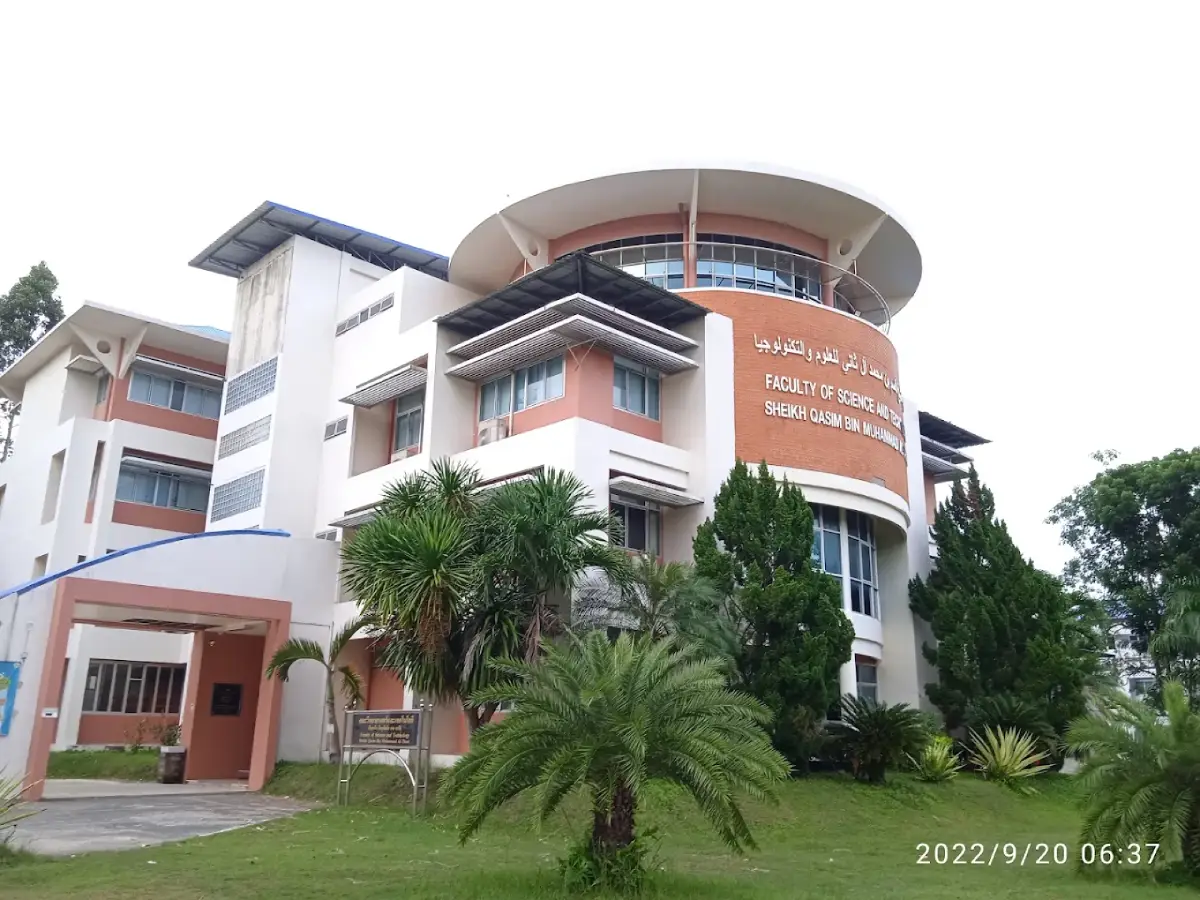
In 2002, an important building named after Sheikh Qasim bin Muhammad Al Thani was formally opened at the Ban Sorong site. The occasion was associated with an ASEAN regional academic seminar concerning the development of Islamic higher education. The event also encouraged cooperation with educational institutions in neighboring countries, demonstrating the college's ambition to participate in international academic networks.
On March 10, 2004, a formal opening ceremony was held for Yala Islamic College at its Ban Sorong site in Pattani Province. The development of this location provided additional facilities for teaching, administration, and student activities. The expansion from Yala to Pattani became one of the most significant chapters in the institution's history, establishing the setting that would later become the principal campus of Fatoni University.
On June 14, 2007, the institution received authorization to change its status from a college to a university, adopting the name Yala Islamic University. This transition reflected its academic, organizational, and institutional development. The university continued to operate as a private higher education institution, offering programs in Islamic sciences alongside other approved academic and professional fields.
In 2013, the institution was granted permission to change its name from Yala Islamic University to Fatoni University. The university's historical record identifies October 3, 2013, as the date of this change. The new name reinforced its association with Pattani and the wider historical region while preserving its founding commitment to Islamic education and the development of graduates with academic knowledge and moral responsibility.
The name Fatoni is associated with historical Arabic and Malay references to Pattani, a region long connected with Islamic learning, trade, and cultural exchange. By adopting this name, the institution strengthened its regional identity while using a form recognizable within international Islamic academic contexts.
One of the most important figures in Fatoni University's history is Associate Professor Dr. Ismail Lutfi Japakiya, who was among the scholars involved in initiating the institution and has played a continuing role in its development. Wan Muhammad Nor Matha is another important figure associated with the University Council and support for the institution. Their contributions form part of the broader history of the university's establishment and its growth in the southern border region.
As of 2026, Associate Professor Dr. Ismail Lutfi Japakiya serves as President of Fatoni University. The university's leadership includes administrators responsible for academic affairs, general management, research and innovation, student development, academic services, and engagement with society. Its current development priorities include educational quality, digital learning, and an academic environment that supports both professional achievement and Islamic ethical values.
The university's educational philosophy emphasizes the development of graduates with academic expertise and ethical awareness grounded in Islamic principles. Its public-facing identity includes the phrase “My University is My Paradise,” expressing the aspiration to create a supportive environment for learning, personal development, and student well-being. Quran study circles and Tarbiyah Islamiyah activities form part of this approach to developing knowledge, character, and responsibility.
Islamic learning at Fatoni University includes studies of the Quran, Sunnah, foundational beliefs, Islamic law, and ethics. These disciplines encourage students to examine religious sources systematically and apply their understanding in education, scholarship, personal conduct, and community life. This academic foundation is particularly important for graduates preparing to teach Islamic subjects or work in institutions serving Muslim communities.
The academic programs and admissions information published for 2026 identify five faculties: the Faculty of Islamic Studies and Law, Faculty of Liberal Arts and Social Sciences, Faculty of Science and Technology, Faculty of Education, and Faculty of Medicine and Health Sciences. The Graduate School and International College provide additional academic structures associated with advanced education and international language learning.
The Faculty of Islamic Studies and Law is closely connected with the university's founding academic mission. Its fields of study include Shariah, Islamic Studies, Law, Quran and Sunnah, and Usuluddin and Da'wah. Selected programs are offered through international tracks, providing opportunities for students to develop the language skills required for studying Islamic scholarship from different parts of the world.
Shariah examines Islamic legal principles and methods of interpretation, while Islamic Studies offers broader knowledge of Islamic religious traditions. Quran and Sunnah emphasizes the study of the Quran and the teachings and practices of Prophet Muhammad. Usuluddin and Da'wah combines foundational Islamic knowledge with the study of communicating religious teachings effectively and responsibly.
The faculty's law program provides education in the Thai legal system and legal reasoning. It supports the development of knowledge concerning rights, duties, justice, and the rule of law. Studying law alongside Islamic academic disciplines creates opportunities to understand legal institutions and social issues in a region characterized by religious and cultural diversity.
The Faculty of Liberal Arts and Social Sciences provides education in languages, economics, administration, and business-related subjects. Its published programs include Arabic, English, Malay and Indonesian for Business and Communication, Local Management and Sustainable Development Administration, Financial Economics, and Innovation Management and Business Creation. These subjects prepare students for professional activities in business organizations, public agencies, educational institutions, and international settings.
Arabic is important for accessing Islamic scholarship and communicating with Arabic-speaking communities. English supports international education, business, and professional communication. Malay and Indonesian have particularly strong relevance to southern Thailand and its neighboring ASEAN countries. These language programs represent an important part of Fatoni University's academic identity and contribute to its connections with regional and international communities.
The faculty's programs in economics, business, and public administration address organizational management, financial systems, innovation, local governance, and sustainable development. Such knowledge is relevant to community enterprises, private organizations, and public institutions. In particular, local management and sustainable development studies provide a foundation for understanding the relationship between public administration, community participation, and the responsible use of resources.
The Faculty of Science and Technology offers education in applied science and digital disciplines, including Digital Technology and Science through an international program and Halal Food Product Research and Development. Digital education supports knowledge of information systems, data, and technology applications, while halal food research combines food science, product quality, safety, and production standards.
Halal food education has particular relevance to the economy of southern Thailand, where businesses and consumers place importance on food produced according to halal requirements. Product development requires scientific knowledge of ingredients, food processing, quality control, safety, and manufacturing standards. Education in this field can therefore contribute to the development of personnel for food industries and related enterprises.
The Faculty of Education plays an important role in preparing teachers and educational professionals. Its undergraduate offerings include Early Childhood Education, Islamic Studies Education, Arabic Education, General Science Education, English Education, and Malay Language and Educational Technology. These programs combine subject knowledge with teaching methods, educational psychology, assessment, curriculum development, and classroom applications of technology.
Teacher education at Fatoni University is closely associated with the multicultural environment of southern Thailand. Schools in the region may serve children with different linguistic backgrounds and educational traditions. Preparing teachers familiar with Thai, Malay, Arabic, and Islamic education can support more effective communication and context-sensitive teaching. Practical teaching experience also helps students understand their professional responsibilities within real educational settings.
The Faculty of Medicine and Health Sciences appears in the university's 2026 curriculum information with a Bachelor of Science program in Oriental Medicine. This academic field expands the university's educational scope into health-related studies. Its curriculum concerns knowledge and practices related to health within the approved academic framework of the program.
The Graduate School provides academic programs at graduate diploma, master's, and doctoral levels. The published curriculum directory includes Islamic Studies, Arabic Language and Literature, Political Science, Educational Administration, Educational Science and Learning Management Innovation, and Teaching English. It also includes a Graduate Diploma in the Teaching Profession. Postgraduate education contributes to the development of researchers, teachers, academic specialists, and professionals seeking advanced qualifications.
Fatoni University's International College is associated with the Ban Parame Tae area in Budi Subdistrict, Mueang Yala District, Yala Province. It provides language-related educational activities and opportunities for international academic engagement. The continued relationship between educational locations in Yala and Pattani reflects the historical development of the institution from Yala Islamic College to Fatoni University.
Research and academic services form another important part of the university's mission. Its research-related units support knowledge development and engagement with communities. Studies in Islamic sciences, languages, social sciences, and applied technologies can contribute to educational development, community administration, local economies, and a better understanding of the cultural and social conditions of Thailand's southern border provinces.
The university also supports academic learning through digital technologies and library services. The Academic Resources Center provides access to books, information resources, lending services, and digital educational materials. Online learning platforms and information systems help students and academic staff conduct research, access resources, and manage academic activities more efficiently. These services are especially useful for a university with multiple language programs and international students.
The Fatoni University Academic Resources Center is one of the institution's principal learning facilities. In 2026, it organized an orientation activity introducing new students to library resources and services. Such activities help students develop information literacy, understand academic research practices, and use the institution's learning materials effectively.
The library's published service hours are Sunday through Thursday from 8:30 AM to 6:00 PM and Saturday from 8:30 AM to 4:00 PM. It is closed on Fridays. These hours differ from those of the admissions office, reflecting the individual operating schedules of university departments and student services.
Other facilities include teaching buildings, laboratories, meeting rooms, collaborative learning spaces, student activity areas, and campus internet services. The university emphasizes a supportive environment combining education, student development, and religious practice. Buildings associated with academic activities include facilities used by the Faculty of Education, the Faculty of Islamic Studies and Law, and the Graduate School.
The Wan Muhammad Nor Matha Auditorium is an important venue for university ceremonies, large meetings, and academic events. On August 16, 2026, the university held its 21st degree conferral ceremony there for graduates of the 2025 academic year. The auditorium therefore serves as a significant setting for major milestones in the lives of students, graduates, university personnel, and their families.
The campus also includes a mosque and facilities for Islamic religious activities. These spaces support daily prayers, community gatherings, and the religious aspects of university life. Their presence enables students and staff to organize academic activities and everyday routines in a manner consistent with their religious practices.
The cultural life of Fatoni University places particular importance on Quranic learning, ethical development, respect for teachers, and personal discipline. Quran study circles, often referred to as Halaqah, provide opportunities for students to read, discuss, and develop their understanding of religious teachings. These activities complement classroom learning and help strengthen students' intellectual, moral, and social development.
On February 6, 2026, the Faculty of Islamic Studies and Law organized a Majlis Khatm Al-Quran activity. The event involved Quranic recitation, religious reflection, and participation by faculty members and students. It demonstrated the university's continuing emphasis on religious learning as part of its educational culture.
Ramadan is another important period within the university's religious and academic calendar. The 2026 university calendar included a Ma'al-Quran activity and I'tikaf activities during the final ten days of Ramadan. I'tikaf is associated with dedicating time to worship, reflection, and spiritual development. These activities demonstrate how the university coordinates its academic calendar with the religious life of its community.
The Faculty of Education has also organized Muallim Day activities recognizing the contributions of teachers and educational professionals. On September 14, 2026, the faculty held its EDU FTU Open House event, providing opportunities for secondary school students to learn about university programs and future educational pathways. Events of this kind support engagement between the university and prospective students from the surrounding region.
Degree conferral ceremonies are important occasions in the university's institutional culture. They recognize academic achievement and bring together graduates, families, faculty members, alumni, and representatives of public and community organizations. These ceremonies reinforce the relationship between professional education and the wider responsibilities of graduates toward society.
Student development at Fatoni University includes activities promoting moral responsibility, cooperation, community service, and personal growth. The university's international programs and student community encourage communication across different linguistic and cultural backgrounds. Thai, Arabic, Malay, and English are important languages within its academic environment, depending on the nature and requirements of individual programs.
Fatoni University contributes to community development in Thailand's southern border provinces through education, research, and academic services. Graduates in teaching and Islamic education are particularly relevant to schools and community learning institutions. Knowledge in economics, local administration, technology, and halal food research can also support local enterprises and organizations seeking to strengthen professional capabilities.
International cooperation forms another aspect of the university's identity. Its history includes support and academic collaboration involving institutions and organizations in the Muslim world and across Southeast Asia. International programs and language education help students prepare for further study, research, and professional activities involving people from different countries.
For visitors interested in educational tourism, Fatoni University offers an opportunity to learn about the development of Thailand's first private Islamic higher education institution. Its history illustrates the transition from Yala Islamic College to a multidisciplinary university serving the southern border region. Visitors interested in the library, academic buildings, or religious activities should contact the university in advance and follow the relevant rules concerning access, dress, and the use of religious facilities.
The university's admissions office can be contacted Sunday through Thursday from 8:30 AM to 3:30 PM at +66 83 048 7436. For general university enquiries, the published telephone number is +66 73 418 613. These are office contact arrangements rather than universal campus opening hours. Libraries, classrooms, religious facilities, and special activities may operate according to different schedules.
Getting There: Fatoni University's principal campus is located at 135/8 Moo 3, Ban Sorong, Khao Tum Subdistrict, Yarang District, Pattani Province 94160. Visitors traveling by private vehicle can follow the main road network into Yarang District and continue toward Khao Tum Subdistrict and Ban Sorong. Entering “Fatoni University” into a navigation application will help identify the correct campus in Pattani. Travelers coming from Pattani city can arrange private or hired transportation, while visitors from Yala can use the road connections between Yala and Pattani to reach Yarang District.
Travelers using public transportation should check bus routes and onward connections to Ban Sorong in advance. The university lies outside central Pattani, and direct public transport options may be limited. Rail passengers can travel to a suitable railway station in Pattani or Yala Province before continuing by road. Confirming the Pattani campus as the destination is particularly important because the university also maintains educational activities associated with its historical location in Yala Province.
A university visit can be combined with cultural and historical exploration in Pattani Province. Yarang Ancient City is particularly relevant because it preserves archaeological evidence of early communities and historical development in the Malay Peninsula. Other places of interest include Pattani Central Mosque, Krue Se Mosque, and Wat Chang Hai. These sites reflect different periods and traditions in the region's religious and cultural history. Visitors should respect local customs and the access arrangements of religious sites.
From the original initiative of Muslim scholars in the 1980s to the establishment of Yala Islamic College in 1998, the transition to university status in 2007, and the adoption of the name Fatoni University in 2013, the institution has developed a distinctive educational identity. It now provides academic opportunities across Islamic sciences, law, languages, education, science, technology, and contemporary professional disciplines. Through research, academic services, and community engagement, Fatoni University remains an important part of the educational and social landscape of southern Thailand, emphasizing the development of knowledgeable graduates guided by ethical responsibility.
Summary Table
| University Name | Fatoni University |
| Thai Name | มหาวิทยาลัยฟาฏอนี |
| Abbreviation | FTU |
| Institution Type | Thailand's first private Islamic higher education institution |
| Principal Campus Location | Ban Sorong, Khao Tum Subdistrict, Yarang District, Pattani Province, Thailand |
| Full Address | 135/8 Moo 3, Ban Sorong, Khao Tum, Yarang District, Pattani 94160, Thailand |
| Additional Educational Location | Ban Parame Tae, Budi Subdistrict, Mueang Yala District, Yala Province, associated with the former Yala Islamic College and the International College |
| Former Names | 1. Yala Islamic College 2. Yala Islamic University |
| Original Establishment Date | April 3, 1998 |
| Conversion to University Status | June 14, 2007 |
| Adoption of Fatoni University Name | October 3, 2013, according to the university's historical record |
| Institutional Age in 2026 | 28 years since establishment in 1998 and 19 years since conversion to university status in 2007 |
| Founders and Important Figures | 1. Associate Professor Dr. Ismail Lutfi Japakiya 2. Ismail Ali 3. Abdulhalim Saising 4. Jihad Bungotayong 5. Ahmad Umar Japakiya 6. Wan Muhammad Nor Matha, a significant figure in university governance and institutional support |
| Founding Organization | Foundation for Islamic Higher Education in Southern Thailand |
| University President | Associate Professor Dr. Ismail Lutfi Japakiya |
| Educational Identity | Academic knowledge combined with Islamic ethical development, expressed through the concept My University is My Paradise |
| Faculties Listed in 2026 Curriculum Information | 1. Faculty of Islamic Studies and Law 2. Faculty of Liberal Arts and Social Sciences 3. Faculty of Science and Technology 4. Faculty of Education 5. Faculty of Medicine and Health Sciences |
| Other Academic Units | Graduate School and International College |
| Study Levels | Bachelor's Degrees, Graduate Diploma, Master's Degrees, Doctoral Degrees, and Modular Certificate Programs |
| Academic Strengths | Islamic Studies, Shariah, Quran and Sunnah, Arabic, Malay, Law, Teacher Education, Local Administration, Digital Technology, and Halal Food Product Research |
| Important Campus Facilities | 1. Wan Muhammad Nor Matha Auditorium 2. Fatoni University Academic Resources Center and Library 3. Faculty of Education Building 4. Faculty of Islamic Studies and Law Building 5. Graduate School Building 6. Mosque and Prayer Facilities 7. Classrooms, Laboratories, and Student Activity Areas |
| University Activities and Traditions | 1. Halaqah Quran Study Circles 2. Majlis Khatm Al-Quran 3. Ma'al-Quran Activities 4. I'tikaf During Ramadan 5. Degree Conferral Ceremonies 6. Muallim Day and Academic Open House Events |
| Admissions Office Open Days | Sunday – Thursday |
| Admissions Office Hours | 8:30 AM – 3:30 PM |
| University Library Hours | Sunday – Thursday: 8:30 AM – 6:00 PM Saturday: 8:30 AM – 4:00 PM Closed on Friday |
| Organized Campus Visits | Contact the university in advance and follow rules regarding access, dress, and the use of religious facilities |
| Campus Facilities | Library, Digital Learning Resources, Teaching Rooms, Laboratories, Meeting Facilities, Student Activity Areas, Prayer Facilities, and Student Support Services |
| Getting There | Travel from Pattani city or Yala toward Yarang District, then continue to Khao Tum Subdistrict and Ban Sorong. Use Fatoni University's Pattani campus as the navigation destination. |
| Attractions Accessible from the University | 1. Yarang Ancient City, Yarang District 2. Dong Ton Yi Community, Yarang District 3. Pattani Central Mosque, Mueang Pattani District 4. Krue Se Mosque, Mueang Pattani District 5. Wat Chang Hai Rat Buranaram, Khok Pho District |
| Restaurants and Cafés in Khao Tum and Yarang | 1. Fatoni Cafe & Roastery, Khao Tum, Tel. +66 61 151 5710 2. Rizqi Steamed Buns and Boat Noodles, Khao Tum, Tel. +66 81 368 3343 3. Bubble Street @FTU, Khao Tum, Tel. +66 91 312 6525 4. Lazeo Coffee, Khao Tum, Tel. +66 98 727 2713 5. Kampong Kayang Tea and Noodle Restaurant, Khao Tum, Tel. +66 80 889 9276 |
| Accommodation in Pattani Province | 1. The Wood Pattani Hotel, Mueang Pattani, Tel. +66 91 479 0666 2. CS Pattani Hotel, Mueang Pattani, Tel. +66 73 335 093 3. Southern View Hotel Pattani, Mueang Pattani, Tel. +66 73 450 570 4. Blue Lapan Inn Pattani, Mueang Pattani, Tel. +66 61 221 3699 5. Santisook Midtown, Mueang Pattani, Tel. +66 98 749 8884 |
| University Telephone | +66 73 418 613 |
| Admissions Office Telephone | +66 83 048 7436 |
| Academic Resources Center Telephone | +66 86 994 0023 |
| Official Website | https://ftu.ac.th/ |
| Admissions Website | https://admission.ftu.ac.th/ |
| Current Status | Active private university with academic teaching, admissions, research, and campus activities in the 2026 academic year |
Academic Programs and Fields of Study at Fatoni University, Academic Year 2026 (B.E. 2569)
| Faculty and Degree Level | Programs and Fields Published in the University Curriculum and Admissions Information |
| Faculty of Islamic Studies and Law | Bachelor's Degrees 1. Bachelor of Arts in Shariah 2. Bachelor of Arts in Islamic Studies 3. Bachelor of Laws in Law 4. Bachelor of Arts in Quran and Sunnah (International Program) 5. Bachelor of Arts in Usuluddin and Da'wah (International Program) |
| Faculty of Liberal Arts and Social Sciences | Bachelor's Degrees 1. Bachelor of Arts in Arabic (International Program) 2. Bachelor of Arts in English (International Program) 3. Bachelor of Arts in Malay and Indonesian for Business and Communication (International Program) 4. Bachelor of Public Administration in Local Management and Sustainable Development Administration 5. Bachelor of Economics in Financial Economics 6. Bachelor of Business Administration in Innovation Management and Business Creation |
| Faculty of Science and Technology | Bachelor's Degrees 1. Bachelor of Science in Digital Technology and Science (International Program) 2. Bachelor of Science in Halal Food Product Research and Development |
| Faculty of Education | Bachelor's Degrees 1. Bachelor of Education in Early Childhood Education 2. Bachelor of Education in Islamic Studies 3. Bachelor of Education in Arabic 4. Bachelor of Education in General Science 5. Bachelor of Education in English 6. Bachelor of Education in Malay Language and Educational Technology |
| Faculty of Medicine and Health Sciences | Bachelor's Degree 1. Bachelor of Science in Oriental Medicine |
| Graduate School | Graduate Diploma 1. Graduate Diploma in the Teaching Profession Master's Degrees 2. Master of Arts in Islamic Studies 3. Master of Arts in Arabic Language and Literature 4. Master of Political Science in Political Science 5. Master of Education in Educational Science and Learning Management Innovation 6. Master of Education in Educational Administration 7. Master of Education in Teaching English Doctoral Degrees 8. Doctor of Philosophy in Islamic Studies 9. Doctor of Philosophy in Arabic Language and Literature 10. Doctor of Philosophy in Educational Science and Learning Management Innovation 11. Doctor of Philosophy in Educational Administration |
| International College | International language learning and related educational activities in the Ban Parame Tae area, Budi Subdistrict, Mueang Yala District, Yala Province |
Frequently Asked Questions (FAQ)
Q: Where is Fatoni University located?
A: Fatoni University's principal campus is located at 135/8 Moo 3, Ban Sorong, Khao Tum Subdistrict, Yarang District, Pattani Province 94160, Thailand. The university also has educational activities associated with Budi Subdistrict in Yala Province.
Q: What are the opening days and hours of Fatoni University?
A: The Admissions Office is open Sunday through Thursday from 8:30 AM to 3:30 PM and is closed on Friday and Saturday. The library and other departments maintain their own service schedules.
Q: When was Fatoni University established?
A: The institution was established on April 3, 1998, as Yala Islamic College. It became Yala Islamic University on June 14, 2007, and adopted the name Fatoni University in 2013.
Q: Who founded Fatoni University?
A: The university originated from a group of Muslim scholars, including Associate Professor Dr. Ismail Lutfi Japakiya and several colleagues. Its development was supported by the Foundation for Islamic Higher Education in Southern Thailand.
Q: Is Fatoni University a public or private university?
A: Fatoni University is a private university and is recognized as Thailand's first private Islamic higher education institution.
Q: What faculties does Fatoni University have?
A: The university's 2026 curriculum and admissions information lists five faculties: Islamic Studies and Law, Liberal Arts and Social Sciences, Science and Technology, Education, and Medicine and Health Sciences. The university also has a Graduate School and an International College.
Q: Does Fatoni University offer international degree programs?
A: Yes. International programs are listed in fields such as Quran and Sunnah, Usuluddin and Da'wah, Arabic, English, Malay and Indonesian for Business and Communication, and Digital Technology and Science.
Q: How can I apply to Fatoni University?
A: Prospective students can review available programs and admissions announcements at https://admission.ftu.ac.th/ or contact the Admissions Office at +66 83 048 7436.
 Category: ●University
 Group: ●Private University
Last Update : 4 DayAgo
 Last Update : 4 DayAgo
 Click to Access the Navigation Map GPS

 Art, Culture and Heritage
 Historical Sites and Monuments(3)
 Landmarks and Memorials(7)
 Royal Palace(2)
 Art, Craft Centres, Tradition(7)
 Historic Homes and Cities(1)
 Educational Places
 Museum for Study(1)
 Training Center(1)
 Public university(1)
Private University(1)
 Places of Worship
 Temple(13)
 Mosque(5)
 Other Sacred Sites(4)
 Research and Development
 Royal Project(2)
 Suburban Living
 Village, Community(5)
 Local Market(2)
 Nature and Wildlife
 National Parks and Marine Reserves(2)
 Mountain (Doi)(3)
 Waterfalls(3)
 River, Canal(2)
 Bays and Beaches(13)
 Islands(2)
 Other natural attractions(1)
 Entertainment and Agricultural
 Farms, Parks and Ecotourism(1)
 Travel Articles, Recipes
 Travel Review, Food Review(1)
 Southern Food Menu, Southern Food Recipes(3)


