
lovethailand home >South Travel Attractions >Pattani Travel Attractions >Sai Buri >La Han > Wat Sutthikawat
TL;DR: Wat Sutthikawat is located at No. 5, Ban Thung Noi Or Ban Khi, Moo 1, Lahan Subdistrict, Saiburi District, Pattani Province 94110, Thailand, open Daily, hours 08.00 – 17.00.
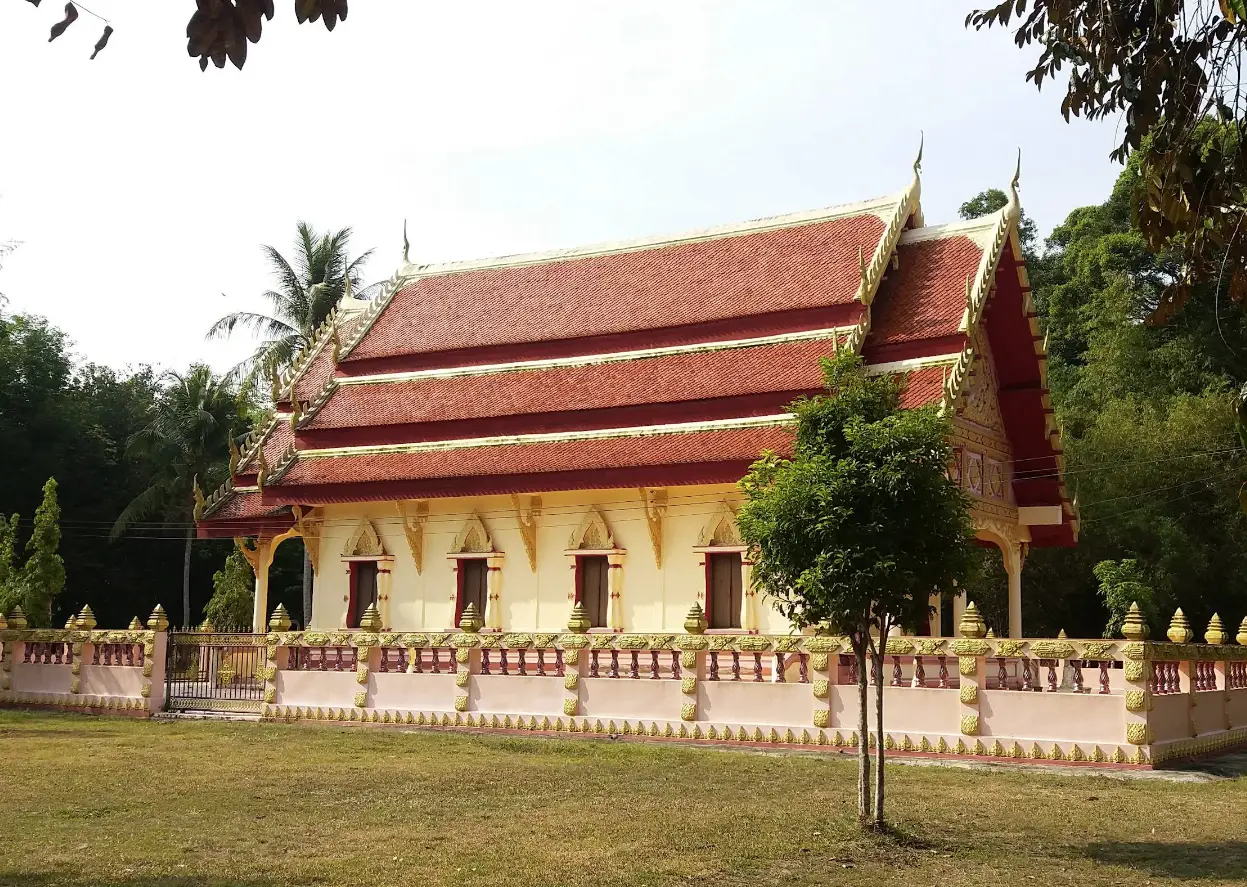
Wat Sutthikawat
Open Days: Daily
Opening Hours: 08.00 – 17.00
Wat Sutthikawat in Pattani Province is one of the important old Buddhist temples of Saiburi District. It is closely connected with the historical identity of Saiburi, local Buddhist faith, ancient Buddha images, a sacred well, and archaeological evidence from the Srivijaya period. The temple is also known in older local accounts as Wat Sakhi, Wat Kwak Khi, Wat Khi, Wat Krak, or Wat Sak. These names point to the temple’s long and layered history before it became known as Wat Sutthikawat.
The value of Wat Sutthikawat lies in several connected elements: the small vihara on a low hill, the 3 seated Buddha images in the Maravijaya posture, the sacred well beside the path to the vihara, the temple’s connection with the oath-water ceremony of old Saiburi, Srivijaya-period clay votive tablets, old Buddha images, a wooden standing Buddha image, a damaged old pagoda, and the temple’s role as a place of faith and learning for local people.
Historical information describes Wat Sutthikawat as an old temple associated with Saiburi since the flourishing period of Srivijaya. Temple-history records also state that it was established around 1757, during the late Ayutthaya period. Local tradition remembers Nang Thong, also known as To Thong Chom Chao Hom Phaya Chi, as the founder of the temple. This gives Wat Sutthikawat deeper significance than a local village temple alone.
Current Pattani temple records identify Wat Sutthikawat as a Mahanikaya community temple established in 1757 and granted its royal consecrated boundary in 1943. The current abbot is listed as Phra Athikan Suchat Suchato, and the temple has 5 resident monks. Recent 2025 Kathin information also confirms the temple as an active community temple with continuing Buddhist activity and a scheduled Kathin ceremony on 18 October 2025 at 13.30.
The old name Wat Sakhi is one of the most meaningful parts of the temple’s identity. The word sakhi means witness. Cultural-environment information explains that this name is connected with the sacred well located beside the path to the vihara. The well is about 1 sok wide and 1 sok deep, and its clear water remains near the surface throughout the year. In the past, the ruler of Saiburi used water from this well in the oath-water ceremony for government officials.
The sacred well is therefore not an ordinary water source. It represents truth, oath, loyalty, and sacred witness in the historical setting of Saiburi. Because its water was used in the oath ceremony, Wat Sutthikawat was connected not only with Buddhist worship but also with local governance, public duty, and the sacred order of the old town.
The 3 Buddha images in the vihara form the heart of the temple’s sacred identity. Cultural records describe the vihara as a small building on a low hill. Inside are 3 Buddha images in the Maravijaya posture. Their arrangement resembles the Buddha images at Wat Phra Borommathat Chaiya, with one image said to have been found buried near a banyan tree in Chame or Chong Maew village behind Suriya Sunthon Scout Camp. Local Buddhists then brought the image to the vihara and created 2 more images, placing them diagonally in a triangular arrangement.
The 3 Buddha images are highly respected by local people and were registered as historic objects by the Fine Arts Department on 8 March 1935. This makes them important not only as sacred images but also as recognized cultural heritage. Visitors should therefore approach the vihara with both faith and awareness of conservation.
The Maravijaya posture represents the Buddha’s victory over Mara before enlightenment. It symbolizes determination, inner steadiness, mindfulness, and triumph over fear and temptation. Worshippers often come to pay respect for blessing and moral strength, but the deeper Buddhist meaning is the reminder to cultivate wisdom, calmness, and perseverance.
Wat Sutthikawat also has a local riddle-like inscription or oral saying connected with hidden treasure: “Phut 3 dok, wat khao 3 sok, wat ok 3 wa, choen khit thoet na cha dai khong di.” Local tradition says that a novice once solved this riddle, and people later tried to dig for valuables near the vihara of the 3 Buddha images. Whether read as legend or local memory, this story confirms the temple’s reputation as an ancient and sacred place.
Another important layer of the temple’s history is the discovery of Srivijaya-period clay votive tablets. Cultural information states that these tablets resemble forms recorded by George Cœdès, are mostly made of unfired clay, date around 907–1007, and depict Mahayana bodhisattvas. This evidence connects Wat Sutthikawat with the wider Buddhist world of the southern peninsula and Southeast Asia.
The Srivijaya-period votive tablets are significant because they show that the temple area was part of an older Buddhist cultural landscape. They are not merely collectible objects. They reflect religious practice, votive-making traditions, Mahayana Buddhist influence, and the importance of the Saiburi area within the wider history of southern Buddhism.
Temple-history records also state that Wat Sutthikawat has 50 rai, 3 ngan, and 53 square wa of temple land. Its monastic buildings include an ordination hall, sermon hall, 4 monks’ residences, a dining hall, and a multipurpose building. Some buildings were recorded as old and deteriorated. These details show that the temple has supported full Buddhist community life, including monastic practice, merit-making, teaching, and gatherings of laypeople.
The ordination hall is one of the temple’s important religious spaces. Historical records mention a brass principal Buddha image with a lap width of 1.25 meters, donated by Border Patrol Police Company 2, Region 4 in 1975. This detail shows the temple’s connection with both local Buddhists and state-related communities in the southern border area.
Other sacred objects recorded at the temple include a small stucco Buddha image donated by Nai Lek Siwang of Ban Kho in 1945, a brass Buddha image, 3 stucco Buddha images in the vihara, a carved wooden Buddha image in the Abhaya or restraining-relatives posture, brass chief disciples, and an old damaged pagoda. These objects show the layers of devotion that have accumulated in the temple across different periods.
The carved wooden Buddha image in the restraining-relatives posture is especially meaningful. In Buddhist interpretation, this posture represents the calming of conflict and the restoration of peace. In a culturally diverse area such as Saiburi, the image carries a strong symbolic value of restraint, compassion, and peaceful coexistence.
Wat Sutthikawat was also historically regarded as an important temple of the Saiburi ecclesiastical community. Temple-history information states that it was once considered the temple of the ecclesiastical head of Saiburi and was used for the official oath-water ceremony. This confirms that the temple had importance at the town level, not only within a village context.
The temple is also described in local travel information as a place of learning for the public. This is consistent with the traditional role of Thai Buddhist temples in rural communities. Temples preserve Dhamma teachings, local memory, ritual knowledge, community identity, and cultural history. Wat Sutthikawat should therefore be understood as both a sacred site and a local learning site.
A meaningful visit should begin at the vihara of the 3 Buddha images, followed by respectful attention to the sacred well. Visitors should avoid touching, collecting water, or interfering with the well without permission from temple caretakers. This place is deeply respected by local people and should be treated as a living sacred site rather than a curiosity.
For deeper understanding, visitors can read Wat Sutthikawat through 4 layers. The first is faith: the 3 Buddha images, sacred well, and other Buddha images. The second is town history: the name Wat Sakhi and the oath-water ceremony. The third is archaeology: Srivijaya-period clay votive tablets and old sacred objects. The fourth is community life: the temple as a spiritual anchor and place of learning for the people of Saiburi.
Wat Sutthikawat fits well into a historical Saiburi travel route. Nearby places include Lao Ia Kong Shrine, Wang Phiphitphakdi, the old Saiburi palace, Masjid Raya, Wasukri Beach, Wat Liap, and the old Thai-Chinese community area of Saiburi. This route allows visitors to experience Saiburi through Buddhist, Chinese, Malay, Islamic, royal, coastal, and trading-community dimensions.
Lao Ia Kong Shrine helps explain the Chinese dimension of Saiburi, while Wat Sutthikawat reflects the Buddhist and ritual history of the old town. Visiting both places together gives a fuller picture of Saiburi as a multi-faith historical settlement with strong community memory.
Wang Phiphitphakdi and the old Saiburi palace add the history of local rulers and architecture. Wang Phiphitphakdi reflects the prosperity of old Saiburi through architecture influenced by Western and local styles. Wasukri Beach adds the coastal dimension. Together with Wat Sutthikawat, these places form a strong one-day cultural route.
Travel is most convenient by private car, rental car, or local hired vehicle. From Pattani city, travel toward Saiburi District and continue into Lahan Subdistrict. Daytime travel is recommended so visitors have enough time for worship, learning, photography, and visits to nearby Saiburi attractions.
Visitors should dress modestly, speak quietly, remove shoes where required, avoid disturbing monks and worshippers, and photograph sacred objects respectfully. The 3 Buddha images and the sacred well should be treated with particular care because they carry both religious and cultural significance.
Food options in Saiburi include local restaurants, halal food, cafés, noodles, and made-to-order dishes. Accommodation is available in Saiburi for visitors who want to stay close to the old town and beach, while Pattani city offers more hotel choices and easier transport connections to other districts.
The strength of Wat Sutthikawat lies in the richness of its evidence. It has late-Ayutthaya-period temple history, old names connected with sacred witness, a sacred well used in the oath-water ceremony, 3 Buddha images registered as historic objects, Srivijaya-period clay votive tablets, multiple sacred images, an old pagoda, and continuing monastic life in the present. A complete article about the temple should therefore cover faith, archaeology, town history, ritual, and community learning together.
Getting There From Pattani city, travel toward Saiburi District and continue into Lahan Subdistrict. A private car, rental car, or local hired vehicle is the most convenient option. The temple can be included in a route with Lao Ia Kong Shrine, Wang Phiphitphakdi, the old Saiburi palace, Masjid Raya, Wasukri Beach, Wat Liap, and the old Thai-Chinese community area of Saiburi.
In summary, Wat Sutthikawat is an important old temple of Saiburi District, Pattani Province. Its key features are the 3 Buddha images in the Maravijaya posture, the sacred well connected with the name Wat Sakhi and the oath-water ceremony, Srivijaya-period clay votive tablets, old sacred objects, and its continuing role as a spiritual center for local people. It is a meaningful destination for worship, merit-making, learning about Saiburi history, and understanding Buddhist heritage in Pattani through both faith and cultural evidence.
| Name | Wat Sutthikawat |
| Former / Related Names | Wat Sakhi, Wat Kwak Khi, Wat Khi, Wat Krak, Wat Sak |
| Location | No. 5, Ban Thung Noi Or Ban Khi, Moo 1, Lahan Subdistrict, Saiburi District, Pattani Province 94110, Thailand |
| Coordinates | 6.6734984289, 101.619184996 |
| Temple Type | Mahanikaya Community Temple |
| History | Established as a temple around 1757 during the late Ayutthaya period and received its royal consecrated boundary in 1943 |
| Highlights | 3 Buddha images in the Maravijaya posture, sacred well, Wat Sakhi history, oath-water ceremony, Srivijaya-period clay votive tablets, wooden Buddha image, and old pagoda |
| Important Buddha Images / Sacred Objects | 3 Buddha images in the vihara, brass principal Buddha image in the ordination hall, stucco Buddha images, brass Buddha image, carved wooden Buddha image in the restraining-relatives posture, brass chief disciples, and old pagoda |
| Historic Objects / Archaeology | The 3 Buddha images were registered as historic objects on 8 March 1935, and Srivijaya-period clay votive tablets dated around 907–1007 were found in the temple area |
| Sacred Well | A sacred well beside the path to the vihara, about 1 sok wide and 1 sok deep, with clear water near the surface throughout the year; historically connected with the oath-water ceremony of Saiburi |
| Important Structures | Vihara of the 3 Buddha images, ordination hall, sermon hall, 4 monks’ residences, dining hall, multipurpose building, and old pagoda |
| Abbot / Caretaker | Phra Athikan Suchat Suchato |
| Main Contact Number | 084-8543863 |
| Current Status | Active community temple with 5 resident monks, a current abbot, and continuing Buddhist activities such as Kathin |
| Open Days | Daily |
| Opening Hours | 08.00 – 17.00 |
| Community Role | Spiritual anchor for local people, public learning place, and a temple historically connected with important Saiburi civic ritual |
| Facilities | Worship area, vihara, ordination hall, sermon hall, sacred well area, merit-making area, and parking around or near the temple |
| Main Areas / Zones | Vihara of the 3 Buddha images, sacred well, ordination hall, sermon hall, monks’ residence area, old pagoda, and community merit-making area |
| Travel Information | From Pattani city, travel toward Saiburi District and continue into Lahan Subdistrict. Private car, rental car, or local hired vehicle is the most convenient option |
| Nearby Tourist Attractions | 1. Lao Ia Kong Shrine, about 6 km 2. Wang Phiphitphakdi, about 6 km 3. Old Saiburi Palace, about 6 km 4. Masjid Raya, about 6 km 5. Wasukri Beach, about 8 km 6. Wat Liap Saiburi, about 6 km 7. Thai-Chinese Community Area Of Saiburi, about 6 km |
| Nearby Restaurants | 1. Kuai Tiao Sen Klang Saiburi, about 6 km, Tel. 089-1516719 2. ZN Cha & Burger, about 6 km, Tel. 084-8544088 3. Ma Kae Ma Kin, about 6 km, Tel. 083-4601887 4. Sobariyah Saiburi Restaurant, about 6 km, Tel. 061-2296359 5. Plai Na Restaurant, about 6 km, Tel. 089-4676216 6. Sup Ton Makham, about 8 km, Tel. 091-3165595 |
| Nearby Accommodations | 1. Saiburi Resort, about 6 km, Tel. 086-6931691, 081-7381093, 073-411915 2. Suan Pa Resort, about 8 km, Tel. 073-420336 3. Nee Ran Nee Resort, about 10 km 4. C.S. Pattani Hotel, about 58 km, Tel. 073-335093, 073-336090 5. Park View Resort Pattani, about 58 km, Tel. 073-335100 |
Frequently Asked Questions (FAQ)
Q: Where is Wat Sutthikawat located?
A: Wat Sutthikawat is in Lahan Subdistrict, Saiburi District, Pattani Province, about 4 kilometers from Saiburi town.
Q: What are the opening hours of Wat Sutthikawat?
A: The temple is open daily from 08.00 to 17.00.
Q: What were the former names of Wat Sutthikawat?
A: Older and local names include Wat Sakhi, Wat Kwak Khi, Wat Khi, Wat Krak, and Wat Sak before the temple became known as Wat Sutthikawat.
Q: What is the main highlight of Wat Sutthikawat?
A: The main highlights are the 3 Buddha images in the Maravijaya posture, the sacred well, Srivijaya-period clay votive tablets, the old pagoda, and the temple’s connection with the oath-water ceremony of Saiburi.
Q: Why is the sacred well important?
A: The sacred well is connected with the old name Wat Sakhi and was historically used in the oath-water ceremony for officials of Saiburi, making it a deeply respected sacred point.
Q: Why are the 3 Buddha images important?
A: The 3 Maravijaya Buddha images are the temple’s major sacred objects and were registered as historic objects by the Fine Arts Department on 8 March 1935.
Q: Who is the current abbot of Wat Sutthikawat?
A: Current Pattani temple records and recent Kathin information list Phra Athikan Suchat Suchato as the abbot.
Q: What nearby places can be visited with Wat Sutthikawat?
A: Nearby places include Lao Ia Kong Shrine, Wang Phiphitphakdi, the old Saiburi palace, Masjid Raya, Wasukri Beach, Wat Liap, and the old Thai-Chinese community area of Saiburi.
 Category: ●Places of Worship
 Group: ●Temple
Last Update : 5 DayAgo
 Last Update : 5 DayAgo
 Click to Access the Navigation Map GPS
 Art, Culture and Heritage
 Historical Sites and Monuments(3)
 Landmarks and Memorials(7)
 Royal Palace(2)
 Art, Craft Centres, Tradition(7)
 Historic Homes and Cities(1)
 Educational Places
 Museum for Study(1)
 Training Center(1)
Temple(13)
Training Center(1)
Temple(13)
 Mosque(5)
 Other Sacred Sites(4)
 Research and Development
 Royal Project(2)
 Suburban Living
 Village, Community(5)
 Local Market(2)
 Nature and Wildlife
 National Parks and Marine Reserves(2)
 Mountain (Doi)(3)
 Waterfalls(3)
 River, Canal(2)
 Bays and Beaches(13)
 Islands(2)
 Other natural attractions(1)
 Entertainment and Agricultural
 Farms, Parks and Ecotourism(1)
 Travel Articles, Recipes
 Travel Review, Food Review(1)
 Southern Food Menu, Southern Food Recipes(3)


