
lovethailand home >South Travel Attractions >Chumphon Travel Attractions >Pha To >Pha To > Ban Klong Ruea
TL;DR: Ban Klong Ruea is located at Moo 9, Pak Song Subdistrict, Phato District, Chumphon Province, open Daily, hours 08.00 - 16.30.
Ban Klong Ruea
Open Days: Daily
Opening Hours: 08.00 - 16.30
Ban Klong Ruea in Chumphon is an eco-tourism village in Moo 9, Pak Song Subdistrict, Phato District. Surrounded by humid evergreen forest and headwater landscapes, the village is best known for the idea of “People Live, Forest Remains,” a community-based model showing how local people can live with the forest, protect water sources, restore ecological balance, and earn supplementary income through responsible eco-tourism. The village offers homestay accommodation, nature-study walks, bamboo rafting, four-layer agroforestry learning, rare plant observation, and community learning around Thailand’s first Tree Bank. Ban Klong Ruea received the Thailand Tourism Award in 2006 in the eco-tourism category and an environmental recognition from PATA, making it one of Chumphon’s strongest examples of meaningful community-based tourism.
Ban Klong Ruea is one of Chumphon’s most important models of eco-tourism because its value comes not only from forest scenery, streams, waterfalls, or homestay experiences, but from the way the community manages the relationship between people and nature. The village has proved that people can live close to the forest without destroying it, as long as land-use boundaries, community rules, and shared responsibility are respected. This makes Ban Klong Ruea a living case study of how conservation, livelihood, tourism, and local governance can work together.
The village is located in Moo 9, Pak Song Subdistrict, Phato District, Chumphon Province. It lies in a headwater environment at approximately 220-260 metres above sea level. The area includes conservation forest, national reserved forest, farmland, and restored forestland. This landscape explains why water, forest, agriculture, and community life are inseparable here. The forest holds moisture, the streams support daily life, farming provides income, and eco-tourism brings outside visitors into the community’s learning process.
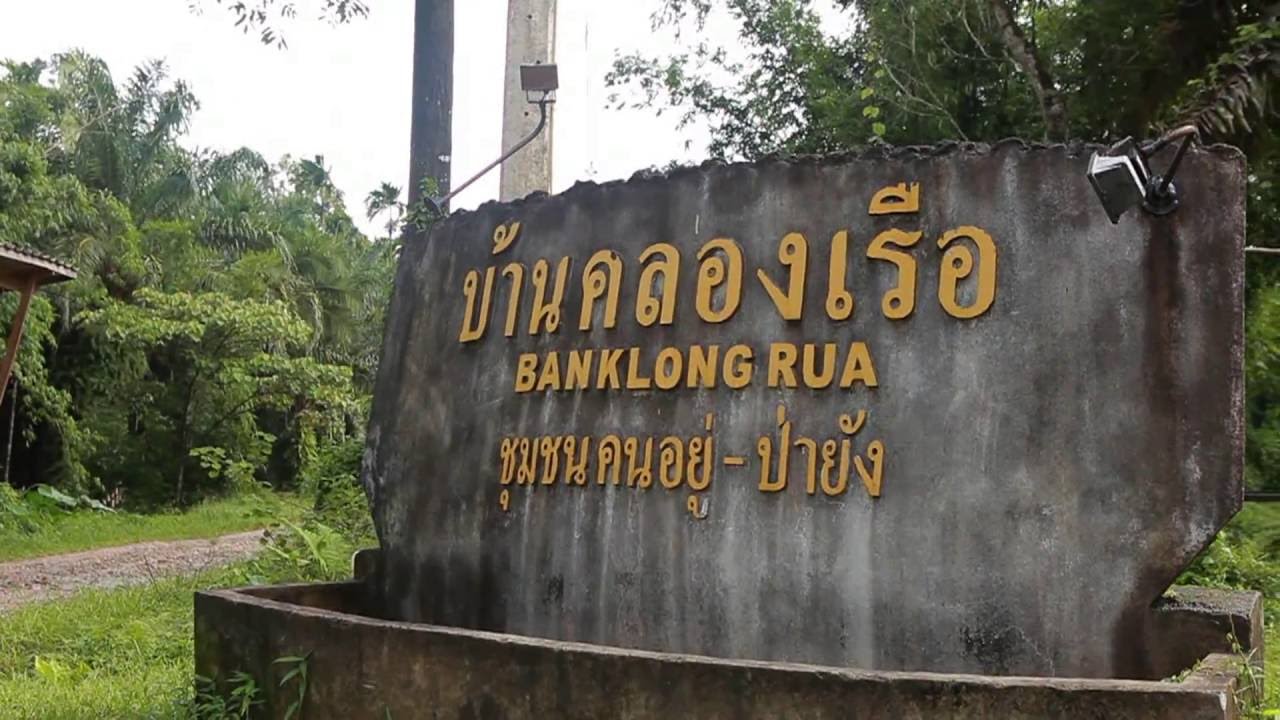
The name “Klong Ruea” comes from a local canal whose form resembles a boat. The canal is more than a physical feature; it is part of the identity of the village. It reflects the role of water in local life, agriculture, ecological balance, and tourism activities. To visit Ban Klong Ruea is therefore to understand how a small upstream community organizes its life around water, forest, land, and shared rules.
The history of Ban Klong Ruea can be understood in several stages. Before 1975, the area was largely fertile forest with rich soil and abundant water. Later, settlers entered the area, using parts of the forest for tin panning, small-scale mining, and farming. By the 1980s, people from different regions of Thailand had moved in and began growing coffee and other crops. These changes created pressure on the forest and eventually led to the need for a more organized land-use agreement. In the early 1990s, local discussion and support from conservation agencies led to the establishment of land-use boundaries and the “People Live, Forest Remains” approach.
The strength of Ban Klong Ruea is that the community did not choose between people and forest. Instead, it created a system where both could continue together. Farmland was clearly defined, forest areas were protected, and natural resources were used within agreed limits. This approach allowed the community to protect the forest while still maintaining livelihoods. The result is a village where conservation is not just a slogan, but part of everyday life.
Tourism became more organized after students and outside supporters encouraged the community to develop a homestay program. Local people formed a community homestay group, creating supplementary income while giving visitors a chance to learn from the village. Tourism here did not begin with resorts or large facilities. It began with local homes, local food, forest knowledge, and the willingness of villagers to share their way of life.
Ban Klong Ruea homestay allows visitors to stay with local families, eat home-cooked food, experience the forest-stream environment, and learn the rhythm of an upstream community. Facilities are simple and nature-oriented rather than hotel-like. The village has historically had limited urban-style infrastructure, but community life has adapted through solar power, mountain water supply, and practical local systems. Visitors should therefore approach the homestay as a learning experience, not as a conventional hotel stay.
Main activities include forest walks, rare plant observation, bamboo rafting, waterfall visits, birdwatching, agroforestry learning, and community-lifestyle study. The surrounding forest includes rare plants such as bua phut, krathon phra ram, krathon ruesi, large bamboo species, ferns, orchids, and medicinal plants. Wildlife and unusual species such as lanternflies and pangolins have also been associated with the area, reflecting the biological richness of the headwater forest.
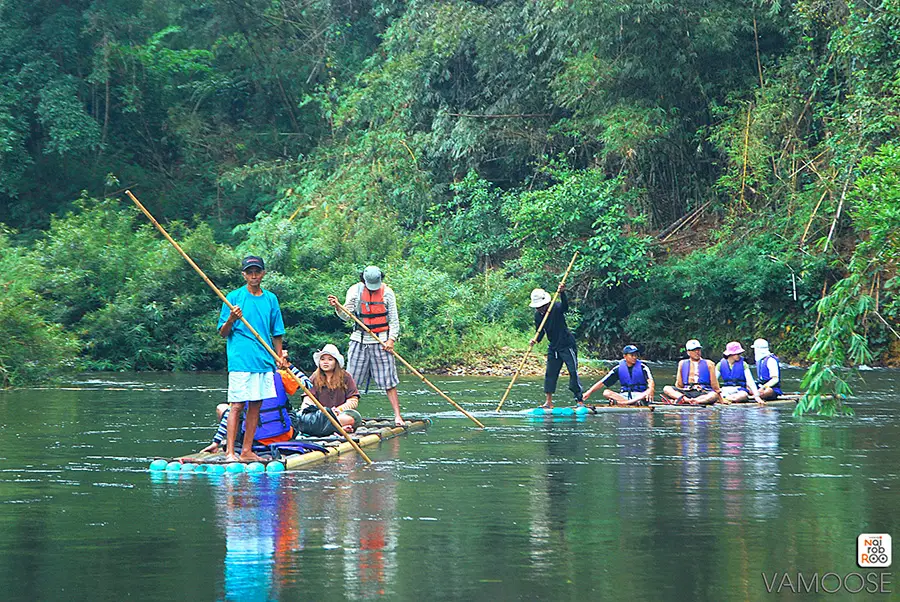
Bamboo rafting is one of the most memorable activities. It is not only a leisure activity, but also a gentle way to experience the stream, forest shade, and water clarity of the area. Floating slowly through the forested stream helps visitors understand why the community places such importance on protecting upstream forests. Visitors should always follow local guidance, avoid unsafe water areas, and never leave litter in the river or forest.
Heo Ta Chan Waterfall and Heo Phlu Nang Waterfall are important natural attractions connected with Ban Klong Ruea. The route to Heo Ta Chan Waterfall involves walking about 1 km through rubber gardens and natural forest. Along the way, visitors may see forest plants, herbs, and small wildlife. Heo Phlu Nang Waterfall is nearby and can be included in the same nature route. A local guide is strongly recommended because forest trails and water conditions can change according to season.
Another major learning topic is four-layer agroforestry. This system arranges plants by height and function. The upper layer includes tall economic trees and useful timber such as sato, betel nut, local durian, or native tree species. The middle layer includes fruit trees such as mangosteen and longkong. The lower layer includes vegetables, herbs, and forest vegetables. The underground layer includes rhizome and tuber crops such as galangal, turmeric, and other edible or useful plants. This system allows limited land to produce food, income, shade, biodiversity, and ecological recovery at the same time.
Four-layer agroforestry is not merely a farming technique. It is a survival strategy. By moving away from single-crop dependency and toward mixed forest-like gardens, villagers can reduce chemical use, increase household food security, diversify income, and reduce pressure to expand into forest areas. For visitors interested in sustainable agriculture, this is one of Ban Klong Ruea’s most valuable lessons.
Ban Klong Ruea is also known for establishing Thailand’s first Tree Bank. The idea encourages villagers to plant and maintain valuable trees in their own farmland, record them, and view living trees as long-term assets. This changes the meaning of trees from something to be cut and sold into something to be protected, valued, and passed on. The Tree Bank is therefore both an environmental tool and a community economic idea.
The community itself is culturally distinctive. Many residents originally came from different parts of Thailand, but they built a shared identity through cooperation, trust, and common rules. Local life remains simple and warm. Mutual help, community work, local farming, and shared meals continue to shape the atmosphere of the village. This makes Ban Klong Ruea more than a tourist program; it is a real community with a meaningful social fabric.
Ban Klong Ruea has received recognition from several organizations, including the Thailand Tourism Award in 2006 for eco-tourism and environmental recognition from PATA. These awards matter because they confirm the community’s long-term efforts to combine conservation with livelihood. The village became known not because it built large tourist facilities, but because it protected the forest and allowed visitors to learn from that process.
Getting There requires advance planning. The main route uses the Pak Song-Ban Na road, branching from Highway 4006, the Ratchakrut-Lang Suan route. At the junction, turn right onto the Ban Hang Kae-Klong Ruea road. The final access route to the village is about 11 km and includes sections of paved road, gravel road, and concrete road. Visitors should use a suitable vehicle, check road and weather conditions, and contact the community before traveling, especially for homestay stays, trekking, or bamboo rafting.
The best time to visit depends on the intended activity. Forest walks and waterfall visits require safe weather and local guidance. Homestay stays and community learning can be arranged throughout the year with advance contact. During the rainy season, visitors should be cautious of slippery trails, stream conditions, and access-road changes. Cool or post-rain periods often provide lush scenery and fresh forest atmosphere.
Visitors should prepare for real eco-tourism. Comfortable walking shoes, quick-drying clothing, drinking water, personal medicine, a flashlight, and a personal trash bag are useful. Do not collect plants, disturb wildlife, enter deep forest without a guide, or ignore community rules. The best way to visit Ban Klong Ruea is as a respectful learner rather than a consumer of nature.
A well-planned Phato route can combine Ban Klong Ruea with nearby places such as Heo Ta Chan Waterfall, Heo Phlu Nang Waterfall, Por Ta Hin Chang Waterfall, Phato Watershed Conservation Management Unit, Khao Nom Sao, and the Phato bamboo-rafting route. Staying overnight in the homestay allows visitors to understand the community more deeply, while a one-day visit should focus on fewer activities to allow enough time for meaningful learning.
Overall, Ban Klong Ruea reveals a deeper side of Chumphon beyond beaches, islands, and roadside souvenirs. It is an upstream village that uses forest as a foundation for life, community rules as a tool for coexistence, four-layer agroforestry as an economic strategy, Tree Bank as a long-term value system, and eco-tourism as a bridge between outsiders and community knowledge. Visiting Ban Klong Ruea is therefore not just a homestay trip or bamboo-rafting experience, but a chance to learn how sustainability can become real when a community understands the value of the forest and chooses to protect it together.
| Name | Ban Klong Ruea / Ban Klong Ruea Homestay / Ban Klong Ruea Eco-Tourism Village |
| Location | Moo 9, Pak Song Subdistrict, Phato District, Chumphon Province |
| Address | Ban Klong Ruea, Moo 9, Pak Song Subdistrict, Phato District, Chumphon 86180, Thailand |
| Coordinates | 9.765673417978183, 98.70143422605011 |
| Contact Number | 084-889-4532 |
| Community Contact / Local Resource Person | Mr. Manat Klai Rung |
| Highlights | Eco-tourism village, community homestay, People Live Forest Remains model, nature-study forest walks, bamboo rafting, four-layer agroforestry, Heo Ta Chan Waterfall, Heo Phlu Nang Waterfall, and Thailand’s first Tree Bank |
| Distinctive Features | An upstream community that lives with the forest, restores forestland, manages farmland through community rules, practices four-layer agroforestry, and uses eco-tourism to support conservation and local livelihoods |
| Important Awards | Thailand Tourism Award 2006 In The Eco-Tourism Category And Environmental Recognition From PATA |
| Open Days | Daily |
| Opening Hours | 08.00 - 16.30. Advance contact is recommended for homestay stays and community activities. |
| Travel Information | Use the Pak Song-Ban Na road branching from Highway 4006, the Ratchakrut-Lang Suan route. Then turn right onto Ban Hang Kae-Klong Ruea road for about 11 km. The route includes paved, gravel, and concrete sections. |
| Current Status | Open as an eco-tourism village, community learning site, and homestay destination in Pak Song Subdistrict, Phato District |
| Main Areas / Zones | 1. Village And Homestay Area 2. Nature-Study Forest Trails 3. Streams And Bamboo-Rafting Route 4. Four-Layer Agroforestry And Mixed Gardens 5. Ban Klong Ruea Tree Bank 6. People Live Forest Remains Learning Area 7. Heo Ta Chan And Heo Phlu Nang Waterfall Routes |
| Recommended Activities | Homestay Stay, Nature Walks, Bamboo Rafting, Birdwatching, Rare Plant Observation, Four-Layer Agroforestry Learning, Tree Bank Learning, Community-Lifestyle Study, And Guided Eco-Tourism |
| Visitor Guidelines | Contact The Community In Advance, Respect Community Rules, Do Not Collect Forest Products, Do Not Disturb Wildlife, Do Not Litter, Do Not Enter Deep Forest Without A Local Guide, And Prepare Properly For Nature-Based Travel |
| Nearby Tourist Attractions | 1. Heo Ta Chan Waterfall, About 1 km 2. Heo Phlu Nang Waterfall, About 2 km 3. Por Ta Hin Chang Waterfall, About 10 km 4. Phato Watershed Conservation Management Unit, About 15 km 5. Khao Nom Sao, About 18 km 6. Phato Bamboo-Rafting Route, About 20 km |
| Nearby Restaurants | 1. Kin Kan Pang Wan Phato Restaurant, About 25 km, Tel. 061-358-1183 2. Phato Fresh Coffee, About 25 km, Tel. 087-997-2375 3. Krua Tai Noad Phato, About 30 km, Tel. 095-425-5491 4. Je U A La Carte And Yum, Sam Yaek Phato, About 50 km, Tel. 098-468-7606, 089-474-4882 5. Sukhee Tam Sang Lang Suan, About 50 km, Tel. 095-042-1295, 080-003-1433 |
| Nearby Accommodations | 1. Ban Klong Ruea Homestay, In The Village, Tel. 084-889-4532 2. Phu Khwan Mueang Resort, About 20 km, Tel. 077-539-251, 081-893-9189, 087-890-0614 3. Rim Klong Resort, About 22 km, Tel. 081-079-2804, 084-443-7105 4. Phu Nam Sai Resort, About 25 km, Tel. 077-576-316-9, 087-060-9360, 081-895-4978 5. Ban Nai Chok Homestay, About 30 km, Tel. 089-594-1468, 081-747-1511 6. Resort Krua Khun Muek, About 30 km, Tel. 077-654-561 |
Frequently Asked Questions (FAQ)
Q: Where Is Ban Klong Ruea Located?
A: Ban Klong Ruea is located in Moo 9, Pak Song Subdistrict, Phato District, Chumphon Province. It is an eco-tourism village and homestay community in an upstream forest area.
Q: What Are The Opening Days And Hours?
A: The village is listed as open daily from 08.00 to 16.30. Visitors should contact the community in advance for homestay stays, trekking, rafting, or guided activities.
Q: What Is The Main Highlight Of Ban Klong Ruea?
A: The main highlight is the People Live Forest Remains model, together with homestay stays, forest walks, bamboo rafting, four-layer agroforestry, Thailand’s first Tree Bank, and community-based forest conservation.
Q: What Awards Has Ban Klong Ruea Received?
A: Ban Klong Ruea received the Thailand Tourism Award in 2006 in the eco-tourism category and an environmental recognition from PATA.
Q: What Activities Can Visitors Do?
A: Visitors can stay in a homestay, walk in the forest, go bamboo rafting, observe rare plants, learn about four-layer agroforestry, study the Tree Bank, and experience local community life.
Q: How Do Travelers Get There?
A: Use the Pak Song-Ban Na road branching from Highway 4006, the Ratchakrut-Lang Suan route. Then turn right onto the Ban Hang Kae-Klong Ruea road for about 11 km.
Q: What Should Visitors Prepare Before Visiting?
A: Visitors should contact the community in advance, wear proper walking shoes, bring quick-drying clothing, personal medicine, a flashlight, and a personal trash bag, and follow local guidance for all nature activities.
Q: What Nearby Places Can Be Combined With A Visit?
A: Nearby places include Heo Ta Chan Waterfall, Heo Phlu Nang Waterfall, Por Ta Hin Chang Waterfall, Phato Watershed Conservation Management Unit, Khao Nom Sao, and the Phato bamboo-rafting route.
 Category: ●Suburban Living
 Group: ●Village, Community
Last Update : 2 MonthAgo
 Last Update : 2 MonthAgo
 Click to Access the Navigation Map GPS
Ban Klong Ruea Map
Recommend

 Art, Culture and Heritage
 Historical Sites and Monuments(1)
 Landmarks and Memorials(2)
 Art, Craft Centres, Tradition(3)
 Museums(2)
 Educational Places
 Educational Gardens, Farm(1)
 Places of Worship
 Temple(31)
 Other Sacred Sites(10)
 Research and Development
 Royal Project(1)
Village, Community(5)
 Local Market(1)
 Nature and Wildlife
 National Parks and Marine Reserves(7)
 Mountain (Doi)(5)
 Dam, Reservoir, Lake(1)
 Waterfalls(26)
 Hot Springs(1)
 Caves(21)
 River, Canal(7)
 Bays and Beaches(30)
 Islands(13)
 Other natural attractions(7)
 Entertainment and Agricultural
 Farms, Parks and Ecotourism(3)
 Outdoor and Adventure Activities(4)
 Shopping
 Shopping and Night Market(1)
 Travel Articles, Recipes
 Travel Review, Food Review(1)


