
lovethailand home >South Travel Attractions >Chumphon Travel Attractions >Tha Sae >Tha Kham > Wat Thep Charoen (Tham Rap Ro)
TL;DR: Wat Thep Charoen (Tham Rap Ro) is located at Village No. 4, Tha Kham Subdistrict, Tha Sae District, Chumphon Province, open Daily, hours 08.30 – 15.30.
Wat Thep Charoen (Tham Rap Ro)
Open Days: Daily
Opening Hours: 08.30 – 15.30
Wat Thep Charoen (Tham Rap Ro) is an important Buddhist temple, cave complex, archaeological site, and local museum in Village No. 4, Tha Kham Subdistrict, Tha Sae District, Chumphon Province. The temple stands at the foot of Khao Rap Ro, also known locally as Khao Phra, a limestone mountain closely linked with the history of old Chumphon. Within the temple grounds are sacred caves, ancient Buddha images, Luang Pu Lak Mueang, a sandstone Buddha footprint, cave paintings, a local museum, and the preserved body of Luang Pu Sai or Phra Khru Thep Sitthachan at Sala Rat Samakkhi. This makes Wat Thep Charoen one of the most complete cultural sites in Chumphon for visitors interested in Buddhism, archaeology, local legends, cave scenery, and southern Thai heritage.
The Rap Ro cave area was declared a national historic site on 27 September 1936. This status gives the temple and the surrounding cave landscape strong historical and cultural value. The area is associated with the old city of Uthumphon, believed in local tradition to have been a port and frontier town on the ancient route across the Malay Peninsula. For this reason, Wat Thep Charoen is more than a cave temple. It is a place where religion, trade routes, settlement history, and local belief are layered together in one landscape.
According to temple records, Wat Thep Charoen is located at No. 60, Ban Tha Kham, Village No. 4, Tha Kham Subdistrict, Tha Sae District, Chumphon Province. It belongs to the Mahanikaya monastic order and covers 34 rai, 8 ngan, and 16 square wah of land. The northern and western sides border Khao Phra, while the southern and eastern sides border Khlong Thale Sia. This setting gives the temple a distinctive character, combining a limestone mountain, sacred caves, a canal, temple buildings, and the local community of Ban Tha Kham.
The temple was established in 1927 and received its royal consecrated boundary in 1928. The consecrated boundary measures 8 metres wide and 20 metres long. In Thai Buddhism, such a boundary is important because it allows the ordination hall to be used for formal monastic ceremonies. Wat Thep Charoen also has a Dhamma section of a Buddhist scripture school that began in 1943, showing that the temple has long served not only as a place of worship and pilgrimage but also as a centre of Buddhist learning.
Important structures inside the temple include the ordination hall, sermon hall, monks’ residences, multipurpose pavilion, crematorium, kitchen, and religious activity areas. The ordination hall is 6 metres wide and 15 metres long, built in 1927 as a reinforced concrete structure. The sermon hall is 12 metres wide and 22 metres long, built in 1970 in an applied Thai style. The multipurpose pavilion is 3.80 metres wide and 15 metres long, built in 1990. The temple also houses the main Buddha image in the Maravijaya posture and Sala Rat Samakkhi, where the preserved body of Phra Khru Thep Sitthachan is enshrined.
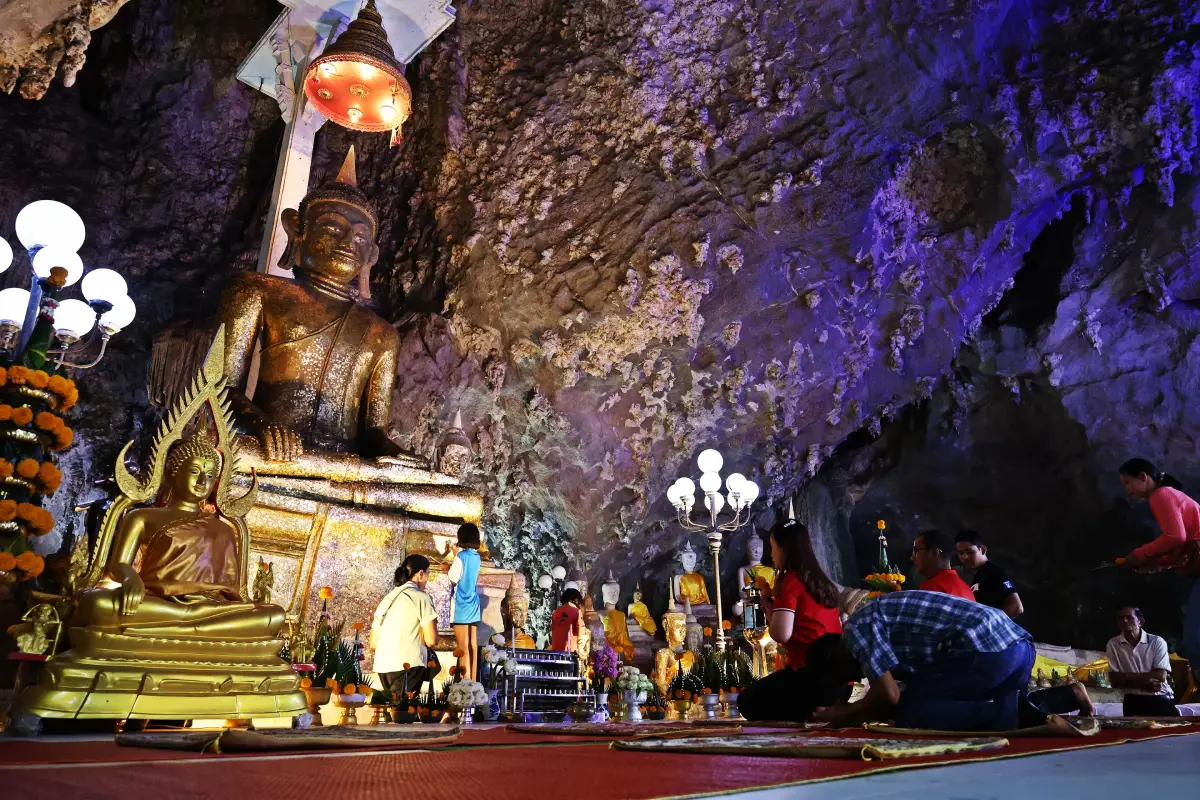
One of the most sacred places in the temple is Tham Phra, also called Tham Pu Lak Mueang. Inside the cave is Luang Pu Lak Mueang, a revered Buddha image regarded by local people as a spiritual pillar of Chumphon. The cave contains many Buddha images, including stucco images, bronze Buddha images, wooden Buddha images, reclining Buddha images, and Buddha images in the Maravijaya posture created by local artisans. The large Luang Pu Lak Mueang image is enshrined in the middle of the cave, standing about 6 metres high with a lap width of about 5 metres, and is associated with Ayutthaya-style Buddhist art.
Another striking feature of the cave complex is the group of 577 dressed Buddha images in the Maravijaya posture. These images are among the most memorable sights at Wat Thep Charoen. Visitors often begin by paying respect inside the temple, then continue to Tham Phra to worship Luang Pu Lak Mueang before visiting other caves that are open to the public. A visit to Wat Thep Charoen therefore combines merit-making with the experience of an archaeological and historical cave site.
Tham Ai Te, also written Tham Ai Tei, is one of the most distinctive caves in the complex. Its wall contains a painted reclining Buddha image about 4.80 metres long and 2 metres wide, positioned around 40 centimetres above the water surface. The image is outlined in red and black, with coloured sections added around the body. The head and hair are painted black, the face and arms are white, and the robe is painted in an orange-yellow tone. The image remains unfinished and is often associated with Ayutthaya-period artistic influence. Part of the cave has also been adapted for meditation practice, making it meaningful both as an art site and a religious retreat space.
Tham Sai is located close to Tham Phra or Tham Pu Lak Mueang. It is known for its stalactites and stalagmites and for a local story that a large banyan tree once stood at the cave entrance. Local memory connects this tree with the making of the Chumphon city pillar. Visitors who want to see the inner cave should allow enough time and follow temple guidance, as some areas need lighting and careful walking.
The sandstone Buddha footprint is another important sacred object at Wat Thep Charoen. It is carved from red sandstone and decorated with the 108 auspicious symbols. Around the edge are carvings connected with minority settlement. The footprint reflects Buddhist symbolism, local craftsmanship, and the religious imagination of the region. The local museum also displays an important red sandstone Buddha footprint around 1 metre long, which is one of the key objects visitors should see.
Sala Rat Samakkhi houses the preserved body of Luang Pu Sai, or Phra Khru Thep Sitthachan, a former abbot deeply respected by local people. His memory is strongly connected with the temple’s religious heritage and the origin of the local museum. After Typhoon Gay damaged Chumphon and Wat Thep Charoen in 1989, monks and villagers repaired the former abbot’s residence and discovered many objects that he had collected. This discovery led to the creation of the temple’s local museum.
The Wat Thep Charoen Local Museum was established in 2000, using the old sermon hall as its exhibition space. The museum displays objects found in the temple and local area, including Buddha images, ceramics, brassware, old household objects connected with former local rulers, a replica sword of Phraya Nakhon, and artefacts linked with the old city of Uthumphon. The museum helps visitors understand Wat Thep Charoen as a learning site, not only as a place for worship or cave sightseeing.
The temple is also connected with southern Thai folk art, especially the finely carved shadow puppets made by Lung Wen Chittara. Shadow puppetry is an important performing art in southern Thailand. Its presence at the temple and local museum connects Buddhism, archaeology, and local craftsmanship in one cultural setting. This makes Wat Thep Charoen valuable for visitors who want to understand both sacred heritage and living folk traditions.
The major annual tradition of the temple is the Rap Ro Cave pilgrimage and gilding ceremony for the sacred city-pillar Buddha image. Local people in Tha Sae and nearby areas believe that the 14th waning moon of the 5th lunar month marks the end of the old lunar year. Making merit and gilding Luang Pu Lak Mueang on this occasion is considered highly auspicious. On the night of the 13th waning moon of the 5th lunar month, performances and festivities are held around the temple. On the morning of the 14th waning moon, people climb to the cave to worship and gild the sacred image. Traditional entertainments such as Nora, boxing, Likay, and Ram Wong may also be held near the cave area.
Khao Rap Ro is a limestone mountain running roughly north to south. It is about 2 kilometres long and 1.25 kilometres wide, with the highest point in the southern part rising to around 181 metres above mean sea level. The mountain is an important archaeological landscape. Stone adzes and pottery fragments found in its caves show that people lived in this area from the prehistoric period, at least 2,000 years ago. This makes Wat Thep Charoen and Khao Rap Ro important for understanding both Buddhism and human settlement in the region.
Visitors should allow at least half a day if they want to see Tham Phra, Tham Ai Te, Tham Sai, Sala Rat Samakkhi, the Buddha footprint, and the local museum. The cave paths require care. Good walking shoes are recommended. Visitors should not touch stalactites or stalagmites, write on cave walls, climb into restricted areas, or move any objects inside the caves. The area is both a sacred temple and a national historic site, so respectful behaviour is essential.
Getting There is convenient by private car or rental car. From Phet Kasem Road, Highway 4, near kilometre marker 490, turn left into the road leading toward Tha Kham and continue to Wat Thep Charoen. Travelers can also follow the rural route through Tha Sae District and Ban Tha Kham to reach the temple. From Chumphon town, drive north toward Tha Sae District and use navigation to Wat Thep Charoen, Ban Tha Kham, Village No. 4.
The best time to visit is from morning to early afternoon, which allows enough time for worship, cave visits, and the local museum. Those who want to explore several cave areas should plan extra walking time, especially when traveling with elderly visitors. Some parts of the temple are on slopes or inside caves. During rainy weather, visitors should be careful of slippery surfaces and choose only safe, open areas to visit.
In summary, Wat Thep Charoen (Tham Rap Ro) is one of Chumphon’s most valuable cultural sites. Its importance comes from Khao Rap Ro, Tham Phra, Luang Pu Lak Mueang, 577 dressed Buddha images, Tham Ai Te with its reclining Buddha cave painting, Tham Sai with stalactites and stalagmites, the sandstone Buddha footprint, Sala Rat Samakkhi, the local museum, and the annual Rap Ro Cave pilgrimage. Visitors who want to understand Chumphon beyond beaches and coastal viewpoints should include this temple in their cultural route.
| Name | Wat Thep Charoen (Tham Rap Ro) |
| Known As | Wat Tham Rap Ro, Rap Ro Cave, Khao Rap Ro, Khao Phra |
| Location | Village No. 4, Tha Kham Subdistrict, Tha Sae District, Chumphon Province |
| Address | No. 60, Village No. 4, Rat Charoen Road, Tha Kham Subdistrict, Tha Sae District, Chumphon 86140, Thailand |
| Coordinates | 10.62392, 99.11336 |
| Highlights | National historic site, Tham Phra, Luang Pu Lak Mueang, 577 dressed Buddha images, Tham Ai Te, Tham Sai, sandstone Buddha footprint, Sala Rat Samakkhi, and Wat Thep Charoen Local Museum |
| History | Established as a temple in 1927, granted its royal consecrated boundary in 1928, and declared a national historic site on 27 September 1936 |
| Monastic Order | Mahanikaya |
| Temple Area | 34 rai, 8 ngan, 16 square wah |
| Boundaries | North and West: Khao Phra; South and East: Khlong Thale Sia |
| Main Areas / Zones | Ordination Hall, Sermon Hall, Monks’ Residences, Multipurpose Pavilion, Crematorium, Kitchen, Sala Rat Samakkhi, Tham Phra, Tham Ai Te, Tham Sai, and Wat Thep Charoen Local Museum |
| Sacred Objects | Luang Pu Lak Mueang Buddha Image, Principal Buddha Image in the Ordination Hall, 577 Dressed Buddha Images, Sandstone Buddha Footprint, and the Preserved Body of Luang Pu Sai or Phra Khru Thep Sitthachan |
| Local Museum | Established in 2000, displaying Buddha images, ceramics, brassware, old local ruler objects, a replica sword of Phraya Nakhon, and artefacts from the temple area |
| Important Tradition | Rap Ro Cave pilgrimage and gilding ceremony for Luang Pu Lak Mueang, held around the 13th to 14th waning moon of the 5th lunar month |
| Open Days | Daily |
| Opening Hours | 08.30 – 15.30 |
| Admission Fee | Free Admission |
| Main Contact Number | +66 77 547 056 |
| Travel Information | From Phet Kasem Road, Highway 4, near kilometre marker 490, turn left toward Tha Kham and continue to Wat Thep Charoen, Ban Tha Kham, Village No. 4. |
| Current Status | Open as a temple, national historic site, local learning centre, and local museum |
| Nearby Tourist Attractions | 1. Khao Phang Forest Park, about 6 km 2. Ban Na Ta Jae Cafe Lan Thung, about 6 km 3. Wat Kaeo Inthayaram, about 2 km 4. Wat Lum, about 2 km 5. Kiam Wooden Bridge at Nong Yai, about 13 km 6. Nong Yai Royal Development Project, about 13 km 7. Wat Sam Kaew, about 14 km |
| Nearby Restaurants | 1. Khun Sarai Restaurant, about 5 km, Tel. +66 77 547 223, +66 77 547 224, +66 77 547 225 2. Seedlock Shell Saphan 5, about 8 km, Tel. +66 62 380 3376 3. Poolsri Tha Sae Chicken Rice, about 12 km 4. Mukda Restaurant Tha Sae, about 13 km 5. Khao Pra Jao Coffee, about 16 km, Tel. +66 98 145 5518 |
| Nearby Accommodations | 1. Jirada Resort, about 6 km, Tel. +66 77 548 234 2. Chinida Resort Chumphon, about 7 km, Tel. +66 91 039 3838 3. Boon Dawee Hotel, about 10 km, Tel. +66 77 599 644 4. Tha Sae Resort, about 12 km, Tel. +66 65 598 0758 5. Natcha Resort, about 26 km, Tel. +66 90 868 1181 |
Frequently Asked Questions (FAQ)
Q: Where is Wat Thep Charoen (Tham Rap Ro) located?
A: Wat Thep Charoen (Tham Rap Ro) is located at No. 60, Village No. 4, Rat Charoen Road, Tha Kham Subdistrict, Tha Sae District, Chumphon Province.
Q: What are the opening days and hours?
A: It is open daily from 08.30 to 15.30.
Q: Is there an admission fee?
A: Admission is free.
Q: What are the main highlights of Wat Thep Charoen?
A: The main highlights include Tham Phra, Luang Pu Lak Mueang, 577 dressed Buddha images, Tham Ai Te, Tham Sai, the sandstone Buddha footprint, Sala Rat Samakkhi, and the local museum.
Q: When was Wat Thep Charoen declared a national historic site?
A: The Rap Ro cave area was declared a national historic site on 27 September 1936.
Q: Why is Tham Ai Te important?
A: Tham Ai Te contains a painted reclining Buddha image on the cave wall, an important piece of cave art connected with Buddhist belief and Ayutthaya-period artistic influence.
Q: When is the Rap Ro Cave pilgrimage held?
A: The tradition is associated with merit-making and gilding Luang Pu Lak Mueang around the 13th to 14th waning moon of the 5th lunar month.
Q: How should visitors prepare for the cave areas?
A: Visitors should dress modestly, wear shoes with good grip, walk carefully, avoid touching cave formations, avoid writing on cave walls, and never move any objects inside the historic site.
Tel : 077547056
 Tel : 077547056
Mobile : 0818925623, 0862721606
 Mobile : 0818925623, 0862721606
 Category: ●Places of Worship
 Group: ●Temple
Last Update : 2 MonthAgo
 Last Update : 2 MonthAgo
 Click to Access the Navigation Map GPS
Wat Thep Charoen (Tham Rap Ro) Map
Recommend

 Art, Culture and Heritage
 Historical Sites and Monuments(1)
 Landmarks and Memorials(2)
 Art, Craft Centres, Tradition(3)
 Museums(2)
 Educational Places
 Educational Gardens, Farm(1)
Temple(31)
Educational Gardens, Farm(1)
Temple(31)
 Other Sacred Sites(10)
 Research and Development
 Royal Project(1)
 Suburban Living
 Village, Community(5)
 Local Market(1)
 Nature and Wildlife
 National Parks and Marine Reserves(7)
 Mountain (Doi)(5)
 Dam, Reservoir, Lake(1)
 Waterfalls(26)
 Hot Springs(1)
 Caves(21)
 River, Canal(7)
 Bays and Beaches(30)
 Islands(13)
 Other natural attractions(7)
 Entertainment and Agricultural
 Farms, Parks and Ecotourism(3)
 Outdoor and Adventure Activities(4)
 Shopping
 Shopping and Night Market(1)
 Travel Articles, Recipes
 Travel Review, Food Review(1)


