
lovethailand home >South Travel Attractions >Chumphon Travel Attractions >Sawi >Sawi > Phra That Sawi
TL;DR: Phra That Sawi is located at Moo 1, Ban Wat Sawi, Sawi Subdistrict, Sawi District, Chumphon Province, open Daily, hours 08.00 - 16.30.
Phra That Sawi
Open Days: Daily
Opening Hours: 08.00 - 16.30
Phra That Sawi, also known as Phra Borommathat Sawi, is one of Chumphon’s most important Buddhist and historical landmarks. It is located at Wat Phra Borommathat Sawi, Moo 1, Ban Wat Sawi, Sawi Subdistrict, Sawi District, Chumphon Province. The golden bell-shaped stupa is believed to have been built in the Ayutthaya period and contains relics of the Buddha. The temple is strongly associated with the legend of King Si Thamma Sokkarat, a flock of crows, the discovery of a relic casket, and the nearby Phra Suea Mueang Shrine beside the Sawi River. It is an important destination for worship, local history, architecture, and cultural travel in southern Chumphon.
Phra That Sawi is one of the most meaningful sacred places in Chumphon Province. It is not only an old stupa respected by local people, but also a cultural landmark that brings together legend, Buddhist faith, architecture, archaeology, and local tradition. The stupa stands inside Wat Phra Borommathat Sawi in Sawi District, close to the Sawi River and not far from major transport routes. This makes it a practical and rewarding stop for travelers driving between Chumphon town and Lang Suan, or for visitors exploring the Sawi area in more detail.
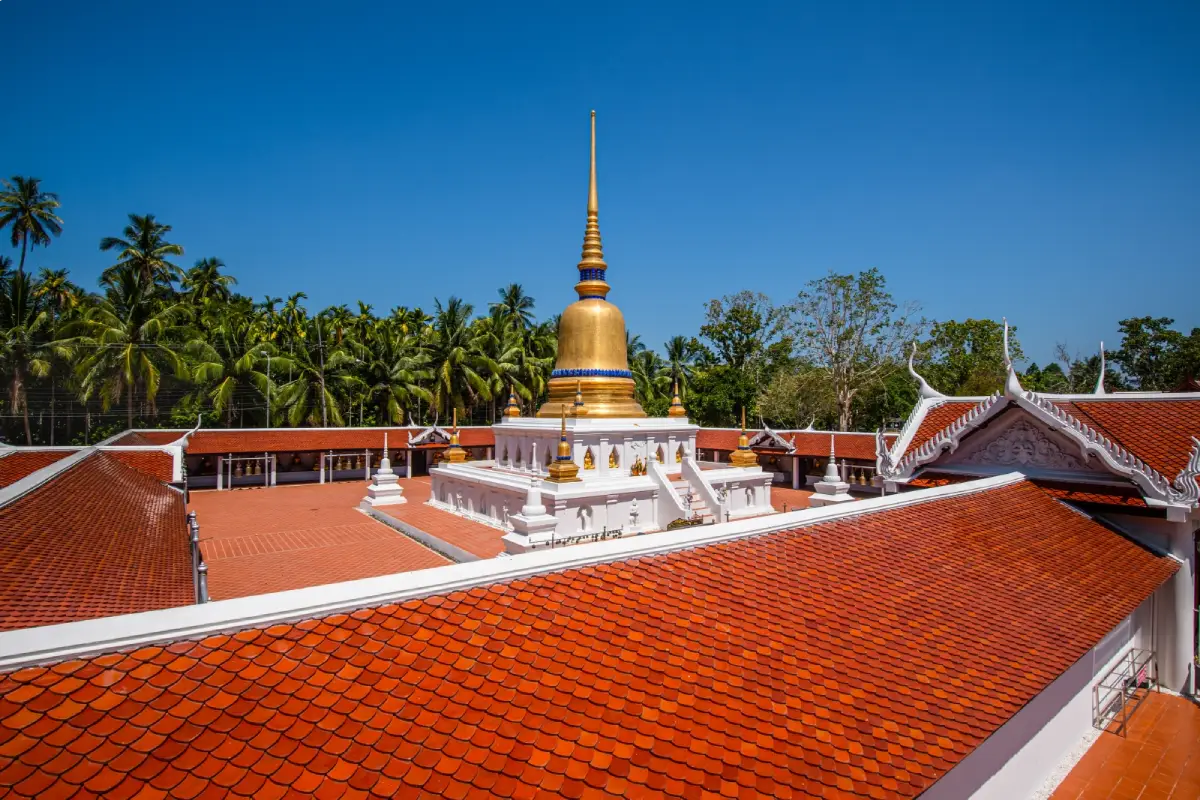
The beauty of Phra That Sawi lies in its calm and dignified form. The stupa is a bell-shaped chedi with a golden body rising from a white square base. Its design shows clear influence from Phra Mahathat Chedi in Nakhon Si Thammarat, but it has its own local identity and proportions. According to the Fine Arts Department, the stupa is about 14.25 metres high, with a square base measuring 8.50 metres on each side. It has elephant niches, standing guardian figures, an eastern stairway, Buddha niches around the upper level, a golden mosaic-covered bell-shaped body, and four smaller corner stupas.
The best-known legend of Phra That Sawi tells that King Si Thamma Sokkarat once led his army to rest in the Sawi area. While there, he saw a strange event: a white crow and a flock of other crows gathered above a pile of broken bricks, crying out and flapping their wings. The King ordered the pile of bricks to be removed. Beneath it, a large stupa base was found, and deeper inside was a relic casket containing relics of the Buddha. The King then ordered a new stupa to be built and held a seven-day, seven-night celebration. He named it “Phra Borommathat Kawee Peek,” with “peek” referring to the flapping of wings in the southern dialect. Over time, the name was shortened and changed into “Phra That Sawi.”
This legend gives the site much more meaning than a simple old stupa. The story of the crows, the brick mound, and the relic casket reflects a traditional belief that sacred discoveries can be revealed through unusual natural signs. Knowing this story before visiting makes the experience richer. The base, elephant niches, guardian figures, corner stupas, and golden bell-shaped form become parts of a larger cultural memory shared by the people of Sawi and Chumphon.
Another important area inside the temple is Phra Suea Mueang Shrine, located in front of the stupa on the eastern side near the Sawi River. According to legend, before King Si Thamma Sokkarat left the area, he was concerned that no one would guard the sacred relics. A soldier named Mueang volunteered to remain as protector. The King ordered Mueang to be ritually sacrificed so that his spirit would guard the stupa. The shrine became known as Phra Suea Mueang Shrine. Today it remains a respected sacred place, and many visitors worship there together with the main stupa.
The shrine has architectural and cultural value in its own right. It was originally a simple wooden enclosed structure. It was later rebuilt as a Thai-style building with a gabled roof and tiled covering to harmonize with the setting of Phra That Sawi. Inside is a life-size seated figure associated with the guardian spirit. Visitors should approach the shrine respectfully, keep noise low, and treat it as a sacred place closely connected with the stupa’s legend.
Phra That Sawi was officially registered as a national historic site in the Royal Gazette on 21 December 2001. The protected historic area covers approximately 1 rai, 1 ngan, and 30 square wa. This official status confirms the importance of Phra That Sawi as a national cultural and architectural heritage site. Visitors should therefore see it not only as a local temple, but also as a protected monument that deserves careful treatment. Touching, climbing, littering, or disturbing the historic elements should be avoided.
The temple also has Wat Phra Borommathat Sawi Museum, which collects historical information and objects related to the temple and local area. Visitors interested in history should allow extra time for the museum when it is open. It helps explain the stupa, local beliefs, restoration history, and the temple’s relationship with the Sawi community. A visit can therefore move beyond worship and become a deeper learning experience about Chumphon’s cultural heritage.
An important living tradition connected with the stupa is the annual royal cloth procession and robe-wrapping ceremony for Phra Borommathat Sawi. This cultural event brings together communities from Sawi and other districts of Chumphon. Participants join processions, carry long ceremonial cloths, circle the stupa clockwise, and offer the cloth to wrap the sacred chedi as an act of Buddhist devotion. The tradition shows that Phra That Sawi is not only an ancient monument but also a living center of faith for the people of Chumphon.
Getting There from Chumphon town is straightforward. Use Highway 41 on the Chumphon-Lang Suan route and drive toward Sawi District. The temple is around 47 km from Chumphon town. Once in Sawi, continue toward Sawi Subdistrict and Ban Wat Sawi. Travelers using public transport can take the train to Sawi Railway Station and then continue by local hired transport or motorcycle taxi to the temple. Those traveling without a private car should arrange a return ride in advance.
Travelers with a private car can make Phra That Sawi the main stop on a Chumphon-Lang Suan route. The site is close enough to major roads to be convenient, yet culturally rich enough to deserve dedicated time. Nearby places that can be combined in the same route include Wat Phra That Tham Khwan Mueang, Khao Muen Chani Viewpoint, Ban Thong Tom Yai, Prince of Chumphon Shrine at Hua Khao Than, Sawi Railway Station, and Arunothai Beach.
The best time to visit is in the morning or late afternoon, when the weather is more comfortable for walking around the stupa. Visitors should dress modestly because this is both a Buddhist temple and a national historic site. Walk quietly, remove shoes where required, do not disturb worshippers, and avoid touching or climbing on historic elements. Photography should be done respectfully and without blocking people who come to pray.
A good visit should begin with worship inside the temple, followed by a slow walk around the main stupa. Observe the square base, elephant niches, guardian figures, small corner stupas, and golden bell-shaped chedi. After that, continue to Phra Suea Mueang Shrine in front of the stupa. If the museum is open, spend time there to understand the history, local beliefs, and restoration work connected with the temple.
Phra That Sawi is suitable for many types of travelers: Buddhist pilgrims, history lovers, architecture enthusiasts, families, and road-trip travelers passing through Chumphon. It is easy to access, does not require a long visit, and offers strong cultural value. The site works well as a main attraction in Sawi District rather than merely a quick roadside stop.
The value of Phra That Sawi lies in its many layers. At the center is the relic of the Buddha, which gives the stupa its sacred status. Around that are the legend of King Si Thamma Sokkarat, the white crow, and the discovery of the relic casket. Architecturally, the stupa reflects influence from Nakhon Si Thammarat while preserving its own local identity. Culturally, Phra Suea Mueang Shrine and the annual robe-wrapping tradition keep the site alive in the faith of the community.
In the broader picture, Phra That Sawi helps travelers understand Chumphon beyond beaches, islands, viewpoints, and seafood. It shows that the province also has major Buddhist heritage, historic architecture, local legend, and strong community traditions. A visit to Phra That Sawi brings auspiciousness, cultural insight, and a deeper understanding of Sawi District and southern Chumphon.
| Name | Phra That Sawi / Phra Borommathat Sawi / Wat Phra Borommathat Sawi |
| Location | Moo 1, Ban Wat Sawi, Sawi Subdistrict, Sawi District, Chumphon Province |
| Address | No. 5, Moo 1, Sawi Subdistrict, Sawi District, Chumphon 86130, Thailand |
| Coordinates | 10.230116, 99.091594 |
| Contact Numbers | 077-531-195, 081-087-6539 |
| Highlights | A historic Buddhist stupa containing relics of the Buddha, Phra Suea Mueang Shrine, temple museum, and annual royal cloth procession and robe-wrapping ceremony |
| Historical Period | Believed to date from the Ayutthaya period. The temple was established in 1782 and the stupa underwent major restoration in the early reign of King Rama VI after the upper part collapsed. |
| Name Origin | The name comes from the legend of King Si Thamma Sokkarat, a flock of crows flapping above a brick mound, and the discovery of relics of the Buddha. The original name “Phra Borommathat Kawee Peek” later became “Phra That Sawi.” |
| Architectural Features | A bell-shaped stupa about 14.25 metres high on a square base measuring 8.50 metres on each side, with elephant niches, guardian figures, an eastern stairway, Buddha niches, and four smaller corner stupas |
| Current Status | Open as a Buddhist temple, national historic site, and important faith-based attraction in Sawi District, Chumphon Province |
| Open Days | Daily |
| Opening Hours | 08.00 - 16.30 |
| Admission Fee | No Admission Fee. Donations may be made voluntarily. |
| Travel Information | From Chumphon town, use Highway 41 on the Chumphon-Lang Suan route for about 47 km, then enter Sawi District and Sawi Subdistrict. By train, get off at Sawi Railway Station and continue by local hired transport. |
| Main Areas / Zones | 1. Main Phra Borommathat Sawi Stupa 2. Circumambulation Area Around The Stupa 3. Phra Suea Mueang Shrine 4. Wat Phra Borommathat Sawi Museum 5. Temple Grounds And Worship Area 6. Sawi Riverfront Area In Front Of The Stupa |
| Facilities | Parking Area, Public Restrooms, Accessible Pathways, Worship Area, Donation Items, And Temple Museum |
| Important Tradition | Annual royal cloth procession and robe-wrapping ceremony for Phra Borommathat Sawi, with processions, chanting, clockwise circumambulation, and cloth offering to the stupa |
| Visitor Guidelines | Dress Modestly, Keep Noise Low, Remove Shoes Where Required, Do Not Touch Historic Elements, Do Not Litter, And Avoid Disturbing Worshippers |
| Nearby Tourist Attractions | 1. Wat Phra That Tham Khwan Mueang, About 1 km 2. Sawi Railway Station, About 2 km 3. Khao Muen Chani Viewpoint, About 8 km 4. Prince Of Chumphon Shrine At Hua Khao Than, About 11 km 5. Ban Thong Tom Yai, About 13 km 6. Arunothai Beach, About 20 km |
| Nearby Restaurants | 1. Sabaidee And JOKE BY SABAIDEE, About 2 km, Tel. 077-531-949, 081-714-5664 2. Baan Fai Fa Sawi, About 3 km, Tel. 062-242-6605 3. Aroi Dee ST Restaurant, About 4 km, Tel. 077-510-254, 081-895-5296 4. Siriwan Restaurant, About 4 km, Tel. 077-531-010 5. Khrua Baan Rim Nam Rai Lang City Sawi, About 9 km, Tel. 083-396-1442 |
| Nearby Accommodations | 1. Kiangchan Resort, About 3 km 2. Baan Dala Hotel, About 3 km, Tel. 077-532-154 3. Baan Suan Thiwa Ratri, About 4 km 4. Civilai Motel, About 4 km, Tel. 061-236-2236 5. Saithan Resort Chumphon, About 6 km |
Frequently Asked Questions (FAQ)
Q: Where Is Phra That Sawi Located?
A: Phra That Sawi is located inside Wat Phra Borommathat Sawi, Moo 1, Ban Wat Sawi, Sawi Subdistrict, Sawi District, Chumphon Province.
Q: Why Is Phra That Sawi Important?
A: It is an important historic Buddhist stupa in Chumphon, containing relics of the Buddha, connected with the legend of King Si Thamma Sokkarat, and registered as a national historic site.
Q: What Are The Opening Days And Hours?
A: The site is open daily from 08.00 to 16.30.
Q: Is There An Admission Fee?
A: No. There is no admission fee, but visitors may make donations voluntarily.
Q: What Is Phra Suea Mueang Shrine?
A: It is the guardian shrine in front of Phra That Sawi. According to legend, it is connected with a soldier named Mueang who became the spiritual guardian of the sacred relics.
Q: How Do Travelers Get There From Chumphon Town?
A: Travel by Highway 41 on the Chumphon-Lang Suan route for about 47 km, then enter Sawi District and Sawi Subdistrict. By train, get off at Sawi Railway Station and continue by local hired transport.
Q: What Important Tradition Is Associated With Phra That Sawi?
A: The annual royal cloth procession and robe-wrapping ceremony is an important Chumphon tradition, with a procession, circumambulation, chanting, and cloth offering to the stupa.
Q: What Nearby Attractions Can Be Combined With A Visit?
A: Nearby places include Wat Phra That Tham Khwan Mueang, Sawi Railway Station, Khao Muen Chani Viewpoint, Prince of Chumphon Shrine at Hua Khao Than, Ban Thong Tom Yai, and Arunothai Beach.
 Category: ●Places of Worship
 Group: ●Other Sacred Sites
Last Update : 2 MonthAgo
 Last Update : 2 MonthAgo
 Click to Access the Navigation Map GPS
Phra That Sawi Map
Recommend

 Art, Culture and Heritage
 Historical Sites and Monuments(1)
 Landmarks and Memorials(2)
 Art, Craft Centres, Tradition(3)
 Museums(2)
 Educational Places
 Educational Gardens, Farm(1)
 Temple(31)
Other Sacred Sites(10)
 Research and Development
 Royal Project(1)
 Suburban Living
 Village, Community(5)
 Local Market(1)
 Nature and Wildlife
 National Parks and Marine Reserves(7)
 Mountain (Doi)(5)
 Dam, Reservoir, Lake(1)
 Waterfalls(26)
 Hot Springs(1)
 Caves(21)
 River, Canal(7)
 Bays and Beaches(30)
 Islands(13)
 Other natural attractions(7)
 Entertainment and Agricultural
 Farms, Parks and Ecotourism(3)
 Outdoor and Adventure Activities(4)
 Shopping
 Shopping and Night Market(1)
 Travel Articles, Recipes
 Travel Review, Food Review(1)


