
lovethailand home >Northeastern Travel Attractions >Ubon Ratchathani Travel Attractions >Nam Yun >Song > Chong An Ma
TL;DR: Chong An Ma is located at Song Subdistrict, Nam Yuen District, Ubon Ratchathani Province, Thailand, open Thursday Only, hours 09.00 – 12.00.
Chong An Ma
Open Days: Thursday Only
Opening Hours: 09.00 – 12.00
Chong An Ma in Ubon Ratchathani is a temporary border trade checkpoint between Thailand and Cambodia, located in Song Subdistrict, Nam Yuen District, Ubon Ratchathani Province. It is one of the most distinctive border destinations in southern Ubon Ratchathani, combining local trade, mountain scenery, forested roads, and the everyday life of people living along the Thai-Cambodian frontier. The site is known for its small border market where essential goods are exchanged between Thai and Cambodian communities within a controlled border area.
At present, Chong An Ma operates on a limited schedule: Thursday only, from 09.00 to 12.00. It functions as a temporary border trade point, not a permanent international border checkpoint and not a free-access tourist crossing. People entering the area must follow official procedures, remain within the designated market zone, and comply with border officers. This makes Chong An Ma suitable for visitors who want to observe a real border market, learn about local cross-border trade, and experience the geography of Nam Yuen’s frontier landscape within the permitted time and area.
Chong An Ma is about 12 km from Nam Yuen town and about 115 km from Ubon Ratchathani city. The journey from the provincial city leads through Det Udom and the southern part of Ubon Ratchathani before continuing to Nam Yuen and Song Subdistrict. The final section toward Chong An Ma is especially atmospheric, with rural communities, forested roadside scenery, mountain slopes, and a sense of approaching the edge of Thailand. This journey is part of the experience, not merely a transfer to the market.
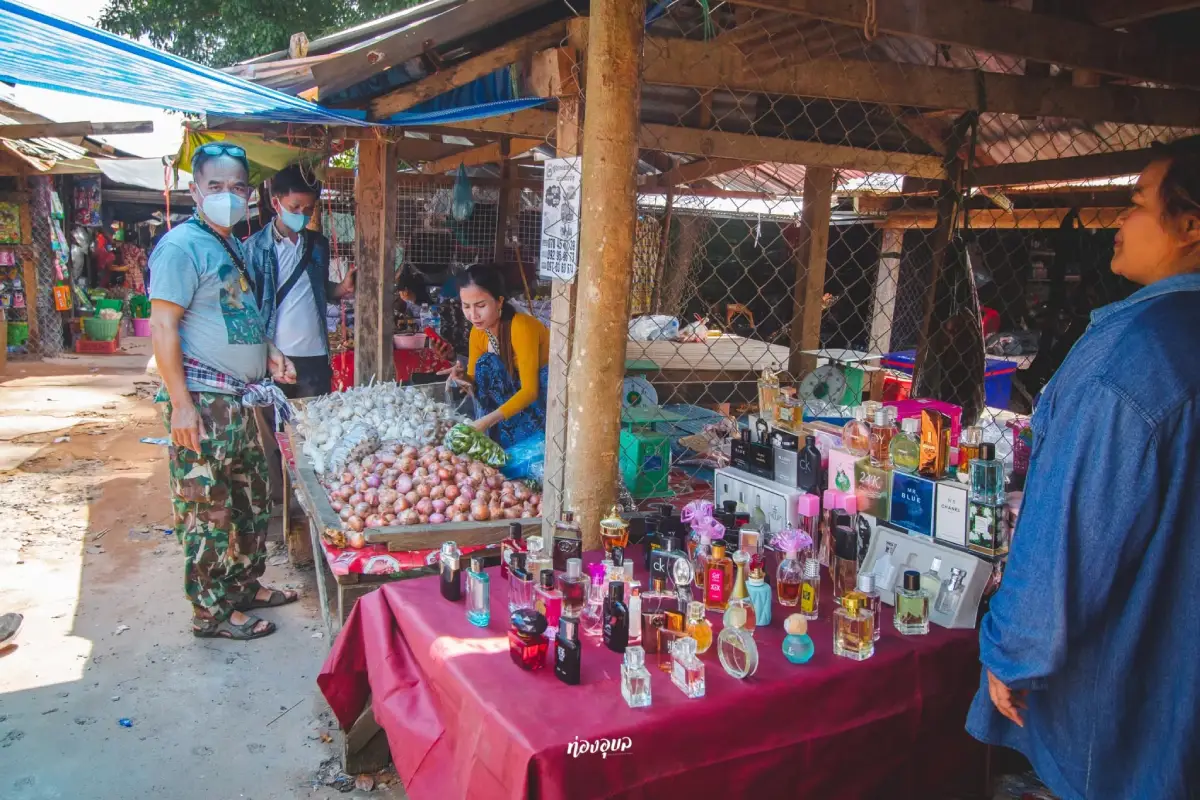
The importance of Chong An Ma lies in its role as a meeting point between border trade, local livelihood, and security management. On market days, traders and local residents from both sides bring goods for exchange and purchase within the permitted zone. Typical goods associated with the border market include essential consumer products, fresh food, fruit, vegetables, household items, and selected local products. The atmosphere is simple, practical, and strongly connected with daily life rather than tourism decoration.
Unlike urban markets designed mainly for visitors, Chong An Ma is a working border market. Its identity comes from vendors, carts, basic goods, officers, market stalls, and the controlled movement of people. For travelers, this makes the site valuable as a real social and economic landscape. It shows how communities along the border continue to depend on regulated trade, face-to-face exchange, and mutual familiarity between people on both sides.
The road to Chong An Ma is one of its major charms. Travelers pass through quiet rural areas, farmland, forested sections, and mountain scenery before reaching the border market area. The landscape shows a different side of Ubon Ratchathani from the provincial city, the Mekong River attractions, and the better-known cultural sites. This is southern Ubon Ratchathani as a frontier landscape: open, green, mountainous, and closely connected with neighboring Cambodia.
The main areas at Chong An Ma include the Thai-side market, the document-checking or card-exchange zone, parking space, goods stalls, officer-controlled areas, and the route that connects toward the Cambodian-side market. Visitors should understand that the site is not organized like a conventional tourist attraction. It is a border operation area where trade and security work together. The visible presence of officers, carts, umbrellas, stalls, and basic goods is part of the authentic character of the place.
Geographically, Chong An Ma belongs to the Phanom Dong Rak mountain range, a long natural borderland between Thailand and Cambodia. The pass-like terrain gives the area its historical and practical importance. Natural gaps and mountain passes have long shaped movement, settlement, trade, and control along frontiers. Chong An Ma therefore has meaning not only as a market, but also as a landscape shaped by geography.
The name “Chong An Ma” reflects the landform of the area. The Thai word “chong” refers to a pass or opening, while “an ma” suggests a saddle-like form. The name therefore points to a mountain-pass landscape that resembles a saddle. This makes the name meaningful for travelers because it describes the actual terrain of the place.
Chong An Ma has long been associated with lively border trade during market days. Cambodian shoppers come to buy Thai goods, while Thai traders and visitors can encounter products and everyday items connected with the Cambodian side. The exchange is practical and community-based. It is not driven by large-scale commercial tourism, but by people who need food, goods, and household supplies in their daily lives.
Visitors must follow the instructions of border officers. Movement is limited to the market zone, and access beyond the permitted area is not allowed. Photography should be done respectfully and only in appropriate areas. Military or official operation zones should not be photographed unless permission is given. This is essential because Chong An Ma is a real border area, not a fully open tourism site.
The current operating window from 09.00 to 12.00 on Thursday is short, but it is enough for visitors staying in Nam Yuen to see the market atmosphere, observe the trade process, buy basic goods, and experience the border landscape. Travelers starting from Ubon Ratchathani city should leave very early because the drive is long. Staying overnight in Nam Yuen is a more relaxed option for those who want to combine Chong An Ma with nearby nature attractions.
Chong An Ma connects naturally with other attractions in Nam Yuen and nearby districts. The area is close to the broader landscape of Phu Chong-Na Yoi National Park, the Emerald Triangle, and the Thai-Lao-Cambodian frontier region. This allows travelers to combine border-market travel with forest, waterfall, reservoir, and mountain-view experiences in the same trip.
Huai Luang Waterfall in Phu Chong-Na Yoi National Park is one of the best-known natural attractions in the region. It is a large waterfall dropping from a cliff into a beautiful pool below, with emerald-colored water and a pale sandy area near the base. The waterfall is especially attractive from the rainy season into the cool season, and it works well as a nature-focused continuation after visiting Chong An Ma.
Kaeng Kalao is another natural stop inside the Phu Chong-Na Yoi area. It features a stream flowing over rocky ground in a shaded forest atmosphere. For travelers who enjoy slower nature stops, Kaeng Kalao adds water, rock, forest, and butterfly scenery to the trip. Phu Hin Dang and Chong Bok further expand the route with mountain, border, and viewpoint landscapes.
Chong Bok, also known as part of the Emerald Triangle region, is associated with the meeting area of Thailand, Laos, and Cambodia. This gives southern Ubon Ratchathani a special geographic identity. Travelers interested in borders, maps, and regional geography can understand the area better by connecting Chong An Ma with Chong Bok and Phu Chong-Na Yoi National Park.
Lam Huai Bon Reservoir in Song Subdistrict is another nearby local landscape. It adds a peaceful water-and-mountain atmosphere to a Chong An Ma trip. For visitors who want a softer stop after the border market, the reservoir offers a quiet view of the local environment and helps show that Song Subdistrict is not only a border-trade area but also a community surrounded by natural resources.
A practical travel plan begins in Nam Yuen town in the morning, continues to Chong An Ma during the official Thursday opening period, and then returns to town for lunch. In the afternoon, visitors can continue to Lam Huai Bon Reservoir or head farther toward Phu Chong-Na Yoi National Park. This route keeps the border visit within the correct time while still allowing travelers to experience the surrounding natural landscape.
Travelers starting from Ubon Ratchathani city should treat Chong An Ma as a full-day trip. The distance is long, and the checkpoint has a limited operating window. A comfortable plan is to travel to Nam Yuen the day before, stay overnight, visit Chong An Ma on Thursday morning, and then continue to natural attractions or return to Ubon Ratchathani city later in the day.
For photography, the best subjects are the roadside mountain scenery, the market atmosphere, goods stalls, carts, signs, and general community activity in permitted areas. Visitors should not photograph military positions, officer operation points, security procedures, or sensitive border areas without permission. Respectful photography is part of responsible travel in a border zone.
Chong An Ma is best suited for travelers who want to understand real border life rather than simply visit a scenic attraction. Its value lies in the everyday details: people buying essential goods, traders arranging products, officers controlling movement, and communities interacting across the border. These details make Chong An Ma a meaningful social and cultural destination.
For international travelers, Chong An Ma offers a different perspective from Thailand’s major tourist border crossings. It is small, controlled, practical, and community-oriented. Visitors can see how border trade works at a local scale and how geography, regulation, livelihood, and cross-border relationships shape everyday life.
Visitors should bring proper identification documents, dress neatly, carry cash for small purchases, and prepare drinking water, sun protection, and comfortable shoes. Payment systems in border markets may be limited, so cash remains practical. Travelers should also allow extra time for the drive, especially when coming from Ubon Ratchathani city.
Chong An Ma is overseen by border security authorities, including the Suranaree Force, the 2nd Army Region, local military units, Nam Yuen District authorities, and related agencies. Their role is to manage movement, trade conditions, public safety, and the order of the border area. Cooperation with officers is essential for a smooth visit.
The cultural value of Chong An Ma comes from seeing people from both sides meet under a regulated market system. Trade here is not only about money. It is about familiarity, language, practical needs, trust, and border-community relationships. The goods may be simple, but the social meaning is strong.
Chong An Ma also helps visitors understand Ubon Ratchathani as a border province. The province is often known for the Mekong River, Pha Taem, temples, and cultural festivals, but its southern districts also reveal another dimension: mountains, border trade, security landscapes, and frontier communities. Visiting Chong An Ma together with Nam Yuen and Phu Chong-Na Yoi gives a fuller view of Ubon Ratchathani.
The site should not be approached as a leisure market with unlimited access. Its restrictions are part of its identity as a real border checkpoint. Visitors who understand this will appreciate the place more accurately. Chong An Ma is valuable because it is authentic, regulated, local, and closely tied to the realities of border life.
A visit becomes more complete when combined with Nam Yuen town. After the border market, travelers can eat in town, stop at a local café, continue to a reservoir, or plan a nature trip into the national park area. This balanced route brings together trade, community, forest, mountain, and local food in one travel experience.
Chong An Ma in Ubon Ratchathani is therefore more than a border market. It is a living border landscape where trade, geography, community, and official control meet. For travelers who want to see a deeper side of southern Ubon Ratchathani, the site offers a clear and memorable look at Thai-Cambodian border life in a real local setting.
| Name | Chong An Ma |
| Location | Song Subdistrict, Nam Yuen District, Ubon Ratchathani Province, Thailand |
| Site Type | Temporary Thai-Cambodian border trade checkpoint with a local border market, controlled crossing area, forested road, and mountain-border landscape |
| Highlights | Thai-Cambodian border market, local goods exchange, forest-and-mountain road scenery, border-community livelihood, and Phanom Dong Rak frontier landscape |
| Cultural Significance | A local border-trade space where Thai and Cambodian communities exchange essential goods and maintain practical cross-border livelihood connections |
| Travel Information | About 12 km from Nam Yuen town and about 115 km from Ubon Ratchathani city. Best reached by private car, rental car, or hired local transport. |
| Current Status | Open as a limited temporary border trade point within the designated market area and under border-officer procedures |
| Open Days | Thursday Only |
| Opening Hours | 09.00 – 12.00 |
| Fees | No admission fee for the market area. Personal expenses depend on purchases, food, and local services. |
| Border Access Conditions | People may enter and exit only within the designated market zones of both countries through card exchange. Only essential consumer goods are permitted, and vehicles are not allowed to pass. |
| Facilities | Parking area, border market, document-check or card-exchange point, goods stalls, vendor area, and officers on duty |
| Main Areas / Zones | Thai-side market zone, card-exchange zone, parking zone, goods-stall zone, officer-controlled area, route toward the Cambodian-side market, and forested access road to Chong An Ma |
| Caretaker | Suranaree Force, 2nd Army Region, local military units, Nam Yuen District authorities, and related border-control agencies |
| Local Administrative Offices | Song Subdistrict Municipality, Fax 0-4525-2524 / Nam Yuen Subdistrict Municipality, Tel. 045-251947 |
| Nearby Tourist Attractions | 1. Nam Yuen Town, about 12 km 2. Lam Huai Bon Reservoir, Song Subdistrict, about 10 km 3. Chong Bok / Emerald Triangle, about 35 km 4. Phu Chong-Na Yoi National Park, about 50 km 5. Huai Luang Waterfall, about 53 km 6. Kaeng Kalao, about 55 km 7. Phu Hin Dang, about 60 km |
| Nearby Restaurants | 1. KFC Big C Nam Yuen, about 13 km, Tel. 061-408-0614 2. Yumbar Nam Yuen, about 13 km, Tel. 080-574-9966 3. Tam Nua Restaurant @ Nam Yuen, about 13 km, Tel. 063-786-2463 4. Ting Korea And Hug Der Café At Nam Yuen, about 13 km, Tel. 089-582-0494 5. Nitzer Cafe & Arapaima Fish Park, about 14 km, Tel. 099-238-9618 |
| Nearby Accommodations | 1. Nam Yuen Resort, about 13 km, Tel. 083-461-3010 2. Sriboonruang Hotel Nam Yuen, about 14 km, Tel. 062-197-6878 3. Phakchuda Resort Nam Yuen, about 13 km, Tel. 064-441-9422 4. Taweerut Resort, about 14 km, Tel. 089-947-5933 5. Kanthiya Garden Hotel, about 15 km |
Frequently Asked Questions (FAQ)
Q: Where is Chong An Ma located?
A: Chong An Ma is located in Song Subdistrict, Nam Yuen District, Ubon Ratchathani Province, Thailand, on the Thai-Cambodian border.
Q: What days is Chong An Ma open?
A: Chong An Ma is open on Thursday only, from 09.00 to 12.00.
Q: Is there an admission fee?
A: No. There is no admission fee for the market area. Personal expenses depend on purchases, food, and local services.
Q: Is Chong An Ma a permanent international checkpoint?
A: No. Chong An Ma is a temporary border trade point, not a permanent international checkpoint. Access is limited to the designated market area and official procedures.
Q: What can visitors buy at Chong An Ma?
A: Visitors can find essential consumer goods, fresh food, fruit, vegetables, household items, and selected local products related to Thai-Cambodian border trade.
Q: How far is Chong An Ma from Ubon Ratchathani city?
A: It is about 115 km from Ubon Ratchathani city and about 12 km from Nam Yuen town.
Q: What nearby places can be visited after Chong An Ma?
A: Nearby places include Lam Huai Bon Reservoir, Chong Bok, the Emerald Triangle, Phu Chong-Na Yoi National Park, Huai Luang Waterfall, Kaeng Kalao, and Phu Hin Dang.
Q: What type of traveler is Chong An Ma suitable for?
A: It is suitable for travelers interested in border markets, Thai-Cambodian local trade, frontier geography, forested mountain roads, and southern Ubon Ratchathani beyond mainstream attractions.
 Category: ●Art, Culture and Heritage
 Group: ●Landmarks and Memorials
Last Update : 3 MonthAgo
 Last Update : 3 MonthAgo
 Click to Access the Navigation Map GPS
 Historical Sites and Monuments(5)
Landmarks and Memorials(2)
Historical Sites and Monuments(5)
Landmarks and Memorials(2)
 Royal Palace(1)
 Art, Craft Centres, Tradition(7)
 Museums(3)
 Places of Worship
 Temple(37)
 Other Sacred Sites(4)
 Research and Development
 Royal Project(2)
 Suburban Living
 Village, Community(2)
 Local Market(4)
 Nature and Wildlife
 National Parks and Marine Reserves(5)
 Mountain (Doi)(6)
 Dam, Reservoir, Lake(8)
 Waterfalls(12)
 Hot Springs(1)
 Caves(2)
 River, Canal(11)
 Bays and Beaches(8)
 Islands(2)
 Other natural attractions(6)
 Entertainment and Agricultural
 Zoos and Aquariums(2)
 Animal camps and shows(1)
 Farms, Parks and Ecotourism(1)
 Waterpark(1)
 Travel Articles, Recipes
 Travel Review, Food Review(1)


