
lovethailand home >Northeastern Travel Attractions >Ubon Ratchathani Travel Attractions >Si Muang Mai >Song Yang > Wat Phu Lon
TL;DR: Wat Phu Lon is located at Song Yang Subdistrict, Si Mueang Mai District, Ubon Ratchathani Province, open Daily, hours 08.30 – 16.30.
Wat Phu Lon
Open Days: Daily
Opening Hours: 08.30 – 16.30
Wat Phu Lon in Ubon Ratchathani, also known as Phu Lon Monastic Retreat, is an important meditation site in Song Yang Subdistrict, Si Mueang Mai District, Ubon Ratchathani Province. Located about 20 kilometres north of Si Mueang Mai town and about 78 kilometres from Ubon Ratchathani city, the temple stands on a modest rocky hill covered with trees, sandstone formations, open rock terraces and natural shelters. The atmosphere is quiet, shaded and deeply suited to contemplation. Wat Phu Lon is especially significant because it is known as the first samatha-vipassana meditation site of Luang Pu Mun Bhuridatto, one of the most influential meditation masters in modern Thai Buddhism and a central figure in the Thai forest meditation tradition.
The value of Wat Phu Lon does not come from grand architecture or monumental buildings. Its importance comes from silence, natural austerity, and its direct connection with Luang Pu Sao Kantasilo and Luang Pu Mun Bhuridatto. Phu Lon is a rocky hill where open stone terraces, caves, forest patches and natural shelters create an ideal place for seclusion. In the past, the area was wild, remote, affected by forest fever and inhabited by dangerous animals. When Luang Pu Sao brought Luang Pu Mun here to train in meditation, the landscape itself became part of the discipline. The forest, the rocks, the animals, the solitude and the discomfort all supported the training of mindfulness, concentration and inner strength.
Phu Lon is located close to Ban Kham Bong, the birthplace of Luang Pu Mun Bhuridatto. This makes the area especially meaningful because it connects both the beginning of his life and the beginning of his serious spiritual training. Ban Kham Bong represents his birth and early life, while Phu Lon represents the first deep stage of his meditative formation under the guidance of Luang Pu Sao. For visitors who follow the life of Luang Pu Mun, this landscape helps explain how a young monk from a local village became the great meditation master whose influence spread throughout Thailand and beyond.
Around 1897, Luang Pu Sao Kantasilo brought Luang Pu Mun to Phu Lon for intensive meditation training. At that time, the place was full of forest, illness and wild animals. Luang Pu Mun worked with local villagers to carry stone, clay and earth up the hill to create a simple shelter beneath the rocks. This shelter was not built for beauty or comfort. It was built so that he could practise without being disturbed by animals and weather. The shelter at Phu Lon therefore preserves the spirit of early forest meditation: simplicity, hardship, discipline and complete dedication to the training of the mind.
One of the most memorable stories connected with Phu Lon concerns a tiger that tried to attack Luang Pu Mun while he was meditating, but was unable to harm him. Today, a tiger footprint without claws is still associated with the wall of the shelter. For devotees and visitors, this footprint is not merely a curious mark on stone. It is a symbol of courage, concentration and spiritual composure. In the forest meditation tradition, danger is not treated only as a threat. It becomes a test of mindfulness and fearlessness. The story of the tiger at Phu Lon therefore helps visitors understand the intensity of early forest practice.
After Luang Pu Sao had trained Luang Pu Mun and recognized that his concentration had become firmly established, Luang Pu Sao departed. Luang Pu Mun continued to practise at Phu Lon for about five years. This period was crucial in shaping his inner discipline. He practised meditation, developed concentration, reflected deeply, and later taught his mother until she developed faith and followed the path of renunciation. Around 1906, Luang Pu Mun left Phu Lon and did not return. Because of this, Phu Lon became remembered as the first foundation of his samatha-vipassana practice.
The phrase “first samatha-vipassana meditation site of Luang Pu Mun” carries deep meaning. Samatha refers to the development of calm and concentration, while vipassana refers to insight into the nature of reality. Phu Lon was the place where these foundations became firmly established in Luang Pu Mun’s path. Before he travelled widely through forests, mountains and remote regions, Phu Lon provided the early training ground. Many later meditation teachers in the Thai forest tradition traced their inspiration to Luang Pu Mun. For that reason, Phu Lon is not only a local temple. It is one of the key spiritual landscapes in the history of Thai forest Buddhism.
The physical landscape of Wat Phu Lon is modest but powerful. The hill is not very high, but it contains open stone terraces, overhanging rock formations, natural shelters and patches of forest. From certain viewpoints, visitors can see flat-topped mountain ridges and rice fields below. On clear days, the view expresses the quiet beauty of rural Ubon Ratchathani. The landscape helps visitors imagine the conditions in which early forest monks practised: a life close to rock, forest, wind, heat, rain and silence. This is very different from visiting a city temple or a highly developed tourist landmark.
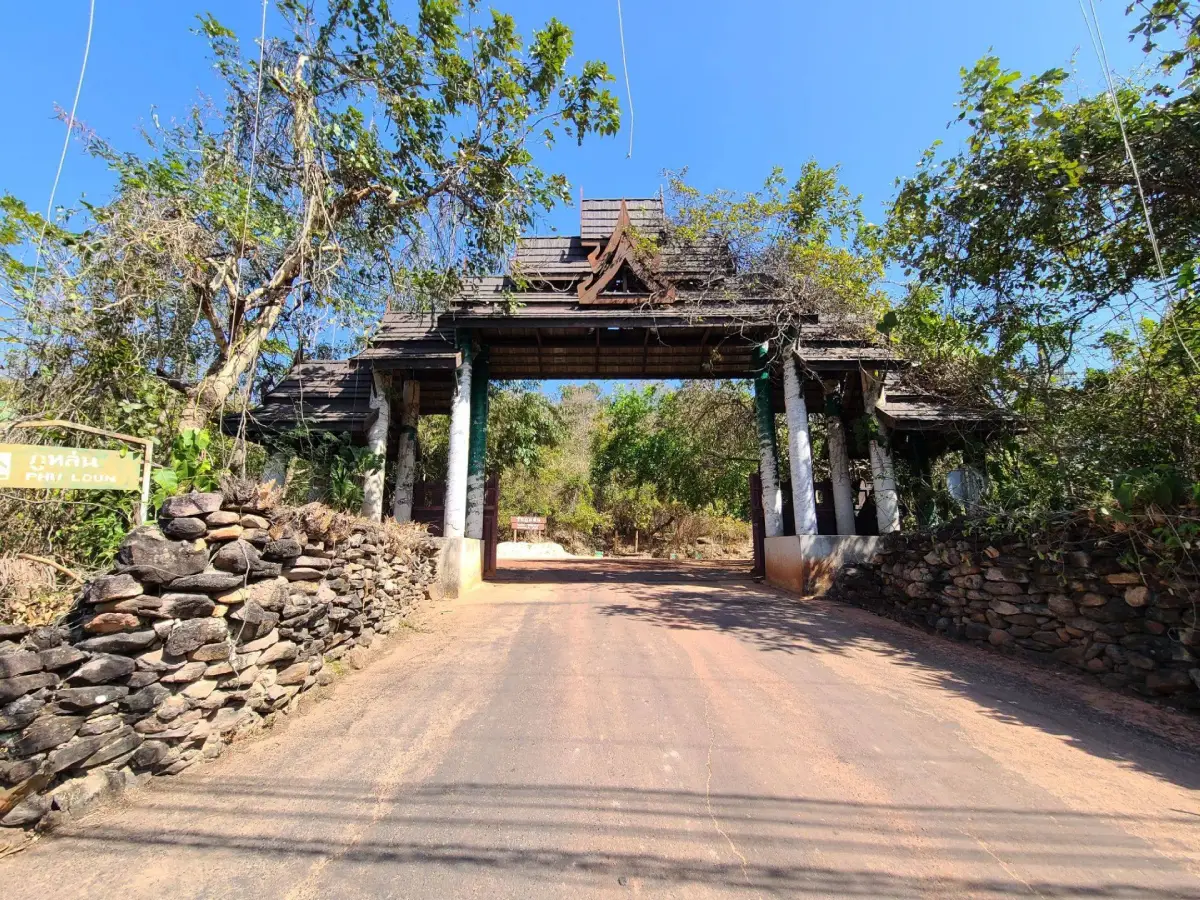
The entrance to Wat Phu Lon is simple and blends with the surrounding forest. Visitors immediately sense that this is not a temple built around spectacle. It is a place built around memory and meditation. Within the compound are walking areas, stone terraces, the meditation shelter, the tiger footprint, a statue of Luang Pu Mun, viewpoints, and an exhibition area presenting the lives of Luang Pu Sao and Luang Pu Mun. A visit should therefore be slow and respectful. Each point is connected with the history of practice and should be approached with calm attention rather than hurry.
The rock shelter associated with Luang Pu Mun is one of the most important areas of the temple. Visitors should approach it quietly because it marks the place where the young meditation monk practised in seclusion. The shelter was created simply, using stone, clay and local materials, in order to provide basic protection during meditation. It is very different from an ordinary tourist cave. Its meaning comes from ascetic practice, endurance and the deep memory of forest meditation. Standing near the shelter helps visitors understand the physical conditions that shaped Luang Pu Mun’s early practice.
The statue of Luang Pu Mun at Wat Phu Lon is another important point of devotion. Devotees come to pay respect, reflect on his teachings and remember his discipline. The statue is meaningful because it stands within the actual landscape where he practised, not in a place separated from his life story. For followers of the Thai forest tradition, paying respect to Luang Pu Mun at Phu Lon is a direct encounter with the early ground of his spiritual development. It is one of the most important stops on a pilgrimage route connected with his life.
The exhibition area inside the temple helps visitors understand the life stories of Luang Pu Sao and Luang Pu Mun more clearly. It presents their roles in the development of meditation practice, their discipline, their teachings and their influence on Thai Buddhism. This educational dimension is important because many visitors know Luang Pu Mun as a famous meditation master but may not understand the early conditions of his training. At Wat Phu Lon, the landscape and exhibition work together: one gives the physical place, while the other provides the historical explanation.
The restoration and development of Wat Phu Lon are closely connected with Phra Khru Kamonphawanakorn, also known as Si Thon Kamalo. He was a development monk who had practised at Phu Lon and later returned to restore the site. From 1984 onward, he led efforts to improve the temple, preserve the meditation place, build facilities and make the site accessible to devotees and visitors. His work allowed Phu Lon to become better known while still preserving its identity as a place of meditation and devotion. The temple received its consecrated boundary on 30 June 1995.
Phra Khru Kamonphawanakorn passed away in 2006, but his restoration work remains part of the temple’s living memory. Thanks to his effort, the site associated with Luang Pu Mun was preserved for later generations. Visitors today can still walk to the shelter, see the natural surroundings, pay respect at the statue, and learn about the early forest meditation tradition. A visit to Wat Phu Lon is therefore also a way to remember the monks and lay supporters who helped protect this sacred place after the time of Luang Pu Mun.
Today, Wat Phu Lon is under the care of Phra Khru Sunthon Winayakhun, the abbot of the temple, together with the monastic community and local supporters in Song Yang. The temple remains active as a place of worship, meditation, merit-making and cultural learning. Local people continue to visit and make merit, while pilgrims and travelers come to follow the path of Luang Pu Mun. The temple atmosphere remains simple and calm. Visitors should therefore speak quietly, avoid unnecessary noise and behave with the respect due to a living sacred place.
Wat Phu Lon is suitable for several types of visitors. Buddhist devotees come to pay respect to Luang Pu Mun and Luang Pu Sao. Travelers interested in Thai Buddhism come to learn about the early history of the forest meditation tradition. People seeking peace come to sit quietly and walk through the natural landscape. Cultural travelers come to connect Phu Lon with Ban Kham Bong, Wat Si Bun Rueang and the Ban Kham Bong Buddhist Park. Nature lovers come for the rocky hill, forest atmosphere and viewpoint. This combination makes Phu Lon one of the most meaningful destinations in Si Mueang Mai District.
A strong Luang Pu Mun pilgrimage route can begin at Ban Kham Bong, his birthplace. From there, visitors can continue to Wat Si Bun Rueang, where he was ordained as a novice, then visit the Ban Kham Bong Buddhist Park and proceed to Wat Phu Lon, where he received early intensive meditation training. This route allows visitors to understand his life in sequence: birthplace, novice ordination, devotional memorial and first meditation training ground. It is a highly meaningful route for anyone interested in the Thai forest tradition.
Wat Phu Lon can also be connected with natural and cultural attractions in Si Mueang Mai and nearby districts. These include Pha Luang Waterfall Forest Park, Wat Phu Chan Daeng Phawanaram, Kaeng Saphue, Sam Phan Bok and Pha Taem National Park. Each place has a different character. Phu Lon emphasizes meditation and silence. Ban Kham Bong emphasizes the life of Luang Pu Mun. Pha Luang emphasizes seasonal forest scenery. Kaeng Saphue and Sam Phan Bok show the power of river landscapes. Pha Taem preserves prehistoric cliff paintings and dramatic Mekong views. Travelers can therefore plan a half-day, full-day or overnight route depending on time.
The best times to visit Wat Phu Lon are morning and late afternoon. Morning gives softer light and a quieter atmosphere for worship and reflection. Late afternoon is suitable for viewing the surrounding ridges and fields from the hill. The rainy season and early cool season make the forest around the temple greener and more comfortable, although the rock surfaces can be slippery after rain. Visitors should walk carefully, especially around stone terraces and natural shelters. Proper footwear is strongly recommended.
A complete visit usually takes about one to two hours. Begin at the entrance and temple grounds, continue to the rock shelter associated with Luang Pu Mun, observe the tiger footprint, pay respect to the Luang Pu Mun statue, visit the exhibition area, and then walk to the viewpoint. Visitors who wish to sit quietly or practise meditation should choose a suitable area without disturbing monks, meditators or other visitors. Wat Phu Lon is not a place for loud tourism. Its true value is found through silence, patience and respect.
Wat Phu Lon is open daily from 08.30 to 16.30, and admission is free. Visitors may make donations to support temple maintenance according to their faith. Modest dress is expected. Shoes should be suitable for walking on stone and uneven ground. Visitors should bring drinking water, especially during the hot season. Do not litter, write on rocks, touch the tiger footprint unnecessarily, or move beyond the provided paths. Preserving the quiet and cleanliness of the site is part of respecting the meditation history of the temple.
Getting There from Ubon Ratchathani city is straightforward by private vehicle. Travel toward Trakan Phuet Phon and Si Mueang Mai District, then continue to Song Yang Subdistrict and Ban Phu Lon. The distance is about 78 kilometres from Ubon Ratchathani city, and the journey normally takes around 1.5 to 2 hours depending on road and traffic conditions. From Si Mueang Mai District town, the temple is about 20 kilometres to the north. Private cars, vans and local hired vehicles are the most practical options because public transport directly to the temple is limited.
Because Wat Phu Lon is close to Ban Phu Lon and not far from Ban Kham Bong, travelers can plan a route without rushing. A good route begins at Ban Kham Bong in the morning, continues to Wat Si Bun Rueang and the Ban Kham Bong Buddhist Park, and then proceeds to Wat Phu Lon. After the visit, travelers can return to Si Mueang Mai for food and accommodation, or continue toward Khong Chiam for Mekong scenery and Pha Taem National Park on the following day. This route combines meditation history, local culture and natural landscapes.
For international visitors, Wat Phu Lon is one of the clearest places to understand the Thai forest meditation tradition. The site shows that serious Buddhist practice was not developed in comfort, but in forests, rocky hills, caves and remote shelters where monks trained the mind through discipline, seclusion and direct experience. The rock shelter, tiger footprint, open stone terrace and statue of Luang Pu Mun all help explain the environment that shaped early forest practice. Travelers interested in Buddhism, meditation, ascetic practice or Thai religious history will find Wat Phu Lon especially meaningful.
Overall, Wat Phu Lon is one of the most important spiritual sites in Ubon Ratchathani for understanding the roots of the Thai forest tradition. It combines the memory of Luang Pu Sao and Luang Pu Mun, the natural power of stone terraces and forest, the tiger footprint as a symbol of spiritual courage, educational exhibitions, viewpoints and continuing local devotion. A visit to Wat Phu Lon is not simply a temple visit on a hill. It is a return to the early ground of a great meditation master and a direct encounter with the quiet strength of Buddhist practice in northeastern Thailand.
| Name | Wat Phu Lon / Phu Lon Monastic Retreat, Ubon Ratchathani |
| Location | Song Yang Subdistrict, Si Mueang Mai District, Ubon Ratchathani Province |
| Address | Wat Phu Lon, Song Yang, Si Mueang Mai, Ubon Ratchathani 34250, Thailand |
| Coordinates | 15.636161, 105.276807 |
| Highlights | The First Samatha-Vipassana Meditation Site Of Luang Pu Mun Bhuridatto, Open Stone Terrace, Rock Shelter, Tiger Footprint, Luang Pu Mun Statue, Exhibition On Luang Pu Sao And Luang Pu Mun, And Views Of Flat-Topped Mountain Ridges |
| History | Around 1897, Luang Pu Sao Kantasilo brought Luang Pu Mun Bhuridatto to train in meditation at Phu Lon. Luang Pu Mun practised here for about five years before leaving around 1906. The site was later restored by Phra Khru Kamonphawanakorn (Si Thon Kamalo) from 1984 onward and received its consecrated boundary on 30 June 1995. |
| Name Origin | The name is connected with the rocky hill of Ban Phu Lon in Song Yang Subdistrict, a landscape of stone terraces, forest, natural shelters and quiet conditions suitable for meditation. |
| Distinctive Features | A modest rocky hill meditation site with a peaceful forest atmosphere, remembered as the early training ground where Luang Pu Mun Bhuridatto developed the foundations of samatha and vipassana practice. |
| Travel Information | From Ubon Ratchathani city, travel toward Trakan Phuet Phon and Si Mueang Mai, then continue to Song Yang and Ban Phu Lon. The distance is about 78 km and normally takes around 1.5 to 2 hours by car. From Si Mueang Mai town, the temple is about 20 km north. |
| Current Status | Open To Visitors And Still Used As An Active Buddhist Temple, Meditation Site, Merit-Making Place And Cultural Learning Destination Connected With Luang Pu Mun Bhuridatto |
| Open Days | Daily |
| Opening Hours | 08.30 – 16.30 |
| Fees | Free Admission; Donations For Temple Maintenance Are Accepted According To Faith |
| Facilities | Parking Area, Temple Courtyard, Walking Paths, Luang Pu Mun Worship Area, Exhibition Area, Viewpoint And Meditation Spaces |
| Main Areas / Zones | Wat Phu Lon Entrance Open Stone Terrace Rock Shelter Used By Luang Pu Mun For Meditation Tiger Footprint On The Shelter Wall Luang Pu Mun Bhuridatto Statue Exhibition On Luang Pu Sao And Luang Pu Mun Nature Walking Path Viewpoint Over Flat-Topped Mountain Ridges And Rice Fields Meditation And Secluded Practice Area |
| Caretaker | Wat Phu Lon, The Dhammayut Monastic Community, Song Yang Local Community And Supporters Of The Luang Pu Mun Pilgrimage Route |
| Abbot | Phra Khru Sunthon Winayakhun |
| Important Former Restorer | Phra Khru Kamonphawanakorn (Si Thon Kamalo), who played a major role in restoring and developing Wat Phu Lon from 1984 onward |
| Visitor Note | Visitors should dress modestly, speak softly, wear shoes suitable for walking on stone, avoid littering, avoid writing on rocks, avoid touching the tiger footprint, and respect monks and meditators. |
| Nearby Tourist Attractions | 1. Ban Kham Bong, Birthplace Of Luang Pu Mun Bhuridatto, About 5 km 2. Wat Si Bun Rueang, Ban Kham Bong, About 5 km 3. Ban Kham Bong Buddhist Park, Luang Pu Mun Bhuridatto, About 6 km 4. Wat Phu Chan Daeng Phawanaram, About 8 km 5. Pha Luang Waterfall Forest Park, About 25 km 6. Kaeng Saphue, Phibun Mangsahan District, About 45 km 7. Sam Phan Bok, Pho Sai District, About 70 km 8. Pha Taem National Park, Khong Chiam District, About 75 km |
| Nearby Restaurants | 1. Sabai Phung, Si Mueang Mai, About 20 km, Tel. 061-954-0245 2. Turbo Nom Sod, Si Mueang Mai, About 20 km, Tel. 061-689-7546 3. Taeng On & Sasikan Cook-To-Order Restaurant, About 21 km, Tel. 089-699-5943 4. Khrua Phatsada, About 22 km, Tel. 085-316-4395 5. KFC PTTOR Si Mueang Mai, About 22 km, Tel. 065-729-8603 6. Local Food Stalls In Ban Kham Bong And Ban Phu Lon, About 5 – 6 km |
| Nearby Accommodations | 1. Phat Resort, Si Mueang Mai, About 22 km, Tel. 089-719-1219 2. Ban Klang Soi Resort Ubon, About 22 km, Tel. 081-966-7939, 090-190-9824 3. Sabaidee Hongphak, Si Mueang Mai, About 25 km, Tel. 086-248-7474, 080-473-7555 4. Sabaidee Residence, About 25 km, Tel. 086-824-7474, 087-909-7955 5. Araya Resort Khong Chiam Riverside, About 55 km, Tel. 092-389-5231 6. Community Homestays Along The Luang Pu Mun Pilgrimage Route In Ban Kham Bong And Si Mueang Mai, About 5 – 25 km |
Frequently Asked Questions (FAQ)
Q: Where is Wat Phu Lon located?
A: Wat Phu Lon is located in Song Yang Subdistrict, Si Mueang Mai District, Ubon Ratchathani Province, about 20 km north of Si Mueang Mai town and about 78 km from Ubon Ratchathani city.
Q: What are the opening hours of Wat Phu Lon?
A: Wat Phu Lon is open daily from 08.30 to 16.30.
Q: Is there an admission fee?
A: No. Admission to Wat Phu Lon is free. Visitors may make donations for temple maintenance according to their faith.
Q: Why is Wat Phu Lon important?
A: Wat Phu Lon is known as the first samatha-vipassana meditation site of Luang Pu Mun Bhuridatto. Luang Pu Sao Kantasilo brought Luang Pu Mun here for meditation training around 1897.
Q: What are the highlights of Wat Phu Lon?
A: The main highlights are the rock shelter used by Luang Pu Mun for meditation, the tiger footprint, the Luang Pu Mun statue, the open stone terrace, the exhibition on Luang Pu Sao and Luang Pu Mun, and the viewpoint over flat-topped mountain ridges.
Q: Who is the abbot of Wat Phu Lon?
A: The abbot of Wat Phu Lon is Phra Khru Sunthon Winayakhun.
Q: What should visitors prepare before visiting Wat Phu Lon?
A: Visitors should dress modestly, wear shoes suitable for walking on rock surfaces, bring drinking water, speak softly, avoid littering, avoid writing on rocks, and respect monks and meditators.
Q: What nearby attractions can be visited after Wat Phu Lon?
A: Nearby attractions include Ban Kham Bong, Wat Si Bun Rueang, Ban Kham Bong Buddhist Park, Wat Phu Chan Daeng Phawanaram, Pha Luang Waterfall Forest Park, Kaeng Saphue, Sam Phan Bok and Pha Taem National Park.
 Category: ●Places of Worship
 Group: ●Temple
Last Update : 3 MonthAgo
 Last Update : 3 MonthAgo

 Click to Access the Navigation Map GPS
Wat Phu Lon Map
Recommend

 Art, Culture and Heritage
 Historical Sites and Monuments(5)
 Landmarks and Memorials(2)
 Royal Palace(1)
 Art, Craft Centres, Tradition(7)
 Museums(3)
Temple(37)
 Other Sacred Sites(4)
 Research and Development
 Royal Project(2)
 Suburban Living
 Village, Community(2)
 Local Market(4)
 Nature and Wildlife
 National Parks and Marine Reserves(5)
 Mountain (Doi)(6)
 Dam, Reservoir, Lake(8)
 Waterfalls(12)
 Hot Springs(1)
 Caves(2)
 River, Canal(11)
 Bays and Beaches(8)
 Islands(2)
 Other natural attractions(6)
 Entertainment and Agricultural
 Zoos and Aquariums(2)
 Animal camps and shows(1)
 Farms, Parks and Ecotourism(1)
 Waterpark(1)
 Travel Articles, Recipes
 Travel Review, Food Review(1)


