
lovethailand home >Northeastern Travel Attractions >Si Sa Ket Travel Attractions >Khu Khan >Huai Nuea > Wat Khian Burapharam
TL;DR: Wat Khian Burapharam is located at Ban Phran, Moo 4, Huai Nuea Subdistrict, Khukhan District, Si Sa Ket Province 33140, Thailand, open Daily, hours 08.00 - 17.00.
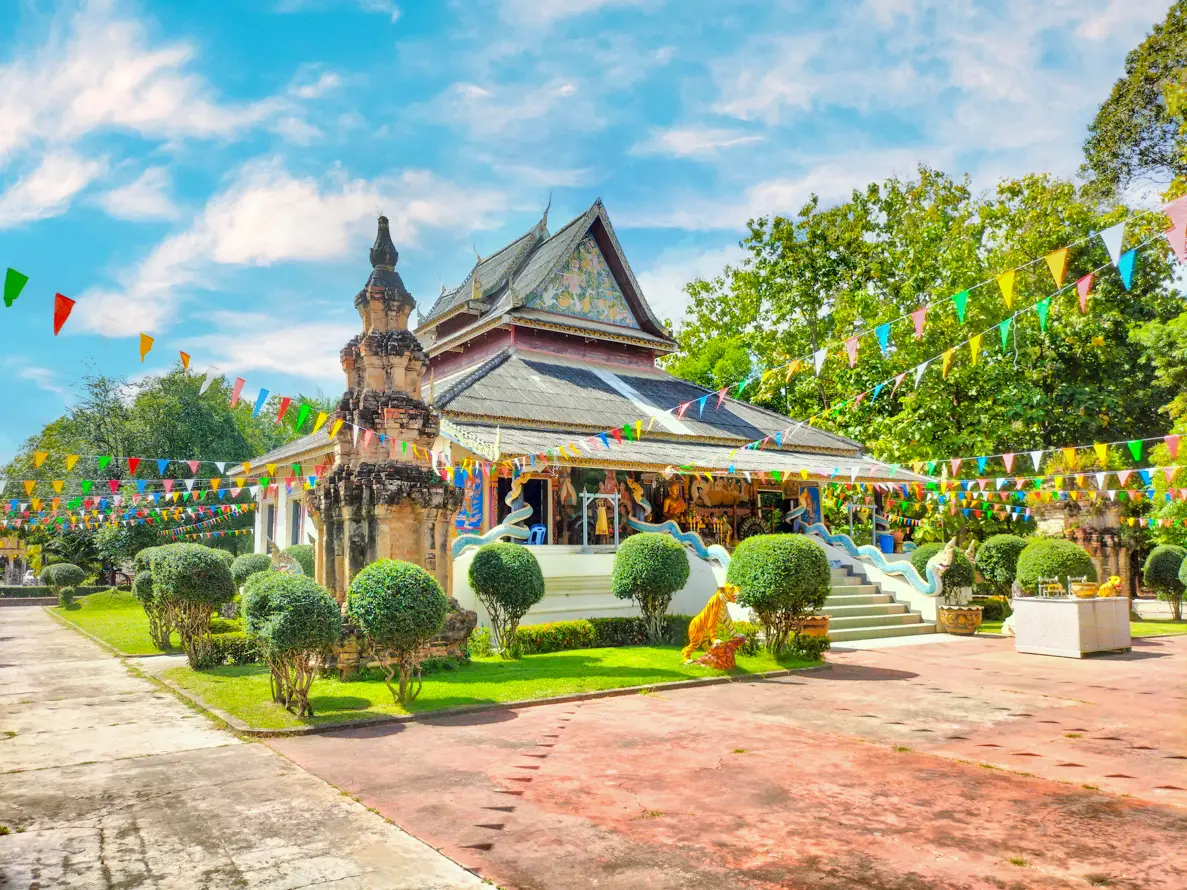
Wat Khian Burapharam
Open Days: Daily
Opening Hours: 08.00 - 17.00
Wat Khian Burapharam, Si Sa Ket is one of the most important historic temples in Khukhan District, located in Ban Phran, Moo 4, Huai Nuea Subdistrict, Khukhan District, Si Sa Ket Province. The temple is about 400 meters east of Khukhan District Office and around 49 kilometers from Si Sa Ket city. It is a sacred place where the history of old Khukhan, Isan Buddhist architecture, local Thai-Khmer cultural memory, and the devotion to Luang Pho To meet in one setting. For visitors who want to understand the cultural depth of Lower Northeastern Thailand, Wat Khian Burapharam is not merely a temple to visit. It is a historical and spiritual gateway into the old town of Khukhan.
The temple was originally known as “Wat Khmer,” reflecting the cultural background of the Khukhan area, where local Khmer language and culture have long been part of community life. Over time, the name “Khmer” was pronounced in local speech as “Khian,” and people commonly referred to the temple as Wat Khian. When the temple name was formalized, it became Wat Khian Burapharam. The word “Burapha” means east, referring to the temple’s position on the eastern side of old Khukhan town. The name therefore preserves language, geography, and community memory at the same time.
The importance of Wat Khian Burapharam lies in its role as a long-standing temple of Khukhan. Khukhan was an old frontier town in Lower Isan, with a history shaped by Thai-Lao, Khmer, Kui or Suai, and other local communities. Wat Khian Burapharam is one of the places where this layered identity can still be seen clearly. It is a working Buddhist temple, a registered historic site, a place of local pilgrimage, and a living reminder of how Buddhist faith, town history, and local art have supported one another for generations.
The temple’s key origin story dates to around 1780, during the Thonburi period. Local tradition tells that Phraya Krai Phakdi Si Nakhon Lamduan, the second governor of Khukhan, together with local officials and villagers, moved people to establish a new town around the area of present-day Ban Tabaek and Ban Phran. While clearing the forest at the present temple site, the villagers found a red stone rising from a termite mound. Its form resembled a Buddha image. The governor ordered the area to be prepared, a base to be strengthened, and a large Buddha image in the Mara-vijaya posture to be built over the mound. This became the great Buddha image of the town.
This story of the red stone on the termite mound is central to the sacred identity of Luang Pho To. In local belief, termite mounds and unusual natural forms can be associated with sacred power, the earth, and hidden spiritual significance. When the red stone was found in the shape of a Buddha image, the community did not treat it as an ordinary natural object. It was understood as an auspicious sign. Building a large Buddha image over it transformed a natural point in the forest into a Buddhist sacred place. This is one of the reasons why Luang Pho To remains deeply meaningful to the people of Khukhan.
At first, the great Buddha image was believed to have stood in the open as the main sacred image of the new town. Monks and novices were invited to stay, and a temple began to form around the image. However, the settlement was later moved to another area because the original location was too far from a reliable water source. As the town moved, the temple declined and eventually became abandoned. Forest grew thick around the Buddha image. Local stories describe the abandoned area as so dense that a pregnant tigress once gave birth on the lap of the Buddha image. This vivid story shows both the abandonment of the temple and the enduring presence of the sacred image in the forest.
Later, Phra Lak Kham Ut, a local guardian monk or ritual figure associated with the town, encountered the Buddha image and felt strong devotion. He persuaded villagers to restore the abandoned temple and build an ordination hall over the image. This protected Luang Pho To and gave the sacred area a more formal Buddhist structure. Another well-known story tells that someone later stole the crystal eyes of the Buddha image. Through the sacred power of the image, villagers heard a loud cry echo through the forest. The next morning, they discovered that the eyes had been taken. This story became part of the temple’s sacred memory and strengthened the community’s belief in Luang Pho To.
A major restoration took place around 1782 under Phraya Krai Phakdi Si Nakhon Lamduan, also known as Bun Chan, the third governor of Khukhan. The original image was covered with brickwork and the base was raised, making the image larger and more dignified. After this restoration, people began calling the image “Luang Pho To,” meaning the Great Reverend Buddha. From that time onward, Luang Pho To became the principal sacred image of Wat Khian Burapharam and one of the most revered Buddha images of Khukhan.
Luang Pho To is enshrined inside the ordination hall of Wat Khian Burapharam. The image is a gilded stucco Buddha in the posture of subduing Mara, measuring about 3.50 meters across the lap and about 6.80 meters high. Its artistic character combines Lan Xang and late Ayutthaya influences. The Mara-vijaya posture represents the Buddha’s victory over temptation before enlightenment, symbolizing stability, spiritual strength, and moral victory. For the people of Khukhan, Luang Pho To is not only an old Buddha image but also a powerful source of blessing and confidence.
The ordination hall is the most important historic structure in the temple. It is an Isan-style sim, or traditional ordination hall, built of brick and plaster in a rectangular form. It stands on a raised base and has stairways at the front and back. The roof has layered gables, and wooden decorative elements appear on the gables and roofline. Carved wooden designs include floral patterns, kanok motifs, Naga-head finials, and scenes from the Ramakien. These details make the building an important example of local craftsmanship and the architectural character of historic temples in Lower Isan.
The sim of Wat Khian Burapharam is valuable because it preserves the logic of local temple architecture. It was not designed as a large royal-style ordination hall, but as a sacred building appropriate to the scale and needs of a local community. The brick walls, elevated base, timber roof elements, and carved ornamentation show how local craftsmen combined function, faith, and beauty. The building is modest in size yet powerful in presence, and its value comes from proportion, age, craft, and continued use.
Around the ordination hall, there were once four small Lan Xang-style stupas at the corners. Today, two are still visible in front of the ordination hall, while the two at the rear remain only as ruins or have largely disappeared. These stupas deepen the artistic value of the temple because they show the link between Khukhan and the broader religious culture of Lan Xang and Isan. Their placement around the ordination hall also shows that the sacred area was once arranged with a clear ritual and architectural plan.
Wat Khian Burapharam was registered as a national historic site, with a protected boundary announced in the Royal Gazette, Volume 107, Part 16, on 25 January 1990. The protected area covers about 2 rai and 53 square wah. This recognition confirms that the ordination hall, Luang Pho To, and related historic elements have significance not only for the local community but also for the cultural heritage of Thailand. Preserving the temple is therefore a shared responsibility of the monastery, community, local authorities, and heritage agencies.
In 2001, a major restoration was authorized for the ordination hall and Luang Pho To. This restoration helped protect the historic sim and the sacred Buddha image while allowing the temple to continue receiving worshippers. A replica of Luang Pho To was also cast so that people could apply gold leaf to the replica without damaging the original principal image. This arrangement shows a careful balance between living devotion and heritage conservation.
Today, Wat Khian Burapharam remains an active local Buddhist temple under the Mahanikaya order. The temple grounds cover more than 21 rai and contain the historic ordination hall, sermon hall, monks’ residences, multipurpose hall, merit-making hall, meditation halls, crematorium, bell tower, kitchen, and storage buildings. The temple therefore continues to function as a real community monastery. It supports worship, local merit-making, Buddhist ceremonies, meditation, funerary rites, and community gatherings.
The current abbot is Phra Khru Burapha Phothitham, who is listed as the fourteenth abbot of the temple and has overseen the monastery from 2007 to the present. He works with resident monks, the temple community, Ban Phran villagers, Khukhan residents, and related local agencies to maintain the temple, its sacred objects, historic buildings, and religious activities. This continued care is one reason why Wat Khian Burapharam remains a living temple rather than a silent historic ruin.
A visit to Wat Khian Burapharam should begin with paying respect to Luang Pho To inside the ordination hall. Visitors should remove their shoes in the designated area, dress modestly, and enter the hall respectfully. After worshipping, it is worth observing the size of the image, the gilded surface, the facial expression, the base, the surrounding atmosphere, and the way the large Buddha image sits within the old sim. Visitors can then study the ordination hall itself, including the brick walls, wooden roof ornaments, carved gables, Ramakien motifs, and the Lan Xang-style stupas outside.
The relationship between Luang Pho To and Khukhan is one of the most important aspects of the temple. Luang Pho To is not simply a Buddha image inside a temple. It is a town guardian image that has shaped the memory and identity of Khukhan for centuries. Local sayings and cultural references often connect the old town with Luang Pho To of Wat Khian. To pay respect here is to encounter the spiritual core of old Khukhan and to see how a single sacred image can hold together community history, language, art, and faith.
Wat Khian Burapharam is also a strong starting point for a cultural route in Khukhan. It is close to Khukhan City Pillar Shrine, the monument to Phraya Krai Phakdi Si Nakhon Lamduan, Wat Thai Thep Nimit, Wat Lamphu, and other old-town landmarks. Travelers can begin at Wat Khian to pay respect to Luang Pho To, continue to the city shrine and historical monument, and then visit Wat Lamphu to see Phra Kaew Neramit. This route gives a broad understanding of Khukhan as an old town shaped by Buddhism, local leadership, Khmer-influenced culture, and Isan heritage.
Getting There is convenient from Khukhan town because the temple is only about 400 meters from the district office. From Si Sa Ket city, travelers can drive to Khukhan District, about 49 kilometers away, then continue to Ban Phran in Huai Nuea Subdistrict. The temple is accessible by private car, local transport, or hired vehicle. Visitors using public transport should get off in Khukhan town and continue by local vehicle to the temple. The location also makes it easy to combine the temple with other cultural sites in Khukhan on the same trip.
The best time to visit is in the morning or late afternoon before closing. Morning offers a quieter atmosphere for worship, while late afternoon light makes the old woodwork, roofline, stupas, and temple courtyard easier to observe. Visitors who wish to take photographs should do so respectfully. Flash should be avoided near sacred objects and old surfaces, and visitors should not climb onto historic elements or disturb people who are worshipping.
Proper etiquette is essential because Wat Khian Burapharam is both an active temple and a historic site. Visitors should dress modestly, remove shoes before entering the ordination hall, speak quietly, avoid touching Luang Pho To or ritual objects unnecessarily, avoid climbing on stupa bases or historic structures, avoid writing on walls or wooden surfaces, and help keep the temple clean. Visiting an old temple requires more care than visiting a modern attraction because each element is part of inherited heritage.
There is no fixed tourist admission fee at Wat Khian Burapharam. Visitors may enter during opening hours to pay respect to Luang Pho To and explore public areas of the temple. Donations, flowers, garlands, candles, and merit-making offerings are voluntary according to personal faith. This keeps the temple open and accessible to local residents, pilgrims, students, cultural travelers, and international visitors alike.
For cultural learning, Wat Khian Burapharam is ideal for those interested in Khukhan history, Isan sim architecture, historic Buddha images, Thai-Khmer local culture, and heritage conservation. The temple reveals many layers of time: the discovery of a red stone on a termite mound, the building of a great Buddha image, the abandonment of the temple, its restoration by town leaders, the construction of an ordination hall over the image, national historic-site registration, and continued religious use today. These layers give the temple deeper meaning than visual beauty alone.
For international visitors, Wat Khian Burapharam offers a clear introduction to the cultural landscape of Lower Isan. The temple brings together Buddhism, Lan Xang art, late Ayutthaya influence, local Isan architecture, Khmer-language memory, and the identity of old Khukhan. It shows that Si Sa Ket Province is not only known for Khmer stone sanctuaries; it also preserves Buddhist community temples that reveal everyday faith, local language, craftsmanship, and historical memory.
Wat Khian Burapharam is therefore one of the essential places for understanding Khukhan. Luang Pho To is the spiritual heart of the temple. The Isan sim is a precious architectural record. The Lan Xang-style stupas preserve old religious symbolism. The temple’s name, evolving from Wat Khmer to Wat Khian Burapharam, preserves language and memory. Together, these elements make the temple much more than a place to pay respect. It is a doorway into the history, faith, and cultural heritage of Si Sa Ket Province.
| Place Name | Wat Khian Burapharam, Si Sa Ket |
| Former / Local Names | Wat Khmer, Wat Khian, Wat Burapharam, Wat Khian Burapharam |
| Place Type | Local Buddhist Temple, Mahanikaya Monastery, Registered National Historic Site, Isan Sim Architecture Site, And Faith-Based Cultural Attraction In Khukhan |
| Location | Ban Phran, Moo 4, Huai Nuea Subdistrict, Khukhan District, Si Sa Ket Province 33140, Thailand |
| Coordinates | 14.716143, 104.205654 |
| Distance From Key Points | About 400 meters from Khukhan District Office and about 49 kilometers from Si Sa Ket city |
| Significance | A historic temple of Khukhan, home to Luang Pho To, and a registered national historic site preserving an old Isan-style ordination hall and Lan Xang-style stupa remains |
| Historical Summary | Local tradition tells that around 1780, a red stone resembling a Buddha image was found on a termite mound while the area was being cleared for settlement. A large Buddha image was built over it, later restored and enlarged, becoming Luang Pho To, the sacred image of Khukhan. |
| Name Origin | The temple was first called Wat Khmer. The name became Wat Khian in local pronunciation, and the official name became Wat Khian Burapharam because the temple is located east of old Khukhan town. |
| Main Sacred Image | Luang Pho To, a gilded stucco Buddha image in the Mara-vijaya posture, about 3.50 meters across the lap and about 6.80 meters high, with Lan Xang and late Ayutthaya artistic influence |
| Main Historic Structure | The Isan-style ordination hall, or sim, built of brick and plaster with carved wooden roof ornaments, floral motifs, Naga-head finials, and Ramakien scenes on the gable |
| Stupas / Historic Remains | The ordination hall originally had four Lan Xang-style stupas at the corners. Two remain visible at the front, while the rear pair survives only as ruins or traces. |
| Historic Site Status | Registered as a national historic site with a protected boundary announced in the Royal Gazette, Volume 107, Part 16, on 25 January 1990, covering about 2 rai and 53 square wah |
| Abbot / Caretaker | Phra Khru Burapha Phothitham, Abbot Of Wat Khian Burapharam, together with resident monks, Ban Phran community, Khukhan community, Huai Nuea Subdistrict Administrative Organization, and related Buddhist and cultural heritage agencies in Si Sa Ket |
| Current Status | Active local Buddhist temple where visitors can pay respect to Luang Pho To, make merit, join Buddhist activities, and study the historic Isan sim and Khukhan heritage |
| Open Days | Daily |
| Opening Hours | 08.00 - 17.00 |
| Admission Fee | Free Admission. Donations, flowers, garlands, candles, and merit-making offerings are voluntary according to personal faith. |
| Main Areas / Zones | 1. Historic Isan Sim / Ordination Hall Zone 2. Luang Pho To Worship Zone 3. Front Lan Xang-Style Stupa Zone 4. Rear Stupa Ruins And Historic Traces Zone 5. Sermon Hall Zone 6. Meditation Hall Zone 7. Monks’ Residence And Active Temple Area 8. Temple Courtyard And Community Activity Area 9. Bell Tower, Kitchen, And Merit-Making Area 10. Khukhan History And Heritage Learning Zone |
| Facilities | Temple courtyard, Luang Pho To worship area, halls, ceremony spaces, parking in permitted areas, and a walking route around the ordination hall and stupas |
| Related Contact | Huai Nuea Subdistrict Administrative Organization, Tel. 090-612-1832 Si Sa Ket Provincial Office Of Buddhism, Tel. 045-622645 Si Sa Ket Natural And Cultural Environment Conservation Unit, Tel. 045-612611, 065-121-4049 |
| Travel Information | From Si Sa Ket city, travel about 49 kilometers to Khukhan District, then continue to Ban Phran in Huai Nuea Subdistrict. The temple is about 400 meters from Khukhan District Office and is convenient by private car, hired local vehicle, or as part of a Khukhan old-town cultural route. |
| Visitor Etiquette | Dress modestly, remove shoes before entering the ordination hall, keep quiet, avoid touching Luang Pho To or ritual objects unnecessarily, do not climb on stupa bases or historic structures, do not write on old surfaces, and keep the temple clean. |
| Nearby Tourist Attractions | 1. Khukhan City Pillar Shrine, about 1 km 2. Phraya Krai Phakdi Si Nakhon Lamduan (Ta Kacha) Monument, about 1 km 3. Wat Thai Thep Nimit, about 1 km 4. Wat Lamphu / Phra Kaew Neramit, about 4 km 5. Wat Sa-ang Photiyan, about 5 km 6. Bansuansrisuparb Hotel And Nong Sa-ang Nature Route, about 5 km, Tel. 087-245-9125, 080-240-7090 7. Prasat Ta Leng, about 24 km 8. Si Sa Ket City, about 49 km |
| Nearby Restaurants | 1. Loft House Café Khukhan, about 1 km, Tel. 086-364-9492 2. El Fante Cafe / Zab Nua Khukhan, about 2 km, Tel. 094-557-0578, 094-268-9666 3. Jeab Taban Tam Khukhan, about 2 km, Tel. 061-034-9564 4. Ran Lao @Khukhan, about 3 km, Tel. 082-515-1626 5. Por Nam Chai Rice Porridge Restaurant, Khukhan Road, Mueang Si Sa Ket, about 49 km, Tel. 098-128-5251 6. Hai Thong Isan Food, Mueang Si Sa Ket, about 50 km, Tel. 096-306-9505, 061-498-2025 |
| Nearby Accommodations | 1. Cheyenne Resort Khukhan, about 2 km, Tel. 085-024-4829 2. Bansuansrisuparb Hotel, about 5 km, Tel. 087-245-9125, 080-240-7090 3. Rana Resort Khukhan, about 5 km, Tel. 083-798-7353 4. Sawatdee Resort Khukhan, about 7 km, Tel. 086-450-1840 5. Prompiman Hotel, Mueang Si Sa Ket, about 49 km, Tel. 045-612-667, 045-612-696, 045-612-150 6. B2 Sisaket Boutique & Budget Hotel, about 50 km, Tel. 052-009-161, 088-263-2897 |
Frequently Asked Questions (FAQ)
Q: Where is Wat Khian Burapharam located?
A: Wat Khian Burapharam is located in Ban Phran, Moo 4, Huai Nuea Subdistrict, Khukhan District, Si Sa Ket Province. It is about 400 meters from Khukhan District Office and about 49 kilometers from Si Sa Ket city.
Q: What are the opening days and hours?
A: The temple is open daily from 08.00 to 17.00. Visitors can pay respect to Luang Pho To and explore the historic ordination hall during these hours.
Q: Is there an admission fee?
A: There is no fixed tourist admission fee. Donations, flowers, garlands, candles, and merit-making offerings are voluntary according to personal faith.
Q: Why is Luang Pho To important?
A: Luang Pho To is a large gilded stucco Buddha image in the Mara-vijaya posture, about 3.50 meters across the lap and 6.80 meters high. It is the revered town Buddha image of Khukhan and has been worshipped for centuries.
Q: What was the original name of Wat Khian Burapharam?
A: The temple was originally called Wat Khmer. In local pronunciation, the name became Wat Khian, and the official name later became Wat Khian Burapharam because the temple stands east of old Khukhan town.
Q: Who is the current abbot of Wat Khian Burapharam?
A: The current abbot is Phra Khru Burapha Phothitham, who oversees the temple together with resident monks, the local community, and related religious and cultural heritage agencies.
Q: What are the main highlights inside the temple?
A: Main highlights include Luang Pho To, the historic Isan-style ordination hall, carved wooden gable and roof details, Lan Xang-style stupas in front of the hall, and the atmosphere of an old Khukhan town temple.
Q: How should visitors behave at the temple?
A: Visitors should dress modestly, remove shoes before entering the ordination hall, keep quiet, avoid touching sacred objects or historic surfaces unnecessarily, avoid climbing on old structures, and keep the temple clean.
 Category: ●Places of Worship
 Group: ●Temple
Last Update : 1 MonthAgo
 Last Update : 1 MonthAgo
 Click to Access the Navigation Map GPS
Wat Khian Burapharam Map

 Art, Culture and Heritage
 Historical Sites and Monuments(12)
 Landmarks and Memorials(1)
 Art, Craft Centres, Tradition(8)
Temple(13)
Art, Craft Centres, Tradition(8)
Temple(13)
 Other Sacred Sites(3)
 Suburban Living
 Village, Community(2)
 Nature and Wildlife
 National Parks and Marine Reserves(2)
 Dam, Reservoir, Lake(7)
 Waterfalls(5)
 River, Canal(5)
 Bays and Beaches(2)
 Entertainment and Agricultural
 Zoos and Aquariums(1)
 Farms, Parks and Ecotourism(3)


