
lovethailand home >Northeastern Travel Attractions >Sakon Nakhon Travel Attractions >Muang Sakon Nakhon >That Choeng Chum > City Gate and Phraya Prachantapratejthani
TL;DR: City Gate and Phraya Prachantapratejthani is located at Nong Han Luang Sculpture / Sakon Nakhon City Gate Area, That Choeng Chum Subdistrict, Mueang Sakon Nakhon District, Sakon Nakhon Province, open Daily, hours 24 Hours.
City Gate and Phraya Prachantapratejthani
Open Days: Daily
Opening Hours: 24 Hours
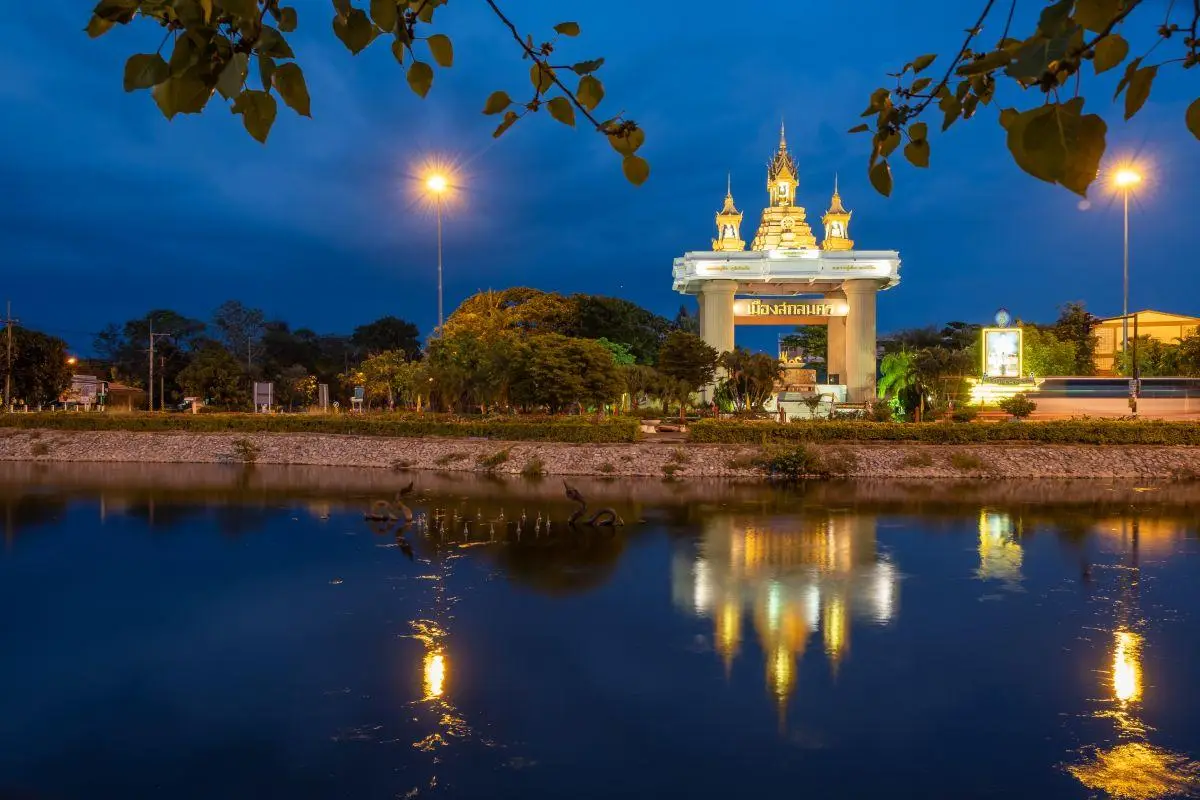
Sakon Nakhon City Gate and the Monument of Phraya Prachant Prathet Thani are key landmarks at the western entrance to Sakon Nakhon city, near Highway 22, Saphan Khom, and Ruam Jai Thai Sakon Square. The city gate is decorated with three wax-castle-style pavilions, a replica of Luang Por Ong Saen, statues of Phra Ajarn Mun Bhuridatta and Phra Ajarn Fun Ajaro, and nearby stands the monument of Phraya Prachant Prathet Thani, the first governor of Sakon Nakhon and one of the most important historical figures in the city’s development.
Sakon Nakhon City Gate and the Monument of Phraya Prachant Prathet Thani form one of the most meaningful landmark areas in Mueang Sakon Nakhon District. Located at the entrance to the city, near Highway 22 and Saphan Khom, this site introduces visitors to the identity of Sakon Nakhon before they even reach the city center. It brings together Buddhist faith, local history, urban memory, cultural symbolism, and civic pride in one highly visible public space.
For foreign travelers, this is more than a roadside photo stop. The gate functions like a visual summary of Sakon Nakhon Province. Its design reflects the province’s strong Buddhist heritage, its famous Wax Castle Festival, its connection with the Thai Forest Tradition, and its respect for an important early governor who helped shape the modern city. A short visit here helps travelers understand why Sakon Nakhon is often described as a city of Buddhism, sacred relics, ancient civilization, and spiritual culture.
The city gate stands prominently at the western edge of Sakon Nakhon city, on the route coming from Udon Thani. It is close to Ruam Jai Thai Sakon Square and the historic Saphan Khom area. The structure has tall supporting columns, a broad entrance opening, and ornate upper decorations. Large Thai lettering identifies the city, making it a popular place for visitors to take a commemorative photograph upon arrival.
The most distinctive feature of the city gate is the group of three wax-castle-style pavilions on top of the structure. These pavilions refer to Sakon Nakhon’s famous Prasat Phueng, or wax castle tradition, one of the province’s most important cultural expressions. The central pavilion contains a replica of Luang Por Ong Saen, a revered Buddha image associated with Wat Phra That Choeng Chum Worawihan, the spiritual heart of the city.
The left pavilion houses a statue of Phra Ajarn Mun Bhuridatta, one of the most influential monks in the Thai Forest Tradition. He played a crucial role in shaping modern meditation practice in Thailand and spent important periods of his life in the northeastern region. The right pavilion contains a statue of Phra Ajarn Fun Ajaro, another highly respected monk closely associated with Sakon Nakhon. Together, these figures make the gate a symbolic center of faith, not merely an entrance arch.
The staircase of the city gate is guarded by golden naga serpents, a visual element deeply connected with Buddhist and Mekong-region symbolism. The naga forms create a ceremonial feeling as visitors walk up to view the gate. The public space around the structure is used for photography, walking, resting, and gathering. During the evening, the gate becomes especially attractive when lights illuminate the structure and create a more dramatic cityscape.
Beside the city gate stands the Monument of Phraya Prachant Prathet Thani, also known as Ngoen Kham Phromsakha Na Sakon Nakhon. He is remembered as the first governor of Sakon Nakhon and as an important leader who helped develop the city. His bronze likeness stands on a dignified pedestal in a landscaped area next to the gate. Visitors can approach the monument to pay respect, take photographs, and learn about the person behind one of the most important names in Sakon Nakhon’s civic history.
Phraya Prachant Prathet Thani was born on 19 January 1839, during the reign of King Rama III. He entered government service at the age of 19 and was first appointed as Thao Suriya, a military-administrative position. In 1872, he received the title Phra Si Sakun Wong as assistant official of Sakon Nakhon. Later, he became Uppahat, or deputy governor, and in 1886 received the title Phraya Prachant Prathet Thani as governor of Sakon Nakhon.
His career was long and influential. He served in government for 66 years and held the position of city ruler and provincial governor for 37 years. His work covered a period of major change in northeastern Thailand, including administrative development, transport routes, communication, military affairs, and relations with neighboring communities. He is remembered by the people of Sakon Nakhon as a leader who helped build and develop the city.
The importance of Phraya Prachant Prathet Thani extends beyond his official position. He is associated with public works, temple patronage, local administration, and the modernization of Sakon Nakhon during an important historical transition. He was later granted the family name Phromsakha, and permission was given for the family to use Na Sakon Nakhon as part of the surname. This reflects the status of his family and his lasting role in the history of the province.
The monument itself has a detailed history. The bronze statue was commissioned on 24 February 1975 by a committee led by members of the Phromsakha Na Sakon Nakhon family and local supporters. The statue was cast in bronze at Ban Chang Lo in Thonburi and made one and a half times life size. After completion, it was temporarily placed at Wat Chaeng Saeng Arun in Sakon Nakhon.
The original intention was to install the monument in a public area of the city, similar to monuments of important figures in other provinces. However, public installation required official government procedures. The committee therefore first built a pedestal within Wat Chaeng Saeng Arun. The base was constructed from brick and cement, with an inscription panel on the front and space for ashes inside. On 18 January 1981, a religious ceremony was held to place the statue on its pedestal, and the monument was officially opened on 24 May 1981.
As the temple area became more crowded and the city expanded, descendants and related groups decided that the monument should be moved to a more visible public location. With official permission, a new pedestal was constructed beside the Sakon Nakhon City Gate. The foundation-laying ceremony for the new base took place on 23 April 2011. After the construction was completed, the bronze statue was moved from Wat Chaeng Saeng Arun to its current location beside the city gate, with ashes placed beneath the base.
The monument remains socially active today. Sakon Nakhon Province holds a wreath-laying ceremony to honor Phraya Prachant Prathet Thani and remember his contributions as the first governor of the city. The ceremony takes place at the monument near Nong Han Luang Sculpture, also known as Sakon Nakhon City Gate. Government officials, members of the armed forces, police, the provincial Red Cross, descendants of the Phromsakha Na Sakon Nakhon family, and local people attend the ceremony to pay respect.
The city gate and monument together help visitors understand the historical layers of Sakon Nakhon. The oldest layer is the memory of Nong Han Luang, an ancient city associated with legends and early civilization. Another layer is the influence of Khmer culture and ancient religious monuments in the region. A later layer connects the area with Lan Xang culture and the name Chiang Mai Nong Han. In the Rattanakosin period, the city became Sakon Thawapi and was later renamed Sakon Nakhon during the reign of King Rama III.
The history of Sakon Nakhon is deeply connected with sacred places, especially Wat Phra That Choeng Chum Worawihan. During the reign of King Rama I, Ban That Choeng Chum was raised to the status of Mueang Sakon Thawapi. Later, during the reign of King Rama III, the city experienced disruption during the Anouvong rebellion. Afterward, the city was rebuilt, and Royal Wong Kham was appointed as Phraya Prachant Prathet Thani. The city’s name was changed to Sakon Nakhon, marking a major step in its modern historical identity.
Today, Sakon Nakhon is known by several meaningful phrases: a city of Buddhism, a land of five sacred relics, a place of ancient civilization, and a spiritual basin of Isan. These expressions are strongly reflected in the city gate. The Buddha image, the forest meditation masters, the wax castle pavilions, and the monument of the first governor all represent the key elements of the province: faith, history, culture, leadership, and community memory.
The wax-castle-inspired design on top of the gate is especially important. Sakon Nakhon’s Wax Castle Festival is one of the most distinctive Buddhist traditions in northeastern Thailand. Wax castles are created through skilled community craftsmanship and offered as part of the Buddhist merit-making tradition around the end of Buddhist Lent. By placing wax-castle forms on the city gate, Sakon Nakhon presents its cultural identity to every visitor entering the city.
The replica of Luang Por Ong Saen in the central pavilion symbolizes Sakon Nakhon’s Buddhist heart. The original revered image is closely associated with Wat Phra That Choeng Chum Worawihan, one of the most important sacred sites in the province. The presence of Phra Ajarn Mun and Phra Ajarn Fun on the city gate links the monument to the Thai Forest Tradition, a major spiritual movement that influenced Buddhist practice throughout Thailand.
The area around the gate is also part of contemporary city life. Local people use nearby open spaces for walking, gathering, exercise, relaxation, and public events. Visitors often stop for less than an hour, but the site can be appreciated more deeply when one understands its symbolism. It is both a gateway and a civic shrine, both a photo spot and a public memory space.
For travelers arriving by private car, this landmark is a practical first stop. It is located near a main road and can be included at the beginning or end of a city itinerary. Because traffic can be busy, visitors should park only where it is safe and allowed. Avoid stopping on red-and-white curb sections or in areas that obstruct traffic. The back and side areas near the gate are safer places to stop when conditions allow.
Visitors arriving by plane can travel from Sakon Nakhon Airport to the city and include the gate as part of the first city route. Travelers staying in town can reach the site easily by private vehicle, taxi, local transport, or app-based ride. The location is within the municipal area and close to hotels, restaurants, markets, public offices, and other attractions.
Getting There is straightforward. From central Sakon Nakhon, travel along Rat Phatthana Road or the local road network connecting with Highway 22. If approaching from Udon Thani, the city gate appears before entering the inner city. The landmark is near Saphan Khom and Ruam Jai Thai Sakon Square in That Choeng Chum Subdistrict. It is about 2 km from Wat Phra That Choeng Chum Worawihan and about 9 km from Sakon Nakhon Airport.
The best time to visit depends on the purpose of the trip. Morning is suitable for clear photographs and a quieter atmosphere. Late afternoon offers softer light and a more relaxed city mood. Evening visits are popular because the lighting makes the gate look more dramatic. The monument of Phraya Prachant Prathet Thani can be visited respectfully at any time, but daylight hours are better for reading details and observing the surrounding area.
The city gate also works well as the starting point for a cultural route in Sakon Nakhon. From here, travelers can continue to Wat Phra That Choeng Chum Worawihan, Suan Somdet Phra Srinagarindra Park, Sakon Nakhon Freshwater Aquarium, Wat Pa Suthawat, the Phra Ajarn Mun Bhuridatta Thera Museum, Phu Phan Museum, and Hug Mueang Sakon Walking Street. This route covers sacred relics, urban green space, local history, religious heritage, and contemporary city culture.
For travelers interested in photography, recommended angles include the front view showing the Thai words “Mueang Sakon Nakhon,” the naga staircase, the side view that includes both the statue and the gate columns, and the wider view from the public square. In the evening, the illuminated gate and surrounding landscape create strong visual depth. Visitors should stay aware of traffic, especially when photographing from roadside areas.
When paying respect at the monument, visitors should act with dignity. Phraya Prachant Prathet Thani is remembered as an important historical figure and the first governor of Sakon Nakhon. Visitors may stand quietly, offer a garland, or simply bow in respect. The monument area should be kept clean, and climbing on the pedestal or placing objects in inappropriate areas should be avoided.
The landmark is also suitable for families and students because it provides a simple introduction to the history of Sakon Nakhon. From this one place, visitors can continue learning about Nong Han Luang, Sakon Thawapi, Wat Phra That Choeng Chum, the five sacred relic sites, the Wax Castle Festival, and the Thai Forest Tradition. The gate helps connect these themes visually, making the history of the province easier to understand.
For foreign visitors, Sakon Nakhon City Gate is especially useful because it turns local identity into visible symbols. The wax castle pavilions represent Buddhist craftsmanship and community merit-making. The Buddha image and monk statues represent spiritual heritage. The monument of Phraya Prachant Prathet Thani represents civic history and leadership. The public square represents modern local life. Together, these elements create a clear first impression of the province.
Sakon Nakhon City Gate and the Monument of Phraya Prachant Prathet Thani are therefore much more than a roadside landmark. They tell the story of a city shaped by ancient settlement, Buddhism, Khmer and Lan Xang cultural layers, royal administration, local leadership, and continuing community pride. A visit here offers a concise but meaningful introduction to Sakon Nakhon, making it a recommended first stop for anyone exploring the city.
| Name | Sakon Nakhon City Gate And The Monument Of Phraya Prachant Prathet Thani |
| Location | Nong Han Luang Sculpture / Sakon Nakhon City Gate Area, That Choeng Chum Subdistrict, Mueang Sakon Nakhon District, Sakon Nakhon Province |
| Address | Rat Phatthana Road, near the entrance to Sakon Nakhon city and Saphan Khom, That Choeng Chum Subdistrict, Mueang Sakon Nakhon District, Sakon Nakhon 47000, Thailand |
| Coordinates | Sakon Nakhon City Gate 17.169381, 104.143091 / Monument Of Phraya Prachant Prathet Thani 17.169766, 104.142974 |
| Highlights | Large city gate with three wax-castle-style pavilions, a replica of Luang Por Ong Saen, statues of Phra Ajarn Mun Bhuridatta and Phra Ajarn Fun Ajaro, and the monument of Phraya Prachant Prathet Thani, the first governor of Sakon Nakhon |
| History | Connected with the history of Nong Han Luang, Sakon Thawapi, and the renaming of the city to Sakon Nakhon during the reign of King Rama III. The monument was initiated in 1975, first opened in 1981, and later moved to the city gate area after the new base was constructed in 2011. |
| Name Origin | The city gate name refers to the entrance to Sakon Nakhon, while the monument is named after Phraya Prachant Prathet Thani, also known as Ngoen Kham Phromsakha Na Sakon Nakhon, the first governor of Sakon Nakhon. |
| Distinctive Features | A large civic landmark on a main road, with naga staircases, wax-castle pavilions, worship elements, a public square, and a memorial statue area for respectful visits and photography |
| Travel Information | Travel via Highway 22 or Rat Phatthana Road toward Sakon Nakhon city. The landmark is near Saphan Khom and Ruam Jai Thai Sakon Square and can be reached by private car, rental car, taxi, or app-based ride. |
| Current Status | Open to visitors as a public city landmark and a place to pay respect to Phraya Prachant Prathet Thani |
| Open Days | Daily |
| Opening Hours | 24 Hours |
| Fees | Free Admission |
| Facilities | Walking area, photo spots, staircase to the city gate, landscaped space, relaxation area, and nearby roadside parking where permitted and safe |
| Main Areas / Zones | 1. Sakon Nakhon City Gate 2. Three Wax-Castle-Style Pavilions 3. Replica Of Luang Por Ong Saen 4. Statue Of Phra Ajarn Mun Bhuridatta 5. Statue Of Phra Ajarn Fun Ajaro 6. Naga Staircase And Photo Area 7. Monument Of Phraya Prachant Prathet Thani 8. Ruam Jai Thai Sakon Square And Nearby Relaxation Area |
| Caretaker | Sakon Nakhon City Municipality |
| Main Contact Number | Sakon Nakhon City Municipality, Tel. 0-4271-1203 |
| Important Memorial Event | The wreath-laying ceremony in honor of Phraya Prachant Prathet Thani is held to commemorate the first governor of Sakon Nakhon and his contributions to the city. |
| Nearby Tourist Attractions | 1. Saphan Khom, about 0.2 km 2. Ruam Jai Thai Sakon Square, about 0.2 km 3. Suan Somdet Phra Srinagarindra Sakon Nakhon, about 1.3 km 4. Sakon Nakhon Freshwater Aquarium, about 1.6 km 5. Wat Phra That Choeng Chum Worawihan, about 2 km 6. Hug Mueang Sakon Walking Street, about 2.3 km 7. Wat Pa Suthawat And Phra Ajarn Mun Bhuridatta Thera Museum, about 2.9 km 8. Phu Phan Museum, about 3.5 km |
| Nearby Restaurants | 1. Kham Hom Sakon Nakhon, Rat Phatthana Soi 5, about 1.6 km, Tel. 081-873-7564 2. Paris Steamed Rice Dumplings Sakon Nakhon, about 2.2 km 3. Saban Nga, about 2.3 km, Tel. 042-733-428, 088-983-1282 4. Sweet Cottage Bakery & Tea Room, about 2.5 km 5. Lert Rot Kai Kata, about 2.6 km 6. Sakol Phet Kitchen, about 3.2 km, Tel. 099-206-0298 7. Food’s Land, about 5 km, Tel. 090-345-4318 |
| Nearby Accommodations | 1. HOP INN Sakon Nakhon, about 0.8 km, Tel. 042-716-399 2. Dusit Hotel, about 1.1 km, Tel. 042-711-198 3. @SAKON Hotel, about 1.6 km, Tel. 042-713-234, 080-422-5929 4. The Room Boutique Hotel - Sakon Nakhon, about 2.3 km, Tel. 099-262-9269 5. Sakon Grand Palace Hotel, about 3.2 km, Tel. 042-714-886 6. Honghub Sakon Hotel, about 4.3 km, Tel. 099-021-5595 7. NK Residence Sakon Nakhon, about 7 km, Tel. 089-391-6594 |
Frequently Asked Questions (FAQ)
Q: Where is Sakon Nakhon City Gate located?
A: Sakon Nakhon City Gate is located on Rat Phatthana Road near Saphan Khom and Ruam Jai Thai Sakon Square in That Choeng Chum Subdistrict, Mueang Sakon Nakhon District, Sakon Nakhon Province.
Q: What are the opening hours of Sakon Nakhon City Gate?
A: It is open daily, 24 hours, as a public city landmark.
Q: Is there an admission fee?
A: No. Visitors can take photos, walk around, and pay respect at the monument free of charge.
Q: Who was Phraya Prachant Prathet Thani?
A: Phraya Prachant Prathet Thani, also known as Ngoen Kham Phromsakha Na Sakon Nakhon, was the first governor of Sakon Nakhon and an important leader in the city’s development.
Q: What are the main highlights of Sakon Nakhon City Gate?
A: The highlights include the large city gate, three wax-castle-style pavilions, the replica of Luang Por Ong Saen, statues of Phra Ajarn Mun Bhuridatta and Phra Ajarn Fun Ajaro, the naga staircase, and the monument of Phraya Prachant Prathet Thani.
Q: How do travelers get to Sakon Nakhon City Gate?
A: Travelers can use Highway 22 or Rat Phatthana Road toward Sakon Nakhon city. The landmark is near Saphan Khom and Ruam Jai Thai Sakon Square and is easy to reach by private car, rental car, taxi, or app-based ride.
Q: What is the best time to visit?
A: Morning is best for clear photos and viewing details, while late afternoon and evening are ideal for softer light and illuminated city-gate views.
Q: What nearby attractions can be visited on the same trip?
A: Nearby places include Saphan Khom, Suan Somdet Phra Srinagarindra Sakon Nakhon, Sakon Nakhon Freshwater Aquarium, Wat Phra That Choeng Chum Worawihan, Hug Mueang Sakon Walking Street, Wat Pa Suthawat, and Phu Phan Museum.
 Category: ●Art, Culture and Heritage
 Group: ●Historical Sites and Monuments
Last Update : 3 MonthAgo
 Last Update : 3 MonthAgo
 Click to Access the Navigation Map GPS
City Gate and Phraya Prachantapratejthani Map
Recommend
 Historical Sites and Monuments(9)
 Landmarks and Memorials(2)
 Royal Palace(1)
 Art, Craft Centres, Tradition(8)
 Museums(3)
 Educational Places
 Educational Gardens, Farm(2)
 Places of Worship
 Temple(18)
 Church(2)
 Other Sacred Sites(4)
 Research and Development
 Royal Project(3)
 Suburban Living
 Village, Community(7)
 Nature and Wildlife
 National Parks and Marine Reserves(4)
 Mountain (Doi)(3)
 Dam, Reservoir, Lake(14)
 Waterfalls(4)
 Caves(4)
 River, Canal(9)
 Bays and Beaches(1)
 Islands(1)
 Other natural attractions(5)
 Entertainment and Agricultural
 Zoos and Aquariums(1)
 Farms, Parks and Ecotourism(4)
 Outdoor and Adventure Activities(1)
 Travel Articles, Recipes
 Travel Review, Food Review(1)


