
lovethailand home >Northeastern Travel Attractions >Khon Kaen Travel Attractions >Phu Wiang >Nai Muang > Dinosaur Fossil Excavation Sites
TL;DR: Dinosaur Fossil Excavation Sites is located at Phu Wiang National Park, Wiang Kao District, Khon Kaen Province, open Daily, hours 08.30 – 16.30.
Dinosaur Fossil Excavation Sites
Open Days: Daily
Opening Hours: 08.30 – 16.30
The Dinosaur Fossil Excavation Sites in Khon Kaen, located inside Phu Wiang National Park, are among the most important paleontological learning sites in Thailand. This is where the first dinosaur bone fossil in the country was discovered, marking the beginning of systematic dinosaur research in Thailand. Set within the mountains and sedimentary rock formations of Phu Wiang in Wiang Kao District, Khon Kaen Province, the excavation sites allow visitors to experience the original field locations where fossils around 130 million years old were found. For foreign travelers, this destination combines science, nature, Thai geological history, and real fossil discovery locations in one meaningful trip.
The significance of Phu Wiang is much deeper than simply seeing dinosaur bones. Before the discovery at Phu Wiang, Thailand was not widely known as a dinosaur fossil country. The first fossil discovery in 1976 changed that. From one large bone fragment found during geological exploration, Phu Wiang gradually became the birthplace of Thai dinosaur studies. Later excavations revealed many important fossils, including large plant-eating sauropods, fish-eating theropods, carnivorous dinosaurs, ancient crocodiles, turtles, fish, and other prehistoric animals. These findings helped place Khon Kaen and northeastern Thailand on the international map of paleontology.
Phu Wiang National Park has a distinctive landscape that helps explain why so many fossils were found here. The area has a basin-like mountain structure, with ridges surrounding an inner valley. Its rocks belong to the Khorat Group, a major sedimentary rock sequence in northeastern Thailand. Important rock formations in the region include Phu Kradung, Phra Wihan, Sao Khua, Phu Phan, and Khok Kruat formations. The dinosaur bones in Phu Wiang are mainly associated with the Sao Khua Formation, which was deposited during the Early Cretaceous period. These rocks preserve the remains of a prehistoric environment with rivers, floodplains, wetlands, and diverse animal life.
The discovery story began in 1976, when a geologist from the Department of Mineral Resources was exploring for uranium in the Phu Wiang area. At Huai Pratu Ti Ma, a large fossil bone was found in the Sao Khua Formation. Further examination showed that the bone was from a sauropod dinosaur, a large long-necked plant eater. This discovery became the first confirmed dinosaur fossil found in Thailand and opened the way for systematic paleontological surveys in the country. What began as a geological survey soon became a major scientific milestone for Thailand.
Serious dinosaur exploration in Phu Wiang began in the early 1980s, when Thai and French paleontological teams surveyed the Pratu Ti Ma area and nearby fossil localities. They found large bones of plant-eating dinosaurs, crocodile teeth, turtle shells, ancient fish teeth, fish scales, and other fossils. These discoveries showed that prehistoric Phu Wiang was not a dry barren land. It was once a dynamic ecosystem with rivers, water sources, vegetation, aquatic animals, herbivorous dinosaurs, and predators living together during the Early Cretaceous period.
There are 9 dinosaur excavation sites in Phu Wiang National Park. Not all are open to general visitors, but 4 major sites are accessible for educational tourism: Excavation Site No. 1, Site No. 2, Site No. 3, and Site No. 9. These open sites are connected by a walking trail of about 6 kilometers. Along the route, visitors pass forest, sandstone terrain, slopes, covered excavation shelters, information panels, and fossil display areas. The trail gives travelers a rare opportunity to experience paleontology in the field rather than only inside a museum.
Excavation Site No. 1, known as Pratu Ti Ma, is one of the most important dinosaur discovery locations in Thailand. This site produced many large sauropod bones and contributed to the identification of Phuwiangosaurus sirindhornae, a new genus and species of sauropod dinosaur. Phuwiangosaurus was a large plant-eating dinosaur with a long neck, long tail, and four-legged posture. Its species name honors Her Royal Highness Princess Maha Chakri Sirindhorn. Today, this dinosaur is one of the most important symbols of Phu Wiang and Thai paleontology.
Site No. 1 also yielded teeth of Siamosaurus suteethorni, a fish-eating theropod dinosaur. Its cone-shaped teeth resemble those of crocodiles and suggest a diet connected with fish or aquatic prey. The discovery of Siamosaurus shows that the Phu Wiang ecosystem contained not only large herbivorous dinosaurs but also specialized predators adapted to life near water. Its species name honors a key Thai paleontologist involved in the study of dinosaur fossils in the country.
Excavation Site No. 2, known as Tham Chia, is another important site for sauropod fossils. Six fossilized neck bones of a sauropod were discovered here in 1987. These bones helped researchers better understand the body structure, neck anatomy, and movement of large plant-eating dinosaurs from Phu Wiang. The site is also historically significant because it received royal visits and public attention during the development of dinosaur research and fossil education in the region.
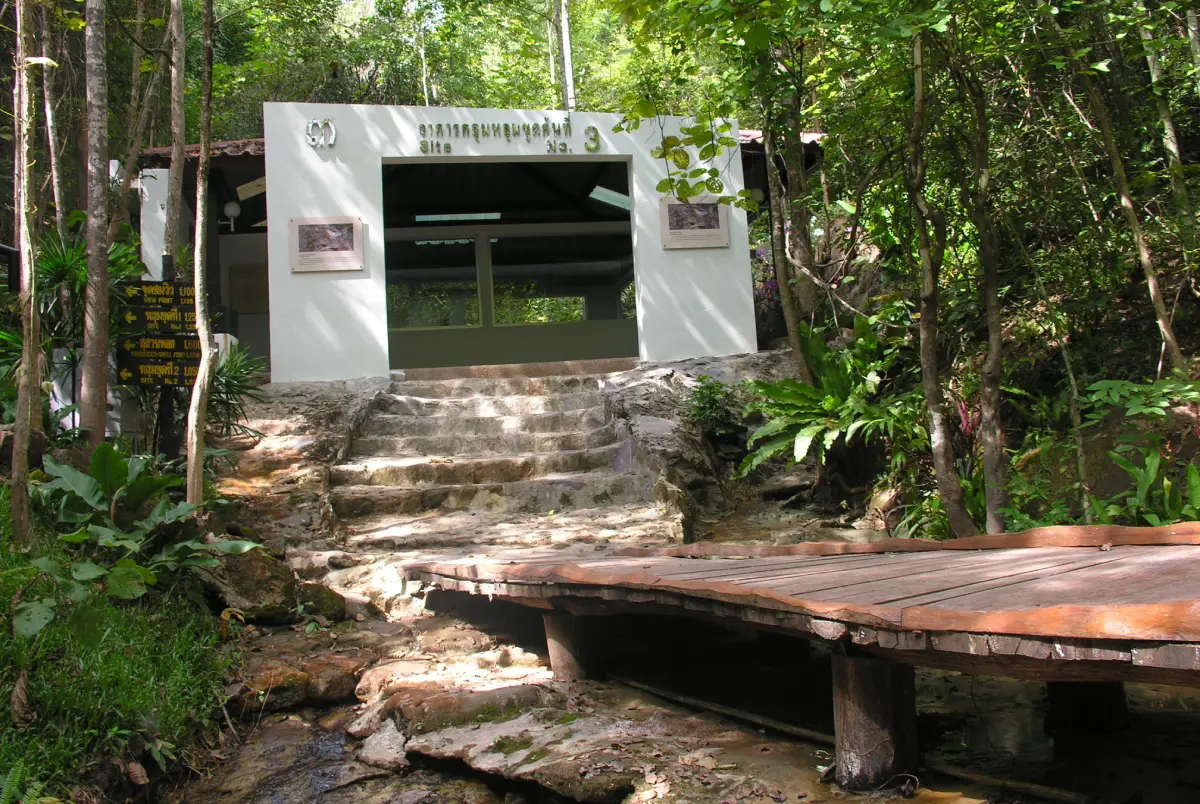
Excavation Site No. 3, located around Huai Pratu Ti Ma, is important both historically and scientifically. Large sauropod fossils were found embedded in sandstone here, and recent renewed excavation work has brought new attention to the site. Some fossil material once thought to belong to one known dinosaur group may require fresh interpretation. This shows that paleontology is an ongoing scientific process. Fossils do not always provide immediate answers. They must be studied, compared, mapped, cleaned, and reinterpreted as new data and techniques become available.
Excavation Site No. 9, known as Hin Lat Yao, is famous for Siamotyrannus isanensis, a large carnivorous dinosaur from the Early Cretaceous. Fossils found here include hip bones, vertebrae, and tail elements. Siamotyrannus is significant because it provides evidence related to the early evolution of tyrannosaur-like theropods. Although it is not the same as the later and more famous Tyrannosaurus rex, Siamotyrannus is scientifically important because it is older and helps explain how tyrannosaur lineages may have developed in Asia before spreading elsewhere.
The 3 best-known dinosaurs from Phu Wiang are Phuwiangosaurus sirindhornae, Siamosaurus suteethorni, and Siamotyrannus isanensis. Each represents a different ecological role. Phuwiangosaurus was a large plant eater. Siamosaurus was a fish-eating predator with crocodile-like teeth. Siamotyrannus was a large carnivorous theropod. Together, they show that the Early Cretaceous environment of Phu Wiang supported a complex ecosystem with herbivores, aquatic prey, predators, and other prehistoric animals.
Other fossil evidence from Phu Wiang includes small theropods similar to Compsognathus, ostrich-like ornithomimosaurs, crocodiles, turtles, ancient fish, and dinosaur footprints from another part of the park. These remains help complete the picture of the ancient environment. Phu Wiang was not a place where one kind of dinosaur lived alone. It was a living ecosystem with many animals sharing rivers, floodplains, wetlands, and vegetated landscapes around 130 million years ago.
What makes the excavation sites different from a museum is that visitors can see the original field context. Dinosaur bones are not usually found as perfect skeletons standing on the ground. They are buried in rock layers, sometimes partly exposed by erosion. Scientists must identify them carefully, widen the excavation area, record the position of each bone, protect fragile surfaces, make field maps, and remove surrounding rock without damaging the fossil. The work often takes months or years, and the interpretation of one fossil may take even longer.
Every fossil fragment matters. A single tooth may reveal the presence of a predator. A piece of vertebra may identify a body region. A hip bone may help classify a dinosaur group. The way bones are arranged in the rock may suggest whether the animal died in place, was washed by water, was scavenged by predators, or was buried by sediment after flooding. Walking through the Phu Wiang excavation route helps visitors understand that paleontology is not treasure hunting. It is a careful scientific investigation of life, death, landscape, and time.
Phuwiangosaurus sirindhornae is especially important as one of Thailand’s best-known sauropods. It had a long neck and tail, walked on 4 legs, and fed on plants. Fossil evidence suggests that both adult and young individuals may have lived in the region, which raises interesting questions about herd behavior, habitat use, and dinosaur growth. The presence of such large herbivores implies that ancient Phu Wiang had enough vegetation and water to support them.
Siamosaurus suteethorni adds a very different image to the Phu Wiang ecosystem. Its distinctive conical teeth suggest a specialized feeding habit, possibly connected with fish. This makes it one of the most interesting theropods found in Thailand. It also reminds visitors that not all carnivorous dinosaurs were the same. Some were large land predators, while others may have hunted near rivers or wetlands. The discovery of Siamosaurus helps link the dinosaur story of Phu Wiang with water-based habitats.
Siamotyrannus isanensis gives Phu Wiang a strong international scientific value. As an early tyrannosaur-related theropod, it helps researchers explore the origin and early evolution of the tyrannosaur lineage. Its discovery shows that Thailand has contributed important fossil evidence to questions that extend far beyond local history. When visitors stand near Site No. 9, they are not only looking at a local fossil site; they are standing in a place that contributes to the global story of dinosaur evolution.
Visitors who plan to walk the excavation trail should prepare properly. The route is about 6 kilometers if visiting the main open sites, and parts of it involve forest paths and slopes. Comfortable walking shoes, drinking water, a hat, sun protection, and insect repellent are recommended. The best time to start is in the morning or during cooler hours. Families with children or elderly travelers should check with park staff before beginning the full trail, as some sites are easier to access than others.
Phu Wiang National Park is not only a dinosaur site. It also contains natural attractions such as Pha Chom Tawan viewpoint, Tat Fa camping area, Tham Suriyan Chanthra cave, nature trails, forest areas, and viewpoints that reveal the mountain basin landscape. This combination of paleontology and nature makes the park especially rewarding. Visitors can learn about the world of 130 million years ago and then continue to enjoy the forests and scenery of present-day Khon Kaen.
Before or after visiting the excavation sites, travelers should stop at the Phu Wiang Dinosaur Research Center and Museum, located about 3 kilometers before the national park. The museum explains the discovery of dinosaur fossils in Khon Kaen and nearby areas. Its exhibitions cover the origin of the universe, the evolution of life, dinosaurs around the world, dinosaurs from the Phu Wiang mountain range, laboratory work, fossil conservation, a dinosaur garden, rocks and minerals, and a royal tribute room. Visiting the museum first helps travelers understand the excavation sites much more clearly.
The museum plays an important role in connecting field discoveries with public education. Many fossils cannot be left exposed in the field or handled by visitors, so replicas, fossil samples, maps, diagrams, videos, and laboratory displays help explain the research process. Children can learn how fossils form, why bones turn into stone, how scientists read rock layers, and why naming a new dinosaur species requires careful study. Adults can also gain a deeper appreciation of the scientific work behind every fossil discovery.
Renewed excavation work at Phu Wiang in recent years has brought fresh attention to the area. After decades of research, some old fossil material is still being reexamined, and new discoveries may change earlier interpretations. Modern methods such as detailed mapping, 3D imaging, improved preparation tools, and comparison with fossils from other countries can reveal new information from old sites. This means Phu Wiang is not only a historical discovery area. It remains an active scientific landscape with questions still waiting to be answered.
Visitors should follow all park rules when exploring the excavation sites. Fossils, rocks, and fragments should not be touched, scratched, moved, or removed. Even a small piece may contain important scientific information. Visitors should stay on designated trails, avoid climbing on excavation shelters or rock exposures, keep noise low, protect wildlife, and carry trash out of the park. The excavation sites are tourism destinations, learning areas, and scientific resources at the same time. Their preservation depends on responsible visitors.
For families, the Phu Wiang dinosaur sites are excellent outdoor classrooms. Children can see where real dinosaur fossils were found, understand that fossils are embedded in rock, and learn why scientific discovery takes patience. The experience can inspire interest in geology, biology, natural history, conservation, and Thai science. Instead of seeing dinosaurs only as movie creatures, children can understand them as real animals that once lived in the landscape that is now northeastern Thailand.
Getting There from Khon Kaen city is most convenient by private car. Take Highway 12 toward Chum Phae. After passing the Nong Ruea area, turn onto Highway 2038 toward Phu Wiang and Wiang Kao District. Continue past Phu Wiang and Wiang Kao toward Phu Wiang National Park. The distance from Khon Kaen city is about 87 kilometers. Travelers coming from Chum Phae can also take the route toward Khon Kaen and turn onto Highway 2038. Once past Phu Wiang town, continue toward the national park rather than turning toward Si Bun Rueang.
Private vehicles are strongly recommended because travelers can stop at the dinosaur museum before entering the park and continue to the visitor center and excavation trail at their own pace. Public transport may reach Phu Wiang or Wiang Kao town, but local transport is needed to reach the park. Travelers without a car should arrange pickup and return times in advance, as the national park is not served by frequent public transport throughout the day.
A good one-day itinerary begins in Khon Kaen city in the morning. First, visit the Phu Wiang Dinosaur Research Center and Museum to understand the scientific background. Then continue to Phu Wiang National Park, stop at the visitor center, and choose the excavation trail section that fits your time and energy. If time allows, add Pha Chom Tawan viewpoint or another natural attraction in the park. Travelers who want to walk the full trail and study each site carefully should consider staying overnight in Phu Wiang or Wiang Kao.
The best season to visit is the cool season or the period after the rains, when walking conditions are more comfortable and the forest is pleasant. The hot season is also possible, but visitors should start early and bring enough water. During the rainy season, check trail conditions before entering the park because slopes and forest paths may become slippery. A full visit to the excavation sites may take 2 to 4 hours, while the museum can add another 1 to 2 hours.
The excavation sites are managed within Phu Wiang National Park under the Department of National Parks, Wildlife and Plant Conservation. Fossil research and museum interpretation are closely connected with the Department of Mineral Resources and the Phu Wiang Dinosaur Research Center and Museum. This cooperation between conservation officers, geologists, paleontologists, educators, and local communities makes Phu Wiang a rare destination where national park management, fossil science, public education, and tourism come together.
The Dinosaur Fossil Excavation Sites in Phu Wiang are more than a tourist attraction for dinosaur fans. They connect the deep past of the Earth with present-day Khon Kaen. Bones buried in rock for 130 million years reveal that landscapes, climates, rivers, animals, and continents have changed continuously. Walking through the excavation trail is a journey through time, allowing visitors to imagine a world long before humans existed and to appreciate the scientific value of every rock layer and fossil fragment.
In summary, the Dinosaur Fossil Excavation Sites in Phu Wiang National Park are essential for anyone interested in Thailand’s natural history. They form the first dinosaur fossil discovery area in the country, include 9 excavation sites, and feature major visitor-accessible sites such as Nos. 1, 2, 3, and 9. The area is associated with internationally significant dinosaurs such as Phuwiangosaurus sirindhornae, Siamosaurus suteethorni, and Siamotyrannus isanensis, all around 130 million years old. When combined with the Phu Wiang Dinosaur Research Center and Museum, this destination offers one of the most complete dinosaur learning experiences in Thailand.
| Name | Dinosaur Fossil Excavation Sites, Phu Wiang National Park |
| Location | Phu Wiang National Park, Wiang Kao District, Khon Kaen Province |
| Address | Phu Wiang National Park, Nai Mueang Subdistrict, Wiang Kao District, Khon Kaen 40150, Thailand |
| Reference Coordinates | Approximately 16.67833, 102.35361 |
| Highlights | Thailand’s first dinosaur fossil discovery area, with 9 excavation sites and major visitor-accessible sites including Nos. 1, 2, 3, and 9 |
| History | The first dinosaur bone fossil in Thailand was discovered at Phu Wiang in 1976. The major fossils are from the Early Cretaceous period, around 130 million years ago. |
| Distinctive Features | Covered excavation shelters, fossil interpretation signs, nature trails, sedimentary rock terrain, and a basin-like mountain landscape inside Phu Wiang National Park |
| Key Evidence | Sauropod bones, fish-eating dinosaur teeth, carnivorous dinosaur fossils, hip bones, vertebrae, tail bones, crocodile teeth, turtle shells, ancient fish teeth, and fish scales |
| Important Dinosaurs Found | 1. Phuwiangosaurus sirindhornae 2. Siamosaurus suteethorni 3. Siamotyrannus isanensis 4. Small theropods similar to Compsognathus 5. Ostrich-like ornithomimosaurs |
| Visitor-Accessible Excavation Sites | Excavation Site No. 1: Pratu Ti Ma Excavation Site No. 2: Tham Chia Excavation Site No. 3: Huai Pratu Ti Ma Excavation Site No. 9: Hin Lat Yao |
| Walking Trail | The main visitor-accessible excavation sites are connected by a walking trail of about 6 km. Comfortable shoes, drinking water, a hat, and early timing are recommended. |
| Travel Information | From Khon Kaen city, take Highway 12 toward Chum Phae, then turn onto Highway 2038 toward Phu Wiang and Wiang Kao before continuing to Phu Wiang National Park. The distance is about 87 km. |
| Current Status | Open to visitors as a fossil learning area and nature trail within Phu Wiang National Park |
| Open Days | Daily |
| Opening Hours | 08.30 – 16.30 |
| National Park Entrance Fees | Thai Visitors: Adults 40 Baht, Children 20 Baht Foreign Visitors: Adults 200 Baht, Children 100 Baht |
| Facilities | Visitor center, covered excavation shelters, information signs, nature trails, parking area, welfare shop, park accommodation, camping area, and rest areas within the park |
| Main Areas / Zones | 1. Phu Wiang National Park Visitor Center 2. Excavation Site No. 1: Pratu Ti Ma 3. Excavation Site No. 2: Tham Chia 4. Excavation Site No. 3: Huai Pratu Ti Ma 5. Excavation Site No. 9: Hin Lat Yao 6. Pha Kan Wela 7. Pha Chom Tawan Viewpoint 8. Tat Fa Camping Area 9. Tham Suriyan Chanthra 10. Phu Wiang Dinosaur Research Center and Museum, about 3 km before the park |
| Caretaker | Phu Wiang National Park, Department of National Parks, Wildlife and Plant Conservation, together with relevant fossil and geological agencies |
| Main Contact Number | Phu Wiang National Park Visitor Center Tel. 043-438-333 Phu Wiang National Park Tel. 085-852-1771 Phu Wiang Dinosaur Research Center and Museum Tel. 043-438-204, 043-438-206 |
| Nearby Tourist Attractions | 1. Phu Wiang Dinosaur Research Center and Museum, about 3 km 2. Pha Chom Tawan Viewpoint, about 4 km 3. Tat Fa Camping Area, about 6 km 4. Tham Suriyan Chanthra, about 8 km 5. Wat Tham Pha Koeng, Wiang Kao District, about 18 km 6. Phu Pha Man National Park, about 70 km |
| Nearby Restaurants | 1. Khiang Na Cafe, about 4 km, Tel. 089-621-6294 2. Mae Boonluan Beef Noodle & Coffee, about 11 km, Tel. 083-668-8716 3. Jungle Cafe Phu Wiang Khon Kaen, about 12 km, Tel. 062-897-4141 4. Je Nong Tam Mua Phu Wiang, about 13 km, Tel. 061-117-4421 5. Ma De Phu Wiang, about 14 km, Tel. 092-659-8598 6. Kai Yang Nong Tan, about 31 km, Tel. 087-864-0222 |
| Nearby Accommodations | 1. Chuanchom Resort Phuwiang, about 3 km, Tel. 080-450-2502, 085-609-1325 2. Pitchaya Ville Resort, about 12 km, Tel. 080-831-7399 3. Pruksa Garden Hotel Phu Wiang, about 15 km, Tel. 043-291-639 4. Phuwiang Grand Hotel, about 16 km, Tel. 093-989-7180, 091-130-7022 5. The Pool Resort Hotel Phuwiang, about 17 km, Tel. 062-269-4949 6. Little Box Hotel, about 45 km, Tel. 043-306-815 |
Frequently Asked Questions (FAQ)
Q: Where are the Dinosaur Fossil Excavation Sites in Khon Kaen located?
A: They are located inside Phu Wiang National Park in Wiang Kao District, Khon Kaen Province. This area is Thailand’s first dinosaur fossil discovery site.
Q: How many dinosaur excavation sites are there in Phu Wiang National Park?
A: There are 9 dinosaur excavation sites in the park. The main visitor-accessible sites are Nos. 1, 2, 3, and 9.
Q: Which dinosaurs were found at Phu Wiang?
A: Major dinosaurs found at Phu Wiang include Phuwiangosaurus sirindhornae, a large plant-eating sauropod; Siamosaurus suteethorni, a fish-eating theropod with crocodile-like teeth; and Siamotyrannus isanensis, a large carnivorous theropod.
Q: How old are the dinosaur fossils at Phu Wiang?
A: The major dinosaur fossils from Phu Wiang are around 130 million years old and belong to the Early Cretaceous period.
Q: Is there an entrance fee for the dinosaur excavation sites?
A: Visitors pay the Phu Wiang National Park entrance fee. Thai adults pay 40 Baht and Thai children pay 20 Baht. Foreign adults pay 200 Baht and foreign children pay 100 Baht.
Q: How much time should visitors spend at the excavation sites?
A: Visitors should allow about 2–4 hours for the excavation trail. If visiting the Phu Wiang Dinosaur Research Center and Museum as well, add another 1–2 hours.
Q: Should visitors go to the dinosaur museum before or after the excavation sites?
A: Visiting the museum first is recommended because it explains the dinosaurs, rock layers, fossil discoveries, and scientific background before visitors see the actual field sites.
Q: What should visitors keep in mind when visiting the excavation sites?
A: Visitors should stay on marked trails, avoid touching or moving rocks and fossils, avoid climbing on shelters or rock exposures, keep the area clean, and follow park staff instructions carefully.
 Category: ●Art, Culture and Heritage
 Group: ●Historical Sites and Monuments
Last Update : 4 MonthAgo
 Last Update : 4 MonthAgo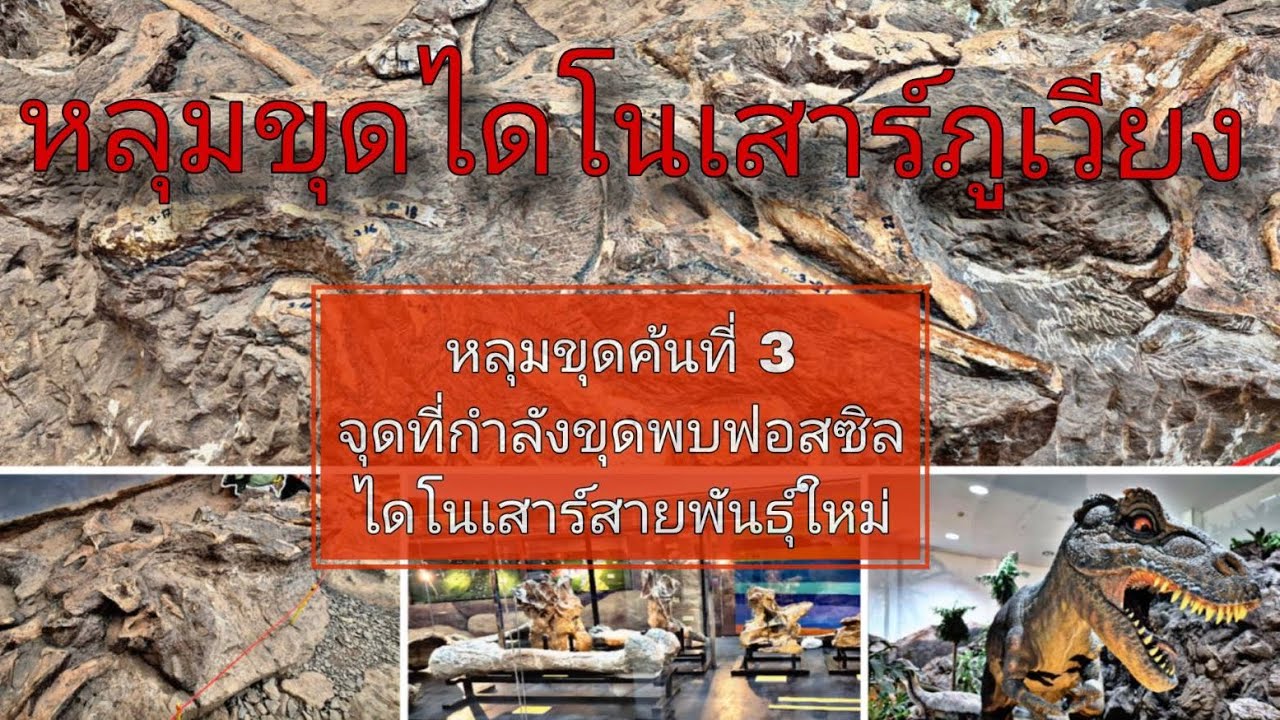
 Click to Access the Navigation Map GPS
Dinosaur Fossil Excavation Sites Map
Recommend
 Historical Sites and Monuments(7)
 Landmarks and Memorials(3)
 Art, Craft Centres, Tradition(2)
 Museums(4)
 Educational Places
 Museum for Study(2)
 Places of Worship
 Temple(27)
 Other Sacred Sites(5)
 Suburban Living
 Village, Community(3)
 Local Market(1)
 Nature and Wildlife
 National Parks and Marine Reserves(5)
 Mountain (Doi)(1)
 Dam, Reservoir, Lake(4)
 Waterfalls(8)
 Caves(9)
 River, Canal(10)
 Bays and Beaches(3)
 Islands(1)
 Other natural attractions(5)
 Entertainment and Agricultural
 Zoos and Aquariums(2)
 Animal camps and shows(2)
 Farms, Parks and Ecotourism(7)
 Waterpark(3)
 Travel Articles, Recipes
 Travel Review, Food Review(1)


