
lovethailand home >Northeastern Travel Attractions >Khon Kaen Travel Attractions >Muang Khon Kaen >Phra Lap > Wat Pa Saeng Arun (The Sim Isan)
TL;DR: Wat Pa Saeng Arun (The Sim Isan) is located at Ban Loeng Pueai, Phra Lap Subdistrict, Mueang Khon Kaen District, Khon Kaen Province, open Daily, hours 08.00 – 17.00.
Wat Pa Saeng Arun (The Sim Isan)
Open Days: Daily
Opening Hours: 08.00 – 17.00
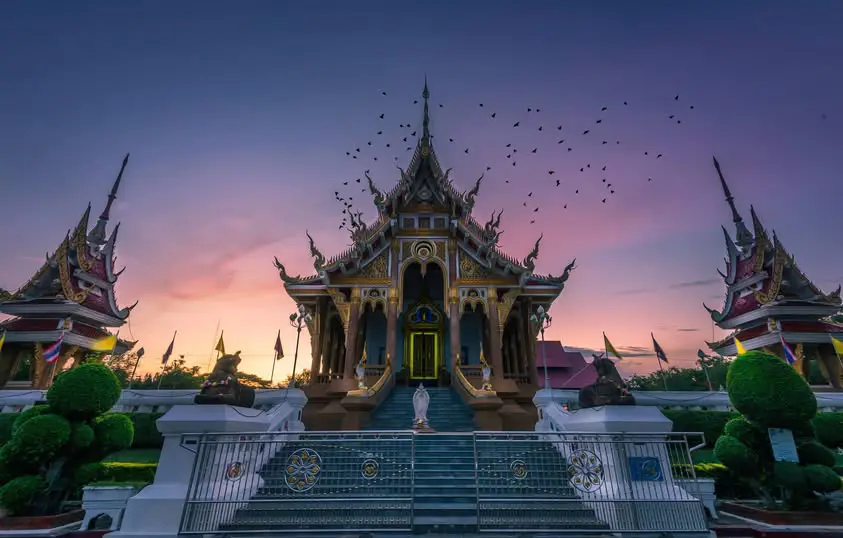
Wat Pa Saeng Arun in Khon Kaen Province, also widely known for its Sim Isan, is located in Ban Loeng Pueai, Phra Lap Subdistrict, Mueang Khon Kaen District, Khon Kaen Province. It is one of the most distinctive Buddhist and cultural attractions near Khon Kaen city. The temple is especially known for its northeastern-style ordination hall, or sim, which stands in the middle of the temple compound in a peaceful forest-temple atmosphere. The sim combines upper Isan architectural identity with central Thai elements and is decorated with mural patterns inspired by mudmee silk, one of the most recognizable cultural identities of Khon Kaen. For foreign travelers, this temple offers a valuable introduction to Isan Buddhist architecture, Thai silk-inspired art, forest-temple serenity, and the rural heritage of northeastern Thailand.
Wat Pa Saeng Arun was established in 1930 by Phra Ajahn Thet Thetsarangsi, also known as Luang Pu Thet, of Wat Hin Mak Peng in Nong Khai Province, together with Phra Ajahn Pin Panyaphalo. In its early period, the temple was informally called Wat Pa Phra Khue because the people of Ban Phra Khue supported the temple. Later, Ban Loeng Pueai community became closely involved in supporting the temple, and the name was changed to Wat Pa Saeng Arun. The name suggests a forest temple filled with the first light of dawn, a fitting image for a place associated with calmness, contemplation, and spiritual renewal.
The temple is located in Phra Lap Subdistrict, an area connected with the local history and community life of Khon Kaen. Wat Pa Saeng Arun was originally a local temple under the Dhammayuttika Nikaya and received its official monastic boundary on 11 October 1985. It was later elevated to the status of a royal temple, which strengthened its importance as a religious institution in Khon Kaen. Today, the temple continues to welcome Buddhist devotees, local residents, students, families, and travelers who come to make merit, pay respect to the Buddha images, admire the Sim Isan, and learn about Isan rural life through the temple’s outdoor museum.
The word sim is an Isan term meaning Buddhist ordination hall. In northeastern Thailand, a sim is traditionally the sacred building where important monastic ceremonies are performed. Many old Isan sims are smaller and simpler than central Thai ordination halls, but they are highly meaningful because they reflect local climate, community craftsmanship, and Buddhist faith. The Sim Isan at Wat Pa Saeng Arun develops this local idea into a larger and more elaborate sacred structure. It emphasizes form, proportion, stability, protection from sun and rain, and the beauty of regional design. It is not only a religious building but also a cultural statement about preserving local architecture for future generations.
The Sim Isan stands at the center of the temple compound. It is about 15 meters wide and 35 meters long, supported by 52 columns, with 14 windows and 3 doors. The roof is covered with traditional fish-scale tiles, and four bell towers stand around the structure. A surrounding glass wall marks the sacred boundary of the building. The overall form combines upper Isan architectural style with central Thai architectural features. Its tiered roof, gilded decorative elements, window frames, entrance details, and symmetrical composition create an impressive visual presence, while the surrounding trees and forest-temple atmosphere soften the building and make the temple feel calm and contemplative.
Inside the sim, the principal Buddha image is Phra Phuttha Rangsiyophas Sukphiphat, a Buddha image in the subduing Mara posture. The image has a lap width of 69 inches and is more than 2 meters high. It serves as the spiritual center of the sim and is an important object of devotion for visitors. The interior atmosphere is quiet and sacred, creating a strong contrast with the ornate exterior. Visitors who enter the space can experience the sim not only as an architectural attraction but as a place for worship, reflection, and inner calm.
One of the most distinctive artistic features of the sim is its mural decoration inspired by mudmee silk patterns. Mudmee silk is one of Khon Kaen’s most important cultural identities, especially in communities known for traditional silk weaving. By bringing mudmee motifs into the wall paintings of a Buddhist ordination hall, the temple connects textile heritage with sacred architecture. The murals are not just decorative surfaces. They express the relationship between local craft, regional identity, and Buddhist space.
Mudmee patterns are meaningful because they represent knowledge, labor, design, color, and community memory. A mudmee silk textile is created through the careful tying and dyeing of threads before weaving. When these patterns are translated into temple murals, they become part of a sacred visual language. The sim therefore tells visitors that local craftsmanship can belong inside a Buddhist sacred building and that the wisdom of ordinary people can become an important part of religious art.
In addition to mudmee patterns, the interior includes images of celestial beings in decorative niches, while the doors and windows are carved with scenes from the Vessantara Jataka. This Jataka story is one of the most important Buddhist narratives in Thai and Isan culture. It teaches generosity, sacrifice, and the perfection of giving. The presence of this story within the sim allows visitors to appreciate the building both as art and as a visual teaching of Buddhist values.
Behind the Sim Isan, a Buddha image in the contemplation posture is enshrined on the exterior wall, and below it stands a statue of King Chulalongkorn, Rama V. This area gives visitors another point of reverence as they walk around the building. It also connects Buddhist devotion with the memory of the Thai monarchy. The exterior layout encourages visitors to move around the entire sim rather than viewing only the front façade.
Another important Buddha image of the temple is Luang Pu Khao, a small Chiang Saen-style Buddha image in the subduing Mara posture. It has a lap width of about 11 inches and is more than one foot high. Luang Pu Khao is regarded as a treasured Buddha image of the temple. While the principal Buddha image inside the sim represents the grandeur of the sacred hall, Luang Pu Khao reflects a more intimate form of local devotion and long-standing temple faith.
The temple also has the Luang Pho Ong Dam Hall, where a black Buddha image modeled after an image associated with Nalanda University in India is enshrined. The hall also contains Buddha images for each day of birth and statues of important forest meditation masters, including Luang Pu Man Phurithatto and Luang Pu Thet Thetsarangsi. This area is meaningful for visitors interested in Thai forest Buddhism, daily-birth Buddha worship, and the lineage of respected meditation monks in northeastern Thailand.
Another notable structure is Sala Mai Kaen Kham, a hall built using kaen kham wood as the principal material. The wood is used throughout the structure, from the columns to the upper roof components, and even in the bases of Buddha images. This hall is valuable because it reflects local woodworking knowledge and the use of natural materials in Buddhist architecture. It is both a sacred space and an example of vernacular craftsmanship.
Wat Pa Saeng Arun also includes an open-air museum of rural Isan life. This outdoor museum displays sculptural scenes representing the lifestyle, occupations, and traditions of rural northeastern communities. It focuses especially on agriculture, food gathering, and the daily life of previous generations. The displays help younger visitors understand how their ancestors lived, worked, and survived through patience, resourcefulness, and close relationships with nature.
The open-air museum adds educational value to the temple. Many tools, occupations, and rural practices of the past are no longer common in modern daily life. By presenting them through models and scenes, the temple helps preserve memory in a form that is easy to understand. Together with the Sim Isan and its mudmee-inspired murals, the museum makes Wat Pa Saeng Arun a learning site that combines Buddhism, architecture, textile identity, rural life, and Isan cultural heritage.
Behind the temple, visitors can also find a large fish pond known for giant Mekong catfish and other fish. Visitors may observe the fish and make merit by feeding them. This area gives the temple a more relaxed and family-friendly atmosphere. The temple grounds also include a small artificial waterfall, gardens, lawns, and many trees, making the compound pleasant for walking and resting after visiting the sim.
What makes Wat Pa Saeng Arun special is that it feels like a forest temple while remaining very close to Khon Kaen city. Although it is only a short drive from the city area, the temple atmosphere is quiet, green, and spacious. The compound includes religious halls, meditation areas, gardens, an outdoor museum, and shaded spaces. It is suitable for visitors who want to make merit, meditate, appreciate architecture, or spend peaceful time away from the city’s busier areas.
For architecture lovers, the Sim Isan is a particularly important example of how local northeastern forms can be developed into a large and elegant sacred structure. Traditional Isan architecture often responds to local weather through practical features such as extended roofs, elevated spaces, and strong shaded forms. Wat Pa Saeng Arun expresses these ideas through a larger building with columns, roof tiers, decorated openings, and a strong sacred profile. The result is a structure that is beautiful, functional, and deeply connected to regional identity.
For those interested in folk art and textiles, the mudmee mural patterns inside the sim are essential. They show how textile motifs can move beyond cloth and become part of temple art. Mudmee patterns carry repetition, rhythm, color, and memory. When they appear on a temple wall, they become a sacred surface that speaks about local women’s knowledge, weaving communities, and the cultural pride of Khon Kaen. Visitors who have seen Khon Kaen silk or Chonnabot mudmee silk before will find this connection especially meaningful.
For students and cultural learners, Wat Pa Saeng Arun is a strong field-learning destination. It connects Thai forest Buddhism, Isan ordination hall architecture, mudmee textile identity, wood craftsmanship, rural heritage, outdoor museum design, and community-based learning. A visit to the temple can help learners understand how a single religious site can preserve many layers of society: faith, art, education, environment, and local memory.
For general travelers, the temple is easy to combine with other attractions in and around Khon Kaen city. It can be visited together with Bueng Thung Sang, Khon Kaen National Museum, Khon Kaen City Pillar Shrine, Wat Thung Setthi, Wat Nong Waeng, Ton Tann Market, or Bueng Kaen Nakhon. A half-day route can include merit-making at Wat Pa Saeng Arun, viewing the Sim Isan and outdoor museum, having lunch or coffee nearby, and continuing to another city attraction in the afternoon.
For photographers, Wat Pa Saeng Arun offers several attractive viewpoints. The front of the sim reveals the tiered roof and gilded spires. The four bell towers and surrounding wall create symmetrical compositions. The back of the sim offers additional sacred images, while the gardens and shaded areas provide softer scenes. Morning light gives the temple a peaceful mood, while late afternoon light highlights the architectural details. Photography should be done respectfully, without touching murals or disturbing worshippers.
For foreign visitors, the temple is an excellent place to understand that Thai Buddhist architecture varies greatly by region. Central Thai temples, northern temples, and northeastern temples each have their own forms and cultural meanings. At Wat Pa Saeng Arun, visitors can see the local Isan term sim, upper northeastern architecture, mudmee silk patterns, a forest-temple environment, and an outdoor museum of rural life. This makes the temple more than a place for sightseeing. It is a compact introduction to the cultural identity of Khon Kaen and Isan.
Visitors should dress respectfully because Wat Pa Saeng Arun is an active Buddhist temple and a royal temple. Sleeveless shirts, very short shorts, and overly revealing clothing should be avoided. Shoes should be removed in designated areas. Visitors should keep quiet inside sacred spaces, avoid touching murals and decorative surfaces, and follow instructions from monks or temple staff. Groups should contact the temple in advance if they want a more organized visit or explanation.
The temple is especially pleasant in the morning or late afternoon. Morning visits are suitable for merit-making and quiet worship, while late afternoon is suitable for photography and a relaxed walk around the grounds. Visitors should allow about 1 to 2 hours to pay respect to the Buddha images, admire the Sim Isan, observe the mudmee murals, walk through the outdoor museum, and enjoy the peaceful forest-temple atmosphere.
Getting There from Khon Kaen city is convenient. Take Highway 12, also known as Si Chan Road, toward Kalasin for about 6 km. After reaching the appropriate U-turn point, return toward the city side for about 1 km, then turn left onto the local public works road and continue for about 300 meters. Wat Pa Saeng Arun will be on the right-hand side. The temple can be reached by private car, rental car, taxi, or ride-hailing service. Because it is close to the city, it is easy to include in a short cultural itinerary.
Visitors using public transport can start from Khon Kaen city and continue by local hired vehicle or ride-hailing service to the temple. Since the distance is not far, this is a practical option, but the return trip should be planned in advance, especially in the evening. Families, school groups, and travelers who want to visit several nearby places in one day will find private transport more convenient.
A practical half-day route begins at Wat Pa Saeng Arun in the morning. Visitors can pay respect to the principal Buddha image, explore the Sim Isan, observe the mudmee murals, and walk through the open-air museum of rural Isan life. After that, they can stop at a nearby café or restaurant in Phra Lap Subdistrict, then continue to Bueng Thung Sang or Khon Kaen National Museum. In the late afternoon, they may continue to Wat Nong Waeng or Bueng Kaen Nakhon for city views and evening atmosphere.
For a full-day route, Wat Pa Saeng Arun can be combined with several important Khon Kaen attractions. Travelers may begin with the Sim Isan, continue to Wat Thung Setthi to see Maha Chedi Si Trai Lok That, visit Khon Kaen National Museum or the City Pillar Shrine, and end the day at Ton Tann Market or a restaurant in the city. This route offers a balanced view of Khon Kaen through religion, architecture, museum learning, food, and everyday urban culture.
Wat Pa Saeng Arun is therefore more than a beautiful temple for photography. It is a living religious site where faith, local architecture, mudmee silk identity, rural memory, and forest-temple calm come together. The Sim Isan at the center of the temple shows how northeastern Thai cultural roots can become a refined sacred building without losing their local character. For anyone who wants to understand Khon Kaen beyond shopping malls and main roads, Wat Pa Saeng Arun is a destination worth including in the travel plan.
| Name | Wat Pa Saeng Arun / Sim Isan at Wat Pa Saeng Arun |
| Thai Name | วัดป่าแสงอรุณ / สิมอีสาน วัดป่าแสงอรุณ |
| Location | Ban Loeng Pueai, Phra Lap Subdistrict, Mueang Khon Kaen District, Khon Kaen Province |
| Address | Wat Pa Saeng Arun, 448 Moo 9, Yothathikan Road, Ban Loeng Pueai, Phra Lap Subdistrict, Mueang Khon Kaen District, Khon Kaen 40000, Thailand |
| Coordinates | 16.425674, 102.885842 |
| Highlights | The Sim Isan ordination hall, mudmee silk-inspired murals, Phra Phuttha Rangsiyophas Sukphiphat, open-air museum of rural Isan life, Luang Pho Ong Dam Hall, Kaen Kham wooden hall, and peaceful forest-temple atmosphere near Khon Kaen city |
| History | Established in 1930 by Phra Ajahn Thet Thetsarangsi and Phra Ajahn Pin Panyaphalo. It was first informally known as Wat Pa Phra Khue before being renamed Wat Pa Saeng Arun with support from Ban Loeng Pueai community. |
| Temple Status | Third-Class Royal Temple, Ordinary Type, under the Dhammayuttika Nikaya |
| Temple Area | Approximately 39 rai |
| Name Origin | Wat Pa Saeng Arun suggests a peaceful forest temple associated with the first light of dawn, while Sim Isan comes from the Isan word sim, meaning Buddhist ordination hall. |
| Distinctive Features of Sim Isan | An upper Isan-style ordination hall blended with central Thai architecture, about 15 meters wide and 35 meters long, with 52 columns, 14 windows, 3 doors, a traditional fish-scale tiled roof, 4 bell towers, and a surrounding sacred wall |
| Principal Buddha Images | Phra Phuttha Rangsiyophas Sukphiphat, a subduing Mara Buddha image with a lap width of 69 inches and a height of more than 2 meters, and Luang Pu Khao, a treasured Buddha image of the temple |
| Important Artworks | Mudmee silk-inspired wall paintings, celestial figures in decorative niches, carved doors and windows depicting Vessantara Jataka, and Isan architectural elements designed for beauty, stability, and protection from sun and rain |
| Main Areas / Zones | 1. Sim Isan or Buddhist ordination hall 2. Mudmee silk-inspired mural zone inside the sim 3. Phra Phuttha Rangsiyophas Sukphiphat, the principal Buddha image 4. Contemplation Buddha image and King Rama V statue behind the sim 5. Luang Pho Ong Dam Hall and birth-day Buddha images 6. Kaen Kham wooden hall 7. Open-air museum of rural Isan life 8. Giant Mekong catfish pond, garden, and artificial waterfall 9. Meditation hall, multipurpose hall, kitchen, and Buddhist activity areas |
| Activities / Traditions | Merit-making on Buddhist holy days, worship on important Buddhist occasions, meditation, Dhamma listening, paying respect to the principal Buddha image, viewing Sim Isan, and learning rural Isan life through the open-air museum |
| Visitor Etiquette | Dress modestly, remove shoes in designated areas, keep quiet, avoid touching murals or decorative surfaces, do not climb on religious structures, and follow temple instructions. |
| Travel Information | From Khon Kaen city, take Highway 12 or Si Chan Road toward Kalasin for about 6 km. After making a U-turn, drive back toward the city for about 1 km, then turn left onto the local public works road and continue for about 300 meters. The temple is on the right-hand side. |
| Current Status | Open for merit-making, worship, Sim Isan visits, and outdoor museum learning during visiting hours |
| Open Days | Daily |
| Opening Hours | 08.00 – 17.00 |
| Fees | Free Admission |
| Facilities | Parking area, restrooms, temple courtyard, merit-making areas, meditation hall, kitchen, garden, open-air museum, and resting areas within the temple compound |
| Caretaker | Wat Pa Saeng Arun Royal Temple, Dhammayuttika Nikaya |
| Abbot | Phra Phromwachiradilok (Saman Sumedho, Pali Grade 9) |
| Related Contact Numbers | 043-221-132, 043-270-191 |
| Official Website / Official Page | Facebook: Wat Pa Saeng Arun Khon Kaen Facebook: Phra Phromwachiradilok, Wat Pa Saeng Arun |
| Nearby Tourist Attractions | 1. Bueng Thung Sang, about 4 km 2. Khon Kaen National Museum, about 5 km 3. Khon Kaen City Pillar Shrine, about 6 km 4. Wat Thung Setthi, about 7 km 5. Ton Tann Market, about 9 km 6. Wat Nong Waeng and Phra Mahathat Kaen Nakhon, about 9 km 7. Bueng Kaen Nakhon, about 10 km |
| Nearby Restaurants | 1. Garden Seen Cafe&Restaurant, about 0.5 km, Tel. 091-740-1997 2. Do Farm Cafe, about 2 km, Tel. 061-938-2277 3. Lang Wang Boat Noodle Khon Kaen, about 2 km, Tel. 090-321-7397, 080-965-2479 4. Rai Kuen Din, about 3 km, Tel. 088-813-5166 5. Si Koi Fao Nong Yai, about 5 km, Tel. 086-859-7147 6. Ma Sang Wa Branch 1, about 5 km, Tel. 085-519-4196, 080-526-4088 |
| Nearby Accommodations | 1. Baan Suan Thanwalai Khon Kaen, about 2 km, Tel. 084-262-8915 2. Green Hotel & Resort Khon Kaen, about 4 km, Tel. 043-247-222, 088-551-5179 3. Avani Khon Kaen Hotel & Convention Centre, about 5 km, Tel. 043-209-888 4. Romantic Khonkaen Hotel, about 5 km, Tel. 061-929-8484 5. Le Cassia Hotel Khon Kaen, about 6 km, Tel. 043-333-666, 043-242-222 6. Piman Garden Boutique Hotel, about 6 km, Tel. 089-276-7111 |
Frequently Asked Questions (FAQ)
Q: Where is Wat Pa Saeng Arun located?
A: Wat Pa Saeng Arun is located in Ban Loeng Pueai, Phra Lap Subdistrict, Mueang Khon Kaen District, Khon Kaen Province, not far from Khon Kaen city on the route toward Kalasin.
Q: What are the opening hours of Wat Pa Saeng Arun?
A: The temple is open daily from 08.00 to 17.00 for merit-making, worship, visiting the Sim Isan, and exploring the open-air museum.
Q: Is there an admission fee?
A: No. Admission is free for visitors who want to make merit, pay respect to the Buddha images, view the Sim Isan, and learn about rural Isan life inside the temple compound.
Q: What is the main highlight of Sim Isan at Wat Pa Saeng Arun?
A: The main highlight is the upper Isan-style ordination hall blended with central Thai architecture, featuring a fish-scale tiled roof, 4 bell towers, 52 columns, and mudmee silk-inspired wall paintings that represent Khon Kaen’s cultural identity.
Q: Which Buddha image is enshrined inside the Sim Isan?
A: The principal Buddha image inside the Sim Isan is Phra Phuttha Rangsiyophas Sukphiphat, a subduing Mara Buddha image with a lap width of 69 inches and a height of more than 2 meters.
Q: What else can visitors see inside Wat Pa Saeng Arun?
A: Visitors can see Luang Pho Ong Dam Hall, the Kaen Kham wooden hall, the open-air museum of rural Isan life, a giant Mekong catfish pond, gardens, an artificial waterfall, and meditation areas.
Q: How long should visitors spend at Wat Pa Saeng Arun?
A: Visitors should allow about 1 to 2 hours to pay respect, admire the Sim Isan, observe the mudmee murals, walk through the open-air museum, and enjoy the peaceful forest-temple setting.
Q: What nearby attractions can visitors combine with Wat Pa Saeng Arun?
A: Nearby attractions include Bueng Thung Sang, Khon Kaen National Museum, Khon Kaen City Pillar Shrine, Wat Thung Setthi, Wat Nong Waeng, Phra Mahathat Kaen Nakhon, Ton Tann Market, and Bueng Kaen Nakhon.
 Category: ●Places of Worship
 Group: ●Temple
Last Update : 4 MonthAgo
 Last Update : 4 MonthAgo
 Click to Access the Navigation Map GPS
Wat Pa Saeng Arun (The Sim Isan) Map
Recommend

 Art, Culture and Heritage
 Historical Sites and Monuments(7)
 Landmarks and Memorials(3)
 Art, Craft Centres, Tradition(2)
 Museums(4)
 Educational Places
 Museum for Study(2)
Temple(27)
 Other Sacred Sites(5)
 Suburban Living
 Village, Community(3)
 Local Market(1)
 Nature and Wildlife
 National Parks and Marine Reserves(5)
 Mountain (Doi)(1)
 Dam, Reservoir, Lake(4)
 Waterfalls(8)
 Caves(9)
 River, Canal(10)
 Bays and Beaches(3)
 Islands(1)
 Other natural attractions(5)
 Entertainment and Agricultural
 Zoos and Aquariums(2)
 Animal camps and shows(2)
 Farms, Parks and Ecotourism(7)
 Waterpark(3)
 Travel Articles, Recipes
 Travel Review, Food Review(1)


