
lovethailand home >Northeastern Travel Attractions >Kalasin Travel Attractions >Kham Muang >Phon > Ban Phon Phrae Wa Silk Weaving Group
TL;DR: Ban Phon Phrae Wa Silk Weaving Group is located at Phon Subdistrict, Kham Muang District, Kalasin Province, Thailand, open Daily, hours 08.30 – 17.00.

Ban Phon Phrae Wa Silk Weaving Group
Open Days: Daily
Opening Hours: 08.30 – 17.00
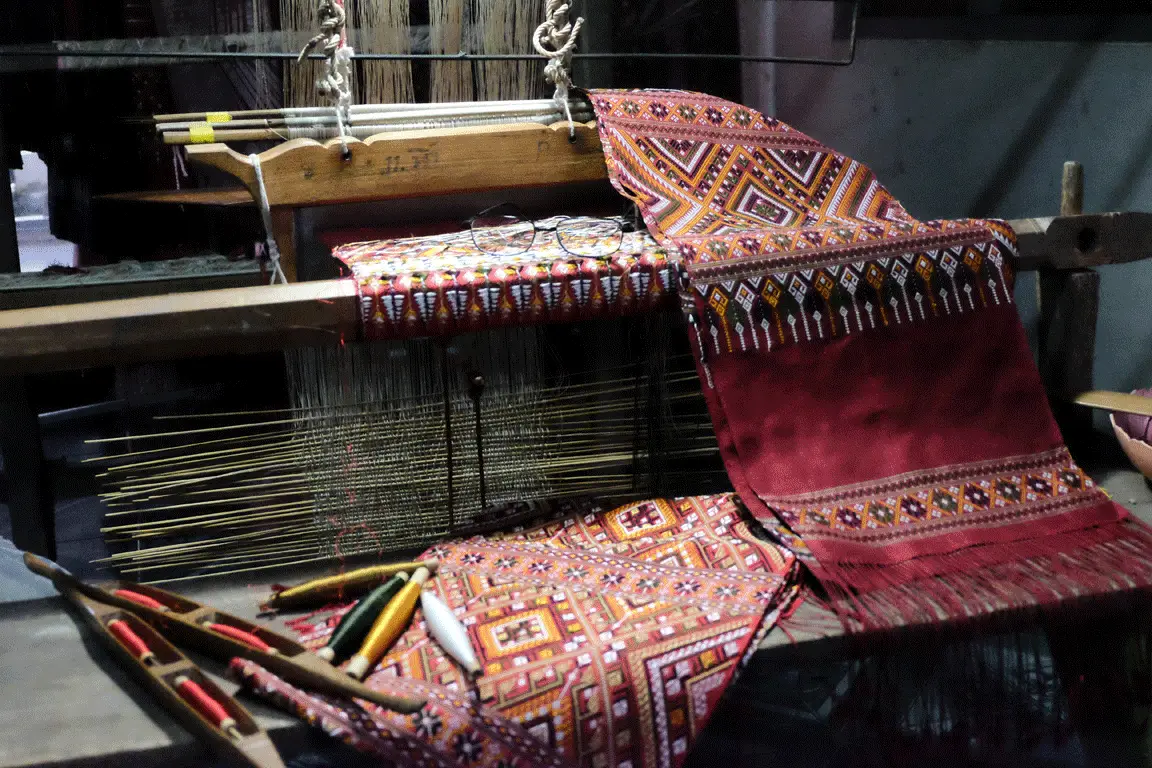
Ban Phon Phrae Wa Silk Weaving Group in Kalasin Province is one of Thailand’s most important destinations for traditional silk textile heritage. Located in Phon Subdistrict, Kham Muang District, about 70 km from Kalasin city via Highway No. 227, Ban Phon is widely known as the home of Phrae Wa silk, a refined handwoven silk of the Phu Thai people. With intricate patterns, rich colours, and a complex weaving process that requires advanced craftsmanship, Phrae Wa silk from Ban Phon has long been admired as the “Queen of Thai Silk.” For foreign travelers, this village is not only a place to buy beautiful silk products but also a cultural gateway into the identity, dress traditions, craftsmanship, and living heritage of the Phu Thai community in northeastern Thailand.
Ban Phon is a Phu Thai village with a strong cultural identity. The Phu Thai people are an ethnic group whose historical roots are connected with the Sipsong Chutai region before migrating through Laos and settling in parts of northeastern Thailand, especially in Kalasin, Sakon Nakhon, Nakhon Phanom, and Mukdahan. The community has preserved its language, beliefs, traditional dress, rituals, music, and weaving knowledge for generations. Among these cultural treasures, Phrae Wa silk is the most celebrated. Traditionally, it was used as a shoulder cloth or diagonal sash worn by Phu Thai women during major ceremonies, merit-making festivals, and important community events.
The word “Phrae Wa” carries cultural meaning. “Phrae” refers to a beautiful piece of woven cloth, while “Wa” refers to a traditional unit of length measured by outstretched arms. In its original form, Phrae Wa was a relatively small silk cloth about one wa in length, used for draping over the shoulder or wearing across the body. Although the cloth was not large, its surface was filled with complex patterns, colour arrangements, and woven details. A single piece required patience, memory, accuracy, and deep understanding of traditional motifs. This is why Phrae Wa silk is often seen not simply as textile but as a woven record of family knowledge and Phu Thai heritage.
The patterns of Ban Phon Phrae Wa silk are commonly described in two major groups: the main motifs and the border or band motifs. The main motifs cover the prominent areas of the cloth and often feature geometric forms, diamond shapes, repeated lines, plant-inspired designs, symbolic animals, and cultural motifs related to local beliefs. The band motifs help frame, separate, and balance the main patterns. Together they create rhythm and harmony across the whole textile. When viewed closely, the cloth reveals extremely fine details; when viewed from a distance, the overall composition appears bold, elegant, and unmistakably distinctive.
In the past, Phrae Wa silk was strongly associated with a deep red or lac-dyed red ground colour. The woven details were created with coloured silk threads such as yellow, blue, white, green, and other tones inserted throughout the cloth. Today, Ban Phon weavers have expanded the colour palette to meet contemporary tastes and market demand. Phrae Wa silk is now available not only in red but also in cream, soft pink, purple, blue, green, and other modern colour combinations. This development allows the textile to be used in a wider range of clothing, ceremonial wear, fashion pieces, home decoration, and collectible silk items while still preserving its traditional identity.
The beauty of Phrae Wa silk lies in the complexity of its weaving process. Unlike plain silk fabric, Phrae Wa requires careful pattern picking and supplementary weft techniques that allow multiple colours to appear within intricate motifs. The weaver must follow inherited patterns, memory, or a sample cloth while controlling thread tension, colour placement, pattern rhythm, and the relationship between motifs. Even a small mistake can disturb the balance of the design. For this reason, weaving Phrae Wa demands both technical mastery and artistic sensitivity. It is a high-level textile art that cannot be rushed.
A visit to Ban Phon allows travelers to experience Phrae Wa silk within its living community context. The village is associated with several important cultural and craft spaces, including the Ban Phon Phrae Wa Silk Weaving Cooperative, the Queen Sirikit SUPPORT Foundation-related Phrae Wa Silk Weaving Centre, and the Phu Thai Phrae Wa Silk Cultural Centre. These places function as learning areas, product centres, cultural interpretation spaces, and community economic platforms. Visitors can see silk products, learn about the Phu Thai way of life, and understand how traditional craftsmanship continues to support local livelihoods.
The modern revival of Ban Phon Phrae Wa silk is closely connected with the royal patronage of Her Majesty Queen Sirikit The Queen Mother. In 1977, during a royal visit to Kham Muang District, Her Majesty saw Phu Thai women from Ban Phon wearing Phrae Wa silk in the traditional diagonal-sash style. She recognized the beauty and cultural value of the cloth and encouraged its preservation. In 1978, the Ban Phon Phrae Wa weaving project was brought under the care of the SUPPORT Foundation, beginning with a farmers’ housewives group of 70 members. This royal support became a turning point that helped rescue Phrae Wa from decline and brought it to national recognition.
Another important development was the adaptation of Phrae Wa from a traditional shoulder cloth into wider and longer silk fabric suitable for tailored clothing. The original form was about one wa long and half a wa wide, but under the development approach supported by the royal initiative, the fabric was expanded into standard sizes that could be used for modern garments. This allowed Phrae Wa to become more accessible to contemporary users while still maintaining its traditional motifs and weaving techniques. Today, it can be made into women’s dresses, men’s shirts, shawls, scarves, handbags, and other refined products.
In 1995, the weaving activities developed into a women’s occupational weaving group in Ban Phon. In 2008, the organization was registered as Ban Phon Kalasin Phrae Wa Silk Weaving SUPPORT Centre Cooperative Ltd. The cooperative structure helped improve product collection, material supply, marketing, and product development. Over time, the weaving network expanded beyond Ban Phon and involved members from several districts, including Kham Muang, Somdet, Sam Chai, and Sahatsakhan. This shows how Phrae Wa silk has grown from a village-based heritage into a wider community economy while preserving its cultural roots.
When looking at Phrae Wa silk, travelers should see it as a form of textile art rather than just fabric. One piece passes through many stages: preparing silk threads, cleaning, dyeing, setting up the loom, arranging the design, picking the pattern, inserting coloured threads, and weaving each row with precision. The richness of the cloth comes from the relationship between technique and aesthetics. A skilled weaver can make the cloth appear richly patterned without becoming visually chaotic, colourful without being harsh, and detailed while still graceful. This is why Phrae Wa has earned such a respected place among Thai silk traditions.
The Phu Thai Phrae Wa Silk Cultural Centre in Ban Phon provides useful context for understanding the textile. It presents the daily life, culture, traditions, local wisdom, and Phu Thai identity of the community. Visitors can learn about the broader cultural setting behind Phrae Wa silk, including traditional houses, festivals, dress, and local heritage. This makes the centre a good starting point before visiting weaving groups or selecting silk products, especially for travelers who want to understand the story behind the patterns.
Ban Phon is best explored slowly. The value of this destination is not only in seeing finished silk products but in observing details, asking about patterns, comparing colour tones, and understanding why this textile is so highly regarded in Thai craft culture. If visitors have a chance to see a weaving demonstration, they will notice that the loom is more than a tool. It is a working space where the weaver uses hands, eyes, memory, rhythm, and concentration to create a living piece of cultural knowledge. Each movement matters, and each row contributes to the final beauty of the cloth.
Products available in Ban Phon may include full silk pieces, shawls, fabric for tailored clothing, scarves, handbags, and contemporary items made from Phrae Wa silk. Travelers who want to buy Phrae Wa should look carefully at the density of the weave, the clarity of the pattern, the consistency of the silk threads, the finishing of the edges, and the suitability of the colour for their intended use. For tailored clothing, it is important to ask about the length and width of the cloth. For collectors, a complete motif, balanced colour, and clear cultural story make a piece more meaningful.
Phrae Wa silk should be cared for gently. Because it is handwoven silk with complex patterning, it should not be washed harshly, twisted, or dried under strong sunlight for long periods. Gentle hand-washing, mild silk-friendly detergent, and drying in the shade help preserve the shine, colour, and texture of the fabric. If kept as a collectible textile, it should be stored in a dry and clean place away from humidity. Proper care allows Phrae Wa silk to remain beautiful for many years.
Beyond its beauty, Phrae Wa silk has strong economic and social value. Buying directly from Ban Phon supports local weavers, cooperative members, and community families. It helps younger generations see that traditional knowledge can create livelihoods, and it keeps handweaving relevant in the present day. For visitors, a Phrae Wa purchase is not simply a souvenir but a contribution to the survival of a living craft tradition.
Phrae Wa silk is also connected with Phu Thai dress and ceremonial life. Traditional Phu Thai women’s clothing often includes dark garments with red accents, silk sarongs, and the Phrae Wa shoulder cloth worn during important occasions. The textile is therefore part of a larger cultural system involving dress, music, dance, ritual, and social identity. Seeing Phrae Wa in this context helps foreign travelers understand that its motifs are not merely decorative; they carry memory, dignity, and community meaning.
Ban Phon Phrae Wa Silk Weaving Group is suitable for many types of visitors. General travelers can shop for authentic community products. Students can learn about ethnic culture and traditional craftsmanship. Designers can study motif structures, colour relationships, and textile composition. Collectors of Thai textiles can look for distinctive pieces from one of the country’s most respected weaving communities. International visitors can discover that Thai silk is far more diverse than a single style; Phrae Wa is one of the most refined and culturally specific forms of Thai silk artistry.
For travel planning, Ban Phon works well as a main stop on a cultural route in northern Kalasin. From Kalasin city, visitors can travel along Highway No. 227 toward Kham Muang District for about 70 km. The route is best done by private car, rental car, or hired local vehicle because it allows travelers to stop at nearby cultural and natural attractions. These may include the Phu Thai Phrae Wa Silk Cultural Centre, Wat Pa Rangsipaliwan, Phu Pha Wua Forest Park, Phu Noi Dinosaur Site, Wat Dan Nok Khian, and further attractions such as Sirindhorn Museum and Phu Kum Khao Dinosaur Excavation Site.
The area around Ban Phon offers more than silk. The Phu Thai cultural centre provides background on local lifestyle and traditions. Wat Pa Rangsipaliwan offers a peaceful religious atmosphere within the community. Phu Pha Wua Forest Park adds a natural landscape dimension, while Phu Noi Dinosaur Site and Sirindhorn Museum connect the trip with Kalasin’s prehistoric heritage. A full-day itinerary can begin with Phrae Wa silk in the morning, lunch in Kham Muang, and a natural or archaeological attraction in the afternoon.
Visitors should allow at least 1-2 hours to explore the weaving group and product areas. Those who are especially interested in textiles should allow more time for conversation, comparison, and learning. Carrying cash is useful when purchasing community products, although some sellers may support bank transfer. Travelers visiting as a group or hoping to see a demonstration should contact the centre in advance to make the visit smoother.
Respect for the value of handmade work is important. A handwoven Phrae Wa cloth takes time, costly materials, and highly trained skills. Small differences between handmade pieces are part of their character, not flaws. Bargaining should be polite and reasonable because the price reflects the difficulty of the technique, the number of colours, the complexity of the motif, and the time spent by the weaver. Buying with understanding helps preserve the dignity of the craft and supports the community directly.
Ban Phon Phrae Wa Silk Weaving Group is one of the most meaningful cultural destinations in Kalasin. It combines travel, learning, craft preservation, royal-supported community development, and local identity in one place. Visitors can see the beauty of Thai silk, understand the heritage of the Phu Thai people, and appreciate how a village textile tradition became known nationally and internationally. For travelers who want to understand Kalasin beyond its better-known dinosaur attractions, Ban Phon offers a deeper and more human story: silk woven from memory, devotion, and the skilled hands of Phu Thai weavers.
Getting There from Kalasin city, take Highway No. 227 toward Kham Muang District for about 70 km to reach Phon Subdistrict and Ban Phon. Important visitor points related to Phrae Wa silk include Ban Phon Kalasin Phrae Wa Silk Weaving SUPPORT Centre Cooperative Ltd. and the Phu Thai Phrae Wa Silk Cultural Centre. Private car, rental car, or a hired local vehicle is recommended because it makes it easier to connect the weaving centre with nearby attractions, restaurants, and accommodations. Daytime visits are best for seeing the silk clearly and supporting local product purchases.
| Name | Ban Phon Phrae Wa Silk Weaving Group / Ban Phon Phrae Wa Silk Weaving Village |
| Location | Phon Subdistrict, Kham Muang District, Kalasin Province, Thailand |
| Address | Ban Phon Kalasin Phrae Wa Silk Weaving SUPPORT Centre Cooperative Ltd., 173 Moo 5, Ban Phon, Phon Subdistrict, Kham Muang District, Kalasin 46180, Thailand Phu Thai Phrae Wa Silk Cultural Centre, 176 Moo 2, Phon Subdistrict, Kham Muang District, Kalasin, Thailand |
| Highlights | A major Phu Thai silk-weaving community known for Phrae Wa silk, a highly refined handwoven textile praised as the Queen of Thai Silk |
| History | The weaving tradition was supported by Her Majesty Queen Sirikit The Queen Mother after her visit to Kham Muang District in 1977. The Ban Phon Phrae Wa weaving project was brought under the SUPPORT Foundation in 1978, and the cooperative was officially registered in 2008. |
| Name Origin | “Phrae” refers to a beautiful woven cloth, while “Wa” refers to a traditional length of about one wa. The original cloth was worn over the shoulder as a ceremonial sash by Phu Thai women. |
| Distinctive Features | Handwoven silk using intricate pattern picking and supplementary coloured silk techniques. The patterns include main motifs and band motifs. Traditional red grounds are now joined by cream, soft pink, purple, blue, green, and contemporary colour palettes. |
| Travel Information | From Kalasin city, take Highway No. 227 toward Kham Muang District for about 70 km. Private car, rental car, or hired local vehicle is recommended. |
| Current Status | Open as a learning, product, and cultural preservation centre for Phrae Wa silk and Phu Thai heritage in Ban Phon. |
| Open Days | Daily |
| Opening Hours | 08.30 – 17.00 |
| Fees | No admission fee |
| Facilities | Phrae Wa silk product area, Phu Thai cultural learning area, product display area, and community information space |
| Main Areas / Zones | 1. Ban Phon Kalasin Phrae Wa Silk Weaving SUPPORT Centre Cooperative Ltd. 2. Phrae Wa silk product area 3. Silk-weaving demonstration and learning area 4. Phu Thai Phrae Wa Silk Cultural Centre 5. Exhibition area for Phu Thai lifestyle, traditions, and local wisdom |
| Caretaker | Ban Phon Kalasin Phrae Wa Silk Weaving SUPPORT Centre Cooperative Ltd. and local administrative organizations in Phon Subdistrict |
| Main Contact Number | 091-747-3959, 043-856204, 043-856157 |
| Nearby Tourist Attractions | 1. Phu Thai Phrae Wa Silk Cultural Centre, 1 km 2. Wat Pa Rangsipaliwan, Ban Phon, 2 km 3. Phu Pha Wua Forest Park, 12 km 4. Phu Noi Dinosaur Site, 18 km 5. Wat Dan Nok Khian, 17 km 6. Sirindhorn Museum and Phu Kum Khao Dinosaur Excavation Site, 42 km |
| Nearby Restaurants | 1. Coffee BAR Kham Muang, 10 km, Tel. 065-296-9851 2. Mang Mee Moo Kratha Kham Muang Branch, 10 km, Tel. 098-356-9299 3. PunThai Coffee Kham Muang, 10 km 4. Amlam Cafe, 10 km 5. Jungle Cafe Kham Muang Kalasin, Thung Khlong Branch, 11 km 6. Naphu Cafe by Phetchjinda Organic Farm, 18 km |
| Nearby Accommodations | 1. Khummok Resort, 2 km 2. Leelawadee Resort Kham Muang, 10 km, Tel. 088-330-0595 3. Sabai Dee Resort Kham Muang, 10 km, Tel. 063-354-3886 4. Huean Him Phu Resort, 24 km 5. Rim Thung Sahatsakhan Resort, 35 km |
Frequently Asked Questions (FAQ)
Q: Where is Ban Phon Phrae Wa Silk Weaving Group located?
A: It is located in Phon Subdistrict, Kham Muang District, Kalasin Province. Key visitor points include Ban Phon Kalasin Phrae Wa Silk Weaving SUPPORT Centre Cooperative Ltd. and the Phu Thai Phrae Wa Silk Cultural Centre.
Q: Why is Ban Phon Phrae Wa silk special?
A: It is a handwoven silk textile of the Phu Thai people, created with intricate pattern picking and supplementary coloured silk techniques. Its designs include main motifs and band motifs, earning it the reputation as the Queen of Thai Silk.
Q: Is Phrae Wa silk always red?
A: Traditional Phrae Wa often used a deep red ground, but today it is also woven in cream, soft pink, purple, blue, green, and other contemporary colours.
Q: How do I get from Kalasin city to Ban Phon?
A: Take Highway No. 227 from Kalasin city toward Kham Muang District for about 70 km. Traveling by private car, rental car, or hired local vehicle is recommended.
Q: What are the opening hours?
A: The Ban Phon Phrae Wa silk learning and cultural area opens daily from 08.30 to 17.00. Groups or visitors hoping to see a demonstration should contact the centre in advance.
Q: Is there an admission fee?
A: No admission fee is charged. Visitors can explore the learning areas and purchase Phrae Wa silk products directly from the community.
Q: What should I buy as a souvenir from Ban Phon?
A: Recommended items include Phrae Wa silk fabric, shawls, tailored-clothing fabric, scarves, handbags, and contemporary products made from Phrae Wa silk.
Q: What nearby attractions can be combined with a visit to Ban Phon?
A: Nearby attractions include the Phu Thai Phrae Wa Silk Cultural Centre, Wat Pa Rangsipaliwan, Phu Pha Wua Forest Park, Phu Noi Dinosaur Site, Wat Dan Nok Khian, and Sirindhorn Museum.
 Category: ●Suburban Living
 Group: ●Village, Community
Last Update : 4 MonthAgo
 Last Update : 4 MonthAgo
 Click to Access the Navigation Map GPS
Ban Phon Phrae Wa Silk Weaving Group Map

 Art, Culture and Heritage
 Historical Sites and Monuments(2)
 Landmarks and Memorials(3)
 Art, Craft Centres, Tradition(4)
 Museums(3)
 Art Gallery(1)
 Educational Places
 Educational Gardens, Farm(1)
 Places of Worship
 Temple(21)
 Other Sacred Sites(7)
Village, Community(3)
 Nature and Wildlife
 National Parks and Marine Reserves(3)
 Mountain (Doi)(2)
 Dam, Reservoir, Lake(5)
 Waterfalls(4)
 Caves(2)
 River, Canal(3)
 Bays and Beaches(1)
 Other natural attractions(2)
 Entertainment and Agricultural
 Animal camps and shows(1)
 Farms, Parks and Ecotourism(2)
 Travel Articles, Recipes
 Travel Review, Food Review(1)


