
lovethailand home >Northeastern Travel Attractions >Kalasin Travel Attractions >Muang Kalasin >Kalasin > Kalasin City Pillar Shrine
TL;DR: Kalasin City Pillar Shrine is located at Intersection of Kalasin Road and Kaeng Samrong Road, Kalasin Subdistrict, Mueang Kalasin District, Kalasin Province 46000, Thailand, open Daily, subject to published visiting arrangements, hours 06:00 – 17:00.
Kalasin City Pillar Shrine
Open Days: Daily, subject to published visiting arrangements
Opening Hours: 06:00 – 17:00
Kalasin City Pillar Shrine, also known as Chao Pho Lak Mueang Kalasin Shrine, is one of the most important sacred landmarks in Kalasin Province, northeastern Thailand. Located at the intersection of Kalasin Road and Kaeng Samrong Road in Kalasin Subdistrict, Mueang Kalasin District, the shrine serves as a spiritual center for local residents and an important reminder of the province's history. Its origins are closely connected with Thao Somphamit, the founder and first governor of Kalasin, who received the noble title Phraya Chai Sunthon in 1793. The shrine is particularly notable for its traditional Thai four-sided architecture, red-and-gold decorative details, historic city pillar, and an ancient Dvaravati sandstone boundary marker associated with the archaeological city of Fa Daet Song Yang. It also plays a central role in the Bun Sam Ha tradition, an important northeastern Thai ceremony dedicated to purification, community well-being, and respect for the guardian spirits of the city.
Kalasin City Pillar Shrine stands in the historic urban district, surrounded by important roads, established neighborhoods, and commercial communities. This part of the city is closely associated with the development of Kalasin from the early settlement of Ban Kaeng Samrong into an administrative center. Its convenient location allows residents to visit for worship and traditional ceremonies throughout the year. For travelers, the shrine offers an opportunity to explore the province's early history and gain a deeper understanding of the spiritual traditions that remain influential in northeastern Thai society.
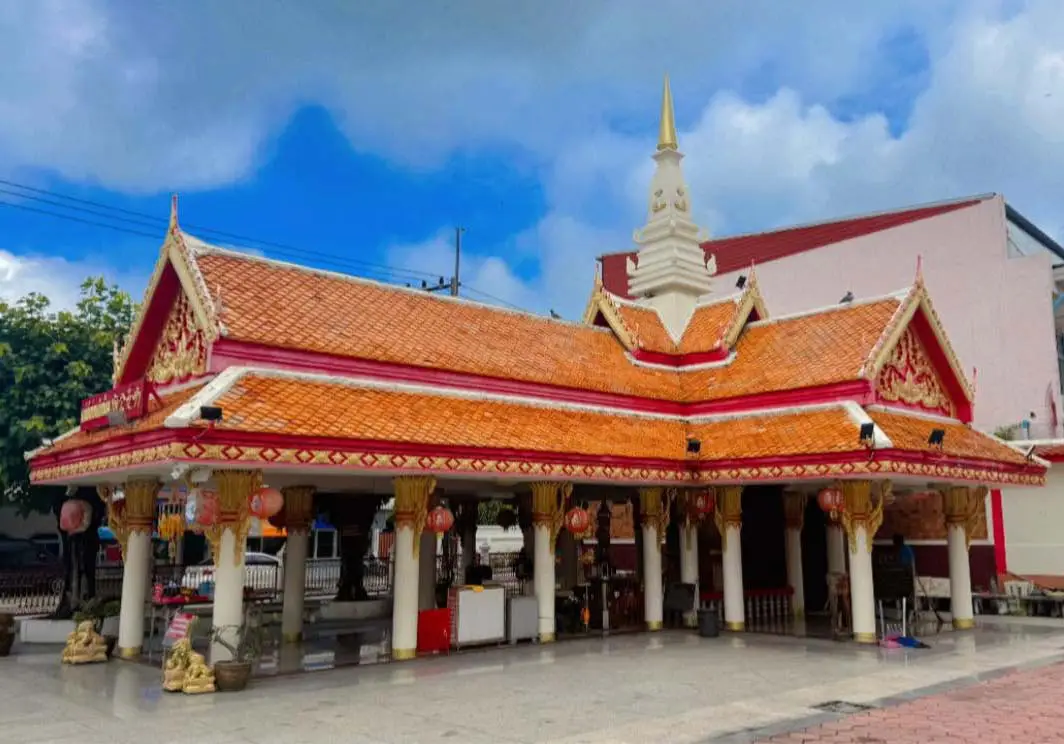
The exterior of the shrine is distinguished by its orange-red tiled roofs, elaborately decorated red-and-gold gables, and a tall ornamental spire rising above the center of the structure. Signs bearing the shrine's name in Thai and Chinese reflect the interaction between traditional Thai artistic expression and the cultural heritage of Thai-Chinese communities. Light-colored columns decorated with golden motifs support the projecting roofs, creating an elegant architectural composition. Together, these elements give the shrine a dignified appearance while illustrating the cultural diversity that has contributed to the development of Kalasin.
Inside the shrine stands the city pillar, which has been revered by generations of local residents. Historical accounts describe the original pillar as a rectangular piece of padauk wood that gradually deteriorated over time. Another significant feature is an ancient sandstone sema, or Buddhist boundary marker, brought from the historic city of Fa Daet Song Yang. Decorated with low-relief carvings depicting scenes from the life of the Buddha, the stone is enshrined behind the city pillar. Its presence gives the shrine archaeological and art-historical importance beyond its primary function as a place of worship.
The history of Kalasin is closely connected with the movement of communities from areas around the Mekong River during the early Rattanakosin period. A group led by Thao Somphamit migrated southward across the Phu Phan mountain range and eventually established settlements in the Pao River basin. Their migration and choice of settlement location were fundamental to the emergence of Kalasin as a town that subsequently developed into an important administrative center in central northeastern Thailand.
Initially, Thao Somphamit and his followers settled at Ban Klang Muen. Thao Trai and a group of representatives were then sent to search for a more suitable location for a permanent town. Their exploration identified the area around Kaeng Samrong near the Pao River as an appropriate site because of its water resources, agricultural land, and favorable natural conditions. The community subsequently relocated to this area, where the foundations of the town were gradually established along with the spiritual beliefs and ceremonial traditions associated with its development.
The Pao River played a crucial role in Kalasin's early history. Its waters supported agriculture, livestock raising, and the establishment of settlements over many generations. The river also connected communities throughout the surrounding region. As a result, the settlement at Kaeng Samrong developed within a landscape particularly suitable for an agricultural society. The relationship between water resources and settlement patterns remains an important theme in understanding the historical development of Kalasin.
In 1793, Thao Somphamit presented a bronze water vessel as tribute to King Rama I, formally known as King Phutthayotfa Chulalok, and requested that Ban Kaeng Samrong be elevated to the status of a town. The king granted the settlement the name Kalasin and appointed Thao Somphamit as its first governor under the title Phraya Chai Sunthon. This event marked the official establishment of Kalasin within the administrative system of the early Rattanakosin Kingdom.
The name Kalasin is traditionally explained through two words: "Kala," meaning black, and "Sin," referring to water or a river. Together, they convey the meaning of a place associated with dark-colored waters. This interpretation reflects the importance of waterways and the natural environment in the history of the settlement. The bronze water vessel presented to King Rama I remains an important symbol in local accounts of the town's establishment.
The founding of Kalasin involved more than the creation of an administrative settlement. It was also a process of building a new community, establishing social order, and strengthening shared cultural and spiritual identities. Sacred places dedicated to the guardians of the town played an important role in bringing families and different community groups together. Such places provided common spaces for worship, collective ceremonies, and the expression of respect toward the spiritual protectors of the settlement.
The history of the Kalasin city pillar predates the town's official establishment. According to accounts recorded in the chronicles of Kalasin, a city pillar existed as early as 1792, one year before the town received its royal name. The original pillar was associated with the Kut Nam Kin area beside the Pao River. It was subsequently relocated because riverbank erosion threatened the stability of the original site.
The relocation of the city pillar from the riverside into the developing urban area illustrates how environmental conditions and the expansion of settlements influenced the preservation of sacred landmarks. Although riverside locations provided significant advantages for agriculture and transportation, they were also vulnerable to flooding and erosion. Moving the pillar to a more secure location helped protect an object closely connected with the community's historical memory and spiritual identity.
The original city pillar was made from rectangular padauk wood, measuring approximately 8 inches across, 7 inches thick, and about one and a half traditional cubits in height. Over time, deterioration affected the wood, leaving only portions of the original material in sound condition. The condition of the pillar highlights the challenges of preserving historic sacred objects and helps explain the later decision to undertake restoration work and construct a replacement pillar.
Historical accounts also refer to 12 stones placed around the original city pillar and inscribed with the Trinisinhé sacred diagram. These stones formed part of traditional ritual practices intended to promote auspiciousness and spiritual protection for the town. Their association with the pillar illustrates the combination of local beliefs, protective symbolism, and older Thai ceremonial traditions that formed part of the city's spiritual heritage.
The architectural form of Kalasin City Pillar Shrine developed through several periods of construction and restoration. A major renovation took place in 2000, contributing to the four-sided traditional Thai structure seen in the modern shrine. The building provides protection for the sacred objects inside while also creating an appropriate ceremonial space for residents and visitors.
The shrine's four-sided design, known in Thai architecture as a chatumuk structure, emphasizes the central sacred area while extending roofed sections in several directions. This arrangement creates visual balance and reinforces the importance of the central space. Red-and-gold decorative patterns on the gables further enhance the ceremonial character of the building and demonstrate the application of traditional Thai artistic conventions to a local sacred landmark.
The tall central roof ornament rises prominently above the lower sections of the structure. Its vertical emphasis follows architectural traditions in which elevated decorative elements symbolize the importance of a sacred building. The ornamented columns, gables, rooflines, and central spire work together to create a coherent visual composition.
Decorative lanterns and Chinese-language signage contribute to the shrine's distinctive appearance. They also reflect the cultural diversity of Kalasin's urban community, where people from different backgrounds have participated in trade, settlement, and local religious activities. The combination of Thai and Chinese decorative traditions is characteristic of many sacred and community landmarks throughout Thailand.
Among the shrine's most valuable historical features is the ancient sandstone Buddhist boundary marker associated with Fa Daet Song Yang. The stone is decorated with low-relief carvings related to the life of the Buddha and represents the artistic traditions of the Dvaravati period. Its installation at the city pillar shrine connects a landmark established within the Rattanakosin historical context with a much older Buddhist cultural heritage.
Sema stones are important archaeological evidence for understanding Dvaravati Buddhism in northeastern Thailand. Some are relatively plain, while others feature carved representations of Buddhist narratives and Jataka stories. The discovery of numerous such markers at Fa Daet Song Yang demonstrates the importance of the ancient settlement as a center of Buddhist artistic and religious activity. Examining the sema at Kalasin City Pillar Shrine therefore provides visitors with an introduction to the province's much longer religious history.
Kalasin City Pillar Shrine is a sacred shrine dedicated to the spiritual guardians of the city rather than a Buddhist monastery where monks reside. Consequently, it does not have an abbot in the same manner as a temple. Ceremonial activities are associated with provincial authorities, Kalasin Municipality, event committees, and members of the local community who collectively maintain the shrine's traditions and organize important commemorative events.
The devotion of Kalasin residents to the city pillar reflects hopes for peace, prosperity, safety, and harmony within the community. Individuals visit the shrine to pay respect on important personal or family occasions, before significant journeys, or when beginning new undertakings. Worship at the shrine also serves as a symbolic expression of gratitude toward the founders of the town and the generations who contributed to its development.
Traditional offerings at the shrine include flowers, incense, candles, and other ceremonial items used according to local customs. These offerings express personal respect and devotion. Visitors should use the designated offering areas, maintain cleanliness, and avoid unnecessary contact with historic objects. Such practices help preserve a place of both spiritual and historical importance.
One of the traditions most closely associated with Kalasin City Pillar Shrine is Bun Sam Ha, an important ceremony in northeastern Thailand. The term "Sam Ha" is related to the Thai word for cleansing or purification. The tradition involves merit-making and rituals intended to remove misfortune, promote spiritual well-being, and bring peace and prosperity to the community. It is traditionally observed during the seventh lunar month.
Bun Sam Ha forms part of Heet Sip Song, the traditional cycle of 12 monthly merit-making customs observed in Isan society. These traditions are connected with agricultural seasons, community relationships, Buddhist practices, and local beliefs concerning spiritual protection. The ceremony during the seventh lunar month is particularly associated with purification and the collective well-being of the settlement.
In Kalasin, Bun Sam Ha ceremonies extend beyond the city pillar shrine to several other sacred places and ancestral shrines. These include Pu Hae Shrine, Pu Han Shrine, Pu Kula Bunhom Shrine, Pu Bun Ta Kut Ngong Shrine, and Chao Somphamit Shrine. Together, these sites form a network of community sacred places associated with protective spirits, respected ancestors, and important historical figures.
The Ho Chao Ban, or community guardian spirit shrine, is associated with traditional beliefs in powerful protective spirits responsible for safeguarding the settlement. Its history is connected with the period of Thao Somphamit and the early establishment of Kalasin. Accounts describe an earlier location near the Pao River and a subsequent relocation following changes to the riverbank. Studying the Ho Chao Ban alongside the city pillar shrine reveals that traditional beliefs about community protection involved several interconnected sacred places rather than a single monument.
Chao Somphamit Shrine commemorates Thao Somphamit, the historical founder of Kalasin. Its inclusion in the Bun Sam Ha ceremonial network illustrates the close relationship between collective memory of the town's founder and local practices of ancestor and guardian-spirit veneration. Through these traditions, residents preserve knowledge of their community's history while participating in ceremonies handed down through generations.
On June 10, 2026, Kalasin Province organized Buddhist chanting ceremonies at the city pillar shrine as part of the Bun Sam Ha celebrations. Phra Methee Watcharachan, abbot of Wat Klang Royal Monastery and the provincial ecclesiastical chief, presided over the monastic proceedings. The provincial governor and representatives of government agencies participated in the lay ceremonies. The activities formed part of a wider program honoring the city pillar and other sacred landmarks throughout Kalasin.
On June 11, 2026, the celebrations continued with merit-making, alms-giving, and ceremonial offerings. Monks, government representatives, and local residents participated in the activities. These events demonstrate the continuing importance of Kalasin City Pillar Shrine as a center of religious and cultural life, where Buddhist traditions coexist with local beliefs concerning the guardians of the city.
Bun Sam Ha is significant not only for its religious symbolism but also for its role in strengthening community relationships. The participation of residents, religious leaders, and government organizations provides an opportunity for collective remembrance, shared cultural expression, and the transmission of local historical knowledge to younger generations.
In 2026, Kalasin Province initiated a major restoration project for the city pillar shrine. The building had undergone its previous significant renovation in 2000 and had subsequently experienced deterioration over time. The new project included improvements to the roofing, ceilings, flooring, external surfaces, lighting systems, and surrounding landscape. The objective was to preserve the dignity of the sacred site while ensuring that it remained suitable for traditional ceremonies and public visits.
An important component of the restoration project was the construction of a new city pillar to replace the deteriorated original. Provincial authorities, relevant organizations, and local residents participated in selecting an auspicious type of timber. The project incorporated traditional practices relating to the ceremonial cutting of wood and the selection of an appropriate auspicious time for the creation of the new pillar.
On April 22, 2026, Kalasin Province held a ceremonial cutting of golden shower tree wood, known locally as ratchaphruek, for the construction of the new city pillar. The provincial governor presided over the lay proceedings, while Phra Ratchasil Sophit, also known as Luang Pu Nu In Kittisaro, led the monastic representatives. The ceremony emphasized both the spiritual meaning of the selected timber and the cooperation between provincial authorities, the Buddhist community, and local residents.
The golden shower tree holds special significance in Thai culture because of its associations with good fortune, prosperity, and national identity. Its flowers are recognized as Thailand's national flower. Selecting this wood for the new city pillar therefore reflects aspirations for stability and prosperity while demonstrating that the construction of a city pillar is traditionally regarded as a ceremonial undertaking rather than simply an architectural project.
Kalasin Province established a target of holding a grand celebration for the restored shrine in 2027, coinciding with the 234th anniversary of the city's establishment. This planned commemoration connects the restoration project with the historical founding of Kalasin and provides an occasion for residents to honor the town's origins and the traditions that have continued since the early Rattanakosin period.
The restoration of the shrine and construction of a replacement pillar represent the preservation of an established cultural tradition rather than the creation of a new belief system. Maintaining the building's architectural identity while repairing deteriorated features reflects an effort to protect cultural heritage and adapt the sacred space for continued use by future generations.
Kalasin City Pillar Shrine is surrounded by several historically and religiously important attractions. One of the most significant is Wat Klang Royal Monastery, located on Somphamit Road. The temple houses Luang Pho Ong Dam, also known as Phra Phuttha Samrit Nirorokhantarai, a highly revered Buddha image closely associated with the history and spiritual identity of Kalasin.
Luang Pho Ong Dam is a bronze Buddha image whose history is connected with the early development of the town. It is regarded as an important sacred symbol and a focus of Buddhist devotion among local residents. Visiting Wat Klang together with Kalasin City Pillar Shrine allows travelers to appreciate the distinction between Buddhist image veneration and traditional beliefs concerning the spiritual guardians of a city.
Wat Klang Royal Monastery also features a traditional Thai ordination hall and Buddhist artwork illustrating religious narratives. Another important object is a replica of the Buddha's footprint made from laterite. These features provide further opportunities to study Kalasin's Buddhist cultural heritage and complement the ancient sandstone sema displayed at the city pillar shrine.
Another important landmark in central Kalasin is the Phraya Chai Sunthon Monument, erected in honor of Thao Somphamit, the town's founder and first governor. The life-sized bronze statue depicts him holding a water vessel in his right hand and a ceremonial sword representing official authority in his left. These objects symbolize the presentation of tribute to King Rama I and his subsequent appointment as governor.
The statue of Phraya Chai Sunthon was created on September 13, 1981, and has become a place where residents pay respect to the founder of Kalasin. Visiting the monument alongside the city pillar shrine helps travelers understand the town's history in sequence, from the search for an appropriate settlement location to the official establishment of the town and the preservation of its founder's memory.
The Kalasin Museum of Local Heritage, commonly known as the Museum of Good Things of Kalasin, presents exhibitions about the province's history, culture, traditions, and everyday life. Situated in the former provincial hall building on Surin Road, the museum provides historical context for understanding the founding of Kalasin and the significance of its city pillar shrine.
Wat Tai Pho Kham is another Buddhist temple in central Kalasin associated with the city's older communities. Its peaceful grounds and mature trees contribute to a traditional temple atmosphere. The temple offers visitors an opportunity to observe the continuing role of Buddhist monasteries as places of worship, community activity, and spiritual reflection within the urban landscape.
Luang Pu Sila Sirichanto Dhamma Park, located in Chiang Khruea Subdistrict of Mueang Kalasin District, is another important destination for Buddhist devotees and visitors interested in contemporary religious practice. The complex includes spacious religious grounds and facilities for worship and meditation. A visit illustrates the diversity of sacred places in Kalasin, ranging from the city pillar shrine to royal monasteries and modern Buddhist practice centers.
Lam Pao Dam is one of Kalasin Province's major water resources and natural attractions. The reservoir supports irrigation and surrounding communities while offering expansive views of the water and open landscapes. Visiting the dam provides an opportunity to understand the continuing importance of the Pao River system to the region's environment, agriculture, and everyday life.
Fa Daet Song Yang Ancient City, located in Kamalasai District, is an important archaeological site associated with Dvaravati culture. Remains include ancient moats, earthen embankments, religious structures, and sandstone sema stones decorated with Buddhist and Jataka narratives. Exploring the ancient city provides valuable context for understanding the historical origin and artistic significance of the sandstone boundary marker enshrined at Kalasin City Pillar Shrine.
Phra That Ya Khu is an ancient Buddhist stupa within the Fa Daet Song Yang archaeological area. Associated with the Dvaravati cultural period, it remains an important religious and historical landmark. The stupa also serves as a center for local cultural activities. Combining a visit to Phra That Ya Khu with Kalasin City Pillar Shrine allows travelers to explore different periods of the province's religious heritage, from ancient Buddhist civilization to the traditions of the Rattanakosin era.
Sirindhorn Museum in Sahatsakhan District is one of Thailand's major centers for learning about geology, dinosaurs, and prehistoric life. Exhibitions focus on fossils discovered around Phu Kum Khao and the scientific study of dinosaurs in northeastern Thailand. A visit to the museum adds a natural history and scientific dimension to a journey through Kalasin, a province notable for its historical, cultural, and geological heritage.
Phu Sing Buddhist Site, also located in Sahatsakhan District, is a hilltop religious destination featuring Buddha images and viewpoints overlooking the surrounding landscape near Lam Pao Reservoir. The elevated setting offers views of hills and water that contrast with the urban environment surrounding Kalasin City Pillar Shrine.
Kalasin's culinary culture is closely associated with the food traditions of northeastern Thailand and the use of locally available ingredients. Popular dishes include larb, koi, som tam, grilled chicken, and regional specialties traditionally served with sticky rice. The provincial town also offers Thai restaurants, noodle shops, Vietnamese cuisine, and contemporary dining establishments, reflecting the diversity of its residents and the changing character of the city.
Several restaurants and local specialty shops can be found near the city pillar shrine. Larb Koi Pho Yai Toeng, situated along Kaeng Samrong Soi behind the shrine, serves traditional northeastern Thai food. Yai Nan Kalasin Souvenir Shop offers local products such as mam, northeastern Thai sausages, and processed regional foods. These establishments illustrate the close relationship between sacred community landmarks and the everyday commercial life of the surrounding neighborhood.
Ban Pho Restaurant on Chai Sunthon Road specializes in Vietnamese-inspired dishes and noodles, particularly pho. Its menu reflects the culinary exchanges that have taken place throughout the Mekong region. Vietnamese food traditions are an established part of the broader northeastern Thai food landscape, shaped by historical migration and cultural contact.
Phupha Pork Leg Restaurant on Anan Nak Road serves convenient Thai meals, while Koishi on Pracha Samakkhi Road offers Japanese cuisine. Calasino, also located on Anan Nak Road, serves pizza, pasta, and bakery products. The variety of dining options in central Kalasin caters to residents, business travelers, and tourists with different preferences.
Accommodation in central Kalasin ranges from smaller hotels to modern and boutique-style establishments. Rom Sai Thong Hotel is located on Phirom Road, Dino Studio Hotel on Chai Sunthon Road, The Moon Hotel on Anan Nak Road, and Supak Hotel on Saneha Road. These properties are situated within Mueang Kalasin District, making them convenient bases for exploring the city pillar shrine and other attractions in the provincial town.
Additional accommodation options include Farisa Garden Hotel on the Thung Mon bypass road and Romlaphat Boutique Villa in Lup Subdistrict. These establishments offer alternatives to hotels in the central commercial area. Staying overnight in Kalasin allows travelers to visit the city pillar shrine, Wat Klang, the local heritage museum, and attractions in neighboring districts at a more relaxed pace.
Travelers can reach Kalasin City Pillar Shrine by following the main roads through Kalasin Municipality toward the intersection of Kalasin Road and Kaeng Samrong Road. Those arriving by private vehicle can use digital mapping services to locate Chao Pho Lak Mueang Kalasin Shrine. Visitors traveling by intercity bus can continue from the local bus terminal by taxi or another locally available transport service.
Kalasin is connected to neighboring provinces, including Khon Kaen, Maha Sarakham, and Roi Et, by the regional highway network. These transport connections make the provincial town a practical starting point for exploring the religious landmarks, historical attractions, archaeological sites, and natural landscapes of central northeastern Thailand.
Kalasin City Pillar Shrine is especially valuable as a place for learning about local history. Its story connects the migration led by Thao Somphamit, the official founding of the town in 1793, the relocation of the original city pillar, the restoration undertaken in 2000, and the major renovation and new city pillar project initiated in 2026.
The shrine also illustrates cooperation among government organizations, Buddhist religious leaders, private-sector representatives, and local residents. This cooperation is particularly visible during Bun Sam Ha celebrations, which link the city pillar shrine with several ancestral and community guardian shrines. Such ceremonies help preserve historical memory and maintain local cultural practices within a changing urban society.
One feature that distinguishes Kalasin City Pillar Shrine from many other city pillar shrines in Thailand is the presence of an ancient Dvaravati sandstone sema alongside the sacred city pillar. These objects represent different historical periods but are preserved within the same religious setting. Their coexistence highlights the relationship between early Buddhist artistic traditions and the community beliefs that developed during the Rattanakosin era.
The modern restoration of the shrine is significant because it seeks to maintain cultural continuity. The site remains a focus of worship and ceremonial activity, making the preservation of its architectural appearance and sacred objects especially important. The construction of a new city pillar is part of a wider effort to pass on the town's historical and spiritual heritage to future generations.
For visitors interested in the founding of Kalasin and the cultural traditions of Isan, the shrine provides an accessible introduction to the province's history. A cultural itinerary can include the Phraya Chai Sunthon Monument, Wat Klang Royal Monastery, and the Kalasin Museum of Local Heritage. Together, these sites illustrate the role of the town's founder, the development of Buddhism, and the everyday lives of local communities.
Travelers with an interest in archaeology can extend their journey to Fa Daet Song Yang Ancient City and Phra That Ya Khu, where evidence of Buddhist civilization predates the establishment of modern Kalasin by many centuries. These destinations demonstrate that the province's cultural history extends far beyond the official founding of the town in 1793.
Those who prefer nature and landscapes can use Kalasin town as a starting point for excursions to Lam Pao Dam, Phu Sing Buddhist Site, and Sirindhorn Museum. Together, these destinations demonstrate the variety of experiences available in Kalasin, including water landscapes, religious viewpoints, and prehistoric fossil discoveries.
Getting There: Kalasin City Pillar Shrine is located at the intersection of Kalasin Road and Kaeng Samrong Road, Kalasin Subdistrict, Mueang Kalasin District, Kalasin Province 46000, Thailand. Travelers driving to the shrine should enter the municipal area of Kalasin and follow Kalasin Road toward the historic town district. Visitors arriving by bus can continue from the bus terminal using locally available transport.
Kalasin City Pillar Shrine represents the continuity of history and cultural identity in the Pao River basin. From the migration of early settlers and the establishment of the town under Thao Somphamit to the preservation of sacred traditions in modern times, the shrine brings together many dimensions of Kalasin's past. Its four-sided Thai architecture, historic city pillar, ancient sandstone sema, and Bun Sam Ha ceremonies make it an important destination for understanding the province's heritage.
The importance of Kalasin City Pillar Shrine extends beyond its architectural beauty. It lies in the continuing bond between the local community, its spiritual traditions, and the memory of those who founded and developed the town. Visiting the shrine together with Wat Klang, the Phraya Chai Sunthon Monument, and nearby historical attractions reveals Kalasin as a province with a rich combination of devotion, history, and longstanding northeastern Thai cultural traditions.
| Place Name | Kalasin City Pillar Shrine (Chao Pho Lak Mueang Kalasin Shrine) |
| Address | Intersection of Kalasin Road and Kaeng Samrong Road, Kalasin Subdistrict, Mueang Kalasin District, Kalasin Province 46000, Thailand |
| Type of Attraction | City Pillar Shrine, Sacred Community Landmark, Historical and Cultural Heritage Site |
| Cultural Significance | Spiritual center of Kalasin residents and an important ceremonial location for the annual Bun Sam Ha tradition |
| History of Kalasin | Kalasin was officially established in 1793 during the reign of King Rama I. Thao Somphamit received the title Phraya Chai Sunthon and became the town's first governor. |
| History of the City Pillar | Local chronicles refer to a city pillar dating to 1792, before the town's official establishment. The original pillar was associated with Kut Nam Kin beside the Pao River and was later relocated because of riverbank erosion. |
| Original City Pillar | Rectangular padauk wood pillar preserved as a historic sacred object despite deterioration over time |
| Important Archaeological Object | Ancient Dvaravati sandstone sema featuring low-relief Buddhist carvings, associated with Fa Daet Song Yang Ancient City |
| Architecture | Traditional Four-Sided Thai Pavilion with Orange-Red Tiled Roofs, Red-and-Gold Gables, and a Tall Central Ornamental Spire |
| Main Features and Areas | 1. Four-Sided City Pillar Shrine Pavilion 2. Sacred City Pillar Area 3. Ancient Sandstone Sema 4. Traditional Offering Area 5. Front Courtyard and Ceremonial Grounds 6. Entrance Near Kalasin Road and Kaeng Samrong Road Intersection |
| Restoration History | A major renovation took place in 2000. Another extensive restoration and new city pillar project began in 2026, with a commemorative celebration planned for 2027. |
| Important Traditions | City Pillar Worship Ceremonies and Bun Sam Ha during the seventh lunar month. The 2026 ceremonies were held on June 10–11. |
| Organizations Involved | Kalasin Provincial Administration, Kalasin Municipality, Kalasin Merchants Association, and organizations involved in cultural events and shrine restoration |
| Open Days | Daily, subject to published visiting arrangements |
| Opening Hours | 06:00 – 17:00, according to published attraction information |
| Admission Fee | No General Admission Fee |
| Getting There | Travel to central Kalasin Municipality and continue to the intersection of Kalasin Road and Kaeng Samrong Road. |
| Nearby Attractions and Regional Highlights | 1. Wat Klang Royal Monastery – Somphamit Road 2. Phraya Chai Sunthon Monument – Central Kalasin 3. Ho Chao Ban Kalasin – Central Kalasin 4. Kalasin Museum of Local Heritage – Surin Road 5. Wat Tai Pho Kham – Central Kalasin 6. Luang Pu Sila Sirichanto Dhamma Park – Chiang Khruea Subdistrict 7. Lam Pao Dam – Kalasin Province 8. Fa Daet Song Yang Ancient City – Kamalasai District 9. Phra That Ya Khu – Kamalasai District 10. Sirindhorn Museum – Sahatsakhan District, Tel. +66 81 846 2371 |
| Popular Restaurants in Kalasin Town | 1. Larb Koi Pho Yai Toeng – Kaeng Samrong Soi, Tel. +66 98 491 9649 2. Yai Nan Kalasin Souvenir Shop – Beside the City Pillar Shrine, Tel. +66 98 491 9649 3. Ban Pho Restaurant – Chai Sunthon Road, Tel. +66 93 923 1954 4. Phupha Pork Leg Restaurant – Anan Nak Road, Tel. +66 64 545 8655 5. Koishi Restaurant – Pracha Samakkhi Road, Tel. +66 92 246 9365 6. Calasino Restaurant – Anan Nak Road, Tel. +66 63 468 9040 |
| Popular Accommodations in Mueang Kalasin | 1. Rom Sai Thong Hotel – Phirom Road, Tel. +66 99 332 2002 2. Dino Studio Hotel – Chai Sunthon Road, Tel. +66 95 663 4517 3. The Moon Kalasin Hotel – Anan Nak Road, Tel. +66 99 462 4655 4. Supak Hotel – Saneha Road, Tel. +66 43 811 595 5. Farisa Garden Hotel – Thung Mon Bypass Road, Tel. +66 88 563 2044 6. Romlaphat Boutique Villa – Lup Subdistrict, Tel. +66 95 265 4289 |
Frequently Asked Questions (FAQ)
Q: Where is Kalasin City Pillar Shrine located?
A: Kalasin City Pillar Shrine is located at the intersection of Kalasin Road and Kaeng Samrong Road, Kalasin Subdistrict, Mueang Kalasin District, Kalasin Province 46000, Thailand.
Q: What are the opening hours of Kalasin City Pillar Shrine?
A: Published attraction information lists daily visiting hours from 06:00 to 17:00. A major restoration project began in 2026, which may affect access to certain areas of the shrine.
Q: Is there an entrance fee for Kalasin City Pillar Shrine?
A: There is no general admission fee. Visitors may purchase flowers or other ceremonial offerings voluntarily.
Q: Who founded Kalasin, and how is the founder connected to the shrine?
A: Kalasin was founded by Thao Somphamit, who received the title Phraya Chai Sunthon and was appointed the town's first governor in 1793. The shrine is closely associated with the city's founding history and its traditional guardian-spirit beliefs.
Q: What are the most important objects inside Kalasin City Pillar Shrine?
A: The shrine houses the historic city pillar and an ancient Dvaravati sandstone sema decorated with Buddhist low-relief carvings. The sema is associated with Fa Daet Song Yang Ancient City.
Q: What is Bun Sam Ha, and why is it important to Kalasin City Pillar Shrine?
A: Bun Sam Ha is a traditional Isan purification and merit-making ceremony held during the seventh lunar month. The ceremonies involve offerings and worship at the city pillar shrine, community guardian shrines, and ancestral sacred places. In 2026, activities were organized on June 10–11.
Q: When was Kalasin City Pillar Shrine restored?
A: A major renovation was completed in 2000. Another extensive restoration project, including the construction of a new city pillar, began in 2026, with a commemorative celebration planned for 2027.
Q: What attractions can visitors explore near Kalasin City Pillar Shrine?
A: Important nearby landmarks include Wat Klang Royal Monastery, the Phraya Chai Sunthon Monument, Ho Chao Ban Kalasin, the Kalasin Museum of Local Heritage, and Wat Tai Pho Kham. Travelers can also explore Lam Pao Dam, Fa Daet Song Yang Ancient City, and Phra That Ya Khu on longer excursions.
 Category: ●Places of Worship
 Group: ●Other Sacred Sites
Last Update : 6 DayAgo
 Last Update : 6 DayAgo
 Click to Access the Navigation Map GPS
Kalasin City Pillar Shrine Map

 Art, Culture and Heritage
 Historical Sites and Monuments(2)
 Landmarks and Memorials(3)
 Art, Craft Centres, Tradition(4)
 Museums(3)
 Art Gallery(1)
 Educational Places
 Educational Gardens, Farm(1)
 Temple(21)
Other Sacred Sites(7)
 Suburban Living
 Village, Community(3)
 Nature and Wildlife
 National Parks and Marine Reserves(3)
 Mountain (Doi)(2)
 Dam, Reservoir, Lake(5)
 Waterfalls(4)
 Caves(2)
 River, Canal(3)
 Bays and Beaches(1)
 Other natural attractions(2)
 Entertainment and Agricultural
 Animal camps and shows(1)
 Farms, Parks and Ecotourism(2)
 Travel Articles, Recipes
 Travel Review, Food Review(1)


