
lovethailand home >Central Travel Attractions >Samut Prakan Travel Attractions >Phra Samut Jedi >Laem Fa Pha > Wat Khun Samuttrawat (Wat Khun Samut Jean)
TL;DR: Wat Khun Samuttrawat (Wat Khun Samut Jean) is located at Moo 9, Ban Khun Samut Chin, Laem Fa Pha Subdistrict, Phra Samut Chedi District, Samut Prakan, open Open Daily, hours 06:00 AM - 05:30 PM.
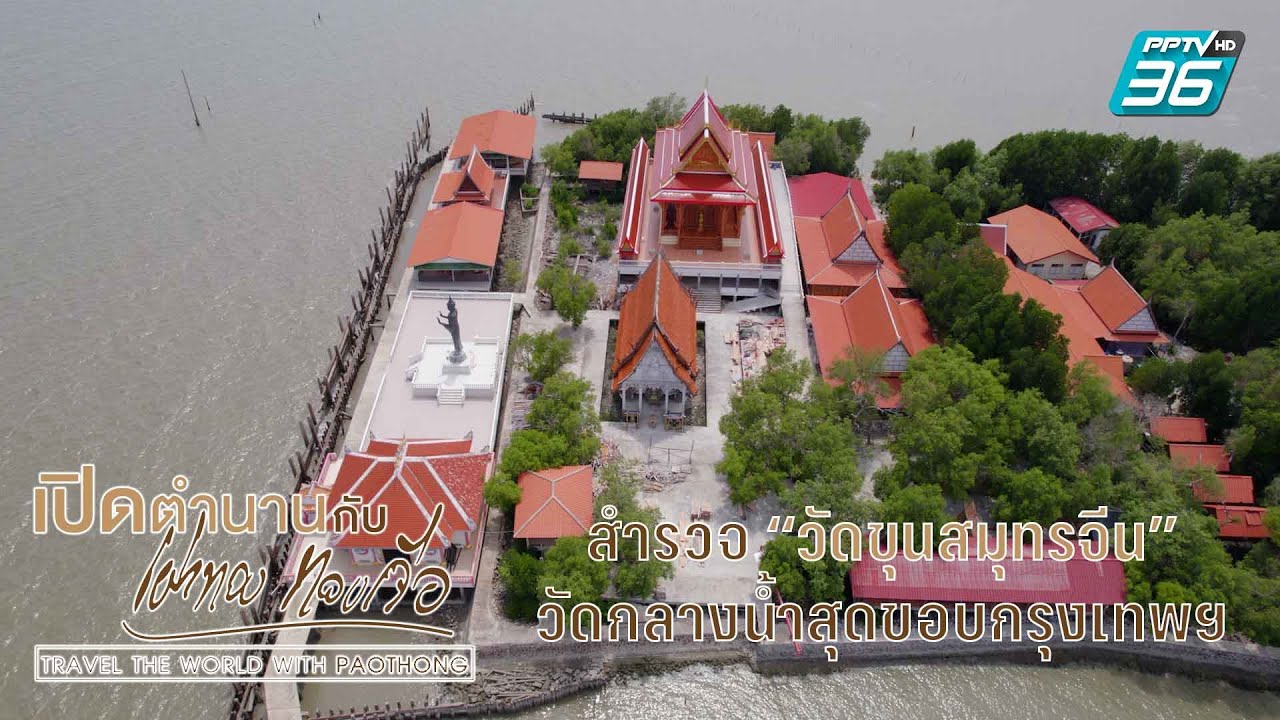
Wat Khun Samuttrawat (Wat Khun Samut Jean)

Open Days: Open Daily
Opening Hours: 06:00 AM - 05:30 PM
Wat Khun Samuttrawat is a Mahanikaya Buddhist temple in Ban Khun Samut Chin, Laem Fa Pha Subdistrict, Phra Samut Chedi District, Samut Prakan. It is one of the most distinctive temples in the province because of its extraordinary coastal setting. The temple stands on a small piece of land projecting into the Gulf of Thailand, in an area where the shoreline has been dramatically eroded over time. This makes the temple more than a religious site. It is also one of the clearest visible symbols of coastal change in Samut Prakan.
What makes the temple especially memorable is the story of the land that has disappeared into the sea. In the past, the temple grounds covered more than 76 rai, all donated by the people of Ban Khun Samut Chin. Today, only around 5 rai remain because severe coastal erosion has washed away most of the original land. That alone gives the temple a rare identity. Visitors do not come here only to make merit, but also to witness the powerful impact of the sea on a real living community.
Ban Khun Samut Chin itself is widely recognized as one of the most severely eroded coastal communities in Thailand. Visiting Wat Khun Samuttrawat therefore offers much more than a temple stop. It gives visitors direct contact with a place where religion, daily life, environmental struggle, and local resilience all meet. The temple has become one of the most meaningful landmarks in the area because it stands at the center of that story.
The temple was built on 17 July B.E. 2510, with Nai Prateuang Charoennak and Village Head Han Kengsamut leading the construction efforts. The land for the temple was donated by Nai Sa-nga Soncharoen and Nai Chalo Huadsuwan. Construction had already begun in B.E. 2505, and the Ministry of Education later officially declared it a temple on 22 August B.E. 2516. The temple was named after Ban Khun Samut Chin, the community that supported its creation. This background clearly shows that the temple grew directly out of collective faith and local commitment.
The first abbot of the temple was Luang Ta Bai. Today, the temple is under the care of Phra Khru Vinaiyathorn Somnuek, and current public temple information shows that the temple remains active with resident monks and ongoing religious activities. That matters because it confirms that Wat Khun Samuttrawat is still a living temple, not only a historical or scenic stop.
For many years, the temple has faced two constant challenges: coastal erosion and flooding. In response, the temple and local residents have worked together to protect the site. One of the most visible methods has been the use of old utility poles placed in rows to break wave energy and trap sediment, helping to rebuild small sections of land. At the same time, monks and villagers have planted mangroves to strengthen the natural coastal buffer. These efforts give the temple a very unusual role. It is not only a place of worship, but also a center of practical shoreline protection and local environmental adaptation.
The floors of the ordination hall and monk residences have been raised so that seawater does not damage them further. The ordination hall is still used for religious ceremonies, and inside it is the principal Buddha image known as Luang Pho Pak Daeng. This image is one of the temple’s most important sacred objects and is a major focus of devotion for both local residents and visitors. Many people come to the temple specifically to pay respect to Luang Pho Pak Daeng before walking out to see the surrounding coast.
Another memorable feature is the wooden pavilion by the sea, where Luang Pho To and Luang Pu Thuat are enshrined. The setting of this pavilion adds greatly to the temple’s character. It allows visitors to experience a sacred space in direct contact with sea wind and open coastal scenery, something rarely found at more inland temples. This combination of devotion and landscape is one of the strongest reasons the temple is so widely remembered.
On another side of the temple is a Chinese pavilion that enshrines Guan Yin. This gives the temple an added cultural layer and reflects the mixed devotional traditions found in many coastal communities of the Gulf of Thailand. Instead of being limited to a single visual or ritual identity, the temple brings together Thai Buddhist devotion and Chinese sacred imagery in a very natural community setting.
The overall atmosphere of Wat Khun Samuttrawat is unlike that of most temples in Samut Prakan. Reaching it already feels like a journey to the edge of the land. The approach through Ban Khun Samut Chin, the long walkway, the open sea breeze, and the visible signs of shoreline change create a very powerful sense of place. Visitors who are interested in temples, local history, coastal life, or environmental change usually find this temple far more emotionally memorable than a standard urban temple visit.
From a travel perspective, the temple is ideal for people who want to explore Samut Prakan through community and landscape, not just through its better-known monuments. It can be combined very naturally with Ban Khun Samut Chin, coastal erosion viewpoints, Phra Samut Chedi, Chulachomklao Fort, and the naval museum zone. Many visitors also choose to stay overnight in the community to experience the temple and surrounding village at a slower pace.
Getting There is easiest by private car. Visitors usually drive into the Phra Samut Chedi area and continue toward Ban Khun Samut Chin. The final part of the route requires walking along the elevated access path into the village and temple area. Another practical option is to stay at a local homestay in Ban Khun Samut Chin, which makes visiting the temple and the coastal community much easier. This is a destination best suited to slow travel rather than rushed sightseeing.
The best time to visit is in the morning through late morning or later in the afternoon, when the heat is less intense and the coastal atmosphere is more comfortable. Since the site is open to the sea and sun, visitors should allow enough time, dress appropriately, and be prepared for a walk. For those planning a one-day or overnight community-based trip, Wat Khun Samuttrawat is one of the strongest and most meaningful stops in the district.
Overall, Wat Khun Samuttrawat is a temple with exceptional identity. Its story is built from community faith, coastal loss, sacred images, and the continuing resilience of Ban Khun Samut Chin. It is one of the most distinctive temples in Samut Prakan for anyone who wants to understand the province through local life, religion, and the changing shoreline of the Gulf of Thailand.
| Name | Wat Khun Samuttrawat |
| Location | Moo 9, Ban Khun Samut Chin, Laem Fa Pha Subdistrict, Phra Samut Chedi District, Samut Prakan |
| Address | Moo 9, Ban Khun Samut Chin, Laem Fa Pha, Phra Samut Chedi, Samut Prakan 10290 |
| Highlights | A seaside temple deeply affected by coastal erosion, featuring Luang Pho Pak Daeng, a wooden seaside pavilion, Luang Pho To, Luang Pu Thuat, and a Guan Yin Chinese shrine |
| History | Construction began in B.E. 2505, the temple was built on 17 July B.E. 2510, and it was officially declared a temple on 22 August B.E. 2516 |
| Name Origin | The temple was named after Ban Khun Samut Chin, the coastal community that donated land and helped establish the temple |
| Distinctive Features | A temple at the edge of the Gulf of Thailand, with greatly reduced land due to erosion and visible community efforts to restore the shoreline with poles and mangroves |
| Travel Information | Best reached by car to Ban Khun Samut Chin, followed by walking along the access path into the community and temple area |
| Current Status | Open and active, with continuing temple activities |
| Open Days | Open Daily |
| Opening Hours | 06:00 AM - 05:30 PM |
| Fees | No entrance fee |
| Facilities | Access walkway into the community, worship areas, a wooden seaside pavilion, and walking routes around the coastal temple zone |
| Main Areas / Zones | Ordination Hall of Luang Pho Pak Daeng, Seaside Wooden Pavilion of Luang Pho To and Luang Pu Thuat, Guan Yin Chinese Pavilion, and surrounding shoreline area |
| Abbot / Caretaker | Phra Khru Vinaiyathorn Somnuek |
| Main Contact Number | 089-788-7334 |
| Official Website / Official Page | Facebook: Wat Khun Samut Trawat |
| Nearby Tourist Attractions | 1. Ban Khun Samut Chin Community 0 km. 2. Coastal Erosion Viewpoint at Ban Khun Samut Chin 1 km. 3. Phra Samut Chedi 12 km. 4. Chulachomklao Fort 14 km. 5. Naval Museum at Chulachomklao Fort 14 km. |
| Nearby Restaurants | 1. Krua Khun Samut Chin Seafood 1 km. Tel. 089-986-7400 2. Wang Kong Homestay 1 km. Tel. 099-121-2034 3. Krua Nai Tum Seafood 2 km. 4. Krua Chon Thong 5 km. 5. Rim Wang Seafood and Fishing Park 5 km. |
| Nearby Accommodations | 1. Ban Khun Samut Chin Homestay 1 km. Tel. 085-020-0024 2. Ban Khun Samut Chin Homestay, Phu Yai Samorn Kengsamut 1 km. Tel. 096-870-3867 3. Wang Kong Homestay 1 km. Tel. 099-121-2034 4. Baan Saen Sabai Phra Samut Chedi 11 km. 5. Chalermwong Kobe Hotel 12 km. |
Frequently Asked Questions (FAQ)
Q: Where is Wat Khun Samuttrawat located?
A: The temple is in Moo 9, Ban Khun Samut Chin, Laem Fa Pha Subdistrict, Phra Samut Chedi District, Samut Prakan.
Q: Why is Wat Khun Samuttrawat so well known?
A: It is famous because it stands in a coastal community severely affected by erosion, where the temple’s land has been reduced dramatically by the sea.
Q: What are the main highlights inside the temple?
A: The main highlights are Luang Pho Pak Daeng in the ordination hall, the seaside pavilion of Luang Pho To and Luang Pu Thuat, and the Guan Yin Chinese shrine.
Q: How do I get to Wat Khun Samuttrawat?
A: Most visitors drive to Ban Khun Samut Chin first and then continue on foot along the access walkway into the community and temple area.
Q: Is Wat Khun Samuttrawat open every day?
A: Yes. Publicly available visitor information shows the temple is open daily, generally from around 06:00 AM to 05:30 PM.
Q: What can I visit after Wat Khun Samuttrawat?
A: Good nearby stops include Ban Khun Samut Chin Community, the coastal erosion viewpoint, Phra Samut Chedi, Chulachomklao Fort, and the naval museum area.
 Category: ●Places of Worship
 Group: ●Temple
Last Update : 7 MonthAgo
 Last Update : 7 MonthAgo
 Click to Access the Navigation Map GPS
Wat Khun Samuttrawat (Wat Khun Samut Jean) Map
Recommend

 Art, Culture and Heritage
 Historical Sites and Monuments(2)
 Landmarks and Memorials(1)
 Art, Craft Centres, Tradition(9)
 Museums(5)
 Historic Homes and Cities(1)
Temple(30)
 Mosque(1)
 Other Sacred Sites(9)
 Suburban Living
 Local Market(1)
 Floating Market(3)
 Nature and Wildlife
 River, Canal(1)
 Bays and Beaches(2)
 Entertainment and Agricultural
 Zoos and Aquariums(1)
 Animal camps and shows(1)
 Farms, Parks and Ecotourism(1)
 Outdoor and Adventure Activities(1)
 Travel Articles, Recipes
 Travel Review, Food Review(1)


