
lovethailand home >Central Travel Attractions >Pathum Thani Travel Attractions >Sam Khok >Bang Toei > Shinawatra University (Pathum Thani Campus)
TL;DR: Shinawatra University (Pathum Thani Campus) is located at 99 Moo 10, Bang Toei Subdistrict, Sam Khok District, Pathum Thani Province 12160, Thailand, open Monday – Friday (Published Office Working Schedule), hours 08:00 – 17:00.
Shinawatra University (Pathum Thani Campus)
Open Days: Monday – Friday (Published Office Working Schedule)
Opening Hours: 08:00 – 17:00
Shinawatra University, Pathum Thani Campus, is the main campus of Shinawatra University (SIU), a private higher education institution in Thailand recognized for its international academic orientation, innovation, management, technology, and research. Located at 99 Moo 10, Bang Toei Subdistrict, Sam Khok District, Pathum Thani Province 12160, the campus occupies approximately 300 rai, or 48 hectares, surrounded by landscaped green spaces, distinctive modern buildings, and a predominantly agricultural environment. The university originated from an educational initiative developed in 1996 by Thaksin Shinawatra and Professor Dr. Purachai Piumsombun. It officially received permission to operate on December 27, 1999, and welcomed its first students in September 2002. The institution was renamed Metharath University in 2022 before returning to the name Shinawatra University on February 19, 2024. Today, its Pathum Thani campus continues to serve as the university's principal academic location, supporting higher education, research, and international academic cooperation.
Shinawatra University's main campus offers a setting that differs significantly from universities located in crowded urban districts. Its location in Sam Khok places it within an area historically associated with agricultural land, waterways, and the communities of the Chao Phraya River basin. Rather than occupying a compact city-center site, the university was developed as a spacious educational environment with academic buildings, student residences, recreational facilities, and landscaped grounds arranged across a substantial area.
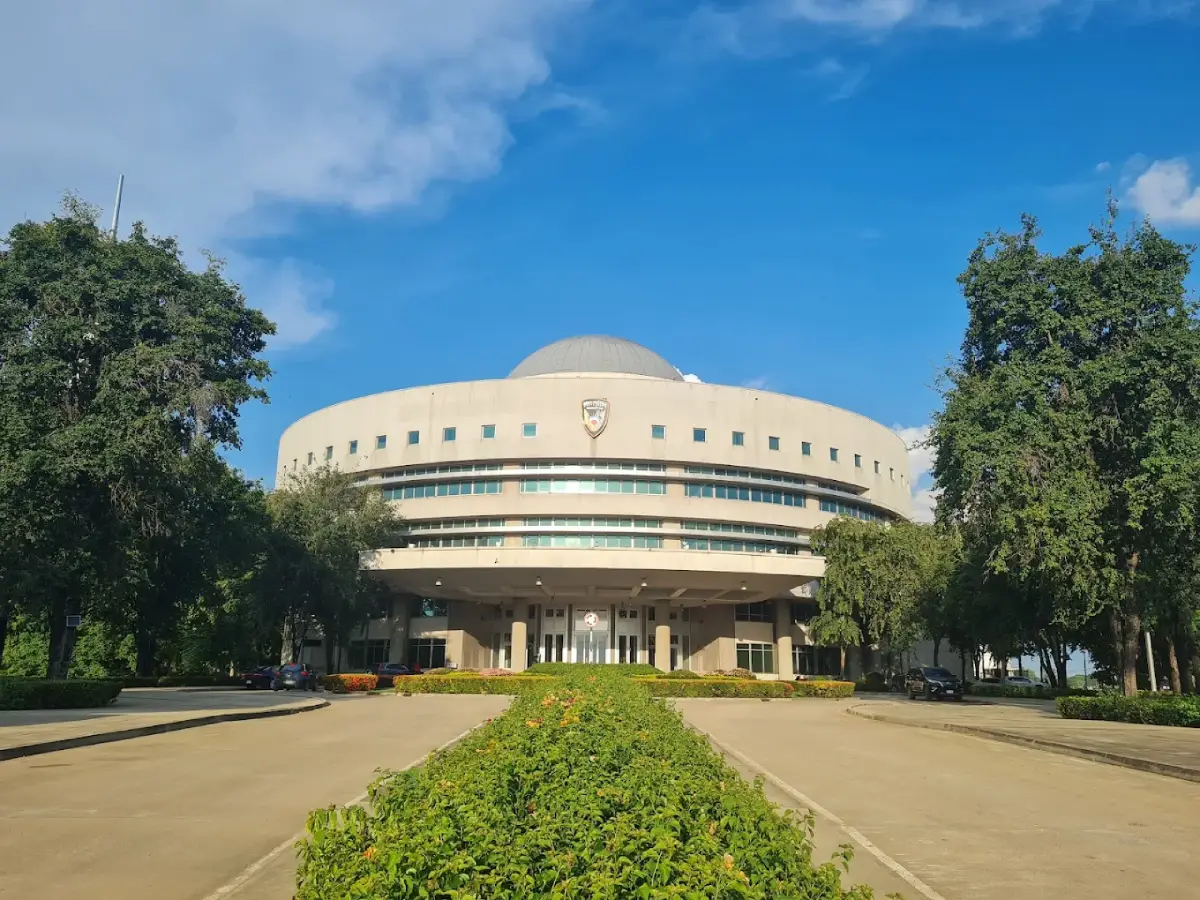
One of the campus's most recognizable characteristics is its modern architecture, particularly the large circular buildings and curved structures that distinguish it from conventional university campuses. The pale-colored buildings, landscaped lawns, water features, and elevated connecting walkways create a visual identity closely associated with Shinawatra University. These elements make the campus interesting not only as an educational institution but also as an example of contemporary campus planning and environmentally conscious architectural design in Thailand.
The history of Shinawatra University began in 1996 with an initiative by Thaksin Shinawatra and Professor Dr. Purachai Piumsombun to establish a private university capable of supporting human resource development in Thailand and neighboring countries. Their educational vision reflected a growing need for graduates with knowledge of management, technology, entrepreneurship, leadership, and international business. At a time when digital communication and economic globalization were transforming professional life, the proposed university was intended to provide an education relevant to a rapidly changing world.
Another important figure in the university's early development was Dr. Soontorn Boonyatikarn, whose work contributed to the concept of developing a university campus in harmony with its environment. His architectural approach emphasized the relationship between building design, climatic conditions, energy use, and human comfort. This helped establish the principle that the physical campus should function as more than a collection of classrooms: it should be an integrated environment that supports learning, daily life, and the responsible use of resources.
Following the planning and establishment process, OAI Education Company Limited received authorization from Thailand's Ministry of University Affairs to establish Shinawatra University on December 27, 1999. This date represents the university's formal legal establishment and serves as the reference point for calculating its institutional age. The university subsequently developed its governance arrangements, facilities, academic programs, and administrative systems in preparation for its first intake of students.
The first meeting of the Shinawatra University Council took place on May 19, 2000, with Professor Dr. Purachai Piumsombun serving as the university's first president. The university admitted its first group of students in September 2002, marking the transition from an institutional development project to an operating university. These early years were essential in establishing the academic framework, professional staffing, and student services that would support the institution's subsequent growth.
In its initial years, Shinawatra University emphasized disciplines associated with business administration, management, information technology, and international education. Its educational philosophy promoted the application of academic knowledge to practical challenges, the development of entrepreneurial capabilities, and the preparation of graduates for international professional environments. This direction reflected the growing importance of information technology, communication systems, and cross-border economic relationships during the early twenty-first century.
The university also sought to create an academic environment accessible to students from different countries. International programs and multicultural learning have been important aspects of its institutional identity. Studying in an international environment can help students improve their communication skills, develop intercultural awareness, and gain experience working with people from different educational and social backgrounds.
A significant administrative development occurred in 2021 when the university's license holder was changed to Faith Star (Thailand) Company Limited, according to the university's educational development plan. On October 25, 2022, Shinawatra University officially changed its name to Metharath University. This was an institutional name change rather than the establishment of an entirely new university, and the original authorization date of December 27, 1999, remained an important part of the institution's history.
Another major milestone occurred in 2024 when Thailand's Ministry of Higher Education, Science, Research and Innovation authorized Metharath University to restore its former name, Shinawatra University. The change took effect on February 19, 2024, and the relevant ministerial announcement was published in the Royal Thai Government Gazette on March 6, 2024. As a result, Shinawatra University became the official name of the institution once again.
The university's historical development can therefore be understood through several distinct dates: 1996 marks the original establishment initiative; 1999 marks its formal authorization; 2002 marks the beginning of teaching activities; 2022 marks the change to Metharath University; and 2024 marks the restoration of the Shinawatra University name. Distinguishing these milestones provides a clearer understanding of the university's institutional continuity and its development over time.
Three individuals hold particular importance in the university's early history. Thaksin Shinawatra contributed to the founding initiative, Professor Dr. Purachai Piumsombun participated in establishing the university and became its first president, and Dr. Soontorn Boonyatikarn contributed to the architectural and environmental development of the campus. Their roles represent three different aspects of the university's foundation: educational vision, institutional management, and campus design.
The university's name is directly associated with its founding initiative, while the English name Shinawatra University and the abbreviation SIU are used in academic documents and international communications. The institution's historical emblem is described as a shield-shaped symbol associated with the sun, representing the pursuit of knowledge, intellectual development, innovation, and ethical responsibility. Older institutional descriptions also identify gray, green, and orange as the university's colors and the salacca palm as its symbolic tree. Current applications of the university emblem and other official identity elements should follow the versions authorized by the institution.
Shinawatra University's educational vision emphasizes international engagement, leadership, management, entrepreneurship, innovation, and social responsibility. These principles are reflected in its Educational Development Plan for 2024–2028, which establishes strategic directions for academic program improvement, research, community services, arts and cultural activities, and institutional administration. The plan also addresses the importance of adapting higher education to changing economic, social, and technological conditions.
The Pathum Thani campus is especially notable for its extensive landscaped setting. The university's published development plan identifies the main site as covering approximately 300 rai in Bang Toei, Sam Khok, surrounded by agricultural land, particularly rice-growing areas. This environment gives the university a different atmosphere from densely developed city campuses, allowing educational buildings, student accommodation, sports facilities, and open spaces to coexist within a planned setting.
The architectural concept is closely associated with Dr. Soontorn Boonyatikarn's approach to environmental design, which considers climatic responsiveness, energy use, and the relationship between buildings and their surroundings. The university's distinctive geometry and interconnecting walkways are therefore significant not merely as visual features but also as elements of a broader architectural plan intended to accommodate different academic and everyday functions.
The large circular academic buildings, with their curved facades and dome-like roof structures, have become recognizable images of Shinawatra University. The scale and geometry of these buildings distinguish them from conventional rectangular classroom blocks, while the connecting pedestrian structures help establish relationships between different parts of the campus. In combination with trees, lawns, and water features, the architecture provides an interesting example of modern university design in Thailand.
According to the university's development plan, the General Learning Building has approximately 13,693 square meters of floor area. It contains classrooms accommodating groups of around 20 to 50 students as well as larger rooms designed for approximately 150 to 180 students. Facilities include computer laboratories, specialized teaching laboratories, meeting rooms of different sizes, and individual and group study areas. These spaces support different learning methods, ranging from conventional lectures to collaborative activities and independent research.
The Combined Laboratory Building occupies approximately 6,977 square meters and provides facilities for fundamental scientific subjects such as physics, chemistry, and biology. It also includes specialized practical learning spaces, including nursing laboratories. Laboratory facilities are an essential part of education in science and professional disciplines because they enable students to apply theoretical knowledge, develop technical skills, and understand procedures related to safe professional practice.
The university library is located on the fifth and sixth floors of the General Learning Building, according to the university's published development plan. Covering approximately 800 square meters, the library provides areas for reading, academic research, group work, meetings, and electronic information searches. Its services include a digital library system, electronic books, academic databases, and resources intended to support teaching, learning, and research across the university's academic disciplines.
Access to academic information is particularly important in higher education because students and researchers must consult reliable books, scholarly journals, and research materials. The university's development plan identifies information resources covering areas such as business, education, computer science, healthcare, political science, and environmental studies. The university also describes English-language self-learning resources designed to help students strengthen the language skills needed for international academic work.
Student welfare and accommodation are also important features of the main campus. The university provides separate male and female dormitories, dining facilities, a nursing room, and recreational areas. These services are particularly useful for students arriving from other Thai provinces or overseas, as accommodation and everyday facilities within the campus can help reduce travel difficulties and support participation in academic and extracurricular activities.
Sports facilities contribute to the university's emphasis on student development and quality of life. The campus includes a two-story gymnasium covering approximately 1,830 square meters, along with outdoor activity areas totaling around 80,000 square meters. Facilities described in the university's development plan include a standard football field, basketball courts, and tennis courts. These spaces support exercise, recreation, organized sporting activities, and social interaction among students and university personnel.
Campus management also includes measures concerning safety and building maintenance. The university's development plan describes security personnel, surveillance systems, building inspections, and emergency preparation activities. Such arrangements are important for an educational institution that accommodates students, teachers, staff, and visitors across a large campus with teaching facilities, laboratories, and residential buildings.
In terms of academic organization, Shinawatra University's Educational Development Plan for 2024–2028 identifies nine faculties and one Academy of Arts and Philosophy. The academic areas include management, public administration and law, liberal arts, nursing, education, engineering and technology, health sciences, economics, psychology, and arts and philosophy. This structure reflects the university's development from an institution strongly associated with business and technology into one whose published academic portfolio encompasses a wider range of professional, scientific, social science, and creative disciplines.
The Faculty of Management covers academic areas associated with business administration, organizational management, international trade, marketing, logistics and supply chain management, human resources, accounting, and information management. These fields are relevant to the development of administrators, entrepreneurs, and professionals working in domestic and international business environments. The broader objective is to connect management knowledge with practical organizational challenges and economic development.
Public administration and law address subjects related to government organization, legal systems, public policy, political science, and administrative decision-making. These disciplines contribute to understanding the relationships between institutions, law, society, and governance. Meanwhile, liberal arts programs include fields associated with creative design, visual communication, digital animation, music education, and other artistic disciplines, reflecting the increasing interaction between the creative economy and digital technologies.
The Faculty of Nursing is an important part of the university's professional education portfolio. Nursing education involves scientific knowledge, practical clinical skills, patient care, health promotion, and professional ethics. The availability of nursing laboratories within the university's Combined Laboratory Building supports practical learning and the development of professional competencies. Nursing education also emphasizes communication, responsible decision-making, and cooperation with other healthcare professionals.
The Faculty of Education addresses topics such as educational administration, teaching methods, early childhood education, language teaching, and professional preparation for educational personnel. These areas are relevant to the development of teachers, educational administrators, and researchers who must understand contemporary educational systems and respond to changing learning environments. The university's published program list includes educational studies at undergraduate, postgraduate diploma, master's, and doctoral levels.
Engineering and technology are represented in the university's development plan through subjects such as mechanical engineering, safety engineering, project management, artificial intelligence, and network security. These fields relate to contemporary technological and industrial requirements, particularly the importance of digital systems, engineering competence, and secure information infrastructure. The university's academic portfolio also includes economics and psychology, disciplines that contribute to the study of economic systems, human behavior, and social development.
Health sciences and the Academy of Arts and Philosophy further illustrate the diversity of the university's published academic interests. Health-related subjects include public health, elderly care, and selected healthcare technologies, while the arts and philosophy portfolio includes fine arts, design, performing arts communication, cultural studies, and intangible cultural heritage. These disciplines provide opportunities for interdisciplinary research and the exchange of knowledge across scientific, professional, and creative fields.
International academic cooperation forms another part of Shinawatra University's educational direction. The university has presented initiatives related to transnational education and international learning partnerships. These activities are connected to its wider goal of preparing students for a global academic and professional environment, encouraging cross-cultural interaction and creating opportunities for cooperation between educational institutions in different countries.
Research is one of the university's central institutional missions. Its educational development plan emphasizes basic research, applied research, creative work, and academic activities that can benefit communities and society. The plan also promotes cooperation with external organizations and the development of research activities relevant to national and international needs. Such approaches seek to connect academic knowledge with economic, social, and technological development.
Academic services and the preservation of arts and culture also form part of the university's responsibilities. Its development plan outlines objectives involving community academic services, cultural exchange, creative activities, and the integration of cultural knowledge with teaching and research. These objectives are particularly relevant in an international university environment, where students from different backgrounds can engage with Thai cultural traditions while sharing knowledge of their own communities.
Student development extends beyond formal classroom education. The university's published strategies address extracurricular activities, sports, counseling, student welfare, and alumni relations. These areas contribute to a broader understanding of university life, in which the educational experience includes opportunities to develop interpersonal abilities, responsibility, independent thinking, and professional relationships.
Traditional Thai academic activities, such as Wai Khru ceremonies and new-student orientation, provide useful cultural context for understanding university life in Thailand. However, the organization and scheduling of individual activities at Shinawatra University depend on its annual academic calendar and official announcements. Visitors and prospective students interested in participating should consult the university's current event information rather than relying on historical schedules.
For those interested in educational tourism and architecture, Shinawatra University's Pathum Thani campus provides an opportunity to examine the relationship between campus planning, modern building design, and environmental conditions. Its circular buildings, elevated pedestrian connections, landscaped areas, and extensive grounds demonstrate how an educational campus can be designed as a coordinated physical environment rather than as a collection of unrelated structures.
Nevertheless, Shinawatra University is an operating educational institution, not a conventional public tourist attraction. Access to classrooms, laboratories, student residences, and restricted academic facilities is subject to university regulations. Individuals or groups wishing to arrange a study visit, architectural observation, or institutional tour should contact the university in advance and obtain permission from the responsible administrative office.
The surrounding Sam Khok District provides opportunities to learn about the cultural history of Pathum Thani Province. The district has long-standing connections with Mon communities, Buddhist temples, agricultural traditions, and the Chao Phraya River. Visitors with sufficient time can combine university-related activities with visits to nearby temples, local restaurants, and heritage areas. These destinations offer a broader introduction to the history and everyday life of communities north of Bangkok.
Getting There is most convenient by private car or hired vehicle. The university is located in Bang Toei Subdistrict, Sam Khok District, Pathum Thani Province, and can be approached through the Kanchanaphisek Road corridor and roads connecting with the Pathum Thani–Sam Khok–Sena route. Travelers departing from Bangkok should enter “Shinawatra University Main Campus” or “Shinawatra University Pathum Thani” into their navigation application to avoid confusion with the university's Bangkok academic location.
Public transportation may also be used to reach the wider Pathum Thani area, although travelers may need to continue to the campus by taxi or local hired vehicle. As the university is situated in a suburban and partly agricultural setting, planning the final stage of the journey in advance is advisable. Visitors traveling for examinations, admissions, academic meetings, or other scheduled events should allow sufficient time to reach the campus.
For administrative inquiries, published university-related working schedules indicate Monday to Friday, 08:00 to 17:00. These hours are associated with office work and should not be interpreted as the opening hours of every academic building, classroom, laboratory, or visitor facility. Anyone planning an appointment, application visit, study tour, or special activity should call the university at +66 2 599 0000 to confirm the appropriate contact hours and access arrangements.
Shinawatra University's Pathum Thani campus represents an important example of private higher education development in Thailand. Its history extends from the founding initiative in 1996 and formal establishment in 1999 to the start of academic operations in 2002 and the restoration of its original name in 2024. The combination of international education, research, distinctive architecture, and a spacious environmentally oriented campus makes it a notable educational institution in Pathum Thani Province and an interesting case study in the relationship between higher education, architectural planning, and social development.
| University Name | Shinawatra University, Pathum Thani Main Campus |
| Thai Name | มหาวิทยาลัยชินวัตร วิทยาเขตปทุมธานี |
| Institution Type | Private University |
| Address | 99 Moo 10, Bang Toei Subdistrict, Sam Khok District, Pathum Thani Province 12160, Thailand |
| Campus Location | Sam Khok District, Pathum Thani Province |
| Campus Area | Approximately 300 Rai (48 Hectares) |
| Founding Initiative | 1996 |
| Official Establishment Date | December 27, 1999 |
| First Student Intake | September 2002 |
| Former Name (2022–2024) | Metharath University |
| Restoration Of Shinawatra University Name | February 19, 2024 |
| Institutional Age As Of November 1, 2026 | 26 Years Since Formal Establishment |
| Key Historical Figures | Thaksin Shinawatra, Professor Dr. Purachai Piumsombun And Dr. Soontorn Boonyatikarn |
| First University President | Professor Dr. Purachai Piumsombun |
| Historical Emblem | Shield-Shaped Symbol Associated With The Sun And The Pursuit Of Knowledge |
| Historically Published University Colors | Gray, Green And Orange |
| Historically Published Symbolic Tree | Salacca Palm |
| Distinctive Features | Circular Academic Buildings, Modern Architecture, Extensive Green Spaces And Environmentally Oriented Campus Design |
| Academic Focus | International Education, Business And Management, Technology, Liberal Arts, Health Sciences, Education, Economics And Interdisciplinary Research |
| Academic Units Listed In The 2024–2028 Development Plan | Faculty Of Management; Faculty Of Public Administration And Law; Faculty Of Liberal Arts; Faculty Of Nursing; Faculty Of Education; Faculty Of Engineering And Technology; Faculty Of Health Sciences; Faculty Of Economics; Faculty Of Psychology; Academy Of Arts And Philosophy |
| Other Published Academic Location | Bangkok Academic Location At The BBD Building, Vibhavadi Rangsit Road, According To The University Development Plan |
| Important Campus Facilities | General Learning Building, Combined Laboratory Building, Library, Student Dormitories, Gymnasium And Outdoor Activity Areas |
| Student Facilities | Classrooms, Computer And Science Laboratories, Digital Library, Dining Facilities, Student Accommodation, Nursing Room, Football Field, Basketball Courts And Tennis Courts |
| Published Office Working Days | Monday – Friday |
| Published Office Working Hours | 08:00 – 17:00 |
| Campus Visits | Advance Permission Required For Academic Buildings, Laboratories And Restricted Areas |
| Getting There | Private Car Or Hired Vehicle Via The Kanchanaphisek Road Corridor And Connecting Roads To Sam Khok District |
| Nearby Attractions In Sam Khok | 1. Wat Bot (Sam Khok) 2. Wat Sing 3. Wat Surat Rangsan 4. Wat Pa Phuritatta Pattipatharam 5. Wat Thua Thong |
| Restaurants And Cafés In Sam Khok | 1. Pad Thai Goong Sod Nai Suan 2. Flourist Matchahouse Cafe 3. The Gardener Cafe 4. Elvis Suki3 5. Baan Keangnam Restaurant |
| Accommodation In Sam Khok | 1. The Pine Resort 2. Pan Ville Resort 3. Klong Sa Resort 4. IngNatee Resort 5. River View Pathum Hotel & Residence |
| Telephone | +66 2 599 0000 |
| Official Website | https://siu.ac.th/ |
| Current Institutional Status | Operating Under The Name Shinawatra University, With Its Main Campus In Pathum Thani Province |
Shinawatra University Academic Programs Listed In The 2024–2028 Educational Development Plan (Program Register Dated June 30, 2024)
| Faculty / Academic Unit | Published Programs And Fields Of Study |
| Faculty Of Management | Undergraduate And Other Listed Programs 1. Bachelor Of Business Administration In Management (International Program) 2. Bachelor Of Business Administration In International Trade (International Program) 3. Bachelor Of Business Administration In Accounting And Finance (International Program) 4. Bachelor Of Business Administration In Marketing (International Program) 5. Bachelor Of Business Administration In Logistics And Supply Chain Management (International Program) 6. Bachelor Of Business Administration In Human Resource Management (International Program) 7. Graduate Management Program In Information Management And Information Systems (International Program, As Designated In The Published Register) 8. Bachelor Of Accountancy In Accounting Master's Level 9. Master Of Business Administration In Management (International Program) 10. Master Of Business Administration In Management 11. Master Of Management In Information Resource Management (International Program) Doctoral Level 12. Doctor Of Philosophy In Management (International Program) 13. Doctor Of Philosophy In Innovation In Business Administration And Politics |
| Faculty Of Public Administration And Law | Bachelor's Level 1. Bachelor Of Laws 2. Bachelor Of Public Administration Master's Level 3. Master Of Political Science 4. Master Of Public Administration Doctoral Level 5. Doctor Of Political Science 6. Doctor Of Public Administration |
| Faculty Of Liberal Arts | Bachelor's Level 1. Bachelor Of Arts In Digital Animation (International Program) 2. Bachelor Of Arts In Art And Design (International Program) 3. Bachelor Of Arts In Product Design (International Program) 4. Bachelor Of Arts In Music Education (International Program) Master's Level 5. Master Of Education In Music (International Program) 6. Master Of Education In Fine Arts (International Program) 7. Master Of Communication Arts In Journalism And Communication (International Program) Doctoral Level 8. Doctor Of Philosophy In Music Education (International Program) 9. Doctor Of Philosophy In Journalism And Communication (International Program) |
| Faculty Of Nursing | Bachelor's Level 1. Bachelor Of Nursing Science 2. Bachelor Of Nursing Science (International Program) |
| Faculty Of Education | Bachelor's Level 1. Bachelor Of Education In Early Childhood Education (International Program) 2. Bachelor Of Education In Educational Management (International Program) 3. Bachelor Of Education In Physical Education (International Program) 4. Bachelor Of Education In Early Childhood Education 5. Bachelor Of Education In English Teaching Graduate Diploma 6. Graduate Diploma In Teaching Profession Master's Level 7. Master Of Education (International Program) 8. Master Of Education In Educational Administration (International Program) 9. Master Of Education In Educational Administration 10. Master Of Education In Physical Education And Sports Management (International Program) 11. Master Of Education In English Teaching Doctoral Level 12. Doctor Of Philosophy In Education (International Program) 13. Doctor Of Philosophy In Educational Administration (International Program) 14. Doctor Of Philosophy In Educational Administration 15. Doctor Of Philosophy In Physical Education And Sports Management (International Program) 16. Doctor Of Philosophy In Chinese Language Teaching (International Program) 17. Doctor Of Philosophy In English Teaching |
| Faculty Of Engineering And Technology | Bachelor's Level 1. Bachelor Of Engineering In Safety Engineering 2. Bachelor Of Science In Project Management (International Program) 3. Bachelor Of Engineering In Mechanical Engineering Master's Level 4. Master Of Science In Project Management (International Program) 5. Master Of Science In Artificial Intelligence And Network Security (International Program) Doctoral Level 6. Doctor Of Philosophy In Artificial Intelligence And Network Security (International Program) |
| Faculty Of Health Sciences | Professional And Undergraduate Programs 1. Doctor Of Chiropractic Program (International Program) 2. Graduate Program In Traditional Chinese Medicine (International Program) 3. Bachelor Of Science In Beauty Business Management (International Program) Master's Level 4. Master Of Public Health (International Program) 5. Master Of Science In Elderly Care Science (International Program) 6. Master Of Science In Assisted Reproductive Technology (International Program) Doctoral Level 7. Doctor Of Philosophy In New Normal Public Health Administration (International Program) 8. Doctor Of Philosophy In Elderly Health Management Technology (International Program) 9. Doctor Of Philosophy In Assisted Reproductive Technology (International Program) |
| Faculty Of Economics | Master's Level 1. Master Of Economics (International Program) Doctoral Level 2. Doctor Of Economics (International Program) |
| Faculty Of Psychology | Master's Level 1. Master Of Science In Psychology (International Program) Doctoral Level 2. Doctor Of Philosophy In Psychology (International Program) |
| Academy Of Arts And Philosophy | Master's Level 1. Master Of Fine Arts In Fine Arts And Design (International Program) 2. Master Of Arts In Performing Arts Communication (International Program) 3. Master Of Arts In Intangible Cultural Heritage (International Program) Doctoral Level 4. Doctor Of Philosophy In Semiotics And Cultural Studies (International Program) 5. Doctor Of Philosophy In Performing Arts Communication (International Program) 6. Doctor Of Philosophy In Fine Arts And Design (International Program) 7. Doctor Of Philosophy In Intangible Cultural Heritage (International Program) |
Frequently Asked Questions (FAQ)
Q: Where is Shinawatra University's Pathum Thani Campus located?
A: The main campus is located at 99 Moo 10, Bang Toei Subdistrict, Sam Khok District, Pathum Thani Province 12160, Thailand.
Q: What are the opening days and hours of Shinawatra University?
A: Published university-related office working schedules indicate Monday to Friday, 08:00 to 17:00. Visitors should contact the university on +66 2 599 0000 to confirm the appropriate office hours before traveling.
Q: When was Shinawatra University founded?
A: The university was officially authorized on December 27, 1999, following an establishment initiative beginning in 1996. Its first students were admitted in September 2002.
Q: Who founded Shinawatra University?
A: Thaksin Shinawatra and Professor Dr. Purachai Piumsombun played important roles in establishing the university, while Dr. Soontorn Boonyatikarn contributed to the architectural and environmental planning of the campus.
Q: Why was Shinawatra University previously called Metharath University?
A: The institution changed its name to Metharath University on October 25, 2022, before restoring the Shinawatra University name with effect from February 19, 2024, under a ministerial announcement.
Q: What makes Shinawatra University distinctive?
A: The university is associated with international education, management, technology, research, and distinctive environmentally oriented architecture, including circular buildings and extensive landscaped grounds.
Q: What faculties and programs does Shinawatra University offer?
A: Its 2024–2028 Educational Development Plan identifies academic areas including management, law, liberal arts, nursing, education, engineering and technology, health sciences, economics, psychology, and arts and philosophy. The published program register is dated June 30, 2024; applicants should consult the latest admissions announcements to identify programs accepting students in the 2026 academic year.
Q: Can visitors enter Shinawatra University's campus?
A: Visits to teaching buildings, laboratories, student accommodation, and other restricted areas require appropriate permission. For study visits or campus access arrangements, contact the university at +66 2 599 0000.
 Category: ●University
 Group: ●Private University
Last Update : 2 DayAgo
 Last Update : 2 DayAgo

 Click to Access the Navigation Map GPS
Shinawatra University (Pathum Thani Campus) Map
Recommend

 Art, Culture and Heritage
 Historical Sites and Monuments(2)
 Landmarks and Memorials(1)
 Art, Craft Centres, Tradition(2)
 Museums(11)
 Art Gallery(1)
 Educational Places
 Museum for Study(1)
 Library(1)
 Training Center(1)
 Public university(2)
 Rajamangala University of Technology(1)
 Rajabhat University(1)
Private University(7)
 Places of Worship
 Temple(44)
 Mosque(1)
 Other Sacred Sites(1)
 Research and Development
 Royal Project(1)
 Suburban Living
 Local Market(2)
 Floating Market(3)
 Nature and Wildlife
 River, Canal(1)
 Entertainment and Agricultural
 Animal camps and shows(1)
 Stadium(2)
 Amusement Park(1)
 Waterpark(1)
 Travel Articles, Recipes
 Travel Review, Food Review(1)


