
lovethailand home >North Travel Attractions >Kamphaeng Phet Travel Attractions >Muang Kamphaeng Phet >Nakhon Chum > Kamphaengphet Rajabhat University
TL;DR: Kamphaengphet Rajabhat University is located at Nakhon Chum Subdistrict, Mueang Kamphaeng Phet District, Kamphaeng Phet Province, Thailand.

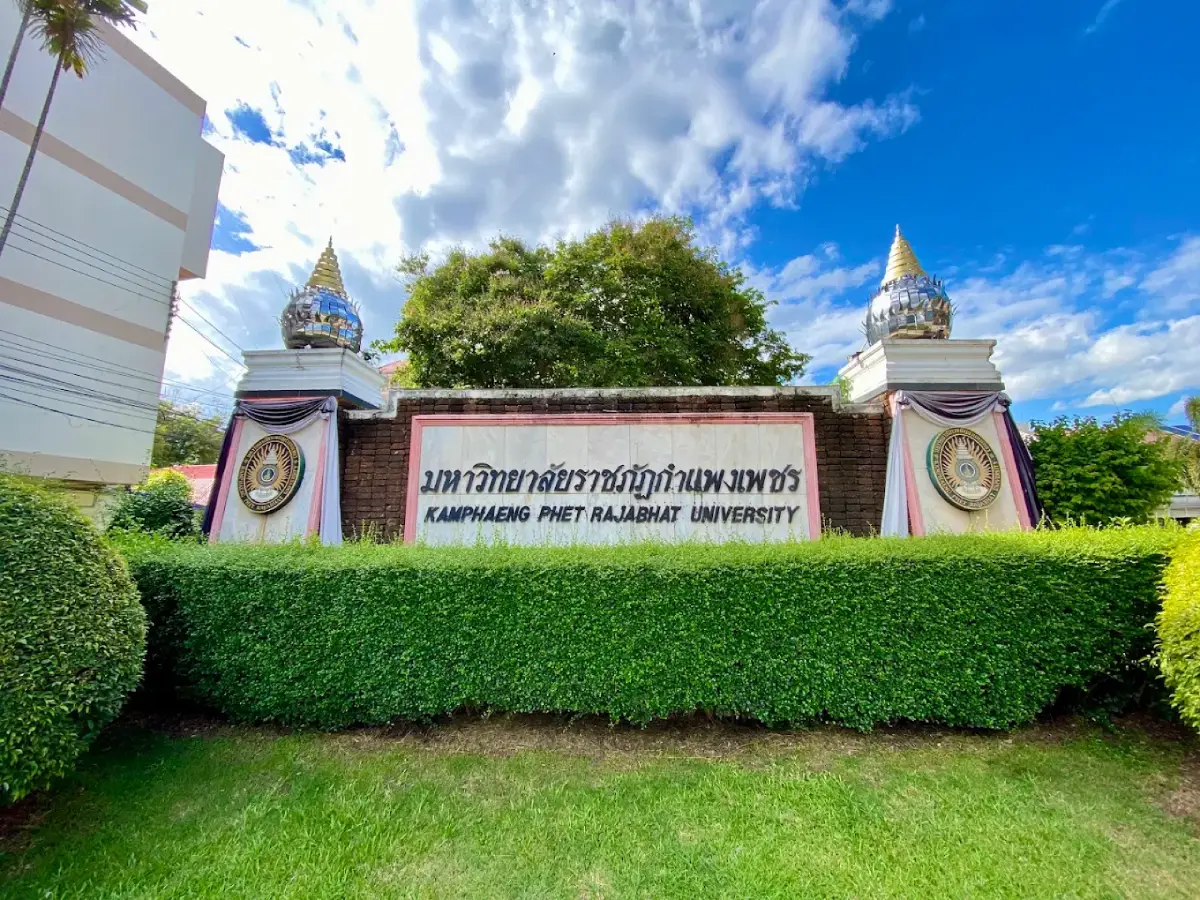
Kamphaengphet Rajabhat University
Open Days (Administrative Offices): Monday – Friday (Closed on Public Holidays)
Opening Hours (Administrative Offices): 08:30 – 16:30
Kamphaeng Phet Rajabhat University (KPRU) is a public university in northern Thailand with an educational history spanning more than five decades. Located at 69 Moo 1, Nakhon Chum Subdistrict, Mueang Kamphaeng Phet District, Kamphaeng Phet Province 62000, the institution was founded on September 29, 1973, as Kamphaeng Phet Teachers College. It subsequently became Kamphaeng Phet Rajabhat Institute before gaining university status on June 15, 2004. Today, KPRU plays an important role in teacher education, professional training, research, innovation, community development, and the preservation of Thai arts and culture. Its educational mission extends beyond Kamphaeng Phet Province to Tak Province and surrounding areas, supporting both academic advancement and sustainable regional development.
The university is situated in the Wang Yang community of Nakhon Chum Subdistrict, on an original campus covering approximately 421 rai and 58 square wah. Its grounds include academic buildings, laboratories, educational resource facilities, a student activity center, administrative offices, sports facilities, landscaped grounds, and water features. The green spaces and lakeside environment contribute to a calm atmosphere suited to academic study and student life. Its location near the Ping River and the historic Nakhon Chum community also connects the university to the cultural heritage and development of Kamphaeng Phet.
Kamphaeng Phet Rajabhat University is more than an institution awarding academic degrees. It functions as a regional center for knowledge creation, professional development, and collaboration with local communities. Its activities include educating teachers, supporting entrepreneurship, studying local wisdom, strengthening community economies, and working with local administrative organizations. These responsibilities reflect the distinctive mission of Thailand's Rajabhat universities, which emphasize higher education in the service of local and regional development.
The history of KPRU is closely connected with Thailand's efforts to expand educational opportunities beyond major cities. During the early years of the institution, access to teacher-training colleges and higher education remained limited for many residents of provincial communities. Establishing a teachers college in Kamphaeng Phet helped address the need for qualified teachers while giving students from Kamphaeng Phet, Tak, and neighboring provinces more opportunities to pursue education closer to home.
On September 29, 1973, the Thai Cabinet approved the establishment of Kamphaeng Phet Teachers College under the Department of Teacher Education. The college was founded at Wang Yang Village, Moo 1, Nakhon Chum Subdistrict, Mueang Kamphaeng Phet District. This date is recognized as the official establishment of the institution and continues to be commemorated as the university's anniversary.
The college was established through government policy and the work of the Department of Teacher Education rather than by a single individual founder. Its original purpose was to train educational personnel capable of meeting the growing demand for teachers in provincial schools. The establishment of a local teacher-training institution helped reduce geographical barriers and supported the expansion of educational opportunities for young people in surrounding communities.
In 1975, the Teachers College Act B.E. 2518 (1975) elevated Thailand's teachers colleges to the status of higher education institutions under the Ministry of Education. This development strengthened Kamphaeng Phet Teachers College's place within the national higher education system and formally recognized its responsibility for preparing teachers and educational professionals with the qualifications required by their profession.
During the 1976 academic year, Kamphaeng Phet Teachers College admitted its first regular group of 392 students to the Certificate in Education program, known in Thai as Por Kor Sor. These students were selected through local subdistrict councils in Kamphaeng Phet and Tak provinces. The first intake was an important achievement because it marked the beginning of the college's practical contribution to the preparation of teachers for regional schools.
Teacher training during this period combined subject knowledge with professional educational studies. Students learned about teaching methods, educational psychology, assessment, classroom practice, and school-related responsibilities. The aim was not simply to provide academic qualifications, but to prepare graduates to apply their knowledge in schools and contribute to the educational development of their communities.
A significant change occurred in 1984 with the introduction of the second amendment to the Teachers College Act. This legislation allowed teachers colleges to offer programs beyond the teaching profession. For Kamphaeng Phet Teachers College, the change opened the way to broader academic development and the introduction of fields responding to the professional needs of the region, including science, humanities, social sciences, and other career-oriented subjects.
In the 1986 academic year, the college began admitting students through its in-service education program, known as Kor Sor Bor Por. This initiative extended higher educational opportunities to individuals already employed in teaching and other professions. It allowed working personnel to develop their academic qualifications and professional abilities while maintaining their careers, reinforcing the institution's role in lifelong learning and regional workforce development.
On February 14, 1992, King Bhumibol Adulyadej graciously bestowed the name Rajabhat Institute upon 36 teachers colleges across Thailand. The term Rajabhat conveys a relationship with royal service and the responsibility to serve the country. Its adoption marked an important moment in the institutional identity of the colleges, emphasizing the values of knowledge, integrity, service, and responsibility toward society.
On January 25, 1995, Kamphaeng Phet Teachers College officially became Kamphaeng Phet Rajabhat Institute under the Rajabhat Institute Act B.E. 2538 (1995). This legal transformation expanded the institution's academic responsibilities and administrative structure. It provided a stronger foundation for offering higher education in multiple disciplines and developing curricula that reflected the evolving needs of local communities.
During the Rajabhat Institute period, academic activities expanded beyond traditional teacher training. The institution developed programs associated with business, management, technology, education, and local development. In the 1998 academic year, it admitted its first group of students to a special graduate program leading to a Master of Education in Educational Administration. This marked an important transition toward advanced academic study and the preparation of professionals with specialized knowledge.
One of the institution's most significant contributions to educational access was its expansion into Mae Sot District in Tak Province. In the 2000 academic year, special-program students began studying at a learning center established at Sapphawitthayakhom School in Mae Sot. In 2001, a regional higher education center was established on approximately 600 rai of land in Mae Pa Subdistrict, Mae Sot District, and the first regular cohort of students was admitted.
The development of the Mae Sot educational area was particularly important because of the district's position along the Thailand–Myanmar border. Mae Sot is associated with cross-border trade, business development, transport, and a diverse local economy. By expanding higher education into this area, the institution provided opportunities for local students and working professionals while supporting the development of skills relevant to the regional economy.
In the 2002 academic year, additional special graduate programs were introduced, including a Master of Arts in Development Strategy and a Master of Education in Curriculum and Instruction. These programs strengthened the institution's ability to prepare educators, administrators, and development professionals capable of using research and advanced knowledge to improve schools, organizations, and communities.
On June 15, 2004, Kamphaeng Phet Rajabhat Institute officially became Kamphaeng Phet Rajabhat University under the Rajabhat University Act B.E. 2547 (2004), which was published in the Royal Gazette on June 14, 2004. Under the legislation, 41 Rajabhat institutes throughout Thailand gained university status, becoming public higher education institutions with their own legal identities and expanded academic responsibilities.
The transition to university status did not replace the institution's original mission of teacher education. Instead, it broadened the scope of its responsibilities to include the education of graduates in multiple academic fields, research, academic services, innovation, and the preservation of arts and culture. KPRU consequently developed into an institution that serves both students pursuing qualifications and communities seeking knowledge and development support.
Following the establishment of the university, graduate education continued to expand. In 2005, additional special graduate programs were introduced at the Mae Sot educational center. In 2007, programs related to local government administration and industrial technology for local development were introduced. These developments reflected growing demand for personnel skilled in administration, organizational development, and the application of technology to regional challenges.
In 2008, the university participated in an educational cooperation project with Thailand's Department of Local Administration. The project offered a Bachelor of Public Administration program in Fiscal Management for local government personnel from Kamphaeng Phet, Tak, and Sukhothai provinces. It demonstrated the university's ability to respond to the professional development needs of public officials whose work directly affects local communities.
The university reached another academic milestone in 2009 when it admitted its first doctoral students in Administration and Development Strategy. In 2014, a doctoral program in Educational Administration was introduced. These developments strengthened KPRU's role in advanced education and research, supporting the preparation of academic specialists, educational leaders, and professionals responsible for institutional and community development.
In 2019, KPRU moved from the Ministry of Education to the newly established Ministry of Higher Education, Science, Research and Innovation as part of Thailand's national restructuring of higher education administration. This transition connected the university more closely with national policies involving research, technology, innovation, workforce development, and the application of academic knowledge for public benefit.
On September 29, 2026, Kamphaeng Phet Rajabhat University celebrated the 53rd anniversary of its establishment as a teachers college in 1973. Anniversary activities provide opportunities to recognize the institution's history, honor the contributions of its staff and graduates, and strengthen the relationships among current students, lecturers, administrators, alumni, and retired personnel. Merit-making ceremonies and activities recognizing members of the university community formed part of the 2026 observances.
As of October 2026, Assistant Professor Dr. Preeyanut Phromphasit serves as President of Kamphaeng Phet Rajabhat University. The university's administration oversees academic programs, research, student development, community services, and initiatives aimed at improving educational opportunities and quality of life within the region.
The name Rajabhat is central to the identity of the university. It reflects the royal name bestowed upon Thailand's former teachers colleges and the broader concept of contributing to the public good. KPRU therefore combines higher education with a continuing responsibility to serve local communities through teacher training, research, knowledge transfer, and support for social and economic development.
The university emblem incorporates five symbolic colors: blue, green, gold, orange, and white. Blue represents the monarchy associated with the granting of the Rajabhat name, green symbolizes the natural environment, gold represents intellectual advancement, orange reflects the vitality of local arts and culture, and white represents purity of thought and scholarly integrity. Together, these colors communicate the values and historical identity of Rajabhat higher education.
The official university colors are orange and white. Orange represents the bricks and laterite associated with the ancient city walls of Kamphaeng Phet, symbolizing stability and connecting the university with the province's historic architecture. White represents religious values, goodness, ethical conduct, morality, and wisdom. The combination expresses the relationship between the cultural identity of Kamphaeng Phet and the university's commitment to education grounded in ethical principles.
The university's symbolic tree is the golden teak, and its symbolic flower is the golden teak flower. Teak is one of Thailand's most valued timber species and has long been associated with the country's natural resources. As an institutional symbol, the tree represents lasting value, stability, growth, and the connection between education and the natural environment.
The university motto, written in Pali as “Paññāvuḍḍhi Nikamābhivaḍḍhanaṃ,” expresses the principle of creating wisdom and developing local communities. Its Thai interpretation, “สร้างสรรค์ภูมิปัญญา พัฒนาท้องถิ่น,” may be translated as “Creating Wisdom, Developing Local Communities.” The motto conveys the idea that academic knowledge should be created and applied for the benefit of society rather than remaining confined to classrooms and research institutions.
An important spiritual and educational symbol of the university is Phra Phuttha Withan Panyabodi, a Buddha image associated with the idea of a center of wisdom and knowledge. It represents the connection between education, intellectual development, morality, and Buddhist values in Thai society. The image is part of the university's cultural identity and its emphasis on developing students' knowledge alongside ethical responsibility.
University traditions reflect both the institution's educational heritage and wider Thai cultural practices. One of the most important is the Wai Khru ceremony, during which students formally pay respect to their teachers and express gratitude for the knowledge and guidance they receive. The ceremony reinforces the relationship between teachers and students, encouraging respect, humility, responsibility, and commitment to learning.
On June 25, 2026, KPRU held its Wai Khru ceremony for the 2026 academic year under the theme “Nom Chit Wantha Bucha Khun Khru Katanyu Katavethi,” emphasizing gratitude and respect for teachers. The event was organized through the Student Administration Organization and the Student Development Division, giving students an opportunity to honor their lecturers and begin the academic year with a shared sense of purpose.
On the same day, the Faculty of Humanities and Social Sciences organized its own Wai Khru ceremony at the Suphannika Conference Room on the third floor of the Student Activity Center (SAC). The event illustrates how the tradition is observed at both university and faculty levels, reflecting the continuing importance of respect for teachers within Thai higher education.
Technical education students also maintain a tradition associated with Phra Wisanu Kam, the deity of craftsmanship in Thai cultural belief. On July 23, 2026, the Faculty of Industrial Technology held its annual Wai Khru Chang and Phra Wisanu Kam worship ceremony in front of the faculty's Phra Wisanu Kam image. Traditional dance performances, including Ram Phleng Cha and Ram Phleng Reo, were presented by performers from the Sirindhorn Ethics Education Center in Kamphaeng Phet. The ceremony demonstrated the relationship between contemporary technological education and the traditional Thai respect for craftsmanship and master teachers.
The anniversary of the university's founding is another important cultural occasion. Ceremonies and commemorative activities held around September 29 help bring together students, lecturers, administrators, alumni, and retired staff. Such events encourage members of the university community to reflect on the institution's development from a teachers college into a comprehensive public university dedicated to regional service.
Beyond academic traditions, KPRU plays a role in preserving regional arts and cultural heritage through its Office of Arts and Culture. The office supports cultural exhibitions, traditional performances, and community activities. Examples include the Rabam Chakangrao dance, traditional Khon performances, and other presentations of Thai performing arts. These activities help sustain local cultural knowledge and introduce students to forms of heritage that remain significant to the identity of Kamphaeng Phet.
On August 22, 2026, the Office of Arts and Culture participated in the “Here Is Tha Phutsa Model” exhibition in Tha Phutsa Subdistrict, Khlong Khlung District, Kamphaeng Phet Province. The program included exhibitions and a traditional Ram Bai Si Su Khwan performance. By participating in the event, the university helped connect cultural knowledge with community development and created opportunities for residents to engage with local traditions.
Student life at KPRU includes activities that develop abilities beyond academic study. On July 22, 2026, the university organized Open Club 2026 under the theme “BLOOM TOGETHER.” The event introduced students to university clubs and opportunities for extracurricular involvement. Activities of this kind support leadership, teamwork, communication, social participation, and relationships among students from different faculties.
The university campus contains several important facilities that support its educational mission. The Office of the President serves as a central administrative unit, coordinating the work of different university departments. Its building forms part of a campus environment characterized by landscaped grounds and water features, reflecting the importance of creating a pleasant setting for both study and administration.
The Office of Academic Resources and Information Technology is an important center for learning support. Its services include academic information resources and technology-related support for students and staff. The university library and educational resource facilities provide spaces for reading, research, study, and access to information, making them essential components of the institution's academic infrastructure.
The campus also includes a Language Center supporting the development of communication skills. Foreign-language proficiency is increasingly important for students entering careers in education, business, tourism, international communication, and other fields. Language development facilities help connect formal academic study with the practical communication abilities required in professional environments.
The Student Activity Center, commonly known as SAC, is another major campus facility. It provides venues for meetings, student events, educational activities, and extracurricular programs. The center helps students develop interpersonal skills, organize projects, participate in university life, and gain experience in leadership and teamwork alongside their academic studies.
Important cultural spaces on the campus include the area associated with Phra Phuttha Withan Panyabodi and the Phra Wisanu Kam ceremonial grounds of the Faculty of Industrial Technology. These locations carry meaning beyond their physical features. They represent the university's continuing attention to morality, respect for teachers, cultural continuity, and the relationship between professional education and Thai traditions.
The campus lakeside environment, including an area known as Sa Pla Buek, has also served as a setting for community and university ceremonies. Historical anniversary activities included a Buddhist merit-making ceremony beside the pond. Such spaces provide visual identity to the campus while offering settings for gatherings that reinforce the relationships among members of the university community.
Academically, KPRU has six faculties: the Faculty of Education, Faculty of Humanities and Social Sciences, Faculty of Management Science, Faculty of Science and Technology, Faculty of Industrial Technology, and Faculty of Nursing. It also operates an educational area in Mae Sot, Tak Province, and provides graduate-level education through its academic programs and supporting units. Together, these academic divisions enable the university to prepare graduates in a wide range of disciplines.
The Faculty of Education remains closely connected with KPRU's original purpose as a teachers college. Teacher preparation and professional development have remained central to the institution's identity since its establishment. Programs included in the 2026 admissions information cover English, mathematics, early childhood education, social studies, general science, computer education, physical education, Thai, primary education, and Chinese.
Teacher education is an important part of the region's educational development because teachers directly influence learning opportunities in schools. Students preparing for the profession study academic subjects alongside educational methods, learning materials, classroom management, and practical teaching experiences. The university's continued involvement in teacher education supports both future teachers and professionals seeking to develop their educational qualifications.
The Faculty of Humanities and Social Sciences offers education in languages, culture, law, public administration, social development, and information-related disciplines. Fields appearing in the 2026 admissions information include Thai, English, Chinese, social development, business English for international communication, information science and digital media management, law, public administration, geoinformatics, music education, and art education. These disciplines contribute to the development of communication, cultural understanding, social analysis, and public-sector skills.
The Faculty of Management Science focuses on business-related and management education. Programs include marketing, business management, finance and banking, digital business, modern entrepreneurship, accounting, communication arts, and tourism and hospitality business management. These subjects are relevant to small and medium-sized enterprises, community businesses, the service economy, and tourism development in Kamphaeng Phet Province.
The faculty's business programs are particularly relevant to changes in the digital economy. Subjects involving digital business, marketing, and entrepreneurship help students develop an understanding of technological applications, business planning, customer communication, financial management, and organizational operations. These skills can support both employment and self-employment in modern economic environments.
The Faculty of Science and Technology contributes to education in applied sciences, digital systems, environmental studies, food-related innovation, and public health. The 2026 admissions information includes computer science, information technology, food innovation and business, chemistry, environmental science and technology, public health, science education, and applied mathematics through a dual-degree study arrangement.
These scientific and technological disciplines are relevant to regional development in several ways. Information technology supports digital transformation, food innovation connects science with agricultural and commercial activities, environmental studies contribute to natural resource management, and public health education helps prepare personnel for community health-related responsibilities. The faculty therefore provides knowledge that can be applied in collaboration with public agencies, businesses, and community organizations.
The Faculty of Industrial Technology prepares students for technical, engineering, logistics, and design-related professions. Programs listed for 2026 include electrical engineering technology, civil engineering technology, computer technology, logistics management, energy engineering and control systems, smart grid and electric vehicle engineering, materials and industrial engineering, and product and graphic design.
The faculty's academic activities connect technical problem-solving with industrial applications and design. Energy systems, control technologies, and electric vehicle engineering provide students with opportunities to study technologies relevant to modern infrastructure and industry. Product and graphic design adds a creative dimension, helping students understand how functional design and technical knowledge can contribute to product development.
The Faculty of Nursing plays an important role in developing personnel for the healthcare sector. The 2026 admissions information includes the Bachelor of Nursing Science program and a certificate program for practical nursing assistants. These programs contribute to the preparation of personnel who support patient care, health promotion, and healthcare services in hospitals and related institutions.
Kamphaeng Phet Rajabhat University, Mae Sot, extends the university's educational mission into Tak Province. Its 2026 admissions list includes international business management, digital business and creative media, business economics and entrepreneurial innovation, English for business communication, accounting, computer technology, logistics management, and public administration. These fields reflect the demand for professional knowledge in a border economy connected with trade, transport, enterprise development, and public services.
The Mae Sot educational area is important because it provides students with more opportunities to pursue higher education close to their home communities. Its programs also help support workforce development relevant to the local economy, including international trade, business operations, logistics, digital technology, and public administration. The university's presence in Mae Sot strengthens the connection between educational opportunities and regional economic needs.
KPRU also offers graduate-level programs. The 2026 admissions information lists master's degrees in educational administration, curriculum and instruction, modern management, and public administration, together with a doctoral program in educational administration. Graduate education enables professionals to develop specialized expertise, advanced research skills, and the capacity to apply academic knowledge to challenges in education, organizational management, and society.
Several programs in the university's 2026 admissions information are identified as Cooperative and Work Integrated Education, or CWIE. This approach links university education with practical work experience and collaboration with employers. It is intended to support the development of professional competence, problem-solving abilities, teamwork, and familiarity with working environments, helping students prepare for employment after graduation.
Beyond teaching, KPRU conducts research and academic services connected with regional development. The Research and Development Institute and the Office of Academic Services and Revenue Generation support projects involving community cooperation, knowledge transfer, and the practical application of research. These activities connect academic expertise with local needs in areas such as education, economic development, resource management, and quality of life.
An important example is the Tha Phutsa Model, a community development initiative involving cooperation between the university, local authorities, and residents of Tha Phutsa Subdistrict in Khlong Khlung District. The initiative brings together academic knowledge, research, innovation, and community participation to support local development. It also provides opportunities to present community products and exchange knowledge through public events.
On August 22, 2026, KPRU and participating organizations held the “Here Is Tha Phutsa” exhibition to present work from the Tha Phutsa Model initiative. Exhibits included academic knowledge, innovative projects, and community products. The event created a platform for cooperation among the university, government organizations, and residents, demonstrating how academic expertise can contribute to community-based development.
On September 10, 2026, the university organized a meeting to review the results of its Rajabhat University Local Development Strategy projects for the 2026 fiscal year. The review covered the 12-month period from October 2025 to September 2026 and focused on evaluating project outcomes, identifying challenges, sharing lessons learned, and establishing directions for future community initiatives.
These projects illustrate why local development is central to KPRU's mission. Academic knowledge becomes more valuable when it can be applied to practical challenges faced by communities. Research and university services can support local product development, entrepreneurship, public administration, and better economic opportunities. Students also benefit by learning from real community situations and seeing the broader social value of their academic disciplines.
Another example of the university's cultural research activities was a seminar held on August 25, 2026, concerning the literary work Thung Maharaj and its relationship to cultural tourism. Organized by the Thai program of the Faculty of Humanities and Social Sciences, the event explored the theme “Nakhon Chum: A City of People, Rivers, and Memories.” The activity connected literary studies with local history and the possibilities of developing cultural tourism routes.
Nakhon Chum provides a particularly meaningful setting for this kind of research because of its connections with historic settlements, ancient monuments, and communities along the Ping River. Studying local literature and community history can help preserve regional knowledge while creating new ways to communicate the cultural identity of Kamphaeng Phet to students, residents, and visitors.
KPRU also contributes to educational tourism through academic activities, exhibitions, learning centers, and community cultural projects. Although its primary purpose is education and not every part of the campus is open to public sightseeing, selected university events provide opportunities for visitors and students from other institutions to learn about technology, academic research, cultural heritage, and community development.
Visitors interested in academic study tours should contact the relevant university department in advance. This is particularly important when access is requested to teaching facilities, specialized laboratories, educational resource areas, or venues used for scheduled activities. Advance coordination helps ensure that a visit is appropriate for the university's academic timetable and safety requirements.
For prospective students, KPRU offers a range of academic options spanning education, languages, social sciences, science, technology, business, tourism, nursing, and public administration. Applicants should review the official admissions announcements and degree requirements through the Office of Academic Promotion and Registration. Entry qualifications, student intake numbers, study arrangements, and selection conditions can differ among academic programs and admission rounds.
Choosing the right program involves considering personal interests, academic strengths, and career objectives. Students interested in teaching should examine professional teaching requirements and practical training arrangements. Those considering science or technology should pay particular attention to laboratory and applied learning opportunities. Business and hospitality applicants may benefit from reviewing the practical training and employer collaboration associated with their chosen programs.
Getting There: Kamphaeng Phet Rajabhat University can be reached by private car, interprovincial bus, or local transportation. The main campus is located in Nakhon Chum Subdistrict, Mueang Kamphaeng Phet District. Travelers driving from Bangkok can use Highway 1, also known as Phahonyothin Road, toward Kamphaeng Phet Province before continuing to Nakhon Chum. The university's official address, 69 Moo 1, can be entered into a navigation system for route guidance.
Visitors traveling from northern or central Thailand can follow the regional highway network toward Mueang Kamphaeng Phet and continue to the university in Nakhon Chum. Those arriving by interprovincial bus can use locally available hired transport to reach the campus. Because transport arrangements can vary, travelers should confirm their onward journey when planning the visit.
People visiting for university applications, examinations, meetings, or academic events should confirm the relevant department and building beforehand. KPRU contains several faculties, administrative offices, and activity venues, so checking the exact destination can help avoid confusion and make the visit more convenient.
The surrounding Nakhon Chum area offers several attractions connected with the history and culture of Kamphaeng Phet. Kamphaeng Phet Historical Park forms part of the UNESCO World Heritage property associated with Sukhothai and Si Satchanalai. Wat Phra Borommathat Nakhon Chum and the ancient temples of Kamphaeng Phet provide opportunities to explore Buddhist heritage, traditional architecture, and the province's historical significance.
The neighborhood also offers local restaurants and accommodation options, including riverside Thai restaurants, noodle shops, contemporary dining venues, boutique hotels, and modest city hotels. These facilities can be useful for parents accompanying students, academic conference participants, visiting lecturers, and travelers attending university events. Staying in Nakhon Chum also allows visitors to combine university activities with sightseeing around the historic town and the Ping River.
From its establishment as Kamphaeng Phet Teachers College in 1973 to its present role as a public university, KPRU has contributed continuously to the development of higher education in the region. Beginning with the need to prepare teachers for provincial schools, it has expanded into numerous academic fields while maintaining a commitment to research, academic services, and cultural preservation.
Kamphaeng Phet Rajabhat University therefore represents more than the pursuit of academic qualifications. It provides educational opportunities, strengthens professional capabilities, preserves cultural heritage, and applies research and innovation to community needs. Its enduring mission is reflected in the principle of “Creating Wisdom, Developing Local Communities,” a statement that connects the university's history with its continuing responsibility to support regional development and the wider public good.
| University Name | Kamphaeng Phet Rajabhat University |
| Thai Name | มหาวิทยาลัยราชภัฏกำแพงเพชร |
| Abbreviation | KPRU / มรภ.กำแพงเพชร |
| Institution Type | Public University under the Ministry of Higher Education, Science, Research and Innovation |
| Location | Nakhon Chum Subdistrict, Mueang Kamphaeng Phet District, Kamphaeng Phet Province, Thailand |
| Address | 69 Moo 1, Nakhon Chum Subdistrict, Mueang Kamphaeng Phet District, Kamphaeng Phet Province 62000, Thailand |
| Original Campus Area | 421 Rai and 58 Square Wah |
| Original Establishment Date | September 29, 1973 |
| Date of University Status | June 15, 2004 |
| Institutional Age in 2026 | 53 Years Since the Establishment of Kamphaeng Phet Teachers College |
| Former Institutional Names | 1. Kamphaeng Phet Teachers College 2. Kamphaeng Phet Rajabhat Institute 3. Kamphaeng Phet Rajabhat University |
| Founding Authority | The Thai Government and the Department of Teacher Education, Following a Cabinet Resolution in 1973 |
| University President in 2026 | Assistant Professor Dr. Preeyanut Phromphasit |
| University Motto | Creating Wisdom, Developing Local Communities |
| University Colors | Orange and White |
| Symbolic Tree | Golden Teak |
| Symbolic Flower | Golden Teak Flower |
| Important Spiritual Symbol | Phra Phuttha Withan Panyabodi |
| Faculties | 1. Faculty of Education 2. Faculty of Humanities and Social Sciences 3. Faculty of Management Science 4. Faculty of Science and Technology 5. Faculty of Industrial Technology 6. Faculty of Nursing |
| Additional Educational Area | Kamphaeng Phet Rajabhat University, Mae Sot, Mae Pa Subdistrict, Mae Sot District, Tak Province |
| Education Levels Listed in 2026 Admissions Information | Bachelor's Degree, Graduate Diploma, Master's Degree, Doctoral Degree, and Practical Nursing Assistant Certificate |
| Academic Strengths | Teacher Education, Humanities, Social Sciences, Applied Sciences, Technology, Business Administration, Nursing, and Community Development Research |
| Important Campus Locations | 1. Office of the President 2. Office of Academic Resources and Information Technology 3. Language Center 4. Student Activity Center (SAC) 5. Sa Pla Buek Pond Area 6. Phra Phuttha Withan Panyabodi Area 7. Phra Wisanu Kam Ceremonial Area, Faculty of Industrial Technology |
| Important Traditions and Activities | 1. University Anniversary on September 29 2. Wai Khru Ceremony 3. Wai Khru Chang and Phra Wisanu Kam Worship Ceremony 4. Open Club Activities 5. Local Arts, Culture, and Community Exhibitions |
| Administrative Open Days | Monday – Friday, Excluding Public Holidays |
| Administrative Opening Hours | 08:30 – 16:30 |
| Campus Visits | Contact the Relevant University Department in Advance to Arrange Academic Visits, Study Tours, or Participation in University Events |
| Campus Facilities | Academic Buildings, Laboratories, Library and Learning Resources, Language Center, Student Activity Center, and Sports Facilities |
| Getting There | Travel toward Mueang Kamphaeng Phet District and Continue to Nakhon Chum Subdistrict by Private Vehicle or Local Transport |
| Nearby Tourist Attractions | 1. Wat Phra Borommathat Nakhon Chum 2. Kamphaeng Phet Historical Park 3. Wat Phra Kaew, Kamphaeng Phet 4. Wat Phra That, Kamphaeng Phet 5. Wat Chang Rop |
| Nearby Restaurants | 1. Baan Rim Nam Restaurant, Nakhon Chum 2. Pao Pak Cham Kala Noodles, Tel. +66 81 887 7221 3. Platapien Eatery, Tel. +66 62 445 6562 4. Oasis Bar & Restaurant Pizza 5. Rub Pra Tan Restaurant, Kamphaeng Phet |
| Nearby Accommodations | 1. Home by the Bridge Hotel, Approx. 3.2 km, Tel. +66 92 197 2939 2. White Wall Riverfront, Approx. 0.9 km 3. La Riva Boutique, Approx. 2.1 km 4. Navarat Heritage Hotel, Approx. 3.6 km 5. Green Park Hotel, Approx. 2.9 km |
| University Telephone | +66 55 706 555 |
| Fax | +66 55 706 518 |
| saraban@kpru.ac.th | |
| Official Website | https://www.kpru.ac.th/ |
| Admissions and Curriculum Website | https://reg.kpru.ac.th/ |
| Current Status | Operating as a Public University in 2026 |
Academic Programs and Fields of Study at Kamphaeng Phet Rajabhat University – Academic Year 2026 The following table presents the programs and fields of study listed in the university's official 2026 admissions information. Programs are organized by faculty, qualification level, and educational location. Fields and specializations within the same degree framework are shown separately to help applicants identify their study options.
| Faculty / Educational Area | Academic Programs and Fields of Study |
| Faculty of Education | Bachelor of Education (4-Year Programs) 1. English Education 2. Mathematics Education 3. Early Childhood Education 4. Social Studies Education 5. General Science Education 6. Computer Education 7. Physical Education 8. Thai Language Education 9. Primary Education 10. Chinese Language Education |
| Faculty of Humanities and Social Sciences | Bachelor of Education 1. Music Education (4 Years) 2. Art Education (4 Years) Bachelor of Arts 3. Thai Language 4. English Language 5. Chinese Language (CWIE) 6. Social Development 7. Business English for International Communication (CWIE) 8. Information Science and Digital Media Management Bachelor of Laws 9. Law Bachelor of Public Administration 10. Public Administration Bachelor of Science 11. Geoinformatics (CWIE) |
| Faculty of Science and Technology | Bachelor of Science 1. Computer Science (CWIE) 2. Information Technology (CWIE) 3. Food Innovation and Business 4. Chemistry (CWIE) 5. Environmental Science and Technology (CWIE) Bachelor of Public Health 6. Public Health (CWIE) Bachelor of Education in Science Education 7. Physics Specialization (4 Years) 8. Chemistry Specialization (4 Years) 9. Biology Specialization (4 Years) Bachelor of Science 10. Applied Mathematics, Dual-Degree Arrangement with Bachelor of Education in Mathematics (4 Years) |
| Faculty of Management Science | Bachelor of Business Administration in Business Administration 1. Marketing 2. Business Management 3. Finance and Banking 4. Digital Business 5. Modern Entrepreneurship (CWIE) Bachelor of Accountancy 6. Accounting Bachelor of Communication Arts 7. Communication Arts Bachelor of Arts 8. Tourism and Hospitality Business Management (CWIE) |
| Faculty of Industrial Technology | Bachelor of Technology 1. Electrical Engineering Technology 2. Civil Engineering Technology Bachelor of Science 3. Computer Technology Bachelor of Business Administration 4. Logistics Management (CWIE) Bachelor of Engineering in Engineering Technology 5. Energy Engineering and Control Systems Specialization 6. Smart Grid and Electric Vehicle Engineering Specialization 7. Materials and Industrial Engineering Specialization Bachelor of Fine Arts 8. Product and Graphic Design (CWIE) |
| Faculty of Nursing | Bachelor's Degree 1. Bachelor of Nursing Science Certificate Program 1. Practical Nursing Assistant |
| Kamphaeng Phet Rajabhat University, Mae Sot, Tak Province | Bachelor of Business Administration in Business Administration 1. International Business Management 2. Digital Business and Creative Media 3. Business Economics and Entrepreneurial Innovation 4. English for Business Communication Bachelor of Accountancy 5. Accounting Bachelor of Science 6. Computer Technology Bachelor of Business Administration 7. Logistics Management (CWIE) Bachelor of Public Administration 8. Public Administration |
| Graduate Programs | Master's Degree Programs 1. Master of Education in Educational Administration 2. Master of Education in Curriculum and Instruction 3. Master of Business Administration in Modern Management 4. Master of Public Administration in Public Administration Doctoral Degree Program 1. Doctor of Philosophy in Educational Administration |
| Graduate Diploma Program | Faculty of Education 1. Graduate Diploma in Teaching Profession |
Frequently Asked Questions (FAQ)
Q: Where is Kamphaeng Phet Rajabhat University located?
A: Kamphaeng Phet Rajabhat University is located at 69 Moo 1, Nakhon Chum Subdistrict, Mueang Kamphaeng Phet District, Kamphaeng Phet Province 62000, Thailand.
Q: What are the opening days and hours of Kamphaeng Phet Rajabhat University?
A: The Office of the President is open for administrative contact from Monday to Friday, 08:30 – 16:30, excluding Thai public holidays. Access to individual academic buildings and events follows university regulations.
Q: When was Kamphaeng Phet Rajabhat University founded?
A: The institution was founded on September 29, 1973, as Kamphaeng Phet Teachers College and became Kamphaeng Phet Rajabhat University on June 15, 2004.
Q: Who founded Kamphaeng Phet Rajabhat University?
A: The institution was established following a Thai Cabinet resolution in 1973, with the Department of Teacher Education responsible for establishing Kamphaeng Phet Teachers College.
Q: What is Kamphaeng Phet Rajabhat University known for?
A: The university is particularly known for teacher education, multidisciplinary higher education, research and academic services for local development, and the preservation of Thai arts and culture.
Q: What faculties does Kamphaeng Phet Rajabhat University have?
A: The university has the Faculty of Education, Faculty of Humanities and Social Sciences, Faculty of Management Science, Faculty of Science and Technology, Faculty of Industrial Technology, and Faculty of Nursing. It also operates an educational area in Mae Sot, Tak Province.
Q: Does Kamphaeng Phet Rajabhat University have a campus in Mae Sot?
A: Yes. Kamphaeng Phet Rajabhat University, Mae Sot, is located in Mae Pa Subdistrict, Mae Sot District, Tak Province, and provides higher education opportunities for students in the border region.
Q: Can members of the public visit Kamphaeng Phet Rajabhat University?
A: Visitors interested in educational tours, academic visits, or university events should contact the relevant department in advance to confirm access requirements and obtain any necessary permission.
Q: How can I contact Kamphaeng Phet Rajabhat University?
A: Contact the Office of the President by telephone at +66 55 706 555, email saraban@kpru.ac.th, or visit the official website at https://www.kpru.ac.th/.
 Category: ●University
 Group: ●Rajabhat University
Last Update : 1 WeekAgo
 Last Update : 1 WeekAgo
 Click to Access the Navigation Map GPS
Kamphaengphet Rajabhat University Map
Recommend

 Art, Culture and Heritage
 Historical Sites and Monuments(4)
 Landmarks and Memorials(1)
 Art, Craft Centres, Tradition(4)
 Museums(4)
 Historic Homes and Cities(1)
Rajabhat University(1)
 Places of Worship
 Temple(25)
 Other Sacred Sites(8)
 Research and Development
 Royal Project(2)
 Suburban Living
 Village, Community(2)
 Local Market(2)
 Nature and Wildlife
 National Parks and Marine Reserves(4)
 Mountain (Doi)(2)
 Dam, Reservoir, Lake(4)
 Waterfalls(4)
 Hot Springs(1)
 River, Canal(3)
 Bays and Beaches(2)
 Other natural attractions(1)
 Entertainment and Agricultural
 Farms, Parks and Ecotourism(5)
 Waterpark(1)
 Shopping
 Shopping and Night Market(1)
 Travel Articles, Recipes
 Travel Review, Food Review(1)


