
lovethailand home >Central Travel Attractions >Kanchanaburi Travel Attractions >Muang Kanchanaburi >Nong Bua > Kanchanaburi Rajabhat University
TL;DR: Kanchanaburi Rajabhat University, Kanchanaburi attractions : University, Rajabhat University.
Kanchanaburi Rajabhat University
Open Days: Monday – Friday (General administrative offices, excluding public holidays)
Opening Hours: 08:30 – 16:30 (Administrative office hours)
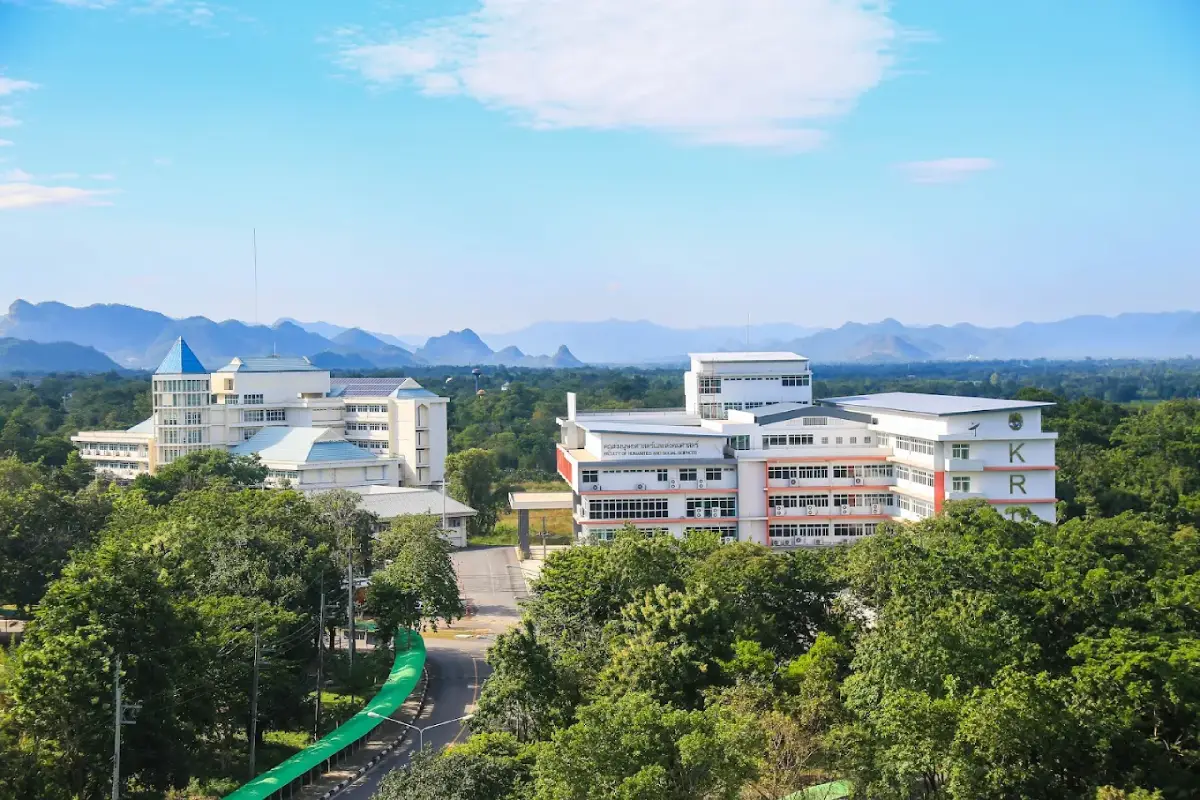
Kanchanaburi Rajabhat University (KRU) is a public university in Kanchanaburi Province, western Thailand. Established on September 29, 1973, as Kanchanaburi Teachers College, the institution became Kanchanaburi Rajabhat Institute in 1995 before receiving university status on June 15, 2004. The university is located at 70 Moo 4, Ban Phu Phra, Nong Bua Subdistrict, Mueang Kanchanaburi District, Kanchanaburi Province. Its campus covers more than 542 rai of naturally landscaped land, featuring wooded hills, rocky terrain, and grounds extending toward the Khwae Yai River. Today, Kanchanaburi Rajabhat University plays an important role in teacher education, multidisciplinary higher education, research, academic services, and the preservation of local cultural heritage. Its central mission is to apply education, knowledge, and innovation to improving quality of life in Kanchanaburi and Thailand's western region.
One of the university's most distinctive characteristics is its combination of educational heritage and natural surroundings. Unlike universities situated in densely developed urban districts, Kanchanaburi Rajabhat University occupies an extensive landscape of hills, mature trees, natural rock formations, and green spaces. This environment creates a distinctive setting for teaching, studying, and community activities. Its location along Highway 323 also connects the campus with Kanchanaburi city and destinations along the Khwae Yai River, reinforcing its position as both an educational institution and a regional center of learning.
The university's history began during a period when Thailand was expanding educational opportunities beyond major cities. Teacher training was an important national priority, particularly as schools in provincial communities required increasing numbers of qualified educators. Establishing a teachers college in Kanchanaburi was part of this broader educational development. The institution was intended to prepare teachers and strengthen the educational resources available to communities in the surrounding region.
On September 29, 1973, the Thai Ministry of Education officially established Kanchanaburi Teachers College under the Department of Teacher Education. The institution was located in Ban Phu Phra, Moo 4, Nong Bua Subdistrict, Mueang Kanchanaburi District. This date marks the foundation of the institution from which the present-day university developed and remains an important reference point in its history.
The choice of Ban Phu Phra provided substantial space for educational facilities and long-term institutional development. The naturally hilly landscape and proximity to the Khwae Yai River gave the college a geographical identity that distinguished it from other educational establishments in Kanchanaburi. Over the decades, this close relationship between the campus and its natural environment became part of the institution's recognizable character.
A significant stage of development came with the Teachers College Act of 1975, which helped establish a formal framework for teacher-training institutions across Thailand. Kanchanaburi Teachers College organized its Faculty of Education and Faculty of Humanities and Social Sciences. Their academic departments covered education, psychology, curriculum studies, Thai and English languages, sociology, history, geography, philosophy, religion, music, performing arts, and other foundational disciplines. These academic units formed the basis for the institution's early teaching and professional training activities.
The academic year 1976 was another important milestone. Kanchanaburi Teachers College admitted its first cohort of students to the Certificate in Education program, known in Thai as Por Kor Sor (ป.กศ.). This marked the beginning of its formal teaching operations and the development of an alumni community whose members would contribute to schools and educational institutions in Kanchanaburi and other parts of Thailand.
Teacher education in the institution's early years combined academic subject knowledge with practical teaching skills and an understanding of learners. Graduates were prepared to support the expansion of education and the improvement of teaching standards in local communities. This original mission remains an important part of Kanchanaburi Rajabhat University's identity, even as its academic offerings have expanded far beyond teacher training.
As Thailand's higher education system evolved, Kanchanaburi Teachers College gradually broadened its educational role. The institution developed from a college primarily responsible for preparing teachers into an establishment offering a wider range of academic disciplines. This transformation reflected changes taking place across Thailand's teachers colleges, which were increasingly expected to contribute to regional workforce development and community education as well as school teaching.
February 14, 1992, became a landmark date in the history of Thailand's Rajabhat institutions. On that day, His Majesty King Bhumibol Adulyadej the Great graciously bestowed the name "Rajabhat" upon the country's teachers colleges. The term is commonly understood to mean "People of the King," reflecting the ideal of serving the nation and its people. February 14 subsequently became Rajabhat Day, an annual occasion for Rajabhat universities throughout Thailand to commemorate the royal contribution and reaffirm their commitment to public service and local development.
In 1995, Kanchanaburi Teachers College was elevated to Kanchanaburi Rajabhat Institute. This change represented an important expansion of its academic status and responsibilities. The institute developed a broader academic structure comprising four major faculties: the Faculty of Education, Faculty of Humanities and Social Sciences, Faculty of Science and Technology, and Faculty of Management Science.
The Rajabhat Institute period marked a transition toward multidisciplinary higher education. In addition to preparing teachers, the institution increasingly supported education in languages, social sciences, scientific subjects, management, and professional disciplines relevant to regional employment and economic development. It also strengthened collaboration with government agencies, local communities, and educational organizations to ensure that academic knowledge could address practical needs within the region.
Another decisive transformation occurred in 2004 with the enactment of the Rajabhat University Act B.E. 2547. The legislation was published in the Royal Thai Government Gazette on June 14, 2004, and took effect the following day. On June 15, 2004, Kanchanaburi Rajabhat Institute officially became Kanchanaburi Rajabhat University, with the legal status and responsibilities of a public university.
The establishment of Kanchanaburi Rajabhat University in 2004 did not represent the creation of an entirely new institution. Instead, it continued the educational heritage of Kanchanaburi Teachers College, founded in 1973. Two dates are therefore especially important in understanding its history: September 29, 1973, when the original teachers college was established, and June 15, 2004, when the institution formally became Kanchanaburi Rajabhat University.
By 2026, the institution had completed 53 years since its original establishment and 22 years under university status. Its development from a provincial teachers college into a multidisciplinary public university reflects the broader evolution of higher education in Thailand. The university's responsibilities now extend across teaching, research, innovation, academic services, and cultural preservation, while maintaining its historical commitment to regional educational development.
The university's name carries both historical and geographical significance. "Rajabhat" reflects the royally bestowed name and the mission of serving the country and its people, while "Kanchanaburi" identifies the province in which the university is located. Together, the name expresses the institution's identity as a center of higher education dedicated to developing human resources and knowledge for the benefit of society, particularly the communities of Kanchanaburi.
The official emblem of Kanchanaburi Rajabhat University incorporates the royal insignia associated with King Bhumibol Adulyadej the Great. Its design includes the Athitthit Throne, a central chakra, and a seven-tiered royal umbrella. The five colors appearing in the emblem are blue, green, gold, orange, and white. They symbolize the monarchy, the natural environment, intellectual prosperity, local Thai arts and culture, and the purity of scholarly thought. The emblem represents the university's historical relationship with the Rajabhat tradition and the educational ideals associated with the royal granting of its name.
The university's official colors are yellow and golden yellow, representing the prosperity of knowledge and cultural development. Its institutional flower is the Khiu Nang flower, also known locally as the Oraphim flower. The flower has become an important part of the university's visual and cultural identity, and the name Oraphim also appears in campus activities and facilities. It represents a recognizable symbol shared by students, staff, and alumni.
The university's principal Buddha image is Phra Phuttha Lokachet Kanchana Mongkhon Khet, which holds spiritual significance within the university community. Its traditional Buddhist motto is "สุทนฺโต วต ทเมถ," meaning "One should train oneself well before training others." This principle is particularly meaningful for an institution founded as a teachers college. It emphasizes that teaching others requires knowledge, integrity, personal development, and the ability to serve as a responsible example.
Kanchanaburi Rajabhat University's institutional identity is expressed through the Thai phrase "มีวินัย ใฝ่เรียนรู้ คู่จิตสาธารณะ," which emphasizes discipline, a commitment to learning, and public-mindedness. These values encourage students to develop responsibility, intellectual curiosity, and a willingness to contribute to society. The university's distinctive character is summarized as "แหล่งเรียนรู้ สู่การพัฒนาท้องถิ่น," meaning "A Source of Learning for Local Development." This reflects its role in creating and sharing knowledge that strengthens communities and supports sustainable regional progress.
University traditions remain an important means of preserving the institution's educational heritage. One of the most meaningful ceremonies is the Wai Khru ceremony, during which students express respect and gratitude toward their teachers. The ceremony has particular significance at Kanchanaburi Rajabhat University because of its origins in teacher education. It also reminds students of their responsibilities toward learning, personal development, and the teaching profession. In the 2026 academic year, the university held its Wai Khru ceremony for regular-program students on July 23, 2026, at the Multipurpose Academic Building Auditorium.
Rajabhat Day, observed annually on February 14, is another important occasion. It commemorates the royal bestowal of the Rajabhat name in 1992 and provides an opportunity for members of the university community to reflect on their institution's origins and social responsibilities. In 2026, Kanchanaburi Rajabhat University organized a Buddhist merit-making and almsgiving ceremony on February 13, at the plaza in front of Building 9. University staff and students took part in the ceremony as an expression of respect, unity, and institutional remembrance.
Other religious and cultural activities connect university life with Thai traditions. These include Songkran celebrations, water-pouring ceremonies to seek blessings from respected elders, and ceremonial bathing of the university's Buddha image. In April 2026, the university organized the ceremonial procession and bathing of its principal Buddha image, together with Songkran activities. Such events preserve traditional customs while strengthening relationships between different generations of students and staff.
Institutional anniversaries and ceremonies recognizing contributions to education also help preserve the university's collective memory. During the institution's 53rd anniversary year in 2026, Kanchanaburi Rajabhat University organized the "Phra Khuru Thewabodi 53 Years of Khru Kan" recognition ceremony. The event highlighted the value of educational service and honored individuals associated with the university's educational mission. Such activities connect the institution's history with the people who have contributed to its development.
Student activities are another important part of campus culture. The university's internal sporting event, known as "Khiu Nang Games," takes its name from the university's symbolic flower. Sporting activities provide opportunities for students from different faculties to develop teamwork, leadership, sportsmanship, and friendships. They reflect the university's approach to education as a process that develops personal character and social skills alongside academic achievement.
Local arts and cultural preservation form another major aspect of the university's mission. The Office of Arts and Culture supports the study, conservation, and promotion of Kanchanaburi's historical and cultural heritage. Its work involves local history, traditional arts, cultural knowledge, community traditions, and collaboration with cultural networks. This responsibility is especially relevant in Kanchanaburi, a province characterized by a rich historical landscape and diverse communities throughout western Thailand.
A notable cultural initiative in 2026 was the "Moradok Phaendin Kan" or "Heritage of Kanchanaburi" project, held on August 10, 2026, at the university's Cultural Hall. Activities included cultural exhibitions, competitions in Thai history and culture, Thai etiquette contests, public speaking, drawing, cultural performances, and presentations of local community knowledge and products.
The Heritage of Kanchanaburi project illustrates how the university approaches cultural preservation as an active educational process rather than simply collecting documents or artifacts. Students, schoolchildren, and members of the public are encouraged to engage with cultural knowledge through creative activities and practical experiences. By connecting history and traditional culture with design, innovation, and community products, the university helps demonstrate how cultural heritage can contribute to education and regional economic development.
Several important buildings and facilities support the university's educational and cultural activities. The Multipurpose Academic Building and its auditorium serve as venues for major ceremonies, meetings, and student events. Building 9 is another significant administrative and activity space. Individual faculty buildings accommodate classrooms, teaching facilities, practical training areas, and academic activities according to the requirements of their respective disciplines.
The Phatcharapanya Building, associated with the Faculty of Humanities and Social Sciences, is another important academic facility. It supports educational activities in fields such as languages, humanities, social sciences, and community development. The building represents the university's continuing investment in facilities that respond to the development of its academic programs.
The Office of Academic Resources and Information Technology plays a central role in supporting university education and research. It provides academic information resources, technology-related services, and facilities that assist students and university personnel in studying, teaching, and conducting research. Such services are increasingly important as university education combines classroom instruction with digital resources, information systems, and independent learning.
The Kanchanaburi Rajabhat University Cultural Hall is particularly relevant to visitors interested in regional history and culture. The university uses the facility for exhibitions, educational activities, and the presentation of Kanchanaburi's cultural heritage. In 2026, the Cultural Hall hosted public awareness activities and the Heritage of Kanchanaburi project, helping introduce this learning resource to students and local communities. Groups interested in visiting the Cultural Hall should coordinate arrangements with the Office of Arts and Culture in advance.
The Kanchanaburi Rajabhat University Demonstration School also forms part of the institution's educational environment. The school reflects the university's continuing relationship with school-level education and its historical development from a teacher-training college. Its presence connects university-level academic expertise with educational activities for younger learners.
Another facility associated with applied learning is Silalai, a professional training center connected with hospitality and service education. Facilities of this type are valuable because they allow students to apply classroom knowledge in practical settings. Such experience helps students develop professional skills and an understanding of real service operations.
Academically, Kanchanaburi Rajabhat University is organized into five principal faculties: the Faculty of Education, Faculty of Humanities and Social Sciences, Faculty of Science and Technology, Faculty of Management Science, and Faculty of Industrial Technology. Each faculty contributes a different area of academic expertise while sharing the university's broader objective of developing knowledgeable, professionally capable, and socially responsible graduates.
The Faculty of Education has a particularly close connection with the institution's origins. Its academic programs focus on preparing teachers and developing educational professionals. Undergraduate education includes the Bachelor of Education program with subject specializations such as physical education, Thai, English, mathematics, social studies, general science, early childhood education, and primary education. Graduate education includes educational administration and curriculum and learning management.
The Faculty of Education's contribution extends beyond preparing graduates for classroom teaching. It also supports the development of instructional approaches, educational research, school administration, curriculum development, and the professional advancement of teachers. These areas are essential as schools respond to changing technologies, social conditions, and the educational needs of learners at different ages.
The Faculty of Humanities and Social Sciences offers education in disciplines relating to language, society, law, public administration, and cultural creativity. Its academic fields include business English, Chinese, Thai as a foreign language, Thai for professional purposes, public administration, law, digital content design, music, and social innovation for community development. These areas connect the study of people and societies with intercultural communication, professional knowledge, and local community development.
Such disciplines are especially relevant to Kanchanaburi, where communities have diverse historical and cultural backgrounds. Language education, law, social sciences, and public administration help develop graduates who can work with different communities and institutions. Programs in digital content design and social innovation also link traditional knowledge with modern communication, creative work, and contemporary approaches to social development.
The Faculty of Science and Technology contributes to education and workforce development in science, computer technology, data management, artificial intelligence, food technology, plant management, and sports science. These academic areas are increasingly important as digital technologies and data-driven methods influence business, professional work, agriculture, and public services.
The faculty also supports teacher education in areas such as computer education and home economics education. This creates an important connection between scientific knowledge and teaching expertise. Subjects relating to plants and food technology are particularly relevant to the agricultural resources and economic activities found throughout Kanchanaburi Province.
The Faculty of Management Science provides education in business administration, marketing, modern trade management, digital business technology, accounting, communication, new media, tourism, and hospitality. These academic areas have direct relevance to Kanchanaburi's economy, which includes tourism, services, retail activities, and local businesses. Students can apply their knowledge of management and technology to a wide range of professional and entrepreneurial situations.
The Faculty of Industrial Technology specializes in industrial technology, design, automation and robotics, logistics and supply chain management, mechanical technology, and modern automotive systems. Its academic programs support the development of technical and industrial skills needed in contemporary workplaces. The faculty emphasizes the practical application of technological knowledge to production, industrial operations, and process improvement.
In addition to undergraduate programs, Kanchanaburi Rajabhat University provides graduate-level education in fields such as educational administration, curriculum and learning management, accounting, and computer science and information technology. Graduate study supports professional advancement and the creation of new knowledge through research. Because the university's official curriculum database includes programs from different revision years, prospective students should consult the relevant admission announcements to determine which programs are accepting new applicants in the 2026 academic year.
Research and innovation are essential components of the university's mission. Through its Research and Development Institute and academic faculties, Kanchanaburi Rajabhat University supports research activities that connect university knowledge with economic, social, environmental, and community development. This approach reflects the wider Rajabhat mission of producing knowledge that benefits local communities and contributes to sustainable development.
One example of the university's community-oriented approach in 2026 was a project to develop new textile patterns expressing the identities of Kanchanaburi Rajabhat University and the Nong Bua community. Organized in connection with the Office of Arts and Culture, the project linked design knowledge, traditional cultural resources, and community identity. Activities of this kind demonstrate how creative academic work can support local products and strengthen cultural awareness.
Environmental sustainability is another area of institutional engagement. In September 2026, Kanchanaburi Rajabhat University participated in a collaborative initiative concerning greenhouse gas reduction. The activity reflects the university's involvement in broader discussions and cooperation relating to environmental responsibility, resource management, and sustainable development.
Community academic services are particularly important to the university's relationship with Kanchanaburi. Knowledge from education, management, technology, science, and cultural studies can be transferred through training activities, academic projects, and cooperation with local organizations. These relationships help connect university expertise with the needs of schools, community groups, government agencies, and private enterprises.
Kanchanaburi presents a valuable environment for community-oriented higher education because of its extensive natural resources, agricultural areas, rivers, historical landmarks, and cultural diversity. Academic knowledge can be applied to issues such as resource management, responsible tourism, local business development, educational improvement, and cultural conservation. The university's regional mission provides a framework for connecting such issues with teaching, research, and public engagement.
For visitors interested in educational tourism, Kanchanaburi Rajabhat University offers a distinctive combination of university history, campus scenery, and cultural learning. Visitors can explore the institution's background through its official emblem, important buildings, and educational activities, while its Cultural Hall provides a particularly relevant connection to Kanchanaburi's local heritage. Public events and exhibitions offer opportunities to appreciate the role of the university beyond formal classroom education.
Visitors should distinguish between public activities, administrative appointments, and access to restricted academic facilities. Kanchanaburi Rajabhat University is an active educational institution rather than an attraction where every building is freely accessible to tourists. Those planning group visits, Cultural Hall tours, or access to specialized learning facilities should contact the relevant university department in advance. General administrative offices operate from Monday to Friday, 08:30 – 16:30, excluding public holidays. Teaching schedules and event hours may differ from administrative office hours.
The university is also situated within reach of several well-known historical attractions in Kanchanaburi. These include the Bridge over the River Kwai, Kanchanaburi War Cemetery, and the Thailand-Burma Railway Centre. Visitors attending university events or conducting academic business can combine their trip with visits to these destinations, allowing additional time for transport and checking the visitor arrangements of individual attractions.
Getting There: Kanchanaburi Rajabhat University is located at 70 Moo 4, Nong Bua Subdistrict, Mueang Kanchanaburi District, along Highway 323 on the Kanchanaburi–Sangkhla Buri route. The campus lies approximately 14 kilometers north of central Kanchanaburi. Visitors traveling by private car can follow Highway 323 north from Kanchanaburi city and look for the university entrance signs. Travelers coming from Bangkok can first reach Kanchanaburi Province and then continue toward Nong Bua.
For travelers using public transport, intercity buses and trains provide access to Kanchanaburi city. From there, a local hired vehicle or arranged transfer can be used to reach the university. Because the campus is outside the central urban area, visitors should confirm their onward transport arrangements before traveling. Extra time is recommended when attending examinations, admission activities, conferences, or events with large numbers of participants.
For general inquiries, Kanchanaburi Rajabhat University's central telephone numbers are 034-534059-60, and its official website is www.kru.ac.th. The website provides access to university news, academic information, admission announcements, and information from individual departments. Prospective students can contact the Office of Academic Promotion and Registration for assistance with academic programs, enrollment, and academic calendars.
In 2026, Kanchanaburi Rajabhat University continues to operate as a public institution of higher education offering undergraduate and graduate studies while carrying out research, community academic services, and cultural preservation. Assistant Professor Dr. Narongdech Rattananonsathien serves as Acting President of the university.
Kanchanaburi Rajabhat University is therefore more than a place offering university degrees. Its history reflects over five decades of educational development in western Thailand, beginning with a teachers college in 1973 and evolving into a multidisciplinary public university. Through teacher preparation, academic research, cultural activities, professional education, and community engagement, the university continues to express its guiding principle of being a source of learning for local development.
| University Name | Kanchanaburi Rajabhat University (มหาวิทยาลัยราชภัฏกาญจนบุรี) |
| Abbreviation | KRU / มรภ.กจ. |
| University Type | Public Rajabhat University |
| Location | Ban Phu Phra, Nong Bua Subdistrict, Mueang Kanchanaburi District, Kanchanaburi Province, Thailand |
| Address | 70 Moo 4, Nong Bua, Mueang Kanchanaburi, Kanchanaburi 71190, Thailand |
| Original Foundation Date | September 29, 1973 |
| University Establishment Date | June 15, 2004 |
| Institutional Age in 2026 | 53 years since the establishment of Kanchanaburi Teachers College |
| Former Names | Kanchanaburi Teachers College; Kanchanaburi Rajabhat Institute |
| Original Establishing Authority | Ministry of Education, under the Department of Teacher Education |
| Acting President in 2026 | Assistant Professor Dr. Narongdech Rattananonsathien |
| Campus Area | More than 542 rai |
| Campus Environment | Naturally landscaped hills, trees, rocky terrain, and grounds adjoining the Khwae Yai River |
| Official Colors | Yellow and Golden Yellow |
| Official Flower | Khiu Nang or Oraphim Flower |
| Principal Buddha Image | Phra Phuttha Lokachet Kanchana Mongkhon Khet |
| Traditional Motto | สุทนฺโต วต ทเมถ – One Should Train Oneself Well Before Training Others |
| Institutional Identity | Discipline, Commitment to Learning, and Public-Mindedness |
| Distinctive Mission | A Source of Learning for Local Development |
| Faculties | 1. Faculty of Education 2. Faculty of Humanities and Social Sciences 3. Faculty of Science and Technology 4. Faculty of Management Science 5. Faculty of Industrial Technology |
| Degree Levels | Bachelor's, Master's, and Doctoral Degrees according to the university's academic programs |
| Academic Strengths | Teacher Education, Languages, Social Sciences, Science and Technology, Business, Tourism, Logistics, Industrial Technology, and Community Development |
| Important Campus Facilities | 1. Building 9 2. Multipurpose Academic Building and Auditorium 3. Phatcharapanya Building 4. Office of Academic Resources and Information Technology 5. Kanchanaburi Rajabhat University Cultural Hall 6. Kanchanaburi Rajabhat University Demonstration School 7. Silalai Professional Training Center |
| Important Traditions and Events | Wai Khru Ceremony, Rajabhat Day, Institutional Anniversary Activities, Buddha Image Bathing Ceremony, Songkran Activities, Khiu Nang Games, and Cultural Heritage Programs |
| Administrative Open Days | Monday – Friday, excluding public holidays |
| Administrative Opening Hours | 08:30 – 16:30 |
| Visitor Access | Visitors planning group tours or access to specialized learning facilities should coordinate arrangements with the relevant university department |
| Getting There | Follow Highway 323 north from Kanchanaburi city toward Nong Bua, approximately 14 km from the city center |
| Nearby Attractions and Kanchanaburi City Landmarks | 1. Wat Tham Phutthawat, Nong Bua 2. Wat Si Uplaram, Nong Bua 3. Bridge over the River Kwai 4. Thailand-Burma Railway Centre 5. Kanchanaburi War Cemetery (Don Rak) |
| Nearby Restaurants | 1. Krua Por Pla, Near Kanchanaburi Rajabhat University, Tel. +66 93 664 5568 2. Larb Roi Et, Nong Bua, Tel. +66 90 446 9522 3. Imagine House, Tel. +66 64 774 4447 4. Niyom Suk Kanchanaburi, Tel. +66 98 498 2877 5. Lung Jo Tom Saep, Tel. +66 92 931 9171 |
| Nearby Accommodation | 1. Silalai Hotel, On Campus, Tel. +66 98 375 5785 2. Vawa Guesthouse, Nong Bua, Tel. +66 98 239 4245 3. Kanvela Resort, Nong Bua 4. Aurora Resort Kanchanaburi 5. The Breath Kanchanaburi |
| Main Telephone | +66 34 534059-60 |
| Academic Promotion and Registration | +66 34 534068 or +66 34 534059-60, extensions 172-175 |
| Official Email | saraban@kru.ac.th |
| Official Website | www.kru.ac.th |
| Current Status | Operating public university with academic programs in the 2026 academic year |
Kanchanaburi Rajabhat University Academic Programs and Fields of Study, Academic Year 2026 (B.E. 2569)
| Faculty of Education | Bachelor's Degree 1. Bachelor of Education, Physical Education 2. Bachelor of Education, Thai Language 3. Bachelor of Education, English Language 4. Bachelor of Education, Mathematics 5. Bachelor of Education, Social Studies 6. Bachelor of Education, General Science 7. Bachelor of Education, Early Childhood Education 8. Bachelor of Education, Primary Education Master's Degree 9. Master of Education, Educational Administration 10. Master of Education, Curriculum and Learning Management Doctoral Degree 11. Doctor of Philosophy, Educational Administration 12. Doctor of Philosophy, Curriculum and Learning Management |
| Faculty of Humanities and Social Sciences | Bachelor's Degree 1. Bachelor of Public Administration, Public Administration 2. Bachelor of Laws, Law 3. Bachelor of Arts, Music 4. Bachelor of Arts, Social Innovation for Community Development 5. Bachelor of Arts, Business English 6. Bachelor of Arts, Chinese 7. Bachelor of Arts, Digital Content Design 8. Bachelor of Arts, Thai as a Foreign Language 9. Bachelor of Arts, Thai for Professional Purposes 10. Bachelor of Education, Music Education |
| Faculty of Science and Technology | Bachelor's Degree 1. Bachelor of Science, Data Management and Artificial Intelligence 2. Bachelor of Science, Computer Science 3. Bachelor of Science, Innovation in Plant Management 4. Bachelor of Science, Food Technology 5. Bachelor of Science, Sports and Exercise Science 6. Bachelor of Education, Computer Education 7. Bachelor of Education, Home Economics Education Master's Degree 8. Master of Science, Computer Science and Information Technology |
| Faculty of Management Science | Bachelor's Degree 1. Bachelor of Business Administration, Hotel Business, MICE and Tourism 2. Bachelor of Business Administration, Modern Trade Business Management 3. Bachelor of Business Administration, Modern Marketing 4. Bachelor of Business Administration, Management 5. Bachelor of Business Administration, Digital Technology for Business 6. Bachelor of Accountancy 7. Bachelor of Communication Arts, Communication, New Media and Multimedia 8. Bachelor of Arts, Creative Tourism Master's Degree 9. Master of Accountancy |
| Faculty of Industrial Technology | Bachelor's Degree 1. Bachelor of Industrial Education, Architecture and Design 2. Bachelor of Industrial Education, Industrial Arts 3. Bachelor of Technology, Industrial Technology: Industrial Engineering Technology Specialization 4. Bachelor of Technology, Industrial Technology: Mechanical and Modern Automotive Technology Specialization 5. Bachelor of Technology, Automation and Robotics Technology 6. Bachelor of Technology, Logistics and Supply Chain Management |
Frequently Asked Questions (FAQ)
Q: Where is Kanchanaburi Rajabhat University located?
A: Kanchanaburi Rajabhat University is located at 70 Moo 4, Nong Bua Subdistrict, Mueang Kanchanaburi District, Kanchanaburi 71190, Thailand. The campus is approximately 14 kilometers north of central Kanchanaburi along Highway 323.
Q: When was Kanchanaburi Rajabhat University established?
A: The institution was founded on September 29, 1973, as Kanchanaburi Teachers College and officially became Kanchanaburi Rajabhat University on June 15, 2004.
Q: What are Kanchanaburi Rajabhat University's opening days and hours?
A: General administrative offices are open Monday to Friday, 08:30 – 16:30, excluding public holidays. Teaching schedules, special events, and access to individual facilities may follow different arrangements.
Q: How many faculties does Kanchanaburi Rajabhat University have?
A: The university has five principal faculties: Education, Humanities and Social Sciences, Science and Technology, Management Science, and Industrial Technology.
Q: What degree levels are offered at Kanchanaburi Rajabhat University?
A: The university offers bachelor's, master's, and doctoral degree programs in selected disciplines. Prospective applicants should consult the official admission announcements for the 2026 academic year to confirm which programs are currently accepting students.
Q: What is Kanchanaburi Rajabhat University known for?
A: The university has a long history in teacher education and local development. Its academic activities also cover languages, social sciences, science and technology, business, tourism, industrial technology, and community-oriented research.
Q: Can tourists and members of the public visit Kanchanaburi Rajabhat University?
A: Members of the public may contact university offices and participate in public events according to university arrangements. Group visits, Cultural Hall tours, and access to specialized academic facilities should be coordinated with the relevant departments in advance.
Q: How can I get to Kanchanaburi Rajabhat University?
A: From Kanchanaburi city, follow Highway 323 north toward Nong Bua for approximately 14 kilometers. Travelers arriving in Kanchanaburi by bus or train can arrange a local vehicle transfer to the university.
 Category: ●University
 Group: ●Rajabhat University
Last Update : 6 HourAgo
 Last Update : 6 HourAgo
 Click to Access the Navigation Map GPS
Kanchanaburi Rajabhat University Map
Recommend

 Art, Culture and Heritage
 Historical Sites and Monuments(13)
 Landmarks and Memorials(5)
 Art, Craft Centres, Tradition(7)
 Museums(7)
 Art Gallery(1)
 Public university(1)
 Autonomous Universities(1)
Rajabhat University(1)
 Private University(1)
 Places of Worship
 Temple(37)
 Church(2)
 Other Sacred Sites(7)
 Research and Development
 Royal Project(1)
 Suburban Living
 Village, Community(5)
 Local Market(1)
 Nature and Wildlife
 National Parks and Marine Reserves(11)
 Mountain (Doi)(6)
 Dam, Reservoir, Lake(9)
 Waterfalls(19)
 Hot Springs(3)
 Caves(20)
 River, Canal(3)
 Other natural attractions(4)
 Entertainment and Agricultural
 Zoos and Aquariums(2)
 Animal camps and shows(4)
 Farms, Parks and Ecotourism(11)
 Cinema(1)
 Outdoor and Adventure Activities(2)
 Travel Articles, Recipes
 Travel Review, Food Review(1)


