lovethailand home >North Travel Attractions >Uttaradit Travel Attractions >Mueang Uttaradit >Tha Sao > Wat Yai Tha Sao
TL;DR: Wat Yai Tha Sao is located at Samran Ruen Road, Mueang Uttaradit District, Uttaradit Province, open Daily, hours Contact the temple in advance to visit the museum and important heritage objects.
Wat Yai Tha Sao
Open Days: Daily
Opening Hours: Contact the temple in advance to visit the museum and important heritage objects
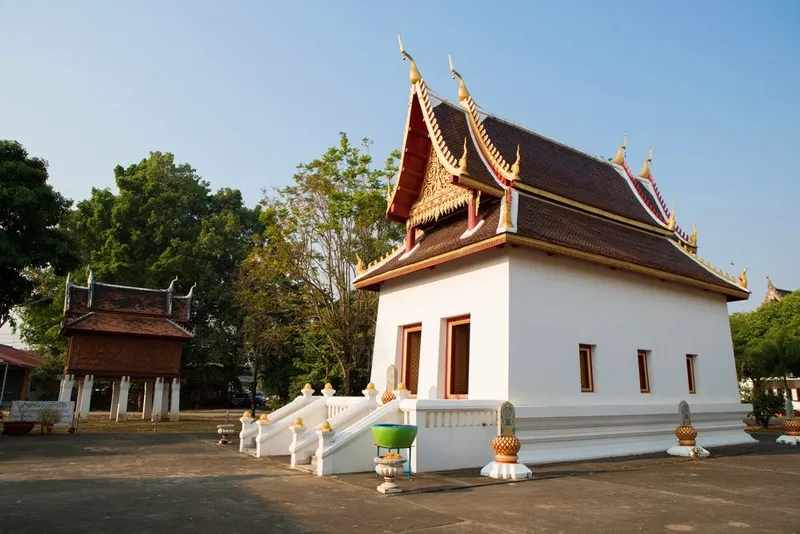
Wat Yai Tha Sao in Uttaradit Province is an old and culturally significant temple located on Samran Ruen Road near Tha Sao Railway Station. It is one of the most meaningful heritage sites for travelers interested in traditional Thai wood carving, old temple architecture, Buddhist culture, and the history of the Tha Sao community. The temple serves not only as a religious center for local residents but also as a place where rare examples of local craftsmanship have been preserved, including an old vihara, 2 carved wooden doors, a traditional scripture hall, and a carved wooden ceremonial palanquin.
The importance of Wat Yai Tha Sao is closely tied to the old Tha Sao community. In the past, Tha Sao was an active settlement connected with trade, transport, and movement along the Nan River basin and the wider urban development of Uttaradit. The community included people of different backgrounds, including Thai, Chinese, Tai Yuan or Lanna, and Lao groups who settled and lived together over many generations. This cultural diversity helped shape the religious life, craftsmanship, and social identity of the area. Wat Yai Tha Sao therefore stands as a spiritual and cultural center of this old community.
The temple is believed to have been established around the late Ayutthaya period, at the same time as the growth of the Tha Sao settlement. Its historical value can still be seen through surviving architectural and artistic elements. The old vihara, the traditional scripture hall, and the carved wooden palanquin all show that the temple once played an important role in religious ceremonies, Buddhist learning, and the preservation of sacred texts. For this reason, Wat Yai Tha Sao is not simply an old neighborhood temple but an important cultural record of Uttaradit’s past.
One of the temple’s advantages for travelers is its convenient location near Tha Sao Railway Station. Visitors arriving by train can walk from the station to the temple within a short time, making it an excellent destination for cultural travelers who enjoy slow exploration. Samran Ruen Road, which passes near the temple, also connects the area with old community routes and other parts of Mueang Uttaradit. This makes the temple suitable for a city heritage route that combines railway travel, an old community, and Buddhist art.
The old vihara is the main highlight of Wat Yai Tha Sao. It is admired for its traditional Thai architectural character and, especially, for its 2 carved wooden doors. These doors are rare examples of old craftsmanship and show how wood could be transformed into a sacred surface filled with delicate patterns. The carvings reveal the skill, patience, and artistic sensitivity of craftsmen in the past. Looking closely at the wooden doors allows visitors to understand how religious faith and fine craftsmanship were brought together in temple architecture.
In addition to the carved doors, the wooden decorative patterns at the front of the vihara are also worth careful attention. The lines and forms show the grace of traditional Thai design and demonstrate that temple decoration was not created merely for beauty. It also helped mark the transition from the everyday world into a sacred religious space. The carved wooden details at Wat Yai Tha Sao therefore reflect both artistic refinement and Buddhist devotion.
The old scripture hall, or ho trai, is another highly valuable structure within the temple. A ho trai was traditionally used to store the Tripitaka and Buddhist manuscripts, making it an important place of learning and preservation. The ho trai at Wat Yai Tha Sao is a raised wooden structure with cement pillars and a roof covered with clay tiles. Its carved wooden gables include symbolic motifs such as a kala face, scrolling vine patterns, Garuda holding Naga, and other carved decorative elements. These details make the building both functional and deeply symbolic.
The details of the scripture hall show the relationship between architecture and belief. The kala face can be understood as a protective motif, while the scrolling vine and kanok patterns reflect the elegance of Thai decorative art. The Garuda holding Naga motif expresses power and cosmological meaning often found in Buddhist and Brahmanical-influenced Thai art. Wat Yai Tha Sao is therefore an excellent place to observe how old temple architecture can combine practical use, sacred meaning, and artistic beauty in one structure.
Another important heritage object at the temple is a carved wooden ceremonial palanquin. It is believed to date from the reign of King Borommakot and was used for processions involving sacred Buddha images. The palanquin includes carved Naga details, a double lion base, a seat, lotus-inspired carvings, and traces of lacquer and gilding. This object is significant because it reflects Buddhist ceremonies, royal-period craftsmanship, and the ritual importance of processions in old religious life. It is now displayed at the temple’s sermon hall.
When viewed together with other important temples in Uttaradit, Wat Yai Tha Sao has its own distinctive role. Wat Tha Thanon is known for Luang Pho Phet, Wat Thamma Thipatai is known for the carved door from Wat Phra Fang, and Wat Klang Thammasakorn is known for murals and a community museum. Wat Yai Tha Sao contributes another essential dimension through its old vihara, carved wooden doors, scripture hall, and ceremonial wooden palanquin. Visiting this temple helps complete a broader understanding of Uttaradit’s Buddhist art and cultural heritage.
The atmosphere of Wat Yai Tha Sao remains calm and local. Although it is easy to reach, the temple still feels like an old community temple rather than a crowded tourist site. Visitors can begin by paying respect inside the temple, then walk slowly to see the old vihara, carved doors, wooden decorative details, the scripture hall, and the sermon hall where important objects are displayed. This slow pace is the best way to appreciate the temple’s layered value.
Wat Yai Tha Sao is also a living religious center for the local community. It hosts merit-making activities, Buddhist holy day observances, Songkran events, Buddhist Lent ceremonies, and other religious activities. These events show that the temple is not only a preserved historical site but also an active place of faith. Its cultural value comes from the continuity between past and present, where old craftsmanship remains within a temple still used by the community.
For travelers interested in cultural tourism, Wat Yai Tha Sao is especially rewarding because its beauty lies in details. The carved wooden doors, the old scripture hall, and the palanquin require careful observation. This is a temple for visitors who enjoy history, architecture, and quiet discovery rather than quick sightseeing. It shows that important Thai craftsmanship can be found not only in royal temples or major cities, but also in local community temples of Uttaradit.
Visitors should allow at least 30 minutes to 1 hour for a meaningful visit. Those who want to see museum areas or important heritage objects should contact the temple in advance. Since old wooden objects are sensitive to handling, humidity, light, and environmental changes, visitors should avoid touching any heritage items unless permission is given. Responsible viewing helps protect the temple’s cultural legacy for future generations.
For those interested in the Tha Sao community, the temple is an excellent starting point. Its location near Tha Sao Railway Station and Samran Ruen Road makes it easy to understand how rail travel, urban movement, old communities, and Buddhist temples connect in Uttaradit. Visitors can arrive by train, walk to the temple, and experience a quieter side of the city that still preserves the feeling of an older settlement.
Getting There is convenient by private car, local transport, or train. By car, visitors can follow Samran Ruen Road toward the Tha Sao area. By train, travelers can get off at Tha Sao Railway Station and continue on foot to the temple. This route is especially suitable for cultural travelers who want to experience Uttaradit at a slower pace and combine railway travel with old temple sightseeing.
A recommended cultural route can begin at Wat Yai Tha Sao to see the old vihara, scripture hall, and wood carvings. Travelers can then continue to Wat Thamma Thipatai to see the carved door from Wat Phra Fang, Wat Tha Thanon to pay respect to Luang Pho Phet, and Wat Klang Thammasakorn to see old murals and a community museum. If time allows, the route can be extended to the Phraya Phichai Dap Hak Monument, Phraya Phichai Dap Hak Museum, Wat Phra Borommathat Thung Yang, or Wat Phra Thaen Sila At. This route gives visitors a rich view of Uttaradit through faith, craftsmanship, history, and community life.
Visitors should dress respectfully and behave calmly because Wat Yai Tha Sao is an active Buddhist temple. When visiting heritage areas, they should follow temple guidance, avoid touching carved wood or old objects, and avoid flash photography where sensitive materials are displayed. Careful and respectful travel helps preserve the temple’s historic value and supports the local community’s role in heritage conservation.
Wat Yai Tha Sao is more than an old temple in Tha Sao. It is a cultural inheritance that reflects the identity of the local community, the faith of Uttaradit people, and the beauty of traditional Thai craftsmanship. Its old vihara, carved wooden doors, scripture hall, and ceremonial palanquin allow visitors to see the depth of local Buddhist art in a quiet and authentic setting. A visit here offers peace, historical insight, and a memorable encounter with Uttaradit’s living cultural heritage.
| Name | Wat Yai Tha Sao |
| Location | Samran Ruen Road, Mueang Uttaradit District, Uttaradit Province |
| Address | Wat Yai Tha Sao, Samran Ruen Road, Mueang Uttaradit District, Uttaradit Province 53000 |
| Highlights | Old vihara, 2 carved wooden doors, wooden decorative patterns at the front of the vihara, traditional scripture hall, and carved wooden ceremonial palanquin |
| History | An ancient temple believed to have been established with the Tha Sao community around the late Ayutthaya period |
| Distinctive Features | Traditional wood carving, old vihara, raised wooden scripture hall, and heritage objects reflecting the faith and craftsmanship of the Tha Sao community |
| Main Areas / Zones | Old vihara, traditional scripture hall, sermon hall, carved wooden palanquin display area, and temple grounds for Buddhist ceremonies |
| Key Heritage Object | Carved wooden ceremonial palanquin believed to date from the reign of King Borommakot, currently displayed at the sermon hall |
| Traditions / Rituals | Buddhist holy day merit-making, Songkran activities, Buddhist Lent ceremonies, end-of-Lent observances, and community religious events |
| Travel Information | Accessible by car via Samran Ruen Road or by train to Tha Sao Railway Station, then walking to the temple |
| Current Status | Open and operating |
| Open Days | Daily |
| Opening Hours | Contact the temple in advance to visit the museum and important heritage objects |
| Fees | No admission fee |
| Abbot / Caretaker | Phra Khru Winaithon Thai Sapanyo |
| Main Contact Number | 055-403-093, 084-815-2380 |
| Nearby Tourist Attractions | 1. Tha Sao Railway Station, about 1 km 2. Wat Thamma Thipatai, about 3 km 3. Wat Tha Thanon, about 4 km 4. Uttaradit Walking Street, about 4 km 5. Phraya Phichai Dap Hak Monument, about 5 km 6. Phraya Phichai Dap Hak Museum, about 5 km |
| Nearby Restaurants | 1. Moment CoffeeClub Samran Ruen Soi 7, about 1 km, Tel. 093-229-8893 2. PunThai Coffee Samran Ruen Road, about 3 km, Tel. 085-610-5555 3. Samran, about 3 km, Tel. 096-329-2397 4. Krua Chai Nam Rim Mae Nam Nan Uttaradit, about 5 km, Tel. 055-429-044 5. Krua Ban Lang, about 5 km, Tel. 082-449-3924 |
| Nearby Accommodations | 1. Araya Hotel, about 3 km, Tel. 065-161-6541 2. K2 Living Hotel Uttaradit, about 3 km, Tel. 055-411-548, 090-243-4468 3. Chatchawan Resort Uttaradit, about 4 km, Tel. 055-411-455, 061-623-9587 4. Jutha Mansion Uttaradit, about 4 km, Tel. 093-963-9159, 099-635-4294 5. Grand Vana Hotel, about 5 km, Tel. 055-403-333 |
Frequently Asked Questions (FAQ)
Q: Where is Wat Yai Tha Sao located?
A: Wat Yai Tha Sao is located on Samran Ruen Road in Mueang Uttaradit District, near Tha Sao Railway Station and the old Tha Sao community.
Q: What is the main highlight of Wat Yai Tha Sao?
A: The main highlights are the old vihara, 2 carved wooden doors, wooden decorative patterns, the traditional scripture hall, and the carved wooden ceremonial palanquin.
Q: How old is Wat Yai Tha Sao?
A: The temple is believed to have been established with the Tha Sao community around the late Ayutthaya period.
Q: Why is the scripture hall important?
A: The scripture hall was built to preserve the Tripitaka and Buddhist manuscripts. Its raised wooden structure and carved decoration reflect traditional craftsmanship and Buddhist learning.
Q: Is there an admission fee?
A: No. There is no admission fee, but visitors who want to see the museum or important heritage objects should contact the temple in advance.
Q: Can visitors travel to Wat Yai Tha Sao by train?
A: Yes. Visitors can get off at Tha Sao Railway Station and walk to the temple conveniently.
Q: What nearby attractions can be visited with Wat Yai Tha Sao?
A: Nearby attractions include Wat Thamma Thipatai, Wat Tha Thanon, Uttaradit Walking Street, Phraya Phichai Dap Hak Monument, and Phraya Phichai Dap Hak Museum.
 Category: ●Places of Worship
 Group: ●Temple
Last Update : 5 MonthAgo
 Last Update : 5 MonthAgo

 Click to Access the Navigation Map GPS
Wat Yai Tha Sao Map
Recommend

 Art, Culture and Heritage
 Historical Sites and Monuments(2)
 Landmarks and Memorials(8)
 Art, Craft Centres, Tradition(3)
 Museums(1)
 Historic Homes and Cities(1)
Temple(42)
 Other Sacred Sites(6)
 Suburban Living
 Village, Community(4)
 Nature and Wildlife
 National Parks and Marine Reserves(5)
 Mountain (Doi)(3)
 Dam, Reservoir, Lake(3)
 Waterfalls(11)
 Caves(3)
 River, Canal(3)
 Other natural attractions(3)
 Entertainment and Agricultural
 Farms, Parks and Ecotourism(1)
 Travel Articles, Recipes
 Travel Review, Food Review(1)


