
lovethailand home >Northeastern Travel Attractions >Bueng Kan Travel Attractions >Bueng Khong Long >Bueng Khong Long > Hat Kham Somboon Beach
TL;DR: Hat Kham Somboon Beach, Bueng Kan attractions : Nature and Wildlife, Bays and Beaches.
Hat Kham Somboon Beach
Open Days: Daily, according to published visitor information
Opening Hours: 07:00 – 18:00 according to the published attraction listing
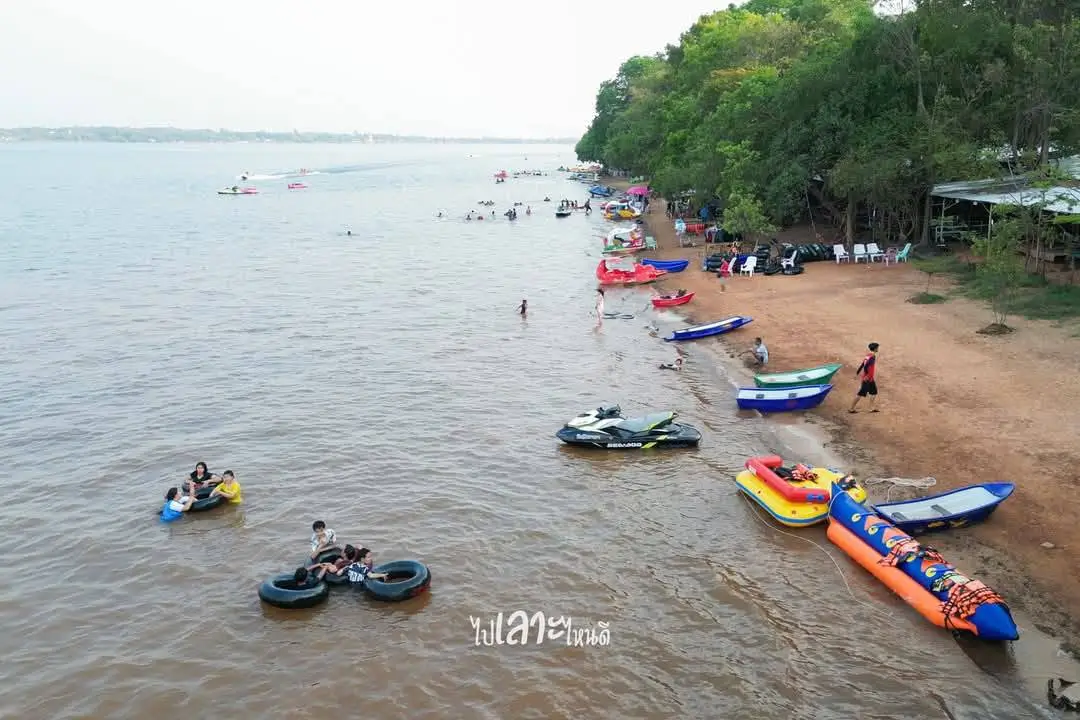
Hat Kham Somboon Beach in Bueng Kan Province, Thailand, also affectionately known as the Bang Saen of Isan, is a popular freshwater beach and lakeside recreation destination in upper northeastern Thailand. Located in Ban Kham Somboon, Village 3, Bueng Khong Long Subdistrict, Bueng Khong Long District, the beach extends along the shore of Bueng Khong Long, a large freshwater lake surrounded by greenery and views of the Phu Langka mountains. Visitors come for the natural sandy shoreline, shady trees, lakeside dining areas, inflatable swimming equipment, and water-based recreation. Although its relaxed atmosphere resembles that of a coastal resort, Hat Kham Somboon is not beside the sea. Its distinctive setting combines freshwater scenery, northeastern Thai food, community life, and the ecological importance of an internationally recognized wetland.
The beach lies beside Bueng Khong Long, a large body of freshwater that plays an important role in the natural environment and everyday life of Bueng Kan Province. The lake has an elongated shape, broad stretches of open water, and shorelines associated with several surrounding communities. From Hat Kham Somboon, visitors can enjoy views across the water toward the opposite shore and distant mountains on clear days. The sense of openness creates an atmosphere reminiscent of a seaside destination, even though the area is located far inland in northeastern Thailand. This distinction between a freshwater lake and the ocean is central to the character of the beach.
The nickname Bang Saen of Isan reflects Hat Kham Somboon's identity as an inland recreation area with a coastal holiday atmosphere. It does not mean that the beach has any geographical connection with Bang Saen in Chon Buri Province. The resemblance comes from its sandy shoreline, waterside restaurants, shaded seating, swimming activities, and groups of families and friends enjoying time together during weekends and holidays. Nevertheless, Hat Kham Somboon has its own cultural and environmental identity. It belongs to a landscape of northeastern Thai communities, freshwater habitats, and protected wetlands rather than a marine coastline.
Ban Kham Somboon is the community closely associated with the beach and its development as a visitor destination. The beach takes its name from the village, making its local identity clear. Travelers approach the attraction through roads connecting the community with Bueng Khong Long town. Along the way, they encounter an environment where village life and natural scenery exist close together. Tourism at Hat Kham Somboon is therefore not separated from the surrounding community; restaurants, small businesses, and visitor services form part of the area's everyday economic activity.
Bueng Kan became Thailand's 77th province on March 23, 2011, when it was separated from Nong Khai Province. The province is known for a varied natural landscape including sandstone mountains, forests, waterfalls, the Mekong River, and wetlands. Hat Kham Somboon adds a different kind of experience to destinations such as Phu Sing, Three Whale Rock, Phu Thok, and the waterfalls of Phu Wua Wildlife Sanctuary. Instead of concentrating on mountain trekking or remote forest scenery, the beach offers relatively accessible lakeside relaxation, local dining, and activities close to established communities.
The development of Hat Kham Somboon as a tourist destination is connected with the historical use of Bueng Khong Long as an important local water resource. Surrounding communities have long depended on the lake and its environment for their livelihoods, including activities related to freshwater resources. As transportation and tourism services developed, parts of the shoreline with natural sand and shady trees became attractive recreational areas. Restaurants and other services gradually made the beach more convenient for visitors, helping it establish a reputation as a community-based destination while retaining its essential freshwater character.
Bueng Khong Long also has a history of water-resource development. The Tourism Authority of Thailand describes a reservoir development project associated with a royal initiative in 1977, followed by completion of related irrigation work in 1980. The surrounding area was subsequently declared the Bueng Khong Long Non-Hunting Area in 1982. These developments demonstrate the changing role of the lake from a resource used by surrounding communities to an area with increasingly important functions in water management, environmental conservation, and tourism. Hat Kham Somboon exists within this broader history rather than as an isolated recreational beach.
The international ecological importance of Bueng Khong Long was formally recognized when the Bung Khong Long Non-Hunting Area was designated a Wetland of International Importance under the Ramsar Convention on July 5, 2001. It was assigned site number 1098 and became Thailand's second Ramsar-listed wetland. The designated area covers approximately 2,214 hectares, equivalent to 13,837.5 rai. This international recognition reflects the lake's importance for aquatic organisms, waterbirds, wetland vegetation, and the broader freshwater ecosystem. Hat Kham Somboon's location along the lake therefore places a popular recreational destination beside an area of considerable conservation value.
The Ramsar Convention is an international agreement concerned with the conservation and wise use of wetlands. Wetlands include much more than places where water simply collects. They are ecosystems involving interactions among water, soil, vegetation, and animals. Recognition under the convention highlights the significance of Bueng Khong Long as a natural habitat and a resource for surrounding communities. Recreational activities along the shore must therefore be understood in relation to water quality, the protection of wildlife, and the long-term ecological health of the lake.
Bueng Khong Long differs substantially from the Mekong River, which forms part of the international boundary along the eastern side of Bueng Kan Province. The Mekong is a major flowing river within a multinational drainage system, while Bueng Khong Long is an inland freshwater lake with its own surrounding catchment and wetland environment. Wind can produce small waves on the lake's surface, creating the appearance of a seaside beach. However, the lake is not subject to the oceanic tidal conditions experienced on Thailand's marine coasts. This freshwater setting gives Hat Kham Somboon a recreational identity distinct from both riverbanks and saltwater beaches.
The sandy shoreline is one of Hat Kham Somboon's defining features. Natural sand extends along sections of the shore, while large trees provide shade in several places. Tourism reports have described the beach as extending for more than one kilometer, giving visitors a choice of seating areas and different views. The width and appearance of the exposed sand can change with water levels and seasonal conditions. At times, a larger strip of sand may be visible, while at other times the water extends closer to the trees. These natural changes are part of the character of a freshwater shoreline.
Trees along the beach contribute significantly to the relaxed atmosphere. Their shade makes the shoreline more comfortable during periods of strong sunlight. Restaurants use suitable areas near the water to provide tables, chairs, and sheltered seating, allowing guests to eat while enjoying the lake. The setting is informal and closely connected with local lifestyles, unlike a resort complex dominated by large buildings and heavily developed infrastructure. The natural combination of shade, sand, and open water is central to the appeal of Hat Kham Somboon.
The Phu Langka mountains form an important part of the scenery visible from the beach. The mountain landscape contains sandstone formations, cliffs, and forested slopes. Seen from the lakeshore, the distant hills stand against the sky beyond the water, creating a striking contrast between a broad lowland lake and rugged uplands. On clear days, the outline of the mountains becomes particularly distinct. During more humid or cloudy weather, mist and changing light can give the landscape a softer and quieter appearance.
Mornings at Hat Kham Somboon often have a different atmosphere from the busier hours later in the day. Restaurant activity and visitor numbers may be relatively limited early in the morning, allowing the lake and surrounding scenery to stand out. Gentle morning light changes the appearance of the water and distant hills. It can be an appealing time to appreciate the shoreline, trees, and natural surroundings before recreational activities become more active.
By midday, Hat Kham Somboon can become a lively gathering place, especially on weekends and public holidays. Families and groups of friends visit lakeside restaurants, while recreational equipment adds color to the shoreline. The combination of food, conversation, and water activities resembles the atmosphere of an inland holiday beach. Visitors can choose between relaxing under the trees, sitting beside the lake, or participating in the activities offered by local operators.
The afternoon brings further changes in light and atmosphere. Shadows from shoreline trees move across the seating areas, while the lake reflects the colors of the sky. Open areas around the water can receive cooling breezes, adding to the sense of relaxation during warm weather. Wind conditions also affect the surface of the lake, however, and stronger breezes may create waves that influence swimming or boating safety. The recreational character of the beach remains closely connected with natural weather conditions.
Hat Kham Somboon can appeal to visitors of different ages because it offers seating, dining, and lakeside sightseeing in addition to water activities. Older travelers may prefer a shaded restaurant with views of the lake, while children and younger visitors may be interested in swimming and recreational equipment. Families can therefore enjoy different activities while remaining within the same general area. Nevertheless, the lake must not be treated as a controlled swimming pool with a uniform depth or consistently predictable underwater conditions.
Swimming and playing in the water are among the activities traditionally associated with Hat Kham Somboon, particularly during hot weather. Parts of the sandy shore provide access to the freshwater lake. The suitability of each location depends on the water level, lakebed conditions, and weather. Depth can change even relatively close to the shoreline. Swimming should therefore take place only where it is permitted, and visitors should avoid areas used by boats or other moving watercraft.
Inflatable swimming rings are commonly associated with the beach's recreational atmosphere. Some operators provide equipment for visitors who wish to enjoy the shallow areas near shore. Such equipment can be entertaining, but an inflatable ring is not a substitute for a properly fitted life jacket. Wind and waves can move floating equipment farther from land than expected. Children must remain under close adult supervision at all times, regardless of whether they are using a swimming ring or another flotation device.
Banana boats and other recreational watercraft have also been offered at Hat Kham Somboon. Availability depends on the operators and the conditions during a particular visit. Participants must follow safety instructions and use appropriate protective equipment. A large freshwater lake can experience wind, waves, and changing weather, so the risks of outdoor boating must not be confused with those of a controlled swimming facility. Safety decisions should always take account of current conditions.
Boating can offer a different perspective on Bueng Khong Long. From the water, passengers may see the sandy shoreline, lakeside restaurants, trees, and distant mountains within a wider panorama. However, all boat activities must remain within authorized operating areas and comply with applicable safety and environmental rules. Bueng Khong Long is an important freshwater ecosystem, and boat use must not disturb sensitive habitats or areas reserved for the protection of aquatic organisms and waterbirds.
Lakeside restaurants are one of the main reasons Hat Kham Somboon has earned its reputation as the Bang Saen of Isan. Establishments operate along the shore and nearby roads, providing opportunities to dine with views across the water. Some offer seating very close to the lake, while others provide tables beneath the trees. This arrangement allows food and relaxation to become part of the same experience. Families can enjoy meals together without needing to separate dining from sightseeing.
Food served around Hat Kham Somboon includes northeastern Thai specialties and familiar Thai dishes. Popular types of food described in local tourism information include grilled fish, grilled prawns, fish cooked in seasoned broth, spicy hot pots, salads, and small freshwater shrimp dishes. Individual restaurants have different menus and cooking styles. These dishes reflect the social nature of local dining, with families and friends sharing several plates while enjoying the lakeside atmosphere.
Grilled fish fits particularly well with a freshwater recreation destination. It can be served with vegetables, dipping sauces, and other local dishes, making it suitable for groups. Soups and spicy salads provide further variety, especially for larger gatherings. The presence of multiple restaurants allows travelers to select the combination of scenery and food that suits them. Eating beside the lake is therefore a central part of the destination rather than simply a convenience for people participating in water sports.
Northeastern Thai dishes with bold flavors contribute to the area's culinary identity. Som tam, laab, and various spicy salads are associated with Isan food culture, while cooked fish and shared dishes suit informal family meals. The diversity of food options means that many visitors come to Hat Kham Somboon primarily for a meal and a pleasant view, without intending to swim. This makes the beach an appealing destination for a wider range of travelers.
Shaded shelters and lakeside seating are another distinctive part of Hat Kham Somboon's character. They allow visitors to enjoy the water views without remaining in direct sunlight throughout the day. Some seating areas use simple materials that complement the local environment. Families can eat, relax, and supervise children from suitable areas near the shore. Certain shelters belong to restaurants or private operators, so their use may be subject to service conditions rather than being freely available public space.
Shops and visitor services can help travelers enjoy the beach without bringing every piece of recreational equipment from home. Food, drinks, and water activity equipment have traditionally been available through local businesses. Visitors who prefer a simple lakeside walk can enjoy publicly accessible areas, while those seeking dedicated seating or activities may choose paid services. This flexibility is part of the appeal of a community-oriented recreation destination.
Hat Kham Somboon is not defined by monumental buildings or large architectural landmarks. Its main attraction is the relationship between the natural shoreline and the services developed by surrounding communities. The beach can be understood in terms of several types of activity areas: sandy shoreline sections, restaurants and shaded seating, water recreation areas, and lakeside viewpoints. These descriptions identify the character of different spaces rather than implying that each is a formally fenced or permanently designated zone. The continuity between the beach and dining establishments is part of the destination's informal atmosphere.
The shoreline provides opportunities for walking and observing the freshwater environment. Water levels influence how much sand is exposed, while some sections remain closer to trees and service areas. These variations create different scenes during different seasons. Walking along accessible parts of the shore allows visitors to observe restaurants, sandy areas, and the broader landscape. Photographers can use the line of the beach to draw attention toward the lake and mountains in the distance.
Lakeside viewing areas are especially appealing to visitors interested in scenery and photography. The wide water surface allows broad views of the sky, distant hills, and changing light. Morning and afternoon produce different colors and shadows. Cloudy conditions can also add texture to the sky and its reflection on the water. The Phu Langka mountains provide a recognizable backdrop, highlighting the distinctive relationship between sandstone uplands and freshwater wetlands in Bueng Khong Long District.
The hot season is a particularly popular period for lakeside recreation. Swimming, shaded seating, and meals beside the water offer opportunities to relax during warm weather. Reports from earlier years have described substantial numbers of visitors during long weekends and holidays. These crowds contribute to a lively atmosphere and support local businesses. However, the suitability of swimming still depends on water and weather conditions on the day rather than the season alone.
During the rainy season, surrounding vegetation becomes greener, and the mountains can appear especially lush. The scenery may be attractive, but rain and wind can make outdoor dining and water activities less convenient. Water levels and waves may change as weather conditions develop. Visitors should therefore distinguish between enjoying the lake scenery and participating in activities that require safe water conditions. A rainy-season visit can still provide a rewarding experience without swimming.
Cooler periods of the year offer another form of enjoyment. Northeastern Thailand can experience more comfortable daytime weather during parts of the cool season, making lakeside dining and sightseeing appealing. Bueng Khong Long is also important for resident and migratory waterbirds. Bird activity varies with the season and habitat conditions, and important birdwatching locations are not necessarily the same areas used for swimming and dining. Nature observation and recreational beach activities therefore offer different ways of experiencing the same lake environment.
Bueng Khong Long supports various fish, aquatic plants, and other freshwater organisms. It also provides habitat for waterbirds, including species that move through the region seasonally. Its combination of open water and wetland vegetation supports organisms with different ecological needs. These natural values are a major reason that the lake requires careful environmental management. It should not be regarded solely as an unlimited recreational space where every type of human activity can take place without consequences.
Birdwatching in the wider Bueng Khong Long area differs from swimming at Hat Kham Somboon. Many waterbirds require relatively quiet habitats away from heavy disturbance. Observing them involves using appropriate locations and timing under the conservation arrangements of the non-hunting area. Visitors interested in birds can learn about species and habitats through conservation information while avoiding nesting areas or activities that disturb wildlife. The protection of natural habitats takes priority over approaching animals closely for photographs.
The Bueng Khong Long Non-Hunting Area plays an important role in protecting the lake's natural environment. Its conservation responsibilities include the protection of wildlife and related habitats. Tourism along the shore, including restaurants and recreation, must remain compatible with the relevant environmental regulations. The coexistence of tourism and conservation within the same lake system makes management of visitor numbers, waste, noise, and boating particularly important.
Don Sawan is a location associated with the lake's natural and cultural landscape. The name appears in information relating to the non-hunting area and in local traditional stories. Raised areas and islands within the lake contribute to its geographical diversity and may provide important natural habitats. Visitors must not assume that every island or raised area is freely accessible, because some sections may have conservation functions rather than recreational purposes.
Bueng Khong Long is also connected with the legend of Rattaphanakhon and devotion to Pu U Lue Naga. According to local folklore, an ancient city collapsed and became a large lake, while Pu U Lue was transformed into a guardian Naga associated with the area. This story is an important part of the community's cultural heritage, although it is a traditional belief rather than a scientific explanation of the lake's formation. Visiting Hat Kham Somboon can therefore form part of a wider exploration of local folklore, with cultural interpretation kept distinct from geographical and ecological knowledge.
Pu U Lue Naga Shrine and related places of worship in Bueng Khong Long District attract visitors interested in local spiritual traditions. These shrines are associated with Naga beliefs and prayers for well-being. Several are located in communities, while others are connected with islands in the lake. Traveling from Hat Kham Somboon to a shrine adds a cultural dimension to a lakeside visit. However, the different shrines have separate names and locations and should not be treated as one interchangeable destination.
Don Pho Island is another important location associated with the Pu U Lue legend and local worship. The island lies within Bueng Khong Long and includes a place of religious significance. Access involves boat travel rather than the road approach used for Hat Kham Somboon. A trip combining the beach and the island offers opportunities to experience the lake from both the shore and the water. Boat availability and weather conditions remain important considerations for this separate excursion.
Bueng Khong Long Public Park is another recreational area linked to community activities and local festivals. The park provides public space for gatherings and cultural events, including activities connected with the Pu U Lue tradition. Visiting both the beach and the park highlights two different forms of lakeside recreation. Hat Kham Somboon emphasizes sandy shoreline dining and water activities, while the public park plays a broader role in community gatherings and organized events.
The landscape of Phu Langka contributes significantly to the identity of Hat Kham Somboon. Phu Langka is a sandstone mountain environment containing forests, cliffs, and natural attractions. Its elevated terrain contrasts with the broad freshwater lake below, creating a distinctive regional landscape. Travelers interested in both lakeside relaxation and sandstone mountain scenery can explore these different environments within the wider district, provided that travel time and access requirements are considered separately.
Naka Cave in Phu Langka National Park is a well-known geological and cultural attraction in Bueng Khong Long District. Its rock surfaces include patterns that resemble the scales of a mythical Naga serpent, and the site is reached by an uphill forest trail. Visiting Naka Cave is considerably different from relaxing at Hat Kham Somboon because it requires physical exertion and compliance with national park regulations. Treating the cave as a separate major activity allows visitors to enjoy both destinations more thoroughly.
Wat Tham Chai Mongkhon is another religious destination associated with the Phu Langka area and local Buddhist traditions. Its mountain setting and cultural stories add a different dimension to travel in Bueng Khong Long. Combining the temple with the beach highlights the variety of attractions available in the district. Visitors should observe appropriate dress and respectful behavior at religious sites, which have different expectations from a recreational lakeside beach.
A journey involving Hat Kham Somboon can therefore include several kinds of experiences: lakeside relaxation, regional food, wetland ecology, Naga folklore, Buddhist worship, and sandstone mountain landscapes. Combining destinations according to personal interests reveals more of Bueng Khong Long than a swimming visit alone. Not every attraction should be scheduled for the same day, however, because mountain trails and island journeys require more time and different arrangements than a beach that can be reached by road.
Hat Kham Somboon contributes to the local economy by attracting visitors who use lakeside restaurants and recreational services. Local businesses can earn income from meals, drinks, seating areas, and other visitor activities. Tourism during holidays supports commercial activity in the surrounding community. At the same time, economic development must remain compatible with the lake's environmental health. Clean water and an attractive natural shoreline are among the most important reasons people continue to visit.
The destination's community-based character creates an informal and welcoming atmosphere. Many dining establishments are small businesses that make use of their lakeside location. Visitors encounter local hospitality through food and everyday services rather than through a large resort complex. The relationship between tourism and the community is important to the future of the beach, because successful recreation must coexist with the needs of residents and the protection of the natural environment.
Local authorities have a role in the development and promotion of Hat Kham Somboon as a visitor destination. Bueng Khong Long Subdistrict Municipality publishes information about the beach as one of the district's attractions. Conservation authorities have separate responsibilities concerning wildlife and the wetland ecosystem. These different roles demonstrate how tourism services, community administration, and environmental protection must work alongside one another in an area where recreational use takes place beside a protected freshwater habitat.
Maintaining a clean shoreline is essential because restaurants and other services operate close to the water. Food waste, packaging, and litter left in unsuitable locations may be washed or blown into the lake. Such pollution can affect fish, aquatic plants, and the appearance of the beach. Cleanliness is therefore not simply a matter of making the destination more attractive; it contributes directly to protecting the natural system on which the local tourism economy depends.
Water-based recreation must also respect the wetland environment. Activities involving fast-moving boats or excessive noise may disturb wildlife when conducted in sensitive areas. Operators are responsible for following applicable safety and environmental requirements, while visitors should avoid restricted habitats and respect conservation boundaries. Appropriate use of the lake helps maintain a balance between enjoyable recreation and the protection of its ecological value.
Hat Kham Somboon is not a conventional ticketed attraction like a museum or amusement park. Published tourism listings indicate that general admission is free. However, restaurants, shaded shelters, swimming equipment, and recreational water activities may involve separate charges set by individual operators. These are service costs rather than a general entrance fee. The distinction is useful for understanding the beach's flexible visitor arrangements, particularly when different members of a family choose different activities.
A published attraction listing gives daily visiting hours of 07:00 to 18:00. These hours relate to general beach access and should not be confused with the operating hours of individual restaurants. Some dining establishments may offer evening service beyond the listed daytime visiting period. The presence of later restaurant hours does not automatically mean that swimming or other lake activities are permitted throughout the night. Activities outside the normal visiting period remain subject to local access and safety arrangements.
Although Bueng Khong Long does not experience large ocean swells, wind and weather can still create waves across its broad surface. These conditions may affect inflatable equipment and smaller boats. Visitors should choose activities suited to current conditions and avoid entering the water when strong winds or poor visibility make it unsafe. Attention to depth, swimming ability, and the supervision of companions is more important than assuming that calm-looking freshwater is always free of hazards.
Young children require particular care when swimming at Hat Kham Somboon. The lakebed may change in depth, and children can experience difficulty controlling their movements if unexpectedly frightened in the water. Parents should remain close, prevent children from drifting away from shore on inflatable equipment, and select areas appropriate to their swimming ability. Correctly used flotation equipment can assist with safety, but it cannot replace attentive adult supervision.
For older visitors, Hat Kham Somboon offers the advantage of restaurants and shaded lakeside seating that do not require participation in water sports. Visitors can enjoy the scenery and spend time with family members while remaining on land. Sandy or wet surfaces may be difficult for people with limited mobility, however, so the condition of paths and the distance between parking and seating areas should be considered when selecting a location.
Photography at Hat Kham Somboon often focuses on the sandy beach and open lake. From the shore, a single composition may include trees, lakeside restaurants, and distant mountains. In calm weather, the water can reflect the sky and the outline of the hills. When wind rises, ripples create a different texture across the lake surface. These scenes reveal the changing character of a living freshwater environment and can be enjoyed without participating in any water activities.
The beach atmosphere can differ substantially between weekdays and holidays. During hot-weather weekends, restaurants and visitor areas may be busier as families and groups travel to the lake. A lively environment supports local businesses but also makes orderly parking and respectful use of shared space more important. Visitors traveling in groups should avoid blocking access to shops, residential areas, or public pathways so that the beach remains comfortable for other users.
Hat Kham Somboon can serve as a convenient rest stop during a wider journey through Bueng Kan Province. After visiting cultural or natural attractions, travelers may enjoy a meal beside the lake before continuing to their next destination. Nevertheless, other attractions in the province are not necessarily close simply because they share the same provincial address. Visits to Naka Cave, waterfalls, or Phu Thok require consideration of actual road distances and the time needed at each location.
The diversity of lakeside restaurants also allows visitors to choose how much time to spend at Hat Kham Somboon. Some may come only for a meal and a view, while others spend several hours relaxing with family or participating in water activities. This flexibility suits a broad range of travel styles, including quiet sightseeing, social gatherings, and casual exploration of regional cuisine.
Accommodation in Bueng Khong Long District includes small hotels, resorts, and homestays. Staying locally can make it easier to divide sightseeing across several days, especially for travelers planning to explore the lake, Pu U Lue shrines, and Naka Cave. Some accommodation is located near the district's principal roads, while other properties are closer to the lakeside environment. The most suitable location depends on the planned activities and the travel arrangements for each day.
Traveling from Bueng Kan town to Hat Kham Somboon is possible by road through the regional highway network. One published route follows Highway 212 toward the Bueng Kan–Nakhon Phanom corridor, turns onto Highway 2026 around the Ban Dong Bang junction, and continues toward Bueng Khong Long District. After passing the district area, travelers join Rural Road BK 3009 toward the lake and Ban Kham Somboon. Tourism information gives an approximate distance of 96 kilometers from central Bueng Kan to the Bueng Khong Long area on this route, with additional travel to the specific beach entrance.
Rural Road BK 3009 is associated with access to Hat Kham Somboon and the surrounding lakeside communities. Private cars and rental vehicles can be used to reach the village area and visitor services. Road travel also makes it easier to continue to other attractions in the district, including shrines and natural landmarks that are not immediately beside the beach. Vehicles should be parked only in appropriate areas, without obstructing restaurants, community roads, or nearby homes.
Hat Kham Somboon is generally easier to approach than mountain trails or remote forest attractions because visitors can reach the lakeside community directly by road. Traveling to the beach does not require a boat or a long forest trek. In contrast, visiting a shrine on an island or an attraction high on Phu Langka involves separate transportation and access arrangements. Understanding these differences helps travelers appreciate the range of activities offered across Bueng Khong Long District.
The beach is important to local life not only as a place for swimming but also as a setting for social gatherings, meals, and shared recreation. Residents and visitors use the shoreline to meet, relax, and spend time together, giving it a community role alongside its economic value. At the same time, the freshwater wetland provides the environmental foundation that makes the place attractive. Recreation and conservation are therefore connected rather than completely separate concerns.
From an environmental perspective, Hat Kham Somboon allows people to experience the scenery of a major wetland without a difficult trek into remote terrain. The broad lake visible from the shore is part of an ecosystem that supports many forms of life. Appreciating the lake through recreation can encourage a broader understanding of water resources, wildlife habitats, and the relationship between local communities and their environment.
From a cultural perspective, Hat Kham Somboon is connected with the traditions of communities around Bueng Khong Long and the Naga folklore associated with Pu U Lue. The same lake that provides recreation also serves as the setting of important local stories. Visitors traveling between the beach and worship sites can discover that the landscape has several meanings at once: a freshwater resource, a place for leisure, and a setting for cultural memory. This combination gives the destination a depth beyond its visual resemblance to a seaside beach.
Hat Kham Somboon is ultimately a destination whose appeal comes from its simplicity and close relationship with the surrounding community. The wide freshwater lake, natural sand, shady trees, and distant Phu Langka mountains provide a distinctive environment for relaxation. Lakeside restaurants and recreational services allow families and friends to spend time together, while Bueng Khong Long's designation as an internationally important wetland highlights the natural value of the setting. A visit therefore reveals more than the inland beach nicknamed the Bang Saen of Isan; it offers an introduction to one of Bueng Kan Province's important freshwater landscapes and the community life that surrounds it.
| Place Name | Hat Kham Somboon Beach, also known as the Bang Saen of Isan |
| Attraction Type | Freshwater beach and recreational lakeside destination |
| Address | Ban Kham Somboon, Village 3, Bueng Khong Long Subdistrict, Bueng Khong Long District, Bueng Kan Province 38220, Thailand |
| Reference Coordinates | 17.985685, 104.024575 |
| Waterbody | Bueng Khong Long, an important freshwater lake in Bueng Kan Province |
| Main Features | Natural sandy shoreline, shady trees, broad freshwater views, the Phu Langka mountain backdrop, and lakeside restaurants and shelters |
| Alternative Name | The Bang Saen of Isan, reflecting the beach-like recreational atmosphere of this inland freshwater destination |
| Environmental Significance | Located beside Bueng Khong Long, an internationally important wetland designated as Ramsar Site No. 1098 on July 5, 2001 |
| Designated Wetland Area | Approximately 2,214 hectares, equivalent to 13,837.5 rai |
| Relevant Authorities | Bueng Khong Long Subdistrict Municipality for local tourism information and municipal matters, together with conservation agencies responsible for the Bueng Khong Long Non-Hunting Area |
| Open Days | Daily, according to the published attraction listing |
| Published Visiting Hours | 07:00 – 18:00 |
| Admission Fee | Free general admission according to published attraction information |
| Additional Service Costs | Food, shaded seating, swimming equipment, and water activities are charged separately by individual operators |
| Main Activities | Lakeside sightseeing, shoreline walks, dining, swimming in permitted areas, and water activities offered by local operators |
| Visitor Areas | Sandy shoreline, restaurant and shaded seating areas, water recreation sections, and lakeside viewpoints |
| Facilities | Parking areas, restaurants, small shops, seating facilities, and recreational equipment offered by individual businesses |
| Local Food | Grilled fish, grilled prawns, seasoned fish dishes, spicy hot pots, salads, and northeastern Thai specialties |
| Seasonal Atmosphere | Hot-season recreation, lush rainy-season landscapes, and cooler-weather sightseeing depending on annual conditions |
| Getting There | Travel by road to Bueng Khong Long District, then follow Rural Road BK 3009 toward Ban Kham Somboon, Village 3 |
| Distance From Bueng Kan Town | Approximately 96 km to the Bueng Khong Long area on a published tourism route, with additional local travel to the beach entrance |
| Municipal Contact | Bueng Khong Long Subdistrict Municipality: +66 42 416 168 |
| Safety Considerations | Variable lake depth, wind and waves, moving watercraft, close supervision of children, and environmental protection |
| Nearby And Connected Attractions | 1. Bueng Khong Long – the freshwater lake containing Hat Kham Somboon 2. Bueng Khong Long Non-Hunting Area – protected wetland around the lake 3. Bueng Khong Long Public Park – Bueng Khong Long town area 4. Pu U Lue Naga Shrine – places of worship in Bueng Khong Long District 5. Don Pho Island – within Bueng Khong Long, accessible by boat 6. Wat Tham Chai Mongkhon – Pho Mak Khaeng Subdistrict 7. Naka Cave – Phu Langka National Park 8. Phu Langka Mountains – mountain landscape in and around Bueng Khong Long District |
| Nearby Restaurants | 1. Nong Ple Hat Kham Somboon – Ban Kham Somboon, Village 3, Tel. +66 83 709 2375 2. Krua Khun Phet, Hat Kham Somboon Restaurant – Ban Kham Somboon, Village 3, Tel. +66 88 518 6586 3. Krua Chom Bueng, Hat Kham Somboon – beach area, Tel. +66 93 949 3489 4. Ae Pla Phao Hat Kham Somboon – beach area, Tel. +66 80 768 8949 5. Nong Ing Pla Phao Hat Kham Somboon – Ban Kham Somboon, Village 3, Tel. +66 84 152 6752 6. Nong Non Pla Phao Hat Kham Somboon – beach area, Tel. +66 84 329 8044 7. Krua Sia Ye – Hat Kham Somboon Road, Village 3, Tel. +66 85 749 1346 8. Mae Pranom Pla Phao – beach area, Tel. +66 89 931 5298 |
| Nearby Accommodation | 1. Ban Hak Hom Hat Kham Somboon – Bueng Khong Long Subdistrict, Tel. +66 91 064 6528 2. HR Resort Bueng Khong Long – Ban Pho Mak Khaeng area, Tel. +66 95 673 0123 3. Le Bueng Bueng Khong Long – Bueng Khong Long Subdistrict, Tel. +66 63 032 5885 4. KP House Homestay – Ban Non Sawang Nuea, Tel. +66 92 255 9926 5. Rak Khong Long Resort – Ban Bueng Charoen, Tel. +66 61 020 0780 6. Goodtime Bueng Khong Long – Ban Sawang Phatthana, Tel. +66 99 453 8294 |
Frequently Asked Questions (FAQ)
Q: Where is Hat Kham Somboon Beach located?
A: Hat Kham Somboon is located in Ban Kham Somboon, Village 3, Bueng Khong Long Subdistrict, Bueng Khong Long District, Bueng Kan Province, Thailand. It is a freshwater beach beside Bueng Khong Long Lake, with lakeside restaurants and recreational areas.
Q: Are Hat Kham Somboon and the Bang Saen of Isan the same place?
A: Yes. The Bang Saen of Isan is a nickname for Hat Kham Somboon, referring to its sandy shoreline and seaside-style recreational atmosphere. It is an inland freshwater beach rather than a coastal beach.
Q: What are the opening hours of Hat Kham Somboon?
A: A published attraction listing gives daily visiting hours of 07:00 to 18:00. Individual restaurants and water activity operators may follow different schedules.
Q: Is there an entrance fee for Hat Kham Somboon?
A: Published attraction information indicates that general admission is free. Restaurants, shaded seating, inflatable swimming equipment, and recreational water activities may involve additional charges set by individual operators.
Q: Can visitors swim at Hat Kham Somboon?
A: Swimming is a traditional recreational activity at the beach. Visitors must use permitted areas and consider water depth, weather, waves, and moving boats. Children require close adult supervision at all times.
Q: What can visitors do at Hat Kham Somboon?
A: Popular activities include enjoying views of Bueng Khong Long, walking along the sandy shore, dining in lakeside restaurants, swimming where permitted, and using recreational water equipment when services are available.
Q: Why is the natural environment around Hat Kham Somboon important?
A: The beach lies beside Bueng Khong Long, which was designated Ramsar Site No. 1098 on July 5, 2001. The wetland supports freshwater ecosystems, aquatic species, and waterbirds.
Q: What other attractions can be visited around Hat Kham Somboon?
A: Related destinations include Bueng Khong Long Public Park, Pu U Lue Naga Shrine, Don Pho Island, Bueng Khong Long Non-Hunting Area, Wat Tham Chai Mongkhon, and Naka Cave in Phu Langka National Park.
 Category: ●Nature and Wildlife
 Group: ●Bays and Beaches
Last Update : 2 WeekAgo
 Last Update : 2 WeekAgo
 Click to Access the Navigation Map GPS
Hat Kham Somboon Beach Map
Recommend

 Art, Culture and Heritage
 Landmarks and Memorials(1)
 Museums(1)
 Places of Worship
 Temple(12)
 Other Sacred Sites(4)
 Suburban Living
 Local Market(1)
 National Parks and Marine Reserves(1)
 Mountain (Doi)(3)
 Waterfalls(5)
 Caves(1)
 River, Canal(4)
Bays and Beaches(1)
 Islands(1)
 Entertainment and Agricultural
 Waterpark(1)
 Shopping
 Shopping and Night Market(1)
 Travel Articles, Recipes
 Travel Review, Food Review(1)


