
lovethailand home >Northeastern Travel Attractions >Bueng Kan Travel Attractions >Mueang Bueng Kan >Wisit > Fifth Thai–Lao Friendship Bridge
TL;DR: Fifth Thai–Lao Friendship Bridge, open Daily, hours 06:00 – 22:00 for the permanent international border crossing.

Fifth Thai–Lao Friendship Bridge
Open Days: Daily
Opening Hours: 06:00 – 22:00 for the permanent international border crossing
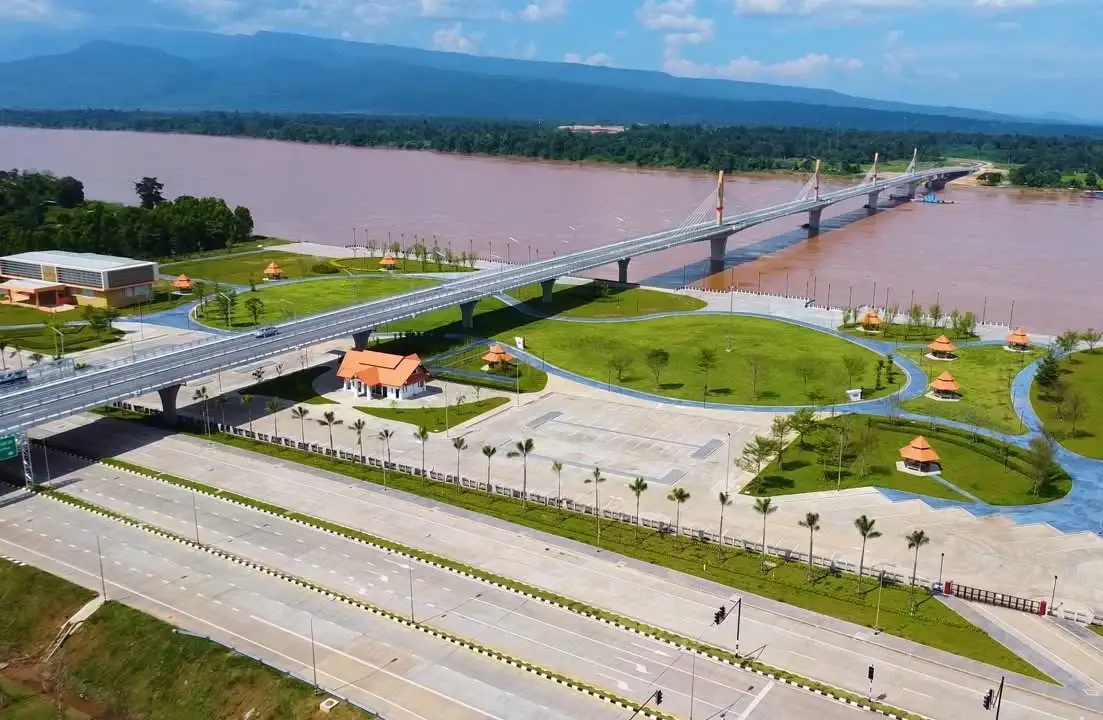
The Fifth Thai–Lao Friendship Bridge (Bueng Kan–Bolikhamxay) is an international bridge spanning the Mekong River between Thailand and the Lao People's Democratic Republic. It connects Bueng Kan Province in northeastern Thailand with Bolikhamxay Province in Laos. The bridge is a major transportation development for the upper northeastern region of Thailand, supporting passenger travel, international freight, cross-border trade, tourism, and relations between the two neighboring countries. The river-crossing structure measures 1,350 meters in length and uses a cable-stayed design. It has two traffic lanes and pedestrian walkways along both sides, although access to the walkways and other parts of the structure remains subject to border and traffic regulations. The official inauguration took place on December 25, 2025, and the bridge opened for public cross-border travel on December 27, 2025.
The Fifth Thai–Lao Friendship Bridge occupies an important position on the Mekong River, one of Southeast Asia's major waterways. For communities throughout the region, the Mekong has long served as a natural resource, a transport route, a source of livelihoods, and a boundary between countries. Building a permanent road bridge across the river represents more than the creation of a convenient crossing. It connects communities with longstanding historical and cultural ties through a modern transportation network. While river transport previously played a central role in local cross-border movement, the bridge provides an additional road-based alternative that makes travel between the two banks more continuous and practical.
On the Thai side, the bridge is situated in Mueang Bueng Kan District, Bueng Kan Province. The mapped location of the bridge itself is associated with Wisit Subdistrict, while the officially designated permanent border checkpoint is located at Ban Don Yom in Khai Si Subdistrict. This distinction matters for travelers because reaching a viewing location near the bridge and entering the immigration facilities are different activities. Anyone intending to cross the international border must follow the designated roads and enter the official checkpoint. A riverside viewpoint or the mapped position of the bridge should not be confused with the controlled border-crossing entrance.
On the Lao side, the bridge connects with Ban Kluai Udom near Pakxan in Bolikhamxay Province. Pakxan is an important Mekong riverside town and an administrative and economic center of the province. Its connection with Bueng Kan creates additional opportunities for travel between the two communities, while also providing access to road networks leading farther into Laos and toward Vietnam. The bridge therefore serves both immediate local travel needs and longer-distance transportation across the wider region.
The bridge's significance is closely connected with the geography of Bueng Kan Province. Located along the Mekong River on Thailand's northeastern border, Bueng Kan has road links to Nong Khai, Udon Thani, Sakon Nakhon, and Nakhon Phanom. The international crossing connects these domestic transportation routes to the Lao road network, strengthening Bueng Kan's role as a gateway for regional travel and trade. What was already an important riverside provincial center has gained an additional function as a strategic point in a wider cross-border transport system.
Before the Fifth Friendship Bridge entered service, travel between the Bueng Kan and Pakxan areas relied heavily on waterborne crossings and border facilities with operational limitations affecting vehicle types and transport capacity. A permanent road bridge makes it possible to accommodate cars, buses, and freight movements within an integrated road system. The associated immigration and customs facilities also provide dedicated spaces for checking travelers, vehicles, and goods. These developments are important for both safety and the orderly administration of international travel.
The Fifth Thai–Lao Friendship Bridge is a cooperative infrastructure project between the governments of Thailand and Laos. Transportation authorities and other responsible organizations on both sides participated in the project's development. The overall scheme includes the Mekong River bridge, approach roads, border checkpoint buildings, inspection facilities, and related transportation infrastructure. Together, these components strengthen international road connectivity and support economic cooperation within the Greater Mekong Subregion.
Construction was organized into separate components covering the approach roads, border facilities, and bridge structure. On the Thai side, the work included roads linking with the existing highway network, sections associated with the immigration and customs area, and the crossing over the Mekong River. This division allowed different types of engineering work to be carried out systematically. Building roads on land, providing facilities for border authorities, and constructing a major bridge across a large river each required different technical considerations. Coordination with Laos was also necessary to ensure that the roads and border systems would connect and function effectively.
The bridge spans approximately 1,350 meters across the Mekong River, reflecting both the scale of the waterway and the engineering complexity of constructing international infrastructure. Its cable-stayed design uses major supporting pylons and tensioned cables to transfer loads from the bridge deck into the structural system. This arrangement is suitable for substantial spans and creates a recognizable architectural form. The combination of pylons, cables, and an extended roadway gives the bridge a distinctive appearance when viewed from the riverbanks.
One of the most noticeable features is the arrangement of the bridge pylons and the cables extending outward toward the roadway. Their organized pattern recalls the form of the khaen, a traditional bamboo mouth organ closely associated with northeastern Thai and Lao culture. The architectural concept draws inspiration from this instrument, giving the bridge a cultural identity as well as a structural purpose. The design symbolizes the close cultural relationship between communities on both sides of the Mekong, combining modern engineering with regional heritage.
The bridge has two vehicle lanes and pedestrian walkways incorporated into the structure on both sides. Nevertheless, it is an international road crossing rather than an unrestricted public promenade. The existence of pedestrian walkways does not mean visitors may freely walk across the bridge, stop for photographs, or use every part of the structure as a leisure area. Access depends on traffic rules, border controls, and instructions issued by the responsible authorities. International travelers must complete all required immigration procedures rather than attempting to cross outside the designated system.
Landscaping and supporting facilities were also included in the development around the bridge approaches. The project area features connecting roads, open spaces, landscaped sections, and structures related to transportation and public use. These elements help create an organized and visually attractive gateway between the two countries. However, access to landscaped grounds, activity spaces, and riverside locations depends on which sections are open to the public. Visitors should not enter controlled border areas or international traffic lanes without authorization.
The official inauguration on December 25, 2025, was an important event in the history of relations between Thailand and Laos. His Majesty King Maha Vajiralongkorn and Her Majesty Queen Suthida of Thailand presided over the opening ceremony together with Lao President Thongloun Sisoulith and his spouse. The ceremony took place at the bridge in Bueng Kan Province and demonstrated the project's significance as a symbol of cooperation between the two countries. It also marked a major milestone in the development of modern transportation across the Mekong River in upper northeastern Thailand.
The opening also coincided with the 75th anniversary of diplomatic relations between Thailand and Laos in 2025. The relationship between the two countries extends beyond diplomacy and economics to include languages, cuisine, music, religious traditions, and everyday cultural practices shared by communities along the Mekong. The bridge therefore represents more than a physical connection. It embodies the development of longstanding cultural relationships into a large-scale infrastructure partnership between neighboring countries.
Following the inauguration, the bridge opened for public travel on December 27, 2025. Thailand's permanent border checkpoint is located at Ban Don Yom in Khai Si Subdistrict, Mueang Bueng Kan District, opposite the Lao crossing in the Ban Kluai Udom and Pakxan area of Bolikhamxay Province. The checkpoint accommodates the inspection of travelers, vehicle documents, and goods under the immigration and customs regulations of both countries. These facilities are essential for lawful and orderly international movement.
The permanent international border crossing operates daily from 06:00 to 22:00. These hours refer to border operations and should not be interpreted as unrestricted opening hours for sightseeing throughout the bridge complex. Travelers must follow immigration, customs, and other official procedures according to their nationality, travel purpose, and mode of transport. Documentation must be presented for inspection before proceeding to the next stage of the journey.
Crossing an international border differs fundamentally from traveling within one country. Passengers must complete the departure process in Thailand and the entry process in Laos. When returning, they undergo the corresponding procedures in reverse. The required documents depend on nationality, passport type, immigration status, visa conditions, and the purpose of the visit. It is therefore inappropriate to assume that one set of entry rules applies to every traveler using the bridge.
Thai nationals may travel to Laos using passports under the applicable regulations. Border passes and other travel documents, where accepted, are subject to restrictions concerning permitted destinations and duration of stay. A border pass is not equivalent to an internationally recognized passport for unrestricted travel. Anyone intending to continue beyond the areas authorized by the relevant travel document must ensure that their documents cover the full journey.
Foreign visitors traveling from Thailand into Laos must meet the Lao immigration requirements applicable to their nationality. Entry permission may depend on a visa, an authorized exemption, or another form of entry approval. The existence of a permanent international bridge does not guarantee visa-free entry for every nationality, nor does it establish that every type of visa can be obtained at the checkpoint. Entry decisions remain subject to Lao immigration law and the authority of border officials.
Taking a private vehicle across the bridge requires compliance with international vehicle travel regulations. In addition to the passports or travel documents of the driver and passengers, the journey may require vehicle registration, authorization documents, customs procedures, and appropriate insurance. Vehicles driven by someone other than the registered owner may require further documentation establishing permission to use the vehicle abroad. These requirements make private car travel more administratively demanding than using a scheduled international bus.
International bus services provide an important alternative for travelers who prefer not to drive across the border. A scheduled service linking Bueng Kan with Bolikhamxay began operating on January 8, 2026, using the Fifth Thai–Lao Friendship Bridge. The service enables passengers without private cars to travel between the two provinces through public transportation. It also supports tourism, business visits, family travel, and other forms of lawful cross-border movement.
When the international service was launched, the published fare between Bueng Kan and Bolikhamxay was 100 baht per passenger. Buses from Bueng Kan Provincial Bus Terminal were scheduled to depart at 08:00, 10:30, 13:00, and 15:30, with departures from Pakxan Bus Terminal listed at corresponding times. A separate cross-bridge shuttle service was also introduced, with an initial advertised fare of 20 baht per passenger and service hours from 08:00 to 17:00. These transport schedules are distinct from the border checkpoint's daily operating hours of 06:00 to 22:00.
International buses simplify some aspects of travel because passengers do not need to arrange private vehicle entry documents. However, bus passengers must still present the required personal travel documents and complete immigration procedures. Scheduled public transport improves accessibility between Bueng Kan and Pakxan for people who do not own cars. It can also support everyday cross-border activities, including shopping, business travel, and visiting relatives.
During the bridge's initial operating period, bridge tolls were waived while the relevant administrative and legal procedures were being completed. On August 18, 2026, the Thai Cabinet approved in principle a draft ministerial regulation establishing toll rates for different vehicle categories. The regulation provides for the commencement of toll collection on a date to be formally announced by the Director-General of the Department of Highways. Approval of a draft regulation is therefore not the same as the actual commencement of toll collection. Bridge tolls must also be distinguished from bus fares, visa expenses, and other travel-related charges.
The road network connecting to the bridge is just as important as the bridge itself. An international crossing can function efficiently only when approach roads, checkpoints, and inspection facilities are capable of handling different types of traffic. On the Thai side, Highway 244 provides the principal approach to the bridge and connects with Bueng Kan's wider road system. The design must accommodate private vehicles, passenger buses, and freight trucks, which require different circulation arrangements and inspection spaces.
On the Lao side, the bridge connects with the transportation network in Bolikhamxay, allowing onward travel from Pakxan to other parts of the country. This connectivity makes the bridge a component of a broader regional transport system rather than a crossing serving only two neighboring towns. Freight and passengers may originate in other provinces or countries and use the bridge as one stage of a longer journey.
An important strategic purpose of the Fifth Friendship Bridge is to strengthen road connections from Thailand through Laos toward Vietnam. The crossing offers an additional route for businesses and travelers moving between upper northeastern Thailand and central Vietnam. Nevertheless, the efficiency of international freight transport depends on several factors, including road conditions, customs clearance, vehicle standards, border regulations, and operating costs. The bridge adds valuable physical infrastructure, while its ultimate economic benefits depend on how effectively the entire transportation system functions.
Cross-border commerce benefits from better transportation alternatives because businesses gain more options for moving goods and planning routes. International freight must still undergo customs inspection, documentation checks, and any relevant taxation procedures. The bridge provides a physical route capable of supporting road transport, but it does not remove the legal requirements associated with exporting or importing goods. The development of supporting logistics services remains important to making full use of the crossing.
The bridge may also contribute to the long-term economy of Bueng Kan by creating opportunities for logistics companies, transport services, warehouses, hotels, restaurants, and tourism-related businesses. Easier road travel can increase the province's role as a stopover or starting point for journeys into Laos. However, actual economic growth depends on freight volumes, passenger demand, investment, and the availability of supporting services. The bridge establishes the foundation for broader connectivity rather than guaranteeing a particular level of commercial activity.
Tourism is another sector that benefits from the bridge. Visitors traveling in Bueng Kan can use the province as a gateway to Pakxan and other destinations in Bolikhamxay. At the same time, travelers from Laos gain an additional road connection to Bueng Kan's natural attractions, religious sites, and neighboring Thai provinces. The crossing therefore supports different styles of travel, ranging from short international visits and riverside sightseeing to longer journeys covering multiple provinces or countries.
The river landscape around the bridge is attractive in its own right. From publicly accessible points along the Mekong, visitors can observe the long bridge crossing the water and the distinctive pylons supporting its cables. The structure creates a striking contrast between modern engineering and the natural setting of the river. Changes in sunlight throughout the day alter the appearance of the pylons, cables, and bridge deck, making the crossing an interesting landmark in Bueng Kan's evolving cityscape.
Viewing the bridge from a permitted riverside area is different from crossing it. Travelers who wish to photograph the structure should use publicly accessible locations or areas specifically authorized by officials. Stopping vehicles on the bridge, parking along active international traffic lanes, or entering restricted checkpoint areas can be dangerous and may violate border security regulations. Attractive photographs can be taken from safe positions without interfering with traffic or inspection operations.
Landscaping within the bridge project gives the surrounding area a more organized appearance. Project photographs show connecting roads, open paved spaces, green areas, walkways, and smaller buildings associated with the overall development. These features contribute to the visual identity of the border gateway and may support public activities where access is permitted. However, the availability of individual grounds and paths depends on the authorities responsible for managing the site and the activities taking place at any given time.
The bridge's role as a symbol of public friendship is reflected in activities organized after its opening. On October 4, 2026, Bueng Kan Province held a cross-border cycling event connecting Bueng Kan and Bolikhamxay at the Fifth Thai–Lao Friendship Bridge. The event demonstrated how the crossing can represent social cooperation and friendly relations between the two countries, in addition to its transport and commercial functions. It also connected tourism, recreation, and cultural exchange between communities on opposite sides of the Mekong.
Although the bridge is a modern engineering achievement, the surrounding region has a much older cultural relationship with the Mekong River. Thai and Lao communities share traditions, food, languages, and ways of life shaped by generations of interaction. The Mekong is therefore both a political boundary and a cultural link. The Fifth Friendship Bridge gives this connection a physical form through which people can travel between neighboring communities as part of everyday life.
Bueng Kan Province offers a varied landscape of rivers, wetlands, forests, and sandstone mountains. A journey involving the Fifth Friendship Bridge can therefore be combined with several types of local sightseeing. Travelers interested in riverside culture can continue into Bueng Kan town, while those interested in nature may explore Nong Kut Thing, Phu Sing, or the forests and waterfalls of Phu Wua. These attractions differ in location, accessibility, and the time required for a visit.
Nong Kut Thing is an important wetland in Mueang Bueng Kan District and is recognized for its rich biological diversity. It is designated as a Wetland of International Importance under the Ramsar Convention. The area supports various aquatic organisms, plants, and bird species, making it an important place for understanding freshwater ecosystems. Visiting Nong Kut Thing and the international bridge within the same trip provides contrasting perspectives on the province's waterways: one emphasizes wetland ecology, while the other demonstrates modern transport across the Mekong.
Wat Ahong Silawat is an important Buddhist temple on the Mekong River in Khai Si Subdistrict, Mueang Bueng Kan District. Located near Kaeng Ahong, the temple is associated with river landscapes and local traditions concerning the so-called Navel of the Mekong. It houses the revered Phra Phuttha Khuwa Nan Sasada Buddha image. Its riverside setting and natural rock scenery create a peaceful atmosphere. Combining a visit to the bridge with Wat Ahong Silawat allows travelers to experience both modern infrastructure and a religious landmark deeply connected with Mekong culture.
Kaeng Ahong is a stretch of the Mekong known for its natural rocks, water movement, and local folklore. Traditional stories describe unusual river depths and beliefs associated with the Naga, the mythical serpent prominent in Mekong cultural traditions. These narratives form part of the region's religious and cultural heritage. Visiting the area offers a different perspective on the river from the view near the bridge and demonstrates the strong relationship between natural landscapes and local beliefs.
Markets and commercial areas in Bueng Kan town are another expression of the province's border identity. Trading relationships between communities along the Mekong have existed for generations, and the opening of the bridge adds another means of reaching the town. International travelers can use local restaurants, shops, and accommodation before continuing to other Thai provinces. Improvements in transport therefore influence the local urban economy as well as longer-distance regional trade.
Phu Sing is another major natural attraction in Bueng Kan Province. Its landscape contains sandstone hills, unusual rock formations, and forest viewpoints. The most famous landmark is Three Whale Rock, which has become a recognizable symbol of the province. Traveling from the bridge to Phu Sing provides a dramatic change of scenery, from an international transport gateway beside the Mekong to a mountainous forest landscape shaped by geological processes.
Three Whale Rock consists of three enormous sandstone formations extending above the forest canopy. Seen from above, they resemble a family of whales swimming together. The area is famous for sunrise views and extensive panoramas of the surrounding woodland. A trip combining the international bridge and Three Whale Rock demonstrates Bueng Kan's contrasting attractions, bringing together a major work of modern engineering and extraordinary natural sandstone formations within the same province.
Phu Thok, in Si Wilai District, is another significant destination in Bueng Kan. It features a sandstone mountain with wooden walkways along the cliff and is closely connected with Luang Pu Juan Kulachettho, a respected monk in Thailand's forest meditation tradition. Phu Thok therefore combines scenic geology with Buddhist religious heritage. Visitors should allocate appropriate time and consider the physical demands of its walking routes, which differ substantially from viewing a bridge or exploring a riverside public area.
For travelers crossing into Laos, Pakxan is the principal town connected directly with the bridge. It serves as an administrative and commercial center of Bolikhamxay Province. Continuing into Pakxan provides an opportunity to experience a Lao town beside the Mekong and connect with the country's main road network. Travelers must comply with immigration permission, authorized lengths of stay, and any vehicle regulations that apply to their journey within Laos.
Road travel onward through Laos toward Vietnam is one of the wider transport purposes the bridge is intended to support. The crossing creates another option for businesses and international travelers moving between countries. However, a multi-country journey involves separate entry and exit requirements at each national border. Personal documents, vehicle authorization, and applicable customs procedures must be addressed independently. Crossing from Thailand into Laos does not automatically authorize entry into a third country.
Local cuisine adds another dimension to a visit to Bueng Kan. Restaurants in Mueang Bueng Kan District serve northeastern Thai dishes, regional specialties, and meals featuring Mekong River fish, depending on the establishment. People traveling through the bridge area can dine in town or along connecting roads. A stop at a local restaurant provides an opportunity to experience everyday life and the culinary traditions shared across the Thai–Lao border region.
Accommodation in Mueang Bueng Kan District ranges from town hotels to riverside properties and smaller resorts in surrounding communities. Travelers crossing the border may choose to stay overnight before or after their international journey to coordinate their arrival with checkpoint and bus service hours. Staying in the town center provides access to restaurants, shops, and major roads, particularly for travelers continuing to other provinces in northeastern Thailand.
Different authorities are responsible for different aspects of the Fifth Thai–Lao Friendship Bridge. The Department of Highways plays a central role in the bridge and connecting road infrastructure. Immigration officials inspect personal travel documents, while customs officers oversee applicable procedures for goods and vehicles. Border administration also involves coordination with security authorities and the corresponding Lao agencies. These responsibilities ensure that infrastructure management and international border operations are carried out within their respective legal frameworks.
Like other major transport structures, the bridge requires continuing maintenance. Its deck, pylons, cables, drainage systems, lighting, and safety installations must be managed according to engineering standards. The use of the bridge by private vehicles and freight trucks makes structural inspection and maintenance especially important. Traffic rules, vehicle weight limits, and operational restrictions are part of the measures that help preserve its safe performance over time.
For visitors interested in architecture and engineering, the bridge is a clear example of a cable-stayed structure. Looking at it from the side reveals how groups of cables extend from the pylons toward the road deck. The bridge presents an impressive architectural composition while fulfilling a demanding structural function. Its culturally inspired design, based on the khaen musical instrument, adds another layer of meaning to the engineering achievement.
Designing and operating an international bridge involves considerations beyond those of an ordinary domestic road crossing. Officials must coordinate traffic arrangements, entry procedures, and controls governing the movement of people and goods between two sovereign countries. The checkpoint system is therefore an essential component of the overall infrastructure. The bridge is not simply an extension of a road; it forms part of a complex border administration network in which several public agencies operate together.
The Mekong River itself adds considerable natural interest to the setting. Its width, seasonal water levels, and banks create different views throughout the year. During periods of high water, the appearance and movement of the river differ from those seen when levels are lower. Safely observing the bridge from an authorized riverside location therefore also provides an opportunity to appreciate the relationship between a major man-made structure and the natural river environment.
The Fifth Thai–Lao Friendship Bridge belongs to a continuing network of friendship bridges built between the two countries. The First Friendship Bridge connects Nong Khai with Vientiane, the Second links Mukdahan with Savannakhet, the Third connects Nakhon Phanom with Khammouane, and the Fourth links Chiang Khong with Huay Xai. The Fifth adds the Bueng Kan–Bolikhamxay route, expanding the number of major road crossings over the Mekong. Each bridge serves a different geographical corridor and contributes to the wider system of transport connections between Thailand and Laos.
Viewed together, the five friendship bridges illustrate how cross-Mekong infrastructure development goes beyond connecting neighboring towns. The bridges support broader networks of trade, travel, and regional economic activity. Each crossing connects with different highways and population centers, allowing transport operators and travelers to select routes according to their origins, destinations, and travel needs. The Fifth Friendship Bridge is therefore part of a larger transportation strategy rather than an isolated construction project.
In daily life, the bridge also supports social connections between neighboring communities. Thai and Lao people have long maintained relationships through trade, family ties, employment, education, and cultural exchange. A permanent road crossing provides an additional lawful and practical means of maintaining these relationships. The bridge serves not only government-level cooperation but also the movement and interaction of ordinary people.
Visitors and motorists must observe traffic rules and instructions from border officials. The bridge is used by private vehicles, scheduled buses, and freight trucks, making orderly traffic management essential. Stopping in prohibited areas, entering restricted facilities, or crossing barriers without permission can interfere with operations and create safety concerns. Photography within checkpoint or security-sensitive areas may also be restricted by the authorities responsible for the facilities.
Drivers taking vehicles across the border must also consider differences in traffic systems, insurance requirements, and road regulations between Thailand and Laos. Crossing into a foreign road network requires attention to signs and traffic arrangements, especially around the controlled areas of the border complex. Following official directions helps reduce confusion where vehicles entering and leaving the two countries may converge.
The checkpoint's operating hours of 06:00 to 22:00 are important for journey planning, but they should not be confused with public transport schedules. International buses and cross-bridge shuttles operate according to their own published timetables. Travelers using private cars should allow sufficient time for personal and vehicle inspections on both sides. Anyone continuing beyond Pakxan should also consider onward travel distances and conditions on the Lao road network.
The bridge is not a temple, museum, or conventional attraction with an ordinary admission ticket. Crossing it involves transport arrangements, applicable vehicle toll regulations, and potentially immigration-related expenses. These are different from bus fares and the costs of travel documents. Viewing the bridge from an authorized public riverside area is also a different activity from crossing the international border. Consequently, transport charges should not be described as a standard admission fee for sightseeing.
With the Fifth Thai–Lao Friendship Bridge now operating, Bueng Kan has gained an important modern landmark that reflects the changing role of the province. The crossing strengthens its place within the regional transport network while complementing the natural and cultural attractions already found along the Mekong and farther inland. Visitors can experience the province's river landscapes, wetlands, temples, and sandstone mountains while also seeing a major engineering structure connecting Thailand with a neighboring country.
Getting There: The Fifth Thai–Lao Friendship Bridge can be reached by private vehicle or local transport from Bueng Kan town. Follow the road network in Mueang Bueng Kan District toward Highway 244, which serves as the approach road to the Mekong crossing. International travelers must follow signs to the permanent border checkpoint at Ban Don Yom in Khai Si Subdistrict and enter the designated inspection area. Visitors intending only to view the bridge should use authorized public access points along the river rather than entering immigration lanes or stopping in restricted traffic areas.
Travelers without private vehicles can use the international bus service from Bueng Kan Provincial Bus Terminal toward Pakxan. The service began operating on January 8, 2026, and cross-bridge shuttle arrangements were also announced for passengers. Public transportation reduces the need to arrange documentation for a privately owned vehicle, but all passengers must still hold valid travel documents and complete the necessary border procedures.
The Fifth Thai–Lao Friendship Bridge is a symbol of the continuing development of relations between Thailand and Laos at a time when international road transport is increasingly important for trade and travel. Its cable-stayed structure above the Mekong is significant not only for engineering but also for its cultural symbolism, particularly the architectural concept inspired by the khaen. The bridge's inauguration in late 2025 marked an important milestone for Bueng Kan Province and strengthened its role as a gateway for regional commerce, international journeys, and tourism across the Greater Mekong Subregion.
| Name | Fifth Thai–Lao Friendship Bridge (Bueng Kan–Bolikhamxay) |
| Category | International river bridge and permanent cross-border road connection |
| Thai-Side Bridge Location | Wisit Subdistrict area, Mueang Bueng Kan District, Bueng Kan Province 38000, Thailand |
| Thai Border Checkpoint | Ban Don Yom, Khai Si Subdistrict, Mueang Bueng Kan District, Bueng Kan Province |
| Lao-Side Connection | Ban Kluai Udom, Pakxan District, Bolikhamxay Province, Lao People's Democratic Republic |
| River Crossed | Mekong River |
| Bridge Length | 1,350 meters |
| Bridge Design | Cable-stayed bridge with two traffic lanes and pedestrian walkways on both sides |
| Architectural Inspiration | The khaen, a traditional musical instrument associated with northeastern Thai and Lao culture |
| Official Inauguration | December 25, 2025 |
| Public Opening Date | December 27, 2025 |
| Border Crossing Days | Daily |
| Border Crossing Hours | 06:00 – 22:00 |
| Bridge Toll Status | Tolls were waived during the initial operating period. On August 18, 2026, the Thai Cabinet approved in principle a draft toll regulation; collection begins only in accordance with the relevant formal announcement. |
| International Bus Fare | 100 baht per passenger, according to the fare announced at the January 2026 launch |
| Cross-Bridge Shuttle Fare | 20 baht per passenger, according to the January 2026 announcement |
| Bueng Kan Bus Departures | 08:00, 10:30, 13:00, and 15:30, according to the January 2026 published schedule |
| Cross-Bridge Shuttle Hours | 08:00 – 17:00, according to the January 2026 published schedule |
| Connecting Roads | Thailand's Highway 244, linking with the road network around Pakxan, Bolikhamxay Province |
| Responsible Authorities | Department of Highways, immigration authorities, customs authorities, and the responsible Thai and Lao border agencies according to their respective duties |
| Main Infrastructure | Bridge structure, approach roads, border checkpoint buildings, vehicle inspection areas, and landscaped areas around the approaches |
| Visitor Access | Access to the bridge and checkpoint facilities is controlled. The structure is not an unrestricted public promenade or stopping area. |
| Border Documents | Passports or other authorized border documents according to eligibility, along with applicable vehicle paperwork when driving internationally |
| Bus Information Phone | Bueng Kan Provincial Bus Terminal: +66 42 490 690 |
| Attractions In The Wider Area | 1. Bridge riverside landscape viewing areas – within the bridge project area 2. Nong Kut Thing Wetland – Mueang Bueng Kan District 3. Wat Ahong Silawat – Khai Si Subdistrict 4. Kaeng Ahong – beside Wat Ahong Silawat 5. Phu Sing – Khok Kong Subdistrict 6. Three Whale Rock – within Phu Sing 7. Phu Thok – Si Wilai District |
| Restaurants In Mueang Bueng Kan District | 1. Krua Sawoey – Wisit Subdistrict, Tel. +66 87 919 4792 2. Krua Hai Yok – Mekong Riverside Road, Tel. +66 88 062 1550 3. Krua Ma – Prasat Chai Road, Tel. +66 42 403 343, +66 81 050 1199 4. Krua Mae Ma – Wisit Subdistrict, Tel. +66 42 491 037 5. Khao Piak Ban Ton – Wisit Subdistrict, Tel. +66 42 491 345 6. Mukda Bakery – Wisit Subdistrict, Tel. +66 42 491 339 7. Khlong Samran Restaurant – Mueang Bueng Kan District, Tel. +66 84 601 9699 |
| Accommodation In Mueang Bueng Kan District | 1. The One Hotel Bueng Kan – Bueng Kan–Nakhon Phanom Road, Tel. +66 42 492 234 2. BK Place Hotel – Mueang Bueng Kan District, Tel. +66 99 638 0988 3. Century Grand Hotel – Mueang Bueng Kan District, Tel. +66 42 492 790 4. Tawa Dai Resort – Ban Saen Suk, Mueang Bueng Kan District, Tel. +66 42 492 225 5. Maena Hotel – Wisit Subdistrict, Tel. +66 42 491 051 6. Khong Sunshine – Wisit Subdistrict, Tel. +66 62 130 4066 7. Ratchawadee Residence – Wisit Subdistrict, Tel. +66 81 871 5447 |
Frequently Asked Questions (FAQ)
Q: Is the Fifth Thai–Lao Friendship Bridge open?
A: Yes. The bridge was officially inaugurated on December 25, 2025, and opened for public cross-border travel on December 27, 2025, linking Bueng Kan Province in Thailand with Bolikhamxay Province in Laos.
Q: Where is the Fifth Thai–Lao Friendship Bridge located?
A: The bridge crosses the Mekong River between Mueang Bueng Kan District in Thailand and Pakxan in Bolikhamxay Province, Laos. The permanent Thai border checkpoint is located at Ban Don Yom, Khai Si Subdistrict, Mueang Bueng Kan District.
Q: What are the opening hours of the border checkpoint?
A: The permanent border crossing operates daily from 06:00 to 22:00. These are immigration and border operating hours, not unrestricted sightseeing hours for the bridge.
Q: Is there a toll for crossing the Fifth Friendship Bridge?
A: Bridge tolls were waived during the initial operating period. On August 18, 2026, the Thai Cabinet approved in principle a draft regulation establishing vehicle toll rates. Actual collection must begin in accordance with the relevant formal announcement.
Q: Can travelers take a bus from Bueng Kan into Laos?
A: Yes. An international bus service between Bueng Kan and Bolikhamxay began on January 8, 2026. The fare announced at launch was 100 baht per passenger, and a separate cross-bridge shuttle was announced at 20 baht per passenger.
Q: How long is the Fifth Thai–Lao Friendship Bridge?
A: The bridge spans 1,350 meters across the Mekong River. It has a cable-stayed design with two traffic lanes, and its architecture draws inspiration from the khaen, a traditional musical instrument shared by northeastern Thai and Lao cultures.
Q: Can travelers drive private cars across the bridge into Laos?
A: Private vehicle crossings are possible when travelers meet the applicable entry and vehicle regulations of both countries. Drivers must carry the required personal documents and vehicle paperwork and complete immigration and customs procedures.
Q: What attractions can be visited in Bueng Kan near the bridge region?
A: Notable attractions in the wider province include Nong Kut Thing Wetland, Wat Ahong Silawat, Kaeng Ahong, Phu Sing, Three Whale Rock, and Phu Thok. These destinations offer a combination of natural scenery, Buddhist heritage, and Mekong riverside culture.
 Category: ●Art, Culture and Heritage
 Group: ●Landmarks and Memorials
Last Update : 2 WeekAgo
 Last Update : 2 WeekAgo
 Click to Access the Navigation Map GPS
Fifth Thai–Lao Friendship Bridge Map
Recommend
 Landmarks and Memorials(1)
 Museums(1)
 Places of Worship
 Temple(12)
 Other Sacred Sites(4)
 Suburban Living
 Local Market(1)
 Nature and Wildlife
 National Parks and Marine Reserves(1)
 Mountain (Doi)(3)
 Waterfalls(5)
 Caves(1)
 River, Canal(4)
 Bays and Beaches(1)
 Islands(1)
 Entertainment and Agricultural
 Waterpark(1)
 Shopping
 Shopping and Night Market(1)
 Travel Articles, Recipes
 Travel Review, Food Review(1)


