
lovethailand home >Northeastern Travel Attractions >Bueng Kan Travel Attractions >Mueang Bueng Kan >Khok Kong > Hin Sam Wan
TL;DR: Hin Sam Wan is located at Ban Non Sai Thong, Khok Kong Subdistrict, Mueang Bueng Kan District, Bueng Kan Province 38000, Thailand, open Daily, hours 05:00 – 17:00.
Hin Sam Wan
Open Days: Daily
Opening Hours: 05:00 – 17:00
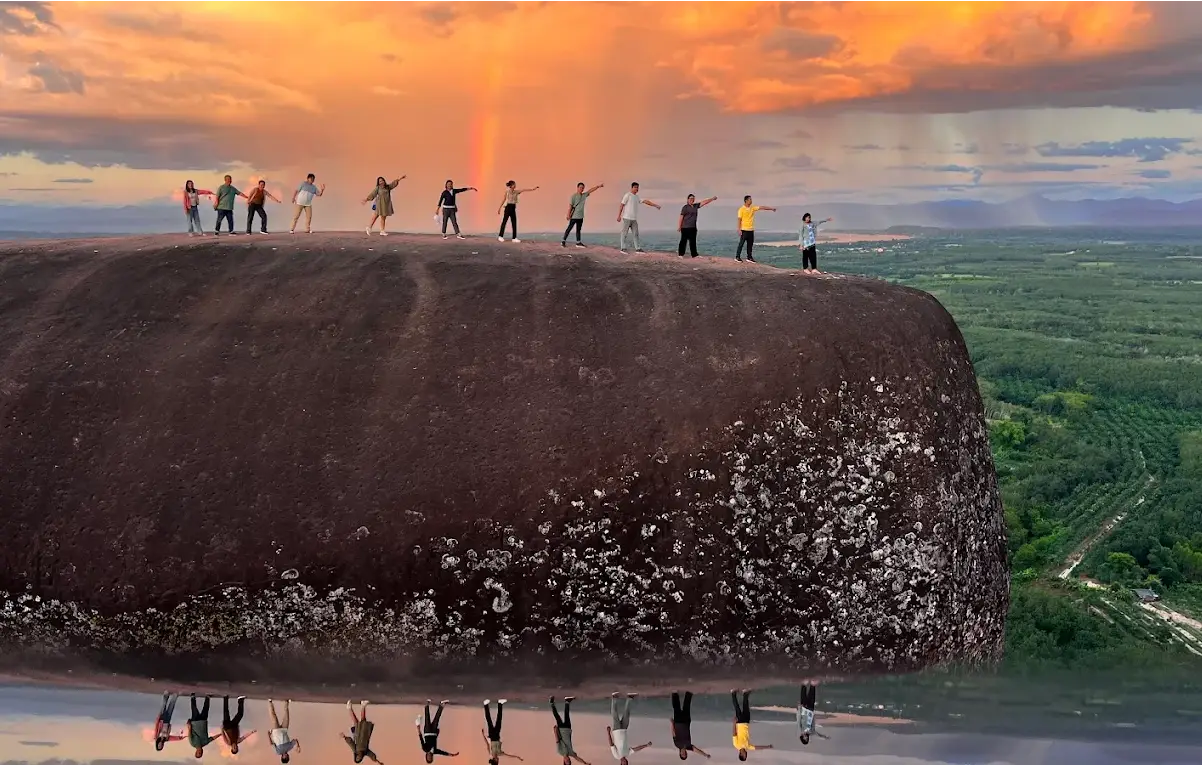
Hin Sam Wan, or Three Whale Rock, in Bueng Kan Province is one of the most distinctive natural attractions in northeastern Thailand. Located near Ban Non Sai Thong in Khok Kong Subdistrict, Mueang Bueng Kan District, the formation lies within the forested landscape of Phu Sing. Its most remarkable feature is a group of three enormous sandstone formations extending outward from a high cliff above a dense green forest. Seen from above, these elongated rocks resemble a family of three whales swimming together through a sea of trees. This striking natural resemblance inspired the name Three Whale Rock. Formed through geological processes and prolonged natural weathering, the rocks have become an iconic landmark of Bueng Kan and a memorable destination for travelers interested in unusual landscapes, scenic viewpoints, and the natural heritage of Thailand.
The appeal of Three Whale Rock extends far beyond the unusual shape of the stones. Its elevated position on Phu Sing provides expansive views over the forested landscape of Bueng Kan and, on clear days, distant mountains across the border in Laos. Visitors can admire a panorama of woodland, sandstone hills, and terrain connected to the Mekong River basin. Sunrise is particularly impressive, as the first light gradually illuminates the forest and changes the color of the sandstone surfaces. The combination of early morning light, vast natural surroundings, and the remarkable whale-shaped formations creates a peaceful and unforgettable experience.
Three Whale Rock forms part of Phu Sing, a protected forest landscape situated within the national reserved forests of Dong Dip Kala, Phu Sing, and Dong Si Chomphu. The area extends across parts of Mueang Bueng Kan and Si Wilai districts. Its terrain is characterized by sandstone mountains extending approximately north to south, with cliffs, rock platforms, caves, massive boulders, and unusual natural formations distributed throughout the forest. The distinctive scenery has developed through a combination of geological structures and environmental processes, including rainwater erosion, weathering, temperature changes, and the gradual breakdown of exposed sandstone.
The Phu Sing forest area covers approximately 12,000 rai, equivalent to about 1,920 hectares. Its forests and mountains form an important part of Bueng Kan's natural environment, supporting local ecosystems and contributing to the conservation of vegetation, soil, and water resources. The surrounding forest is also essential to the visual identity of Three Whale Rock. From an elevated viewpoint, the large sandstone formations appear to float above the canopy, their dark surfaces contrasting sharply with the surrounding green vegetation. Without this extensive forest backdrop, the formations would lose much of the extraordinary appearance that makes them famous.
Aerial views reveal the true character of the rock formation. The three sandstone masses are elongated, gently rounded, and positioned close together, with their projecting ends pointing in similar directions. Together, they resemble enormous marine animals moving through the forest. This striking arrangement led local people and visitors to identify the formations as Father Whale, Mother Whale, and Baby Whale. These descriptive names give the site a memorable identity while highlighting the remarkable relationship between the rocks' shapes and their positions in the landscape.
Father Whale is one of the most prominent formations and attracts particular attention because of its imposing size and scenic position. Mother Whale lies nearby and provides another perspective from which visitors can appreciate the scale and outline of the larger rock. Baby Whale is smaller and completes the family-like arrangement visible in aerial photographs. Access to the individual formations is controlled for safety reasons, as the rocks are positioned along a high cliff and not every section is suitable for walking. Visitors must remain within the areas designated by local authorities.
The name Three Whale Rock illustrates how people interpret natural landforms through familiar images. Similar naming traditions are found at geological attractions across Thailand, where rocks are described as resembling elephants, hearts, or other recognizable objects. What makes Three Whale Rock particularly unusual is the presence of three massive formations arranged in a coherent pattern above the surrounding woodland. Their number, alignment, and elongated contours create an image that is immediately recognizable from the appropriate viewpoint, especially when viewed from above.
Geologically, the sandstone associated with Three Whale Rock is commonly described as being approximately 75 million years old. This figure refers to the estimated age of the geological material and should not be interpreted as the age of the present whale-like shapes. The formations acquired their distinctive appearance through later landscape evolution, during which weathering, erosion, and structural weaknesses gradually transformed the original rock masses. Such processes operate over long periods and continue wherever exposed sandstone interacts with its surrounding environment.
Sandstone develops from deposits of sand that accumulate through natural sedimentary processes. Over time, burial, compaction, and mineral cementation transform loose sediment into solid rock. Later geological changes can expose these rock layers at the Earth's surface, where rainfall, wind, moisture, and temperature variations begin to influence their appearance. As erosion removes weaker material, the landscape develops cliffs, exposed rock platforms, openings, and isolated or partially separated masses of stone. Three Whale Rock is an impressive example of the complex forms that can emerge from these ordinary geological processes.
Weathering does not affect every section of sandstone equally. Differences in mineral composition, cementation, natural fractures, and exposure to water can make some portions more resistant than others. Areas containing weaknesses may deteriorate more rapidly, while stronger sections remain standing. This uneven process, known as differential weathering and erosion, helps explain why large rocks can develop different shapes despite being located within the same geological landscape.
The long, projecting forms at Three Whale Rock reflect the relationship between sandstone structure, existing fractures, and prolonged erosion. As less resistant material was progressively removed, more durable sections remained exposed as substantial elongated formations. Their resemblance to whales is entirely natural rather than the result of human carving or deliberate arrangement. For visitors interested in geology, the site demonstrates how variations within a rock formation can influence the development of an extraordinary landscape.
The surfaces of the formations differ from the small stones commonly encountered along rivers or beaches. Three Whale Rock consists of enormous sandstone masses that remain associated with the mountain landscape. Some exposed surfaces are broad and relatively smooth, while others have natural fractures, grooves, or uneven sections. Their colors vary with moisture and sunlight. The rocks can appear warmer in early sunlight, more intensely illuminated at midday, and darker after rain. Wet conditions also make the surfaces more slippery and require additional caution.
The site's most recognizable appearance is best understood from an aerial perspective, where all three rocks and the gaps between them are visible simultaneously. From this angle, the formations resemble whales traveling together through an expansive green canopy. Standing on the rocks themselves provides a different experience. Visitors appreciate the size of the sandstone, the height of the viewpoint, and the surrounding scenery rather than the complete whale-shaped composition. Both perspectives contribute to the attraction's unusual character.
The forest landscape is inseparable from the appeal of Three Whale Rock. The canopy below the formations provides the visual impression of a green sea, creating the contrast that makes the sandstone appear to float above the trees. The surrounding vegetation is not merely a background for photography; it is an essential component of the local ecosystem. Conserving this forest helps protect soils, natural water processes, wildlife habitats, and the environmental quality of the mountain.
Phu Sing contains several scenic viewpoints distributed across different parts of the mountain. Some face toward the sunrise, while others provide excellent views toward the setting sun. Three Whale Rock is located on the eastern side of Phu Sing and is particularly famous for early morning scenery. Viewpoints farther west, including Sang Roi Bo, offer different lighting and landscape perspectives later in the day. This variety allows visitors to experience several distinct aspects of the mountain during a single excursion.
Sunrise is among the most memorable times to visit Three Whale Rock. As daylight begins to spread across the horizon, the forested landscape gradually emerges from darkness. Depending on atmospheric conditions, the sky may display soft shades of orange, gold, and pink. Shadows stretch across the sandstone while distant ridges become increasingly visible. The open viewpoint provides an exceptional setting for enjoying the quiet atmosphere of dawn and observing the changing light above the trees.
Under suitable weather conditions, mist may settle across lower valleys and forested terrain, adding another dimension to the scenery. White layers of moisture above the green canopy can create an especially dramatic landscape. However, mist is a natural weather phenomenon and does not appear every morning. The distinctive sandstone formations, expansive views, and forest surroundings remain impressive even in clear conditions without mist.
From the viewpoint, visitors can look across the landscape toward Phu Wua forest, Huai Bang Bat, Kaeng Sadok, sandy areas along the Mekong River, and the mountains around Pak Kading in the Lao People's Democratic Republic when visibility allows. These distant landmarks illustrate Bueng Kan's position along Thailand's northeastern border and its relationship with the wider Mekong basin. The panorama includes a combination of mountains, forest, lowland terrain, and river-related landscapes that characterize this part of Southeast Asia.
The Mekong River is central to the geography and cultural history of Bueng Kan. It has influenced settlement patterns, transportation, livelihoods, and the traditions of communities along its banks. Viewing the wider landscape from Phu Sing provides a different understanding of this region than traveling along the riverside itself. From the mountain, visitors can appreciate the relationship between forested uplands, agricultural areas, settlements, and the river basin that connects communities on both sides of the international border.
Visiting Three Whale Rock begins at the visitor service area near the access road to Phu Sing. The mountain is reached through an organized sightseeing transport system. Sections of the access route are narrow, steep, and unpaved, making the terrain unsuitable for ordinary passenger vehicles. Visitors therefore use locally operated pickup trucks that are appropriate for the mountain roads. This arrangement improves safety and helps regulate traffic and access within the forest.
The sightseeing transport service is an important part of the experience because Phu Sing's attractions are distributed across several locations. The trucks carry visitors along the mountain route, allowing them to stop at natural landmarks and viewpoints. Drivers familiar with local conditions manage the journey through steep and uneven sections. This makes it possible for travelers to focus on the scenery rather than navigating difficult roads independently.
The published sightseeing truck charge is 500 baht per vehicle. This is a vehicle-based service fee for touring designated areas of Phu Sing rather than an individual admission charge. The transport system allows groups to travel together under the guidance of people familiar with the route. Passenger numbers, departure arrangements, and specific tour conditions remain subject to the service operator's current safety requirements.
From the parking area near Three Whale Rock, visitors walk approximately 200 meters to reach the viewpoint. This final section provides a transition from the vehicle route to the exposed sandstone landscape. Although the walking distance is relatively short, caution is essential because the ground includes natural rock surfaces and areas near steep drops. Comfortable walking shoes with good traction are strongly preferable to sandals or footwear with slippery soles.
The viewing area is relatively open and can be exposed to direct sunlight and wind. Its impressive width should not create a false sense of security because the site is positioned above a substantial cliff. Visitors must stay within permitted areas and avoid approaching the exposed edges unnecessarily. Excellent photographs and panoramic views can be enjoyed from secure positions without standing at the most dangerous parts of the formations.
Not all three whale-shaped rocks are accessible to visitors. Access to Father Whale and Mother Whale is subject to designated routes and local safety management. Baby Whale is not open for direct visitor access because of the surrounding terrain and safety limitations. These restrictions should be respected at all times. Three Whale Rock is a natural cliff environment rather than a purpose-built observation deck with continuous protective railings.
Photography between the accessible formations is particularly rewarding. Looking from Mother Whale toward Father Whale can emphasize the rock's length, curved profile, and striking position above the forest. Small changes in camera angle can transform the composition without requiring visitors to step beyond safe boundaries. A suitable lens and careful positioning are more valuable than taking unnecessary risks for a dramatic photograph.
Three Whale Rock is only one of several attractions within Phu Sing, making the wider area suitable for a half-day nature excursion. Different viewpoints offer distinctive geological forms and scenery. Visitors can choose the locations best suited to their available time, interests, and mobility. A sightseeing route through several stops provides a more comprehensive understanding of the mountain than visiting the whale-shaped formations alone.
Tham Rue Si Viewpoint, or Hermit Cave Viewpoint, is one of the natural attractions located near Three Whale Rock. It offers another perspective on Phu Sing's sandstone and forest scenery. The surrounding environment includes rock formations and woodland, creating a quieter landscape experience distinct from the exposed whale-shaped cliff. It is a convenient additional stop when exploring the mountain through the organized sightseeing route.
Elephant Head Rock is another well-known natural formation on Phu Sing. Located toward the western side of the mountain, it is named for its resemblance to an elephant's head. Its shape and surroundings differ from those of Three Whale Rock, making it an interesting example of the diversity of sandstone landforms within the same protected forest landscape. The two attractions demonstrate how natural erosion can produce shapes that people associate with very different animals.
Other elephant-shaped rock formations and viewpoints add further variety to the Phu Sing route. These places are recognized for contours that suggest the forms of elephants when viewed from suitable positions. The appeal lies not only in their imaginative names but also in the surrounding mountains and woodland. Together, they offer a useful comparison with the elongated forms of Three Whale Rock and illustrate the diversity of shapes produced by sandstone weathering.
Phu Sing Heart is another named geological attraction associated with the mountain's western landscape. It is recognized for a distinctive rock shape and its position near steep natural terrain. The surrounding vegetation and orientation create scenery different from the eastern viewpoints around Three Whale Rock. Exploring both sides of the mountain reveals how the same sandstone landscape can offer varied views, geological features, and lighting conditions.
Lan Tham is an interesting natural rock platform with a cultural identity reflected in its name. The exposed sandstone contains numerous hollows and depressions formed through prolonged natural erosion and weathering. These features demonstrate how water and environmental processes can gradually transform a solid rock surface into an irregular landscape. Visiting Lan Tham adds an educational dimension to the trip by highlighting smaller-scale geological formations rather than only the massive cliffs and boulders.
Sang Roi Bo is another notable attraction within Phu Sing. Its name refers to the numerous depressions that appear across the sandstone surface. The hollows vary in size, depth, and shape, creating a patterned rock platform that differs considerably from the smoother surfaces of Three Whale Rock. Water movement, erosion, and weathering have played important roles in developing these features, making the area an excellent example of distinctive sandstone geomorphology.
The name Sang Roi Bo reflects the many holes and pools visible on the rock platform. Visitors can observe their varied dimensions from permitted walking areas. The site is also recognized as a sunset viewpoint because its position offers favorable views toward the western landscape. Whereas Three Whale Rock is associated with sunrise, Sang Roi Bo provides a contrasting experience in the late afternoon, allowing travelers to appreciate Phu Sing in a different light.
Phu Sing Wall is recognized for a substantial natural rock formation resembling a long wall. Its shape evokes a constructed structure, although it is entirely the result of natural geological processes. The site illustrates how fractures and differential erosion can create large linear forms within sandstone. The combination of these dramatic rocks and surrounding vegetation adds another dimension to the scenic character of the mountain.
Phu Sing Gate and the area known as Heaven's Gate are associated with openings and separated sandstone formations that resemble entrances or gateways. Their names arise from the appearance of rock masses divided by natural gaps. Such landscapes demonstrate the importance of joints and fractures in the development of sandstone terrain. They also show how local naming traditions help visitors recognize and remember distinctive geological landmarks.
Tham Yai, or Big Cave, is another landmark included in descriptions of the Phu Sing sightseeing route. The site is associated with sandstone rock spaces and natural openings. Cave-like formations and rock shelters can develop where fractures, erosion, and weathering create cavities or spaces beneath exposed rock masses. Together with the cliffs, sculpted boulders, and open platforms elsewhere on the mountain, these features contribute to the diversity of Phu Sing's natural scenery.
Phu Sing also has places connected with Buddhist devotion. A Buddha image known as Luang Pho Phra Sing is enshrined near a rock shelter, reflecting the connection between natural mountain landscapes and religious practices in Thailand. Forests and rocky hills have frequently served as peaceful settings for religious contemplation and worship. Visitors to such places should behave respectfully and recognize their importance to the people who regard them as sacred.
Taken together, the attractions of Phu Sing demonstrate that the area is much more than the location of Three Whale Rock. Its sandstone landscape includes animal-shaped formations, enormous natural walls, pitted rock platforms, caves, cliff viewpoints, and irregular stone passages. Exploring these landmarks provides an opportunity to understand different forms of geological weathering and appreciate the relationship between exposed rock and the surrounding forest ecosystem.
Phu Sing's conservation status is closely connected with the management of the national reserved forest landscape. Protecting vegetation, sandstone formations, and sensitive natural areas is essential to maintaining the destination's long-term value. Organized sightseeing routes and regulated access help manage the pressure created by visitors, particularly near cliff edges and fragile rock surfaces. The protection of these features allows tourism and conservation to coexist.
The responsible forestry authorities oversee the protection of the natural environment and the management of visitor activities. Their duties include maintaining access arrangements, regulating sightseeing transport, supporting visitor safety, and reducing environmental damage. Three Whale Rock is a natural attraction within a forest conservation area rather than a Buddhist temple. Consequently, its administration is based on forestry and tourism management rather than the leadership of a monastic abbot.
Managing visitor capacity is particularly important at Three Whale Rock because the accessible sections are located along a high cliff and have limited safe walking space. Excessive crowding could increase the risk of accidents and place unnecessary pressure on the environment. Designated visitor areas, transport arrangements, and staff supervision are therefore important elements of responsible site management. These measures help preserve access while protecting the natural features that make the attraction distinctive.
The journey through Phu Sing's forest is itself part of the experience. Traveling in a sightseeing pickup truck allows visitors to observe changes in vegetation, terrain, and sandstone formations as the road climbs the mountain. The transition from the lower service area to the elevated viewpoints reveals the relationship between forest cover and geological features. Rather than treating the drive as merely a transfer, travelers can appreciate it as an introduction to the mountain landscape.
During the rainy season, Phu Sing becomes particularly lush. Trees and undergrowth display deep green colors, while clouds and moisture can soften the appearance of distant ridges. The mountain environment is attractive to photographers who enjoy dramatic forest scenery. However, rain can make exposed sandstone, earthen paths, and other walking surfaces slippery. Visitors should exercise greater caution and follow staff instructions concerning access to individual viewpoints.
The cooler and relatively dry season is another popular time to explore Three Whale Rock. Lower morning temperatures can make sightseeing more comfortable, particularly for visitors who wish to arrive before sunrise. Nevertheless, winds along exposed cliff edges may occasionally be strong, and mountain conditions can differ from those in Bueng Kan town. Clothing should therefore be appropriate for the weather and planned time of arrival.
During hotter periods, the open sandstone surfaces receive increasingly intense sunlight as the morning progresses. Shade can be limited at the viewpoints, making early visits more comfortable than spending extended periods on exposed rock during midday. Regardless of the season, visitors should consider both their personal fitness and weather conditions, as walking across natural sandstone requires different precautions from visiting indoor attractions or developed urban parks.
Three Whale Rock appeals to a broad range of travelers, particularly nature enthusiasts, landscape photographers, geology students, and visitors interested in unusual natural landmarks. The organized transport system reduces the need for a long uphill hike and makes the major viewpoints more accessible. However, the final walking sections still involve natural rock surfaces and terrain close to cliffs. Families with children, older adults, and travelers with mobility limitations should assess whether the walking conditions are suitable.
Travelers hoping to see sunrise should arrive at the visitor service area early enough to allow for registration, transport, and the final walk to the viewpoint. Staying overnight in the surrounding district or Bueng Kan town can make an early departure easier. Allowing a comfortable time margin helps prevent unnecessary rushing along the mountain road or across exposed rocks when the light is still limited.
An early start also provides an opportunity to continue exploring other attractions within Phu Sing after sunrise. The route can include Tham Rue Si Viewpoint, Elephant Head Rock, Sang Roi Bo, Lan Tham, or other sites open to visitors. Choosing several stops within the same mountain area allows travelers to experience diverse geological landscapes without immediately undertaking a long road journey to another district.
Practical preparation is straightforward but important. Wear secure shoes with good grip, comfortable clothing, and protection from the sun. Bring sufficient drinking water and carry only essential belongings, as an unnecessarily heavy bag can make walking over uneven surfaces more difficult. Keeping both hands available when negotiating natural terrain is useful, particularly near exposed slopes or irregular rock platforms.
The greatest safety concern is the high cliff. Three Whale Rock includes sandstone formations projecting above steep terrain and forest far below. Visitors should remain at a safe distance from cliff edges and avoid standing, sitting, or posing in precarious positions. Group photographs should be arranged in stable locations away from dangerous drops. Running, horseplay, and sudden movements close to the edge are inappropriate.
Children require close supervision because they may not fully recognize the hazards created by sloping sandstone and exposed cliffs. Parents should keep young children nearby and prevent them from wandering away from permitted areas. Older travelers or people with limited mobility should choose viewpoints and walking distances that match their abilities. Enjoying the surroundings from a secure position is preferable to attempting a hazardous section of the route.
Protecting Three Whale Rock begins with responsible behavior. Visitors should not scratch, carve, paint, or leave marks on the sandstone. Rocks, plants, and other natural materials must remain in place. Litter should be taken back to designated disposal points rather than left in the forest or between boulders. Such practices help preserve the landscape and reduce disturbance to wildlife and the surrounding ecosystem.
Maintaining a peaceful atmosphere is equally important. Loud music, excessive noise, and disruptive behavior can affect both wildlife and other visitors. The natural sounds of wind, leaves, and forest activity are part of the experience of visiting Phu Sing. Respecting the quiet environment helps preserve the destination's character as a place for nature appreciation rather than simply a busy photography location.
Landscape photography at Three Whale Rock changes with the time of day. Early sunlight from the east can produce soft illumination and long shadows, while later morning light reveals more detail in the surrounding forest. Partly cloudy conditions may create attractive patterns of light and shade across the hills. Photographers can achieve a variety of compositions by changing their position within safe areas and taking advantage of different lighting conditions.
Aerial photography has played an important role in making the whale-shaped formation famous because the complete arrangement is most recognizable from above. However, flying a drone within forest and tourism areas is subject to applicable regulations, including permission requirements and rules governing unmanned aircraft. Flying without authorization near visitors, cliffs, or protected environments can create safety and conservation concerns. Ground-level photography from approved viewpoints remains a rewarding option for most travelers.
Three Whale Rock is also valuable as an outdoor educational destination. Students and visitors interested in geography or geology can observe sandstone, natural fractures, weathering patterns, cliffs, and distinctive rock shapes directly. Seeing these features in person provides a clearer understanding of landscape evolution than examining photographs alone. The site can also support learning about forest conservation, visitor management, and the relationship between geological heritage and tourism.
After descending Phu Sing, travelers can explore additional attractions in Mueang Bueng Kan District. The province offers a combination of forests, geological landmarks, Buddhist religious sites, and communities along the Mekong River. Moving from the mountain landscape into town reveals the contrast between protected natural environments and the everyday life of riverside settlements and agricultural communities.
Wat Ahong Silawat is one of the important religious destinations that can be included in a broader Bueng Kan itinerary. Situated near the Mekong River, the temple is associated with Buddhist traditions and local stories connected with the river landscape. Visiting the temple after exploring Three Whale Rock adds a cultural dimension to the journey and provides an opportunity to experience a peaceful religious environment contrasting with the dramatic sandstone cliffs of Phu Sing.
Phu Thok is another significant destination in Bueng Kan Province. Located in Si Wilai District, it is famous for wooden walkways built along a sandstone mountain and its association with Luang Pu Juan Kulachettho, an important figure in Thailand's forest meditation tradition. Phu Thok offers a very different experience from Three Whale Rock, combining steep mountain paths, religious history, and contemplative surroundings. Travelers interested in both nature and Buddhism may include the site in a longer cultural itinerary.
Phu Wua Wildlife Sanctuary is another major natural area in Bueng Kan. Its forests, mountains, and seasonal waterfalls provide a different perspective on the province's natural heritage. While Three Whale Rock is celebrated primarily for sandstone scenery and high viewpoints, Phu Wua is particularly relevant to visitors interested in forest ecosystems and waterfall landscapes. Travel plans should account for the distances between these locations and the different access requirements of each protected area.
Chet Si Waterfall and Tham Phra Waterfall are among Bueng Kan's best-known natural attractions. Associated with the forest and waterways of the Phu Wua region, they offer experiences quite different from the exposed cliffs of Three Whale Rock. Visitors staying for several days can combine sandstone mountains, forest viewpoints, and waterfalls to gain a broader appreciation of the province's environmental diversity.
Bueng Kan town and its Mekong riverside areas are also suitable for relaxation after a morning in the mountains. Visitors can explore local communities, enjoy regional restaurants, and admire the river and the neighboring Lao landscape. The open river scenery differs considerably from the elevated viewpoints of Phu Sing. Experiencing both environments in one journey helps reveal the geographical and cultural variety of northeastern Thailand.
Local food is an important part of traveling in Bueng Kan. The province shares the culinary traditions of northeastern Thailand and communities along the Mekong River. Visitors can enjoy dishes such as som tam, laab, spicy soups, locally prepared specialties, and everyday Thai meals at restaurants in town and surrounding villages. Dining after a mountain excursion provides a welcome opportunity to rest and experience the regional culture through its food.
For visitors planning to see sunrise, accommodation in Mueang Bueng Kan District or closer to the Phu Sing access road can simplify the journey. Staying nearby allows an early departure without the fatigue of traveling a long distance immediately before the excursion. Hotels in Bueng Kan town are also convenient for travelers who wish to enjoy restaurants and Mekong riverside attractions after returning from the mountain. Rural accommodation closer to Phu Sing provides a quieter environment and a stronger sense of proximity to nature.
Family itineraries can be adapted to different ages and physical abilities. The sightseeing transport service makes it possible to reach many attractions without completing a strenuous mountain hike, although short walks are still required at individual stops. Families with young children or older members should allow flexible visiting times and select viewpoints that can be reached safely. Not every traveler needs to explore every section of the exposed sandstone to appreciate the beauty of Phu Sing.
Adventure-oriented travelers can combine Three Whale Rock with other sandstone landscapes in Bueng Kan, including Phu Thok and Naka Cave. These destinations are located in different parts of the province and are best planned across several days rather than treated as neighboring attractions. Three Whale Rock is primarily reached using a mountain sightseeing truck, Phu Thok features cliffside walkways, and Naka Cave requires a demanding forest trek under national park regulations. Allocating adequate time to each location results in a more enjoyable and less exhausting journey.
The importance of Three Whale Rock to Bueng Kan extends beyond its popularity as a photography destination. Visitors contribute to the local economy through sightseeing transport, accommodation, restaurants, and other services. Well-managed tourism provides opportunities for local communities while increasing public awareness of forest and geological conservation. The attraction illustrates how a distinctive natural landmark can support regional tourism without losing sight of the need to protect its environment.
Communities around Khok Kong Subdistrict are closely connected with Phu Sing through their geographical proximity to the forest. Visitor journeys pass through local roads and settlements, creating interactions between tourism and daily village life. Maintaining cleanliness, orderly access, and safe travel arrangements benefits both residents and visitors. Respecting local communities and supporting appropriate services help tourism coexist with the livelihoods of people living near the mountain.
Three Whale Rock has also become an important visual symbol of Bueng Kan tourism. Its unmistakable arrangement of three sandstone forms above a dense forest canopy is instantly recognizable in aerial photographs. The image has helped introduce travelers to the province as a destination with unusual geological scenery and impressive natural viewpoints. It also highlights the landscape diversity of upper northeastern Thailand, a region often associated with the Mekong River, traditional culture, and agricultural plains.
Long-term protection of Three Whale Rock depends on cooperation among forestry authorities, sightseeing operators, local communities, and travelers. Sandstone formations and mountain forest ecosystems cannot be replaced quickly if damaged. Responsible access, appropriate visitor management, litter prevention, and protection of natural rock surfaces are essential. By respecting the environment, visitors help ensure that the geological and scenic qualities of Phu Sing remain available for future generations.
Getting There: Three Whale Rock can be reached by private car or rental vehicle from Bueng Kan town. Follow Highway 212 in the direction of Nakhon Phanom, then take the local road toward the Phu Sing forest access point in Khok Kong Subdistrict, following the available directional signs. Continue to the visitor service area near the base of the mountain. From there, visitors use the designated sightseeing truck service to reach the elevated attractions because sections of the mountain road are narrow, steep, and unpaved.
Travelers arriving from other provinces can first reach Bueng Kan town through the regional road network before continuing toward Phu Sing. Highway 212 is one of the principal routes serving the area. From the visitor service point, the drive toward the Three Whale Rock viewpoint takes approximately 30 to 40 minutes according to published sightseeing-route information. A further walk of approximately 200 meters leads from the nearby parking area to the rock viewpoint.
Visitors hoping to photograph sunrise should arrive at the sightseeing transport service area early enough to complete the necessary arrangements before dawn. Those wishing to explore several Phu Sing attractions should allow approximately half a day for the mountain excursion. All visits must follow the designated opening hours and instructions issued by the responsible personnel, particularly when weather or ground conditions affect access.
Three Whale Rock demonstrates the extraordinary beauty and scale of Thailand's natural sandstone landscapes. Standing above the forest on Phu Sing provides an opportunity to appreciate the vast scenery of Bueng Kan, while the unusual rock shapes reveal the long-term effects of geological change. Learning about the sandstone formations, the surrounding forest, and the conservation of protected natural areas adds depth to the visit. Three Whale Rock is therefore more than a scenic landmark: it is a remarkable outdoor classroom and one of the most distinctive natural symbols of northeastern Thailand.
| Name | Three Whale Rock (Hin Sam Wan), Phu Sing |
| Address | Ban Non Sai Thong, Khok Kong Subdistrict, Mueang Bueng Kan District, Bueng Kan Province 38000, Thailand |
| Natural Area | Phu Sing Forest, within the Dong Dip Kala, Phu Sing, and Dong Si Chomphu National Reserved Forest area |
| Main Characteristics | Three massive elongated sandstone formations projecting from a high cliff above dense forest, resembling a family of whales |
| Geological Age | Approximately 75 million years |
| Name Origin | The resemblance of three sandstone formations to Father Whale, Mother Whale, and Baby Whale when viewed from above |
| Highlights | Sunrise views, Phu Wua forest, Huai Bang Bat, Kaeng Sadok, the Mekong River landscape, and the distant mountains of Pak Kading in Laos |
| Forest Area | Approximately 12,000 rai (1,920 hectares) |
| Responsible Authority | Forestry authorities responsible for the Phu Sing National Reserved Forest area |
| Open Days | Daily |
| Opening Hours | 05:00 – 17:00 |
| Sightseeing Transport Fee | 500 baht per vehicle, according to published sightseeing service information |
| Mountain Access | Designated sightseeing pickup trucks operating from the Phu Sing visitor service area |
| Walking Distance | Approximately 200 meters from the nearby parking area to the viewpoint |
| Mountain Transfer Time | Approximately 30 – 40 minutes from the visitor service area to the Three Whale Rock vicinity |
| Main Areas And Attractions | Three Whale Rock, Tham Rue Si Viewpoint, Elephant Head Rock, Elephant Rock, Phu Sing Heart, Lan Tham, Sang Roi Bo, Phu Sing Wall, Phu Sing Gate, Heaven's Gate, and Big Cave |
| Facilities | Visitor service center, toilets near the mountain access point, and sightseeing transport to designated natural attractions |
| Safety Considerations | High cliffs, sloping sandstone, slippery surfaces after rain, and restricted access to certain formations |
| Best Visiting Time | Early morning for sunrise, particularly during cooler and relatively dry weather |
| Visitor Status | Operating as a natural tourism destination during published opening hours, subject to weather and staff safety instructions |
| Contact Numbers | +66 88 536 2717, +66 88 563 8852 |
| Nearby Tourist Attractions | 1. Tham Rue Si Viewpoint – approximately 0.3 km away 2. Elephant Rock – approximately 2.4 km away 3. Sang Roi Bo – approximately 2.7 km away 4. Elephant Head Rock – within the Phu Sing sightseeing route 5. Lan Tham – within the Phu Sing sightseeing route 6. Phu Sing Wall – within the Phu Sing sightseeing route 7. Phu Sing Heart – within the Phu Sing sightseeing route 8. Big Cave – within the Phu Sing sightseeing route |
| Nearby Restaurants And Cafes | 1. Phu Sing Coffee – approximately 3.2 km away 2. Sapparot Cafe – approximately 3.4 km away 3. Nakee Mee Mon Cafe Bueng Kan – approximately 7.6 km away 4. Lab Ped Klang Thung Restaurant – approximately 14 km away 5. Lae Khong View – approximately 15 km away 6. Krua Mae Waen – approximately 16 km away 7. Krua Yai Somjit – approximately 15 km away |
| Nearby Accommodations | 1. Sam Wan Baan Suan – Khok Kong Subdistrict, Tel. +66 64 847 3154 2. Baan Rai Sakul Thong – Mueang Bueng Kan District, Tel. +66 61 604 0384 3. The Little Garden Resort – approximately 9.7 km away 4. Surocha Resort – approximately 17 km away 5. The One Hotel Bueng Kan – approximately 21 km away, Tel. +66 42 492 234 6. Khong Sunshine – approximately 22 km away 7. BK Place Hotel – approximately 22 km away, Tel. +66 99 638 0988 |
Frequently Asked Questions (FAQ)
Q: Where is Three Whale Rock located?
A: Three Whale Rock is located near Ban Non Sai Thong in Khok Kong Subdistrict, Mueang Bueng Kan District, Bueng Kan Province, Thailand. It lies within the Phu Sing forest landscape and is famous for three enormous sandstone formations resembling a family of whales.
Q: What are the opening days and hours of Three Whale Rock?
A: Three Whale Rock is open daily from 05:00 to 17:00. Access to the viewpoint is arranged through the local sightseeing transport service and remains subject to weather conditions and safety instructions.
Q: How much does it cost to visit Three Whale Rock?
A: The published sightseeing pickup truck fee is 500 baht per vehicle. This is a vehicle-based transport charge for visiting designated viewpoints around Phu Sing rather than an individual admission fee.
Q: Why does Three Whale Rock look like a family of whales?
A: The three large sandstone formations developed through natural cracking, weathering, and erosion over extended periods. Their elongated shapes and arrangement above the forest resemble whales swimming together when viewed from above.
Q: How old is Three Whale Rock?
A: The sandstone is commonly described as being approximately 75 million years old. Its present whale-like appearance developed later through geological weathering and the gradual evolution of the landscape.
Q: Is there a long hike to reach Three Whale Rock?
A: Visitors travel by designated sightseeing pickup truck to a parking area near the attraction, then walk approximately 200 meters to reach the viewpoint. The final section includes natural sandstone surfaces and areas close to high cliffs, so caution is necessary.
Q: What is the best time to visit Three Whale Rock?
A: Early morning is especially recommended for sunrise views over the Phu Sing forest. Cooler and relatively dry weather generally makes sightseeing more comfortable. The rainy season offers lush green scenery, although wet rocks and paths can be slippery.
Q: What other attractions can visitors see at Phu Sing?
A: Other attractions include Tham Rue Si Viewpoint, Elephant Head Rock, Elephant Rock, Phu Sing Heart, Lan Tham, Sang Roi Bo, Phu Sing Wall, Phu Sing Gate, Heaven's Gate, and Big Cave. Visitors can select from the sites accessible along the designated sightseeing route.
 Category: ●Nature and Wildlife
 Group: ●Mountain (Doi)
Last Update : 2 WeekAgo
 Last Update : 2 WeekAgo
 Click to Access the Navigation Map GPS
Hin Sam Wan Map
Recommend

 Art, Culture and Heritage
 Landmarks and Memorials(1)
 Museums(1)
 Places of Worship
 Temple(12)
 Other Sacred Sites(4)
 Suburban Living
 Local Market(1)
 National Parks and Marine Reserves(1)
Mountain (Doi)(3)
 Waterfalls(5)
 Caves(1)
 River, Canal(4)
 Bays and Beaches(1)
 Islands(1)
 Entertainment and Agricultural
 Waterpark(1)
 Shopping
 Shopping and Night Market(1)
 Travel Articles, Recipes
 Travel Review, Food Review(1)


