
lovethailand home >South Travel Attractions >Trang Travel Attractions >Na Yong >La Mo > Wat Mongkhon Sathan (Wat Lamor)
TL;DR: Wat Mongkhon Sathan (Wat Lamor) is located at Lamor Subdistrict, Na Yong District, Trang Province, open Daily, hours 08.00 – 17.00.
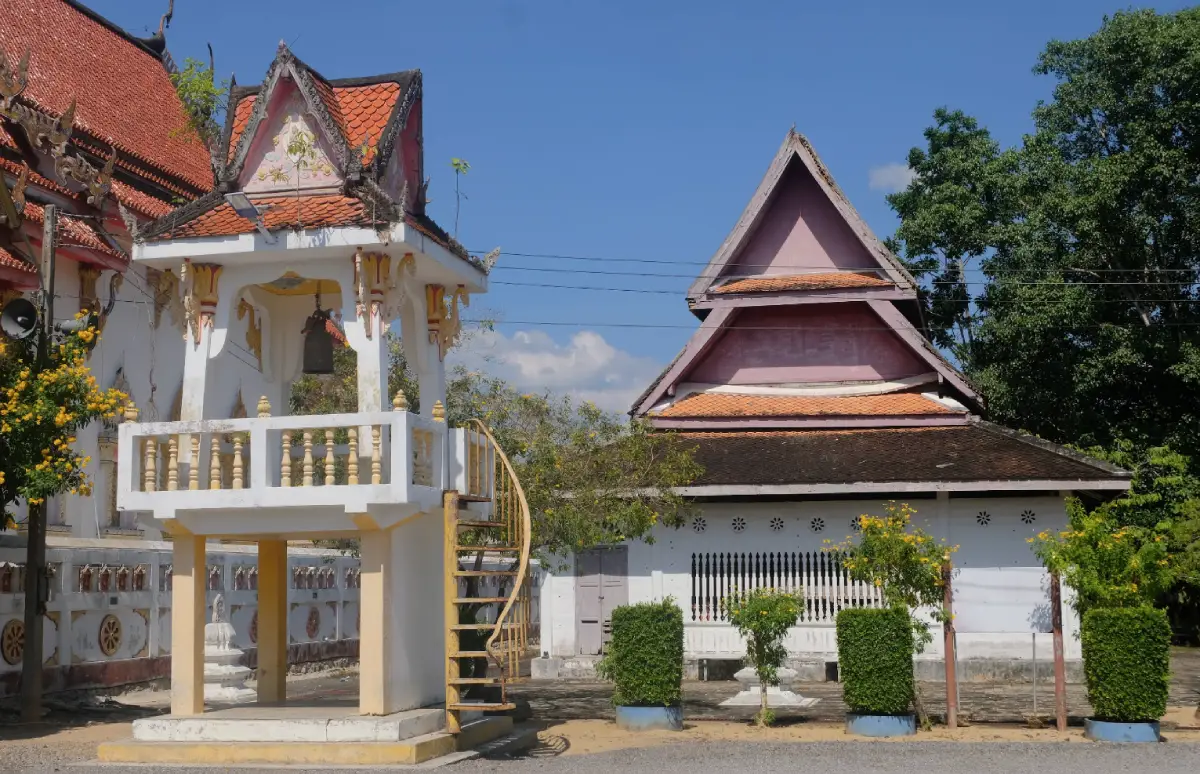
Wat Mongkhon Sathan (Wat Lamor)
Open Days: Daily
Opening Hours: 08.00 – 17.00
Wat Mongkhon Sathan, also known as Wat Lamor, is an old community temple in Lamor Subdistrict, Na Yong District, Trang Province. It is one of Trang’s registered historic sites and is best known for its old ordination hall built by local southern Thai craftsmen. The building is simple and distinctive: it has no traditional chofa, bai raka, hang hong, front gable ornamentation, or decorative brackets, yet its clerestory openings above the doors and windows are decorated with a rising sun motif set inside a semicircular frame. The temple is suitable for travelers who want to see local Buddhist architecture, visit a quiet community temple, and understand Trang’s cultural heritage beyond beaches and islands.
Wat Mongkhon Sathan stands beside Phet Kasem Road in Ban Lamor, Lamor Subdistrict, Na Yong District, Trang Province. The temple remains an active Buddhist temple for the local community, while its old ordination hall has been registered as an ancient monument. The value of the temple lies not only in its age, but in the way its architecture expresses the character of local craftsmanship in southern Thailand. The old hall does not rely on elaborate central Thai temple ornaments. Instead, it uses simple proportions, practical openings, and decorative details that suit the climate and social setting of a local temple.
Wat Mongkhon Sathan was established in 1906 during the reign of King Rama V. Its original name was Wat Lamor, taken from the name of the village where the temple is located. The temple was later renamed Wat Mongkhon Sathan after receiving its consecrated boundary. The current name carries an auspicious meaning and reflects the temple’s role as a long-standing spiritual center for the Lamor community. The change from Wat Lamor to Wat Mongkhon Sathan therefore represents more than a change of name; it marks the temple’s formal religious standing and its continued importance in local Buddhist life.
The old ordination hall was built in 1937. It has a rectangular plan, measuring 12 meters wide and 8 meters long. The structure is made of reinforced concrete and faces east. Its straightforward layout gives the building a calm and solid presence. Unlike grand royal temples, this hall does not emphasize height, glittering decoration, or complex roof ornaments. Its value lies in proportion, restraint, and local design logic. For this reason, the old ordination hall is an important example of southern Thai vernacular Buddhist architecture from the early 20th century.
The most distinctive feature of the old ordination hall is its lack of chofa, bai raka, hang hong, front gable ornamentation, and decorative brackets, elements commonly associated with central Thai temple architecture. Removing these elements gives the building a plain appearance, but the simplicity does not make it less beautiful. Its beauty comes from the balance of the structure, the roof form, the openings, and the quiet setting around the temple. Wat Mongkhon Sathan shows how local craftsmen created a Buddhist building with its own architectural language rather than merely copying a central style.
The clerestory openings above the doors and windows are the hall’s most memorable decorative detail. Each opening is ornamented with a rising sun and radiating rays inside a semicircular frame. Artistically, the rising sun suggests light, renewal, and auspiciousness. Functionally, these openings allow natural light to enter the building and reduce the heaviness of the concrete walls. The result is a building that feels modest from the outside but carefully considered in its use of light.
The hall also has circular ventilation openings along the walls, designed with patterns resembling flower petals. These openings show how local craftsmanship combines beauty with practical use. They help light and air pass through the building, which is especially important in southern Thailand’s warm and humid climate. When daylight enters through these small patterned openings, the interior gains a quiet play of light and shadow that suits the contemplative atmosphere of a Buddhist ordination hall.
The doors and windows are simple double-leaf openings. The building has 4 entrances: a larger central entrance on the front side, one entrance on each long side, and one entrance at the rear. This arrangement supports both movement and ventilation. In the context of a community temple, such practical design mattered as much as visual beauty. The hall was built for religious use, local conditions, and the daily life of the temple, not for display alone.
Behind the principal Buddha image, the south wall contains a narrow barred opening that brings additional light into the rear of the hall. This small feature shows that the builders paid attention to the quality of light inside the sacred space. Rather than leaving the interior dark and closed, the hall allows carefully controlled daylight to enter around the area behind the Buddha image. This detail strengthens the quiet and respectful feeling of the old ordination hall.
The old ordination hall of Wat Mongkhon Sathan was registered as an ancient monument on 29 November 2002, with a protected area of 3 ngan and 59 square wa. This registration confirms the hall’s status as a cultural heritage site rather than simply an old building within a temple compound. Today, the old hall is no longer used as the main ordination hall because a newer ordination hall has been built nearby. Even so, the old hall remains carefully preserved and is the key reason for visiting Wat Mongkhon Sathan.
Wat Mongkhon Sathan is part of Trang’s group of significant historic sites. Trang is often known for its islands, beaches, caves, and food culture, but the province also has many cultural and religious heritage sites. Wat Mongkhon Sathan belongs to the category of Buddhist religious architecture that records the growth of local communities in Na Yong District. A visit to the temple helps travelers see a quieter and deeper side of Trang, one shaped by community faith, vernacular architecture, and local memory.
The temple stands on flat land near the foothills of the Banthat Range. The rear side of the temple is close to Khlong Nang Noi, while the front faces Phet Kasem Road. The surrounding area includes gardens, houses, a school, and local community space. This setting is important because Wat Mongkhon Sathan is not an isolated monument. It remains part of a living cultural landscape where a temple, village, road, school, and waterway are connected in everyday life.
When entering the temple, visitors should focus first on the old ordination hall. The building should be viewed both as a whole and in detail. From a distance, its rectangular shape, lowered roof form, and plain exterior reveal its local character. Up close, the rising sun motifs, circular floral-like openings, simple doors and windows, and careful control of daylight show the intelligence of local craftsmanship. These details make Wat Mongkhon Sathan different from temples that depend mainly on bright colors, gold decoration, or large-scale monuments.
Wat Mongkhon Sathan is suitable for cultural travelers, architecture students, history enthusiasts, conservation-minded visitors, and anyone interested in southern Thai Buddhist heritage. A visit should not be rushed. The value of the site is found in careful observation. Many community temples were not built with large budgets or royal sponsorship; they grew through local devotion and practical craftsmanship. The old ordination hall at Wat Mongkhon Sathan is a strong example of that tradition.
Visitors should behave respectfully because Wat Mongkhon Sathan is still an active Buddhist temple. Modest clothing is recommended. Travelers should avoid loud noise, climbing on old structures, touching architectural details, or writing on the walls and openings. Photography is acceptable when done respectfully and without disturbing monks or local people making merit. Keeping the temple clean and quiet helps preserve both the historic building and the religious atmosphere of the site.
Wat Mongkhon Sathan is also a good starting point for understanding Na Yong District. The district includes old temples, caves, natural attractions, and local craft traditions. Nearby, Na Muen Sri is known for traditional woven textiles, while Khao Chang Hai Cave is known for limestone formations. The route toward Khao Chong offers botanical gardens, waterfalls, and the forested landscape of the Banthat Range. By combining these places, travelers can experience religion, architecture, craft heritage, and nature in one day.
The recommended route begins in Trang city or near the Trang Clock Tower. From there, drive along Wiset Kun Road or connect to Phet Kasem Road toward Na Yong District. Continue along Phet Kasem Road toward Lamor Subdistrict; the temple will be on the right-hand side when coming from Trang city. The road is straightforward and suitable for private cars, rental cars, and motorcycles. Travelers without a private vehicle can reach Na Yong by local transport and continue to the temple by local hire vehicle.
Getting There from Trang city is simple. From the Clock Tower area, take Wiset Kun Road north or head toward Phet Kasem Road. After about 1.7 kilometers, reach the intersection and turn right onto Phet Kasem Road toward Na Yong District. Continue for about 14 kilometers, and Wat Mongkhon Sathan will appear on the right-hand side. The route is convenient for a stop between Trang city, Na Yong, Khao Chong, and the road onward toward Phatthalung.
The best time to visit is from morning to afternoon, when natural light makes the details of the old ordination hall easier to see. Visitors interested in architecture should allow at least 30 minutes to 1 hour. Those planning to continue to Khao Chang Hai Cave or the Na Muen Sri Weaving Community Learning Center should start in the morning, so there is enough time to visit each place without rushing. The Na Yong route works well as either a half-day trip or a full-day cultural and nature itinerary.
For travelers interested in history and architecture, Wat Mongkhon Sathan offers a useful lesson in vernacular temple design. The old ordination hall shows how a community temple in southern Thailand adapted Buddhist architectural ideas to its own context. Small details such as the semicircular rising sun motif and the floral-like circular openings are not decorative accidents. They are evidence of local taste, climate awareness, and the way villagers and craftsmen shaped a sacred building for their community.
From a conservation perspective, Wat Mongkhon Sathan deserves more attention because sites like this are often overlooked in favor of larger or more visually dramatic attractions. The old ordination hall is valuable as evidence, not as a luxurious monument. Preserving its form, avoiding unnecessary alteration, and helping visitors understand its meaning are essential to protecting this kind of cultural heritage. The building reminds travelers that historic value can be quiet, modest, and deeply local.
A visit to Wat Mongkhon Sathan should be intentional rather than hurried. The temple reveals Trang as a province with layered history, community life, religious heritage, and local craftsmanship. Travelers who know Trang mainly for the sea or food will find a different dimension here: old communities, rural Buddhist temples, and buildings that record local history from the reign of King Rama V onward.
The temple tells its story on several levels. First, it is a place of worship for local Buddhist practice. Second, it is a registered historic site with an important old ordination hall. Third, it is a record of southern Thai craftsmanship. Fourth, it remains part of the everyday cultural landscape of Ban Lamor. Taken together, these layers make Wat Mongkhon Sathan a meaningful destination for travelers who want a deeper understanding of Trang Province.
Travelers can make the visit more rewarding by combining Wat Mongkhon Sathan with nearby attractions. Those interested in craft heritage can continue to the Na Muen Sri Weaving Community Learning Center. Those who enjoy natural sites can visit Khao Chang Hai Cave. Travelers who prefer forest and waterfall landscapes can continue toward Khao Chong Botanical Garden or Kachong Waterfall. With thoughtful planning, Wat Mongkhon Sathan becomes more than a short stop; it becomes part of a complete cultural route through inland Trang.
In summary, Wat Mongkhon Sathan is a small but culturally important temple. Its old ordination hall is a valuable example of local southern Thai architecture, clearly different from central Thai temple forms. The temple stands in a living community setting in Lamor Subdistrict, Na Yong District, and offers a quiet but meaningful experience for travelers who want to understand Trang beyond its better-known coastal attractions.
| Name | Wat Mongkhon Sathan, also known as Wat Lamor |
| Location | Lamor Subdistrict, Na Yong District, Trang Province |
| Address | 46 Moo 2, Ban Lamor, Phet Kasem Road, Lamor Subdistrict, Na Yong District, Trang 92170, Thailand |
| Coordinates | 7.555788, 99.730065 |
| Highlights | Old ordination hall built by southern Thai local craftsmen, rising sun clerestory motifs, and registered historic-site status in Trang Province |
| History | Established in 1906 during the reign of King Rama V. Originally named Wat Lamor after the village, the temple was later renamed Wat Mongkhon Sathan after receiving its consecrated boundary. The old ordination hall was built in 1937 and registered as an ancient monument on 29 November 2002. |
| Name Origin | The temple was originally called Wat Lamor after Ban Lamor, then renamed Wat Mongkhon Sathan after receiving its consecrated boundary. |
| Distinctive Features | The old ordination hall measures 12 meters by 8 meters, is built with reinforced concrete, faces east, and has no chofa, bai raka, hang hong, front gable ornamentation, or decorative brackets. Its openings feature rising sun motifs and circular floral-like ventilation patterns. |
| Travel Information | From Trang Clock Tower, take Wiset Kun Road or Phet Kasem Road toward Na Yong District. Continue along Phet Kasem Road for about 14 km, and the temple will be on the right-hand side. |
| Current Status | An active Buddhist temple. The old ordination hall is preserved as an ancient monument and is no longer used as the main ordination hall because a newer hall stands nearby. |
| Open Days | Daily |
| Opening Hours | 08.00 – 17.00 |
| Facilities / Main Areas | Old historic ordination hall, new ordination hall, worship area, and temple grounds used for local Buddhist activities |
| Abbot / Caretaker | Phra Khru Wiset Sorakan |
| Main Contact Number | 075-299-089 |
| Nearby Tourist Attractions | 1. Na Muen Sri Weaving Community Learning Center, about 9 km 2. Khao Chang Hai Cave, about 13 km 3. Khao Chong Botanical Garden, about 20 km 4. Kachong Waterfall, about 22 km 5. Khao Phap Pha Viewpoint, about 25 km |
| Nearby Restaurants | 1. Ruen Sumalee, about 4 km, Tel. 075-299-909, 093-659-4613 2. Ban Ko Piak Cafe & Restaurant Na Yong, about 6 km, Tel. 089-794-6914, 064-112-0964 3. Mee Ko Kang Na Yong, about 7 km, Tel. 087-280-0719 4. Steak Lung Ood Na Yong, about 7 km, Tel. 091-528-1285 5. 99 Basil Tray Na Yong @ Trang, about 8 km, Tel. 091-806-3988, 064-668-3371 |
| Nearby Accommodations | 1. Rimnatee Resort, about 12 km, Tel. 061-251-9566 2. Na Thap Thiang Boutique Resort, about 15 km, Tel. 075-581-555 3. Nara Residence Trang, about 16 km, Tel. 065-661-8420 4. Kachong Hills Tented Resort, about 22 km, Tel. 075-573-513 5. Pubpahouse & Camping Trang, about 25 km, Tel. 087-888-5572 |
Frequently Asked Questions (FAQ)
Q: Where is Wat Mongkhon Sathan located?
A: Wat Mongkhon Sathan is located in Lamor Subdistrict, Na Yong District, Trang Province, beside Phet Kasem Road on the route from Trang city to Na Yong.
Q: What was the original name of Wat Mongkhon Sathan?
A: The temple was originally called Wat Lamor, after Ban Lamor, the village where it is located.
Q: Why is Wat Mongkhon Sathan important?
A: It is one of Trang’s important historic sites and contains an old ordination hall built by southern Thai local craftsmen.
Q: What makes the old ordination hall special?
A: The hall has no traditional chofa, bai raka, hang hong, front gable ornamentation, or decorative brackets. Its clerestory openings are decorated with rising sun motifs, and its wall openings resemble floral patterns.
Q: What are the opening hours of Wat Mongkhon Sathan?
A: Wat Mongkhon Sathan is open daily from 08.00 to 17.00.
Q: How do travelers get to Wat Mongkhon Sathan from Trang city?
A: From Trang Clock Tower, take Wiset Kun Road or Phet Kasem Road toward Na Yong District. Continue for about 14 km, and the temple will be on the right-hand side.
Q: What nearby attractions can be combined with Wat Mongkhon Sathan?
A: Travelers can combine the visit with Na Muen Sri Weaving Community Learning Center, Khao Chang Hai Cave, Khao Chong Botanical Garden, Kachong Waterfall, and Khao Phap Pha Viewpoint.
Q: How should visitors behave when viewing the old ordination hall?
A: Visitors should dress modestly, keep noise low, avoid touching or marking the historic structure, and maintain the cleanliness of the temple grounds.
 Category: ●Places of Worship
 Group: ●Temple
Last Update : 2 MonthAgo
 Last Update : 2 MonthAgo
 Click to Access the Navigation Map GPS
Wat Mongkhon Sathan (Wat Lamor) Map
Recommend

 Art, Culture and Heritage
 Historical Sites and Monuments(1)
 Landmarks and Memorials(2)
 Art, Craft Centres, Tradition(3)
 Museums(2)
Temple(15)
 Mosque(1)
 Other Sacred Sites(7)
 Research and Development
 Royal Project(1)
 Suburban Living
 Village, Community(5)
 Nature and Wildlife
 National Parks and Marine Reserves(6)
 Mountain (Doi)(8)
 Dam, Reservoir, Lake(1)
 Waterfalls(20)
 Hot Springs(1)
 Caves(11)
 Bays and Beaches(11)
 Islands(12)
 Other natural attractions(3)
 Entertainment and Agricultural
 Farms, Parks and Ecotourism(8)
 Outdoor and Adventure Activities(1)
 Travel Articles, Recipes
 Travel Review, Food Review(1)
 Southern Food Menu, Southern Food Recipes(1)


