
lovethailand home >South Travel Attractions >Trang Travel Attractions >Huai Yot >Na Wong > Tham Khao Pina
TL;DR: Tham Khao Pina is located at Wat Khao Pina, Moo 7, Na Wong Subdistrict, Huai Yot District, Trang Province, open Daily, hours 09.00 – 17.00.
Tham Khao Pina
Open Days: Daily
Opening Hours: 09.00 – 17.00
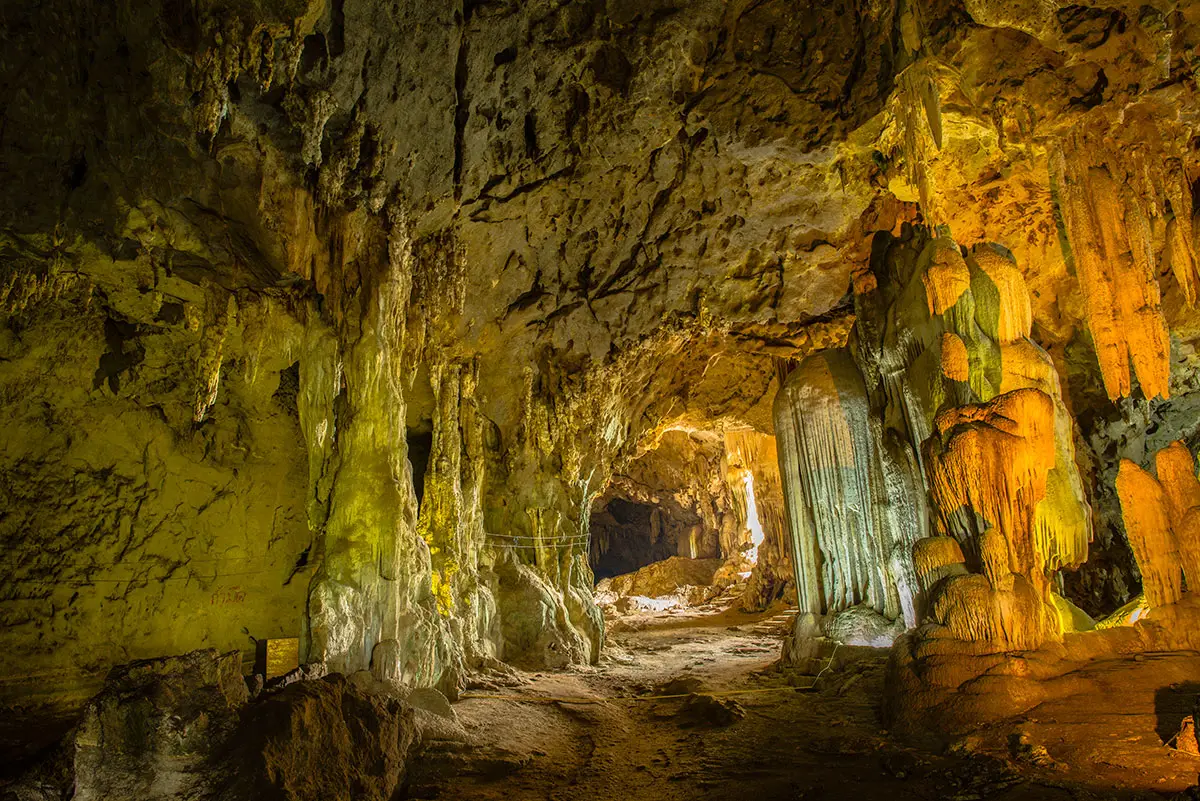
Tham Khao Pina in Trang Province is located within Wat Khao Pina, No. 279, Moo 7, Na Wong Subdistrict, Huai Yot District. It is an isolated limestone hill on the Trang River plain, shaped like an overturned pan, with a hollow interior and multiple cave levels connected by stairways. Key highlights include the reclining Buddha image, Tham Phra Banthom, Tham Chedi, Tham Champa or Tham Sawoei, panoramic viewpoints, and the royal monogram “Por Por Ror” of King Prajadhipok, Rama VII, inscribed on the upper cave wall. Khao Pina is also an archaeological site with prehistoric and historic-period evidence such as tripod pottery, stone tools, polished stone axes, human and animal bone fragments, shells, Buddhist images, and later religious structures.
Tham Khao Pina is one of the most important cave, temple, and archaeological destinations in Huai Yot District, Trang Province. It stands in Na Wong Subdistrict, with Wat Khao Pina at the foot of the limestone hill. A visit here is not only a nature-cave walk. It is also a visit to a living Buddhist temple, a registered archaeological site, a limestone formation, a local heritage landscape, and a place connected with royal visits in Thai history.
Khao Pina is an isolated limestone hill standing among rubber plantations, rice fields, and the lowland landscape of the Trang River basin. From the outside, the hill looks like an overturned pan. Inside, however, the limestone mass is hollow and contains several levels of cave chambers. Concrete stairways lead visitors upward through different cave levels, allowing them to see cave halls, religious images, rock passages, and views of the surrounding Huai Yot countryside.
The core travel description states that Tham Khao Pina is in Na Wong Subdistrict, about 45 km from Trang city along Phetkasem Road, with a side road about 2 km from the main road. The limestone hill is hollow up to the top and has the form of an overturned pan. Wat Pina stands at the foot of the hill. Visitors can use the stairway to explore several cave levels and enjoy views around the hill. The most important mark is the inscription “Por Por Ror,” the royal monogram of King Rama VII, on the cliff area of Tham Champa. These details define the cave’s identity: landscape, temple, royal history, archaeology, and local travel in one site.
The formal location is Wat Khao Pina, No. 279, Moo 7, Na Wong Subdistrict, Huai Yot District, Trang 92210. The temple belongs to the monastic administration of Na Wong Subdistrict, with Phra Athikan Boonlert Tejapañño serving as abbot. Because the cave lies within a temple and archaeological landscape, visitors should behave respectfully, as they are entering both a religious place and a heritage site.
The geological setting is central to the site’s value. Khao Pina is a limestone hill within the Trang River plain, with Khlong Khi Siat on the eastern side. Local and academic descriptions note that the surrounding area may once have been closer to a coastal or wetland environment, partly because an ancient anchor was reportedly found in fields near the hill. This gives Khao Pina meaning beyond its cave chambers. It is part of a changing historical landscape of water, movement, settlement, and human use.
Inside Khao Pina are many caves arranged in different levels. Archaeological references divide the cave system into 6 levels. Important cave areas include Tham Nam, Tham Ruesi, Tham Klaep, Tham Phra Banthom, Tham Phra Ong Klang, Tham Chedi, Tham Lom, the natural water basin, Tham Hoi Khong, and Tham Champa or Tham Sawoei. The visitor experience is therefore a gradual climb from the foot of the hill toward upper cave sections.
The first level is Tham Nam. Its floor is lower than ground level, holds water throughout the year, and has underground water passing through the hill. This section shows the relationship between limestone caves and groundwater. Limestone dissolves slowly through water action, creating cavities, passages, and chambers. Tham Nam therefore helps explain how the cave system of Khao Pina formed naturally over a long period.
The next level includes Tham Ruesi, Tham Klaep, and another unnamed cave between them. Tham Ruesi was formerly called Tham Kraduk, or Bone Cave, because ancient human bones were found there. Later, the area was adapted with a hermit figure near the cave entrance. This shows how one cave area can carry both archaeological memory and later religious or folk interpretation.
Tham Phra Banthom is one of the most important sections for visitors because it houses a reclining Buddha image. This gives the cave a clear sacred atmosphere. In southern Thailand, many limestone caves have been used as Buddhist spaces because caves offer shade, quietness, elevation, and a sense of separation from ordinary life. Tham Phra Banthom shows this long relationship between cave and faith.
Tham Phra Ong Klang contains several plaster Buddha images. Local tradition connects this section with Buddhist travelers and devotees. The story reflects the broader movement of Buddhist faith across the southern peninsula, where rivers, caves, temples, and travel routes linked local communities with major religious centers such as Nakhon Si Thammarat.
Tham Chedi lies about 20 meters above the plain and contains a small chedi. It was restored during the time of Khun Krai, an important former abbot of Wat Khao Pina. The cave is also connected with the memorial placement of Khun Krai’s remains. This adds another layer to the cave’s meaning: it is not only a natural cave and archaeological site, but also a memorial and monastic landscape.
The upper level includes Tham Lom, a natural water basin, Tham Hoi Khong, and Tham Champa. Tham Hoi Khong has yielded archaeological objects such as polished stone axes and tripod pottery. Tham Champa is especially important because it is linked with royal visits. It is also called Tham Sawoei because King Vajiravudh, Rama VI, once visited and took a meal there. Later, King Prajadhipok, Rama VII, inscribed the royal monogram “Por Por Ror” on the cave wall.
The “Por Por Ror” monogram is one of the strongest reasons Tham Khao Pina stands apart from ordinary cave attractions. It is a visible historical trace linking a limestone cave in Na Wong Subdistrict with national royal history. Visitors who reach Tham Champa are not only seeing a high cave and a viewpoint. They are seeing a royal historical mark preserved on the cave wall.
Khao Pina is also an important archaeological site with both prehistoric and historic-period evidence. Finds reported from the cave landscape include pottery, tripod vessels, stone tools, polished stone axes, human bone fragments, animal bones, shells, Buddhist images, and sculptures. These finds show that the cave was used by people over different periods, possibly as shelter, temporary habitation, burial context, ritual space, and later Buddhist religious space.
Tripod pottery and polished stone axes are particularly useful for understanding prehistoric activity in southern Thailand. Tripod vessels are known from several prehistoric contexts, while polished stone axes reflect tool-making and daily-life technology. When these objects are considered together with water sources and the cave’s usable dry spaces, Khao Pina becomes a strong example of how limestone caves supported human activity over long periods.
Khao Pina was registered as an ancient monument on 18 December 1996. This confirms its status as cultural heritage that must be protected. Any improvement, repair, or development within the cave must take archaeological value into account. Visitors also share responsibility by avoiding graffiti, not touching ancient evidence, not climbing formations, and not leaving trash inside the cave.
Another reason to visit Khao Pina is the view. As visitors climb through the cave levels, some openings allow views over rubber plantations, fields, village areas, and the surrounding Huai Yot landscape. Morning and late-afternoon light are especially suitable for walking and photography because the rock surfaces, stairways, cave shadows, and outside views appear more clearly.
Visitors should prepare for a multi-level cave route. Although concrete stairways make access easier, some sections are steep, damp, narrow, or uneven. Wear shoes with good grip, bring drinking water, carry a small flashlight or use a phone light carefully, and stay on the route. Do not enter unmarked or deep cave sections alone.
The cave is also a natural habitat for small cave-dwelling species. Visitors should keep voices low, avoid strong lights directed at animals, avoid food waste, and avoid smoke inside the cave. Limestone cave environments are sensitive and slow to recover. Stalactites, stalagmites, mineral deposits, wall surfaces, and cave textures can be damaged easily by careless contact.
Getting There from Trang city is straightforward by private car, rental car, motorcycle, or hired local transport. Take Phetkasem Road for about 45 km toward Na Wong Subdistrict, then use the side road from the main road for about 2 km to reach Wat Khao Pina. From Huai Yot District Office, take Phetkasem Road toward Krabi for about 14.3 km, turn onto Thetsaban 1 Road or local route TNG 1037 for about 1.7 km, then turn into Wat Khao Pina for about 230 meters.
Private transport is the most convenient option because the cave is located in Na Wong Subdistrict and requires a local road from the main route. Travelers using public transport should first reach Huai Yot or a suitable stop near Na Wong, then continue by local vehicle. Arranging return transport in advance is recommended.
A normal visit takes about 1–2 hours. Visitors who want to explore multiple cave levels, pay respect to the Buddha images, photograph the cave, and climb to the upper royal-monogram area should allow more time. Families with children and older visitors should focus on safer sections and avoid rushing up steep parts.
Tham Khao Pina can be combined with several nearby Huai Yot attractions. Wat Khiri Wihan, Tham Le Khao Kob, Huai Yot town, and Thale Song Hong all fit within a wider inland Trang itinerary. Travelers interested in cave diversity can combine Khao Pina with Tham Le Khao Kob, while those interested in temples and history can combine it with Wat Khiri Wihan and other heritage sites in the district.
Tham Le Khao Kob is an especially useful comparison. Tham Khao Pina is a dry, multi-level limestone cave accessed by stairway, while Tham Le Khao Kob is a water cave explored by boat. Visiting both gives travelers a broader understanding of limestone caves in Huai Yot District, from elevated dry chambers to water-filled underground passages.
Wat Khiri Wihan is suitable for travelers interested in Buddhist heritage and archaeology in the same district. When combined with Tham Khao Pina, the route gives a stronger sense of Huai Yot as a landscape of old temples, limestone hills, caves, water systems, and local communities.
Thale Song Hong offers a different kind of landscape. It is a broad natural basin surrounded by hills, giving travelers a contrast with the limestone-cave route. A combined itinerary can show several sides of Huai Yot in one day: cave, temple, field, old settlement, and inland water landscape.
For photography, Khao Pina offers stairways, cave entrances, Buddha images, limestone walls, cave shadows, viewpoints, and temple details. Good photographs should tell the story of both cave and temple. Avoid flash near sensitive areas, do not touch cave walls for posing, and do not disturb wildlife or other visitors.
Tham Khao Pina is best suited to travelers who appreciate places with depth and evidence. It is not simply a quick photo stop. The cave combines geology, archaeology, Buddhist faith, royal history, local legend, temple life, and countryside scenery. Reading the context before arrival makes the visit much richer because each cave level has its own story.
In conclusion, Tham Khao Pina is one of the strongest cultural and natural destinations in Huai Yot District. It brings together an isolated limestone hill, multiple cave levels, a reclining Buddha, Tham Champa, the “Por Por Ror” royal monogram of King Rama VII, prehistoric artifacts, Wat Khao Pina, and the Na Wong community landscape. With respectful behavior and careful movement, the cave offers a meaningful way to understand Trang beyond beaches, islands, and food routes.
| Name | Tham Khao Pina |
| Related Names | Khao Pina / Wat Khao Pina / Tham Champa / Tham Sawoei |
| Location | Wat Khao Pina, Moo 7, Na Wong Subdistrict, Huai Yot District, Trang Province |
| Address | No. 279, Moo 7, Na Wong Subdistrict, Huai Yot District, Trang 92210, Thailand |
| Coordinates | 7.749212, 99.526943 |
| Highlights | Isolated limestone hill shaped like an overturned pan, multi-level caves, reclining Buddha image, viewpoints, Tham Champa or Tham Sawoei, and the “Por Por Ror” royal monogram of King Rama VII |
| Background | A major cave attraction and archaeological site in Trang Province with prehistoric, historic-period, Buddhist, and royal historical evidence |
| Name Origin | Khao Pina is the local name of the limestone hill in Na Wong Subdistrict, while Tham Champa and Tham Sawoei refer to the upper cave associated with royal visits |
| Landscape | An isolated limestone hill about 100 meters high on the Trang River plain, with Khlong Khi Siat on the eastern side and connected cave chambers inside |
| Main Cave Sections | Tham Nam, Tham Ruesi, Tham Klaep, Tham Phra Banthom, Tham Phra Ong Klang, Tham Chedi, Tham Lom, Natural Water Basin, Tham Hoi Khong, And Tham Champa / Tham Sawoei |
| Key Evidence | Tripod pottery, stone tools, polished stone axes, human bone fragments, animal bones, shells, Buddha images, sculptures, chedi, and the “Por Por Ror” royal monogram |
| Important Periods | Prehistoric Period, Historic Period, Ayutthaya Period, And Rattanakosin Period |
| Registration | Registered As An Ancient Monument In The Royal Gazette On 18 December 1996 |
| Travel Information | From Trang city, take Phetkasem Road for about 45 km to Na Wong Subdistrict, then use the side road for about 2 km. From Huai Yot District Office, take Phetkasem Road toward Krabi for about 14.3 km, turn onto Thetsaban 1 Road for about 1.7 km, then turn into Wat Khao Pina for about 230 meters |
| Current Status | Open As A Cave Attraction, Archaeological Site, And Buddhist Temple Area Within Wat Khao Pina |
| Open Days | Daily |
| Opening Hours | 09.00 – 17.00 |
| Facilities | Concrete stairways to cave levels, temple area, parking area within the temple compound, Buddha-image worship points, and walking access through cave sections |
| Main Areas / Zones | Wat Khao Pina and hill base, cave entrance, Tham Nam, middle cave levels, Tham Phra Banthom, Tham Phra Ong Klang, Tham Chedi, Tham Champa / Tham Sawoei, “Por Por Ror” inscription area, and viewpoint areas |
| Caretaker / Related Authorities | Wat Khao Pina, National Office of Buddhism, Royal Forest Department, Fine Arts Department, and Na Wong Subdistrict Administrative Organization as the local authority |
| Abbot | Phra Athikan Boonlert Tejapañño |
| Contact Numbers | Wat Khao Pina, Tel. 075-215867 / Abbot, Tel. 093-6150090 / Na Wong Subdistrict Administrative Organization, Tel. 075-264078 |
| Visitor Rules | Dress respectfully, keep voices low, do not write on cave walls, do not touch archaeological evidence, do not climb limestone formations, do not leave trash, and walk carefully on stairs and limestone surfaces |
| Nearby Tourist Attractions | 1. Wat Khao Pina, In The Same Area 2. Wat Khiri Wihan, About 8 km 3. Tham Le Khao Kob, About 15 km 4. Huai Yot Town Area, About 16 km 5. Thale Song Hong, About 30 km |
| Nearby Restaurants | 1. Mu Yang Mueang Trang By Dab Rat Mu Yang, About 3 km, Tel. 081-4051212 2. Mu Yang Mueang Trang Mu Yang Tha Do, About 5 km, Tel. 098-7062852 3. Chill Chill Na Wong, About 6 km, Tel. 098-3086230 4. Mu Yang Trang Ko Duang Andaman Intersection Huai Yot, About 9 km, Tel. 081-8981450 5. Krua Manee, About 17 km, Tel. 075-823883, 088-7512712 |
| Nearby Accommodations | 1. Andaman View Resort, About 11 km, Tel. 083-1831702 2. Prangthong Garden Home, About 15 km, Tel. 083-5909427 3. Phuphayaot Resort, About 18 km, Tel. 083-0807541 4. SafezonecafeTrang, About 22 km, Tel. 082-9862455 5. Pak Chaem Resort, About 27 km, Tel. 062-8249693 |
Frequently Asked Questions (FAQ)
Q: Where Is Tham Khao Pina Located?
A: Tham Khao Pina is located within Wat Khao Pina, No. 279, Moo 7, Na Wong Subdistrict, Huai Yot District, Trang Province.
Q: What Are The Opening Hours Of Tham Khao Pina?
A: Tham Khao Pina is open daily from 09.00 to 17.00.
Q: Why Is Tham Khao Pina Important?
A: It is a cave attraction, limestone hill, Buddhist temple area, and archaeological site with prehistoric and historic-period evidence, as well as the “Por Por Ror” royal monogram of King Rama VII.
Q: What Can Visitors See Inside The Cave?
A: Visitors can see several cave levels, including Tham Nam, Tham Ruesi, Tham Phra Banthom, Tham Phra Ong Klang, Tham Chedi, Tham Hoi Khong, and Tham Champa or Tham Sawoei, along with Buddha images, viewpoints, and archaeological evidence.
Q: Where Is The “Por Por Ror” Royal Monogram?
A: The “Por Por Ror” royal monogram is on the upper cave-wall area of Tham Champa or Tham Sawoei. It is the royal monogram of King Prajadhipok, Rama VII.
Q: How Do Travelers Get To Tham Khao Pina?
A: From Trang city, take Phetkasem Road for about 45 km to Na Wong Subdistrict, then use the side road for about 2 km. From Huai Yot District Office, take Phetkasem Road toward Krabi for about 14.3 km, then follow the local road to Wat Khao Pina.
Q: Who Should Visit Tham Khao Pina?
A: The cave is suitable for travelers interested in limestone caves, archaeology, royal history, Buddhist cave temples, countryside viewpoints, and inland Trang travel routes.
Q: What Should Visitors Prepare Before Visiting?
A: Visitors should wear shoes with good grip, bring drinking water, walk only on the provided route, avoid writing on cave walls, avoid touching archaeological evidence, and move carefully on stairs and limestone surfaces.
 Category: ●Nature and Wildlife
 Group: ●Caves
Last Update : 2 DayAgo
 Last Update : 2 DayAgo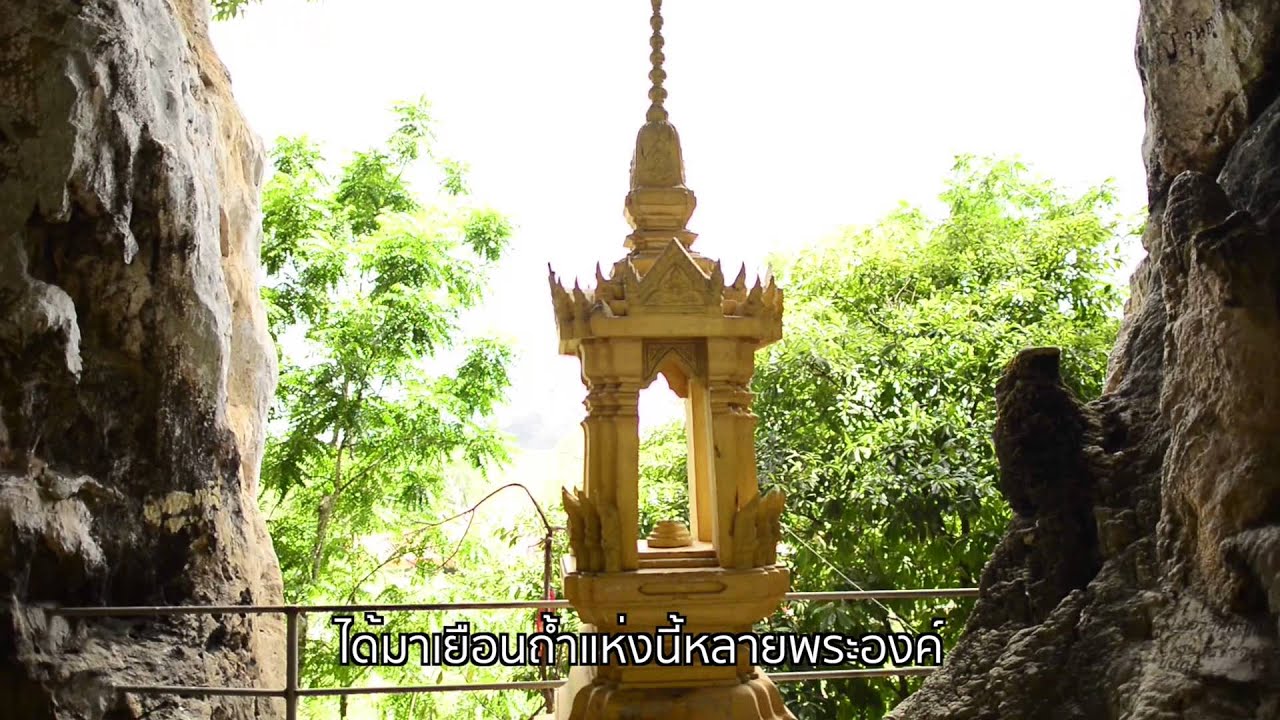
 Click to Access the Navigation Map GPS
Tham Khao Pina Map
Recommend

 Art, Culture and Heritage
 Historical Sites and Monuments(1)
 Landmarks and Memorials(2)
 Art, Craft Centres, Tradition(3)
 Museums(2)
 Places of Worship
 Temple(15)
 Mosque(1)
 Other Sacred Sites(6)
 Research and Development
 Royal Project(1)
 Suburban Living
 Village, Community(5)
 National Parks and Marine Reserves(6)
 Mountain (Doi)(8)
 Dam, Reservoir, Lake(1)
 Waterfalls(20)
 Hot Springs(1)
Caves(11)
Hot Springs(1)
Caves(11)
 Bays and Beaches(11)
 Islands(12)
 Other natural attractions(3)
 Entertainment and Agricultural
 Farms, Parks and Ecotourism(8)
 Outdoor and Adventure Activities(1)
 Travel Articles, Recipes
 Southern Food Menu, Southern Food Recipes(1)


