
lovethailand home >South Travel Attractions >Songkhla Travel Attractions >Hat Yai >Kho Hong > Prince of Songkla University (Hat Yai Campus)
TL;DR: Prince of Songkla University (Hat Yai Campus), Songkhla attractions : University, Public university.
Prince of Songkla University (Hat Yai Campus)
Open Days: Monday – Friday for general administrative offices, excluding public holidays
Opening Hours: 8:30 AM – 4:30 PM for administrative enquiries, not the operating hours of every campus facility
Prince of Songkla University, Hat Yai Campus (มหาวิทยาลัยสงขลานครินทร์ วิทยาเขตหาดใหญ่), commonly known as PSU Hat Yai, is one of the most important centers of higher education, research, and academic services in southern Thailand. The campus is located at 15 Kanjanavanich Road, Kho Hong Subdistrict, Hat Yai District, Songkhla Province 90110. Prince of Songkla University originated from a project to establish a university for southern Thailand during the 1960s. The institution received its royal name on September 22, 1967, and was legally established on March 13, 1968. The Hat Yai site was developed to accommodate the Faculty of Engineering and the expansion of science and technology education. Today, the campus is home to sixteen academic faculties, the Graduate School, and an International College. Its strengths include medicine, engineering, science, pharmacy, dentistry, nursing, agriculture, environmental management, and interdisciplinary research. Major facilities include Songklanagarind Hospital, a natural history museum, the university's historical archives and exhibitions, and a large international convention center serving academic and public activities.
The campus is situated in Kho Hong, an important educational, residential, and commercial area of Hat Yai. Its surroundings are connected to Kanjanavanich Road, Punnakan Road, and other major city routes. Within the university are academic buildings, research laboratories, a teaching hospital, libraries, student residences, sports facilities, restaurants, healthcare services, and landscaped spaces. This combination gives Hat Yai Campus the characteristics of a university town and a major regional healthcare center. Students, staff, patients, and visitors from different parts of southern Thailand use the campus for education, professional services, research, and community activities.
Hat Yai District is an important commercial, transportation, healthcare, and service center in Songkhla Province. It also has strong economic connections with neighboring Malaysia. The establishment of a major university in this area has supported the development of professionals in medicine, technology, industry, agriculture, business, and public administration. At the same time, the university produces research and innovations that can be applied to community needs, including healthcare delivery, natural resource management, value-added agricultural production, and disaster preparedness.
The establishment of Prince of Songkla University was closely associated with Thailand's policy of expanding access to higher education in the south. In 1962, the Southern Development Committee began examining the possibility of establishing a regional institution of higher education. The original proposal involved creating a College of Arts and Sciences that could later develop into a university. Preliminary surveys considered locations in Pattani Province. Although the first phase faced financial and administrative obstacles, it laid the foundation for a university dedicated to regional development.
In 1965, the Thai Cabinet approved the establishment of a university for southern Thailand in principle, with its initial center at Rusamilae Subdistrict, Mueang Pattani District, Pattani Province. Engineering was to be the first faculty, while additional faculties would be established in other southern provinces according to their educational and economic needs. This distributed model reflected an intention to serve the entire southern region rather than concentrate higher education within a single city.
During the early planning period, the proposed institution was called the University of Southern Thailand. Its temporary administrative office was located at the University of Medical Sciences in Bangkok. Colonel Thanat Khoman chaired the committee responsible for establishing the university, while academic leaders helped plan the curriculum and future facilities. Professor Dr. Stang Mongkolsuk was particularly influential in developing the scientific and engineering foundations of the new institution. The project required substantial cooperation because it initially lacked permanent buildings, laboratories, equipment, and sufficient teaching personnel.
On September 22, 1967, King Bhumibol Adulyadej bestowed the name “Prince of Songkla University” in honor of Prince Mahidol of Songkla, the Prince Father. The name established a lasting connection between the university and Prince Mahidol's commitment to medicine, public health, education, and improving people's lives. September 22 subsequently became Prince of Songkla Day, an important annual occasion in the university's calendar.
In 1967, the university admitted its first group of fifty engineering students. Since the permanent campus facilities were not yet ready, these students began studying in temporary facilities in Bangkok. The early engineering program encountered shortages of laboratories, equipment, and academic personnel, making cooperation with existing educational and technical institutions essential. At the same time, plans were developed for a Faculty of Science to provide the foundational scientific teaching required by engineering students and future faculties.
The decision to develop the Hat Yai campus resulted from an important assessment of the original site in Pattani. Professor Dr. Stang Mongkolsuk and colleagues found that the Rusamilae area had soft, low-lying ground close to the sea. These conditions raised concerns about the suitability of the site for heavy machinery and large engineering buildings. Moisture and salt in the coastal environment could also damage metal equipment and electronic instruments. The planning team therefore recommended that the Pattani site be used for education and humanities-related faculties, while engineering should be relocated to a more suitable location.
The area of Kho Hong Subdistrict in Hat Yai District, Songkhla Province, was considered appropriate for engineering education and the long-term expansion of the university. Khunying Long Atthakrawisunthorn donated 690 rai of land for the development of the university. This donation became one of the most important events in the history of Hat Yai Campus, providing land for academic buildings, laboratories, roads, and essential infrastructure. It also demonstrated how private generosity and public educational policy could work together to create opportunities for future generations.
On March 12, 1968, the Prince of Songkla University Act B.E. 2511 was promulgated, taking effect on March 13, 1968. The university recognizes March 13 as its official foundation anniversary. Its establishment under national legislation provided the legal and administrative framework needed to develop permanent academic faculties, university services, and a regional educational mission.
Between 1968 and 1971, the Hat Yai site developed its first academic facilities and equipment for engineering and science education. One of its most significant buildings is the Stang Mongkolsuk Building, whose construction began in 1968 and was completed in 1971. The building was one of the earliest teaching facilities of the Faculty of Engineering. Named in honor of Professor Dr. Stang Mongkolsuk, it is associated with the university's founding generation and the early development of scientific and technical higher education in southern Thailand.
As the university grew, more faculties were established to meet the region's changing requirements. Science, natural resources, management, medicine, and health professions became important areas of development. In 1974, plans for a social science faculty in Hat Yai were approved, and the academic unit was renamed the Faculty of Management Sciences in 1975. This transition reflected the university's expansion beyond science and engineering into business and public administration. The subsequent development of the Faculty of Medicine and its teaching hospital established Hat Yai Campus as a major regional healthcare center.
Professor Dr. Stang Mongkolsuk remains an important figure in the university's history because of his contributions to academic planning and the development of the Hat Yai site. Khunying Long Atthakrawisunthorn is equally significant for donating the land that made the campus possible. Their contributions illustrate that the establishment of a major university required not only government policy but also the commitment of educators, administrators, and members of society who believed in the importance of expanding educational opportunities.
Prince of Songkla University's guiding principle is “Our Soul is for the Benefit of Mankind”, expressed in Thai as “ประโยชน์ของเพื่อนมนุษย์เป็นกิจที่หนึ่ง.” Inspired by the values associated with Prince Mahidol, the principle emphasizes using knowledge, professional skills, and resources for the benefit of others. It continues to influence the university's approach to education, medical services, research, community engagement, and social responsibility.
The university's official color is navy blue, reflecting the sea surrounding southern Thailand and Prince Mahidol's historical association with naval service. Its symbolic flower is the Sri Trang, a flowering tree known for its violet-blue blossoms. The university emblem incorporates a royal crown, the chakra and trident, and the Thai abbreviation ม.อ., associated with the Prince Father's former name. These symbols help connect students, staff, graduates, and alumni across the university's different campuses.
Prince of Songkla University has five campuses: Hat Yai, Pattani, Phuket, Surat Thani, and Trang. Each campus has developed areas of academic expertise appropriate to its regional context. Hat Yai is especially important in medicine, engineering, science, agriculture, health professions, environmental management, and research. Other campuses contribute distinct strengths in their own fields. This multi-campus structure enables the university to respond to the diverse economic, cultural, and environmental conditions of southern Thailand.
As of 2026, Assistant Professor Dr. Niwat Keawpradub serves as President of Prince of Songkla University, while Associate Professor Dr. Wasin Suwannarat serves as Vice President for Hat Yai Campus. University administration includes units responsible for academic support, facilities, human resources, student welfare, and cooperation with external organizations. Each faculty manages teaching and research in accordance with university quality standards and relevant professional requirements.
Hat Yai Campus has sixteen academic faculties: Environmental Management; Traditional Thai Medicine; Natural Resources; Dentistry; Law; Nursing; Management Sciences; Science; Engineering; Liberal Arts; Veterinary Science; Agro-Industry; Medical Technology; Pharmaceutical Sciences; Economics; and Medicine. The Graduate School and International College provide additional support for postgraduate study and international education.
The Faculty of Engineering was the university's first faculty and has been central to the development of Hat Yai Campus since 1967. Its undergraduate programs cover Civil, Mechanical, Electrical, Chemical, Computer, Industrial, Environmental, Manufacturing, Mining and Materials, Mechatronics, Biomedical, and Artificial Intelligence Engineering, together with Rubber Engineering, Engineering and Innovation Management, and Semiconductor Engineering. These programs support professional development in infrastructure, manufacturing, industrial technology, digital systems, and emerging technological fields.
The inclusion of Semiconductor Engineering and Artificial Intelligence Engineering in the 2026 admissions information reflects the university's response to changes in high-technology industries. Rubber Engineering and materials-related disciplines are also particularly relevant to southern Thailand because of the region's important natural rubber industry. Through these programs, the faculty prepares graduates for both established industries and emerging sectors requiring specialist technical expertise.
The Faculty of Science is another founding academic unit. It was established to provide fundamental science teaching and develop research in a wide range of disciplines. Its fields include Mathematics, Physics, Chemistry, Biology, Microbiology, Biotechnology, Computer Science, Materials Science, Polymer Science, Statistics, Data Science, and related applied sciences. These subjects provide essential scientific knowledge for research and professional work in technology, medicine, agriculture, and industry.
Scientific research at the university supports industrial development, agricultural innovation, healthcare, and environmental management. Laboratory work and data analysis contribute to understanding natural processes and solving technological problems. Computer Science, Applied Statistics, and Data Science are increasingly important to organizations that need to manage and interpret large amounts of information.
The Faculty of Medicine is a major component of Hat Yai Campus and one of the foundations of its regional healthcare role. Its academic programs include the Doctor of Medicine and undergraduate education in Physical Therapy. The 2026 admissions information also identifies Radiological Technology and Emergency Medical Operations among the faculty's academic fields. Medical education requires extensive scientific knowledge, clinical training, professional ethics, and practical competence in patient care.
Songklanagarind Hospital is the university's teaching hospital and a major healthcare institution serving southern Thailand. It provides diagnosis, treatment, specialized clinical care, and opportunities for practical training in medicine and other health professions. The hospital also supports clinical research, specialist medical education, and the development of new medical knowledge. Its presence makes the campus an important part of southern Thailand's healthcare infrastructure and creates a direct connection between university teaching and the needs of patients.
The Faculty of Dentistry provides the Doctor of Dental Surgery program and postgraduate education in areas such as Oral Health Sciences, Oral and Maxillofacial Surgery, and Oral Cytology and Biomaterials Science. Dental education combines knowledge of oral health, clinical assessment, treatment procedures, and patient safety. The university's dental hospital supports clinical training and provides professional services to the public.
The Faculty of Pharmaceutical Sciences offers professional education in Pharmaceutical Care and Industrial Pharmacy. These programs develop knowledge related to medicines, appropriate pharmaceutical use, drug production, and patient safety. Postgraduate programs include Clinical Pharmacy, Pharmaceutical Sciences, Cosmetic Science, and Social and Administrative Pharmacy, supporting advanced research and expertise in healthcare systems and the pharmaceutical industry.
The Faculty of Nursing prepares professional nurses for healthcare services and community needs. Its Bachelor of Nursing Science curriculum has undergone regular revision, including an updated curriculum in 2024. Postgraduate education covers specialist areas such as Nursing Administration, Adult and Gerontological Nursing, Pediatric Nursing, and Community Nurse Practitioner studies. These fields strengthen professional competence in patient care and the management of nursing services.
The Faculty of Medical Technology provides education in laboratory-based healthcare sciences. The Bachelor of Science in Medical Technology prepares graduates for work involving clinical laboratory testing, blood analysis, microbiology, and diagnostic support. Students must understand scientific accuracy, laboratory quality assurance, professional ethics, and the responsible handling of patient information. The faculty forms an important part of the university's multidisciplinary health education environment.
The Faculty of Traditional Thai Medicine offers bachelor's, master's, and doctoral degrees in Thai Traditional Medicine. Its academic work develops traditional Thai medical knowledge through professional education and modern research approaches. The campus also has a Thai Traditional Medicine Hospital and related research facilities that support teaching, healthcare services, and innovation associated with Thailand's medical heritage.
The Faculty of Veterinary Science offers the Doctor of Veterinary Medicine program, preparing professionals for animal healthcare, disease prevention, diagnosis, and veterinary practice. Veterinary education is connected with agriculture, food safety, and the relationship between human, animal, and environmental health under the One Health approach. The university's animal hospital provides opportunities for practical training and veterinary services.
The Faculty of Natural Resources focuses on agricultural and natural resource disciplines relevant to southern Thailand. Its undergraduate programs include Agriculture, Animal Science, Aquatic Science, and Agricultural Innovation and Management. These subjects help students understand crop and livestock production, aquaculture, technological development, and resource management. Postgraduate studies include Plant Science, Aquatic Science, Entomology, Animal Science, and Tropical Agricultural Resource Management.
The Faculty of Agro-Industry offers education in Food Science and Technology, Packaging Technology and Materials, and Food Industry Technology and Management. The 2026 admissions information also includes a field related to Healthy Food and Nutrition and Dietetics. These disciplines concern the development of agricultural products, food safety, packaging, and industrial innovations. They are particularly relevant to southern Thailand, where agriculture and food production are important economic activities.
The Faculty of Environmental Management specializes in postgraduate education and research. Its fields include Environmental Management, Marine and Coastal Resource Management, Sustainable Energy Management, and Ecosystem Innovation Management for Sustainable Tourism. Environmental management is particularly significant in southern Thailand because the region contains coastlines, agricultural areas, forests, urban centers, and tourist destinations requiring responsible resource planning and conservation.
The Faculty of Management Sciences offers Business Administration, Accountancy, Public Administration, and an international program in Management and Entrepreneurship. Its business studies include areas related to Business Information Systems, Marketing and Communication, Finance and Investment, Human Resource Management, Logistics and Supply Chain Management, and MICE Management. These fields prepare students for organizational leadership, business operations, and public sector responsibilities.
The Faculty of Economics offers Bachelor of Economics programs, including Agricultural Business Economics. Economics education develops the ability to analyze production, consumption, markets, investment, and public policy. These skills are valuable for understanding the economy of southern Thailand, which includes agriculture, industry, trade, tourism, and cross-border commercial activities.
The Faculty of Law provides the Bachelor of Laws and postgraduate legal education. Law students study legal rights and responsibilities, civil and criminal law, the justice system, and legal frameworks relevant to public administration and business. Such knowledge supports careers in legal practice, government, organizations, and other professions requiring careful legal reasoning.
The Faculty of Liberal Arts offers undergraduate programs in English, Chinese, Applied Thai, Community Studies for Sustainable Development, and Aviation Industry and Service Management. These programs contribute to intercultural communication, regional development, and the service economy. Postgraduate education includes English as an International Language, Human and Social Development, and Thai and Applied Thai studies.
The International College supports education that connects creativity, technology, and global professional skills. Its international Bachelor of Science in Creative Media and Digital Technology is relevant to digital communication, creative content, and emerging media industries. The university's curriculum directory also contains the Thai-Chinese International College of Rubber establishment project, associated with international education in Rubber Engineering and Technology.
Postgraduate education is another major activity of Prince of Songkla University. The Graduate School supports master's, doctoral, and specialized graduate programs across many disciplines. The university's broad research environment creates opportunities for interdisciplinary projects, such as combining engineering with medical technology, applying science to food innovation, and using economic and social research to support community development.
Research and innovation at Hat Yai Campus are closely connected with the economy and development needs of southern Thailand. Important areas include rubber technology, agro-industry, food innovation, healthcare, natural resources, environmental sustainability, and digital transformation. Cooperation among researchers, industries, government agencies, and entrepreneurs helps transform academic knowledge into products, services, and practical solutions.
From February 5 to 8, 2026, the university participated in organizing the Southern Innovation and Technology Expo 2026 (SITE 2026) at the 60th Anniversary of His Majesty the King's Accession to the Throne International Convention Center. The event connected researchers, businesses, public organizations, and technology networks with the goal of stimulating the southern economy through innovation. It also supported Songkhla's development as a regional center for meetings, conferences, and exhibitions.
In October 2026, the campus hosted a regional conference and exhibition related to school botanical gardens and local resource databases under the Royal Plant Genetic Conservation Project. The event brought together organizations concerned with biological resources, botanical knowledge, and environmental education. It demonstrated the university's role in biodiversity conservation, plant research, and sharing scientific knowledge with schools and communities.
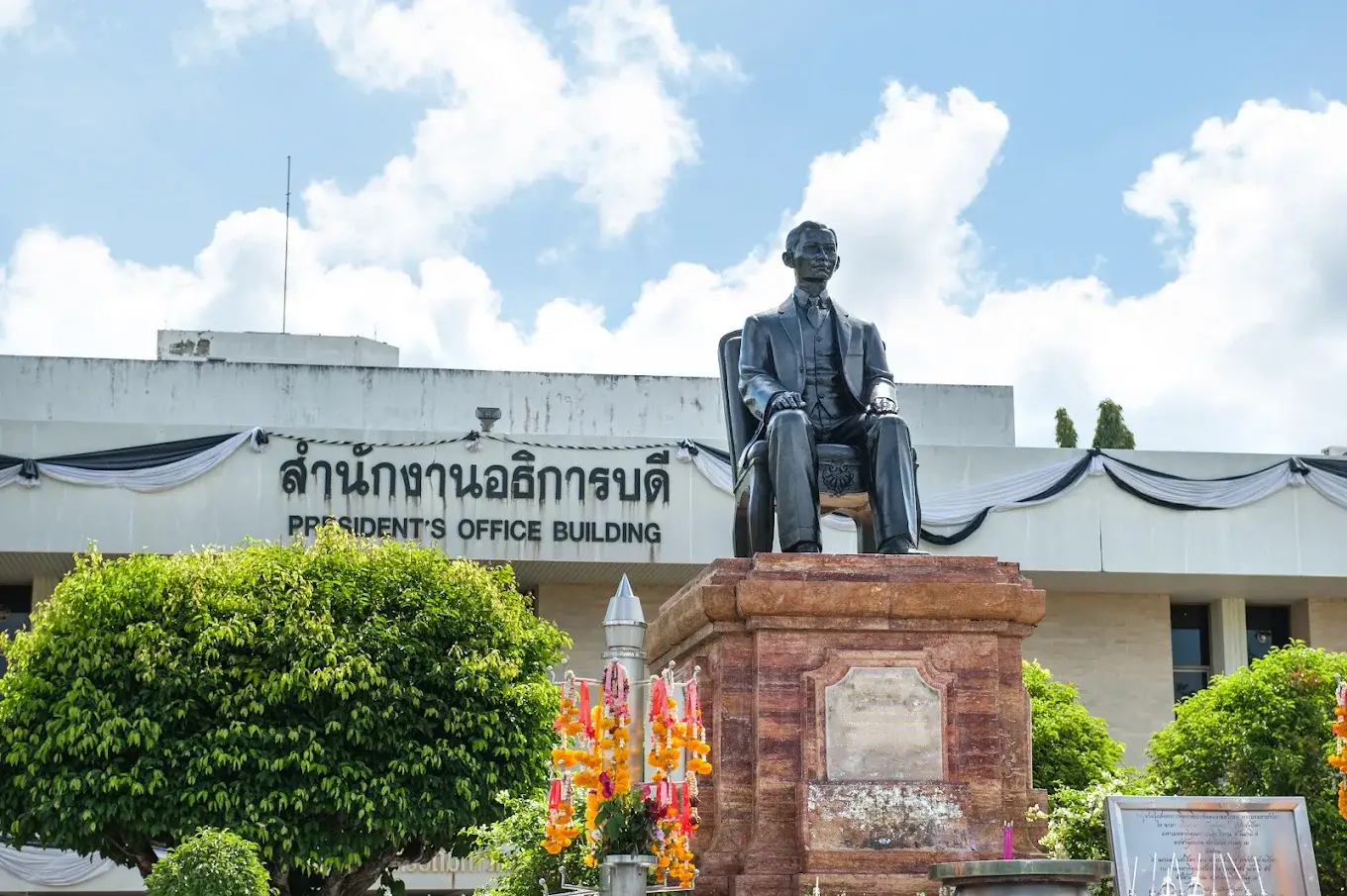
One of the most important sites at Hat Yai Campus is the Prince Mahidol Monument, located in front of the University President's Office. The surrounding area is commonly known as Lan Phra Bida, or the Prince Father's Plaza. The bronze monument depicts Prince Mahidol seated in Western dress, with both hands resting on his lap. It was designed and cast under the supervision of the Fine Arts Department and is approximately one and a half times life-size. King Bhumibol Adulyadej and members of the royal family presided over its inauguration on September 23, 1985.
The Prince Father's Plaza is important both historically and emotionally to the university community. It is used for ceremonial wreath-laying on Mahidol Day and for new student activities. Visiting the monument helps students understand the university's heritage and the importance of service to others. For many members of the community, it is one of the defining landmarks of Hat Yai Campus.
The PSU Hall of History preserves records, photographs, documents, and exhibitions concerning the establishment and development of Prince of Songkla University. Its collections cover the original proposal for a southern university, the development of faculties, campus construction, and the contributions of important individuals. The Hall of History is valuable for understanding the history of higher education in Thailand and serves students, alumni, researchers, and visitors interested in the university's past.
The Princess Maha Chakri Sirindhorn Natural History Museum, formally named the Princess Maha Chakri Sirindhorn 50th Anniversary Natural History Museum, is a publicly accessible learning attraction within Hat Yai Campus. It presents exhibits and specimens relating to organisms, ecosystems, evolution, biodiversity, prehistoric animals, and natural resources. The museum is open Tuesday through Saturday from 9:00 AM to 4:00 PM, excluding public holidays. Visitors can contact the museum at +66 74 282 782 for admissions or +66 74 282 783 for general enquiries.
Educational visits to the natural history museum provide opportunities for students, families, and members of the public to engage with scientific knowledge beyond the classroom. Its displays help explain relationships between living organisms and their environments while encouraging interest in biodiversity conservation. The museum can be included in a broader educational visit to the university, although access to research laboratories and restricted facilities requires permission from the relevant departments.
The 60th Anniversary of His Majesty the King's Accession to the Throne International Convention Center is one of the campus's largest public-event facilities. It hosts national and international academic conferences, exhibitions, research presentations, and other major events. The center has strengthened the university's ability to bring together scholars, businesses, government agencies, and the public, particularly through activities related to technology, innovation, and sustainability.
The Khunying Long Atthakrawisunthorn Learning Resources Center is a major university library and information resource, named in honor of the benefactor who donated land for the Hat Yai campus. The center provides materials and services for academic study, independent reading, and research. Its role demonstrates the continuing importance of both traditional scholarly resources and modern information services in university life.
The Stang Mongkolsuk Building is a historical reminder of the early Faculty of Engineering and the construction of Hat Yai Campus. It illustrates the architecture and educational infrastructure of the university's founding period. The building's historical significance links today's academic community with the educators and researchers who established the institution. Other university buildings contain specialized laboratories and teaching facilities essential to modern professional education.
The university's sports and health facilities and central sports field support exercise, training, competitions, and recreational activities. Student residences, canteens, shops, and university services help students from different provinces live and study on campus. These facilities contribute to the character of Hat Yai Campus as a place for both formal education and shared community experiences.
University traditions are closely associated with three important dates: March 13, the university's legal foundation anniversary; September 22, Prince of Songkla Day; and September 24, Mahidol Day. These occasions commemorate the university's establishment, the Prince Father's legacy, and the institution's responsibility toward society. In 2026, Hat Yai Campus organized its foundation anniversary activities on March 13 under the theme “PSU for Mankind,” bringing together students, staff, and alumni.
On September 24, 2026, the university held a wreath-laying ceremony at the Prince Mahidol Monument to commemorate Mahidol Day. It also organized activities associated with the principle “Our Soul is for the Benefit of Mankind.” These included blood donation, the distribution of school uniforms and equipment to schools affected by flooding, and exhibitions explaining the significance of Mahidol Day. The activities demonstrated the university's commitment to using its resources and expertise to help society.
Welcoming new students is another important university tradition. On June 17, 2026, the university organized a student welcoming ceremony at the Prince Father's Plaza, attended by administrators, academic staff, university personnel, and new students. The event introduced students to the university's history and the meaning of being part of the Prince Father's academic community, while encouraging them to pursue their studies responsibly and contribute positively to society.
The university's Wai Khru teacher-honoring ceremony for the 2026 academic year encouraged students to express gratitude to their teachers and maintain an important Thai educational tradition within a multicultural environment. The ceremony recognizes the relationship between teaching and learning and emphasizes respect, responsibility, and the pursuit of knowledge.
The annual freshman sports tradition provides another opportunity for students to build friendships across faculties. On August 30, 2026, the university organized freshman sports and cheering activities at the central sports field. The event encouraged physical activity, cooperation, school spirit, and the values of fair play, including respect for both victory and defeat.
Cultural learning is also supported through the Princess Galyani Vadhana Institute of Cultural Studies, which is involved in preserving and sharing southern Thai cultural heritage. The university has organized Loy Krathong events as part of its cultural activities. In 2025, the Hat Yai campus held a Loy Krathong celebration near the Faculty of Science, with exhibitions and activities connecting students, staff, and the wider community with Thai traditions.
Community engagement remains an important part of the university's work. In August 2026, Hat Yai Campus organized a meeting to prepare a shelter and response system for people affected by flooding. University units worked together to coordinate resources and develop procedures for assisting local communities. Such activities illustrate the role of the university as an institution that can contribute staff, knowledge, and facilities during emergencies.
For educational tourism, Prince of Songkla University, Hat Yai Campus offers several historically and scientifically significant sites. The Prince Mahidol Monument, Hall of History, Stang Mongkolsuk Building, Natural History Museum, and public academic exhibitions provide opportunities to learn about the development of higher education in southern Thailand. A visit can illustrate how the institution evolved from a small engineering program into a multidisciplinary university with major healthcare, research, and community service functions.
The university's main telephone number is +66 74 282 000, and information is available at www.psu.ac.th. General administrative offices operate during normal weekday government working hours. The Natural History Museum follows a separate schedule, opening Tuesday through Saturday from 9:00 AM to 4:00 PM. Enquiries about the PSU Hall of History and its exhibitions can be directed to +66 74 282 993, and advance coordination is recommended for group visits.
Getting There: Prince of Songkla University, Hat Yai Campus is located at 15 Kanjanavanich Road, Kho Hong Subdistrict, Hat Yai District, Songkhla Province 90110. Visitors traveling by private car can reach the campus from Kanjanavanich Road, one of Hat Yai's important transport routes. Searching for “Prince of Songkla University Hat Yai Campus” in a navigation application will help identify the appropriate university entrance. Travelers from central Hat Yai can follow the roads toward Kho Hong and select an entrance convenient for their intended building or department.
Visitors arriving from outside Songkhla Province can fly to Hat Yai International Airport and continue to the university by taxi or another suitable transport service. Rail travelers can arrive at Hat Yai Junction Railway Station and continue by local transport or hired vehicle. Intercity bus services also connect Hat Yai with other provinces. Visitors attending admission interviews, academic events, or hospital appointments should check their building and entrance in advance because the campus covers a large area with many separate facilities.
Hat Yai offers several attractions that can be visited in connection with a university trip. Hat Yai Municipal Park provides hillside viewpoints and recreational spaces, while Kim Yong Market is a long-established shopping destination for local goods and souvenirs. Greenway Night Market offers food, fashion, and casual evening activities. Wat Mahattamangkalaram, also called Wat Hat Yai Nai, is known for its large reclining Buddha image. The university's own Natural History Museum offers a more academic visitor experience. Together, these places show the diversity of cultural, educational, and recreational activities available in Hat Yai.
Prince of Songkla University, Hat Yai Campus occupies a central position in the history and development of higher education in southern Thailand. From an initial intake of fifty engineering students and the donation of land for its future campus, it has grown into a major multidisciplinary institution with teaching hospitals, research facilities, and extensive public services. Guided by the principle “Our Soul is for the Benefit of Mankind,” the university continues to develop graduates, create knowledge and innovation, and use its resources to support sustainable regional development.
Summary Table
| Institution Name | Prince of Songkla University, Hat Yai Campus |
| Thai Name | มหาวิทยาลัยสงขลานครินทร์ วิทยาเขตหาดใหญ่ |
| University Type | Campus of a Thai Public University |
| Location | Kho Hong Subdistrict, Hat Yai District, Songkhla Province, Thailand |
| Full Address | 15 Kanjanavanich Road, Kho Hong, Hat Yai District, Songkhla 90110, Thailand |
| Original Project Name | University of Southern Thailand |
| Royal Naming Date | September 22, 1967 |
| Legal Establishment Date | March 13, 1968 |
| Hat Yai Campus Origins | Relocation of the planned Faculty of Engineering to Kho Hong during the university's founding period; initial academic buildings developed from 1968 |
| University Age in 2026 | 58 years since the university's legal establishment in 1968 |
| Important Historical Figures | 1. Colonel Thanat Khoman, who played an important role in the Southern University Establishment Committee 2. Professor Dr. Stang Mongkolsuk, an important figure in science, engineering, and the selection of the Hat Yai site 3. Khunying Long Atthakrawisunthorn, who donated 690 rai of land for the university's development in Hat Yai |
| University President in 2026 | Assistant Professor Dr. Niwat Keawpradub |
| Vice President for Hat Yai Campus | Associate Professor Dr. Wasin Suwannarat |
| University Guiding Principle | Our Soul is for the Benefit of Mankind |
| University Color | Navy Blue |
| University Flower | Sri Trang (Jacaranda) |
| University Campuses | 1. Hat Yai Campus 2. Pattani Campus 3. Phuket Campus 4. Surat Thani Campus 5. Trang Campus |
| Faculties at Hat Yai Campus | 1. Faculty of Environmental Management 2. Faculty of Traditional Thai Medicine 3. Faculty of Natural Resources 4. Faculty of Dentistry 5. Faculty of Law 6. Faculty of Nursing 7. Faculty of Management Sciences 8. Faculty of Science 9. Faculty of Engineering 10. Faculty of Liberal Arts 11. Faculty of Veterinary Science 12. Faculty of Agro-Industry 13. Faculty of Medical Technology 14. Faculty of Pharmaceutical Sciences 15. Faculty of Economics 16. Faculty of Medicine |
| Other Academic Units | 1. Graduate School 2. International College 3. Thai-Chinese International College of Rubber Establishment Project |
| Academic Strengths | Medicine and Public Health, Science and Engineering, Rubber and Materials Technology, Agriculture and Natural Resources, Food Technology, Pharmacy, Dentistry, Environmental Management, Data Science, and Artificial Intelligence |
| Important Campus Sites | 1. Prince Mahidol Monument and Prince Father's Plaza 2. University President's Office Building 3. Stang Mongkolsuk Building 4. PSU Hall of History 5. Princess Maha Chakri Sirindhorn 50th Anniversary Natural History Museum 6. Khunying Long Atthakrawisunthorn Learning Resources Center 7. Songklanagarind Hospital 8. University Dental Hospital 9. Traditional Thai Medicine Hospital 10. 60th Anniversary International Convention Center 11. Sports and Health Center and Central Sports Field |
| Important Traditions and Events | 1. University Foundation Anniversary, March 13 2. Prince of Songkla Day, September 22 3. Mahidol Day, September 24 4. Annual Wai Khru Ceremony 5. New Student Welcoming Activities 6. Freshman Sports Tradition 7. PSU Loy Krathong Festival 8. Southern Innovation and Technology Expo 9. Plant Genetic Conservation and Academic Exhibitions |
| Administrative Contact Days | Monday – Friday, excluding public holidays |
| Administrative Contact Hours | 8:30 AM – 4:30 PM |
| Natural History Museum Hours | Tuesday – Saturday, 9:00 AM – 4:00 PM, excluding public holidays |
| Organized Educational Visits | Contact the relevant departments in advance, especially for the Hall of History, laboratories, hospitals, and specialist research facilities. |
| Campus Facilities | Libraries, Student Residences, Canteens, Shops, Sports Facilities, Hospitals, Convention Center, Science Laboratories, Student Activity Buildings, and Parking Areas |
| Getting There | Travel via Kanjanavanich Road to Kho Hong, Hat Yai District. Accessible from central Hat Yai, Hat Yai Junction Railway Station, and Hat Yai International Airport. |
| Attractions on Campus and Around Hat Yai | 1. Princess Maha Chakri Sirindhorn Natural History Museum, on campus 2. Hat Yai Municipal Park, Kho Hong 3. Greenway Night Market, Kanjanavanich Road 4. Kim Yong Market, Central Hat Yai 5. Wat Mahattamangkalaram (Wat Hat Yai Nai) |
| Restaurants in Hat Yai | 1. Khrua Sueatai Halal, Punnakan Road 2. Pa Yang Restaurant, Thumnoonvithi Road, Tel. +66 81 099 7888 3. Ban Khrua, Santiraj Road, Tel. +66 63 730 4619 4. Nomjeen na Phuket @ Hatyai, Wongwanit Road, Tel. +66 86 168 6827 5. Sukishi Charcoal, Central Hat Yai, Tel. +66 92 281 0905 |
| Accommodation Near the University and in Hat Yai | 1. Able Resident Hatyai, Punnakan Soi 8, Tel. +66 74 500 559 2. SUBANAN Hotel and Residence, Ban Thungree, Tel. +66 74 201 777 3. Neca Reiche Hotel, Punnakan Road, Tel. +66 90 082 6555 4. Aston Residence, Ror 6 Canal Road, Tel. +66 93 473 7888 5. Buri Sriphu Hotel, Sriphuwanart Road, Tel. +66 74 247 111 |
| Main University Telephone | +66 74 282 000 |
| PSU Hall of History Telephone | +66 74 282 990 and +66 74 282 993 for exhibition enquiries |
| Natural History Museum Telephone | +66 74 282 782 and +66 74 282 783 |
| Official Website | https://www.psu.ac.th/ |
| Admissions Website | https://admission.psu.ac.th/ |
| Current Status | Active university campus providing teaching, research, healthcare, academic services, and university activities in the 2026 academic year |
Academic Programs and Fields of Study at Prince of Songkla University, Hat Yai Campus, Academic Year 2026 (B.E. 2569)
| Faculty / Unit / Degree Level | Programs and Fields Listed in University Curriculum and 2026 Admissions Information |
| Faculty of Environmental Management Postgraduate | Master's Degrees 1. Master of Science in Marine and Coastal Resource Management 2. Master of Science in Community-Based Ecotourism Management 3. Master of Science in Sustainable Energy Management (International Program) 4. Master of Science in Environmental Management Doctoral Degrees 5. Doctor of Philosophy in Marine and Coastal Resource Management 6. Doctor of Philosophy in Ecosystem Innovation Management for Sustainable Tourism 7. Doctor of Philosophy in Sustainable Energy Management (International Program) 8. Doctor of Philosophy in Environmental Management (International Program) |
| Faculty of Traditional Thai Medicine | Bachelor's Degree 1. Bachelor of Thai Traditional Medicine Master's Degree 2. Master of Thai Traditional Medicine Doctoral Degree 3. Doctor of Thai Traditional Medicine |
| Faculty of Natural Resources | Bachelor's Degrees 1. Bachelor of Science in Agriculture 2. Bachelor of Science in Animal Science 3. Bachelor of Science in Aquatic Science 4. Bachelor of Science in Agricultural Innovation and Management Master's Degrees 5. Master of Science in Soil Resource Management 6. Master of Science in Entomology 7. Master of Science in Agricultural Development 8. Master of Science in Plant Science 9. Master of Science in Aquatic Science 10. Master of Science in Animal Science Doctoral Degrees 11. Doctor of Philosophy in Tropical Agricultural Resource Management 12. Doctor of Philosophy in Plant Science 13. Doctor of Philosophy in Aquatic Science |
| Faculty of Dentistry | Professional Degree 1. Doctor of Dental Surgery Graduate Diploma 2. Graduate Diploma in Clinical Medical Sciences (Dentistry) Higher Graduate Diploma 3. Higher Graduate Diploma in Clinical Medical Sciences (Oral and Maxillofacial Surgery) Master's Degrees 4. Master of Science in Oral Health Sciences 5. Master of Science in Oral and Maxillofacial Surgery 6. Master of Science in Oral Cytology and Biomaterials Science Doctoral Degree 7. Doctor of Philosophy in Oral Health Sciences (International Program) |
| Faculty of Law | Undergraduate Degree 1. Bachelor of Laws (Regular and Special Study Schedules) |
| Faculty of Nursing | Bachelor's Degree 1. Bachelor of Nursing Science Master's Degrees 2. Master of Nursing Science in Nursing Administration 3. Master of Nursing Science in Adult and Gerontological Nursing 4. Master of Nursing Science in Pediatric Nursing 5. Master of Nursing Science in Community Nurse Practitioner Doctoral Degree 6. Doctor of Philosophy in Nursing Science (International Program) |
| Faculty of Management Sciences | Bachelor's Degrees 1. Bachelor of Business Administration (Study Tracks Include Business Information Systems, Marketing and Communication, Finance and Investment, Human Resource Management, Logistics and Supply Chain Management, and MICE Management) 2. Bachelor of Accountancy 3. Bachelor of Public Administration 4. Bachelor of Business Administration in Management and Entrepreneurship (International Program) Postgraduate 5. Graduate-Level Studies in Management |
| Faculty of Science | Bachelor's Degrees 1. Bachelor of Science in Mathematics 2. Bachelor of Science in Microbiology 3. Bachelor of Science in Biology 4. Bachelor of Science in Physics 5. Bachelor of Science in Materials Science 6. Bachelor of Science in Computer Science 7. Bachelor of Science in Polymer Science 8. Bachelor of Science in Statistics 9. Bachelor of Science in Chemistry 10. Bachelor of Science in Applied Chemistry and Biology 11. Bachelor of Science in Biotechnology 12. Bachelor of Technology in Information Technology (Continuing Program) Additional 2026 Admissions Tracks 13. Physical and Biological Sciences 14. Computational Sciences 15. Applied Statistics and Data Science |
| Faculty of Engineering | Bachelor's Degrees 1. Bachelor of Engineering in Electrical Engineering 2. Bachelor of Engineering in Biomedical Engineering 3. Bachelor of Engineering in Mechanical Engineering 4. Bachelor of Engineering in Mechatronics Engineering 5. Bachelor of Engineering in Civil Engineering 6. Bachelor of Engineering in Environmental Engineering 7. Bachelor of Engineering in Industrial Engineering 8. Bachelor of Engineering in Manufacturing Engineering 9. Bachelor of Engineering in Mining and Materials Engineering 10. Bachelor of Engineering in Chemical Engineering 11. Bachelor of Engineering in Computer Engineering 12. Bachelor of Engineering in Artificial Intelligence Engineering 13. Bachelor of Engineering in Engineering and Innovation Management (International Program) 14. Bachelor of Engineering in Rubber Engineering (International Program) 15. Bachelor of Engineering in Semiconductor Engineering Master's Degrees 16. Master of Engineering in Chemical Engineering 17. Master of Engineering in Computer Engineering 18. Master of Engineering in Mechanical Engineering 19. Master of Engineering in Electrical Engineering 20. Master of Engineering in Civil Engineering 21. Master of Engineering in Environmental Engineering 22. Master of Engineering in Mining and Materials Engineering 23. Master of Engineering in Industrial and Systems Engineering 24. Master of Engineering in Logistics and Supply Chain Engineering 25. Master of Engineering in Energy Technology Doctoral Degrees 26. Doctor of Philosophy in Chemical Engineering 27. Doctor of Philosophy in Computer Engineering 28. Doctor of Philosophy in Mechanical Engineering 29. Doctor of Philosophy in Electrical Engineering 30. Doctor of Philosophy in Civil Engineering 31. Doctor of Philosophy in Environmental Engineering 32. Doctor of Philosophy in Mining and Materials Engineering 33. Doctor of Philosophy in Industrial and Systems Engineering 34. Doctor of Philosophy in Energy Technology |
| Faculty of Liberal Arts | Bachelor's Degrees 1. Bachelor of Arts in Aviation Industry and Service Management 2. Bachelor of Arts in Community Studies for Sustainable Development 3. Bachelor of Arts in Chinese 4. Bachelor of Arts in English 5. Bachelor of Arts in Applied Thai Master's Degrees 6. Master of Arts in Teaching English as an International Language 7. Master of Arts in Human and Social Development 8. Master of Arts in Thai and Applied Thai Doctoral Degrees 9. Doctor of Philosophy in Teaching English as an International Language 10. Doctor of Philosophy in Human and Social Development |
| Faculty of Veterinary Science | Professional Degree 1. Doctor of Veterinary Medicine |
| Faculty of Agro-Industry | Bachelor's Degrees 1. Bachelor of Science in Food Science and Technology 2. Bachelor of Science in Packaging Technology and Materials 3. Bachelor of Science in Agro-Industry Technology Management 4. Healthy Food and Nutrition and Dietetics Study Track (International Program), as listed in 2026 admissions information Master's Degrees 5. Master of Science in Food Industry Technology Management 6. Master of Science in Food Science and Technology 7. Master of Science in Healthy Food and Nutrition 8. Master of Science in Biotechnology Doctoral Degrees 9. Doctor of Philosophy in Food Science and Technology 10. Doctor of Philosophy in Healthy Food and Nutrition 11. Doctor of Philosophy in Biotechnology 12. Doctor of Philosophy in Packaging Technology |
| Faculty of Medical Technology | Bachelor's Degree 1. Bachelor of Science in Medical Technology |
| Faculty of Pharmaceutical Sciences | Professional Degrees 1. Doctor of Pharmacy in Pharmaceutical Care 2. Doctor of Pharmacy in Industrial Pharmacy Master's Degrees 3. Master of Science in Cosmetic Science (International Program) 4. Master of Pharmacy in Clinical Pharmacy 5. Master of Science in Pharmaceutical Sciences 6. Master of Pharmacy in Social and Administrative Pharmacy Doctoral Degrees 7. Doctor of Philosophy in Clinical Pharmacy 8. Doctor of Philosophy in Pharmaceutical Sciences |
| Faculty of Economics | Bachelor's Degrees 1. Bachelor of Economics 2. Bachelor of Economics in Agricultural Business Economics Master's Degree 3. Master of Business Administration in Agribusiness Management |
| Faculty of Medicine | Undergraduate and Professional Degrees 1. Doctor of Medicine 2. Bachelor of Science in Physical Therapy 3. Radiological Technology, as listed in 2026 admissions information 4. Emergency Medical Operations, as listed in 2026 admissions information |
| International College | International Bachelor's Degree 1. Bachelor of Science in Creative Media and Digital Technology |
| Thai-Chinese International College of Rubber Establishment Project | Program Listed in the University's Curriculum Directory 1. Bachelor of Engineering in Rubber Engineering and Technology (International Program) |
Frequently Asked Questions (FAQ)
Q: Where is Prince of Songkla University, Hat Yai Campus located?
A: It is located at 15 Kanjanavanich Road, Kho Hong Subdistrict, Hat Yai District, Songkhla Province 90110, Thailand.
Q: When was Prince of Songkla University established?
A: The university received its royal name on September 22, 1967, and was legally established on March 13, 1968. Development of the Hat Yai campus began during the university's founding period.
Q: Who played an important role in establishing Hat Yai Campus?
A: Professor Dr. Stang Mongkolsuk helped establish its scientific and engineering foundations and supported the selection of Kho Hong. Khunying Long Atthakrawisunthorn donated 690 rai of land for the campus.
Q: How many faculties are at Prince of Songkla University, Hat Yai Campus?
A: Hat Yai Campus has sixteen academic faculties, together with the Graduate School and International College. Its disciplines include medicine, science, engineering, agriculture, business, law, and health professions.
Q: What is PSU Hat Yai known for?
A: The campus is particularly known for the Faculty of Medicine and Songklanagarind Hospital, engineering, science, natural resources, pharmacy, dentistry, and research supporting the development of southern Thailand.
Q: Can members of the public visit the Natural History Museum at PSU?
A: Yes. The Princess Maha Chakri Sirindhorn Natural History Museum is open Tuesday through Saturday from 9:00 AM to 4:00 PM, excluding public holidays. For visitor information, call +66 74 282 782. Specialist facilities elsewhere on campus may require prior authorization.
Q: How do visitors travel to Prince of Songkla University, Hat Yai Campus?
A: The campus is accessible from Kanjanavanich Road in Kho Hong, Hat Yai. Visitors can travel from central Hat Yai, Hat Yai Junction Railway Station, or Hat Yai International Airport and continue by local transport or hired vehicle.
Q: How can prospective students apply to PSU Hat Yai?
A: Information about academic programs and admission rounds is available at https://admission.psu.ac.th/. The university's main telephone number is +66 74 282 000.
 Category: ●University
 Group: ●Public university
Last Update : 4 DayAgo
 Last Update : 4 DayAgo

 Click to Access the Navigation Map GPS
Prince of Songkla University (Hat Yai Campus) Map
Recommend

 Art, Culture and Heritage
 Historical Sites and Monuments(2)
 Landmarks and Memorials(7)
 Royal Palace(1)
 Art, Craft Centres, Tradition(4)
 Museums(4)
 Art Gallery(1)
 Educational Places
 Library(1)
 Educational Gardens, Farm(3)
Public university(2)
 Autonomous Universities(1)
 Rajamangala University of Technology(1)
 Rajabhat University(1)
 Private University(1)
 Places of Worship
 Temple(52)
 Mosque(2)
 Other Sacred Sites(11)
 Suburban Living
 Village, Community(3)
 Local Market(3)
 Floating Market(2)
 Nature and Wildlife
 National Parks and Marine Reserves(5)
 Mountain (Doi)(6)
 Dam, Reservoir, Lake(5)
 Waterfalls(12)
 Caves(4)
 River, Canal(2)
 Bays and Beaches(13)
 Islands(3)
 Other natural attractions(2)
 Entertainment and Agricultural
 Zoos and Aquariums(2)
 Animal camps and shows(1)
 Farms, Parks and Ecotourism(6)
 Waterpark(1)
 Travel Articles, Recipes
 Travel Review, Food Review(1)
 Southern Food Menu, Southern Food Recipes(2)


