
lovethailand home >South Travel Attractions >Songkhla Travel Attractions >Muang Songkhla >Khao Rup Chang > Chedi Tuat Chang
TL;DR: Chedi Tuat Chang is located at Moo 2 – Moo 4, Khao Rup Chang Subdistrict, Mueang Songkhla District, Songkhla Province 90000, open Daily, hours 08.00 – 17.00.

Chedi Tuat Chang
Open Days: Daily
Opening Hours: 08.00 – 17.00
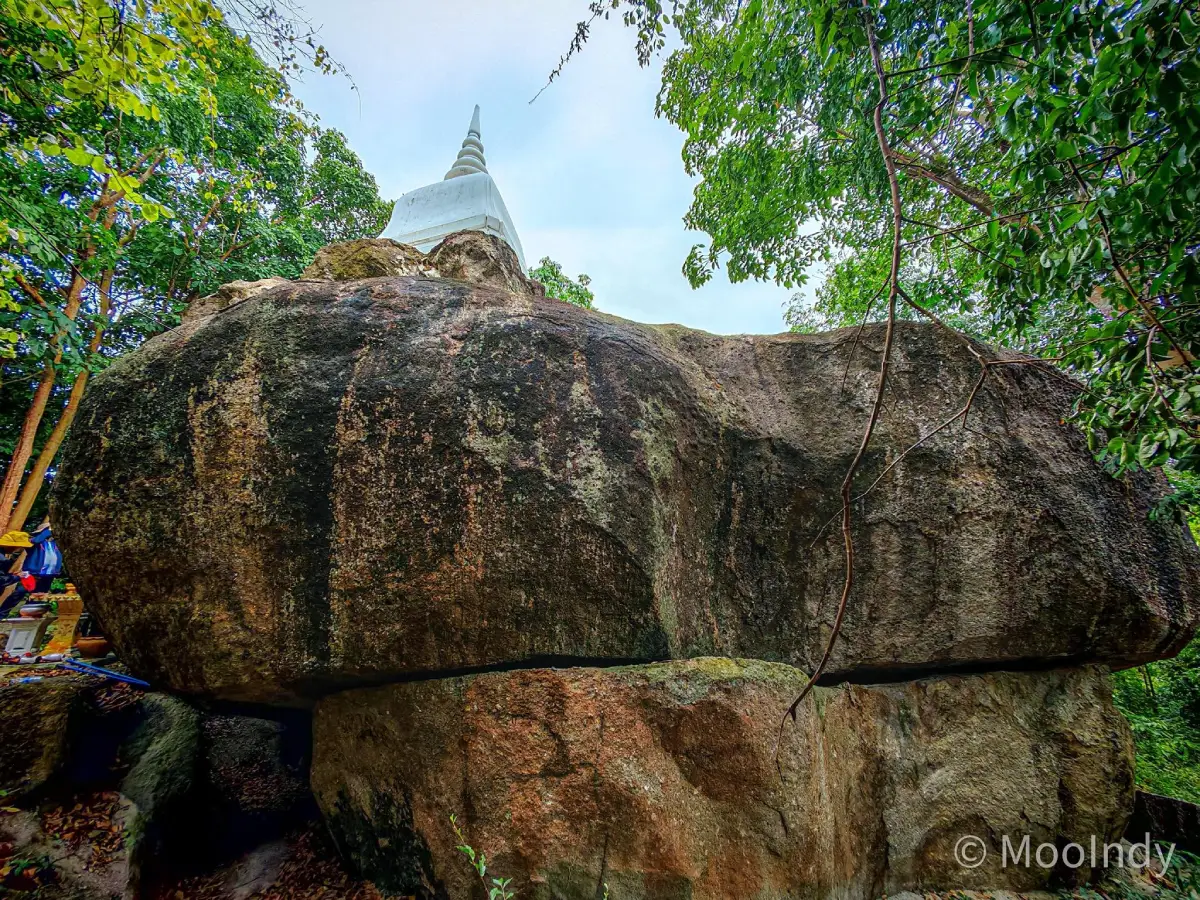
Chedi Tuat Chang, also known as the ancient chedi on Khao Rup Chang, is located on Khao Rup Chang hill in Moo 2 – Moo 4, Khao Rup Chang Subdistrict, Mueang Songkhla District, Songkhla Province. It is a sacred local heritage site where history, folklore, hilltop landscape, and community belief meet. The site is known for an old brick-and-mortar chedi standing on a large rock formation and for the legend of Tuat Chang, the sacred elephant guardian associated with the origin of the name Khao Rup Chang. For travelers who want to understand Songkhla beyond beaches and the old town, this hilltop chedi offers a deeper look at local belief and cultural memory.
Chedi Tuat Chang is not a large tourist attraction in the commercial sense. Its value comes from its quiet hilltop setting, its registered heritage status, and the strong local belief surrounding the place. The name Khao Rup Chang, meaning “elephant-shaped hill”, is closely connected with stories of sacred elephants, guardian spirits, stone formations, and the way local people have respected the mountain for generations. Visiting the site allows travelers to see how a small ancient monument can hold great meaning for a community.
The central legend tells of Thaan Lak Kao, who traveled from the south with 2 elephants named Pho Phlai Kaeo and Mae Phang Nga. He was accompanied by elephant handlers and followers named Bang Do Lo, Yai Ma La, and Bang Sum. The group carried treasures with the intention of contributing to the construction of a great chedi in Nakhon Si Thammarat. When they reached the area now known as Khao Rup Chang, a violent storm struck. The elephants and their handlers died on the hill, and Thaan Lak Kao buried them there. Later, stones appeared with shapes resembling elephants. Local people came to believe that these stones represented the sacred elephants and began calling the area Khao Rup Chang.
The legend of Tuat Chang is more than a local folktale. It explains how the community understands the hill as a sacred place. Stories passed down in the area warn against cutting trees, damaging stones, or showing disrespect on the mountain. Local narratives mention people who suffered misfortune after cutting wood on the hill, investors who damaged rocks and later faced serious accidents, and soldiers during the Second World War who killed and ate a white snake believed to be a disciple of Tuat Chang, then experienced strange illness until a ritual of appeasement was performed. These stories show how belief functions as a form of cultural protection for the mountain, the forest, and the ancient chedi.
Historically, the chedi on Khao Rup Chang was built during the reign of King Rama IV by Chao Phraya Wichian Khiri, also known as Boon Sang Na Songkhla, who governed Songkhla at that time. The chedi is made of brick and mortar and stands on a large rock on the hilltop. Its base is square, measuring about 2.50 meters on each side, and its bell-shaped body follows a twelve-indented-corner form. Although the chedi is modest in size, its hilltop position gives it strong cultural and visual presence.
The Fine Arts Department registered the chedi on Khao Rup Chang as a national ancient monument in the Royal Gazette, Volume 52, Section 75, dated 8 March 1935. This confirms that the site is important not only as a sacred place in local belief, but also as a cultural heritage monument of Songkhla. Visitors should therefore treat the site with care. Climbing on the chedi, touching fragile parts of the structure, moving objects, carving names, or leaving rubbish would damage both the monument and the trust of the local community.
Khao Rup Chang itself also has historical significance because of its landscape. The hill offers wide views over Songkhla and the surrounding area, making it a strategic location in the past. The area was used in military contexts during the Kedah conflict around 1838 and again during the Greater East Asia War period in 1941. These layers make Khao Rup Chang more than a scenic hill. It is a place where belief, topography, defense, and local history overlap.
The chedi has also received attention through conservation work. The Fine Arts Department, the 11th Regional Office of Fine Arts in Songkhla, Songkhla Province, Khao Rup Chang Municipality, Songkhla Regional Observatory, and private-sector partners have supported restoration and landscape improvement work to strengthen the ancient monument and highlight its historical value. Conservation here is not only about repairing masonry. It is also about helping younger generations understand why the chedi, the hill, and the story of Tuat Chang matter.
The site remains linked with annual rituals and cultural activities. The Local Natural and Cultural Environment Conservation Unit of Songkhla Province at Songkhla Rajabhat University has been associated with cultural documentation and ritual activities connected with Tuat Chang. Ceremonies include Brahmin and Buddhist elements and help keep the story of Tuat Chang alive in community practice. Through these ceremonies, the legend does not remain only in written records. It continues as a living tradition connected with the people of Khao Rup Chang.
The strongest feature of Chedi Tuat Chang is the way it combines documented history with living memory. On one level, the chedi is a registered ancient monument with a known historical builder, architectural form, and conservation record. On another level, the same place is surrounded by stories of sacred elephants, Thaan Lak Kao, a white snake, wartime experiences, and vows made by local people. Both levels are necessary to understand the site. Without history, the place becomes only a legend. Without local belief, the chedi loses much of its emotional meaning.
For travelers interested in southern Thai beliefs, Chedi Tuat Chang is a useful example of the concept of “Tuat”. In many southern communities, Tuat can refer to a sacred guardian, ancestral force, local spirit, or protective presence respected by the community. Tuat Chang is therefore understood not only as the memory of 2 elephants in a legend, but also as a guardian of Khao Rup Chang. This belief encourages respect for the mountain, stone formations, trees, and old monuments, linking traditional belief with modern heritage conservation.
Geographically, Khao Rup Chang Subdistrict is a hilly area with communities, educational institutions, learning centers, and several tourist attractions nearby. Chedi Tuat Chang is close to Songkhla Regional Observatory, formally known as the Regional Observatory for the Public, Songkhla. The observatory is located on Khao Rup Chang and offers broad views of Songkhla Lake, the Gulf of Thailand, and Songkhla city. This makes the area especially interesting because visitors can experience a sacred folklore site, an ancient monument, panoramic scenery, and modern astronomy learning within the same hill area.
A visit to Chedi Tuat Chang should not be rushed. Visitors who only want to pay respect and see the chedi should allow at least 45 minutes to 1 hour. Travelers who want to combine the site with Songkhla Regional Observatory, Songkhla Zoo, Songkhla Old Town, or Samila Beach should plan a half-day or full-day route. Morning or late afternoon is usually more comfortable for walking, especially because the site is on a hill and the weather in Songkhla can be hot and humid.
The hilltop environment is part natural landscape and part heritage site. Visitors should wear stable walking shoes, bring drinking water, and prepare sun protection. The area should be used carefully. Do not climb onto the chedi structure, do not move stones or offerings, and do not leave waste behind. The simplicity of the site is part of its value. Chedi Tuat Chang does not need large modern buildings to be meaningful; its power comes from the old chedi, the hill, the rocks, the stories, and the respect surrounding it.
Important details to observe include the large rock base beneath the chedi, the brick-and-mortar construction, the twelve-indented-corner form, the weathered surfaces, and the chedi’s position within the surrounding landscape. For travelers interested in art history, the chedi may appear small compared with major Buddhist monuments in large cities, but its cultural force is strong because it is tied directly to local identity. Observing the site slowly helps visitors understand why small monuments can carry deep heritage value.
A practical travel route can begin at Songkhla Regional Observatory on Khao Rup Chang, continue to Chedi Tuat Chang, then move to Songkhla Zoo for wildlife displays and viewpoints. Travelers who prefer cultural routes can continue to Songkhla Old Town, Nang Ngam Road, Ban Nakhon Nai, Hub Ho Hin Red Rice Mill, Nakhon Nok Road, Tang Kuan Hill, Samila Beach, and the Golden Mermaid statue. This route gives a balanced picture of Songkhla through hills, folklore, ancient monuments, science, old-town food, and the coast.
Food and accommodation options can be found in Khao Rup Chang and Mueang Songkhla. Restaurants around Khao Rup Chang are convenient before or after visiting the hill, while Songkhla Old Town is better for travelers who want heritage food and old-town atmosphere. Travelers who want to stay close to Khao Rup Chang can choose hotels around Kanchanawanit Road or the wider Mueang Songkhla area. Those who prefer historic atmosphere may stay near Nakhon Nai Road, Nakhon Nok Road, or Nang Ngam Road and make Khao Rup Chang a short morning trip.
Getting There is easiest by private car, rental car, or local hired vehicle. Set the destination for Khao Rup Chang Subdistrict or Songkhla Regional Observatory, then continue toward the chedi area on Khao Rup Chang. From central Songkhla, travelers can use Kanchanawanit Road or local roads into Khao Rup Chang. From Hat Yai, the drive to Songkhla and Khao Rup Chang usually takes about 40 to 60 minutes depending on traffic. Once near the hill, it is best to ask local people or nearby service points for the correct route up to the chedi.
Travelers without a private vehicle can take a van or bus from Hat Yai to Songkhla city and then continue by local hired transport to Khao Rup Chang. This option is suitable for travelers who have enough time and want to include several places in one day, such as the observatory, Songkhla Zoo, and the old town. It is advisable to agree on the fare and return pickup point in advance because local public transport may not pass the hill area regularly throughout the day.
Chedi Tuat Chang should be visited with respect rather than hurry. This is both an ancient monument and a sacred site. Visitors should behave quietly, avoid mocking local beliefs, and follow any instructions from caretakers or community members. If a ritual or community event is taking place, visitors should keep a respectful distance unless invited to participate. Such behavior helps protect the relationship between travelers and the local community that continues to preserve the site.
In summary, Chedi Tuat Chang is one of the places that reveals a deeper side of Songkhla. It has a Rama IV-period chedi, national ancient monument status, the legend of Tuat Chang and Thaan Lak Kao, Second World War-era stories, continuing ritual practice, and a hilltop location connected with learning centers and other attractions in Mueang Songkhla. For travelers seeking history, belief, landscape, and local identity in one place, Chedi Tuat Chang is a meaningful stop in Songkhla.
| Name | Chedi Tuat Chang / Ancient Chedi on Khao Rup Chang |
| Location | Moo 2 – Moo 4, Khao Rup Chang Subdistrict, Mueang Songkhla District, Songkhla Province 90000 |
| Address | Khao Rup Chang Subdistrict, Mueang Songkhla District, Songkhla 90000, Thailand |
| Coordinates | 7.1582690039, 100.611157032 |
| Highlights | A sacred hilltop ancient chedi on Khao Rup Chang, linked with the legend of Tuat Chang and local guardian beliefs |
| History | Built during the reign of King Rama IV by Chao Phraya Wichian Khiri, also known as Boon Sang Na Songkhla, and registered as a national ancient monument on 8 March 1935 |
| Name Origin | The name Khao Rup Chang is linked with the legend of Pho Phlai Kaeo and Mae Phang Nga, 2 elephants of Thaan Lak Kao, and stones believed to have emerged in elephant-like forms |
| Distinctive Features | Brick-and-mortar chedi on a large rock, square base measuring about 2.50 meters on each side, and a twelve-indented-corner bell-shaped body |
| Key Evidence | The hilltop chedi, Fine Arts Department ancient monument registration, and cultural heritage records from the Office of Natural Resources and Environmental Policy and Planning |
| Travel Information | Travel by private car, rental car, or local hired vehicle to Khao Rup Chang Subdistrict near Songkhla Regional Observatory. From Hat Yai, the journey usually takes about 40 to 60 minutes depending on traffic |
| Current Status | Open for cultural visits and worship as an important sacred and heritage site of Khao Rup Chang Subdistrict |
| Open Days | Daily |
| Opening Hours | 08.00 – 17.00 |
| Facilities | Sacred worship area, hill access route, viewpoints, and nearby learning attractions in Khao Rup Chang |
| Main Areas / Zones | 1. Ancient Chedi on Khao Rup Chang 2. Large Rock Base Beneath the Chedi 3. Tuat Chang Worship Area 4. Hill Access Route 5. Viewpoints over Songkhla and the Surrounding Area |
| Caretaker / Related Agencies | Fine Arts Department, 11th Regional Office of Fine Arts Songkhla, Khao Rup Chang Municipality, and the Local Natural and Cultural Environment Conservation Unit of Songkhla Province at Songkhla Rajabhat University |
| Main Contact Number | Local Natural and Cultural Environment Conservation Unit of Songkhla Province, Tel. 0-7426-0280 |
| Nearby Tourist Attractions | 1. Songkhla Regional Observatory, about 1 km 2. Songkhla Zoo, about 3 km 3. Songkhla Rajabhat University, about 4 km 4. Kao Seng Beach, about 5 km 5. Songkhla Old Town, about 7 km 6. Nang Ngam Road, about 7 km 7. Samila Beach and Golden Mermaid Statue, about 8 km |
| Nearby Restaurants | 1. Tumroy Khao Rup Chang, about 4 km, Tel. 065-218-7442 2. Rong Ruea Boat Noodle, Khao Rup Chang Branch, about 4 km, Tel. 06-2209-6381 3. Mountain View Cafe & Restaurant, Songkhla Zoo, about 3 km, Tel. 074-260-198 4. Sure Rich, about 5 km, Tel. 081-478-0828 5. Ros Niyom Coffee & Gallery, about 5 km, Tel. 081-690-6640 6. Cheese Yeum Khao Rup Chang, about 5 km, Tel. 062-519-9847 |
| Nearby Accommodations | 1. Songkhla KeeRee Hotel, about 3 km, Tel. 099-163-3310 2. L Residence Hotel, about 4 km, Tel. 095-637-5432 3. Le Siri Hotel, about 5 km, Tel. 074-558-442 4. B Brand Hotel, about 5 km, Tel. 093-615-6688 5. The Peak Songkhla, about 6 km 6. Kaoseng Rockhill Hotel, about 6 km |
Frequently Asked Questions (FAQ)
Q: Where is Chedi Tuat Chang located?
A: Chedi Tuat Chang is located on Khao Rup Chang in Moo 2 – Moo 4, Khao Rup Chang Subdistrict, Mueang Songkhla District, Songkhla Province, near Songkhla Regional Observatory.
Q: What are the opening hours of Chedi Tuat Chang?
A: The site is open daily from 08.00 to 17.00.
Q: Why is Chedi Tuat Chang important?
A: It is a Rama IV-period ancient chedi on Khao Rup Chang and a sacred local site connected with the legend of Tuat Chang.
Q: Why is the area called Khao Rup Chang?
A: The name is linked with the legend of 2 elephants, Pho Phlai Kaeo and Mae Phang Nga, whose forms were believed to have appeared as elephant-shaped stones on the hill.
Q: Is Chedi Tuat Chang a registered ancient monument?
A: Yes. The chedi on Khao Rup Chang was registered as a national ancient monument by the Fine Arts Department in the Royal Gazette on 8 March 1935.
Q: What nearby places can travelers visit with Chedi Tuat Chang?
A: Nearby places include Songkhla Regional Observatory, Songkhla Zoo, Kao Seng Beach, Songkhla Old Town, Nang Ngam Road, Samila Beach, and the Golden Mermaid statue.
Q: What should visitors prepare before visiting Chedi Tuat Chang?
A: Visitors should wear stable walking shoes, bring drinking water, dress respectfully, avoid climbing on the chedi, avoid moving objects, and keep the area clean.
Q: How can travelers get to Chedi Tuat Chang from Hat Yai?
A: Travelers can drive, rent a car, or take local transport from Hat Yai toward Songkhla and continue to Khao Rup Chang. The journey usually takes about 40 to 60 minutes depending on traffic.
 Category: ●Places of Worship
 Group: ●Other Sacred Sites
Last Update : 2 MonthAgo
 Last Update : 2 MonthAgo
 Click to Access the Navigation Map GPS

 Art, Culture and Heritage
 Historical Sites and Monuments(2)
 Landmarks and Memorials(7)
 Royal Palace(1)
 Art, Craft Centres, Tradition(4)
 Museums(4)
 Art Gallery(1)
 Educational Places
 Library(1)
 Educational Gardens, Farm(3)
 University
 Public university(1)
 Autonomous Universities(1)
 Rajamangala University of Technology(1)
 Rajabhat University(1)
 Private University(1)
 Temple(52)
 Mosque(2)
Other Sacred Sites(11)
 Suburban Living
 Village, Community(3)
 Local Market(3)
 Floating Market(2)
 Nature and Wildlife
 National Parks and Marine Reserves(5)
 Mountain (Doi)(6)
 Dam, Reservoir, Lake(5)
 Waterfalls(12)
 Caves(4)
 River, Canal(2)
 Bays and Beaches(13)
 Islands(3)
 Other natural attractions(2)
 Entertainment and Agricultural
 Zoos and Aquariums(2)
 Animal camps and shows(1)
 Farms, Parks and Ecotourism(6)
 Waterpark(1)
 Travel Articles, Recipes
 Travel Review, Food Review(1)
 Southern Food Menu, Southern Food Recipes(2)


