
lovethailand home >South Travel Attractions >Songkhla Travel Attractions >Muang Songkhla >Koh Yo > Ko Yo
TL;DR: Ko Yo is located at Ko Yo Subdistrict, Mueang Songkhla District, Songkhla Province, open Daily, hours 24 Hours.
Ko Yo
Open Days: Daily
Opening Hours: 24 Hours
Ko Yo is a small island in the lower part of Songkhla Lake, located in Ko Yo Subdistrict, Mueang Songkhla District, Songkhla Province. It is one of Songkhla’s most distinctive community-based travel destinations, combining lake scenery, agriculture, fisheries, woven textiles, local food, temples, viewpoints, and a major cultural museum in one compact area. The island is connected to Songkhla city and Singhanakhon District by the Tinsulanonda Bridge, making it easy to visit as a half-day or full-day trip. Ko Yo is not only a scenic island; it is a living lake community where orchards, seabass cages, traditional weaving, old temples, restaurants, homestays, and the Institute for Southern Thai Studies all form part of the island’s identity.
Although Ko Yo is close to Songkhla city, its atmosphere is noticeably different from the urban center. Crossing the Tinsulanonda Bridge brings visitors into a lakeside landscape of wide water views, fish cages, hillside communities, fruit gardens, and small local roads around the island. The terrain consists of low hills, foothill plains, and flatter areas near the lakeshore. This geography has shaped the island’s settlement, agriculture, and fishing economy for generations. Ko Yo is therefore not just a viewpoint in Songkhla Lake, but a real community that has lived with the lake for a long time.
Current local information records Ko Yo as covering about 17.95 square kilometers, or about 11,220 rai, when both land and surrounding water are included. The land area is about 15 square kilometers, or about 9,375 rai. Much of the usable land is connected with fruit gardens, rubber plantations, and mixed agriculture. The hillsides and foothill plains make the island suitable for traditional mixed orchards, locally known as suan somrom. This farming system grows several kinds of fruit trees together so that different crops can produce at different times of the year.
Suan somrom is one of the strongest agricultural images of Ko Yo. Instead of relying on a single crop, local farmers grow fruits such as pomelo, coconut, jackfruit, and champedak in the same garden system. These fruits produce in different seasons, helping households maintain year-round harvests. This system fits the island’s limited land area and reflects local knowledge of soil, water, wind, and microclimate. As visitors drive around Ko Yo, they can still see orchards existing alongside houses, temples, restaurants, homestays, and viewpoints.
The most famous fruit associated with Ko Yo is champedak. It belongs to the same broad fruit family as jackfruit and looks somewhat similar, but the fruit is generally smaller and strongly aromatic. It can be eaten fresh or coated in batter and fried in a style similar to Thai banana fritters. Champedak is therefore more than a fruit crop. It is part of the island’s food identity and one of the local tastes that many visitors remember after traveling to Ko Yo.
Ko Yo is also famous for Ko Yo woven cloth, a local textile highly valued by people who appreciate Thai fabrics. Ko Yo woven cloth is known for its tight weave, clear patterns, practical use, and easy maintenance. Well-known patterns include Ratchawat, Dok Phikun, Dok Phayom, Luk Kaew, and many other traditional designs. Weaving is a craft that reflects skill, patience, material knowledge, and community identity. Over time, Ko Yo woven cloth has become one of Songkhla’s most recognized local products.
The history of Ko Yo weaving is linked with Thai and Chinese settlement on the island. The craft has been passed down over many generations. In earlier times, local weavers used traditional looms, natural fibers, and natural dyes. Later, weaving developed with a wider range of materials, including cotton, silk, and synthetic fibers. Ko Yo cloth includes everyday fabrics as well as more elaborate raised-pattern textiles that require advanced skill. The Ratchawat pattern is especially important because it is closely associated with the identity of Ko Yo and the wider southern Thai weaving tradition.
A visit to Ko Yo should include time for seeing or buying Ko Yo woven cloth from local shops or weaving groups. Each piece of cloth is more than a souvenir. It carries the story of thread, pattern, handwork, and inherited knowledge. Buying directly from local producers helps support weavers and the continuation of the craft. For travelers interested in textiles, Ko Yo is a useful place to understand that local cloth is not only decorative; it also reflects household economy, women’s work, craft transmission, and regional identity.
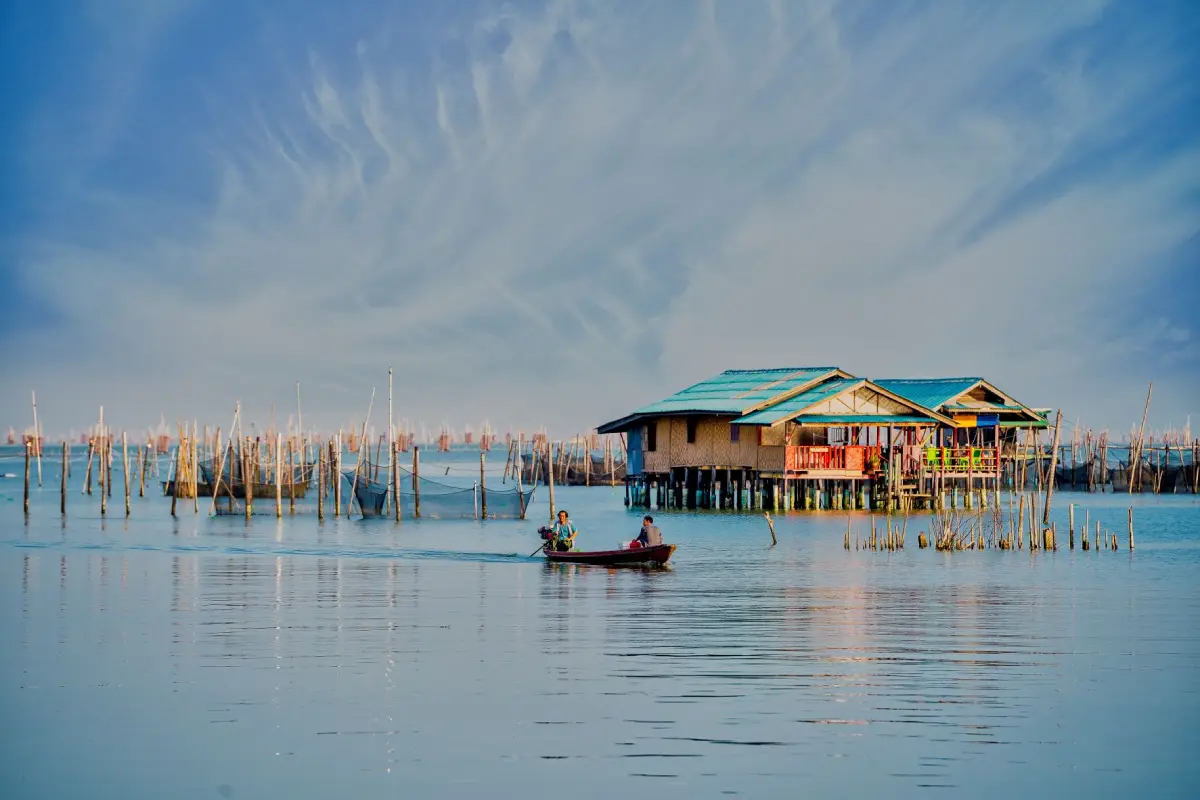
Ko Yo is also known for white seabass raised in floating cages in Songkhla Lake. Visitors can see fish cages in the water from roads around the island and from lakeside restaurants. Seabass farming here depends on local knowledge of lake-water conditions, including changes in salinity in different seasons and locations. Cage-raised seabass has become an important livelihood, a signature ingredient in local restaurants, and one of the most recognizable images of Ko Yo.
Food on Ko Yo is strongly connected with local ingredients. White seabass, lake seafood, and southern Thai dishes are the main highlights. Many restaurants are located by Songkhla Lake or offer views of fish cages, allowing visitors to enjoy both food and scenery. Popular dishes include fried seabass with fish sauce, steamed seabass with lime, sour curry, local seafood dishes, and southern-style meals made with regional herbs and vegetables. This strong link between ingredient, place, and view is one reason Ko Yo remains a popular food destination in Songkhla.
The Institute for Southern Thai Studies is one of the most important places on Ko Yo. Located at Ban Ao Sai in Ko Yo Subdistrict, it is a major learning center for southern Thai culture, history, local wisdom, and ways of life. Its Folklore Museum displays art objects, antiques, tools, clothing, handicrafts, belief systems, and everyday cultural materials from southern Thailand in organized collections. Travelers who want to understand southern Thailand beyond beaches and food should make time for this museum because it explains the region’s cultural background in a clear and structured way.
Another highlight of the Institute for Southern Thai Studies is its viewpoint tower. From the elevated viewpoint, visitors can see Ko Yo, Songkhla Lake, the Tinsulanonda Bridge, surrounding mountains, lakeside communities, orchards, fish cages, and local transport routes. The view helps visitors understand the island’s physical structure and the relationship between settlement, agriculture, fisheries, and the lake. The viewpoint is therefore not only a photo spot, but also a way to see how Ko Yo functions as a lake island community.
Ko Yo can be understood through several travel zones: the bridge and scenic route zone, the community road zone, the mixed-orchard zone, the woven-cloth and local product zone, the seabass-cage and lakeside restaurant zone, the temple and cultural zone, the viewpoint zone, and the Institute for Southern Thai Studies zone. Planning a visit by zone helps travelers use their time well. The island is compact, but it contains many layers. A quick drive around the island may show the views, but a slower visit reveals agriculture, weaving, fisheries, temples, local markets, and community memory.
Ko Yo has several viewpoints. Local information identifies viewing areas around Ban Pa Nhot, the area in front of Wat Thai Yo, the area behind the Ko Yo Subdistrict Administrative Organization office, the artificial-sand beach park at Ban Ao Sai, the high viewpoint at the Institute for Southern Thai Studies, and the meditation area on Khao Kudi. These places show Songkhla Lake from different angles. Some are suitable for sunrise, some for sunset, and others for seeing communities, orchards, and fish cages. Travelers who enjoy photography can choose viewpoints according to time of day and direction of light.
Wat Laem Pho is another important place on Ko Yo. This old lakeside temple is known for its reclining Buddha image and its setting near Songkhla Lake. The area is also linked with the Wat Laem Pho Pracharat Market, which opens on Saturday evenings and sells agricultural products, fishery products, local food, processed goods, OTOP products, and Ko Yo community products. This makes the area suitable for paying respect at the temple, enjoying lake scenery, and buying local food or souvenirs from the community.
Wat Thai Yo is another old temple on Ko Yo and an important cultural site. The temple area is associated with local heritage features such as the chedi on Khao Phehan, the ordination hall, wooden monk residences, traditional Thai-style buildings, an old pond, and other structures that reflect the temple’s historical use of space. Wat Thai Yo adds religious and historical depth to a Ko Yo visit and shows that the island has more than food and scenery. It also has long-standing cultural roots.
Khao Phehan, also spelled Khao Phihan, behind Wat Thai Yo, is connected with local belief and history. The area includes a chedi and spaces respected by the local community. Visitors entering temple or hill areas should dress modestly, keep noise low, and follow local guidance because these places are sacred and connected with community memory. Travelers interested in local history should combine Wat Thai Yo and Khao Phehan in the same route.
Getting to Ko Yo is straightforward. From Songkhla city, take Highway 407 and turn onto Highway 4083 toward Singhanakhon, then cross the Tinsulanonda Bridge to enter Ko Yo. The bridge itself is part of the travel experience because it crosses Songkhla Lake and offers broad views of the water, fish cages, and lakeside communities. A private car or rental car is the most convenient way to travel because it allows visitors to stop at temples, restaurants, viewpoints, weaving shops, orchards, and the museum at their own pace.
Getting There around the island is easiest by following the ring roads and local roads that connect villages, temples, restaurants, fruit gardens, homestays, and viewpoints. A simple loop around the island is suitable for first-time visitors, while travelers who want a deeper experience should choose key stops in advance, such as the Institute for Southern Thai Studies, Wat Laem Pho, Wat Thai Yo, local weaving groups, lakeside restaurants, and the Saturday evening market at Wat Laem Pho. Public transport is possible through Songkhla, but travelers without a private vehicle should arrange local transport and the return trip in advance.
The best times to visit Ko Yo are morning and late afternoon. Morning is suitable for lake views, temples, museum visits, and driving around the island before the day becomes too hot. Late afternoon is good for lakeside dining, sunset views, local products, and a slower community atmosphere. If visiting the Institute for Southern Thai Studies, plan according to the museum’s opening hours because the island itself is accessible throughout the day, while attractions, shops, restaurants, and museums operate on their own schedules.
Accessibility on Ko Yo should be considered place by place. Some shopfronts and roadside areas have enough space for parking and wheelchair access, and some connecting paths are flat, smooth, and not slippery. However, Ko Yo is a community island with slopes, hillside areas, uneven roads, and viewpoints at different levels. Visitors traveling with elderly people or wheelchair users should choose appropriate stops, park close to the destination, and avoid steep or uneven areas.
A half-day Ko Yo itinerary can begin by crossing the Tinsulanonda Bridge, visiting the Institute for Southern Thai Studies for the museum and viewpoint, continuing to Wat Laem Pho or Wat Thai Yo, and ending with a lakeside meal. With more time, visitors should add a stop for Ko Yo woven cloth, buy local fruit or OTOP products, and drive through mixed-orchard areas. This type of route gives a balanced view of the island: nature, community, history, craft, and food.
A full-day Ko Yo itinerary can include more detail. Start in the morning with temples and viewpoints, visit the Institute for Southern Thai Studies before lunch, eat cage-raised seabass or local seafood by the lake at midday, stop for woven cloth and local products in the afternoon, and wait for sunset at a viewpoint or lakeside restaurant. On Saturdays, the Wat Laem Pho Pracharat Market can be added in the evening, giving visitors a stronger sense of local food, products, and community atmosphere.
Responsible travel matters on Ko Yo because Songkhla Lake is a living ecosystem tied to fisheries, fish cages, restaurants, and local quality of life. Visitors should not litter in the lake, avoid disturbing fish cages, avoid blocking houses or shops with parked vehicles, and support local producers respectfully. Good tourism helps income circulate within the island community while reducing pressure on the lake environment.
For travelers interested in history, Ko Yo is significant because it has traces of long settlement. Local sources describe the island as connected with earlier communities before Songkhla’s main urban center moved to the present Bo Yang side. Its position in Songkhla Lake made Ko Yo relevant to transport, fishing, farming, and trade. Thai Buddhist, Thai Muslim, and Chinese-descended communities have all contributed to the island’s layered identity, creating diversity in culture, food, language, and everyday life.
Compared with many other attractions in Songkhla, Ko Yo is strong because it offers several experiences in one place. Visitors can cross a scenic bridge, learn about southern Thai culture, see traditional woven cloth, pay respect at old temples, eat fresh seabass from local cages, buy fruit and community products, and stay in lakeside homestays. This makes Ko Yo suitable for families, elderly travelers, photographers, students, cultural travelers, food lovers, and anyone who wants a slower and more complete view of Songkhla.
In summary, Ko Yo is one of Songkhla’s most important destinations because it brings together nature, lake scenery, culture, food, agriculture, fisheries, and local wisdom. Its beauty is not only visual. It is found in the continuity of island life: suan somrom orchards, champedak fruit, Ko Yo woven cloth, seabass cages, old temples, viewpoints, and the Folklore Museum at the Institute for Southern Thai Studies. Travelers who want to know Songkhla beyond beaches and the old town should spend time on Ko Yo, because this small island offers scenery, taste, knowledge, craft, and community memory in one meaningful journey.
| Name | Ko Yo |
| Location | Ko Yo Subdistrict, Mueang Songkhla District, Songkhla Province |
| Address | Ko Yo Subdistrict, Mueang Songkhla District, Songkhla 90100, Thailand |
| Coordinates | 7.1632938797, 100.540353489 |
| Place Type | Island in Songkhla Lake, old community district, and community-based travel destination |
| Area | Total area about 17.95 square kilometers or 11,220 rai including water; land area about 15 square kilometers or 9,375 rai |
| Highlights | Tinsulanonda Bridge, Songkhla Lake, mixed orchards, champedak, Ko Yo woven cloth, cage-raised seabass, old temples, viewpoints, and the Institute for Southern Thai Studies |
| Terrain | Low hills, foothill plains, and some flat areas suitable for agriculture, orchards, and lakeside communities |
| Local Products And Wisdom | Ko Yo woven cloth, Ratchawat pattern, Dok Phikun pattern, Dok Phayom pattern, local fruits, champedak, and products related to cage-raised seabass |
| Signature Food | Cage-raised white seabass, lake seafood, southern Thai dishes, and local fruit-based snacks |
| Getting There | From Songkhla city, take Highway 407 and turn onto Highway 4083 toward Singhanakhon, then cross the Tinsulanonda Bridge to enter Ko Yo |
| Current Status | Open as a community island and travel destination with normal access; individual attractions, shops, restaurants, and museums operate on their own schedules |
| Island Open Days | Daily |
| Island Opening Hours | 24 hours |
| Island Admission Fee | No island admission fee |
| Institute For Southern Thai Studies | Address: 53/2 Moo 1, Ban Ao Sai, Ko Yo Subdistrict, Mueang Songkhla District, Songkhla 90100. Tel. 074-591-611-2. Opening hours: Monday–Friday 08.30–17.00, Saturday–Sunday 09.00–18.00. Admission fee: 50 Baht |
| Main Zones On The Island | Bridge and viewpoint zone, community road zone, mixed-orchard zone, woven-cloth and OTOP zone, seabass-cage zone, lakeside restaurant zone, temple and culture zone, and Institute for Southern Thai Studies zone |
| Facilities And Accessibility | Island roads, restaurants, shops, accommodation, homestays, viewpoints, and parking at some shopfronts or roadside areas; some areas have flat paths suitable for wheelchair access |
| Caretaker / Local Authority | Ko Yo Subdistrict Administrative Organization |
| Main Contact Number | Ko Yo Subdistrict Administrative Organization, Tel. 0-7430-0457-9 |
| Nearby Tourist Attractions | 1. Institute for Southern Thai Studies, about 1 km 2. Wat Laem Pho / Reclining Buddha of Laem Pho, about 3 km 3. Wat Laem Pho Pracharat Market, about 3 km 4. Wat Thai Yo, about 4 km 5. Khao Phehan / Khao Phihan, about 4 km 6. Ban Pa Nhot Viewpoint, about 5 km |
| Nearby Restaurants | 1. Ko Yo De Lagoon Restaurant, about 2 km, Tel. 074-847-956, 081-853-3447, 090-676-2404 2. Khun Chit Sea View, about 3 km, Tel. 074-591-556 3. Som Tam Pa Ead Ko Yo, about 2 km, Tel. 081-767-1083 4. Chom Chan Restaurant, about 3 km, Tel. 074-450-435 5. Sirada Ko Yo, about 3 km, Tel. 074-450-235, 086-299-7444 6. Mae Ben Pla Phao 3 Ko Yo, about 3 km, Tel. 080-529-6626 |
| Nearby Accommodations | 1. Khum Sai Ngam Hotel And Resort, about 3 km, Tel. 074-591-669 2. Ko Yo Homestay Lung Decha, about 2 km, Tel. 074-440-390, 087-633-5476 3. Suan Mai Homestay, about 2 km, Tel. 081-478-7209 4. Wassakon Thong Homestay Ko Yo, about 2 km, Tel. 085-799-9400, 081-767-2851 5. The Lake House Ko Yo, about 2 km, Tel. 086-965-2382 6. Ruean Raek Homestay, about 4 km, Tel. 081-898-3341 |
Frequently Asked Questions (FAQ)
Q: Where is Ko Yo located?
A: Ko Yo is located in Ko Yo Subdistrict, Mueang Songkhla District, Songkhla Province. It is an island in the lower part of Songkhla Lake and is connected to the Singhanakhon route by the Tinsulanonda Bridge.
Q: What are the opening days and hours of Ko Yo?
A: Ko Yo is a community island with public roads accessible daily, 24 hours. Individual attractions, restaurants, shops, and museums on the island operate on their own schedules.
Q: Is there an admission fee to enter Ko Yo?
A: There is no admission fee to enter Ko Yo itself. Some individual attractions on the island, such as the Institute for Southern Thai Studies, have their own admission fees.
Q: What is Ko Yo famous for?
A: Ko Yo is famous for Songkhla Lake views, the Tinsulanonda Bridge, mixed orchards, champedak, Ko Yo woven cloth, cage-raised white seabass, lakeside restaurants, old temples, viewpoints, and the Institute for Southern Thai Studies.
Q: How do travelers get to Ko Yo?
A: From Songkhla city, take Highway 407 and turn onto Highway 4083 toward Singhanakhon, then cross the Tinsulanonda Bridge to enter Ko Yo. Private car or rental car is the most convenient option.
Q: Is the Institute for Southern Thai Studies on Ko Yo?
A: Yes. The Institute for Southern Thai Studies is located at Ban Ao Sai on Ko Yo. It is a major learning center for southern Thai culture, history, local wisdom, and ways of life, with a Folklore Museum and a high viewpoint.
Q: Which Ko Yo woven cloth patterns are well known?
A: Well-known Ko Yo woven cloth patterns include Ratchawat, Dok Phikun, Dok Phayom, and Luk Kaew. The cloth is known for its tight weave, clear patterns, and easy maintenance.
Q: What should visitors be careful about when visiting Ko Yo?
A: Visitors should keep the lake clean, avoid disturbing fish cages, avoid parking in ways that block local homes or shops, and choose suitable stops when traveling with elderly visitors or wheelchair users.
 Category: ●Nature and Wildlife
 Group: ●Islands
Last Update : 2 MonthAgo
 Last Update : 2 MonthAgo
 Click to Access the Navigation Map GPS
Ko Yo Map
Gellery
Recommend

 Art, Culture and Heritage
 Historical Sites and Monuments(2)
 Landmarks and Memorials(7)
 Royal Palace(1)
 Art, Craft Centres, Tradition(4)
 Museums(4)
 Art Gallery(1)
 Educational Places
 Library(1)
 Educational Gardens, Farm(3)
 Places of Worship
 Temple(52)
 Mosque(2)
 Other Sacred Sites(11)
 Suburban Living
 Village, Community(3)
 Local Market(3)
 Floating Market(2)
 National Parks and Marine Reserves(5)
 Mountain (Doi)(6)
 Dam, Reservoir, Lake(5)
 Waterfalls(12)
 Caves(4)
 River, Canal(2)
 Bays and Beaches(13)
Islands(3)
Bays and Beaches(13)
Islands(3)
 Other natural attractions(2)
 Entertainment and Agricultural
 Zoos and Aquariums(2)
 Animal camps and shows(1)
 Farms, Parks and Ecotourism(6)
 Waterpark(1)
 Travel Articles, Recipes
 Travel Review, Food Review(1)
 Southern Food Menu, Southern Food Recipes(2)


