
lovethailand home >South Travel Attractions >Songkhla Travel Attractions >Muang Songkhla >Bo Yang > Songkhla Aquatic Animal Exhibition Center (Songkhl..
TL;DR: Songkhla Aquatic Animal Exhibition Center (Songkhla Aquarium), Songkhla attractions : Entertainment and Agricultural, Zoos and Aquariums.
Songkhla Aquatic Animal Exhibition Center (Songkhla Aquarium)
Open Days: Under restoration and open according to on-site announcements
Opening Hours: Contact Songkhla Aquarium at 074-322-787 or 074-322-899 before visiting
Songkhla Aquarium, officially known as Songkhla Aquatic Animal Exhibition Center, is an aquatic learning center located at the tip of Laem Son On on Laem Son On Road, Bo Yang Subdistrict, Mueang Songkhla District, Songkhla Province. The site is close to Song Thale Park, Laem Son On, Samila Beach, and the coastal viewpoint for Ko Nu–Ko Maeo, making it one of the most strategically located family and education-oriented attractions in Songkhla city.
The aquarium was established as a place where children, students, local residents, and travelers can learn about aquatic biology, aquatic animal behavior, water ecosystems, marine resources, and environmental conservation. Its best-known features include a fish tunnel, ecosystem-based exhibition tanks, freshwater displays, brackish-water displays, marine displays, and educational content connected with the Gulf of Thailand and Songkhla’s aquatic environments.
The main value of Songkhla Aquarium lies in its ability to present aquatic life in a way that is easy to understand. Children can observe fish colors, shapes, movement, fins, tails, and behavior at close range. Adults can connect the displays with coastal life, fisheries, wetlands, mangrove ecology, and marine conservation. Families can also use the aquarium as an indoor stop during a Songkhla trip, especially when they want an educational activity away from strong sun or rain.
The original exhibition concept was organized around key aquatic ecosystems. The freshwater zone introduced streams, waterfalls, and inland water habitats. The brackish-water zone connected visitors with mangroves and estuarine habitats where fresh and salt water meet. The marine zone displayed sea animals and saltwater fish, including species linked with the Gulf of Thailand. This structure allowed visitors to follow the ecological journey from mountains and streams to mangrove forests, sandy beaches, and the open sea.
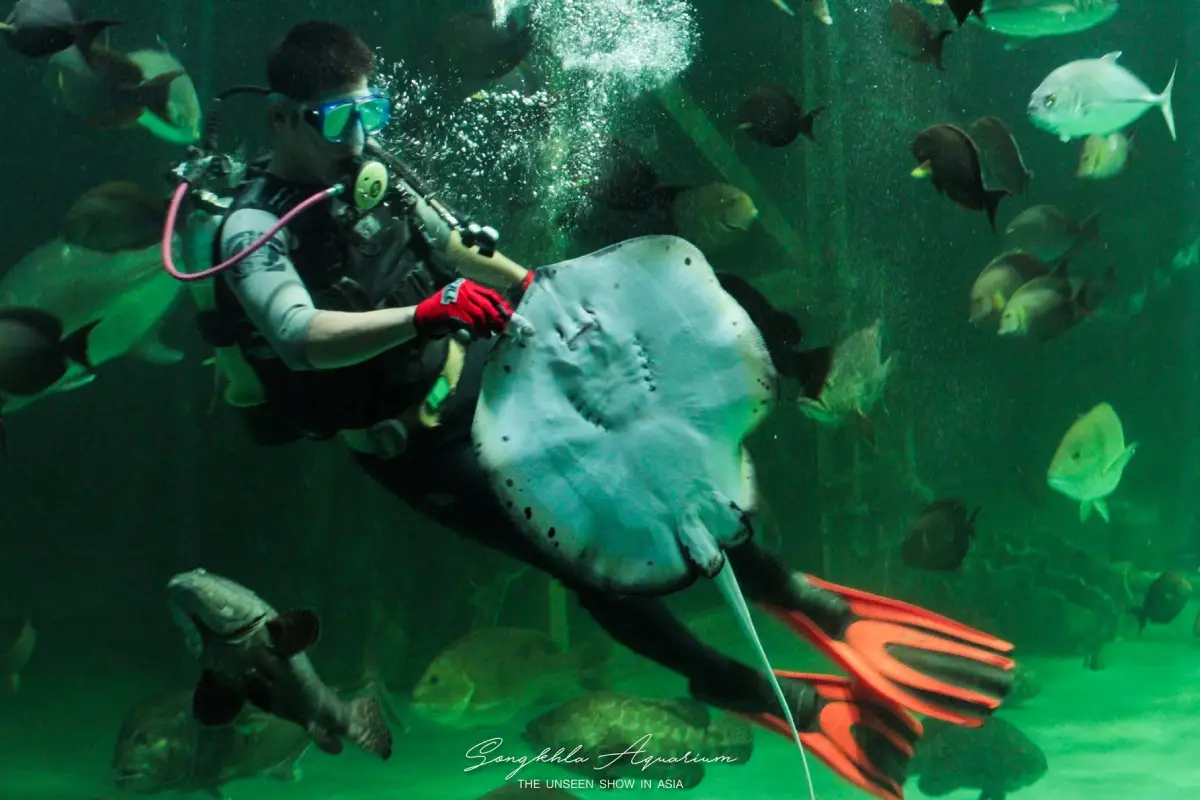
The fish tunnel is one of the most memorable parts of the aquarium. Walking through a tunnel while fish swim around and above creates the feeling of entering an underwater world. This kind of learning is more immersive than reading from a textbook or looking at static images. It helps visitors, especially children, understand aquatic life through direct visual experience.
Important animal highlights associated with Songkhla Aquarium include large giant groupers, leopard sharks, rays, sea turtles, and colorful reef fish. The large grouper display has long been one of the main attractions because it allows visitors to see the scale and presence of a major marine species up close. Displays like these help visitors understand the size, movement, and behavior of animals that are usually hidden beneath the sea surface.
Songkhla Aquarium is important not only as a visitor attraction but also as a conservation learning space. Songkhla is a province shaped by water: the Gulf of Thailand, Songkhla Lake, mangroves, canals, streams, and coastal fisheries all form part of local life. A well-designed aquarium helps people understand why water quality, marine waste, fish habitats, and coastal ecosystems matter to food, livelihoods, tourism, and environmental health.
The location at Laem Son On gives the aquarium strong local relevance. This part of Songkhla sits between sea, lake, public park, coastline, and urban recreation space. Visitors can combine the aquarium with nearby destinations such as Song Thale Park, Samila Beach, Khao Tang Kuan, Songkhla Old Town, and Songkhla National Museum. The aquarium therefore works best as part of a wider city route rather than as a stand-alone stop.
In recent years, Songkhla Aquarium has gone through a restoration period after a long service interruption. Songkhla City Municipality, academic partners, and related agencies have pushed forward plans to restore the site as a learning and recreation center for children, young people, residents, and visitors. This restoration work confirms that the place remains important as a public asset of Songkhla city and as a potential landmark for learning about aquatic life.
The current status makes it important to understand Songkhla Aquarium from two angles: its original role as an aquatic exhibition center and its ongoing value as a site being restored for future educational use. Its core purpose remains clear. It is not only a photo spot or an indoor attraction. It was designed to connect science, recreation, conservation, and Songkhla’s coastal identity in one location.
For travelers interested in southern Thai nature, Songkhla Aquarium is valuable because its exhibition logic is tied to local ecosystems. Freshwater displays connect with streams and upland sources. Brackish-water displays connect with mangroves and estuaries. Marine displays connect with the Gulf of Thailand and reef-related life. This structure helps visitors understand aquatic ecosystems as a connected chain rather than separate tanks of fish.
A careful visit can offer more than the experience of looking at fish. Each zone can raise useful questions: why do some fish live in freshwater while others require saltwater, why are mangroves important as nurseries for aquatic life, why do some marine fish depend on reefs, and how do marine debris and water quality affect animals. These questions turn an aquarium visit into an accessible environmental lesson.
For families with children, the strongest advantage is close observation. Children can see real aquatic animals in front of them and compare their shapes, swimming styles, feeding habits, and colors. Parents can use the visit to teach simple conservation behavior, such as not tapping the glass, not disturbing animals, not littering, and caring for the sea through small everyday actions.
For schools and educational groups, Songkhla Aquarium fits several learning topics: fish biology, freshwater ecosystems, brackish-water ecosystems, marine ecosystems, biodiversity, conservation, aquatic resource management, and the role of local government in developing public learning spaces. Group visits should be arranged in advance when available, especially if teachers want to match the visit with classroom topics.
As a Songkhla city attraction, the aquarium pairs naturally with Samila Beach and Laem Son On. A practical route can begin with the aquarium during the late morning or early afternoon, followed by a walk at Song Thale Park, photography at Samila Beach, viewing Ko Nu–Ko Maeo from the coast, and ending with food or a visit to Songkhla Old Town. This route is suitable for families, elderly travelers, and visitors who prefer short travel distances between stops.
Song Thale Park is one of the closest nearby places. Located around the tip of Laem Son On, it offers an open coastal setting, sea breeze, public space, and a landscape closely tied to Songkhla’s coastal identity. It is a good place to walk or rest before or after visiting the aquarium area.
Samila Beach adds the outdoor seaside experience to an aquarium trip. The beach is known for pine trees, sand, the Golden Mermaid statue, and views of Ko Nu–Ko Maeo. Combining Songkhla Aquarium with Samila Beach gives travelers both an indoor underwater learning experience and an open-air coastal experience in the same day.
Khao Tang Kuan and Songkhla Old Town are suitable extensions for visitors with more time. After seeing the aquarium area and Laem Son On, travelers can go up Khao Tang Kuan for a high view of the city or continue to Songkhla Old Town for old buildings, local streets, murals, food, cafés, and cultural atmosphere. This makes the day more complete, combining nature, learning, history, and local food.
Getting There is easiest by private car or rental car. From Songkhla city center, head toward the tip of Laem Son On and Laem Son On Road. The distance from the city center is about 3 kilometers. From Hat Yai, travelers can use Kanchanawanit Road or Lop Buri Ramesuan Road toward Songkhla city, then continue to the beachfront and Laem Son On area.
Travelers using public transport can take the Songkhla–Hat Yai route into Songkhla city and continue from the Songkhla Clock Tower area by local transport, tuk-tuk, or motorcycle taxi to the tip of Laem Son On. The final section is about 3 kilometers. This is possible for visitors without a car, but the return trip should be planned, especially if combining the aquarium area with an evening walk at Samila Beach or Song Thale Park.
The surrounding area is easy to combine with coastal sightseeing because it connects with the beachfront road and several public recreation areas. During weekends and evening hours, parking and traffic near the beach can take more time, so morning or early afternoon visits are usually easier to manage.
Facilities associated with the aquarium area include free parking, exhibition buildings, seminar space, a restaurant area, a souvenir area, and activity spaces that may operate according to current announcements. Visitors should follow the latest on-site information because not all activity areas necessarily operate at the same time.
A useful visit normally takes at least 1–2 hours for the main exhibition concept. Families with young children should move slowly and take short breaks. School groups should follow the ecosystem sequence from freshwater to brackish water, marine life, and the Gulf of Thailand so that students understand the bigger ecological picture rather than rushing through the tanks.
Visitors should follow basic aquarium etiquette: do not tap glass, do not use flash near animal displays, do not litter, do not put objects into exhibition tanks, do not feed aquatic animals without permission, and keep children from running or disturbing other visitors. These practices protect animal welfare and improve the experience for everyone.
For elderly travelers and wheelchair users, an indoor aquarium is generally easier than many outdoor attractions, but access conditions should be checked before traveling because the site is in a restoration period. Entrances, ramps, toilets, and available visitor areas may depend on the current readiness of the building.
The strength of Songkhla Aquarium is that it connects directly with the identity of Songkhla as a sea, lake, fishery, and tourism city. The aquarium helps visitors see not only the surface of the sea but also the living world beneath it. This makes it an important educational complement to Songkhla’s beaches, lake, seafood culture, and coastal communities.
Overall, Songkhla Aquarium remains a meaningful place for the city even after years of transition and restoration. Its role is broader than a children’s attraction. It links science, environment, tourism, and local memory. With continued restoration and careful management, it can again become an important stop on the Laem Son On and Samila Beach travel route.
In summary, Songkhla Aquarium is an aquatic learning center with an excellent location at Laem Son On. It is tied to freshwater, brackish-water, marine, Gulf of Thailand, and conservation themes. It is suitable for families, students, teachers, and travelers who want to understand Songkhla through aquatic life and environmental learning. Before traveling, contact the aquarium to confirm access, opening status, available activities, and group-visit conditions so the trip can be planned smoothly.
| Name | Songkhla Aquarium / Songkhla Aquatic Animal Exhibition Center |
| Location | Tip of Laem Son On, Bo Yang Subdistrict, Mueang Songkhla District, Songkhla Province |
| Address | 39 Laem Son On Road, Bo Yang Subdistrict, Mueang Songkhla District, Songkhla 90000, Thailand |
| Place Type | Aquarium, aquatic animal learning center, water-ecosystem education site, and family attraction |
| Approximate Area | Total site about 7.5 rai; exhibition building about 2 rai |
| Purpose | Learning about aquatic biology, aquatic animal behavior, water ecosystems, marine resources, and environmental conservation |
| Highlights | Fish tunnel, aquatic displays, large giant grouper, leopard shark, rays, sea turtles, colorful fish, and Songkhla-related ecosystem content |
| Main Exhibition Zones | Freshwater and stream zone, brackish-water and mangrove zone, beach and saltwater animal zone, Gulf of Thailand zone, fish tunnel zone, exhibition hall, seminar room, restaurant area, and souvenir area |
| Current Status | Under restoration to return as a complete learning and recreation space for Songkhla city |
| Open Days | Access follows current on-site announcements; contact the aquarium before visiting |
| Opening Hours | Contact the aquarium before visiting, especially for group visits or activity services |
| Facilities | Free parking, exhibition building, exhibition area, seminar room, restaurant area, souvenir area, and activity spaces according to current announcements |
| Getting There | From Songkhla city center, head to the tip of Laem Son On, about 3 km away. From Hat Yai, use Kanchanawanit Road or Lop Buri Ramesuan Road toward Songkhla, then continue to Laem Son On Road |
| Caretaker / Related Agencies | Songkhla City Municipality and Songkhla Aquarium |
| Main Contact Number | 074-322-787, 074-322-899 |
| Nearby Tourist Attractions | 1. Song Thale Park, about 1 km 2. Laem Son On, about 1 km 3. Laem Samila / Samila Beach, about 2 km 4. Ko Nu–Ko Maeo, about 2 km 5. Khao Tang Kuan, about 2 km 6. Songkhla Old Town, about 3 km 7. Songkhla National Museum, about 4 km |
| Nearby Restaurants | 1. Nong Ple Rice And Curry / Made-To-Order Food, about 1 km, Tel. 086-346-6997, 085-582-8515, 093-713-0474 2. Na Kham Restaurant, about 1 km, Tel. 074-324-840 3. Boonriam Seafood, about 1 km, Tel. 074-311-484 4. Phi Yik Restaurant, about 1 km, Tel. 081-277-1700 5. SEAMILA Samila Beach, about 2 km, Tel. 066-010-8648 6. Ning Isan Food Samila Beach, about 2 km, Tel. 096-346-9697 |
| Nearby Accommodations | 1. BP Samila Beach Hotel And Resort, about 2 km, Tel. 074-440-222 2. Rajamangala Pavilion Beach Resort, about 2 km, Tel. 074-311-355, 074-441-850-9 3. Lake Inn Hotel, about 4 km, Tel. 074-321-044, 074-321-441-2 4. Viva Hotel, about 4 km, Tel. 074-321-033-6 5. Green World Palace Hotel Songkhla, about 5 km, Tel. 074-437-900-8 6. Queen’s Hotel, about 4 km, Tel. 074-311-138, 074-313-072 |
Frequently Asked Questions (FAQ)
Q: Where is Songkhla Aquarium located?
A: Songkhla Aquarium is located at 39 Laem Son On Road, Bo Yang Subdistrict, Mueang Songkhla District, Songkhla Province, near Song Thale Park and Samila Beach.
Q: Is Songkhla Aquarium open for visitors?
A: The site is under restoration and access follows current on-site announcements. Contact Songkhla Aquarium at 074-322-787 or 074-322-899 before visiting.
Q: What are the highlights of Songkhla Aquarium?
A: Highlights include the fish tunnel, freshwater ecosystem displays, brackish-water and mangrove displays, marine displays, Gulf of Thailand content, large giant grouper, leopard shark, rays, sea turtles, and conservation exhibits.
Q: Is Songkhla Aquarium suitable for children?
A: Yes. It is suitable for children, families, students, and school groups because it presents aquatic animals and ecosystems in a clear, visual, and accessible way.
Q: How do travelers get to Songkhla Aquarium?
A: From Songkhla city center, travel about 3 km toward Laem Son On. From Hat Yai, take Kanchanawanit Road or Lop Buri Ramesuan Road toward Songkhla, then continue to Laem Son On Road.
Q: Is parking available?
A: The aquarium area has free parking and is connected with the coastal road near Song Thale Park and Samila Beach.
Q: What nearby places can be visited on the same trip?
A: Nearby places include Song Thale Park, Laem Son On, Samila Beach, Ko Nu–Ko Maeo, Khao Tang Kuan, Songkhla Old Town, and Songkhla National Museum.
Q: What should visitors be careful about?
A: Visitors should confirm access before traveling, avoid tapping aquarium glass, avoid flash photography near aquatic animals, keep the area clean, and supervise children closely inside the exhibition building.
 Category: ●Entertainment and Agricultural
 Group: ●Zoos and Aquariums
Last Update : 2 MonthAgo
 Last Update : 2 MonthAgo
 Click to Access the Navigation Map GPS
Songkhla Aquatic Animal Exhibition Center (Songkhla Aquarium) Map
Recommend

 Art, Culture and Heritage
 Historical Sites and Monuments(2)
 Landmarks and Memorials(7)
 Royal Palace(1)
 Art, Craft Centres, Tradition(4)
 Museums(4)
 Art Gallery(1)
 Educational Places
 Library(1)
 Educational Gardens, Farm(3)
 Places of Worship
 Temple(52)
 Mosque(2)
 Other Sacred Sites(11)
 Suburban Living
 Village, Community(3)
 Local Market(3)
 Floating Market(2)
 Nature and Wildlife
 National Parks and Marine Reserves(5)
 Mountain (Doi)(6)
 Dam, Reservoir, Lake(5)
 Waterfalls(12)
 Caves(4)
 River, Canal(2)
 Bays and Beaches(13)
 Islands(3)
 Other natural attractions(2)
Zoos and Aquariums(2)
 Animal camps and shows(1)
 Farms, Parks and Ecotourism(6)
 Waterpark(1)
 Travel Articles, Recipes
 Travel Review, Food Review(1)
 Southern Food Menu, Southern Food Recipes(2)


