
lovethailand home >South Travel Attractions >Songkhla Travel Attractions >Sathing Phra >Chum Phon > Wat Phra Ratchapraditthan (Wat Pha Kho)
TL;DR: Wat Phra Ratchapraditthan (Wat Pha Kho) is located at Moo 6, Chumphon Subdistrict, Sathing Phra District, Songkhla Province, on Khao Phattha Sing, open Daily, hours 08.00 – 17.00.
Wat Phra Ratchapraditthan (Wat Pha Kho)
Open Days: Daily
Opening Hours: 08.00 – 17.00
Wat Pha Kho, officially Wat Phra Ratchapraditthan, is one of the most important Buddhist temples on the Sathing Phra Peninsula in Songkhla Province. Located on Khao Phattha Sing in Chumphon Subdistrict, Sathing Phra District, the temple is closely associated with Somdet Chao Pha Kho, widely known as Luang Pu Thuat, the revered monk of the famous sea-water-to-fresh-water legend. Wat Pha Kho is now a royal monastery and remains an active place of worship, a historical landmark, and a cultural learning site. Its key highlights include Phra Suwan Malika Chedi Si Rattana Mahathat, the reclining Buddha known as Phra Phuttha Khodom, the sacred footprint, the hilltop pavilion, statues of Luang Pu Thuat, the old judgement hall, the robe-washing well, and the temple museum.
Wat Pha Kho is situated in Moo 6, Chumphon Subdistrict, Sathing Phra District, Songkhla Province, on Khao Phattha Sing or Khao Pha Kho. The temple is about 48 km from Songkhla city. Its location on the peninsula between the Gulf of Thailand and Songkhla Lake gives the temple a special cultural setting. This landscape is shaped by coastal communities, lake-based livelihoods, palmyra palm culture, old trade routes, and long-standing Buddhist faith. For travelers who want to understand Songkhla beyond beaches and the old town, Wat Pha Kho offers a deeper view of the religious and historical roots of southern Thailand.
The temple’s official name is Wat Phra Ratchapraditthan, but most people know it as Wat Pha Kho. The familiar name is connected with the temple’s reclining Buddha, Phra Phuttha Khodom or Phra Khodom. Over time, the name Khodom was locally shortened and softened into Kho and then Pha Kho. This means that the name of the temple is not merely a place name. It preserves the memory of an important Buddha image, the local pronunciation of the community, and the continuing bond between the temple and the people of Sathing Phra.
The history of Wat Pha Kho is layered and complex. Local tradition traces the temple’s origins to around 500 BE, when Phra Chin Sen Thera is said to have founded a temple known as Wat Phra Ratchapraditthan. During the Ayutthaya period, the temple grew in importance as a major Buddhist center on the eastern side of Songkhla Lake. In 2057 BE, during the reign of King Ramathibodi II, Wat Pha Kho was rebuilt on Khao Pha Kho or Khao Phattha Sing. Later, between 2091 and 2111 BE, during the reign of King Maha Chakkraphat, the temple received royal kalpana land grants and became known as Wat Phra Ratchapraditthan. These historical layers explain why Wat Pha Kho is regarded as one of the most important temples on the Sathing Phra Peninsula.
Sathing Phra was once an important area in the Songkhla Lake basin and was historically connected with the old Phatthalung polity. Wat Pha Kho therefore functioned not only as a Buddhist monastery but also as a center of community life, education, ritual authority, and local governance. Historical accounts describe the temple as a place associated with oath-taking ceremonies by rulers of Phatthalung. This role shows that the temple carried social and political significance in addition to its religious meaning. Visiting Wat Pha Kho is therefore a way to understand how temples in southern Thailand once shaped both spiritual and civic life.
In 2026, Wat Phra Ratchapraditthan, or Wat Pha Kho, was elevated to the status of a royal monastery by royal command, according to the Royal Gazette announcement dated 20 May 2026. This marked an important milestone for the temple and for Songkhla Province. The elevation recognizes the temple’s value as a historic Buddhist sanctuary, a center of faith, and a cultural heritage site of southern Thailand. Wat Pha Kho continues to function as a living monastery while also preserving monuments, legends, and traditions that have shaped the identity of Sathing Phra for generations.
The temple is most strongly associated with Somdet Chao Pha Kho, also known as Somdet Phra Ratchamuni Sami Ram Khunupamachan or Luang Pu Thuat. Wat Pha Kho is one of the temples where he resided during his monastic life. The temple preserves his memory through statues, sacred sites, ritual practices, local legends, and objects related to his life. For Thai Buddhists, Luang Pu Thuat is revered for compassion, wisdom, spiritual protection, and the blessing of safe travel. This devotion has made Wat Pha Kho a major pilgrimage destination in Songkhla, especially for visitors who respect Luang Pu Thuat and his legacy.
The most famous legend connected with Luang Pu Thuat is the story of sea water turning into fresh water. According to the story, pirates sailing along the coast saw Somdet Pha Kho and captured him to test his spiritual power. After the ship sailed away, it could not move and was stranded for several days. The supply of fresh water ran out, causing great distress among the pirates. Out of compassion, Somdet Pha Kho placed his left foot into the sea. The water began to shine and turned fresh. The pirates were deeply moved, asked for forgiveness, and brought him back to shore. This story became one of the most powerful reasons why people continue to worship Luang Pu Thuat at Wat Pha Kho.
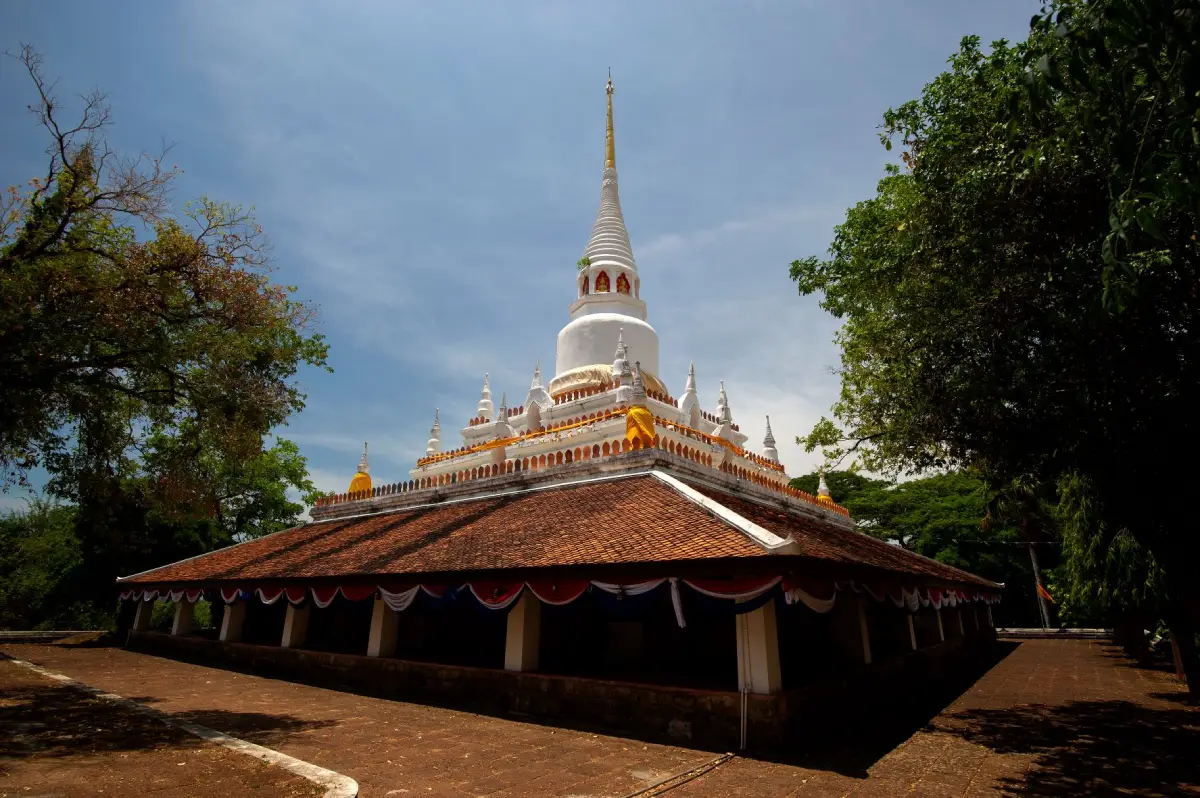
Phra Suwan Malika Chedi Si Rattana Mahathat is the principal ancient monument of Wat Pha Kho. Standing prominently on Khao Phattha Sing, the chedi enshrines relics of the Buddha within its upper section. Its architectural form is a southern Thai interpretation of Lanka-style Buddhist architecture from the Ayutthaya period. The chedi is built of brick and stucco in a bell-shaped form, set on a large square base and surrounded by three circumambulatory terraces. Decorative stucco elephants and other details around the base reflect the craftsmanship of local builders. The chedi was established in 2057 BE and was significantly restored during the reign of King Ekathotsarot between 2148 and 2158 BE.
Phra Suwan Malika Chedi Si Rattana Mahathat is valuable as both a sacred monument and a historical artwork. Its form combines Lanka-style influence, Ayutthaya-period architecture, and southern Buddhist artistic interpretation. The tiered base gives the chedi a distinctive appearance, almost as if a mandapa-like structure supports the sacred stupa above. When visitors climb toward the chedi, its white structure rises clearly above the temple grounds. This view is one of the defining images of Wat Pha Kho and a strong visual symbol of Buddhist faith on the Sathing Phra Peninsula.
The reclining Buddha, known as Phra Phuttha Khodom or Phra Khodom, is another major sacred object at Wat Pha Kho. It is housed in the vihara north of Phra Suwan Malika Chedi Si Rattana Mahathat. The image is a gilded stucco reclining Buddha in the parinirvana posture, created by local southern craftsmen. It measures about 18 meters in length and about 2.5 meters in height. The image dates to the early Ayutthaya period, between 2057 and 2111 BE, and has undergone several restorations. The Buddha reclines on the right side, with closed eyes, the head resting on a pillow, the left arm extended along the body, the right hand placed near the pillow, and both feet aligned one above the other.
This reclining Buddha is more than a large sacred image. It is central to the identity and name of Wat Pha Kho. The transformation of the name Phra Khodom into Kho and Pha Kho shows how the Buddha image became embedded in local memory. Visitors should take time to observe the image quietly, noticing the calm expression, the proportions of the body, the posture, and the atmosphere of the hall. The experience combines worship, art appreciation, and historical reflection, making the reclining Buddha one of the most meaningful stops inside the temple compound.
The sacred footprint on Khao Pha Kho is another important place of worship. It is enshrined inside the hilltop four-sided pavilion. Today, local people commonly believe that the footprint belongs to Somdet Chao Pha Kho, or Luang Pu Thuat, who left the mark on a large stone on Khao Phattha Sing. The footprint is about 17 inches long. The pavilion also enshrines statues of Somdet Chao Pha Kho, revered teachers, and former abbots, allowing visitors to pay respect in one concentrated sacred space. This area is especially important for devotees of Luang Pu Thuat.
The hilltop pavilion deserves unhurried attention because it connects the footprint, Luang Pu Thuat statues, and the elevated sacred geography of the temple. Climbing toward the pavilion helps visitors understand how Wat Pha Kho is arranged around the hill. The higher eastern section functions as a sacred Buddhist area, while the lower western section historically supported monastic residence and community use. This relationship between architecture and landscape gives Wat Pha Kho a strong sense of place. The visit is not only about viewing monuments; it is about experiencing how a hill became a sacred center.
The old judgement hall, or Thammasala, is another valuable structure inside Wat Pha Kho. It stands west of the principal chedi and reflects the temple’s former role as a community center. The building is a four-room brick-and-stucco hall set on a stone-built mound. Its plan is rectangular, about 10 meters wide and 16 meters long. It is believed to date from the Ayutthaya period, with later restoration in the early Rattanakosin period. The hall was once used for judgement and later as a temple school. Its presence shows that Wat Pha Kho historically served religious, educational, and administrative functions.
Another site associated with Luang Pu Thuat is the robe-washing and bathing well. It is located along the path on the right side before reaching the four-sided pavilion. This well adds a more personal dimension to the temple’s memory of Luang Pu Thuat. It is not only grand legends that remain here, but also places connected with daily monastic life, residence, practice, and discipline. Together with the chedi, reclining Buddha, footprint, and museum, the well helps create a complete pilgrimage route through the temple.
The Wat Pha Kho Museum has been open to the public since 1993. It displays sacred images, pottery, brassware, knives, betel-nut tools, old banknotes and coins, ceramics, and objects connected with Luang Pu Thuat, including monastic requisites, robes, a walking stick, and the revered crystal associated with his legend. The museum expands the meaning of the temple from a place of worship into a cultural learning site. Visitors can better understand the history of the temple, the life of Luang Pu Thuat, and the material culture of the local community through the objects preserved here.
A meaningful visit to Wat Pha Kho should begin at Phra Suwan Malika Chedi Si Rattana Mahathat, then continue to the reclining Buddha hall, the hilltop pavilion, the sacred footprint, Luang Pu Thuat statues, the old judgement hall, the robe-washing well, and the museum. This route helps visitors understand the temple through four connected layers: faith, art, legend, and history. The best time for photography is in the morning or late afternoon, when the light is softer and the white chedi stands out clearly against the hilltop setting.
Wat Pha Kho is part of the Mahanikaya order. The current abbot is Phra Khru Punya Phisan, who also serves as the ecclesiastical district chief of Sathing Phra. The temple remains an active Buddhist site with regular religious ceremonies and local traditions. These include events related to Luang Pu Thuat, bathing ceremonies, merit-making, Tak Bat Devo, ancient boat-pulling traditions, and ceremonies to drape cloth around Phra Suwan Malika Chedi Si Rattana Mahathat. These activities show that Wat Pha Kho is not a silent archaeological site. It remains a living religious center for the local community.
The atmosphere of Wat Pha Kho is peaceful and distinctive. Because the temple stands on a hill in rural Sathing Phra, visitors experience old Buddhist architecture, greenery, local roads, village life, and the quiet rhythm of the peninsula. The temple differs from crowded urban attractions because it still feels closely tied to the surrounding community. Travelers should allow enough time to walk slowly, observe the ancient structures, and respect the sacred spaces. A visit here is most rewarding when approached as a cultural and spiritual journey rather than a quick photo stop.
Getting There is easiest by private car. From Songkhla city, take Highway 407 across Tinsulanonda Bridge and Ko Yo, then continue onto Highway 408 on the Songkhla–Ranot route. Around kilometer marker 110, a sign on the left leads to Wat Pha Kho. This route connects Songkhla city with Sathing Phra and Ranot and is ideal for a full-day temple and cultural trip on the Sathing Phra Peninsula. Travelers from Hat Yai can drive toward Songkhla city and continue toward Sathing Phra, or choose a route through Singhanakhon depending on their itinerary.
Visitors using public transport can take a van or local bus along the Songkhla, Sathing Phra, and Ranot route, then continue by local transport for the final section to the temple. Return schedules should be checked in advance, especially in the late afternoon, because local services outside Songkhla city and Hat Yai may be less frequent. Travelers who plan to visit Wat Di Luang, Wat Ton Liap, Wat Cha Thing Phra, Maharat Beach, and Khu Khut Waterfowl Park on the same day will have the most flexibility by private car or hired local vehicle.
Wat Pha Kho is suitable for several types of travelers. Devotees of Luang Pu Thuat come to pay respect and seek blessings. History enthusiasts can study the Ayutthaya-period monuments and the role of Sathing Phra in the Songkhla Lake basin. Art lovers can observe the Lanka-style chedi, the reclining Buddha, and local craftsmanship. Cultural travelers can connect the temple with nearby religious and natural attractions. In one visit, the temple offers sacred relics, southern Buddhist art, local legend, a hilltop landscape, and the continuing faith of the community.
Visitors should dress respectfully because Wat Pha Kho is both a royal monastery and a heritage site. Shoulders and knees should be covered when entering religious buildings. Shoes should be removed where required. Visitors should not climb on ancient structures, touch the reclining Buddha, the footprint, old walls, or museum objects, and should avoid loud voices inside prayer areas. Photography should be done respectfully. Responsible behavior helps protect both the sacred atmosphere and the cultural heritage of the temple.
Overall, Wat Pha Kho is one of the most significant temples in Songkhla Province. It brings together Buddhism, Ayutthaya-period art, Lanka-style architecture, the legend of Luang Pu Thuat, the history of Sathing Phra, and the living faith of southern Thai communities. Visitors can worship the relics enshrined in Phra Suwan Malika Chedi Si Rattana Mahathat, see the large reclining Buddha, pay respect to the sacred footprint, learn about Luang Pu Thuat, and experience the hilltop setting of Khao Phattha Sing in one journey. For travelers seeking the deeper cultural identity of Songkhla, Wat Pha Kho is an essential destination.
| Name | Wat Pha Kho / Wat Phra Ratchapraditthan |
| Temple Status | Royal Monastery |
| Location | Moo 6, Chumphon Subdistrict, Sathing Phra District, Songkhla Province, on Khao Phattha Sing |
| Address | 60 Moo 6, Songkhla PAO Road 2065, Chumphon Subdistrict, Sathing Phra District, Songkhla 90190, Thailand |
| Coordinates | Latitude 7.5990426625, Longitude 100.394809172 |
| Highlights | Temple associated with Somdet Chao Pha Kho or Luang Pu Thuat, Phra Suwan Malika Chedi Si Rattana Mahathat, the reclining Buddha, the sacred footprint, and the Wat Pha Kho Museum |
| History | Local tradition traces the temple to around 500 BE. It became especially important during the Ayutthaya period and was significantly restored between 2148 and 2158 BE during the reign of King Ekathotsarot |
| Name Origin | The name Pha Kho is linked to Phra Phuttha Khodom or Phra Khodom, the reclining Buddha whose name evolved locally into Kho and Pha Kho |
| Distinctive Features | Hilltop temple on Khao Phattha Sing with a Lanka-style bell-shaped chedi and southern Ayutthaya-period Buddhist architecture |
| Important Buddha Image | Phra Phuttha Khodom, a gilded stucco reclining Buddha in the parinirvana posture, about 18 meters long and 2.5 meters high |
| Main Areas / Zones | Phra Suwan Malika Chedi Si Rattana Mahathat, reclining Buddha hall, four-sided pavilion, sacred footprint, Luang Pu Thuat statues, old judgement hall, robe-washing well, and Wat Pha Kho Museum |
| Abbot / Caretaker | Phra Khru Punya Phisan, Abbot of Wat Pha Kho and Ecclesiastical District Chief of Sathing Phra |
| Travel Information | From Songkhla city, take Highway 407 across Tinsulanonda Bridge and Ko Yo, then continue on Highway 408 on the Songkhla–Ranot route. Around kilometer marker 110, a sign on the left leads to the temple |
| Current Status | Open to visitors and remains an active Buddhist temple with ongoing religious ceremonies |
| Open Days | Daily |
| Opening Hours | 08.00 – 17.00 |
| Main Contact Number | 074-304-175 |
| Nearby Tourist Attractions | 1. Wat Di Luang, about 4 km 2. Wat Ton Liap, about 5 km 3. Wat Cha Thing Phra, about 15 km 4. Maharat Beach, about 16 km 5. Khu Khut Waterfowl Park, about 22 km |
| Nearby Restaurants | 1. Yok Niew Restaurant, about 1 km, Tel. 081-894-8535 2. May Boat Noodles, Sathing Phra Branch, about 15 km 3. Jungle Cafe Sathing Phra Songkhla, about 15 km, Tel. 093-579-2386 4. Jaosamut Seafood, Maharat Beach, Sathing Phra, about 16 km, Tel. 097-0647998, 086-5987955 5. Sathing Phra Halal Restaurant, about 15 km |
| Nearby Accommodations | 1. Phang Phao Resort, about 8 km, Tel. 080-607-9568 2. Kradang Nga Resort, about 10 km 3. I-Talay Resort Sathing Phra, about 16 km 4. Rimhaad Resort, about 16 km 5. Jaosamut Sleepbox & Seafood Maharat Beach Songkhla, about 16 km, Tel. 097-0647998, 086-5987955 |
Frequently Asked Questions (FAQ)
Q: Where is Wat Pha Kho located?
A: Wat Pha Kho is located in Moo 6, Chumphon Subdistrict, Sathing Phra District, Songkhla Province, on Khao Phattha Sing, about 48 km from Songkhla city.
Q: How is Wat Pha Kho connected with Luang Pu Thuat?
A: Wat Pha Kho is one of the temples where Somdet Chao Pha Kho, widely known as Luang Pu Thuat, resided. The temple preserves sites, statues, legends, and objects connected with him.
Q: What are the main highlights of Wat Pha Kho?
A: The main highlights are Phra Suwan Malika Chedi Si Rattana Mahathat, the reclining Buddha Phra Phuttha Khodom, the sacred footprint, Luang Pu Thuat statues, the old judgement hall, the robe-washing well, and the Wat Pha Kho Museum.
Q: How large is the reclining Buddha at Wat Pha Kho?
A: The reclining Buddha, known as Phra Phuttha Khodom, is about 18 meters long and 2.5 meters high. It is a gilded stucco Buddha image in the parinirvana posture.
Q: What are the opening hours of Wat Pha Kho?
A: Wat Pha Kho is open daily from 08.00 to 17.00.
Q: How can travelers get to Wat Pha Kho from Songkhla city?
A: From Songkhla city, take Highway 407 across Tinsulanonda Bridge and Ko Yo, then continue on Highway 408 toward Sathing Phra and Ranot. Around kilometer marker 110, a sign on the left leads to the temple.
Q: When was Wat Pha Kho elevated to royal monastery status?
A: Wat Phra Ratchapraditthan, or Wat Pha Kho, was elevated to royal monastery status by royal command according to the Royal Gazette announcement dated 20 May 2026.
Q: What nearby places can visitors combine with Wat Pha Kho?
A: Nearby places include Wat Di Luang, Wat Ton Liap, Wat Cha Thing Phra, Maharat Beach, and Khu Khut Waterfowl Park.
 Category: ●Places of Worship
 Group: ●Temple
Last Update : 2 MonthAgo
 Last Update : 2 MonthAgo
 Click to Access the Navigation Map GPS
Wat Phra Ratchapraditthan (Wat Pha Kho) Map
Recommend

 Art, Culture and Heritage
 Historical Sites and Monuments(2)
 Landmarks and Memorials(7)
 Royal Palace(1)
 Art, Craft Centres, Tradition(4)
 Museums(4)
 Art Gallery(1)
 Educational Places
 Library(1)
 Educational Gardens, Farm(3)
Temple(52)
 Mosque(2)
 Other Sacred Sites(11)
 Suburban Living
 Village, Community(3)
 Local Market(3)
 Floating Market(2)
 Nature and Wildlife
 National Parks and Marine Reserves(5)
 Mountain (Doi)(6)
 Dam, Reservoir, Lake(5)
 Waterfalls(12)
 Caves(4)
 River, Canal(2)
 Bays and Beaches(13)
 Islands(3)
 Other natural attractions(2)
 Entertainment and Agricultural
 Zoos and Aquariums(2)
 Animal camps and shows(1)
 Farms, Parks and Ecotourism(6)
 Waterpark(1)
 Travel Articles, Recipes
 Travel Review, Food Review(1)
 Southern Food Menu, Southern Food Recipes(2)


