
lovethailand home >South Travel Attractions >Satun Travel Attractions >Muang Satun >Phi Man > Wat Chanathip Chaloem
TL;DR: Wat Chanathip Chaloem is located at Sulakanukul Road, Phiman Subdistrict, Mueang Satun District, Satun Province, open Daily, hours 08.00 - 17.00.
Wat Chanathip Chaloem
Open Days: Daily
Opening Hours: 08.00 - 17.00
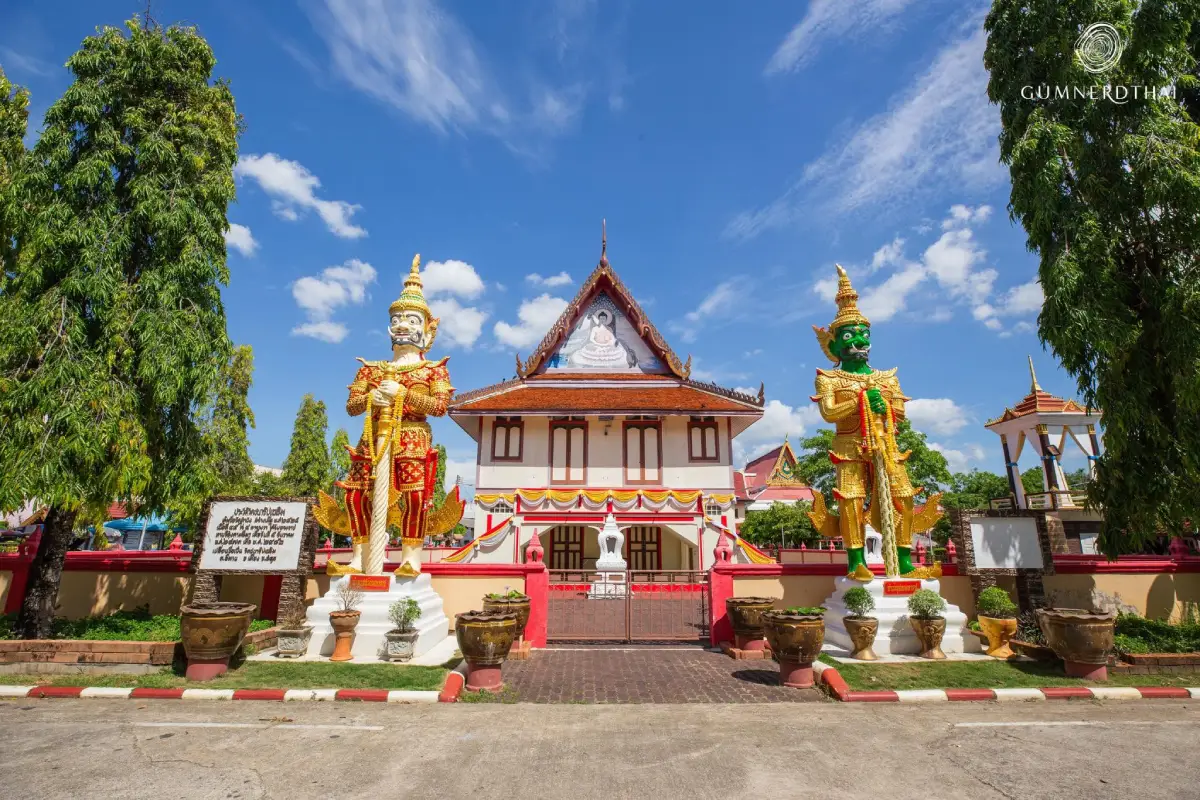
Wat Chanathip Chaloem Royal Monastery in Satun Province is one of the most important Buddhist temples in Satun town. Located at 24 Sulakanukul Road, Phiman Subdistrict, Mueang Satun District, the temple was formerly known as Wat Mambang and is widely recognized as the first Buddhist temple in Satun. It was established around 1882 during the reign of King Rama V and later renamed Wat Chanathip Chaloem in 1939. Today, it is a third-class royal monastery of the ordinary type and remains an active center of Buddhist faith, local history, and cultural memory in one of southern Thailand’s most multicultural provinces.
Wat Chanathip Chaloem is a meaningful stop for travelers who want to understand Satun beyond beaches, islands, and sea routes. The temple tells the story of how Buddhism became established in Satun town, how small Buddhist communities maintained their religious life within a diverse society, and how a local temple gradually became a major religious landmark. Visiting this temple is not only about paying respect to Buddha images or photographing old architecture. It is also a way to read the history of Satun through a living sacred site.
The temple’s former name, Wat Mambang, is closely connected with the old community around Khlong Mambang. In the past, Satun town developed as a small settlement near the canal, where Muslim, Chinese, and Buddhist residents lived alongside one another. The Buddhist community was relatively small, but Wat Mambang became its spiritual center. The temple served as a place for merit-making, chanting, religious ceremonies, ordination, Buddhist education, and community gatherings. This role made the temple deeply important to local Buddhists for more than a century.
The temple was founded around 1882, at a time when Buddhism in Satun did not yet have the same institutional structure as in larger Buddhist towns of southern Thailand. The establishment of Wat Mambang created a clear religious base for Buddhists in the town. It helped support faith, learning, ritual practice, and social cohesion in a province shaped by strong cultural and religious diversity. For this reason, Wat Chanathip Chaloem is important not only as an old temple, but also as a symbol of continuity for Satun’s Buddhist community.
A major turning point came in 1930, when Wat Mambang received its Wisungkhamasima on 5 December 1930. Before that time, no temple in Satun had a consecrated boundary that allowed full ordination ceremonies to be performed locally. Men who wished to be ordained often had to travel to other provinces or rely on monks from outside Satun. The granting of Wisungkhamasima therefore marked a crucial moment in Satun’s Buddhist history. It allowed ordination to take place in Satun and strengthened the temple’s role as the main Buddhist center of the town.
Two monks were especially important in the temple’s development during this period: Phra Saeng and Phra Prueang. They came to Wat Mambang in 1930 to help restore and develop the temple. Phra Saeng became abbot, while Phra Prueang served as deputy abbot and later became the fifth abbot of the temple. Phra Prueang was known for his teaching and preaching ability. His work helped build confidence in Buddhism among local residents and encouraged ordination, religious education, and temple-based community activity in Satun.
In 1939, Wat Mambang was renamed Wat Chanathip Chaloem. This change took place during a wider period of administrative and place-name changes in Satun. The Mambang area became Phiman Subdistrict, and Satun town became more formally structured as a provincial center. The new temple name therefore reflects a transitional period in local history, when an old canal-side community became part of a modern provincial town. Even so, the older name Wat Mambang remains important in local memory.
On 10 October 1991, Wat Chanathip Chaloem was elevated to the status of a third-class royal monastery of the ordinary type. This status confirms the temple’s importance within Satun Province and the Thai Buddhist monastic structure. The temple is not merely an old neighborhood monastery. It is a recognized religious institution that continues to host ceremonies, public activities, and important Buddhist events in the heart of Satun town.
The current abbot of Wat Chanathip Chaloem Royal Monastery is Phra Khru Wimon Thammarot, whose monastic name is Chawano. He has served as abbot since 2016 and also holds the position of Ecclesiastical District Chief of Mueang Satun. His role covers monastic administration, Buddhist education, religious propagation, and temple development. Under this leadership, Wat Chanathip Chaloem continues to function as a central Buddhist institution in the town.
The most distinctive architectural feature of the temple is its two-storey ordination hall, a rare half-masonry, half-wooden structure. Construction began in 1930, was completed in 1939, and the consecration ceremony was held in 1940. The lower floor is built of brick and mortar and is used as a sermon hall, while the upper floor is a wooden structure used for monastic rites. This unusual arrangement allows the building to serve both ritual and community functions within the same structure.
The ordination hall combines several architectural traditions. The building is about 10.30 meters wide and 17.30 meters long. The lower level is masonry, while the upper level is wooden. Roof elements such as chofah, bai raka, and hang hong reflect central Thai Buddhist architecture. The carved wooden details above the upper windows show southern local artistic influence, while stucco details around the upper terrace reflect Sino-Portuguese elements. The overall form also resembles the residence of a Malay elite household, making the building a strong example of multicultural architecture in Satun.
The front of the ordination hall has a balcony and staircases on both sides. There are two front entrances and rows of windows arranged with careful rhythm. The window posts and wooden elements are carved with vine motifs, giving the upper floor a refined and graceful appearance. The contrast between the solid masonry base and the warm wooden upper floor gives the building both strength and delicacy. This balance is one reason the ordination hall is considered the temple’s most important architectural feature.
Inside the upper floor of the ordination hall is the main Buddha image in the Mara-vijaya posture. The image has a lap width of 37 inches and follows the Sukhothai artistic style, with an architectural niche similar to that of Phra Phuttha Chinnarat. The current main Buddha image was enshrined in 2010 to replace the earlier image, while preserving the same form. The upper floor also contains three seasonal replicas of the Emerald Buddha, donated by devotees in 2016.
The lower floor of the ordination hall enshrines Phra Phuttha Aphai Mongkhon Samangkhi Siri Pholanamatyo, a standing Buddha image in the posture of forbidding relatives. It was designed and sculpted by Chuang Mulpinit, a National Artist of Thailand. The image is 23 inches high, made from darkened alloy metal, and contains relics in the head. It was royally bestowed by King Rama IX to Satun Province on the occasion of the Rattanakosin Bicentennial and is used in Songkran and Chak Phra traditions during the end of Buddhist Lent.
Another major sacred structure is Phra Boromthat Chedi Si Mueang Tai, located near the bodhi courtyard. Construction began in 2009 and was completed in 2011. The chedi follows a Lankan-style form, stands about 42 meters high, and has a base measuring 12 by 12 meters. Its design was inspired by Wat Kusinarachaloemrat, a Thai temple in India. The chedi adds a strong devotional dimension to the temple and serves as an important site for paying respect to Buddhist relics.
The lower hall of the chedi houses the original main Buddha image from the ordination hall. This bronze Buddha image, also in the Mara-vijaya posture, has a lap width of 37 inches and follows the Sukhothai style. It became the model for the 1940 Wat Chanathip Chaloem principal Buddha amulet made for the ordination hall’s consecration ceremony. The upper level of the chedi enshrines relics given to Satun Province by the 19th Supreme Patriarch in 1992, along with relics brought from Myanmar on Visakha Bucha Day in 2010.
The temple also includes a Viharn for the Phra Phuttha Chinnarat replica. This raised concrete hall is painted white inside and outside, with decorative gold details around its wall columns. Its four-sided roof adapts local southern design while retaining Buddhist architectural elements such as chofah, bai raka, and hang hong. Inside, the hall enshrines a replica of Phra Phuttha Chinnarat, giving visitors another peaceful place for worship and reflection.
Another important image is Phra Phuttha Sikkhi Thotsaphonyan Thi 1, also known as Somdet Ong Pathom. It was created to mark 12 cycles of the temple’s establishment. This bronze and navaloha Buddha image is in the Mara-vijaya posture, with a lap width of 1.92 meters and a height of 3.6 meters. Its pedestal was created using fresh stucco work by local artisans, making it an important example of contemporary Buddhist art connected with local craftsmanship.
The value of Wat Chanathip Chaloem lies not only in its age. It lies in the temple’s continuing role within a multicultural town. Satun is a province where Buddhist, Muslim, Chinese, and Malay cultural influences have long existed side by side. The temple stands as evidence of how a small Buddhist community maintained its faith, built institutions, and contributed to local identity without being separated from the wider social landscape of the province.
The temple has been recognized as an area for the conservation of local artistic and cultural environment by the Satun local art and environmental conservation unit, together with Satun Cultural Center and Satun Witthaya School. This recognition shows that the temple is valuable not only as a religious site, but also as part of Satun’s historic cultural landscape. Its ordination hall, older structures, temple grounds, and canal-side context all contribute to the heritage character of the town.
The area around the temple is connected with Municipality School 2 (Wat Chanathip Chaloem) and three canals: Khlong Mambang, Khlong Senten, and Khlong Ta Yai. This setting helps explain the temple’s former name and its link with the old Mambang community. Satun town did not grow only from roads. It also grew from waterways, markets, temples, mosques, schools, and the everyday life of people living in a compact multicultural town.
For travelers, Wat Chanathip Chaloem is an excellent starting point for a cultural walk through Satun town. Nearby places include Satun Central Mosque, Satun Street Art, Satun Clock Tower, Kuden Mansion, Satun National Museum, Buriwanich Road, Satun Night Market, and Khao To Phaya Wang Park. Visiting these places together gives travelers a fuller view of Satun’s Buddhist, Muslim, civic, architectural, and local food culture.
Getting to Wat Chanathip Chaloem is easy from central Satun. From the clock tower or Buriwanich Road area, visitors can come by private car, motorcycle, local hired transport, or on foot if staying nearby. The temple is located on Sulakanukul Road in Phiman Subdistrict, within the town center. Travelers can combine the temple with Kuden Mansion, Satun Central Mosque, and the night market in a single half-day route.
The best time to visit is in the morning or late afternoon, when the weather is milder and the light is suitable for seeing architectural details. Visitors interested in photography should spend time at the front of the ordination hall, the twin staircases, the balcony, wooden carvings, window details, and Phra Boromthat Chedi Si Mueang Tai. A general visit takes around 45 minutes to 1 hour, while travelers interested in history and religious art may want to spend longer.
Visitors should dress respectfully and behave calmly because the temple remains an active place of worship. Photography outside the ordination hall and around the chedi should be done politely. Before photographing interior areas or ritual spaces, visitors should ask permission. Sacred objects should not be touched, and visitors should avoid leaning on old architectural elements or disturbing monks and worshippers.
For students, cultural travelers, and anyone interested in local history, Wat Chanathip Chaloem is a valuable place to learn about Buddhism in a southern border province. It shows how religious identity, architecture, education, community life, and multicultural coexistence are expressed through one living site. The temple is therefore not only a tourist attraction, but also a cultural document of Satun town.
Overall, Wat Chanathip Chaloem Royal Monastery is one of the most rewarding cultural sites in Satun town. It brings together the story of Wat Mambang, the first Buddhist temple of Satun, the 1930 granting of Wisungkhamasima, the rare two-storey ordination hall, Phra Boromthat Chedi Si Mueang Tai, important Buddha images, and the role of Buddhism within a diverse community. A visit here gives travelers a deeper understanding of Satun’s history, faith, architecture, and peaceful local identity.
| Name | Wat Chanathip Chaloem Royal Monastery |
| Former Name | Wat Mambang |
| Location | Sulakanukul Road, Phiman Subdistrict, Mueang Satun District, Satun Province |
| Address | 24 Sulakanukul Road, Phiman Subdistrict, Mueang Satun District, Satun Province 91000, Thailand |
| Coordinates | 6.61036, 100.06433 |
| Highlights | Satun’s first Buddhist temple, a third-class royal monastery, and a rare two-storey half-masonry, half-wooden ordination hall |
| History | Established around 1882 as Wat Mambang; received Wisungkhamasima on 5 December 1930; renamed Wat Chanathip Chaloem in 1939; elevated to a third-class royal monastery on 10 October 1991 |
| Name Origin | The former name Wat Mambang is linked with the old Mambang canal-side community; the current name reflects the later administrative and cultural transition of Satun town |
| Distinctive Features | Two-storey ordination hall with a masonry lower floor used as a sermon hall and a wooden upper floor used for monastic rites, with twin staircases, front balcony, and vine-pattern carvings |
| Main Areas / Zones | Ordination Hall, Phra Boromthat Chedi Si Mueang Tai, Phra Phuttha Chinnarat Replica Viharn, Phra Phuttha Sikkhi Thotsaphonyan Thi 1, Boat-Style Bell Tower, Buddhist Memorial Area, And Sermon Hall |
| Facilities | Worship areas, religious ceremony spaces, sermon hall, temple courtyard, architectural photo spots, and temple contact channels |
| Travel Information | Easy to reach from Satun town center via Sulakanukul Road. Visitors can travel by private car, motorcycle, local hired transport, or walk from the clock tower and Buriwanich Road area |
| Current Status | An active royal monastery used for Buddhist worship, ceremonies, and community activities in Satun town |
| Open Days | Daily |
| Opening Hours | 08.00 - 17.00 |
| Fees | Free Admission |
| Abbot | Phra Khru Wimon Thammarot, Monastic Name Chawano |
| Main Contact Number | 074-711996 |
| Official Website / Official Page | Wat Chanathip Chaloem Royal Monastery Website And Official Facebook Page |
| Nearby Tourist Attractions | 1. Satun Street Art, About 0.4 km 2. Satun Central Mosque, About 0.5 km 3. Satun Clock Tower, About 0.5 km 4. Satun National Museum, Kuden Mansion, About 0.8 km 5. Buriwanich Road, About 0.6 km 6. Satun Night Market, About 0.9 km 7. Khao To Phaya Wang Park, About 2 km |
| Nearby Restaurants | 1. @On's Satun Thailand, About 0.4 km, Tel. 074-724-133 2. Keith Homemade Bakery Since 2008, About 0.5 km, Tel. 074-832-369 3. Che Daeng Restaurant, About 0.7 km, Tel. 074-732-225 4. Blues Cup Coffee, About 0.8 km, Tel. 090-991-1291 5. Prikthai Satun, About 1.1 km, Tel. 074-723-777, 090-224-9926 6. Nong Nee Restaurant Satun, About 1.2 km, Tel. 074-723-012, 074-712-277 |
| Nearby Accommodations | 1. SinKiat Buri Hotel, About 0.4 km, Tel. 074-721-055 2. Sinkiat Thani Hotel, About 0.5 km, Tel. 074-711-336 3. The One Boutique Hotel, About 0.6 km, Tel. 095-536-5622 4. Satun Thani Hotel, About 0.8 km, Tel. 074-711-010 5. Satun Boutique Resort, About 2.2 km, Tel. 074-740-188 6. V Valley Resort, About 2.3 km, Tel. 084-241-4159 |
Frequently Asked Questions (FAQ)
Q: Where is Wat Chanathip Chaloem Royal Monastery located?
A: It is located at 24 Sulakanukul Road, Phiman Subdistrict, Mueang Satun District, Satun Province, in the town center near Satun Clock Tower and Buriwanich Road.
Q: What was the former name of Wat Chanathip Chaloem?
A: The temple was formerly known as Wat Mambang. It was renamed Wat Chanathip Chaloem in 1939.
Q: Why is Wat Chanathip Chaloem important?
A: It is regarded as the first Buddhist temple in Satun, received Wisungkhamasima on 5 December 1930, and was elevated to a third-class royal monastery on 10 October 1991.
Q: What is special about the ordination hall?
A: The ordination hall is a rare two-storey structure. The lower floor is brick and mortar and used as a sermon hall, while the upper floor is wooden and used for monastic rites.
Q: What are the opening hours of Wat Chanathip Chaloem?
A: The temple is open daily from 08.00 to 17.00.
Q: Is there an admission fee?
A: Admission is free. Visitors should dress respectfully and behave appropriately because the temple is an active place of worship.
Q: Who is the current abbot of Wat Chanathip Chaloem?
A: The current abbot is Phra Khru Wimon Thammarot, monastic name Chawano, who has served as abbot since 2016.
Q: What nearby attractions can visitors see after the temple?
A: Nearby attractions include Satun Central Mosque, Satun Street Art, Satun Clock Tower, Kuden Mansion, Buriwanich Road, Satun Night Market, and Khao To Phaya Wang Park.
 Category: ●Places of Worship
 Group: ●Temple
Last Update : 2 MonthAgo
 Last Update : 2 MonthAgo
 Click to Access the Navigation Map GPS
Wat Chanathip Chaloem Map
Recommend

 Art, Culture and Heritage
 Historical Sites and Monuments(1)
 Landmarks and Memorials(1)
 Art, Craft Centres, Tradition(5)
 Museums(3)
Temple(3)
Museums(3)
Temple(3)
 Mosque(27)
 Other Sacred Sites(1)
 Suburban Living
 Village, Community(1)
 Local Market(2)
 Nature and Wildlife
 National Parks and Marine Reserves(7)
 Mountain (Doi)(1)
 Dam, Reservoir, Lake(2)
 Waterfalls(9)
 Hot Springs(1)
 Caves(9)
 Bays and Beaches(10)
 Islands(16)
 Other natural attractions(5)
 Entertainment and Agricultural
 Zoos and Aquariums(1)
 Farms, Parks and Ecotourism(4)
 Outdoor and Adventure Activities(1)
 Travel Articles, Recipes
 Travel Review, Food Review(1)


