
lovethailand home >South Travel Attractions >Satun Travel Attractions >La Ngu >Nam Phut > Wang Sai Thong Waterfall
TL;DR: Wang Sai Thong Waterfall is located at Ban Wang Na Nai, Moo 10, Nam Phut Subdistrict, La-ngu District, Satun Province, within Khao Banthat Wildlife Sanctuary, open Daily, hours 08.00 – 17.00.
Wang Sai Thong Waterfall
Open Days: Daily
Opening Hours: 08.00 – 17.00
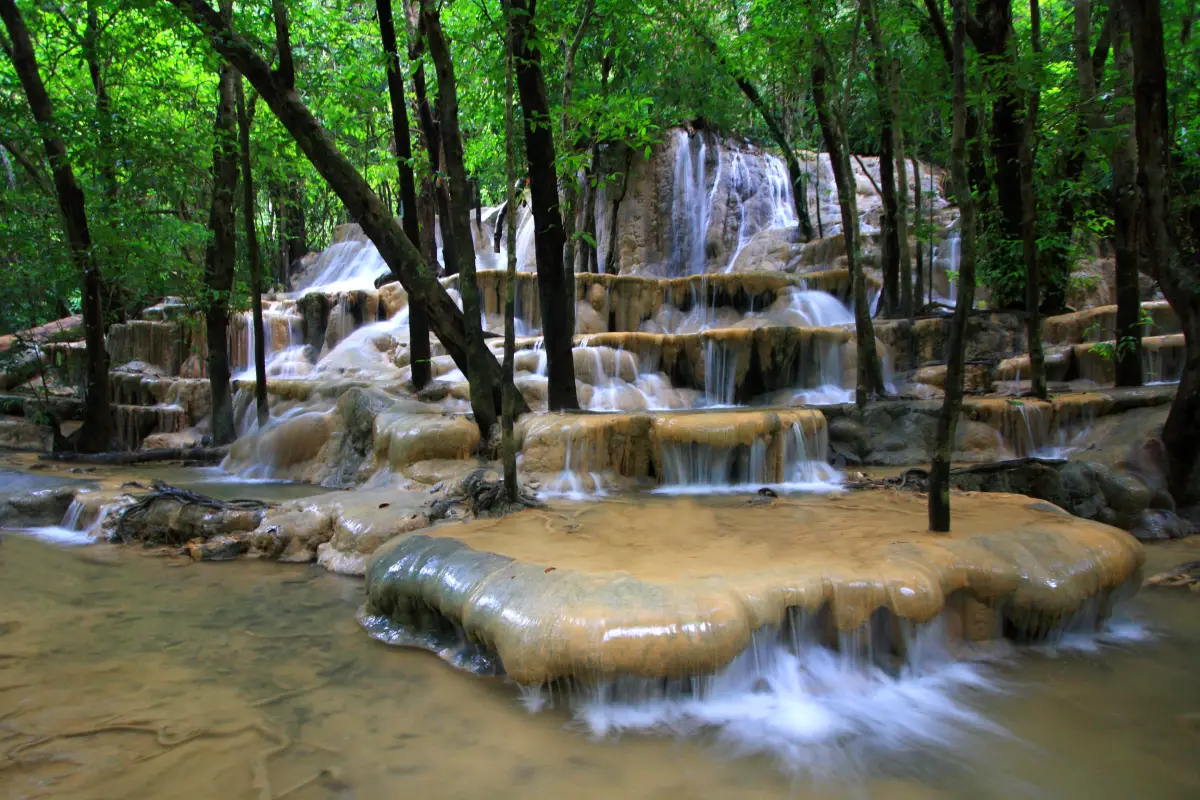
Wang Sai Thong Waterfall in Satun Province is a remarkable limestone waterfall in Nam Phut Subdistrict, La-ngu District. Located within Khao Banthat Wildlife Sanctuary and the Satun UNESCO Global Geopark area, it is one of Satun’s most distinctive inland natural attractions. The waterfall is known for clear water flowing over cream-golden limestone terraces, forming a series of natural pools that descend like overlapping lotus petals. With shaded forest, cool water, accessible viewing areas, and a strong community-tourism setting, Wang Sai Thong is ideal for swimming, photography, nature relaxation, geotourism learning, and rafting activities in the surrounding stream system.
Wang Sai Thong Waterfall shows a different side of Satun. Many travellers associate the province with Ko Lipe, Ko Tarutao, Pak Bara Pier, and the Andaman Sea, but inland Satun has forests, mountains, caves, streams, waterfalls, and geological formations of exceptional value. The La-ngu and Manang areas are closely connected with the Khao Banthat mountain range, making this route especially attractive for travellers who want to combine forest, limestone geology, freshwater scenery, and community-based tourism.
The waterfall originates from Khlong Wang Noi, a stream fed by water emerging from a cave beneath the mountain. As the water flows across limestone terrain, dissolved calcium carbonate is deposited on the rock surface. Over time, this process forms natural limestone rims, terraces, and pools. When sunlight catches the wet limestone, the surface appears golden, giving the waterfall its name, which can be understood as a golden stream pool.
One of the waterfall’s most famous characteristics is its textured limestone surface. Unlike many ordinary waterfall rocks that become slippery from algae, the limestone here has a naturally rougher surface. This makes some sections easier to walk across. Even so, visitors must still be careful because wet leaves, sand, mud, rainfall, and stronger flow can make the area slippery. Proper footwear and attention to safety are important at all times.
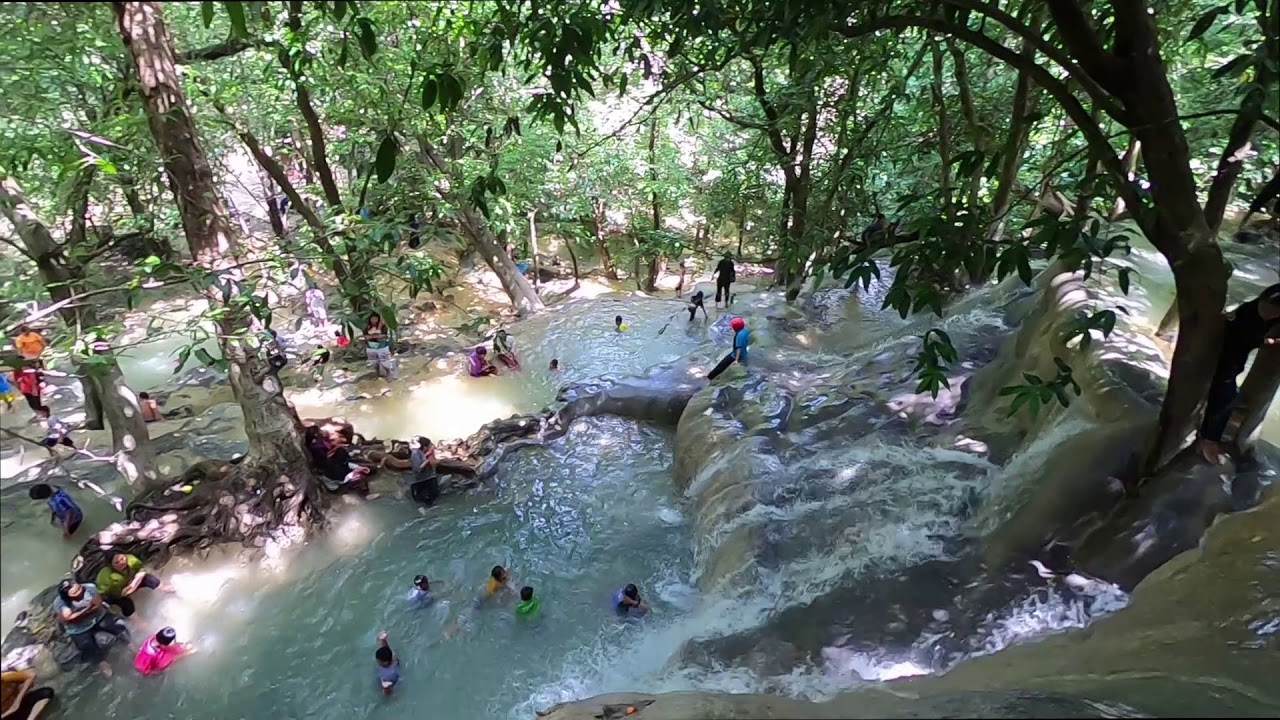
The waterfall consists of many natural pools and descending limestone levels. Some pools are suitable for bathing, some are better for viewing, and others are ideal for photography. Lower sections are generally easier for families and casual visitors, while upper sections require more careful movement. Visitors should avoid risky climbing, waterfall edges, strong currents, and higher areas during or after heavy rain.
The surrounding landscape is shaded by large trees growing among limestone terraces and streambanks. This gives the area a cooler and more refreshing atmosphere than open coastal sites. Visitors can enjoy the sound of flowing water, the shade of forest, and the green scenery of the Khao Banthat range. The combination of clear pools, golden limestone, and dense trees makes Wang Sai Thong one of the most photogenic waterfalls in Satun.
From a geological perspective, Wang Sai Thong is an important geosite in the Satun UNESCO Global Geopark area. It clearly displays the natural process of limestone dissolution and re-deposition. Water flowing over limestone terrain gradually creates rimstone pools and terrace-like formations. This makes the waterfall not only a recreation site, but also a natural classroom for understanding karst landscapes and freshwater limestone deposition.
The area is also listed as a natural site worthy of conservation in Thailand. Its value comes from scenery, ecology, geology, and recreation. The waterfall has year-round water flow, forest vegetation, limestone habitat, and wildlife in the surrounding area. Visitors may see or hear birds, small mammals, insects, and other forest life. The correct way to visit is to keep noise low, avoid feeding wildlife, and leave the natural environment undisturbed.
Suitable activities include bathing in safe pools, walking across designated limestone sections, photographing the waterfall terraces, resting under the trees, learning about limestone waterfalls, and joining Wang Sai Thong rafting activities. Local rafting packages usually follow an 8-10 km stream route through clear water and forest scenery. This gives visitors a more active experience after visiting the waterfall itself.
Community tourism is a major part of the Wang Sai Thong experience. Local operators, homestays, rafting providers, and community groups help support tourism services around the waterfall. Facilities near the site include a visitor-service centre, parking, walking paths, stream-crossing bridges, resting areas, and local tourism services. Visitors should follow wildlife-sanctuary rules and staff instructions because the site is both a recreation area and a protected natural landscape.
The nearby Ban Wang Na Nai community adds cultural depth to the route. The area is associated with the Mani, an Indigenous group of southern Thailand with a long relationship with the forest. Visitors who join community-based activities should behave respectfully, avoid photographing people without permission, stay within arranged visitor areas, and use local services responsibly.
The best visiting conditions depend on rainfall and water level. The rainy season brings strong flow and lush green forest, but also requires caution because streams can rise quickly. The late-year to early-year period is often comfortable for family travel. In any season, visitors should follow the announcements and instructions of local staff, as natural water sites may close temporarily during unsafe weather.
Swimming should be limited to safe pools with gentle current and visible bottom conditions. Children should remain under adult supervision at all times. Older visitors should stay in easier lower sections. Jumping into pools is not recommended because depth and underwater rock conditions can change with season and water flow.
Useful items to bring include non-slip water shoes or sandals with straps, quick-dry clothing, a towel, spare clothes, a waterproof bag for phones or cameras, drinking water, mosquito repellent, and a personal rubbish bag. Soap, shampoo, and detergents should never be used in the stream because the waterfall is part of a natural water system connected with downstream communities.
For photography, Wang Sai Thong offers strong visual compositions: golden limestone terraces, emerald pools, water flowing over layered rock, large tree roots, shaded forest, walkways, and people enjoying the lower pools. Morning is usually the best time for softer light and fewer visitors. Photographs should be taken from safe ground without blocking walkways or standing near dangerous edges.
Getting There is possible from two main directions. From La-ngu District, turn from the Satun-La-ngu road at Ban Kota junction in Kamphaeng Subdistrict and continue for about 26 km to the waterfall. From Thung Wa District, turn at Saphan Wa junction in Pa Kae Bo Hin Subdistrict and continue for about 19 km. The waterfall is located along the Thung Nang Kaeo-Wang Sai Thong road, Highway 4137.
Travellers coming from Satun town can drive toward La-ngu and continue through the Ban Kota route. Travellers from Trang or Thung Wa can use the Saphan Wa-Pa Kae Bo Hin route. Both approaches lead into the forest and community tourism area around Wang Sai Thong. Parking and a forest protection unit are located near the front area, with a short walk leading toward the waterfall zone.
A half-day trip can focus on the waterfall, swimming, photography, and resting under the forest canopy. A full-day trip can add Wang Sai Thong rafting, Chet Khot Cave, Phu Pha Phet Cave, Tham Le Stegodon, or community learning activities at Ban Wang Na Nai. This route offers a compact inland Satun experience covering limestone waterfalls, streams, caves, mountains, and local community tourism.
Compared with other Satun waterfalls, Wang Sai Thong has a highly distinctive identity. Yaroi Waterfall is known for its tiers inside Thale Ban National Park. Ton Pliw Waterfall is known for its high forest cascade. Panan Waterfall is known for year-round flow and a small hydropower context. Wang Sai Thong stands out for its golden limestone terraces, multi-level pools, walkable textured surface, and strong connection with rafting and community-based tourism.
Visitors should not leave rubbish, use soap in the stream, collect plants or rocks, carve limestone surfaces, disturb wildlife, play loud music, climb risky areas, or enter restricted forest or operational zones. The waterfall is beautiful but also sensitive. Responsible behaviour helps preserve its limestone formations, clear pools, and surrounding forest for both local communities and future travellers.
The entrance fee for the wildlife-sanctuary area is 20 baht for Thai adults and 10 baht for Thai children. Foreign visitors pay 200 baht for adults and 100 baht for children. This fee covers general entry to the natural site and does not include rafting, meals, accommodation, transport, or other community tourism services.
Overall, Wang Sai Thong Waterfall is more than a place to swim. It brings together geology, watershed forest, community tourism, rafting, and the inland identity of Satun. Travellers who visit with care will discover that Satun’s natural beauty is not limited to islands and beaches. It also flows through clear water over golden limestone under the forest canopy of the Khao Banthat range.
| Name | Wang Sai Thong Waterfall |
| Location | Ban Wang Na Nai, Moo 10, Nam Phut Subdistrict, La-ngu District, Satun Province, within Khao Banthat Wildlife Sanctuary |
| Address | Nam Phut Subdistrict, La-ngu District, Satun 91110, Thailand, along the Thung Nang Kaeo-Wang Sai Thong Road, Highway 4137 |
| Coordinates | 7.09038, 99.90906 |
| Highlights | Cream-golden limestone waterfall, multi-level natural pools, lotus-like terrace formations, clear water, safe bathing areas, and Wang Sai Thong rafting activities |
| Distinctive Features | Water from Khlong Wang Noi emerges from an underground cave system, flows across limestone, and deposits calcium carbonate into natural terraces and rimstone pools |
| Headwater | Khlong Wang Noi and water emerging from caves beneath the Khao Banthat forest landscape |
| Current Status | Open as a natural attraction and community activity site within the Satun UNESCO Global Geopark area |
| Open Days | Daily |
| Opening Hours | 08.00 – 17.00 |
| Fees | Thai Visitors: Adult 20 Baht, Child 10 Baht Foreign Visitors: Adult 200 Baht, Child 100 Baht Rafting, meals, accommodation, transport, and other community services are not included |
| Best Visiting Time | Morning to early afternoon for swimming and photography. The rainy season has stronger flow but requires caution, while the late-year to early-year period is comfortable for family visits |
| Main Activities | Swimming in safe pools, walking across limestone terraces, photography, nature study, Wang Sai Thong rafting, and Ban Wang Na Nai community tourism |
| Facilities | Visitor-service centre, parking area, walking paths, stream-crossing bridges, resting areas, natural bathing zones, and nearby community tourism services |
| Main Areas / Zones | Wang Sai Thong Forest Protection Unit, parking area, visitor-service centre, waterfall access path, stream bridge, limestone tiers, natural pools, rafting area, and surrounding forest |
| Caretaker / Local Authority | Khao Banthat Wildlife Sanctuary, Department Of National Parks, Wildlife And Plant Conservation; Wang Sai Thong Forest Protection Unit; Nam Phut Subdistrict Administrative Organization; and Wang Sai Thong community tourism groups |
| Head Of Khao Banthat Wildlife Sanctuary | Mr. Thanasan Chantharachot |
| Main Contact Number | Wang Sai Thong Waterfall Visitor-Service Centre Tel. 061-226-4337 Nam Phut Subdistrict Administrative Organization Tel. 0-7483-9790-1 |
| Travel Information | From La-ngu, turn at Ban Kota Junction in Kamphaeng Subdistrict and continue about 26 km. From Thung Wa, turn at Saphan Wa Junction in Pa Kae Bo Hin Subdistrict and continue about 19 km |
| Safety Notes | Avoid entering the water during heavy rain, do not jump into pools, do not climb risky waterfall sections, wear footwear with good grip, and follow staff instructions |
| Nearby Tourist Attractions | 1. Wang Sai Thong Waterfall Visitor-Service Centre, about 0.2 km 2. Wang Sai Thong Rafting Area, about 1 km 3. Chet Khot Cave, about 4 km 4. Than Plio Waterfall, about 7 km 5. Phu Pha Phet Cave, about 10 km 6. Mani Museum / Ban Wang Na Nai Community Learning Area, about 10 km 7. Tham Le Stegodon, about 13 km |
| Nearby Restaurants | 1. Na Wang Sai Thong Community Food Service, about 0.5 km 2. Phubanthad Valley Restaurant, about 1 km, Tel. 085-796-2548 3. Than Thong Resort Restaurant, about 2 km, Tel. 092-357-7988 4. Baan Kafae Na La-ngu, about 26 km, Tel. 099-019-1561 5. Nong Nee Restaurant La-ngu Branch, about 27 km, Tel. 084-069-3118 6. Bara Roti, about 33 km, Tel. 074-783-522 7. Krua Rimlay Seafood Pak Bara, about 35 km, Tel. 083-195-7844, 087-794-0699 |
| Nearby Accommodations | 1. Wang Sai Thong Resort & Homestay, about 0.5 km, Tel. 086-037-8711 2. In Si Thong Homestay Wang Sai Thong Waterfall, about 1 km, Tel. 098-729-7422 3. Phubanthad Valley, about 1 km, Tel. 085-796-2548 4. Phu Pha Daeng Homestay Rafting Satun, about 2 km, Tel. 086-946-9229 5. Thap Thung Thong Rafting & Homestay, about 4 km, Tel. 084-415-2085 6. The Green Villa Resort, about 8 km, Tel. 094-114-5101 7. PhuThan Resort Satun, about 10 km, Tel. 093-005-5501 |
Frequently Asked Questions (FAQ)
Q: Where is Wang Sai Thong Waterfall located?
A: Wang Sai Thong Waterfall is located in Nam Phut Subdistrict, La-ngu District, Satun Province, within Khao Banthat Wildlife Sanctuary and the Satun UNESCO Global Geopark area.
Q: When is Wang Sai Thong Waterfall open?
A: It is open daily from 08.00 to 17.00. Morning to early afternoon is the best time for swimming, walking across the limestone terraces, and photography.
Q: How much is the entrance fee?
A: Thai visitors pay 20 baht for adults and 10 baht for children. Foreign visitors pay 200 baht for adults and 100 baht for children. Rafting, meals, accommodation, transport, and community services are not included.
Q: What makes Wang Sai Thong Waterfall special?
A: It is a golden limestone waterfall with multi-level natural pools, lotus-like terrace formations, clear water, and a strong geotourism identity within the Satun UNESCO Global Geopark area.
Q: Can visitors swim at Wang Sai Thong Waterfall?
A: Swimming is possible in safe pools where the current is gentle and the depth is suitable. Visitors should avoid entering the water during or after heavy rain.
Q: How do visitors get to Wang Sai Thong Waterfall?
A: From La-ngu, turn at Ban Kota Junction in Kamphaeng Subdistrict and continue about 26 km. From Thung Wa, turn at Saphan Wa Junction in Pa Kae Bo Hin Subdistrict and continue about 19 km.
Q: What activities are suitable here?
A: Suitable activities include swimming in safe pools, walking across limestone terraces, nature photography, forest relaxation, geotourism learning, and Wang Sai Thong rafting.
Q: What nearby places can visitors combine with Wang Sai Thong Waterfall?
A: Nearby options include Chet Khot Cave, Than Plio Waterfall, Phu Pha Phet Cave, Ban Wang Na Nai community learning area, Mani Museum, and Tham Le Stegodon.
 Category: ●Nature and Wildlife
 Group: ●Waterfalls
Last Update : 2 MonthAgo
 Last Update : 2 MonthAgo
 Click to Access the Navigation Map GPS
Wang Sai Thong Waterfall Map
Recommend

 Art, Culture and Heritage
 Historical Sites and Monuments(1)
 Landmarks and Memorials(1)
 Art, Craft Centres, Tradition(5)
 Museums(3)
 Places of Worship
 Temple(3)
 Mosque(27)
 Other Sacred Sites(1)
 Suburban Living
 Village, Community(1)
 Local Market(2)
 National Parks and Marine Reserves(7)
 Mountain (Doi)(1)
 Dam, Reservoir, Lake(2)
Waterfalls(9)
 Hot Springs(1)
 Caves(9)
 Bays and Beaches(10)
 Islands(16)
 Other natural attractions(5)
 Entertainment and Agricultural
 Zoos and Aquariums(1)
 Farms, Parks and Ecotourism(4)
 Outdoor and Adventure Activities(1)
 Travel Articles, Recipes
 Travel Review, Food Review(1)


