
lovethailand home >South Travel Attractions >Satun Travel Attractions >Khuan Ka Long >Thung Nui > Panan Waterfall
TL;DR: Panan Waterfall is located at Moo 5, Thung Nui Subdistrict, Khuan Kalong District, Satun Province, open Daily, hours 08.00 – 17.00.

Panan Waterfall
Open Days: Daily
Opening Hours: 08.00 – 17.00
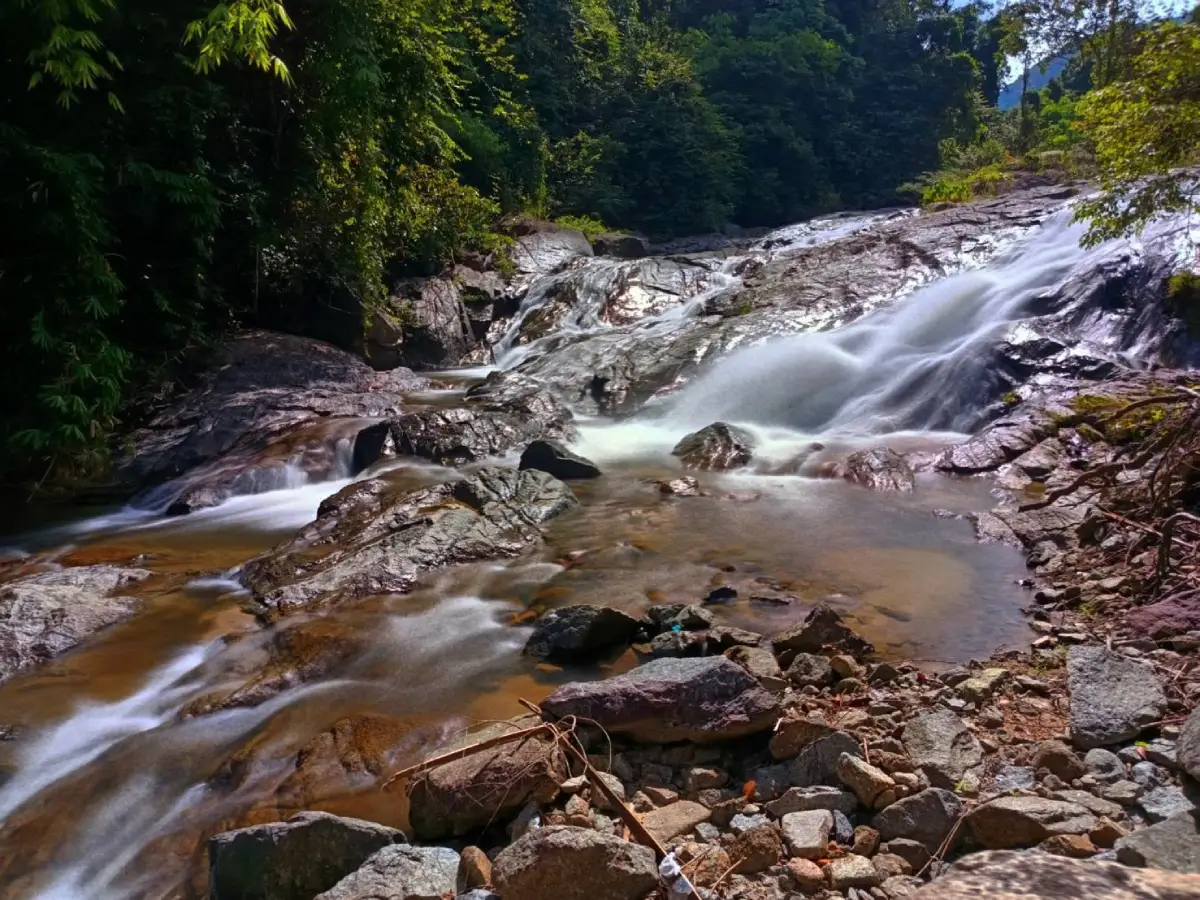
Panan Waterfall, also known as Ton Panan Waterfall, is a natural waterfall in Thung Nui Subdistrict, Khuan Kalong District, Satun Province. It is located about 39 km from Satun town and represents Satun’s inland forest landscape rather than the province’s better-known islands and beaches. The waterfall is fed by Khao Kaming, has year-round water flow, and is surrounded by a still-abundant natural environment. With forest shade, stream pools, boulders, and a quiet community setting, Panan Waterfall is suitable for travellers who want a simple, refreshing nature stop in the Khuan Kalong area.
The waterfall’s headwater comes from Khao Kaming, a mountain and forest area closely connected with Thung Nui’s local water system. Water flows down from the upland forest through stream channels, rocks, and natural pools before forming the waterfall area. The attraction is not based only on size or height. Its charm lies in the cool water, forest atmosphere, streamside rocks, and the feeling of entering a living watershed landscape that remains important to nearby communities.
The area around Panan Waterfall remains naturally rich, with large trees, streamside vegetation, ferns, mosses, and moisture-loving plants growing along rocks and watercourses. The shade and humidity make the waterfall area feel cooler than exposed open areas. This environment is well suited to slow nature walks, photography, resting near the water, and observing the freshwater ecology of a small but important forest stream.
One of the most distinctive features of Panan Waterfall is the presence of a small hydropower dam in the waterfall area. This structure reflects how local water resources have been used not only for recreation, but also for small-scale energy production and community benefit. Visitors can therefore see a landscape where natural water, forest, and human water-use infrastructure exist close together. This gives Panan Waterfall a practical learning dimension in addition to its scenic value.
The waterfall is closely linked with Ban Ton Panan, Ban Nam Ron, and the wider Thung Nui community. These settlements have long relied on mountain water for daily life, agriculture, and local activities. A visit to the waterfall is therefore more than a short stop to see flowing water. It is a chance to understand how forest, stream, community, and local water use are connected in Khuan Kalong District.
Panan Waterfall has several stream sections, boulders, and natural pools along the watercourse. Some areas are suitable for sitting, resting, and bathing when water conditions are safe. Other parts are better for photographing the stream as it moves between rocks and trees. The waterfall suits visitors who enjoy quiet natural details rather than only dramatic high cliffs. Its beauty is found in water texture, shaded rocks, filtered light, and the green forest around the stream.
The site works well for families and small groups who want a calm place to rest near water. Bathing should be done only in safe areas where the current is gentle, the water is not too deep, and the rocks are not dangerously slippery. Children and older travellers should remain under close supervision. Like all natural waterfalls, Panan changes with rainfall and season, so visitors should check actual conditions before entering the water.
The best general season for visiting Panan Waterfall is around December to March, when weather conditions are usually more suitable for entering forest and waterfall areas. From April onward, heavy rainfall can occur in this part of southern Thailand, increasing the risk of slippery ground, stronger currents, and sudden water-level changes. If heavy rain occurs upstream, visitors should avoid entering the stream and move away from the water.
The relationship between Panan Waterfall and its watershed forest is central to the site’s value. Forest cover absorbs rainfall, protects soil, maintains moisture, and gradually releases water into streams. This is why the waterfall can flow throughout the year. Protecting the surrounding forest and avoiding damage to streambanks are therefore essential for keeping the waterfall clean, cool, and alive for future visitors and local communities.
For nature learners, Panan Waterfall is a useful outdoor classroom. In one place, visitors can see flowing water, rocks, streamside vegetation, humid forest conditions, and a small hydropower structure. The site shows that a waterfall is not an isolated feature. It is created by the combined work of mountain terrain, rainfall, forest soil, roots, and water channels that shape the landscape over time.
Photographers will find several simple but attractive subjects: water running over rocks, natural pools under shade, forest plants along the stream, droplets on leaves and stones, filtered sunlight, and the small hydropower setting. Morning to late morning is usually best because the light is softer and the weather is more comfortable. After rain, the forest looks fresh, but slippery ground and stronger water flow require extra care.
Useful items to bring include non-slip shoes, quick-dry clothing, a towel, drinking water, light snacks, a waterproof bag for phones or cameras, mosquito repellent, and a personal rubbish bag. Visitors should avoid bringing excessive disposable packaging. Since the waterfall is a natural water source close to community areas, rubbish and food waste can affect water quality, wildlife behaviour, and the overall experience of other visitors.
Responsible behaviour is important. Visitors should not leave rubbish, use soap or shampoo in the stream, catch aquatic animals, collect plants, carve rocks or trees, play loud music, or interfere with hydropower structures or operational areas. Panan Waterfall is both a recreation site and a water-resource landscape, so it should be used with care, safety awareness, and respect for the local community.
Before entering the water, visitors should assess current conditions. If the water is muddy, fast, rising, or if rain is falling in the upstream area, it is safer to leave the stream immediately. Visitors should not climb algae-covered rocks, jump into pools without knowing their depth, or stand near strong-flowing sections. Natural waterfall safety depends on what is happening on the day of travel, not only on how the site looks during good weather.
Getting There is easiest by private car or motorcycle. From Satun town, take Highway 406 on the Satun-Hat Yai route toward Khuan Kalong District and Thung Nui Subdistrict. At the Ban Thung Nui Mittraphap 42 School area, turn into the local road and continue about 7 km toward the waterfall. The access road reaches the local community and waterfall area, making the site suitable for a day trip from Satun town or Khuan Kalong.
From Khuan Kalong District, travellers can head directly into Thung Nui Subdistrict and Ban Ton Panan. Visitors coming from Hat Yai or Songkhla can use Highway 406 toward Satun and stop at Panan Waterfall before continuing to Satun town, La-ngu, or Pak Bara. Private transport is the most convenient option because it allows travellers to combine the waterfall with nearby natural attractions and cafés in the same trip.
Panan Waterfall pairs especially well with Thung Nui Hot Spring because both are located in the same wider route and offer contrasting natural experiences. The hot spring provides warm mineral-water bathing near the hills, while Panan Waterfall offers cool stream water and shaded forest. A half-day trip can easily combine these two places as a warm-water and cool-water nature route in Thung Nui.
Travellers who want to explore more of Khuan Kalong can combine Panan Waterfall with Namtok Thara Sawan Forest Park, Sai Jai Waterfall, Dao Krachai Waterfall, or cafés and restaurants in the district. This route is ideal for visitors who want to understand Satun’s mountain, forest, waterfall, and community landscape instead of focusing only on marine attractions.
Panan Waterfall is also a good option for travellers who prefer quieter, less commercial nature sites. The experience is based on stream sounds, forest shade, rocks, water, and local atmosphere rather than large built attractions. Its simplicity is part of its value. Visitors who come with the right expectations will appreciate its calm and authentic Thung Nui setting.
Compared with other waterfalls in Satun, Panan has its own character. Yaroi Waterfall is known for nine tiers in Thale Ban National Park. Ton Pliw Waterfall is known for a high and powerful cascade. Dao Krachai Waterfall is associated with star-like water spray. Panan Waterfall stands out as a community-linked waterfall with year-round water, a nearby hot spring route, and the added interest of small-scale hydropower.
Panan Waterfall is suitable for families, nature travellers, people interested in watershed forests, visitors curious about small hydropower, photographers, and those looking for a Satun route beyond islands and beaches. Its strengths are year-round water flow, easy access from the main Satun-Hat Yai road, a forested setting, and its close connection with the Thung Nui community.
The lasting value of Panan Waterfall lies in its multiple roles. It is a stream from Khao Kaming, a community recreation site, a natural learning area, and an example of water use in a mountain landscape. A good visit should emphasize simplicity, safety, and responsibility. When visitors keep the area clean, avoid disturbing the stream, and respect local surroundings, Panan Waterfall can remain an important natural attraction of Thung Nui and Khuan Kalong for years to come.
| Name | Panan Waterfall / Ton Panan Waterfall |
| Location | Moo 5, Thung Nui Subdistrict, Khuan Kalong District, Satun Province |
| Address | Ban Ton Panan, Thung Nui Subdistrict, Khuan Kalong District, Satun 91130, Thailand |
| Area Navigation Coordinates | 6.857321, 100.162730 |
| Distance From Satun Town | About 39 km |
| Highlights | Natural waterfall from Khao Kaming, year-round water flow, abundant forest surroundings, stream pools among rocks, and a small hydropower dam in the waterfall area |
| Distinctive Features | A community-linked forest waterfall suitable for safe bathing, relaxation, photography, watershed learning, and observing small-scale hydropower in a natural setting |
| Headwater | Khao Kaming and the watershed forest of Thung Nui Subdistrict |
| Travel Information | From Satun town, take Highway 406 on the Satun-Hat Yai route toward Khuan Kalong and Thung Nui. Turn in near Ban Thung Nui Mittraphap 42 School and continue about 7 km on the local road toward the waterfall |
| Current Status | Open as a natural attraction in Thung Nui Subdistrict and maintained as a visitor-ready local waterfall area |
| Open Days | Daily |
| Opening Hours | 08.00 – 17.00 |
| Best Visiting Season | December – March, with heavy-rain periods avoided for stream safety |
| Facilities | Road access to the community and waterfall area, natural pools, Panan forest protection unit, nearby community services, and Thung Nui Hot Spring on the same local route |
| Main Areas / Zones | Waterfall access route, stream channel, rock pools, surrounding forest, small hydropower dam area, and Panan forest protection unit |
| Caretaker / Local Authority | Ton Nga Chang Wildlife Sanctuary, Department Of National Parks, Wildlife And Plant Conservation, and Thung Nui Subdistrict Municipality as the local authority |
| Contact Number | Ton Nga Chang Wildlife Sanctuary Tel. 074-894-804 Thung Nui Subdistrict Municipality Tel. 0-7474-0289 |
| Nearby Tourist Attractions | 1. Ban Ton Panan And Thung Nui Community, about 1 km 2. Thung Nui Hot Spring, about 3 km 3. Thung Nui Subdistrict Municipality Tourist Service Centre, about 8 km 4. Namtok Thara Sawan Forest Park, about 25 km 5. Sai Jai Waterfall, about 30 km 6. Dao Krachai Waterfall, about 40 km 7. Thale Ban National Park, about 45 km |
| Nearby Restaurants | 1. Beehive Hill Resort Restaurant, about 8 km, Tel. 074-740-226 2. Conner Cafe Khuan Kalong, about 14 km, Tel. 081-540-2684 3. Soil Pizza, about 18 km, Tel. 091-049-7047 4. Cha @ Kalong Cafe, about 25 km, Tel. 086-955-1522, 092-887-4794 5. D' Andaman Thaifood Restaurant, about 35 km, Tel. 064-591-9939 6. Makan Restaurant, about 45 km, Tel. 086-481-3314 |
| Nearby Accommodations | 1. Beehive Hill Resort, about 8 km, Tel. 074-740-226 2. PalmPuew Resort Satun, about 20 km, Tel. 074-752-403 3. Pa Puk Resort, about 22 km, Tel. 074-797-388 4. Satun Premium Resort, about 35 km, Tel. 081-896-7902 5. Phu Ton Nam Resort, about 40 km, Tel. 085-891-8197 6. Phu Banthat Resort, about 45 km, Tel. 085-796-2548 |
Frequently Asked Questions (FAQ)
Q: Where is Panan Waterfall located?
A: Panan Waterfall, also known as Ton Panan Waterfall, is located at Moo 5, Thung Nui Subdistrict, Khuan Kalong District, Satun Province, about 39 km from Satun town.
Q: When is Panan Waterfall open?
A: It is open daily from 08.00 to 17.00. Morning to early afternoon is the best period for nature walking, safe bathing, and photography.
Q: What makes Panan Waterfall special?
A: The waterfall is fed by Khao Kaming, flows throughout the year, has abundant natural surroundings, features pools among rocks, and includes a small hydropower dam in the waterfall area.
Q: Can visitors swim at Panan Waterfall?
A: Visitors can bathe in safe areas where the current is gentle and the water is not too deep. Bathing should be avoided during or after heavy rain or when the stream level changes quickly.
Q: How do visitors get to Panan Waterfall?
A: From Satun town, take Highway 406 toward Khuan Kalong and Thung Nui. Turn in near Ban Thung Nui Mittraphap 42 School and continue about 7 km on the local road toward the waterfall.
Q: What is the best season to visit Panan Waterfall?
A: December to March is the most suitable period because weather conditions are generally safer for entering forest and waterfall areas.
Q: What nearby places can travellers combine with Panan Waterfall?
A: Nearby options include Thung Nui Hot Spring, Namtok Thara Sawan Forest Park, Sai Jai Waterfall, Dao Krachai Waterfall, and cafés or restaurants in Khuan Kalong District.
Q: What should visitors prepare before going to Panan Waterfall?
A: Visitors should wear non-slip shoes and bring drinking water, quick-dry clothing, a towel, a waterproof bag, mosquito repellent, and a bag for carrying personal rubbish out of the area.
 Category: ●Nature and Wildlife
 Group: ●Waterfalls
Last Update : 2 MonthAgo
 Last Update : 2 MonthAgo

 Click to Access the Navigation Map GPS
Panan Waterfall Map
Recommend

 Art, Culture and Heritage
 Historical Sites and Monuments(1)
 Landmarks and Memorials(1)
 Art, Craft Centres, Tradition(5)
 Museums(3)
 Places of Worship
 Temple(3)
 Mosque(27)
 Other Sacred Sites(1)
 Suburban Living
 Village, Community(1)
 Local Market(2)
 National Parks and Marine Reserves(7)
 Mountain (Doi)(1)
 Dam, Reservoir, Lake(2)
Waterfalls(9)
 Hot Springs(1)
 Caves(9)
 Bays and Beaches(10)
 Islands(16)
 Other natural attractions(5)
 Entertainment and Agricultural
 Zoos and Aquariums(1)
 Farms, Parks and Ecotourism(4)
 Outdoor and Adventure Activities(1)
 Travel Articles, Recipes
 Travel Review, Food Review(1)


