
lovethailand home >South Travel Attractions >Ranong Travel Attractions >Muang Ranong >Khao Niwet > Rattanarangsan Palace (Replica)
TL;DR: Rattanarangsan Palace (Replica), Ranong attractions : Art, Culture and Heritage, Royal Palace.
Rattanarangsan Palace (Replica)
Open Days: Palace Front Grounds Open Daily / Main Buildings Open Tuesday - Sunday
Opening Hours: Palace Front Grounds 05.00 AM - 09.00 PM / Main Buildings 08.30 AM - 04.30 PM
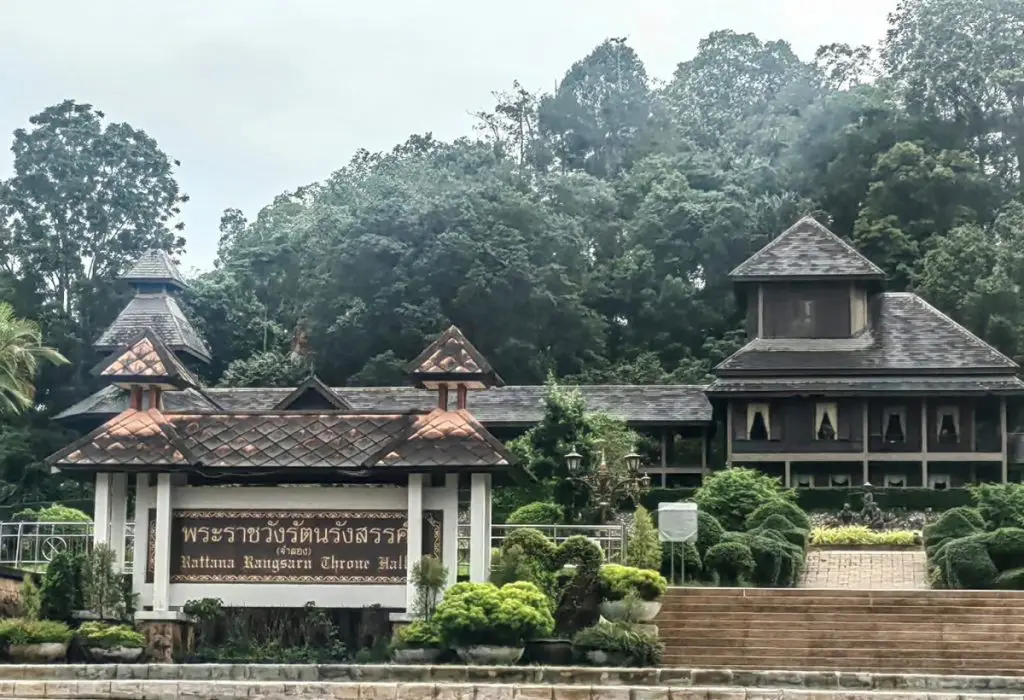
Rattanarangsan Palace (Replica), also known as Rattana Rangsan Throne Hall, is one of the most important historical attractions in Ranong Province. It is located at the foot of Rattanarangsan Hill, or Niwet Khiri Hill, near Ranong Provincial Hall in Khao Niwet Subdistrict, Mueang Ranong District. The palace was built as a memorial to the royal visits and overnight stays of three Thai kings in Ranong: King Chulalongkorn, Rama V, in 1890; King Vajiravudh, Rama VI, in 1909; and King Prajadhipok, Rama VII, in 1928. The site is known for its elegant wooden architecture, the main throne hall, royal bedroom displays, the Queen’s rooms, an octagonal tower, the audience hall, a connecting bridge, landscaped gardens, city viewpoints, and the nearby Hall of Nine Revered Monks, making it a compact but meaningful heritage stop in Ranong town.
Rattanarangsan Palace (Replica) gives travelers a deeper view of Ranong beyond its well-known image as a rainy province of hot springs, mountains, islands, and border scenery. This historical site connects royal history with the urban landscape of Ranong through wooden architecture, hillside setting, and the memory of royal overnight stays in the province. The palace stands close to Ranong Provincial Hall and the old town area, making it easy to combine with restaurants, hotels, markets, shrines, hot springs, and other heritage attractions in the town center.
The present palace is a replica built to commemorate the original Rattanarangsan Palace. The story began during the reign of King Rama V, when King Chulalongkorn visited southern towns and stayed in Ranong in 1890. A wooden royal pavilion was constructed on a hill in the middle of the town by Phraya Rattanasetthi, or Kho Sim Kong, the governor of Ranong. When King Rama V saw the building, he remarked that it was beautiful and strong enough to be a palace rather than a temporary pavilion. He then granted it the name “Rattana Rangsan Throne Hall” and named the hill “Niwet Khiri.”
The historical significance of the palace extends beyond King Rama V’s visit. It is also associated with King Vajiravudh, Rama VI, who stayed in Ranong in 1909, and King Prajadhipok, Rama VII, who stayed there in 1928. The replica palace therefore brings together the memory of three royal visits within one site. This makes it one of Ranong’s clearest historical landmarks connected with the Chakri dynasty and the province’s role as an important Andaman-side town.
The original palace had a practical civic role as well. It was not used only as a royal residence during visits; it also served as a government hall and a ceremonial place for the town. When royal visits occurred, it was prepared as a royal residence. This dual function reflects the way Ranong linked provincial administration, royal authority, and local civic life. Over time, the original structure deteriorated and was later altered for government use before disappearing from the town’s physical landscape. The replica was built later to restore this historical memory.
The present Rattanarangsan Palace (Replica) project began in 2002. In 2004, the committee responsible for the replica resolved that the official name should be “Rattanarangsan Palace (Replica),” and the site opened formally to visitors in 2005. The project was therefore not simply the creation of a new tourist building; it was an effort to bring back a major historical image of Ranong and reconnect the city with its royal heritage.
The palace is visually distinctive because of its woodwork and graceful hillside architecture. Teak and golden takian wood are key materials in the building group, combined with a strong structural base and a Thai-influenced design adapted to the local setting. The roofs, balconies, openings, stairways, and connecting bridge create a clear visual identity. The building looks different from ordinary government buildings or standard tourist facilities, giving Ranong a landmark with both elegance and historical character.
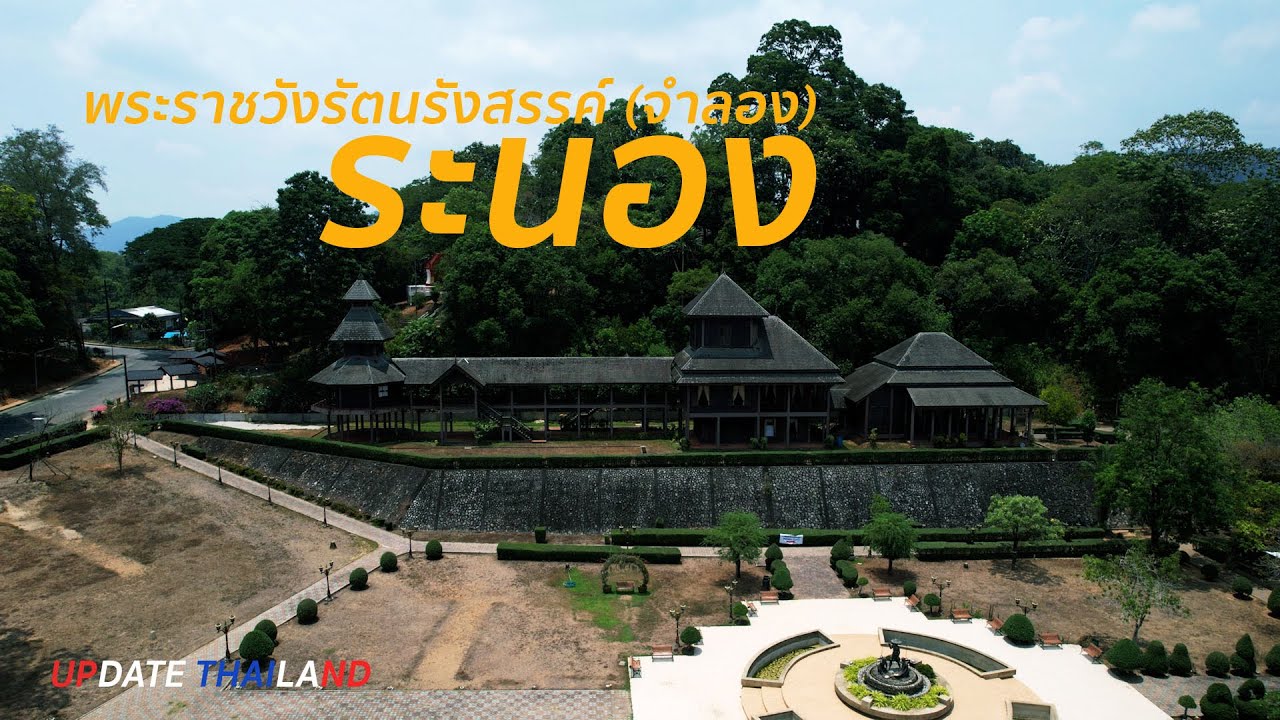
Inside the palace, visitors can see display areas such as the recreated bedroom of King Rama V on the third floor, the Queen’s rooms on the second floor, the audience hall, the octagonal building, and the bridge connecting the royal residence with the octagonal structure. These areas help visitors understand how the palace was designed as a place of reception, royal rest, and formal use. The experience is compact but rich in historical context.
The octagonal building is one of the palace’s most memorable features. Its form is different from ordinary wooden buildings, and its height provides broad views over Ranong town. The second floor has wooden balconies around the structure, while the upper level offers views toward the town, the western side of Ranong, the Thai-Myanmar border direction, and the Andaman horizon on clear days. This gives the building both architectural and scenic value.
The landscaped area around the palace is also important. It functions as a public park where local residents can walk, exercise, rest, and enjoy the town view. The grounds include walking paths, seating areas, greenery, and a metal sculpture of tin panners, a reference to one of Ranong’s most important historical occupations. These details make the palace more than a museum-like building. It is also a living public space in the center of the town.
The palace is one of the best viewpoints in Ranong town because it sits on a hillside close to the urban center. Visitors can look out over the town, surrounding hills, and the distinctive landscape of one of Thailand’s rainiest provinces. Ranong’s geography includes hills, forests, streams, hot springs, and access to the Andaman Sea. Seeing the town from the palace helps visitors understand this geography more clearly.
Near the palace stands the Hall of Nine Revered Monks, a sacred site respected by Ranong residents. It was built in 1982 to mark the 200th anniversary of Rattanakosin and houses images of nine revered southern Thai monks: Luang Pho Chan, Luang Pho Nui, Luang Pho Ruen, Luang Pu Thuat, Luang Pho Biao, Luang Pho Tio, Luang Pho Loi, Luang Pho Noi, and Luang Pho Ban. This gives the palace area both royal-historical meaning and a dimension of local religious devotion.
The Hall of Nine Revered Monks is a small religious building with a form resembling a compact ordination hall. It stands on elevated ground near Rattanarangsan Palace. From around the hall, visitors can also see views of Ranong town and the palace area. It is a good place to pay respect before or after visiting the palace, especially for travelers interested in local faith and the spiritual identity of southern Thailand.
A good visit to Rattanarangsan Palace should include two parts. The first is the palace building group, including the throne hall, exhibition rooms, octagonal building, and connecting bridge. The second is the surrounding garden, viewpoints, public grounds, photography spots, and the Hall of Nine Revered Monks. Visitors who want to see the site properly should allow at least one to two hours, because the place contains history, architecture, views, and local faith in one compact area.
Getting There is straightforward from central Ranong. The palace is located near Ranong Provincial Hall on Lu Wang Road in Khao Niwet Subdistrict. Travelers staying around Rueang Rat Road, the city pillar area, or central Ranong hotels can reach it quickly by private car, rental car, motorcycle, or local hired transport. The approach is on a hillside road, so drivers should take care, especially during rain.
Travelers coming from Bangkok can follow Highway 4, or Phet Kasem Road, toward Chumphon and continue on the Chumphon-Ranong route through Kra Buri and La-un into Ranong town. Once in town, head toward Ranong Provincial Hall or Lu Wang Road. The palace is located at the foot of Rattanarangsan Hill and is easy to combine with other central attractions.
The best time to visit is in the morning or late afternoon. Visitors who want to enter the main buildings should arrive during building hours. Those who want to walk in the front grounds or public garden can visit from early morning until evening. Late afternoon is particularly suitable for photography because the light works well with the wooden buildings and green landscape. During rain, visitors should watch their step on stairs, garden paths, and sloped areas.
Visitors should dress respectfully because the site is connected with Thai royal history and includes a sacred hall nearby. Move calmly, avoid loud behavior, do not touch display items unnecessarily, and follow staff instructions. In the garden area, visitors should keep the place clean, avoid alcohol, avoid smoking, avoid littering, and avoid driving into restricted garden areas. These rules help preserve the atmosphere of the historical site and the public park.
Rattanarangsan Palace is suitable for many types of visitors. History travelers can learn about the royal visits of three kings and Ranong’s role during the Rattanakosin period. Architecture lovers can appreciate the wooden buildings and octagonal tower. Photographers can capture the palace, garden, bridge, and city views. Families can use the site as an accessible open-air learning stop in the center of town.
In a Ranong town itinerary, the palace should be combined with Ranong City Pillar Shrine, Khaw Soo Cheang Monument, Ranong Governor’s Residence, Rueang Rat Road, Raksawarin Hot Springs, and Ranong Governor’s Grave. These places together explain the province through royal history, local leadership, Chinese-Hokkien heritage, old-town life, hot springs, and the memory of the Na Ranong family.
The palace should be understood through both its architecture and its location. Its meaning does not come only from the wooden structures; it also comes from its position on a hill in the middle of Ranong town. This setting gives the palace dignity and connects it with the geography of Ranong as a hill town, hot-spring town, and Andaman border province.
Important points to observe include the main throne hall, recreated royal bedroom, Queen’s rooms, audience hall, octagonal building, connecting bridge, entrance cannon, viewing balcony, public garden, tin-panner sculpture, and Hall of Nine Revered Monks. Each feature tells a different part of the story, from royal memory and local architecture to mining history, landscape, and community faith.
For photography, morning and late afternoon are the best choices. The wooden buildings look especially warm under softer light, and the garden gives natural framing. Good angles include the front of the palace, the bridge, the octagonal tower, the lower garden, and the elevated town view. Visitors should photograph respectfully and avoid taking pictures in restricted areas.
Overall, Rattanarangsan Palace (Replica) is one of the most worthwhile places to visit in Ranong town. It combines royal history, wooden architecture, urban landscape, public gardens, viewpoints, and local sacred space in one place. For travelers who want to understand Ranong beyond hot springs and natural scenery, this palace is an excellent starting point because it connects the memory of three kings, the old governor’s town, hillside geography, traditional woodwork, and the living civic space of modern Ranong.
| Name | Rattanarangsan Palace (Replica) |
| Alternative Names | Rattana Rangsan Throne Hall, Rattanarangsan Palace, Niwet Khiri |
| Thai Name | พระราชวังรัตนรังสรรค์ (จำลอง) |
| Location | At the foot of Rattanarangsan Hill near Ranong Provincial Hall, Khao Niwet Subdistrict, Mueang Ranong District, Ranong Province |
| Address | Lu Wang Road, Khao Niwet, Mueang Ranong District, Ranong 85000, Thailand |
| Coordinates | 9.965353, 98.636632 |
| Highlights | Wooden hillside palace, octagonal building, recreated royal bedroom, Queen’s rooms, audience hall, connecting bridge, public garden, Ranong town viewpoint, and Hall of Nine Revered Monks |
| Historical Significance | Built as a memorial to the royal overnight stays in Ranong of King Rama V in 1890, King Rama VI in 1909, and King Rama VII in 1928 |
| History / Period | The replica project began in 2002, the name Rattanarangsan Palace (Replica) was approved in 2004, and the site opened officially in 2005 |
| Architectural Features | Wooden palace group using teak and golden takian wood, with a three-storey main building, octagonal tower, viewing balcony, connecting bridge, and elegant timber details |
| Interior Displays | Recreated bedroom of King Rama V on the third floor, six Queen’s rooms on the second floor, audience hall, octagonal building, and connecting bridge |
| Hall Of Nine Revered Monks | Located near the palace, built in 1982, and housing images of nine revered southern Thai monks |
| Current Status | Open as a historical attraction, learning site, viewpoint, and public park in Ranong town |
| Open Days | Palace front grounds open daily / main buildings open Tuesday - Sunday and closed on Monday |
| Opening Hours | Palace front grounds 05.00 AM - 09.00 PM / main buildings 08.30 AM - 04.30 PM |
| Admission Fee | Free Admission |
| Facilities | Public garden, walking and jogging paths, seating areas, viewpoint, exhibition rooms, photo spots, worship area at the Hall of Nine Revered Monks, and nearby parking |
| Main Areas / Zones | Rattana Rangsan Throne Hall, Recreated Royal Bedroom, Queen’s Rooms, Audience Hall, Octagonal Building, Connecting Bridge, Viewing Balcony, Entrance Cannon, Palace Garden, Tin-Panner Sculpture, Hall Of Nine Revered Monks |
| Local Authority | Ranong Municipality And Ranong Province |
| Contact Number | 077-811-422 |
| Travel Information | From central Ranong, travel to Lu Wang Road near Ranong Provincial Hall. The site is easily reached by private car, rental car, motorcycle, or local hired transport. From Bangkok, follow Highway 4 through Chumphon toward Ranong, then continue into Ranong town. |
| Nearby Tourist Attractions | 1. Hall Of Nine Revered Monks, about 0.2 km 2. Ranong City Pillar Shrine, about 0.5 km 3. Khaw Soo Cheang Monument, about 0.8 km 4. Ranong Governor’s Residence, about 1 km 5. Raksawarin Hot Springs, about 3 km 6. Ranong Governor’s Grave, about 4 km |
| Nearby Restaurants | 1. FarmHouse Restaurant, about 1 km, Tel. 087-278-4224 2. Chill Chill, about 1 km, Tel. 077-983-350 3. Ranong O Cha, about 1 km, Tel. 088-167-4164 4. Khun Lin Ranong, about 3 km, Tel. 077-822-863, 081-892-3455 5. KeingLay Ranong, about 8 km, Tel. 077-873-969 |
| Nearby Accommodations | 1. Sook Hotel Ranong, about 0.4 km, Tel. 093-581-2500 2. Numsai Khaosuay Resort, about 0.5 km, Tel. 087-222-8886, 077-989-855 3. The B Ranong Trend Hotel, about 0.6 km, Tel. 077-823-111 4. FarmHouse Hotel Ranong, about 1 km, Tel. 087-278-4224 5. Baan Yamoo Ranong, about 4 km, Tel. 095-020-9111 |
Frequently Asked Questions (FAQ)
Q: Where is Rattanarangsan Palace (Replica) located?
A: Rattanarangsan Palace (Replica) is located at the foot of Rattanarangsan Hill, also known as Niwet Khiri Hill, on Lu Wang Road in Khao Niwet Subdistrict, Mueang Ranong District, near Ranong Provincial Hall.
Q: Why was Rattanarangsan Palace (Replica) built?
A: It was built as a memorial to the royal overnight stays in Ranong of three Thai kings: King Rama V, King Rama VI, and King Rama VII.
Q: When is Rattanarangsan Palace open?
A: The palace front grounds are open daily, while the main buildings are open Tuesday to Sunday from 08.30 AM to 04.30 PM and closed on Monday.
Q: Is there an admission fee?
A: No. The site currently lists free admission.
Q: What can visitors see inside the palace?
A: Visitors can see the main throne hall, a recreated bedroom of King Rama V, the Queen’s rooms, the audience hall, the octagonal building, the connecting bridge, viewing balconies, gardens, and the tin-panner sculpture.
Q: What is the Hall of Nine Revered Monks?
A: It is a sacred hall near Rattanarangsan Palace, built in 1982 to house images of nine revered southern Thai monks and serve as a place of worship for local people and visitors.
Q: How do travelers get to Rattanarangsan Palace?
A: From central Ranong, travel to Lu Wang Road near Ranong Provincial Hall. The site can be reached by private car, rental car, motorcycle, or local hired transport.
Q: What nearby places can be combined with this visit?
A: Nearby places include the Hall of Nine Revered Monks, Ranong City Pillar Shrine, Khaw Soo Cheang Monument, Ranong Governor’s Residence, Raksawarin Hot Springs, and Ranong Governor’s Grave.
 Category: ●Art, Culture and Heritage
 Group: ●Royal Palace
Last Update : 2 MonthAgo
 Last Update : 2 MonthAgo
 Click to Access the Navigation Map GPS
Rattanarangsan Palace (Replica) Map
Recommend

 Historical Sites and Monuments(4)
 Landmarks and Memorials(1)
Royal Palace(1)
 Art, Craft Centres, Tradition(4)
 Educational Places
 Educational Gardens, Farm(1)
 Places of Worship
 Temple(12)
 Other Sacred Sites(2)
 Suburban Living
 Village, Community(2)
 Nature and Wildlife
 National Parks and Marine Reserves(6)
 Mountain (Doi)(4)
 Waterfalls(15)
 Hot Springs(3)
 Caves(4)
 River, Canal(2)
 Bays and Beaches(10)
 Islands(8)
 Other natural attractions(3)
 Travel Articles, Recipes
 Travel Review, Food Review(1)


