
lovethailand home >South Travel Attractions >Phuket Travel Attractions >Thalang >Si Sunthon > Thao Thep Krasattri and Thao Si Sunthon Monument
TL;DR: Thao Thep Krasattri and Thao Si Sunthon Monument is located at Tha Ruea Roundabout, Si Sunthon Subdistrict, Thalang District, Phuket Province, open Daily, hours Open 24 Hours.

Thao Thep Krasattri and Thao Si Sunthon Monument
Open Days: Daily
Opening Hours: Open 24 Hours
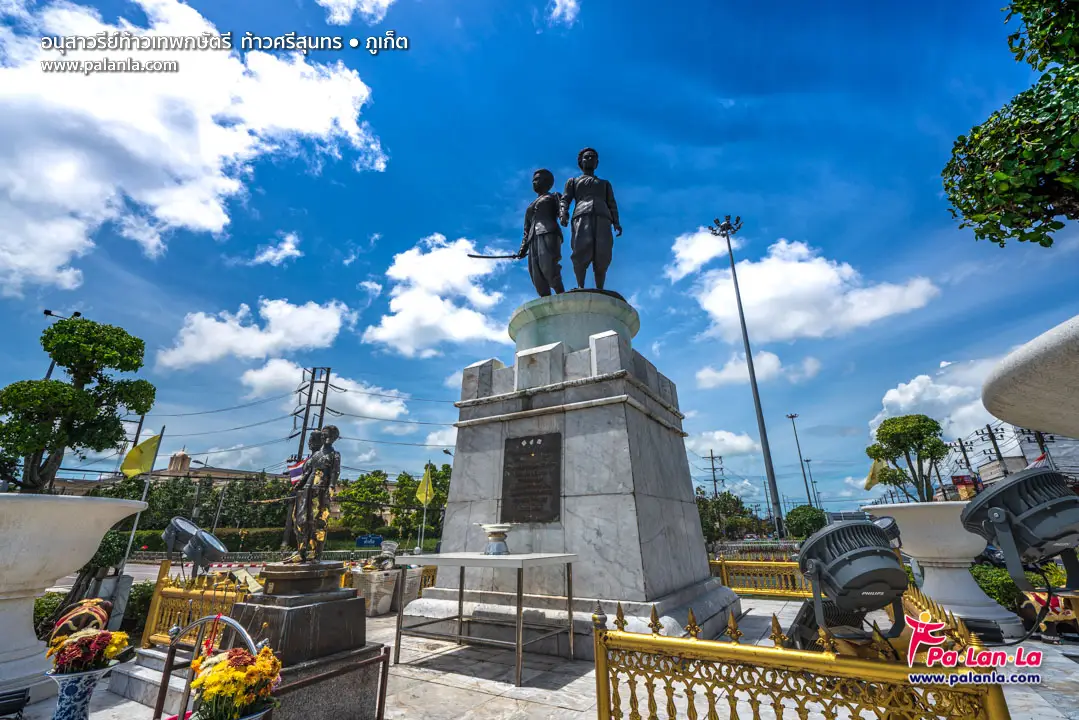
The Thao Thep Krasattri and Thao Si Sunthon Monument in Phuket is one of the island’s most important historical landmarks. Located at the Tha Ruea roundabout in Si Sunthon Subdistrict, Thalang District, about 12 km from Phuket Town, the monument honors two heroic women of old Thalang: Thao Thep Krasattri, formerly Than Phu Ying Chan, and Thao Si Sunthon, formerly Khun Muk. They are remembered for their courage, sacrifice, leadership, and intelligence in defending Thalang against the Burmese invasion in 1785.
For Phuket residents, this monument is more than a roadside landmark. It is a symbol of local pride and collective memory. Travelers arriving from Phuket International Airport toward Phuket Town often pass this roundabout and see the two bronze figures standing prominently on a high pedestal. In that sense, the monument works almost like a historical gateway to Phuket, reminding visitors that the island has a deep cultural and historical identity beyond beaches, resorts, and coastal scenery.
The monument was built by the people of Phuket in 1966 to honor the bravery of Thao Thep Krasattri and Thao Si Sunthon. On 24 March 1967, the bronze statues were placed on the pedestal, a date associated with the retreat of the Burmese army from Thalang in 1785. The official opening ceremony was later held in May 1967. The timing and location of the monument therefore connect the physical place of Thalang with the memory of victory and local sacrifice.
The statues are large free-standing bronze sculptures positioned on a high base at the center of the roundabout. The two heroines are shown in traditional Thai dress, wearing chong kraben, long-sleeved upper garments, and cloth wrapped across the body in a style associated with readiness for action. Each holds a sword, symbolizing determination and leadership during wartime. The composition gives the monument a strong and dignified presence while preserving the image of the two women as protectors of Thalang.
The history behind the monument begins during the early Rattanakosin period, when Burmese forces advanced toward the Andaman coast and attacked Thalang. At that time, the town faced a fragile situation because its governor had passed away and the community needed to organize its defense quickly. Than Phu Ying Chan and her sister Khun Muk took the lead in gathering local people, organizing resistance, strengthening morale, and defending the town.
Their achievement is remembered as one of Phuket’s defining historical episodes. Local history tells that the two heroines used both courage and strategy. Women in the town were gathered and dressed to look like soldiers, giving the invading army the impression that Thalang still had strong military numbers. This psychological strategy, combined with community unity and determined resistance, helped Thalang hold out until the Burmese army withdrew.
After the victory, King Rama I honored Than Phu Ying Chan with the title Thao Thep Krasattri and Khun Muk with the title Thao Si Sunthon. These titles recognized their bravery, sacrifice, and service in protecting Thalang. Their names have since become inseparable from Phuket’s identity and are remembered across the province through roads, place names, ceremonies, historical narratives, and this monument.
The name Thao Thep Krasattri also carries official and historical significance. Older forms of the name appeared in different spellings, but Phuket later sought historical evidence from the Fine Arts Department regarding the proper name of Than Phu Ying Chan. The form Thao Thep Krasattri became the accepted official usage and remains the name used for the monument, the main road, and cultural references in Phuket today.
The location of the monument is highly practical and symbolic. It stands at the Tha Ruea intersection on Thepkasattri Road, one of Phuket’s main routes linking the airport, Thalang, and Phuket Town. Because many visitors and residents pass this route, the monument is one of the most visible historical landmarks on the island. It also serves as a geographic reference point for people traveling between northern Phuket, Phuket Town, and the east coast areas.
The area around the monument includes a worship space and decorative elements. Visitors commonly stop to pay respect, offer garlands, take photos, and continue their journey. Since the monument is located in the middle of a major roundabout, visitors should be careful when parking, crossing the road, or approaching the base. It is best to visit when traffic is lighter and to avoid stopping vehicles in a way that blocks the roundabout.
A visit to the Thao Thep Krasattri and Thao Si Sunthon Monument can be short, but it is meaningful. Most visitors spend around 15 to 30 minutes paying respect and taking photos. Those who want to understand the history of Thalang more deeply should combine the monument with Thalang National Museum, the Thalang Victory Memorial area, Wat Muang Komaraphat, Wat Phra Nang Sang, Wat Phra Thong, Tha Ruea Shrine, and Ban Phraya Wichit Songkhram.
The importance of the monument is also reflected in the annual Thao Thep Krasattri and Thao Si Sunthon commemoration, held every March. The event includes wreath-laying ceremonies, tribute rituals, cultural performances, historical light-and-sound shows, local performances, and cultural markets. These activities keep the story of the two heroines active in public memory and help younger generations understand the significance of the Battle of Thalang.
The wreath-laying and tribute ceremony on 13 March each year shows the strong bond between Phuket people and the two heroines. Government agencies, local organizations, private groups, descendants connected with the heroines, and local residents take part in the ceremony to honor those who defended Thalang. Historical performances are often staged at the Thalang memorial area, helping transform historical memory into a living cultural event.
For cultural travelers, this monument is an essential stop because it introduces Phuket as a place of resistance, settlement, and community strength. A visit here adds historical depth to a Phuket itinerary and helps travelers understand that the island’s identity is built not only on beaches and tourism, but also on local courage, social unity, and historical memory.
The monument is also important because it highlights the role of women in Thai history. Thao Thep Krasattri and Thao Si Sunthon are not remembered simply as brave women, but as leaders who organized a community, maintained morale, used strategy, and acted decisively during a crisis. Their story remains relevant as an example of leadership, resilience, and collective responsibility.
The surrounding area connects naturally with other historical sites in Thalang. Thalang National Museum helps visitors understand local history, archaeology, tin mining, and the cultures of Phuket and the Malay Peninsula. Ban Phraya Wichit Songkhram adds the story of Phuket’s later administration and tin-mining economy. Together, these places help create a cultural route that links the old town of Thalang, the Battle of Thalang, Chinese communities, tin mining, and modern Phuket.
For photography, early morning and late afternoon are the best times because the light is softer and the weather is more comfortable. Midday can be hot, and traffic around the roundabout can be busy. Night visits provide a different atmosphere, but visitors should prioritize safety when parking or crossing the road. The monument is best experienced respectfully and without spending too long in traffic-sensitive areas.
Paying respect at the monument is usually simple. Visitors may bring garlands, flowers, or incense according to personal belief. The area should be used respectfully: avoid littering, do not climb on the monument base, do not obstruct traffic, and keep the space orderly for other visitors. This is a place of civic respect and shared memory.
Getting There is straightforward. From Phuket Town, take Thepkasattri Road, also known as Highway 402, toward Thalang for about 12 km. The monument is located in the middle of the Tha Ruea roundabout. From Phuket International Airport, the trip usually takes about 20 to 30 minutes depending on traffic. From Phuket Old Town, the journey is also usually around 20 to 30 minutes. Visitors can travel by private car, rental car, taxi, local transport, or app-based ride service.
A good one-day historical route in Thalang can begin at the Thao Thep Krasattri and Thao Si Sunthon Monument, continue to Thalang National Museum, then include Ban Phraya Wichit Songkhram, Tha Ruea Shrine, Wat Phra Thong, Wat Phra Nang Sang, and the Thalang memorial area. This route helps visitors move from the symbolic heart of the heroines’ story to museums, temples, and historical places connected with the wider history of Thalang.
In conclusion, the Thao Thep Krasattri and Thao Si Sunthon Monument is one of Phuket’s most meaningful cultural landmarks. It is a place of respect, a traffic landmark, a symbol of local identity, and an open-air history lesson. Even though the site is not large, its meaning is substantial. It tells the story of courage, strategy, unity, and the enduring memory of two women who helped protect Thalang and shaped the identity of Phuket for generations.
| Name | Thao Thep Krasattri and Thao Si Sunthon Monument |
| Location | Tha Ruea Roundabout, Si Sunthon Subdistrict, Thalang District, Phuket Province |
| Address | Thepkasattri Road, Si Sunthon Subdistrict, Thalang District, Phuket 83110, Thailand |
| Coordinates | 7.980987, 98.363922 |
| Highlights | Bronze statues of Phuket’s two heroines, a major historical landmark at Tha Ruea Roundabout, a public worship site, and a symbol of the 1785 Battle of Thalang |
| History | Connected with the Battle of Thalang in 1785 during the reign of King Rama I. The monument was built in 1966, the statues were placed on the pedestal on 24 March 1967, and the official opening ceremony was held in May 1967. |
| Important Figures | Thao Thep Krasattri, formerly Than Phu Ying Chan, and Thao Si Sunthon, formerly Khun Muk, the two heroines who helped defend Thalang from the Burmese army |
| Distinctive Features | Large free-standing bronze sculptures on a high pedestal, showing the two heroines in traditional Thai dress holding swords, symbolizing courage and leadership |
| Travel Information | From Phuket Town, take Thepkasattri Road or Highway 402 toward Thalang for about 12 km. The monument stands in the middle of the Tha Ruea roundabout and is best reached by private car, rental car, taxi, local transport, or app-based ride service. |
| Current Status | A public historical landmark and worship site of Phuket, open daily to residents and visitors |
| Open Days | Daily |
| Opening Hours | Open 24 Hours |
| Admission Fee | No Admission Fee |
| Facilities | Worship area, photo area, limited nearby parking at certain times, and nearby vendors selling garlands and offerings |
| Main Areas / Zones | Monument base, worship area at the roundabout, Tha Ruea intersection, Thepkasattri Road, Si Sunthon Road, and routes connecting to Thalang National Museum and nearby historical sites |
| Caretaker / Related Organizations | Si Sunthon Subdistrict Municipality, Phuket Province, and local authorities involved in public space care and historical commemoration events |
| Main Contact Number | Si Sunthon Subdistrict Municipality Tel. 076-617803-4 |
| Annual Event | The annual Thao Thep Krasattri and Thao Si Sunthon commemoration is held in March, with wreath-laying, tribute ceremonies, cultural activities, and historical performances. |
| Nearby Tourist Attractions | 1. Thalang National Museum, about 0.5 km 2. Ban Phraya Wichit Songkhram, about 1.5 km 3. Tha Ruea Shrine, about 1.5 km 4. Baan Teelanka, about 5 km 5. Wat Phra Thong, about 6 km 6. Wat Phra Nang Sang, about 6 km 7. Ton Sai Waterfall, about 7 km |
| Nearby Restaurants | 1. Krua Praya Phuket, about 1.5 km, Tel. 083-138-6789 2. Pae Kru Wit Ban Tha Ruea Branch, about 2 km, Tel. 081-088-0533, 089-873-7398 3. Fresh Fruit Behind Tha Ruea Shrine, about 2 km, Tel. 083-939-5463, 065-887-8456 4. Mee Sapam Khun Yai Chian, about 5 km 5. Toh Daeng at Baan Ar-Jor, about 16 km, Tel. 062-459-8889 6. Laem Hin Seafood, about 10 km |
| Nearby Accommodations | 1. Tour De Phuket Hotel, about 2 km, Tel. 076-689-797, 064-047-1754 2. NH Boat Lagoon Phuket Resort, about 3 km, Tel. 076-239-888 3. Supicha Pool Access Hotel, about 4 km, Tel. 076-685-350 4. The Kiri Villas Resort, about 7 km 5. The Pago Design Hotel Phuket, about 8 km, Tel. 089-874-3242, 063-340-3553 6. Ratana Apart-Hotel at Rassada, about 9 km, Tel. 076-373-288 |
Frequently Asked Questions (FAQ)
Q: Where is the Thao Thep Krasattri and Thao Si Sunthon Monument located?
A: The monument is located at the Tha Ruea roundabout in Si Sunthon Subdistrict, Thalang District, Phuket Province, on Thepkasattri Road, about 12 km from Phuket Town.
Q: Who were Thao Thep Krasattri and Thao Si Sunthon?
A: Thao Thep Krasattri was formerly Than Phu Ying Chan, and Thao Si Sunthon was formerly Khun Muk. They were the two heroines who led the people of Thalang in defending the town against the Burmese army in 1785.
Q: What are the opening hours of the monument?
A: The monument is a public site open daily for 24 hours, although morning and late afternoon are the most comfortable times to visit.
Q: Is there an admission fee?
A: No. Visitors can pay respect, take photos, and view the monument without an admission fee.
Q: When was the monument built?
A: The monument was built in 1966. The statues were placed on the pedestal on 24 March 1967, and the official opening ceremony was held in May 1967.
Q: When is the annual Thao Thep Krasattri and Thao Si Sunthon commemoration held?
A: The annual commemoration is held in March, with the wreath-laying and tribute ceremony on 13 March, along with cultural activities and historical performances in Thalang.
Q: What nearby places should be visited together with the monument?
A: Nearby places include Thalang National Museum, Ban Phraya Wichit Songkhram, Tha Ruea Shrine, Wat Phra Thong, Wat Phra Nang Sang, and the Thalang memorial area.
Q: What should visitors be careful about when visiting the monument?
A: Visitors should be careful with traffic around the roundabout, use safe crossing points, avoid blocking the road, and keep the worship area orderly and respectful.
 Category: ●Art, Culture and Heritage
 Group: ●Landmarks and Memorials
Last Update : 2 MonthAgo
 Last Update : 2 MonthAgo

 Click to Access the Navigation Map GPS
Thao Thep Krasattri and Thao Si Sunthon Monument Map
Recommend
 Landmarks and Memorials(7)
 Art, Craft Centres, Tradition(5)
 Museums(4)
 Historic Homes and Cities(1)
 Art Gallery(1)
 Educational Places
 Educational Gardens, Farm(2)
 Places of Worship
 Temple(14)
 Mosque(47)
 Other Sacred Sites(15)
 Suburban Living
 Village, Community(2)
 Floating Market(1)
 Nature and Wildlife
 National Parks and Marine Reserves(2)
 Mountain (Doi)(2)
 Dam, Reservoir, Lake(1)
 Waterfalls(4)
 Bays and Beaches(30)
 Islands(12)
 Other natural attractions(10)
 Entertainment and Agricultural
 Zoos and Aquariums(2)
 Stadium(2)
 Farms, Parks and Ecotourism(4)
 Amusement Park(2)
 Waterpark(6)
 Theater(1)
 Outdoor and Adventure Activities(1)
 Shopping
 Shopping and Night Market(1)
 Travel Articles, Recipes
 Travel Review, Food Review(1)
 Southern Food Menu, Southern Food Recipes(5)


